www.orientjchem.org
An International Open Free Access, Peer Reviewed Research Journal
2016, Vol. 32, No. (1): Pg. 701-707
Bioanalytical Method Development and Validation
for Simultaneous Estimation of
Paracetamol
and
Cefixime
by using RP-HPLC in Rabbit Plasma
G. RAVEENDRA BABU
1, A. LAKSHMANA RAO
2* and J. VENKATESWARA RAO
31A.K.R.G. College of Pharmacy, Nallajerla - 534112, India. 2V.V. Institute of Pharmaceutical Sciences, Gudlavalleru - 521356, India.
3Bharat School of Pharmacy, Mangalpalli - 501510, India.
*Corresponding author E-mail: [email protected] http://dx.doi.org/10.13005/ojc/320178
(Received: November 17, 2015; Accepted: February 24, 2016)
ABSTRACT
A novel approach was used to develop and validate a bioanalytical RP-HPLC method for the simultaneous estimation of Paracetamol and Cefixime in rabbit plasma using Cefaclor as internal standard. Evaluation of the content of drugs were done by employing a mixture of Phosphate buffer (pH 6.4) and Acetonitrile (80:20, v/v) as the mobile phase and measure the absorbance at 245 nm
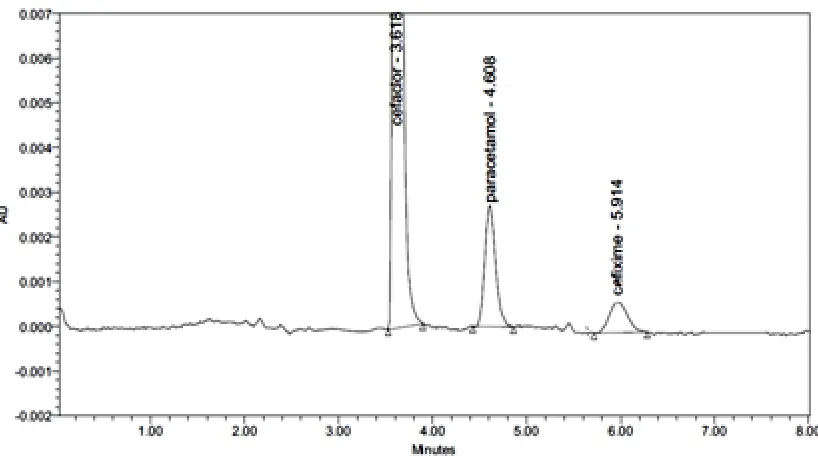
for Paracetamol and Cefixime. Retention time was established to be 3.618 min for Cefaclor, 4.608 min for Paracetamol and 5.914min for Cefixime. The results shown that the analytical technique furnished here establishes acceptable accuracy and precision, shorter and easy sample preparation, reduced the complications for equipment on satisfactory analysis time.
Key words: Paracetamol, Cefixime, Bioanalytical, Simultaneous, Development.
INTRODUCTION
Paracetamol (Figure 1) is chemically N-(4-hydoxyphenyl) ethanamide and it was a non-steroidal anti-inflammatory drug having potent antipyretic, analgesic and anti-inflammatory action1-2. Paracetamol was used for the pains and
high temperature fevers3. Paracetamol acts by
selectively inhibiting the prostaglandin biosynthesis. The bioavailability of theParacetamolwas80% 4.
Cefixime (Figure 2) is chemically (6R,7R)-7-((2-(2-amino-1,3-thiazol-4-yl)-2- (carboxymethoxyimino)acetyl)amino)-3-ethenyl- 8-oxo-5-thia-1-azabicyclo(4.2.0)octo-2-ene-2-carboxylic acid and it was a third generation cephalosporin antibiotic used for the severalbacterial infections5-6. Cefixime acts by binding to specific
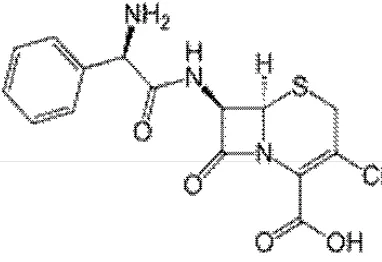
Cefaclor (Figure 3) is chemically 3-chloro-7-D-(2-phenylglycinamido)-3-cephem-4-carboxylic acid monohydrate and it was a semisynthetic cephalosporin antibiotic for oral administration. Cefaclor is used to reduce the development of drug-resistant bacteria.
Literature survey revealed that few analytical methods have been reported forestimation of Paracetamol and Cefixime individually or in combination with other drugs. Thereported methods are Spectrophotometric8-10, HPLC11-14, HPTLC15-16 and
LC-MS17-18. Although no method was reported for the
simultaneous estimation of Paracetamol andCefixime in combined pharmaceutical formulations.
Thepresent study was aimed to develop a simple, sensitive, rapid, precise andaccurate and validated the bionalytical method19 for simultaneous
estimation of Paracetamol and Cefixime according to ICH guidelines20 by using highperformance liquid
chromatography in rabbit plasma.
EXPERIMENTAL
Chemicals, reagents, standards and samples
Blank rabbit plasma, pure samples of drugs like Paracetamol, Cefixime and Cefaclor was obtained from Spectrum Pharma Research Solutions, Hyderabad, India. Analytical grade of Orthophosporic acid was obtained from SD Fine Chemicals Ltd., Mumbai, India. HPLC grade of Acetonitrile and Water was obtained from Qualigens Fine Chemicals,Mumbai, India.
Instrumentation
The analysis was performed by using a chromatographic system Water2695seriesHPLC comprised ofvacuum degas, auto injector, dual gradient pump with photo diode array detector. The HPLC system was equipped with Empower 2 software.
Chromatographicconditions
Paracetamol and Cefixime was analysed in ODS C18 column (250mmx4.6mm, 5µm particle size) for the chromatographic separation. The mobile phase was composed of Phosphate buffer (pH 6.4)
and Acetonitrile (80:20, v/v) and was used as diluent. Filtered through 0.45µm nylon membrane filter under vacuum filtration and pumped at a temperature of 300C, at flow rate of 1ml/min with UV detection
wavelength at 245nm. Injection volume was 10µl. The run time was 8min and the retention time of Paracetamol and Cefixime was found to be 4.608min and 5.914min respectvily.
Preparationofstocksolutions
Primary stock solutions of Paracetamol and Cefixime were prepared individually by dissolving
Fig. 1: Structure of Paracetamol Fig. 2: Structure of Cefixime
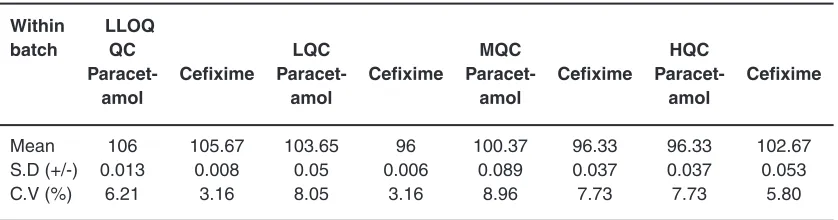
Table 1: Precision and accuracy
Within LLOQ
batch QC LQC MQC HQC
Paracet- Cefixime Paracet- Cefixime Paracet- Cefixime Paracet- Cefixime
amol amol amol amol
Mean 106 105.67 103.65 96 100.37 96.33 96.33 102.67
S.D (+/-) 0.013 0.008 0.05 0.006 0.089 0.037 0.037 0.053
C.V (%) 6.21 3.16 8.05 3.16 8.96 7.73 7.73 5.80
Table 2: Recovery studies
Paracetamol Cefixime Cefaclor
Mean 50.63 51.74 57.20
S.D (+/-) 1.98 1.42 0.509
C.V (%) 3.93 2.75 8.17
Table 3: Long term stability studies
LQC HQC Paracetamol Cefixime Paracetamol Cefixime
Mean 99.27 98.71 104. 86 93.08
S.D (+/-) 0.049 0.018 0.170 0.085
C.V (%) 8.41 8.82 9.09 9.63
Table 4: Freeze-thaw stability studies
LQC HQC Paracetamol Cefixime Paracetamol Cefixime
Mean 104.8 104.6 97.83 100.97
S.D (+/-) 0.035 0.012 0.185 0.056
C.V (%) 5.57 6.19 9.84 5.83
10mg of each in 25ml volumetric flask in diluent. Seriesof working solutions of Paracetamol and Cefixime were prepared by the suitable dilution of the stock solutions withsame diluent to achieve the concentration range of 10-100µg/ml for Paracetamol and 5-50µg/ml for Cefixime.
Procedure
Thestandardsolutionswerepreparedby dilutionofthestocksolutionwithdiluent to obtain a concentrationrange 10-100µg/ml for Paracetamol
and 5-50µg/ml for Cefixime. Triplicate of 10µl injections were prepared for each concentration andchromatographed under the conditions reported above. The peak area of each concentrationwas plotted against the corresponding concentration for getting the calibration curve andthe regression equation was computed.
Preparationofspikedplasmasample
250µl of rabbit plasma, 50µl of internal standard, 10µl of Paracetamol and 10µl ofCefixime
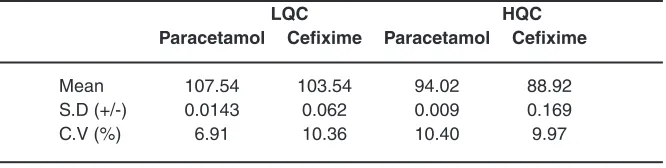
Table 5: Bench top stability studies
LQC HQC Paracetamol Cefixime Paracetamol Cefixime
Mean 107.54 103.54 94.02 88.92
S.D (+/-) 0.0143 0.062 0.009 0.169
C.V (%) 6.91 10.36 10.40 9.97
Table 6: Sample studies
LQC HQC Paracetamol Cefixime Paracetamol Cefixime
Mean 99.46 98.73 99.94 101.38
S.D (+/-) 0.018 0.018 0.994 0.958
N 3 3 3 3
Calibrationandlinearity
Calibration curves were plotted in the concentration range of 10-100µg/ml and 5-50 µg/ ml for Paracetamol and Cefixime respectively of required concentrations in the measured samples. Triplicate of 10µl injections were constructed for each working standard solution. Thepeakarea for each concentration was measured and subsequently to draw against the eachconcentration to obtain the calibration curve.
Method validation Linearity
Calibration curves showed the relation between the concentrations of drugs versus peak area were established. Results manifest linear relationship in the range of 10-100µg/mland 5-50µg/ ml for Paracetamol and Cefixime. In two drugs run from which linear regression equation was measured by following ICH guidelines showninFigure 4 and Figure 5.
Precision and accuracy
Results from the validation data from rabbit plasma were within the acceptable limits. Within batch precision method was measured to range from 6.21 to 8.96% for Paracetamoland 3.16 to 7.73% for Cefixime. The accuracy of the method was measured
in the range of96.33 to 106.0% for Paracetamol and 96.00 to 105.67% for Cefixime shown in Table 1.
Recovery
The analyte recovery for the Paracetamol and Cefixime were measured to be 50.63% and 51.74% respectively. The internal standard for Cefaclor was found to 57.20%showninTable2.
Stability studies Long term stability
The concentration of sample of stability ranged between 99.27 to 104.86% forParacetamol and 93.08 to 98.71% for Cefixime of the utility value shown in Table 3.
Freeze-thaw stability
The sample concentration of freeze-thaw stability was measured to be 97.83 to 104.83% for Paracetamol and 100.97 to 104.60% for Cefixime of utility concentratonshowing the stability of the drug above three freeze-thaw cycles shown in Table 4.
Bench top stability
Fig. 4: Calibration curve of Paracetamol Fig. 5: Calibration curve of Cefixime
Fig. 6: Chromatogram of rabbit plasma blank
to 107.54% for Paracetamol and 88.92 to 103.54% for Cefixime of the utility concentration shown in Table 5.
Sample stability
The concentration of sample of stability was measured range of 99.46 to 99.94% at2-80C
and 98.73 to 101.38% at room temperature for Paracetamol and Cefixime, respectively shown in Table 6.
REULTSANDDISCUSSION
Different stationary phases were tried with various columns,poorandbendpeakeswere
observedwithdifferent columns while C18 column gave satisfactory resolution and free from tailing. Severalmobile phases used like Methanol with Acetonitrilewerefound to separate the compounds doubtful and Potassium dihydrogen phosphate buffer withAcetonitrile lead to good separation. The present study objective was acquired using mobilephase be composed of Phosphate buffer:Acetonitrile in the ratio of 80:20, v/v withthe pH adjusted to 6.4±0.2 with
for Paracetamol was 4.608minand for Cefixime was 5.914min respectvily, at flow rate of 1ml/min. The optimum wavelengthfor detection was 245nm at where much better detector responses for the two drugs wereobtained. The chromatograms of rabbit plasma blank and drugs Cefaclor, Paracetamol and Cefixime were shown in Figure6 & 7 respectively.
ACKNOWLEDGEMENTS
The authors are thankful to A.K.R.G. College of Pharmacy, Nallajerla, India for providing necessary facilities for carryout the research work. The authors are thankful to Spectrum Pharma Research solutions, Hyderabad, India forproviding the pure drugs like Paracetamol, Cefixime and Cefaclor.
Fig. 7: Chromatogram of Cefaclor, Paracetamol and Cefixime in spiked rabbit plasma
REFERENCES
1. British National Formulary, British Medical Association and Royal Pharmaceutical Society, JointFormulary Committee, London.
2015,66.
2. Ayoub, S.S.; Botting, R.M.; Goorth, S.; Willoughby, D.A. Proc. Nati. Acad. Sci., 2014, 101, 11165-11169.
3. Hinz, B.; Cheremina, B.O.; Brune,K. FASEB J. 2007, 22, 383-390.
4. Smilkstein, M.L.; Kanpp, G.L.; Kullig, K.W. N. Engl. J. Med., 1988, 18, 1557-1562.
5. Mcmillan, A.; Young, H. Int. J. STD. AIDS.,
2007, 18, 253-254.
6. Adam, D.; Hostalek, U.; Troster K. Infection,
1995, 23 Suppl 2, S83-S86.
7. Patil, S.P.; Hajare, A.L.; Krishna, K.P. Int. J. Basic Clin. Pharmacol., 2014, 3, 943-946. 8. Behera, S.A.; Ghanty, S.; Ahmad, F.; Santra,
S. J. Anal. Bioanal. Tech.,2013, 3, 2-6. 9. Sharma, S.; Pareek, A.; Joshi, R.; Yashumati,
R.B.; Jain, V.; Jadon, G. Orient J. Chem.,
2013, 29, 787-792.
10. Venkatesan, S.; Kannappan, N. Int. J. Pharm. Pharm. Sci., 2013, 3, 130-135.
11. Devi, T.A.P.; Setti, A.; Nallapeta, S.; Pawar, S.C.; Rao, J.V. J. Med. Allied Sci., 2013, 3, 8-14.
Meltzer, V.; Pincu, E. J. Chromatogr. Sci.,
2012, 50, 335-342.
13. Lalitha, K.V.; Golla, M.M.; Reddy, J.R.; Kumar, K.V.; Aliekya, A. J. Scient. Innova. Res., 2013, 2, 634-641.
14. Khandagle, K.S.; Gandhi, S.V.; Deshpande, P.B.; Gaikwad, N.V. Int. J. Pharm. Pharm. Sci.,
2010, 3, 46-48.
15. Yadav, S.S.; Jagtap, A.S.; Rao, J.R. Der Pharma. Chemica, 2012, 4, 1798-1802. 16. Dhoka, M.V.; Gawande, V.T.; Joshi, P. Eurasian
J. Anal. Chem., 2013, 8, 99-106.
17. Trettin, A.; Jordan, J.; Tsikas, D. J. Chromatogr. B. Analyt. Technol. Biomed. Life Sci.,2014, 1, 177-178.
18. Meng, F.; Chen, X.; Zhong, D. J. Chromatogr. B. Analyt. Technol. Biomed. Life Sci., 2005, 819, 277-282.
19. Gaurav, T.; Ruchi, T. Pharm. Methods, 2010, 1, 25-38.