214
A Study On Traditional And Evolutionary Software
Development Models
Kamran Rasheed, Muhammad Imran, Muhammad Noman, Muhammad Iqbal
Abstract: Today, Computing technologies are becoming the pioneers of the organizations, and helpful in individual functionality i.e. added to computing device we need to add softwares. Set of instruction or computer program is known as software. The development of software is done through some traditional or some new or evolutionary models. Software development is becoming a key and a successful business nowadays. Without software, all hardware is useless. Some collective steps that are performed in the development of these are known as Software development life cycle (SDLC). There are some adaptive and predictive models for developing software. Predictive mean “already known” like WATERFALL, Spiral, Prototype and V-shaped models while Adaptive model include agile (Scrum). All methodologies of both adaptive and predictive have their own procedure and steps. Predictive are Static and Adaptive are dynamic mean change cannot be made to the predictive while adaptive have the capability of changing. The purpose of this study is to get familiar with all these and discuss their uses and steps of development. This discussion will be helpful in deciding which model they should use in which circumstance and what are the development step including in each model.
Keywords: Adaptive vs. Predictive; Software development methodologies; Agile vs. Conventional models; Adaptive and Predictive methodologies; SDLC
————————————————————
I.
INTRODUCTION
Computing Technology has created so much ease for the human that is why changes are occuring with enormous speed. For making a working device only hardware is not essentionl but software has the main role in the functions of these devices because it tel them when to do and how to do. Every software is develop with some steps and these are included or already define in Software development life cycle (SDLC). These steps are necessary and key part for the development of the softwares and these staeps are to be followed. Predictive mean “to make know in advance”. In software development we have some predictive methodologies. In these methodologies we already knows the steps that are required to follows. Predictive models includes (1) waterfall model, (2) v shape model, (3) Iterative, (4) spiral model etc. On the other hand adaptive mean “to adopt”or to “Change according to requirements changes. Thae methodologies has change the working style of the people because it facilitate very much as compare to predictive. Also results are visible in short period of time and changes can be made at any stage. These methodologies includes agile scrum etc. Since predictive models are fixed and cannot be changed according to the needs or any changes that is why these are also known as fixed metholodologies or fixed development models.
While adaptive models are models that are not fixed or bounded by the specific development steps and also it says “Welcome Changes’ whenever requires. These models work only on the outcome or deliverable after every 2 to 4 weeks. That is why these are also known as rapid development models. The organization of this paper is that in section I we have given an overview of whole study. In section II we discussed about all models whereas section III includes Comparison of both models (adaptive vs predictive) while in section IV we represented the usability analysis and finally in section V we concluded the study.
II.
TRADITIONAL/PREDICTIVE MODELS
1. WATERFALL
Waterfall is the first model that is included in the predictive approach of software development model. WaterFall is similar to its word meaning of raining. As rain fall down in a single direction that is towards the earth never it fall or move towards the upward direction. It is fixed in nature and cannot skip any step because it is sequential and every next step is started when last one completely finished. If we need to change at any stage we have to perform and go back through evel step included. Waterfall models includes 6 steps including (1) Requirement Anlaysis or gathering, (2) Designing, (3) Inplementation, (4) Testing, (5) Deployment and last one (6), Maintenance.
a. Requirement Gathering
Requirement describe why and what thing to produced. In this very first step of waterfall model the complete requirement of the system is gathered and all the study work about the system is completed like what will be the working of the system? What are the user requirement or what ar the user need or what he want from this system or software?.
b. Designing
In this second phase of waterfall model we have to design the system related things like (Data flow diagram, Entity relationship diagram, IPO(input, output block),basic forms and graphical user interface(GUI)) etc.
_______________________
Kamran Rasheed, Department of Computer Science, Bahria University Karachi Campus,
Muhammad Imran, Department of Computer Science, Bahria University Karachi Campus,
Muhammad Noman, Department of Computer Science, Bahria University Karachi Campus,
Muhammad Iqbal, Department of Computer Science, Bahria University Karachi Campus,
c. Implementaion
Implmentation is the third phase of the waterfall in which the designed things are converted to reality using different programming languages like (JAVA, C, C++,C# etc.) or for web (HTML CSS,ASP.NET or any CMS etc), All the required functiionalities are added in the implementation phase.
d. Testing
The fourth step or phase of thewaterfall is testing. In this phase we have to test whether the implemented work is working properly or not and whether these are required functionalities or not. This is the main step because uptil here half of the working has been completed.
e. Deployment
In this phase we have to deploy or setup if any company or organization want this system or software. Deployment help in getting knowing all the related bugs or performance issues if present in the software. This point also indicate whether our work is successful or not.
f. Maintenance
Final step of the waterfall is maintenance. In this phase if any error or bug arises then it shuld be resolved. Also after deployment this phase insure that software is working properly all the time and according to user requirements.
Figure 2: Steps or Phases of waterfall model
2. V MODEL
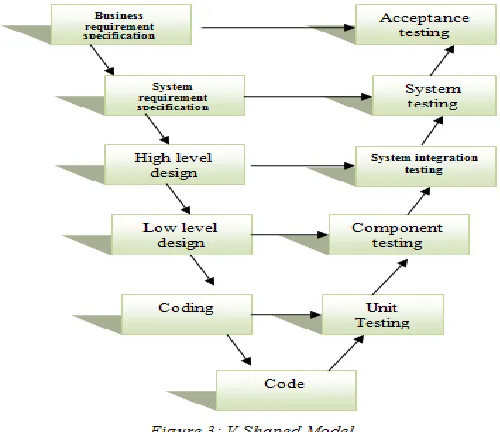
This is the second predictive model that is used for the software developmet. This model depicts a V-shaped that is why it is known as V-Model. V model consist of phases comprised of (1). Requirement specification including both Business and system requirement specification. (2). Design also comprised of two parts High and Low level design then is the (3). Coding. Note these all phases aer tested side by side if we are working on business requirement specification we must have to do the acceptance testing and if we are working on system level specification we ha to perform system testing. If we are working with high level design we have to include system integration tsting and similarly if doing the low level testing so we have to add Components testing and finally with coding we have to add unit testing. This is the model that is used in the sense where there are so many risk involves. That’s is why testing is placed at every level.
A. Requirements
In this model requirements are divided into two parts. (1). Business requirements and (2). System requirements
i. Business requirements
In this step all the business related requirements are gathered like what are the benefits we can achieve after completing this project or work? Or what revenue does it oproduce? Or what are the functionaliies present in the other competitors sysystem or software?
ii.System requirements
System requirements includes the step of gathering all the system requirement like what are the needs of developing this system? What functionalities will be included in the system? What output comes from system? How user interact with the system etc.
B. Designing
Designing paprt alsoo comprises of two parts (1). High level design and (2). Low level design
i. High level design
High level design refers to the first part of the designing phase that need some basic or abstract designing of the system
ii. Low level design
Low level design includes the complete designing of the system that is data flow diagrams, erd etc.
C. Coding
The final phase of V model is coding or the implementation of the system. This phase added all the required functionalities. This phase is considered as the most important step required to complete the projects with the final testing phase. Coding does not depends on any language like (C++, C, JAVA or any other language). Coding can be done by any known language that the developer is capable or if any requirement by the user in case of any condition.
3.SPIRAL
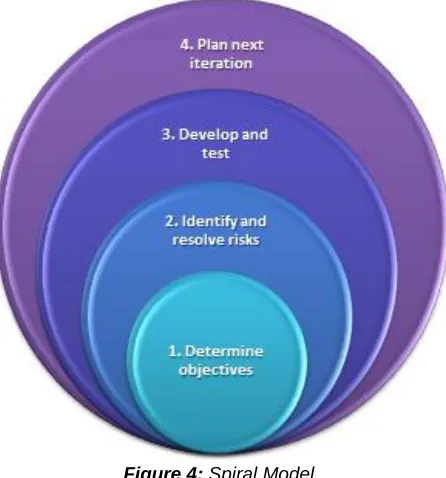
216 model include a continous testing and iterative approach that
help us in anlyzing and reducing risk included in the projects. Spiral model includes step as (1). Identification, (2). Design, (3). Construction or build or implementation and last (4). Risk Analysis.
A. Determine objective
This step is related to thedecision that what thing is to buuild or what aims and objective are to be achieved and what should be tha results we achieve at the end.
B. Identifying and resolving risk
In this step all the possible risks are identified and then decided thawhen it occur what strategies are to be adoted or how identifies risk are effective to the system.
C. Development and testing
After idetifying risks next phase is of development of the system. Over here all the decided functionalities are added to the system.
D. Palnning next iteration
After completion of the development and testing iots time decide that which iteration should be processed next
Figure 4: Spiral Model
4.ITERATIVE OR INCREMENTAL MODEL
This is the fourth model that is include in the predictive model of the development. There are several builds that are started after a complete requirement6 analysis. In this model all the work is been done in the iterative manner. The steps that are iterated every time are (1). Requirement, (2). Design, (3). Implementation and (4). Testing again and again. There are many division of the requirement and all are developedwith this sequence as follows
A. Requirement B. Design
C. Implementation D. Testing
i. Requirement
At thi spoint it is stated and documented that what are the requiremnet of the system and what functionalities are to be added
ii. Designing
How the sytem will be developed that is designed at this stage where graphical user interface (GUI), Entity relationship diagram (Erd), Data flow digrams and class diagrams are designed.
iii. Implementation
After designing part the next process is to develop the whole system according to requirement. This phase is to add all functionalities to the system.
iv. Testing
Testing mean to compile and run the whole run and check whether it is working fine or not or whether there is any bug in the system.
Figure 5 Incremental Model
5.RAPID APPLICATION DEVELOPMENT (RAD)
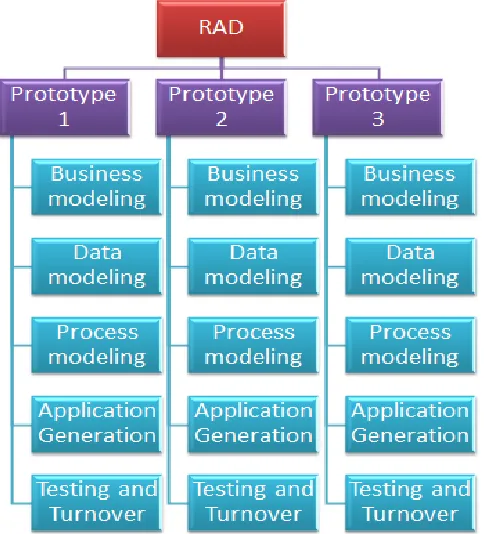
RAD stand for Rapid Application Development. This is the fifth type of predictive methodologies. This type also includes steps that are to be followed and all working are to be done with these steps. There are multiple prototype are under construction at a same time The step of this model includes (1). Business Modeling, (2). Data modeling, (3). Prrocess modelling, (4). Application Generation and finally (5). Testing and turnover
i. Business modelling
It refers to the business oint of view that how the information will flow and distribute throughout several channels. At this point a complete business analysis is performed.
ii. Data modelling
After getting complete ibnformation in the first phase business modelling the dat sets or objects are created. Identification and definataion of the data sets takes place at this phase. Also a relationtionship is created between business and data modelling.
iii. Process modelling
The defination of any enhancement or change occur in the data set is processed in this stage. Description of processes for insertion, deletion, updation of a data object are produced.
iv. Application generation
This stage is assigned for the development or writing codes and adding all required functionalities.Over here data model are created to an application or system
v. Testing and turnover
Finally testing of the generated application is performed to test whether it is working perfectly or not. Also is there any Bug or fault present in the application that may damage or stop the working at any stage. If any bug found then it is turnover mean change are made in order to produce a good application
Figure Rapid Application Development (RAD)
III.
ADAPTIVE MODEL
A. AGILE
Agile mean rapid change or movement of a body quickly and easily. Agile has changed the software development life cycle and move people to itself due to its excellency and
advantages over Predictive models. Agile provide a full function and a running model after every 2-4 week.It provide rapid
IV.
COMPARISON
OF
ADAPTIVE
AND
PREDICTIVE
ADAPTIVE PREDICTIVE
Adaptive are scalable Predictive are not scalable Adaptive communication is
informal
Predictive methodologies communication is formal
Need less cost if restarted at any
stage Need high cost if restarted again
User involment is on large scale User involvement is on small scale
Adaptive methodologies have requirement not clear
Predictive methodologies have clear Requirements
Depend on interperosnel skills Depend on individual or special developers at different stage Small team can accommodate
large projects
Large team required in large projects
Continous performance is tracked and achieved
Phase by Phase performance is tracked
Can start any phase that is complted in 2-4 weeks
Cannot start any phase without completing previous
Need only required
Documentation Need extensive documentation Agile Waterfall, spiral, Iterative
V.
CONCLUSION
218
VI.
REFERENCES
[1]. Software development life cycle SDLC, Available at: “https://www.tutorialspoint.com/sdlc/sdlc_overview.htm”
[2]. http://istqbexamcertification.com/what-is-v-model-advantages-disadvantages-and-when-to-use-it/
[3]. Christian wallin, Rikard Land, Software development life cycle Models. The Basic Types Available at: “http://www.idt.mdh.se/kurser/ISD_cdt417/files/articles/pa per5.pdf”
[4]. Overview of data structures Available at: https://www.tutorialspoint.com/data_structures_algorithm s/data_structures_basics.htm
[5]. Tree data structure ,
https://www.tutorialspoint.com/data_structures_algorithm s/tree_data_structure.htm
[6]. Overview of data structures , http://www.cs.cmu.edu/~clo/www/CMU/DataStructures/Le ssons/lesson4_1.htm
About Authors
Kamran Rasheed He is a student of Bahria University Karachi campus (BUKC). He is doing his Bachelor’s in Computer Science. He is now in 7th Semester. His area of interest includes Content Management System (CMS), Search Engine Optimization, Web Development and Designing. He is also a Content writer and like working in different topic or fields
Muhammad Imran He is also a Student of Bahria University Karachi Campus (BUKC) doing his Bachelors of sciences in Computer Science (BSCS). He is also 7Th Semester. His area of interest lies in the field of web development, System Analysis, User Interface (UI), designing and documenting.
Muhammad Noman He is teaching different practical courses like Web Development, Content Management System (CMS), Multimedia System (MS), Advance Databases and Programming Courses. His area of interest is Hacking, Penetration Testing, Search Engine Optimization (SEO) and Web Development.