INTRODUCTION
Algae are a diverse group of aquatic organ-isms that have the ability to conduct photosynthe-sis. Certain algae are familiar to most people; for instance, seaweeds (such as kelp or phytoplank-ton), pond scum or the algal blooms in lakes. However, a vast and varied world of algae exists. They are not only helpful to us, but also critical to our existence. The term “algae” covers many different organisms capable of producing oxygen through photosynthesis . These organisms are not necessarily closely related. However, they share certain common features, which distinguish them from the other major group of photosynthetic or-ganisms, i.e. the land plants.
Algae belong to a large group of simple pho-tosynthetic organisms. They are subdivided into two major categories based on their size. Microal-gae, are small free-living microorganisms that can be found in a variety of aquatic habitats. They are able of thriving in freshwater, brackish, marine and hypersaline aquatic environments and have been reported1 in desert crust communities,
there-by being able to endure temperature extremes and low water availability. Microalgae are easily dis-tinguished from their larger photosynthetic cous-ins, the macroalgae, which have evolved defined anatomical structures resembling leaves, stems, and roots of higher plants.
Microalgae were among the first life forms on Earth [2]. They are capable of fixing large amounts of carbon dioxide while contributing to approximately 40% to 50% of the oxygen in the atmosphere, thus helping to support the majority of life on our planet. Microalgae are highly productive on a global scale, with cell doublings occurring 1–4 times per day. While microalgae make up only 0.2% of global bio-mass generated through photosynthesis, they account for approximately 50% of the to-tal global fixed organic carbon [3]. Microal-gae, like terrestrial plants, grow and multiply through photosynthesis, a process whereby light energy is converted into chemical en-ergy by “fixing” atmospheric CO2 through the following reaction:
CO2 + 6H2O + Light Energy → C6H12O6 + 6O2
PRODUCTION OF BIODIESEL FROM LOCAL AVAILABLE ALGAE IN JORDAN
Nader Aljabarin1, Asem Al Jarrah2
1 Natural Resources and Chemical Engineering Department, Tafila Technical University, Tafila, Jordan, e-mail:
[email protected]; [email protected]
Volume 18, Issue 6, Nov. 2017, pages 8–12
DOI: 10.12911/22998993/76830 Research Article
ABSTRACT
The present study aims at producing diesel out of algae. The production of biodiesel
was performed at Tafila Technical University laboratories. The algae were brought from Almansora stream at Tafila governorate - Jordan and afterwards dried in an oven
at 80 ºC for 12 hours. The dried algae were ground using disc mill until powder was obtained. The powdered algae underwent a distillation process with the addition of iron sulphate hydrate to the algae using a distillation column in order to extract the oil. Methanol was added to the oil, which was obtained from the distillation and using potassium hydroxide as a catalyst, the product was then separated in a funnel for about 10 hours until two layers of the solution were obtained; the organic layer represents the biodiesel. The biodiesel attributes are similar to the diesel oil, except that it reduces the emission of carbon dioxide CO2 and there is no emission of sulphur dioxide SO2.
Keywords: algae, biodiesel, Almansora, Jordan.
Algae are aquatic, plant-like organisms. They encompass a variety of simple structures, ranging from single-celled phytoplankton floating in the water, to large seaweeds (macroalgae) attached to the ocean floor [4]. Algae can be found anywhere on Earth: residing in oceans, lakes, rivers, ponds and even in snow.
What makes algae only plant-like organisms, instead of full-fledged plants? While algae are often called primitive plants, other terms, like protists, can be used [5]. Protist may be a more accurate term, particularly for the single-celled phytoplankton [8]. However, larger, more com-plex algae, including kelp and chara, are often mistaken for submerged plants.
The difference between these seaweeds and submerged plants is in their structure. Macroal-gae are simpler, and attach themselves to the seabed with a holdfast instead of true roots [4]. Aquatic plants, whether floating, submerged, or emergent (starting in the water and growing out), have specialized parts such as roots, stems and leaves [3]. Most plants also have vascular structures (xylem and phloem), which carry nu-trients throughout the plant. While algae contain chlorophyll (like plants), they do not have such specialized structures [7].
As algae can be single-celled, filamentous (string-like) or plant-like, they are often difficult to classify. Most organizations group algae by their primary color (green, red, or brown), though this solution creates even more problems than it solves [4]. The various species of algae are vastly different from each other, not only in pigmenta-tion, but in cellular structure, complexity, and chosen environment [4, 5]. As such, algal taxon-omy is still under debate and some organizations
classify algae under different kingdoms, includ-ing Plantae, Protozoa and Chromista [8]. While the overarching kingdom classification is not always agreed upon, the species, genus, family, class and phylum of each alga generally are [6].
Primarily, algae are not as highly differenti-ated in the way that plants are, according to the authors of “Algae: Anatomy, Biochemistry, and Biotechnology, 2nd Ed.” [Barsanti L. & Gualtieri P., 2014]. That is to say, they lack true roots, stems and leaves, as well as a vascular system to circu-late water and nutrients throughout their bodies. Second, many algae are unicellular, according to a 2014 article published in the journal Current Bi-ology. They also occur in a variety of forms and sizes. They can exist as single, microscopic cells; they can be macroscopic and multicellular; live in colonies; or take on a leafy appearance as in the case of seaweeds such as giant kelp. Picoplank-ton are between 0.2 to 2 micrometers in diameter, while the fronds of giant kelp are as large as 60 meters in length. Lastly, algae are found in a range of aquatic habitats, both freshwater and saltwater.
METHOD AND PROCEDURE
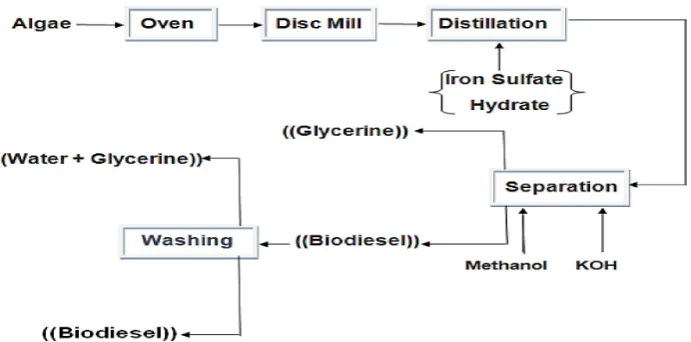
The flow diagram for the production of biodiesel from algae in this work is shown in Figure 1. Appendix A shows photos for the steps of the process. The procedure is as follows: 1. Algae from a stream in Almansora at Tafila
governorate have been drained in an oven at 80 ºC for 12 hours.
3. Iron Sulphate Hydrate in the amount of 20 g was added to 5 g of algae and distilled water up to 100 ml was added and mixed well.
4. Boiling chips are added to the mixture to dis-tribute the heat and prevent explosion.
5. The mixture was distilled in a distillation column for 2 hours and 90ml Algae oil was obtained.
6. Algae oil in the amount of 25 ml and 10 ml of methanol and potassium hydroxide KOH ((97.5% methanol, 2.5% potassium hydroxide KOH)) were added to a separator funnel and shaken in the separatorfor 3 minutes. It had to be vented every 30 seconds. The reaction that took place in this step is as follows:
7. The product was left for 8–12 hours. When two layers were formed, the organic layer, which represents the biodiesel, was collected.
8. The biodiesel sample was tested by taking a small amount of the sample in the spatu-la and heating it with a lighter, the sample combusted rapidly.
RESULTS AND DISCUSSION
In the process 90 ml of oil was obtained from 5 grams of algae, and 7 ml of biodiesel was obtained from 25 ml of oil. Therefore, we obtained 7 ml of biodiesel for each 5 g of al-gae. A good yield of biodiesel was obtained from algae which suggests that biodiesel from algae can be used efficiently as an alternative source of diesel. Moreover, the advantages of biodiesel from algae oil are as follows:
1. It provides rapid growth rates, 2. Algae biofuel is non-toxic,
3. Algae biofuel is highly bio-degradable, 4. High levels of polyunsaturated in algae
bio-diesel is suitable for cold weather climates,
5. It can reduce carbon dioxide emissions based on where it is grown,
6. Algae can be cultivated on land, fresh water, or seawater.
On the other hand, there are certain disadvan-tages of biodiesel from algae:
1. They produces unstable biodiesel with many polyunsaturated fats,
2. Biodiesel performs poorly compared to its mainstream alternative,
3. It is relatively new technology. Other limita-tions include the low concentralimita-tions of free CO2 that are required for peak algal growth and that algal grazers are a significant, but some-what ignored problem.
CONCLUSIONS
Biodiesel can be produced from algae. Technically, algae are an economic option for the production of biodiesel, because of the low cost and broad availability. We had found that we can produce biodiesel from Algae, we can use Algae as a source of renewable energy, and many researchers found that algae is the best source for the production of biodiesel, but this subject has not been explored sufficiently. Further research about the presence of algae, calculation of the production of biodiesel fuel ratio, and analysis chemotherapy needs to be conducted.
The cost of energy production from biodies-el produced from algae is approximatbiodies-ely8 8–20 $ per gallon, pointing out that modern technolo-gies and systems co-production, and food pro-ducers, pharmaceuticals, and projects of chemi-cal high-value, make the total cost of production of biofuels from algae project profitable.
The technology of fuel production from al-gae is still in its infancy; therefore, the produc-tion is expensive and the cost is higher than the global sales of fossil fuels price, since the cost of biofuels production is approximately $10 per gallon, while the price of diesel per gallon on our markets amounts to $3.1.
suited for the production of fuel oils, and ge-netic engineering of the available strains, it will hopefully be possible to reduce the pro-duction rate, compared to the continuing rise in the prices of oil derivatives.
REFERENCES
1. Barsanti L., Gualtieri P., 2014. Algae: Anatomy, Biochemistry, and Biotechnology, 2nd Ed. CRC
Press, 2008.
2. Benemann J.R., Pursoff P., Oswald W.J. 1978.
Engineering Design and Cost Analysis of a Large Scale Microalgae Biomass System. NTIS #H CP/
T1605–01 UC-61.Washington, D.C.: U.S. Depart -ment of Energy, pp. 91.
3. http://technolabelbahaagp.googoolz.com/t1151-topic.
4. http://www.esru.strath.ac.uk/EandE/Web_ sites/02–03/biofuels/what_biodiesel.htm.
5. http://www.renewablesinfo.com/drawbacks_and_ benefits/biofuels_from_algae_advantages_and_ disadvantages.html.
6. Monthly_US_Raw_Material_Usage_for_US_Bio -diesel_Production_2007_2009.pdf (application/ pdfObject)” (PDF). assets.nationalrenderers.org. 2010. Retrieved March 23, 2012.
7. Odum H.T. 1971. Environment, Power and Soci-ety. Wiley-Interscience. p. 331.
8. Omidvarborna et al. 2014. Characterization of par-ticulate matter emitted from transit buses fueled
with B20 in idle modes. Journal of Environmen -tal Chemical Engineering, 2(4), 2335–2342. DOI: 10.1016/j.jece.2014.09.020.