A Survey on CloudSim Toolkit for Implementing
Cloud Infrastructure
Harsha Amipara
PG Student
Department of Computer Engineering NGI (GTU), Junagadh, Gujarat
Abstract
Cloud computing technology is a - The datacenter hardware of cloud providing different kinds of services transparently to the users. Simulation is a situation in which is created by developer for that particular set of condition is created artificially in order to study that could exit in reality. This paper paper we have discussed about how to use cloudsim toolkit with netbeans, working of cloudsim and how to implement cloud infrastructure in cloudsim with example.
Keywords: Cloud, Cloudsim, Cloud Infrastructure, Toolkit, Virtual Machine
________________________________________________________________________________________________________
I.
INTRODUCTION
Cloud i.e. the internet and computing i.e. use of computer technology. Then, Cloud computing is a internet based computing. Using cloud computing any user can have an access over the internet to database resources and different services as long as one needs without worrying about the maintenance and storage of data. Moreover, an important aim of cloud computing has been delivering computing as a utility. Utility computing describes a business model for on-demand delivery of computing power; consumers pay Providers based on usage[7].
Cloud computing can be defined as a way of using computational resources such as storages, operating systems etc. which are located remotely and are provided service over internet. A huge change in the IT sector and IT marketing has been expected by the researchers and academicians. The basic advantages of cloud computing includes low costs, high availability, scalability and elasticity.
Basically different cloud services are categorized in 3 different services like Software as a Service, Infrastructure as a Service, and Platform as a Service. Except of these services, Cloud also provides Data as a Service, Hardware as a Service, Integration as a Service and few other services to consumer.
According to the consumer group consideration cloud deployment can be defined in following 3 ways: public cloud, private cloud, community cloud and hybrid cloud.
It is a Framework for Modeling and Simulation of Cloud Computing Infrastructures and Services written in java language. Specifically in the case of Cloud computing, where access to the infrastructure we have renting in real currency, using simulation-based approaches offer significant benefits, as it allows Cloud customers to develope and test their services in repeatable and controllable environment free of cost, and to tune the performance bottlenecks before deploying on real Clouds[6].
II.
RELATED WORKMohsin Nazir[1] described about the basic information about the Cloud Computing and its various services and models like SaaS, IaaS, PaaS. He also described about the deploying models of Cloud Computing and Virtualization services.
Cloud Architecture: A.
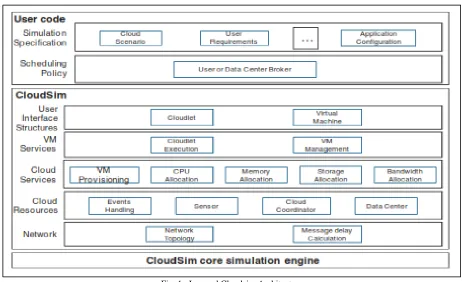
Fig. 1: Layered Cloudsim Architecture
The cloudsimmarchitecture is shown in figure 1[2]. The layered architecture of the cloudsim is consist of the source code cloud services, simulation engine. cloudsim itself is an “ extensible simulation toolkit that enables modeling and simulation of cloud computing systems and applications provisioning environments.”
The cloudsim architecture consists of the VM service that used to be developed by using the cloudsim simulation engine on which the cloud services used to be developed by network topologies. User interface structure is consisting of the cloudlet and virtual machine.
User code column has the application configuration and the data center with the scheduling policies, as that the user code has simulation specification and the policy for the scheduling. Cloudsim is built in a layered method that reflects the layered construction of cloud computing environments themselves.
As cloud computing is a rapidly evolving research area, there a severe lack of defined standards, tools and methods that can efficiently tackle the infrastructure and application level complexities. Hence in the near future there would be a number of is research efforts both in academia and industry towards defining core algorithms, policies, application benchmarking based on execution contexts. By extending the basic functionalities already exposed by cloudsim, researchers would be able to perform tests based on specific scenarios and configurations.
III.
WORKING WITH CLOUDSIM
Class Diagram of Cloudsim: B.
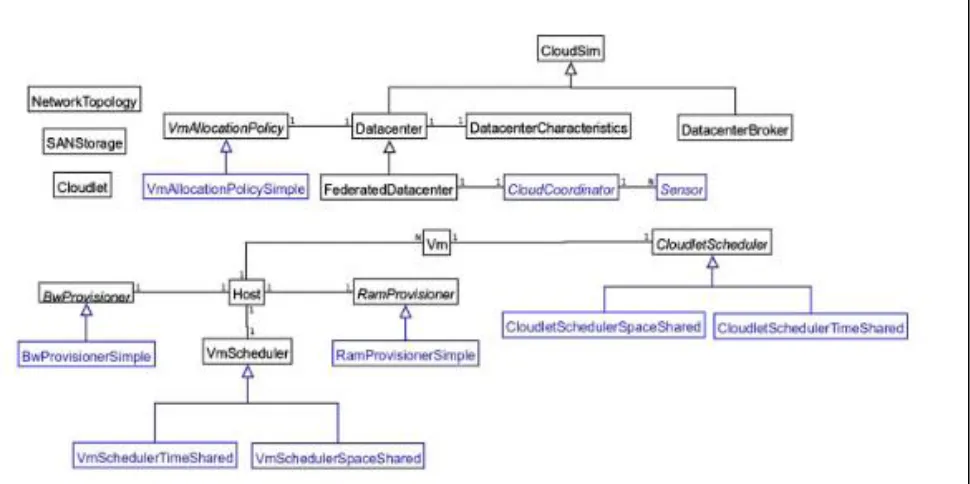
Fig. 2: Class Diagram for Cloudsim
Virtual Machine (VM): 1)
It runs inside host, sharing hostlist with other VMs. Characteristics of the virtual machine are represented in this class. Information about processing power, RAM, network and bandwidth, hosting physical machine are encapsulated. This class represented about the statistics about the resource consumptions by running applications[3].
Host: 2)
This class represent s the characteristics of a physical machine. Host executes actions related to management of virtual machines. A host has a defined policy for providing memory and bandwidth as well as an allocation policy for PE’s to virtual machine. A host is associated to a data center.
Data Center: 3)
Data canter class is a cloud resource whose hostlist are virtualized. It deals with processing of VM queries (handling of VMs) instead of processing cloudlet related queries.
Datacenter Broker: 4)
Datacenter broker represents a broker acting on behalf of a user. It hides virtual machine management, as virtual machine creation, submission of cloudlets to this VMs and destruction of VMs.
Cloudlet: 5)
Cloudlet is a representation of a task in cloudsim. It takes the job and submit to cloudsim. It encapsulates the number of instructions to be executed, amount disk transfer to complete the task. Cloudlet class also provides workload generation model, identification of guest virtual machine on which it’s running.
How to Use Cloudsim: C.
Cloudsim is library(tool) for cloud computing simulation written in java language. So we should have a basic knoeledge of java programming. Cloudsim installation is not needed because it is a libraryso we just have to unpack the package and then add .jar file as a library into our project. It can work with any programming IDEs that support java like netbeans or eclipse.
Now following are the steps for how to use cloudsim with netbeans [5]. 1) Download netbeans from https://netbeans.org/downloads/ and install it. 2) Download cloudsim latest version and unpack it.
3) Open netbeans then add a new project (File -> New project).
4) Name your project and choose a file path. Uncheck “create main class” box. Then “finish” button. 5) Now add cloudsim library into our project.
6) Right click on the project and click on “properties”. A project properties dialog will appear. Select “libraries” and press “add JAR/Folder” button.
7) Goto the folder that cloudsim unpacked. You can finds its library at “jars” folder. Then select file “cloudsim-3.0.2.jar” and add it into your project’s libraries.
Experiment and Result: D.
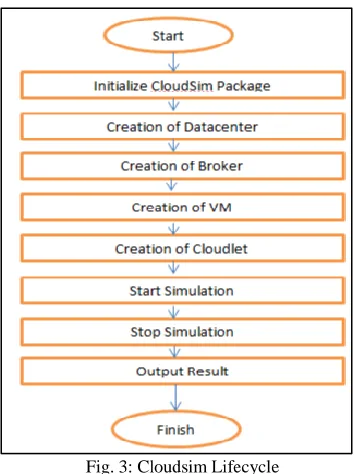
Fig. 3: Cloudsim Lifecycle
Figure 3 shows lifecycle of cloudsim and now we show that how it is implemented.
To evaluate the performance of Cloud, results were simulated in Window XP basic (32-bit), pentium Processor, 370 M Processor, 2.00 GHz of speed with memory of 2 GB and the language used is Java. First code of Simulation is tested on one Data Center with one Host and run on one Cloudlet.
Initialize the CloudSim Package: 1)
Int num_user = 1; //number of cloud users Calendar calendar = Calender.getInstance(); Boolean trace_flag = false; //mean trace events
Initialize the CloudSim Library: 2)
CloudSim.init(num_user, calendar, trace_flag);
Create Datacenters : These are the resource providers in CloudSim. We need at least one of them to run a CloudSim simulation.
Datacenter datacenter0 =createDatacenter(“Datacenter_0”); Create Broker:
3)
DatacenterBroker broker = createBroker(); Int brokerId = broker.getId();
Create one Virtual machine :
Vmlist = new ArrayList<Vm>(); VM description:
4)
Int vmid = 0; Int mips= 1000;
Long size = 10000; //image size (MB) Int ram = 512; //vm memory (MB) Long bw = 1000;
Int pesNumber = 1; //number of cpu String vmm = “Xen”; // VMM name
Create VM: 5)
Vm vm = new Vm(vmid, brokerId, mips, pesNumber, ram, bw, size, vmm, new CloudletSchedulerTimeShared());
Add the VM to the vmList :
vmList.add(vm1);
Submit vm list to the broker :
Broker.submitVmList(vmList);
Creation of Cloudlets: 6)
cloudLetList = new ArrayList<Cloudlet>();
Cloudlet Properties :
PesNumber = 1; long length = 400000; long fileSize = 300; long outputSize = 300;
UtilizationModel utilizationModel = new UtilizationModelFull();
Cloudlet cloudlet = new Cloudlet(id, length,pesNumber, fileSize, outputSize, utilizationModel, utilizationModel1, utilizationModel1);
Cloudlet.setUserId(brokerId); Cloudlet.setVmId(vmid);
Add The Cloudlets To The List: 7)
cloudLetList.add(cloudlet1);
Submit Cloudlet List To The Broker: 8)
Broker.submitCloudletList(cloudLetList);
Start Simulation :
CloudSim.startSimulation(); CloudSim.stopSimulation();
Final step : Print result when simulation is over
List<Cloudlet> newList = broker.getCloudletReceivedList(); printCloudletList(newList);
// Print the debt of each user to each datacenter Datacenter0.printDebts();
The output of this simulation is:
=========================OUTPUT =========================== Cloudlet ID STATUS Data centerID VM ID Time Start Time Finish Time 0 SUCCESS 2 0 320 0 320 *****Power Datacenter: Datacenter_0************************************** User id Debt
3 45.8
*********************************************************************
Now, we increase the datacenter with two hosts and run two cloudlets on it. The cloudlets run in VMs with different MIPS requirements. The cloudlets will take different time to complete the execution depending on the requested VM performance. It prints the following output:
===========================OUTPUT ========================= Cloudlet ID STATUS Data centerID VM ID Time Start Time Finish Time 1 SUCCESS 2 1 120 0 120 0 SUCCESS 2 0 360 0 360
*****Power Datacenter: Datacenter_0************************************** User id Debt
3 256.8
IV.
CONCLUSION
In this paper, we shows that how to use cloudsim with netbeans. And we proposed sorce code for simple example of cloud simulation. We shown various outputs in which the information about cloudlet ID, Cloudlet status, Datacenter ID, VM ID, start time, finish time are given for one or more cloudlets and host.
REFERENCES
[1] Mohsin Nazir ,Cloud Computing: Overview & Current Research Challenges , IOSR Journal of Computer Engineering.
[2] R. N. Calheiros, Rajiv Ranjan, Anton Beloglazov, C.A.F. De Rose, Rajkumar Buyya, “CloudSi m: A toolkit for modeling and si mulation of cloud
computing environments and evaluation of resource provisioning algorithms”, Software Practice and Experience, Wiley publishers, 2010.
[3] Tarun goyal, Arjit Singh, Aakanksha Agrawal , Cloudsim:simulator for cloud computing infrastructure and modeling, ICMOC-2012.
[4] http://www.cloudbus.org/cloudsim/doc/api/org/cloudbus/cloudsim/package-summary.html
[5] http://wahni l l a.wor dpr ess.com/2013/04/22/cl oudsi m- wi th- netbeans/
[6] Ranjan Kumar, G.Sahoo: Cloud Computing Simulation Using CloudSim, International Journal of Engineering Trends and Technology.
[7] William Voorsluys, James Broberg, RajkumarBuyya, “Introduction To Cloud Computing”,Chapter 1 of CLOUD COMPUTING-Principles and Paradigms,