S T U D Y P R O T O C O L
Open Access
Opti-Med: the effectiveness of optimised clinical
medication reviews in older people with
‘
geriatric
giants
’
in general practice; study protocol of a
cluster randomised controlled trial
Floor Willeboordse
1,2*, Jacqueline G Hugtenburg
3, Liset van Dijk
1, Judith E Bosmans
4, Oscar J de Vries
5,
François G Schellevis
1,2and Petra J M Elders
2Abstract
Background:Inappropriate drug use has been identified as one of the most important problems affecting the quality of care in older people. Inappropriate drug use may increase the risk of the occurrence of‘geriatric giants’ such as immobility, instability, incontinence and cognitive impairment. There are indications that clinical medication reviews (CMR) can reduce inappropriate drug use. However, CMRs have not yet been implemented at a large scale in primary care. An innovative medication review program in primary care will be developed which tackles the most important obstacles for a large scale implementation of CMRs. The aim of this study is to assess whether this CMR program is (cost-) effective compared with usual general practice care for older patients with geriatric symptoms with regard to quality of life and geriatric symptoms.
Methods:A cluster randomised controlled trial will be performed in 20 Dutch general practices including 500 patients. Patients of 65 years and older are eligible if they newly present with pre-specified geriatric symptoms in general practice and chronic use of at least one prescribed drug. GP practices will be stratified by practice size and randomly allocated to control (n = 10) or intervention group (n = 10). The intervention consists of CMRs which will be facilitated and prepared by an expert team consisting of a GP and a pharmacist. Primary outcome measures are patient’s quality of life and the presence of self-reported geriatric symptoms during a follow-up period of 6 months. Secondary outcomes are costs of healthcare utilisation, feasibility, number of drug related problems, medication adherence and satisfaction with medication.
Discussion:This study is expected to add evidence on the (cost-) effectiveness of an optimally facilitated, prepared and structured CMR in comparison with usual care in older patients who present a geriatric symptom to their GP. The strength of this study is that it will be conducted in daily clinical practice. This improves the possibilities to implement the CMRs in the primary care setting on a large scale.
Trial registration:Netherlands Trial register: NTR4264
Keywords:Clinical medication review, Geriatric giants, Cluster randomised controlled trial
* Correspondence:[email protected]
1NIVEL, Netherlands Institute for Health Services Research, Po. Box 1568, 3500
BN, Utrecht, The Netherlands
2Department of General Practice & Elderly Care Medicine, EMGO+Institute for
Health and Care Research, VU University Medical Center, van der Boechorststraat 7, 1081 BT, Amsterdam, The Netherlands Full list of author information is available at the end of the article
Background
Inappropriate drug use has been identified as one of the most important problems affecting the quality of care in older people. Appropriate drug use and prescribing in older people is difficult, because of the variability of age-related changes in the metabolism, multimorbidity and polypharmacy [1,2]. In addition, undertreatment of espe-cially preventive medication as well as poor treatment adherence are frequently occurring problems in older people [3]. Because of changes in pharmacokinetics and pharmacodynamics, older people are more prone to re-duced effectiveness of drugs and they may be at higher risk of adverse events and other drug related problems (DRP) [4]. Several studies have shown associations be-tween inappropriate drug use and clinical outcomes such as hospital admissions, falling, adverse drug reactions and functional decline [3,5-8].
Inappropriate drug use may increase the risk of the oc-currence and persistence of geriatric problems [3,5,6,9-15]. The most common major impairments that appear in older people, also referred to as“geriatric giants”are immobility, instability, including falls and dizziness, incontinence and cognitive impairment [16]. The atypical, silent, non-specific disease presentation of a geriatric giant is a common type of symptom presentation in the older adult and associ-ated with limitations of activities of daily living (ADL) [7]. The multi-factorial causes of geriatric giants often include DRPs which can be prescriber-related (e.g. med-ically non-indicated medication or inappropriate dosage), but also patient-related, e.g. ineffectiveness of drugs, ad-verse effects, lack of knowledge and usage of the drugs, and non-adherence [6].
There are indications that clinical medication reviews (CMR) can reduce inappropriate drug use in older people. A CMR is ‘a structured, critical examination of the patient’s medicines with the objective of reaching an agreement with the patient about treatment, optimising the impact of medicines, and minimising the number of drug related problems’[17]. It has been shown that spe-cific subgroups can benefit from a CMR during or im-mediately after hospital admissions [18,19]. In several countries guidelines are developed for CMRs in older and polypharmacy patients [17,20-22]. However, CMRs have not yet been implemented at a large scale because of several obstacles.
First, the evidence for the effectiveness of CMRs is not very extensive and convincing. Several studies have shown positive effects of CMRs on intermediate out-comes such as the number of DRPs, medication adher-ence and patient satisfaction with medication. However, these effects are heterogeneous and so far, few effects have been established on clinical outcome measures as quality of life, hospital admissions or mortality [23-26]. This lack of evidence hinders the provision of financial
incentives and motivation of healthcare professionals for further implementation of CMRs.
Second, the best target group for CMRs may be unclear. At present, patients in primary care are often selected based the number of medications, the polypharmacy cri-teria, which is a large group and not every polypharmacy patient may need a CMR. The current study addresses the appropriateness of medication use in patients who newly present themselves with “geriatric giant” symptoms in general practice. The patients will be selected irrespective of the number of drugs used. Previous research has shown that in many of these geriatric giants, suboptimal pharma-cotherapy plays an important role in the occurrence and/ or persistence of the problems. Undertreatment in these patients is just as often a problem as overtreatment [27].
The third obstacle of CMR implementation is its feasi-bility. A CMR requires a considerable time investment for each review varying from 15 to 60 minutes for a physician and from 30 to 120 minutes for a pharmacist [28]. The current Dutch guideline for polypharmacy in older people recommends in addition to obtain the pa-tient’s input preferably by a home visit and follows the Systematic Tool to Reduce Inappropriate Prescribing (STRIP) method, which includes at least two patient contacts [20,29]. In addition, both lack of knowledge as well as insufficient training of both the GPs as well as the pharmacists hinder the implementation of CMRs. Fi-nally the lack of comprehensive organisation of medical data infrastructure and exchange between professionals are hindering factors.
In this study an innovative CMR program (Opti-Med) will be developed to tackle these obstacles in a primary care setting. This Opti-Med study aims at providing scien-tific evidence for the effectiveness on quality of life and geriatric symptoms of an optimally facilitated, prepared and structured CMR in comparison with usual care in older patients presenting with a new geriatric giant to their GP. The feasibility of implementing the program in the daily routine of several GP practices will be evaluated.
Methods
The Opti-Med study protocol was approved by the Med-ical Ethics Committee of the VU University MedMed-ical Centre Amsterdam (reference 2011/408). For the de-scription of the design of the Opti-Med intervention, the Consolidated Standards of Reporting Trials (CONSORT) statement with extension to cluster randomised trials is followed [30].
Study design
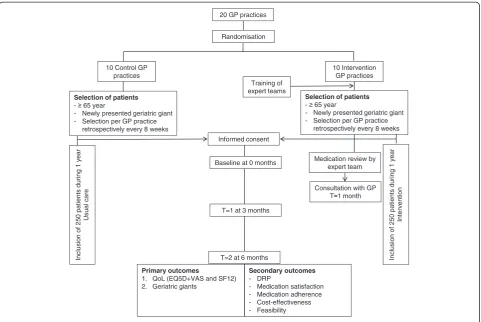
A cluster randomised clinical trial will be performed in 20 general practices including 500 patients (see Figure 1). Al-location of the intervention and control condition will be carried out randomly at practice level. Eligible patients will
Willeboordseet al. BMC Geriatrics2014,14:116 Page 2 of 9
be invited to participate in the study and the medication of the patients listed in the intervention practices will be reviewed. Patients listed in the control practices will re-ceive usual care, with no systematic attention for their medication. The effects of this intervention will be assessed after a follow-up period of 6 months. The ration-ale to use a cluster design at practice level is to prevent contamination of structural attention to CMR activities within the GP practice.
Setting
The study will be embedded in the Academic Network of General Practices of the VU University Medical Centre (ANH-VUmc) that consists of 20 GP practices in Amsterdam, the Netherlands. Similar to almost all GPs in the Netherlands, the GPs in this network use electronic medical record systems in which all patients contact diag-noses are coded using the International Classification of Pri-mary Care first edition (ICPC-1) [31]. All practices employ practice nurses who can assist with the implementation of the intervention, have not yet systematically implemented structured CMR and are therefore eligible for this trial.
This CMR program is tuned to the Dutch healthcare setting where patients are listed with a general practice
and their GP is the first contact point for a patient with healthcare problems. Only in case of emergency or after referral by the GP, patients visit secondary care profes-sionals. Moreover, in the Netherlands it is common to visit one main pharmacy which provides all prescription medication. As such, the pharmacist has the most accur-ate and complete medication data.
Randomisation
Randomisation will be performed by a statistician blinded to characteristics of the practices using a com-puter generated list of random numbers. The practices are stratified by practice size (two strata), to ensure equally sized groups. Before patients are recruited, par-ticipating practices will be randomly allocated to the intervention, or control condition. Patients will be allo-cated to either one of the treatment conditions, based on the practice where they are listed. Blinding of pa-tients, GPs and practice nurses to treatment allocation is not possible due to the nature of the intervention.
Participants
Patients of 65 years and older are eligible if they newly present with a geriatric giant in general practice use at
least one prescription drug chronically. A new geriatric giant is defined as being a first episode if the problem has not been noted in the patients’ medical file during the previous 12 months. Patients with geriatric giants are identified on the basis of the ICPC coded diagnoses [31] (see Additional file 1) in their electronic medical record. Chronic use of at least one drug is defined as at least three prescriptions in the last 12 months in the GP practice. In The Netherlands, prescriptions are always for a maximum of three months of treatment.
Screening questionnaire
Together with the invitation for participation in the study, both intervention and control patients receive a screening questionnaire. The questionnaire consists of four parts:
I. Questions on the presence and self-perceived severity of geriatric giants using visual analogue scales (VAS) (0–10).The geriatric problems that are evaluated are 1. Mobility problem; 2. Dizziness; 3. Urinary incontinence; 4. Problems with cognition; 5. Fear of Falling [32]; Also a question is formulated regarding the number of falls in the previous 6 months;
II. Questions regarding body weight (kg), length (m) and pain (VAS 0–10);
III. Actual drug use including OTC drugs;
IV. Questionnaire aimed at the identification of DRPs from the patient perspective.
Part III and IV of the questionnaire are developed by the authors of this study and have been shown to have good agreement with a patient interview during a home visit [33,34].
Inclusion procedure
For identifying potential participants in the practices a two-step approach will be applied.
Step 1. Eligible patients will be identified retrospectively every 8 weeks on the basis of a selected set of ICPC codes (see Additional file1), age and chronic use of at least one drug, through a predefined search strategy in the GP electronic medical records. Only patients who consulted the GP with one of these diagnoses in this time period and who did not present with this problem to the GP during the previous 12 months are eligible to participate. Step 2. Identified potential participants in step 1 will be
invited to fill out the above described screening questionnaire. If needed, the patient will be offered support at home to fill out the screening
questionnaire. Patients will be included in the trial if they indicate to currently have a score of five or
higher on one of the VAS scales of the geriatric problems or have indicated to have one fall or more in the previous 6 months. Additionally they have to indicate that they are willing to participate in the trial by signing an informed consent form.
Exclusion criteria
Patients are not eligible when they have a diagnosis of dementia in their medical record. In addition, patients with a Mini Mental State Examination (MMSE) score of 18 or less will be excluded from the trial, since this is the cut off for serious cognitive impairment [35,36]. An MMSE interview is only carried out when patients indi-cated they needed help to fill out the screening question-naire. Each 8 weeks, the GPs will receive a list of all eligible patients and they will exclude patients who re-ceived a structured CMR in the last 6 months or are ac-cording to the GP unable to participate (e.g. due to terminal illness or severe psychiatric problems).
Intervention
Preparatory steps
The research assistant prepares together with the prac-tice nurse the CMRs for the expert teams (see below). The required information from the electronic medical files from the GP practice, the pharmacy and the screen-ing questionnaire is collected. This information consists of the actual drug use of the patient including OTC drugs, drug delivery history, potential DRPs, the medical problems of the patient, laboratory test results, e.g. renal function and other measurements such as blood pressure.
Clinical medication review by expert team
An expert team consisting of a GP (not the patient’s GP) and a pharmacist (not the patient’s pharmacist) will re-view the medication. The team will carry out a system-atic assessment aimed at identifying drug related problems (DRP) experienced by the patient as indicated in the screening questionnaire and at optimising the medication of the patient. The medication will be struc-turally reviewed according to the Dutch Systematic Tool to Reduce Inappropriate Prescribing (STRIP) method in-cluding the translated Screening Tool of Older Person’s Prescriptions (STOPP) and Screening Tool to Alert doc-tors to Right Treatment (START) criteria [20,29]. A computer assisted version of the STRIP method, the STRIP-assistant will be used by the team [37]. First, the medications are linked to the diseases or symptoms. Then the following steps will be systematically followed:
1. Undertreatment
2. Effectiveness of treatment 3. Overtreatment
4. Potential adverse events
Willeboordseet al. BMC Geriatrics2014,14:116 Page 4 of 9
5. Interactions and contra-indications 6. Dosing problems
7. Other problems, such as user problems, knowledge or adherence
Finally, the result of this CMR analysis is a pharma-cotherapeutic treatment plan that will be sent to the pa-tient’s GP (see Additional file 2) Three expert teams will be formed for the Opti-Med study.
Implementing the pharmacotherapeutic treatment plan
Patients will be invited for a consultation with the GP in which both the pharmacotherapeutic treatment plan and the patient’s perspective as previously assessed with the screening questionnaire are discussed and definitive changes in the prescribed medication will be implemented.
Monitoring the medication use
Six months after inclusion a check will be carried out by the researchers to identify medication changes compared to the outcome of the CMR (intervention group) and/or compared to baseline drug use of all participating pa-tients. The patients’ GPs will receive a signal if new DRPs are identified. The follow-up of this signal is out-side the scope of this study.
Training
Expert teams will follow accredited online courses for medication reviews and pharmacology in elderly and two medication review workshops. Participating GPs and practice nurses of the intervention practices will be instructed how to carry out the study protocol and will receive a handbook.
Control condition
Eligible patients who are listed in a control practice will be identified and selected in exactly the same manner as in the intervention group. They will be asked to give in-formed consent and to fill in the same questionnaires at inclusion, baseline, 3 and 6 months. Patients in control practices receive usual care, which means that no struc-tured attention will be paid to their medication.
Outcome measures
Measurements by means of patient questionnaires and proxy assessments will be carried out at baseline, after 3 and 6 months It is expected that some patients will de-velop either cognitive problems or other difficulties pre-cluding that they fill out the questionnaires adequately during the study. Self-assessment in these patients might therefore be less reliable or become not feasible. Proxy as-sessment could be a substitute for self-asas-sessment of qual-ity of life [38]. Therefore, patients will be asked to indicate two proxies: an informal care giver and a professional care
giver who will fill out a proxy assessment questionnaire of the patient’s quality of life. Data on morbidity and labora-tory test results will be collected using medical records in the GP practices. Characteristics of medication, changes in medication and adherence to medication will be assessed using dispensing data from the patient’s pharmacist. All outcomes will be assessed at patient level.
Primary outcome measures
Quality of life (QoL) will be assessed using both the SF-12 and the EuroQol (EQ-5D-3 L) at baseline, and after 3 and 6 months. The SF-12 covers eight dimensions of health with two summary scores; physical health (PHS) and mental health (MHS), and has been validated in many different countries and populations [39-42]. The PHS will be used as outcome measure because of its su-perior responsiveness compared to the MHS [43]. The EQ-5D-3 L is a generic preference based health status measure that has been shown to be valid and reliable in a variety of populations and patient groups [44,45]. The EQ-5D-3 L will be assessed using information from the patient and by proxy assessment by an informal carer and a healthcare professional. The proxies will be asked to report on QoL from the patients’ perspective [46]. The EQ-5D scores will be used to calculate utilities using the Dutch tariffs. Quality-adjusted life years (QALYs) will be calculated using linear interpolation be-tween time points. Higher QALY scores indicate more improvement in quality of life [47].
The presence of geriatric giants will be assessed at baseline with the screening questionnaire. At 3 and 6 months, presence of geriatric giants will be assessed with the same questions as in the screening question-naire enabling to assess changes compared to baseline.
Secondary outcome measures
The prevalence of DRPs in patients will be determined at baseline and after 6 months in both groups. The 6 month questionnaire will be similar to the screening question-naire omitting questions that only need to be asked at the beginning of the study. An independent clinical pharma-cologist and GP will assess the DRPs on the basis of the screening questionnaire and the pharmacist’s medication overview using the DOCUMENT checklist [48]. DOCU-MENT stands for Drug selection, Over- or underdose pre-scribed, Compliance, Untreated indications, Monitoring, Education or information, Non-clinical and Toxicity or adverse reaction and has multiple subcategories.
medication?”with a written response assessed on a seven point Likert like scale at baseline, 3 and 6 months [50].
Medication adherence will be measured in two ways; 1. Check for at least one pharmacy delivery in the last six months for all chronically used medication and 2. Self-reported adherence as questioned in the screening and follow-up questionnaires at baseline and 6 months. Self-reported adherence is part of the developed screening questionnaire.
Costs will be measured from a societal perspective. To calculate the costs of the intervention, information will be recorded by the expert team, the GP, the pharmacist and the practice nurse in terms of time and material spent on performing the CMR and the monitoring of the patients. Healthcare costs made by the patient will be assessed from a societal perspective using an slightly adapted version of the Dutch Medical Consumption Questionnaire (iMTA) questionnaire on care consump-tion, including informal care after 3 months (t = 1) and after 6 months [51]. Information on prescribed medica-tion will be derived from the pharmacy administramedica-tion information system (PAIS). Lost productivity costs will not be included since almost all patients will be retired. Healthcare utilisation will be valued according to guide-lines for economic evaluation in healthcare in the Netherlands [52].
Pilot study
Based on the experiences of two small pilot innovation programs, the intervention program was developed ([53] and unpublished results Elders and Bleeker 2009). An Opti-Med pilot study was conducted in two intervention and two control practices for eight weeks including 10 pa-tients. An evaluation was conducted to test the logistics, baseline measurements, questionnaires, and the feasibility and functioning of the expert team of the study. The pilot study resulted in minor changes in the questionnaire in-structions, improvements in logistics and communication with the GP practices.
Process analysis
The process evaluation involves assessing the extent to which the intervention is performed according to the protocol of the study, the time that is spent by the pro-fessionals to perform the activities of the protocol, the nature of the recommendations made to the patients by the GP, compliance with these recommendations, the judgment of the GPs, pharmacists and practice nurses about the intervention program. Data on these topics are collected using structured registration forms during the intervention. In addition, semi-structured interviews will be held with the participating practice nurses, GPs and members of the expert teams at the end of the inter-vention period in order to record their experiences and
opinions on the CMR program. The presence and influ-ence of possible contamination in both intervention and control practices will also be assessed by interviewing GPs or practice nurses at the end of the trial on their opinions to what degree structured attention to medica-tion was an issue during the study period in general or with regard to specific patients.
Sample size
The size of the study groups is based on the difference in change over 6 months between the intervention and control group of the EQ-5D VAS score (score range 0– 100). A difference of 7.4 in the EQ-5D VAS is consid-ered as a clinically relevant difference [54]. The average score among persons with osteoarthritis, a comparable group, is 64.8 (standard deviation 26.5). To establish a difference of 7.4 points as statistically significant with alpha = 0.05 and beta = 0.20, a group size of 225 is suffi-cient, taking the clustered design into account. To adjust for loss to follow up of 10% we will include 500 patients.
Statistical analyses
Descriptive statistics will be used to describe the study population. Dropout and loss to follow up will be described. Effect analyses will be performed according to both
‘intention to treat’and per protocol principles. Differences between intervention and usual care patients on the out-come measures will be compared between the intervention and control group by both univariate and multivariate tech-niques. Multilevel linear and logistic regression analyses will be performed to study differences between the intervention and the control patients. Multilevel analysis is needed in order to take clustering on the GP level and repeated mea-surements in one patient into account. We will adjust for possible confounders, such as gender, age, education level, number of medications and multi-morbidity.
Possible future subgroup analyses will be exploratory, due to lack of power.
Economic evaluation
For the economic evaluation, missing cost and effect data will be imputed using multiple imputation according to the Multivariate Imputation by Chained Equations (MICE) algorithm developed by van Buuren using predictive mean matching and fully conditional specification [55]. The number of imputed datasets will be increased until the fraction of missing information is below 5% [56]. The im-puted datasets will be analysed separately as described below and subsequently pooled using Rubin’s rules.
The effect measures that will be taken into account in the cost-effectiveness are QALYs, and changes in the VAS scores of the geriatric giant symptoms. For effects and costs, linear multilevel regression models will be estimated. Clustering at the level of GP practice will be included in
Willeboordseet al. BMC Geriatrics2014,14:116 Page 6 of 9
these multilevel models. Incremental cost-effectiveness ra-tios (ICERs) will be calculated by dividing the difference in mean total costs between the treatment and control groups by the difference in mean effects between the groups. Costs generally have a highly skewed distribution; therefore, bootstrapping with 5,000 replications will be used to estimate bias-corrected and accelerated confi-dence intervals around cost differences [57]. To account for the clustering of data, bootstrap replications will be stratified for practice [58]. The uncertainty surrounding the ICERs which will be graphically presented on cost-effectiveness planes. Cost-cost-effectiveness acceptability curves and net monetary benefits will also be calculated. Cost-effectiveness acceptability curves show the probability that the medication review programme is cost-effective in comparison with usual care for a range of different ceiling ratios thereby showing decision uncertainty.
Discussion
This study is expected to add evidence on the effectiveness and cost-effectiveness of an optimally facilitated, prepared and structured CMR in comparison with usual care in older patients presenting with a geriatric giant to their GP. Geriatric giants are highly prevalent among older people and represent a major cause of impaired quality of life. Optimising the patient’s medication in addition to treating these geriatric problems or delaying their worsening by treatment, is expected to have a positive additional impact on the patient’s perceived health. Moreover, optimising drug use will also improve the effectiveness of drug treat-ment, prevent adverse drug reactions and potentially harmful drug interactions, and consequently hospital ad-missions or even death.
For healthcare professionals, handling DRPs in older people is a challenge. The burden of aging on the health-care sector, health-care efficiency is an important issue.
The streamlining of the process, the experienced expert teams and minimising the contact moments with the pa-tients due to the written questionnaire as proposed in this study increases the feasibility that CMRs can be imple-mented successfully in usual care. In practice, after this study, expert teams could be implemented in a GP cooper-ation or another regional care settings in which pharma-cists and GPs should be trained and form expert groups.
The strength of this study is that it will be conducted in daily clinical practice and will resemble daily clinical practice as much as possible. This improves the possibil-ities to implement CMRs in the primary care setting.
The most important innovations compared to previous programs are:
1. The CMR will not focus primarily on polypharmacy patients, instead the selection of older patients is based on episodes related to a geriatric giant;
2. The CMR is prepared by a trained expert team consisting of an external GP and an external pharmacist who formulate a pharmacotherapeutic treatment plan for the patient’s GP;
3. The coordination of the CMR at the primary care level is performed by a case manager, usually the practice nurse or assistant;
4. The number of contacts with the patient is reduced by assessing the patient’s perspective by a written questionnaire instead of a home visit.
Quality of life is the primary outcome measure. This may not be sensitive enough to capture the changes in-duced by the intervention. However, we have chosen to use generic health measures as primary outcome mea-sures because we include patients in this study that might have a variety of geriatric symptoms with a het-erogeneous treatment effect. Also we think that in this population quality of life is the most important outcome. In addition, the study is not blinded and there is a possi-bility of contamination between the intervention and con-trol group. We counter possible contamination between treatments groups by using a cluster randomised con-trolled design. That way, caregivers cannot unintentionally apply aspects of the Opti-Med study into their usual care for patients. Patients in the control condition also fill out the screening questionnaire on actual drug use and medi-cation related problems, this is needed for the study, but could underestimate the effectiveness of Opti-Med by in-creasing awareness of possible drug related problems in these control participants. Furthermore, we suppose that current activities on older people care and possible future pharmacist’s polypharmacy projects are minimally inter-fering with the study. This assumption about possible con-tamination will be checked during the process analysis.
Implementation of structured CMR and monitoring will raise the awareness about the importance of opti-mising medication use in general, and especially in older patients among healthcare professionals. In this study, we will evaluate a form of a structured CMR that can easily be implemented in a GP cooperation or care group. If the CMR is shown (cost-) effective and feasible it could also be extrapolated to other groups of patients in the future in whom inappropriate medication use is suspected as well. If proven cost-effective, this will sup-port the nationwide implementation of this structured approach. The first results of the study will be expected at the end of 2015.
Additional files
Additional file 2:Format Pharmacotherapeutic Treatment Plan Opti-Med.
Abbreviations
ADL:Activities of daily living; CMR: Clinical medication review; CONSORT: Consolidated standards of reporting trials; DRP: Drug related problems; GP: General practitioner; ICER: Incremental cost-effectiveness ratio; ICPC: International classification of primary care; MICE: Multivariate imputation by Chained Equations; MMSE: Mini mental state examination; OTC: Over the counter; STRIP: Systematic tool to reduce inappropriate prescribing; PAIS: Pharmacy administration information system; QoL: Quality of life; QALY: Quality-adjusted life year; STOPP: Screening tool of older person’s prescriptions; START: Screening tool to alert doctors to right treatment; VAS: Visual analogue scale.
Competing interests
F. Willeboordse reports a governmental grant from the Dutch Organisation for Health Research and Development (ZonMw), for the conduct of the study. Dr. L. van Dijk reports grants from BMS/Pfizer and Astra Zeneca, outside the submitted work. All other authors declared no conflicts of interest.
Authors’contributions
FW constructed the design of the study and drafted the manuscript. JH, PE and FS developed the study, constructed the design and revised the manuscript. LvD, JB and OdV participated in the design of the study and revised the manuscript. All authors read and approved the final manuscript.
Acknowledgements
The authors thank the Dutch Organisation for Health Research and Development (ZonMw) for funding this research. The authors thank Hanna Joosten (Department of General Practice, VU University Medical Centre, Amsterdam), for estimating the feasibility of the trial based on a registration sample of the Academic Network of General Practitioners of the Department of General practice of the VU medical centre. The authors thank Mark Nielen (NIVEL) for help with the sample size calculation.
Author details
1NIVEL, Netherlands Institute for Health Services Research, Po. Box 1568, 3500
BN, Utrecht, The Netherlands.2Department of General Practice & Elderly Care Medicine, EMGO+Institute for Health and Care Research, VU University Medical Center, van der Boechorststraat 7, 1081 BT, Amsterdam, The Netherlands.3Department of Clinical Pharmacology and Pharmacy, VU University Medical Center, De Boelelaan 1117, 1081 HV, Amsterdam, The Netherlands.4Department of Health Sciences, EMGO Institute for Health and Care Research, Faculty of Earth and Life Sciences, Section of Health Economics & Health Technology Assessment, VU University Amsterdam, Amsterdam, The Netherlands.5Department of Internal Medicine, VU University Medical Center, De Boelelaan 1117, 1081 HV, Amsterdam, The Netherlands.
Received: 3 September 2014 Accepted: 30 October 2014 Published: 18 November 2014
References
1. Mallet L, Spinewine A, Huang A:The challenge of managing drug interactions in elderly people.Lancet2007,370(9582):185–191. 2. Spinewine A, Schmader KE, Barber N, Hughes C, Lapane KL, Swine C,
Hanlon JT:Appropriate prescribing in elderly people: how well can it be measured and optimised?Lancet2007,370(9582):173–184.
3. Leendertse AJ, Egberts AC, Stoker LJ, van den Bemt PM:Frequency of and risk factors for preventable medication-related hospital admissions in the Netherlands.Arch Intern Med2008,168(17):1890–1896.
4. Jansen PAF, Brouwers JABJ:Clinical pharmacology in older persons.
Scientifica2012,2012:723678.
5. Berdot S, Bertrand M, Dartigues JF, Fourrier A, Tavernier B, Ritchie K, Alperovitch A:Inappropriate medication use and risk of falls–a prospective study in a large community-dwelling elderly cohort.
BMC Geriatr2009,9:30.
6. Hanlon JT, Fillenbaum GG, Kuchibhatla M, Artz MB, Boult C, Gross CR, Garrard J, Schmader KE:Impact of inappropriate drug use on mortality
and functional status in representative community dwelling elders.
Med Care2002,40(2):166–176.
7. Jarrett PG, Rockwood K, Carver D, Stolee P, Cosway S:Illness presentation in elderly patients.Arch Intern Med1995,155(10):1060–1064.
8. Rogers S, Wilson D, Wan S, Griffin M, Rai G, Farrell J:Medication-related admissions in older people: a cross-sectional, observational study.
Drugs Aging2009,26(11):951–961.
9. French L, Phelps K, Pothula NR, Mushkbar S:Urinary problems in women.
Prim Care2009,36(1):53–71. viii.
10. Gerretsen P, Pollock BG:Drugs with anticholinergic properties: a current perspective on use and safety.Expert Opin Drug Saf2011,10(5):751–765. 11. Leon C, Gerretsen P, Uchida H, Suzuki T, Rajji T, Mamo DC:Sensitivity
to antipsychotic drugs in older adults.Curr Psychiatry Rep2010, 12(1):28–33.
12. Roughead EE, Semple SJ:Medication safety in acute care in Australia: where are we now? Part 1: a review of the extent and causes of medication problems 2002–2008.Aust New Zealand Health Policy2009,6:18.
13. Woolcott JC, Richardson KJ, Wiens MO, Patel B, Marin J, Khan KM, Marra CA: Meta-analysis of the impact of 9 medication classes on falls in elderly persons.Arch Intern Med2009,169(21):1952–1960.
14. Unwin BK, Porvaznik M, Spoelhof GD:Nursing home care: part II. Clinical aspects.Am Fam Physician2010,81(10):1229–1237.
15. Chrischilles E, Rubenstein L, Van Gilder R, Voelker M, Wright K, Wallace R: Risk factors for adverse drug events in older adults with mobility limitations in the community setting.J Am Geriatr Soc2007,55(1):29–34. 16. Isaacs B:An Introduction to Geriatrics.London: Balliere, Tindall and Cassell; 1965. 17. Task Force on Medicines Partnership and The National Collaborative
Medicines Management Services Programme:Room for Review: a Guide to Medication Review: the Agenda for Patients, Practitioners and Managers.
London: Medicines Partnership; 2002.
18. Gillespie U, Alassaad A, Henrohn D, Garmo H, Hammarlund-Udenaes M, Toss H, Kettis-Lindblad A, Melhus H, Morlin C:A comprehensive pharmacist intervention to reduce morbidity in patients 80 years or older: a randomized controlled trial.Arch Intern Med2009,169(9):894–900. 19. Murray MD, Young J, Hoke S, Tu W, Weiner M, Morrow D, Stroupe KT, Wu J,
Clark D, Smith F, Gradus-Pizlo I, Weinberger M, Brater DC:Pharmacist intervention to improve medication adherence in heart failure: a randomized trial.Ann Intern Med2007,146(10):714–725. 20. Nederlands Huisarts Genootschap (NHG):Multidisciplinaire richtlijn
Polyfarmacie bij ouderen.Utrecht, The Netherlands: 2012. www.nhg.org. 21. Pharmaceutical Society of Australia Ltd:Guidelines for Pharmacists Providing
Home Medicines Review (HMR) Service.Australia: 2011. www.psa.org.au/. 22. Clyne WB, Blenkinsopp A, Seal R:A Guide to Medication Review.Liverpool:
National Prescribing Center NHS; 2008.
23. Patterson SM, Hughes C, Kerse N, Cardwell CR, Bradley MC:Interventions to improve the appropriate use of polypharmacy for older people.
Cochrane Database Syst Rev2012,5, CD008165.
24. Holland R, Desborough J, Goodyer L, Hall S, Wright D, Loke YK:Does pharmacist-led medication review help to reduce hospital admissions and deaths in older people? A systematic review and meta-analysis.
Br J Clin Pharmacol2008,65(3):303–316.
25. Nkansah N, Mostovetsky O, Yu C, Chheng T, Beney J, Bond CM, Bero L:Effect of outpatient pharmacists’non-dispensing roles on patient outcomes and prescribing patterns.Cochrane Database Syst Rev2010,7, CD000336. 26. Lehnbom EC, Stewart MJ, Manias E, Westbrook JI:Impact of medication
reconciliation and review on clinical outcomes.Ann Pharmacother2014, 48(10):1298–1312.
27. Frankfort SV, Tulner LR, van Campen JP, Koks CH, Beijnen JH:Evaluation of pharmacotherapy in geriatric patients after performing complete geriatric assessment at a diagnostic day clinic.Clin Drug Investig2006, 26(3):169–174.
28. Mast RM, Schouten GP, van Woerkom M:Niveau van medicatiebooordeling initiatieven in Nederland kan beter.Pharmaceutisch Weekblad2010,4:a05. 29. Vermeulen Windsant-van den Tweel AMA, Verduijn MM, Derijks HJ,
van Marum RJ:Detectie van ongeschikt medicatiegebruik bij ouderen: worden de STOPP- en START criteria de nieuwe standaard?Ned Tijdschr Geneeskd2012,156(40: A5076):1669–1676.
30. Campbell MK, Piaggio G, Elbourne DR, Altman DG:Consort 2010 statement: extension to cluster randomised trials.BMJ2012,345:e5661. 31. Lamberts HWM:ICPC International Classification of Primary Care.Oxford:
Oxford University Press; 1987.
Willeboordseet al. BMC Geriatrics2014,14:116 Page 8 of 9
32. Scheffer AC, Schuurmans MJ, van Dijk N, van der Hooft T, de Rooij SE: Reliability and validity of the visual analogue scale for fear of falling in older persons.J Am Geriatr Soc2010,58(11):2228–2230.
33. Ahmad A, Mast MR, Nijpels G, Elders PJ, Dekker JM, Hugtenburg JG: Identification of drug-related problems of elderly patients discharged from hospital.Patient Prefer Adherence2014,8:155–165.
34. Willeboordse F, Grundeken LH, van den Eijkel LP, Elders PJ, Hugtenburg JG, Schellevis FG:Patiënt vragenlijst over medicatiegebruik en geneesmiddel gerelateerde problemen vanuit het patiëntenperspectief.Groningen, The Netherlands: Abstract NHG Wetenschapsdag: 13 june 2014; 2014. 35. Wind AW, Gussekloo J, Vernooij-Dassen MJGJ, Bouma M, Boomsma LJ,
Boukes FS:NHG-standaard dementie: tweede herziening.Huisarts Wet
2003,46(13):754–767.
36. Folstein MF, Folstein SE, McHugh PR:Mini-mental state. A practical method for grading the cognitive state of patients for the clinician.
J Psychiatr Res1975,12(3):189–198.
37. Meulendijk M, Spruit M, Drenth-van MC, Numans M, Brinkkemper S, Jansen P:General practitioners’attitudes towards decision-supported prescribing: an analysis of the Dutch primary care sector.Health Informatics J
2013,19(4):247–263.
38. McPhail S, Beller E, Haines T:Two perspectives of proxy reporting of health-related quality of life using the Euroqol-5D, an investigation of agreement.Med Care2008,46(11):1140–1148.
39. Aaronson NK, Muller M, Cohen PD, Essink-Bot ML, Fekkes M, Sanderman R, Sprangers MA, Te VA, Verrips E:Translation, validation, and norming of the Dutch language version of the SF-36 Health Survey in community and chronic disease populations.J Clin Epidemiol1998,51(11):1055–1068. 40. Brazier J, Jones N, Kind P:Testing the validity of the Euroqol and
comparing it with the SF-36 health survey questionnaire.Qual Life Res
1993,2(3):169–180.
41. Gandek B, Ware JE, Aaronson NK, Apolone G, Bjorner JB, Brazier JE, Bullinger M, Kaasa S, Leplege A, Prieto L, Sullivan M:Cross-validation of item selection and scoring for the SF-12 Health Survey in nine countries: results from the IQOLA Project. International quality of life assessment.
J Clin Epidemiol1998,51(11):1171–1178.
42. Ware J Jr, Kosinski M, Keller SD:A 12-item short-form health survey: construction of scales and preliminary tests of reliability and validity.
Med Care1996,34(3):220–233.
43. Haywood KL, Garratt AM, Fitzpatrick R:Older people specific health status and quality of life: a structured review of self-assessed instruments.
J Eval Clin Pract2005,11(4):315–327.
44. The EuroQoL Group:EuroQol–a new facility for the measurement of health-related quality of life. The EuroQol Group.Health Policy1990, 16(3):199–208.
45. Brooks R:EuroQol: the current state of play.Health Policy1996,37(1):53–72. 46. Pickard AS, Knight SJ:Proxy evaluation of health-related quality of life:
a conceptual framework for understanding multiple proxy perspectives.
Med Care2005,43(5):493–499.
47. Lamers LM, Stalmeier PF, McDonnell J, Krabbe PF, van Busschbach JJ: Measuring the quality of life in economic evaluations: the Dutch EQ-5D tariff.Ned Tijdschr Geneeskd2005,149(28):1574–1578.
48. Williams M, Peterson GM, Tenni PC, Bindoff IK, Stafford AC:DOCUMENT: a system for classifying drug-related problems in community pharmacy.
Int J Clin Pharm2012,34(1):43–52.
49. Barbosa CD, Balp MM, Kulich K, Germain N, Rofail D:A literature review to explore the link between treatment satisfaction and adherence, compliance, and persistence.Patient Prefer Adherence2012,6:39–48. 50. Vernon MK, Revicki DA, Awad AG, Dirani R, Panish J, Canuso CM, Grinspan
A, Mannix S, Kalali AH:Psychometric evaluation of the Medication Satisfaction Questionnaire (MSQ) to assess satisfaction with antipsychotic medication among schizophrenia patients.Schizophr Res
2010,118(1–3):271–278.
51. Bouwmans C, Hakkaart-van Roijen L, Koopmanschap M, Krol M, Severens H, Brouwer W:Medical Cost Questionnaire (iMCQ).Rotterdam: iMTA, Erasmus Universiteit Rotterdam; 2013 [www.imta.nl]
52. Hakkaart-van Roijen L, Tan SS, Bouwmans CAW:Handleiding voor kostenonderzoek: methoden en standaard kostprijzen voor economische evaluaties in de gezondheidszorg.College voor Zorgverzekeringen Den Haag The Netherlands2010,13(5):519–527. 53. Ahmad A, Hugtenburg J, Welschen LM, Dekker JM, Nijpels G:Effect of
medication review and cognitive behaviour treatment by community
pharmacists of patients discharged from the hospital on drug related problems and compliance: design of a randomized controlled trial.
BMC Public Health2010,10:133.
54. Walters SJ, Brazier JE:Comparison of the minimally important difference for two health state utility measures: EQ-5D and SF-6D.Qual Life Res Int J Qual Life Asp Treat Care Rehab2005,14(6):1523–1532.
55. Van Buuren S:Multiple imputation of discrete and continuous data by fully conditional specification.Stat Methods Med Res2007,16(3):219–242. 56. White IR, Royston P, Wood AM:Multiple imputation using chained
equations: Issues and guidance for practice.Stat Med2011,30(4):377–399. 57. Joling KJ, Bosmans JE, van Marwijk HW, van der Horst HE, Scheltens P,
Vroomen JL, van Hout HP:The cost-effectiveness of a family meetings intervention to prevent depression and anxiety in family caregivers of patients with dementia: a randomized trial.Trials2013,14:305. 58. van der Leeden R:Handbook of Multilevel Analysis: Resampling Mulitlevel
Models.New York: Springer Science; 2008.
doi:10.1186/1471-2318-14-116
Cite this article as:Willeboordseet al.:Opti-Med: the effectiveness of optimised clinical medication reviews in older people with‘geriatric giants’in general practice; study protocol of a cluster randomised controlled trial.BMC Geriatrics201414:116.
Submit your next manuscript to BioMed Central and take full advantage of:
• Convenient online submission
• Thorough peer review
• No space constraints or color figure charges
• Immediate publication on acceptance
• Inclusion in PubMed, CAS, Scopus and Google Scholar
• Research which is freely available for redistribution