City, University of London Institutional Repository
Citation:
Francis, J., Eccles, M. P., Johnston, M., Whitty, P., Grimshaw, J. M., Kaner, E. F.
S., Smith, L. and Walker, A. E. (2008). Explaining the effects of an intervention designed to
promote evidence-based diabetes care: a theory-based process evaluation of a pragmatic
cluster randomised controlled trial. Implementation Science, 3, 50 - ?. doi:
10.1186/1748-5908-3-50
This is the unspecified version of the paper.
This version of the publication may differ from the final published
version.
Permanent repository link:
http://openaccess.city.ac.uk/1937/
Link to published version:
http://dx.doi.org/10.1186/1748-5908-3-50
Copyright and reuse: City Research Online aims to make research
outputs of City, University of London available to a wider audience.
Copyright and Moral Rights remain with the author(s) and/or copyright
holders. URLs from City Research Online may be freely distributed and
linked to.
Open Access
Research article
Explaining the effects of an intervention designed to promote
evidence-based diabetes care: a theory-based process evaluation of
a pragmatic cluster randomised controlled trial
Jillian J Francis*
1, Martin P Eccles
2, Marie Johnston
3, Paula Whitty
2,
Jeremy M Grimshaw
4, Eileen FS Kaner
5, Liz Smith
6and Anne Walker
1Address: 1Health Services Research Unit, University of Aberdeen, Aberdeen, UK, 2Institute of Health and Society, Newcastle University, Newcastle
upon Tyne, UK, 3College of Life Sciences and Medicine, University of Aberdeen, Aberdeen, UK, 4Clinical Epidemiology Program, Ottawa Health
Research Institute and Department of Medicine, University of Ottawa, Ontario, Canada, 5Faculty of Medical Sciences, Newcastle University,
Newcastle upon Tyne, UK and 6Manchester Business School, University of Manchester, Manchester, UK
Email: Jillian J Francis* - [email protected]; Martin P Eccles - [email protected]; Marie Johnston - [email protected]; Paula Whitty - [email protected]; Jeremy M Grimshaw - [email protected]; Eileen FS Kaner - [email protected];
Liz Smith - [email protected]; Anne Walker - [email protected] * Corresponding author
Abstract
Background: The results of randomised controlled trials can be usefully illuminated by studies of the processes by which they achieve their effects. The Theory of Planned Behaviour (TPB) offers a framework for conducting such studies. This study used TPB to explore the observed effects in a pragmatic cluster randomised controlled trial of a structured recall and prompting intervention to increase evidence-based diabetes care that was conducted in three Primary Care Trusts in England.
Methods: All general practitioners and nurses in practices involved in the trial were sent a postal questionnaire at the end of the intervention period, based on the TPB (predictor variables: attitude; subjective norm; perceived behavioural control, or PBC). It focussed on three clinical behaviours recommended in diabetes care: measuring blood pressure; inspecting feet; and prescribing statins. Multivariate analyses of variance and multiple regression analyses were used to explore changes in cognitions and thereby better understand trial effects.
Results: Fifty-nine general medical practitioners and 53 practice nurses (intervention: n = 55, 41.98% of trial participants; control: n = 57, 38.26% of trial participants) completed the questionnaire. There were no differences between groups in mean scores for attitudes, subjective norms, PBC or intentions. Control group clinicians had 'normatively-driven' intentions (i.e., related to subjective norm scores), whereas intervention group clinicians had 'attitudinally-driven' intentions (i.e., related to attitude scores) for foot inspection and statin prescription. After controlling for effects of the three predictor variables, this group difference was significant for foot inspection behaviour (trial group × attitude interaction, beta = 0.72, p < 0.05; trial group × subjective norm interaction, beta = -0.65, p < 0.05).
Conclusion: Attitudinally-driven intentions are proposed to be more consistently translated into action than normatively-driven intentions. This proposition was supported by the findings, thus offering an interpretation of the trial effects. This analytic approach demonstrates the potential of the TPB to explain trial effects in terms of different relationships between variables rather than differences in mean scores. This study illustrates the use of theory-based process evaluation to uncover processes underlying change in implementation trials.
Published: 19 November 2008
Implementation Science 2008, 3:50 doi:10.1186/1748-5908-3-50
Received: 1 May 2006 Accepted: 19 November 2008
This article is available from: http://www.implementationscience.com/content/3/1/50
© 2008 Francis et al; licensee BioMed Central Ltd.
Background
There is broad, international agreement over what consti-tutes high quality health care for people with diabetes [1,2]. In the UK, this has been enshrined in a National Service Framework for people with diabetes [3]. However, the most efficient method of delivering care remains unclear [4]. A recent systematic review [4] of quality improvement interventions to improve the quality of care in patients with diabetes showed that a range of different interventions resulted in small to modest improvements in glycaemic control and in provider adherence to optimal care. However it also identified important methodologi-cal concerns, including evidence of publication bias.
Given the variety of possibly effective interventions, it may be instructive to focus on possible mechanisms underlying intervention effects, with the goal of identify-ing how such interventions may work. This type of process evaluation can lead to the identification of general princi-ples that will help to optimise interventions. The study reported here was a theory-based process evaluation of a pragmatic cluster randomised controlled trial design. The trial evaluated the effectiveness and efficiency of an area wide 'extended' computerised diabetes register incorpo-rating a full structured recall and management system, actively involving patients and including individualised patient management prompts to primary care clinicians based on locally-adapted evidence-based guidelines.
Three Primary Care Trusts (PCTs) (geographically based organisational units that are directly responsible for health care) served by a district hospital-based diabetes register had produced improvements in the quality of care, but performance had later plateaued leaving scope for further improvement. The opportunity arose to extend the computerised diabetes register to a full structured recall and management system.
The development and implementation of the Diabetes Recall and Management System (DREAM) intervention has been described in detail elsewhere [5,6]. In summary, the pre-existing diabetes register functioned as a central register of patients with diabetes. A structured dataset was completed on paper forms and returned to the central reg-ister; from these data, both patient-specific and aggregated information were provided annually to patients and clini-cians. This system was enhanced in five ways. The software was enhanced by incorporating locally adapted national evidence-based guidelines. The functionality of the system was enhanced to provide: automated prompts to patients and primary care clinicians that a review consultation was necessary; a structured management sheet (including patient-specific management suggestions); an enhanced monitoring system to follow up reasons for non-attend-ance from both patients and clinicians and to re-schedule
appointments, based on non-return of a completed man-agement sheet; and patient feedback for patients in pri-mary care. Because of difficulties operating this element of the software, it was not possible to run the final feature during the lifetime of the trial.
Alongside this trial, a process evaluation study was con-ducted. In the literature about randomised controlled tri-als, process evaluation may focus on one or more of three groups of issues:
1. Quality control, fidelity, or coverage (i.e., was the inter-vention successfully and consistently implemented?).
2. Acceptability of the intervention from the participants' perspective.
3. Explanatory modelling: an exploration of processes underlying change (or lack of change) following a success-fully implemented intervention.
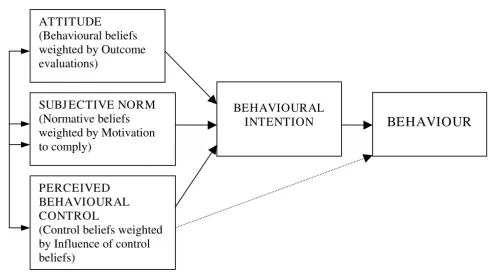
The study reported here investigated the third of these: processes underlying change or lack of change to assess possible reasons for the success or lack of success of the intervention. The evaluation was based on the Theory of Planned Behaviour (TPB) [7]. The TPB proposes a model about how human action is guided. It predicts the occur-rence of a specific behaviour, provided that the behaviour is intentional (i.e., the model does not claim to predict behaviours that are habitual or automatic). The model is increasingly being used to predict intentions and behav-iour with respect to clinical actions [8]. The TPB model is depicted in Figure 1 and represents the three cognitive var-iables that the theory suggests will predict the intention, which is the precursor of behaviour. Because this process evaluation was conducted at the end of the intervention period, we do not claim that the cognitive variables caused a change in behaviour. We distinguish between prediction –, something that researchers do when they know one score (e.g., attitude) and want to estimate another (e.g., intention) – and causation (i.e., when one factor is brought about by another, independently of whether the factors are measured). By using a model which is predictive in this sense, we may illuminate proc-esses underlying the trial results.
the patient's next routine visit to the surgery; within the next six months). In the current study, three behaviours were identified from the clinical guidelines used in the DREAM Trial as being central in the management of Type 2 diabetes: measuring blood pressure, inspecting feet, and prescribing statins (to lower cholesterol). As data about actual behaviour were not available at the level of the individual clinician (but only at the level of primary care practices), we used the measure of intention as the dependent variable for this process evaluation. A recent systematic review concluded that intention is an appropri-ate proxy measure of individual behaviour [9].
The findings of the trial are reported elsewhere [10], but the findings relevant to these three behaviours were: first, patients in intervention practices were significantly more likely than patients in control practices to have a recording of having had either a foot check or a measurement of blood pressure but not a measurement of serum choles-terol; and second, the mean cholesterol level in patients from intervention practices was significantly lower than in control practices, but there was no difference between intervention and control groups in the levels of blood pressure recorded.
The aim of this study was to elucidate the cognitions of health professionals that underlay these selected clinical behaviours. We did this in two ways: first, by testing for differences in cognitions between the intervention and control groups of the trial and second, by identifying the patterns of association within each trial group and com-paring these with effects of the intervention on clinical practice [10].
Methods
Development of the questionnaire
The three 'predictor' variables in the TPB are attitudes (being in favour of, or against doing something); subjec-tive norms (perceived pressure from social sources to do, or not to do something); perceived behavioural control, or PBC (perception of having, or not having control over the behaviour). They may be measured 'directly' by asking responders to summarise their overall attitude, perceived pressure and so on, or 'indirectly', by asking responders about specific beliefs and combining the answers in a manner specified by the theory [7]. According to the TPB, when using direct measures in a regression analysis to pre-dict intention, adding the indirect measures should not increase the level of prediction. However, we included
[image:4.612.61.552.91.366.2]The theory of planned behaviour (Ajzen, 1991)
Figure 1
The theory of planned behaviour (Ajzen, 1991). Attitude = being in favour of, or against, doing something (the behav-iour). Subjective norm = perceived pressure to do, or not to do, the behaviour. Perceived Behavioural Control = perception of having, or not having, control over the behaviour.
ATTITUDE
(Behavioural beliefs
weighted by Outcome
evaluations)
BEHAVIOURAL
INTENTION
PERCEIVED
BEHAVIOURAL
CONTROL
(Control beliefs weighted
by Influence of control
beliefs)
BEHAVIOUR
both measures in the questionnaire to test this part of the theory, because direct and indirect measurement approaches make different assumptions about the under-lying cognitive structures [11]. Briefly, indirect measures are based on responses to items about specific beliefs and scores are then combined by the researcher. The assump-tions are that the method used for combining responses (weighting and then averaging the scores) reflects the methods that individuals use when forming, for example, an attitude, and that all relevant beliefs have been repre-sented among the questionnaire items. Direct measure-ment effectively asks individuals themselves to combine the separate beliefs. It does not rely on the assumption that all relevant beliefs have been represented in the ques-tionnaire but assumes that people can accurately combine and report a global attitude, subjective norm, and per-ceived level of control over the behaviour in question. The construction of the measures of the three predictor varia-bles and of intention was based on standard practice in the field including the advice of researchers [7,11-13].
To construct the indirect measures we first conducted a qualitative study. A member of the research team (LS) interviewed 12 general practitioners (GPs) and practice nurses not involved in the DREAM trial about the behav-iours under investigation. We designed the schedule for these semi-structured interviews to elicit responders' beliefs relating to the constructs of the TPB. Both GPs and practice nurses were encouraged to talk freely about these beliefs, and any ambiguities were clarified using appropri-ate prompts. Interviews were tape recorded and
tran-scribed. Answers to questions were entered into response tables. We identified the most frequently mentioned beliefs and used them to develop items for indirect meas-urement of the three predictor variables.
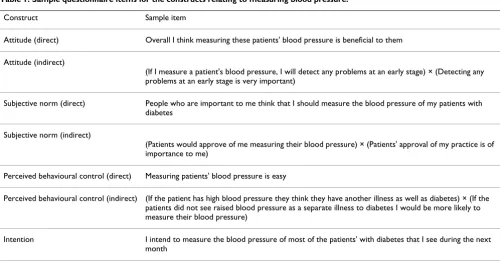
We developed a questionnaire for each of the three behav-iours. The response format for all items was a seven-point Likert-type scale, from 1 (strongly agree) to 7 (strongly disagree). We pre-tested this initial draft of the question-naire with six GPs not involved in the DREAM trial for style and clarity of content and to determine completion time. Minor revisions of wording were made to the ques-tionnaire in the light of their comments. Responses were explored for range, and items with low variance were eliminated from the final questionnaire, because they would be unlikely to discriminate within the analysis. The final questionnaire consisted of 154 items, including questions about the size of practices and demographic details. Sample questions are presented in Table 1; the full questionnaire is available as Additional file 1.
Procedure
The questionnaire was mailed to all 280 GPs and practice nurses in the DREAM trial. Two reminder letters were sent to non-responders at fortnightly intervals.
Psychometric properties of the questionnaire
Internal consistency coefficients were calculated for the intention measure and for the direct measure of attitude, for each of the three behaviours. Coefficient alpha was sat-isfactory (between 0.87 and 0.98). Direct measures of
sub-Table 1: Sample questionnaire items for the constructs relating to measuring blood pressure.
Construct Sample item
Attitude (direct) Overall I think measuring these patients' blood pressure is beneficial to them
Attitude (indirect)
(If I measure a patient's blood pressure, I will detect any problems at an early stage) × (Detecting any problems at an early stage is very important)
Subjective norm (direct) People who are important to me think that I should measure the blood pressure of my patients with diabetes
Subjective norm (indirect)
(Patients would approve of me measuring their blood pressure) × (Patients' approval of my practice is of importance to me)
Perceived behavioural control (direct) Measuring patients' blood pressure is easy
Perceived behavioural control (indirect) (If the patient has high blood pressure they think they have another illness as well as diabetes) × (If the patients did not see raised blood pressure as a separate illness to diabetes I would be more likely to measure their blood pressure)
[image:5.612.55.556.472.734.2]jective norm and perceived behaviour control were two-item measures, and so consistency was assessed using Pearson's correlation coefficients. Using a criterion for acceptability of r > 0.25, internal consistency was high (r > 0.4) for the measures of subjective norms and mixed (two coefficients close to zero) for the measures of PBC. It is not appropriate to use an internal consistency criterion for assessing the reliability of indirect measures, as the objective in using these measures is to sample a diverse range of beliefs [11].
Because the two PBC items did not have adequate internal consistency, it was not valid to combine these scores for the main analysis. We selected one item ('Overall, I feel that I can [do X]') to represent PBC for the analysis as it was more consistently related to the other TPB variables across the three behaviours.
Indirect measures were computed using the 'multiplica-tive composite' approach suggested by Ajzen and Fishbein [13]. That is, the score for each belief was multiplied by the score of its perceived importance weight (see Figure 1) and the resulting products were summed to give a total score for attitude, subjective norms, and PBC for each of the three behaviours. For direct and indirect measures, scores were scaled so that a low score always indicated a more positive attitude, intention, etc.
There is considerable debate in the TPB literature about whether to use response scales of 1 to 7 or -3 to +3 in the multiplicative composite approach (e.g., French and Hankins [14]). As the questionnaire was lengthy, we decided, on a pragmatic basis, to use a consistent 1–7 response format to minimise responder fatigue.
Results
Non-response Analysis
Figure 2 presents the response rates for the survey relative to the trial, for the intervention and control groups. Over-all, the individual response rate was 40.0% (intervention: 42.6%; control: 37.7%). The practice level response rate (at least one responder in the practice) was 81.0% (inter-vention: 82.1%; control: 80.0%). We used a series of chi-square analyses to compare responders and ers on variables that could be accessed for non-respond-ers. These showed no associations with trial group, register, gender, professional role, or working in a training practice (all p > 0.05). However, responders had been qualified for significantly longer than non-responders (M = 22.46 years and M = 18.92 years, respectively; 95% con-fidence interval for mean difference: 0.42 – 6.66).
Chi-square analyses of responders showed no association between trial group (intervention versus control) and the following variables: diabetes register, number of GPs in
the practice, number of nurses in the practice, prescribing status of nurses, and years since qualified (all p > 0.3). Nevertheless, as this was a process evaluation of a trial, the remaining descriptive analyses were conducted separately for intervention and control participants.
Initial analyses
Bivariate correlations between the direct measures for each of the three behaviours are presented, separately for the intervention and control groups, in Table 2. Means, standard deviations, and correlations between the direct and indirect measures of the same construct are also included. These correlations may be used to assess the content validity of the indirect measures. If the indirect measures were individually relevant and together ade-quately represented the range of beliefs, this should result in moderate-to-strong positive correlations between direct and indirect measures. Using this criterion, validity of the indirect measures was acceptable for attitudes and subjec-tive norms, but questionable for PBC. That is, it is possible that, to create a questionnaire of acceptable length, we may have excluded important control beliefs that influ-ence clinicians' perceptions of control over these behav-iours.
Group differences in TPB variables: Multiple analyses of variance (MANOVAs)
To identify factors affecting the mean values of the TPB variables, a series of MANOVAs were conducted. For each of the three behaviours under investigation, intention and direct measure scores for the three predictor variables were entered as dependent variables. Three designs were used:
Trial group (intervention; control) × job title (GP; nurse) × PCT)
Trial group (intervention; control) × practice size (< 4 GPs; ≥ 4 GPs)
Trial group (intervention; control) × years since qualified (≤ 23 years; > 23 years)
criterion validity of the PBC item, as it would be expected that nurses, most of whom are not eligible to prescribe, would report lower control over prescribing behaviour. No other main effects or interaction effects were signifi-cant in the MANOVAs.
Predicting intention: Regression analyses
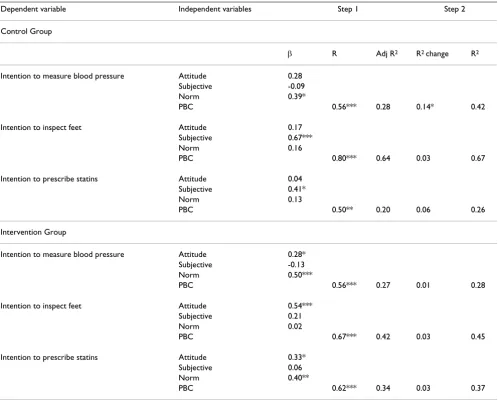
A multiple linear regression analysis on intentions for each of the three behaviours was carried out separately for the intervention and control groups (Table 3). At the first step, the direct measures of Attitude, Subjective Norm, and PBC were entered; indirect measures were entered at
the second step. This was to check whether the solution would change depending on which method of measure-ment (direct or indirect) was used. In the intervention group, the addition of indirect measures did not improve prediction of intention for any of the three behaviours. In the control group, the addition of indirect measures did not improve prediction of intention to prescribe statins or to examine feet. However, prediction of intention to measure blood pressure did improve when indirect meas-ures were added (R2 change = 0.14, p < 0.05). The signifi-cant predictor at the second step was attitude (indirect), β = 0.47, p = .002. Although this finding relates to only one
[image:7.612.58.555.82.545.2]Individual-level and [practice-level] response rates, DREAM survey
Figure 2
of six regression analyses performed, it suggests the possi-bility that clinicians in the control group and intervention group may have been thinking about their beliefs and intentions in different ways.
We performed a second series of hierarchical regression analyses, with professional (GP or nurse) and practice size (< 4 GPs; ≥ 4 GPs) entered at the first step and the direct TPB measures entered at the second step. After controlling for job title and practice size, the TPB predictor variables again significantly added to the variance in intention explained, and the patterns of significant predictors were similar to the first set of analyses. This finding was consist-ent in both the control and intervconsist-ention group for all three behaviours.
Interpreting trial effects
[image:8.612.56.555.110.497.2]Table 3 shows a consistent pattern that may represent an effect of the intervention. Specifically, for inspecting feet and prescribing statins there was a trend for intentions to be predicted most strongly by subjective norms in the con-trol group and by attitudes in the intervention group. To determine whether these trends were reliable, two further hierarchical regression analyses were performed in which the interactions between trial group and attitude, and between trial group and subjective norm, were entered in the second step (Table 4). In the analysis relating to the inspection of feet, intention was predicted not only by the main effect of subjective norm (β = 0.97) but also by both interactions. The directions of the interaction effects indi-cate that subjective norm was a stronger predictor of intention in the control group than in the intervention group. Conversely, attitude was a stronger predictor of
Table 2: Means, standard deviations (SD), and correlations between the predictor variables (direct measures) and intention scores and indirect measures, for each of the three behaviours, computed separately for the intervention and control groups.
Control Group: Direct Measures Intervention group: Direct Measures
Attitude Subj Norm PBC Attitude Subj Norm PBC
Measuring Blood Pressure
Subjective Norm 0.52** - 0.25
-PBC 0.56** 0.36** - 0.15 0.25
-Intention 0.47** 0.21 0.47** 0.28* 0.07 0.39**
Indirect Measure 0.57** 0.43* 0.29* 0.34* 0.39* -0.07
Mean (sd) 1.62(0.67) 2.62(1.33) 2.69(1.81) 1.41(0.63) 2.22(1.32) 2.70(1.97)
Foot examination
Subjective Norm 0.63** - 0.49**
-PBC 0.26 0.22 - 0.12 0.25
-Intention 0.61** 0.77** 0.33* 0.28* 0.48** 0.14
Indirect Measure 0.70** 0.66* -0.03 0.64* 0.54* 0.13
Mean (sd) 2.12(0.91) 2.99(1.44) 3.00(1.51) 1.96(1.09) 2.64(1.43) 3.04(1.73)
Prescribing statins
Subjective Norm 0.52** - 0.61**
-PBC 0.50** 0.52** - 0.44** 0.56**
-Intention 0.31* 0.48** 0.44** 0.42* 0.36** 0.41**
Indirect Measure 0.37** 0.52* 0.32* 0.28* 0.36* 0.07
Mean (sd) 2.44(1.12) 2.94(1.27) 2.83(1.54) 2.19(1.12) 2.66(1.39) 2.62(1.52)
*p < 0.05, **p < 0.01.
PBC = Perceived Behavioural Control; Subj Norm = Subjective Norm.
intention in the intervention group than in the control group. Neither interaction term was significant in the analysis predicting intention to prescribe statins.
Discussion
This study was a theory-based process evaluation under-taken to investigate the cognitive processes underlying trial effects. In addition, extraneous variables that may affect clinicians' cognitions and behaviour were investi-gated, and patterns of clinical behaviours were explored. Results are discussed below in four sections: trial effects; effects of demographic factors on cognitions about clini-cal behaviours; limitations of the study; and general con-clusions.
Trial effects
[image:9.612.58.556.109.510.2]In the context of the effect of interventions on cognitive variables, there are two possible types of effect. First, an intervention may alter the mean values of scores on pre-dictor variables. Second, an intervention may alter the relationships between the cognitive predictor variables and an outcome, in this case, intentions. It appears that the effect of the intervention in the DREAM trial was of the second kind. With respect to inspecting feet, subjective norms were more strongly related to intention in the con-trol group than in the intervention group, and attitudes were more strongly related to intention in the interven-tion group than in the control group. Thus, at the end of the intervention, intentions to inspect feet were 'norma-tively-driven' in the control group but 'attitudinally-driven' in the intervention group.
Table 3: Results of regression analyses on intentions for three behaviours, with direct measures entered at Step 1 and indirect measures entered at Step 2, for control and intervention groups.
Dependent variable Independent variables Step 1 Step 2
Control Group
β R Adj R2 R2 change R2
Intention to measure blood pressure Attitude 0.28
Subjective -0.09
Norm 0.39*
PBC 0.56*** 0.28 0.14* 0.42
Intention to inspect feet Attitude 0.17
Subjective 0.67***
Norm 0.16
PBC 0.80*** 0.64 0.03 0.67
Intention to prescribe statins Attitude 0.04
Subjective 0.41*
Norm 0.13
PBC 0.50** 0.20 0.06 0.26
Intervention Group
Intention to measure blood pressure Attitude 0.28*
Subjective -0.13
Norm 0.50***
PBC 0.56*** 0.27 0.01 0.28
Intention to inspect feet Attitude 0.54***
Subjective 0.21
Norm 0.02
PBC 0.67*** 0.42 0.03 0.45
Intention to prescribe statins Attitude 0.33*
Subjective 0.06
Norm 0.40**
PBC 0.62*** 0.34 0.03 0.37
There are a number of possible explanations for how the intervention might have strengthened the attitude-inten-tion relaattitude-inten-tionship. It could be that clinicians became more familiar with the content of the guideline by receiving the intervention, and that this familiarity (or additional knowledge) strengthened the consistency between atti-tudes and intentions. In addition, when attiatti-tudes are based on direct experience, they are more likely to be brought to mind in the relevant context [15]. Further-more, it may be that the systematic application of the guideline in terms of prompts relating to specific patients made the importance of key clinical indicators more sali-ent. For all of these possibilities, attitudes would super-sede subjective norms as the primary predictor of intentions.
There is empirical evidence that attitudinally-driven intentions are more likely to be translated into action than normatively-driven intentions [16-18]. This has been explained by reference to self-determination theory [19], which distinguishes between self-determined (or intrinsi-cally motivated) and externally controlled regulation of intention. Within this framework, attitudes represent internal pressure (one's own views), whereas subjective norms represent external pressure (the perceived views of others), to act. Self-determination theory proposes that internalised motivation is related to the stability of inten-tions and is a better predictor of behaviour than motiva-tion arising from external sources [20,21].
The implication of this in the context of the DREAM trial is as follows. On the basis of these findings, we would expect higher levels of foot inspection to be recorded in the intervention group than in the control group. This is what was found in the trial. Thus, the results of the current study support the principle that attitudinally-driven
intentions are better translated into action than are norm-atively-driven intentions. A further key trial effect (low-ered cholesterol among participants in the intervention group) was possibly related to the trend (albeit non-sig-nificant in our analysis) for statin prescription also to be attitudinally-driven (i.e., internally motivated) in the intervention group.
A strength of this study was that we investigated three behaviours among the same population at the same time. This enabled us to compare and contrast patterns of pre-diction across the behaviours. The three selected behav-iours were strongly contrasting: the measurement of blood pressure is a frequently enacted behaviour (inten-tion data in this study showed restricted range and possi-ble ceiling effects); the inspection of feet is a clinical action that both physicians and their practice nurses are qualified to do (although our data showed that cognitions of the two professional groups tend to be different); and the prescription of statins is restricted to physicians and a small proportion of nurses. Yet the TPB was effective in predicting intentions to do these contrasting behaviours, suggesting that the model was stable across a range of behaviours
Effects of demographic factors
[image:10.612.55.555.109.279.2]Demographic factors appeared to affect cognitions about clinical behaviours. As may be expected from the different responsibilities assigned to different roles, professional role (GP versus nurse) influenced cognitions. Nurses had stronger positive attitudes and intentions to measure blood pressure and inspect feet, whereas for prescribing statins, GPs had stronger attitudes, perceived control, and intentions. This would be expected and supports the validity of the measurement instruments.
Table 4: Results of regression analyses (n = 112) on intentions to inspect feet and intentions to prescribe statins, with direct measures entered at Step 1 and the interaction between direct measures and trial group entered at Step 2.
Dependent variable Independent variables Step 1 Step 2
β R Adj R2 β R2 change R2
Intention to inspect feet Attitude 0.42*** -0.21
Subjective Norm (SN) 0.38*** 0.97***
PBC 0.06 0.08
0.71*** 0.48
Trial group × Attitude 0.72*
Trial group × SN -0.65* 0.03* 0.51
Intention to prescribe statins Attitude 0.09
Subjective Norm 0.67**
PBC 0.16
0.52*** 0.25 0.02 0.27
A further demographic effect was practice size. In smaller practices, GPs and nurses had stronger intentions to meas-ure blood pressmeas-ure, and GPs had stronger intentions to prescribe statins. This is consistent with the results of a previous trial that tested the effects of educational out-reach in a primary care setting [22], and suggests that a fruitful approach to exploring the implementation of evi-dence-based practice could include an investigation of organisational factors in relation to practice size.
Limitations
This study had a number of limitations. First, although the non-response analysis indicated that the sample was rep-resentative in all but one of the measured variables (number of years since professional qualification), the response rate was low (40% at the individual level; 81% at the practice level). It is also possible that some respond-ers were completing the questionnaire on behalf of other practice staff and this would introduce measurement error. Second, the items measuring PBC had poor psycho-metric properties, and so their reliability is uncertain. Third, TPB constructs were measured only once – after the intervention. However, randomisation of primary care practices to the intervention and control groups in the trial should have resulted in similar cognitions between groups before the intervention took place. Finally, as the process evaluation study sampled only three clinical behaviours out of all the appropriate behaviours relating to this complex intervention, there may have been other mechanisms underlying trial effects that were not detected by this study. For example, it may have been that the auto-mated prompts to patients and clinicians regarding the need for a review consultation resulted in increased con-cordance in interactions between patients and clinicians and that this increased patients' involvement in the man-agement of their condition.
Conclusion
This theory-based process evaluation of the DREAM trial explored cognitions about three clinical behaviours relat-ing to the management of diabetes to identify possible effects of the trial intervention on cognitions, including intentions. Independently of whether participants were in the intervention group or control group, professional role and practice size influenced attitudes, PBC, and inten-tions. This suggests that interventions that are directed to entire practices or health care teams may have different effects on individuals within those teams and across dif-ferent organisational structures. Finally, it appears that the intervention strengthened the link between attitudes and intentions towards inspecting feet, with similar non-sig-nificant trends in cognitions about prescribing statins. This stronger link between internal pressures (attitudes) and intentions than between external pressures (subjec-tive norms) and intentions was associated with trial
out-comes. This lends support to the principle that when intentions are driven by attitudes rather than perceived social pressure, those intentions are more likely to be translated into action. Thus, understanding the difference between attitudes and subjective norms allowed us to understand some of the intervention effects. This study thus illustrates the use of theory-based process evaluation to uncover processes underlying change in implementa-tion trials.
Competing interests
The authors declare that they have no competing interests.
Authors' contributions
MPE, AW, JMG and MJ developed the idea for the study. MPE, AW, LS, MJ and PW developed the instruments and conducted the data collection. JJF, MPE, MJ, conducted the analyses. JJF, MPE, MJ, PW, JMG and EK contributed to the interpretation of the analyses and the drafting of the paper. All authors have seen and approved the final draft.
Additional material
Acknowledgements
We are grateful to the health care professionals who participated in this study.
This project was funded by the European Union as part of the ReBEQI project http://www.rebeqi.org. Jeremy Grimshaw holds a Canada Research Chair in Health Knowledge Transfer and Uptake. Eileen Kaner holds a Department of Health funded NHS Primary Care Career Scientist award.
References
1. The Acropolis Affirmation: Diabetes Care – St Vincent in Progress. Statement from the Saint Vincent Declaration meeting, Athens, Greece, march 1995. Diabetic Med 1995,
12:636.
2. UK Prospective Diabetes Study (UKPDS) Group: Intensive blood-glucose control with sulphonylureas or insulin compared to conventional treatment and risk of complications in patients with type 2 diabetes (UKPDS 33). Lancet 1998, 352:837-853. 3. Department of Health: National Service Framework for Diabetes: Delivery
Strategy London: Department of Health; 2003.
4. Shojania KG, Ranji SR, Shaw LK, Charo LN, Lai JC, Rushakoff RJ, Owens DK: Diabetes Mellitus Care. In Closing the Quality Gap: a critical analysis of quality improvement strategies. Technical review 9 Vol-ume 2. Edited by: Shojania KG, McDonald KM, Wachter RM, Owens DK. Rockville, MD: Agency for Healthcare Research and Quality; 2004.
5. Eccles M, Hawthorne G, Whitty P, Steen N, Vanoli A, Grimshaw J, Wood L: A randomised controlled trial of a patient based Dia-betes Recall and Management System: the DREAM trial: A
Additional file 1
DREAM PE Final Questionnaire. This questionnaire is the theory-based instrument that was used to collect the data for the DREAM process eval-uation study.
Click here for file
Publish with BioMed Central and every scientist can read your work free of charge "BioMed Central will be the most significant development for disseminating the results of biomedical researc h in our lifetime."
Sir Paul Nurse, Cancer Research UK
Your research papers will be:
available free of charge to the entire biomedical community
peer reviewed and published immediately upon acceptance
cited in PubMed and archived on PubMed Central
yours — you keep the copyright
Submit your manuscript here:
http://www.biomedcentral.com/info/publishing_adv.asp
BioMedcentral
study protocol [ISRCTN32042030]. BMC Health Services Research 2002, 2:5.
6. Whitty P, Eccles MP, Hawthorne G, Steen N, Vanoli A, Grimshaw JM, Wood L, Speed C, McDowell D: Improving services for people with diabetes: lessons from setting up the DREAM trial. Prac-tical Diabetes International 2004, 21:323-328.
7. Ajzen I: The Theory of Planned Behavior. Organ Behav Hum Decis Process 1991, 50:179-211.
8. Walker AE, Grimshaw JM, Armstrong E: Salient beliefs and inten-tions to prescribe antibiotics for patients with a sore throat.
British Journal of Health Psychology 2001, 6:347-360.
9. Eccles MP, Hrisos S, Francis J, Kaner E, Dickinson HO, Beyer F, John-ston M: Do self-reported intentions predict clinicians' behav-iour: a systematic review. Implement Sci 2006, 1:28.
10. Eccles MP, Hawthorne G, Whitty P, Steen N, Vanoli A, Grimshaw JM, Wood L: A cluster randomised controlled trial of a Diabetes Recall and Management system: the DREAM trial. In Centre for Health Services Research Report No. 113 University of Newcastle upon Tyne: Centre for Health Services Research; 2006.
11. Francis JJ, Eccles MP, Johnston M, Walker AE, Grimshaw JM, Foy R, Kaner EFS, Smith L, Bonetti D: Constructing questionnaires based on the theory of planned behaviour. A manual for health services researchers. University of Newcastle upon Tyne: Centre for Health Services Research; 2004.
12. Godin G, Kok R: The Theory of Planned Behaviour: A Review of Its Applications to Health-related Behaviours. American Journal of Health Promotion 1996, 11:87-98.
13. Ajzen I, Fishbein M: Understanding attitudes and predicting social behav-iour Englewood Cliffs, New Jersey: Prentice-Hall; 1980.
14. French DP, Hankins M: The expectancy-value muddle in the theory of planned behaviour – and some proposed solutions.
British Journal of Health Psychology 2003, 8:37-55.
15. Fazio RH, Chen J, McDonel EC, Sherman SJ: Attitude-accessibility, attitude-behavior consistency, and the strength of the object-evaluation association. Journal of Experimental Social Psy-chology 1982, 18:339-57.
16. Ajzen I, Fishbein M: Attitude and the Attitude-Behavior Rela-tion: Reasoned and Automatic Processes. In European Review of Social Psychology Edited by: Stroebe W, Hewstone M. New York: John Wiley & Sons; 2001:1-33.
17. Cooke R, Sheeran P: Moderation of cognition-intention and cognition-behaviour relations: a meta-analysis of properties of variables from the theory of planned behaviour. Br J Soc Psy-chol 2004, 43:159-186.
18. Sheeran P, Norman P, Orbell S: Evidence that intentions based on attitudes better predict behaviour than intentions based on subjective norms. European Journal of Social Psychology 1999,
29:403-406.
19. Deci EL, Ryan RM: Intrinsic motivation and self-determination in human behaviour New York: Plenum; 1985.
20. Deci EL, Ryan RM: The "what" and "why" of goal pursuits: Human needs and the self-determination of behavior. Psycho-logical Inquiry 2000, 11:227-268.
21. Chatzisarantis NLD, Biddle SJH: Functional significance of psy-chological variables that are included in the theory of planned behaviour: A self-determination theory approach to the study of attitudes, subjective norms, perceptions of con-trol and intentions. European Journal of Social Psychology 1998,
28:303-322.
![Figure 2Individual-level and [practice-level] response rates, DREAM surveyIndividual-level and [practice-level] response rates, DREAM survey.](https://thumb-us.123doks.com/thumbv2/123dok_us/1631375.116369/7.612.58.555.82.545/figure-individual-practice-response-dream-surveyindividual-practice-response.webp)