3268
Implications, Risks And Challenges Of Cloud
Computing In Academic Field – A State-Of-Art
Ananthi Claral Mary.T, Dr.Arul Leena Rose.P.J.
Abstract: Education helps in the monetary development of a nation. Education has the power to eradicate the poverty in a country. The increasingly complex infrastructure-environment management, development goals and rapidly changing technology pose new kinds of challenges to education sector. In this modern era, the higher educational institutions concentrate on latest technologies and tools to explore learning. At mean time, the educational resources distribution might be uneven across the countries. Cloud computing brings various benefits to integrate into the academic field. There are risk issues for adopting cloud in storing and executing secret data. This paper surveys to analyze uses, issues in adhering cloud computing for the faculty, staff and students in education sector. It also focuses on security issues, risk divisions. The review recognized the areas in which cloud computing can have an influence in education field. Furthermore, this paper aims to discuss about security management and the challenges faced by the education sector in developing countries thus facilitating researchers to find the relevant issues, in which they can focus their efforts.
Keywords: Cloud computing, Academic field, Cloud risk, Challenges, IaaS, SaaS, and PaaS.
————————————————————
1.INTRODUCTION TO CLOUD COMPUTING IN
EDUCATION
Cloud computing is a combination of various services. Cloud provides lot of services to education sectors. Education provides creativity, empowerment and innovation in the development of a nation. Education can be considered as an instrument which shapes the behaviour of human beings. Education improves the moral value of a person. Every person has knowledge only through education; knowledge in a person can be awakened. As an alternative to academic medium such as text books, paper work sheets, and so on the use of internet technologies in scholastic institutions by faculty and students has become standard of data research, productivity and information sharing. Educational organizations can improve learning methodologies by using cloud computing. Cloud computing is most suited for academic sectors, which has budget restrictions. The adoption of cloud computing technology has transformed every aspect of human lives. Though technology has played an integral role it has not been equally adopted in all sectors. Cloud computing is helping academic institutions in cutting costs aroused through the purchase of legacy software. The Massive Open Online Courses enables teachers and students in distant areas to learn and equip themselves with the latest knowledge. Various cloud service providers offers free service applications like Google docs, calendars, emails and document storage and website creation services.
Ananthi Claral Mary.T, PhD Scholar, (Department of Computer Science) SRM Institute of Science & Technology, India.
Dr.Arul Leena Rose.P.J. (Corresponding Author), Associate Professor, Department of Computer Science,
SRM Institute of Science & Technology, India.
2. Central Ideas Behind Cloud Computing
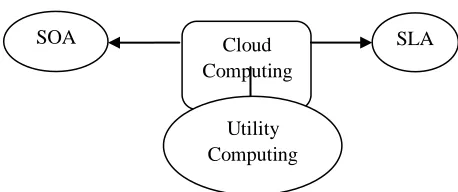
The central ideas behind cloud computing are1. Utility Computing
2. SOA – Service-Oriented Architecture 3. SLA – Service-Level Agreement
Figure 1. Central Ideas Behind Cloud Computing
2.1 Utility Computing
Utility computing provides a service provisioning model.
2.2 Service-Oriented Architecture
It is a combination of various utilities that communicate among one another. It enables full flexibility in designing services, which helps during system integration. SOA is implemented by a Web service model.
Figure 2. Service-Oriented Architecture
2.3 Service-Level Agreement
SLA is a mutual agreement among consumers and service providers that defines detailed service offerings, delivery time, service quality and constraints of offered services
3. Background and Significance
The selected works for the literature review:
Tuncay Ercan (2010) abstracted the usage of cloud computing is more in the financial, industrial and manufacturing sectors when compared to schools and education services [72]. Bo Wang et al., (2011) concluded that the problems of irregular sharing of learning resources
Service Provider
Service Consumer Service request
Service response
SOA Cloud
Computing
SLA
3269 are solved by the usage of cloud computing [12]. Mohssen
M. Alabbadi (2011) discusses in both academia and industry, cloud computing has significant opportunities due to its ease of use and in educational & learning area it can be called as ‟Education and Learning as a Service”. To protect the cube symmetry, a new model formation was projected in [42]. Gunasekar and Anirudh (2011) studied the theoretical, empirical studies to find various security problems in cloud based e-learning technology [21].
Deka Ganesh Chandra, Dutta Borah Malaya (2012) address that in underdeveloped countries; e-learning through cloud computing raises the education level, literacy rates, development in economy where there are limited opportunities and expensive technical education. The benefits of Virtual Computing Lab (VCL) facilities are enjoyed by the students which enhances collaboration environment and cost savings [14]. Saju Mathew (2012) shows how cloud computing can provide a cost-effective infrastructure to progress education performance, liveliness which can bring revolution in education field. It depicts the comparison among internal cloud and educational cloud [60]. Amitava Ghosh et al., (2012) presents a proposed model to identify the important people in a higher education organization interacts with the institute’s information technology division. Further it discusses about cloud delivery models across main stakeholders like students, faculty, clubs, library and admin [4]. Faisal A. Alshuwaier et al (2012) presented different education applications for education infrastructure which are implemented for academic uses are presented in [18]. Srinivas Reddy (2013) focuses on e-learners security threats like browsers security, social aspects of security and address that to ensure e-learners security different security mechanisms like inbuilt virus scanners, various password protection & authentication methods, digital signatures has to be followed [66]. Krelja Kurelovic et al., (2013) conducted a survey in Polytechnic of Rijeka. 158 students participated in the survey. Experimental data were analyzed using descriptive statistics, and hypothesis testing was done to establish the occurrence of situations which specify a service need in the cloud [33]. Anjali Jain, U.S Pandey (2013) focuses on existence of data centers in multiple nations may trigger cross border issues for the academic institutions [6]. Pranay Kumar et al., (2013) proposed various cloud application and utilities related to education namely Amazon, Microsoft, Google, IBM, Salesforce, HP, AMANDA and ZMANDA [50]. Aruna and Prakasam (2013) in [7] proposed cloud based architecture, which illustrates virtual laboratories, e-learning resources, open forums, mobile education can be used by the staff and faculty members to share the knowledge. Cloud provides huge data storage space which can be utilized by the students through internet. Kiran Yadav (2014) presented facilities attached to education cloud like class preparation and review at home by faculty. Users of an education cloud computing system like students, faculty, developers, researchers, admin department, benefits for institutions and students using cloud computing and security issues. To minimize the risk the institutions has to depend on more than one cloud provider [32]. Ayush Gaur, Manoj Manuja (2014) depicted the education cloud architecture and the flow of education cloud [11]. Hongyu and Ivica (2014) abstracted that the development of cloud computing
encourages teachers to educate cloud computing to graduate students hence they can achieve more experience to cloud computing concepts and be ready for jobs in software companies [24]. Sanasam Bimol et al., (2014) discuss about the facilities offered by SPI model, challenges anticipated from adoption of cloud model, pros and cons of cloud computing. The authors concluded that academic organizations have more chances to enhance their routine academic actions which range from learning to utilities to discovery. This leads to increase in knowledge distribution [62]. Munwar et al. (2014) discussed the results taken after the implementation of K-NN and RSA algorithms to progress and mange the confidentiality data level in a cloud environment [43]. Vaishali H Pardeshi (2014) stated the benefits, characteristics of cloud computing and presented a five phase scheme to implement cloud in higher education institutes [74]. Tajinder et al. (2014) discussed that due to the surplus population growth in India there is increase in market size and huge demand for upgradation of education. Ten factors were discussed in a structured manner as barriers for adopting cloud computing [70]. Safiya Okai et al., (2014) identified that when valued data exist outside the firewalls of the institutions; then any hacking will affect all clients saved data [59]. Asgarali, Bahman (2014) stated the necessity of move towards virtual education and effect of cloud computing in online learning [8]. Pradosh et al., (2014) quoted that the risks/threats in cloud based e-learning can be minimized by the usage of encrypted file systems, applications of security principles and hardware security to follow strange attack across the servers [49]. Rajinder, Sandeep (2015)
3270 (2016) discussed the techniques to preserve the
confidentiality in cloud like biometric encryption, secret sharing scheme, encryption and obfuscation, HPI_SECURE, data confidentiality using K-NN classifier [77]. Chetan Bulla et al., (2016) in [13] presented cloud adoption in primary and secondary education and stated the drawbacks and challenges. Rumana Javali (2016) examined the views of school education system using cloud computing in [58]. Abdul Rahman et al, (2016) provide a proposed solution to secure E-learning environment based on cloud. Protection alertness, mechanisms, methodologies and Hacker techniques were elaborated to enhance this model [1]. Samiya Khan et al., (2016) presents a vision for statistical analysis of the education sector in India and explores the feasibility of big data analytics solutions based on cloud for humanizing teaching, at various stages, and maximizing research in the country [61]. Abusfian and Weam (2017) reviewed that cloud computing provides students to retrieve the study materials wherever they are. CC enables HEIs to handle the requirements of software and hardware changes quickly at minimum value. Hence adopting cloud into higher education increases educational rank, effectiveness of students [2]. Khalil H. A. Al-Shqeerat et al., (2017) discovered some cloud usages in education sector, discussed drawbacks of main cloud services and highlighted security challenges [31]. Siti Salmah Md Kassim et al., (2017) in [65], identifies the trust factors of user using Analytical Hierarchical Process confirm that availability; authentication and accountability factors are important trust factors. Steve Jones et al., (2017) investigate the cloud computing implementation in realistic location and from a user perspective of organizations through local government authorities of United Kingdom. It concludes that as more organizations use modern way of data storage space and distribution the requirement for cloud computing solutions grows immensely [68]. Lovedeep et al. (2017) discuss the ways to implement the cloud on the school education system which helps the school administration to manage teacher’s profiles, create account, assign classes, manage time table. Teachers can prepare the class and upload the study materials, power points and videos for next class in home. Students can login to access the study materials, power points, results and assignments. Parents can see their child’s results and attend meetings to know their child’s improvements comparing to past achievements in [34]. Jakia Sultana (2017) identified six factors as important factors for adoption of cloud computing like a) availability of service b) cloud ability of control c) need of resource d) effectiveness in academics e) dearth of proper infrastructure f) dearth of training for staff in [27]. Nitika and Deepam (2017) addressed that there are issues related to threats, consistency, interoperability that has to be managed if we desire to make use of cloud computing in academic system [46]. Hyeong-Jin Kim et al., (2017) uses secure kNN classification by using encrypted index scheme and the Yao’s garbled circuit. This achieves improved performance than the already existing system, in conditions of classification time [25]. Jenny Wang (2017) in [28] addresses that the collaborative activities of cloud in e-learning environment provides the observation about learning process which occurred during the cloud learning activities. It concludes that utilizing cloud computing applications like Google Docs enhances students learning
3271 issues in the use of cloud in education in Saudi Arabia [57].
Geethamani, Ranjani (2018) proposed a system which uses the keygen algorithm for generating the secret key for uploading and downloading files on the cloud server and meta-data generation for verifying the integrity of the data in [19]. Pruthviraj et al., (2018) suggested a proposed system which uses AES with 128 bit key length for encryption process in [51]. Shadi R.Masadeh (2018) proposed a secure hybrid and authentic Scheme, to achieve maximum protection and verification of e-learning environment by integrating the strength of OpenVPN, HMAC, AES, VLAN, sWIFI, PGP, SSL and faces recognition in [63]. Homa Hamidi and Saeed Rouhani (2018) defined the three various benchmark tests deployed analyses accessibility to the first page of the Moodle, analyze the accessibility to the login file system and analyze the accessibility to the academic file. Final consequences that are resulted from comparing the two servers have shown that the QoS indices of cloud computing server are better than the web 2 based server [23]. Maroof Naieem Qadri, S M K Quadri (2018) shows the implementation of Google Suite for Education, Microsoft Office 365 for Education at University of Kashmir [37]. Zulqurnain Ali et al. (2018) projected a theoretical model to enhance academic performance of students through personal characteristics and knowledge management paradigm using technology acceptance model. The study recruited students’ from322 universities who were aware of using cloud services [79]. Rania Almajalid (2018) elaborated the cloud service models, deployment models, features, benefits, challenges of cloud computing in education and focuses the example cases
which have incorporated cloud computing in education. It also suggested that the proposed cloud hybrid model would simplify learning for HEIs in Saudi Arabia [56]. Kamal Kant Hiran et al., (2018) introduces a five-step theoretical structure for adopting hybrid education cloud in HEIs in Ethiopia namely learning strategy based on cloud, needs of higher education, cloud computing applications, selecting the cloud solutions, implementation and maintenance of cloud [30]. Mohammed Ali (2018) has given the most successful cases of adhering cloud computing in HEIs like Greenwich University, Google Docs in MBA group projects, Westminster University in UK in [39]. Mohammad Musudur Rahman et al., (2018) in [40] have proposed a theoretical model which projects 5 independent variables which includes positive, negative consequence on behavioural intention in adopting CC in Bangladesh HEIs. Visalakshi, Varalakshmi (2018) reported that E-learning requests can be processed quickly among the e-learning users using request scheduling algorithm [75]. Ibtissam M rhaoaurh et al. (2018) focuses on twenty-three real barriers for adopting cloud computing and categorized in three categories: policy and organizational issues, technical issues and legal issues [26]. Jolly Upadhyaya et al, (2019) studied the significant difference between the Indian students and USA Universities and this difference was due to the resources available to support the students and faculties [29]. Parves Kamal (2019) focuses the cloud computing use in hash dumps cracking and the means to take measures by using complex passwords and secure hashing algorithm in [48]. Rajamohan Parthasarath et al. (2019) proposed a method which uses public key cryptosystem by implementing RSA Algorithm for providing data storage and security in cloud
[52]. Yousef et al., (2019) attempted to highlight the taxonomy of research literature and reasons in adopting cloud computing in HEIs , are flexible learning environments, mobile learning support, collaborative working, software and hardware cost reduction, virtualisation, service quality, online applications which are ready to access and obstacles which hinder the usage of cloud computing facilities in HEIs are security concerns, confidentiality concerns, vendor lock-in concerns, network concerns, consistency, trust and management concerns, certifying and pricing concerns, acceptance and adoption concerns, sustainability and post-adoption concerns [76]. Zhen-Yu Wu (2019) proposed a mechanism to resolve the problem regarding multiple users request for retrieval in cloud environment and changing modifications in digital-sharing systems using Lagrange interpolation polynomial thereby minimizing the intricacy of threat controlling [78].
4. Research Methodology
4.1 Search Strategy
The search strategy includes review of literature.
4.1.1 Review of Literature
The literature review includes reviewing various publications in leading databases namely IEEE Xplore, ACM Digital Library, Scopus, ScienceDirect, Springer, Google Scholar, ResearchGate between 2010 to 2019.
5. Cloud Service Models
Discussed below are the various services offered through cloud computing:
1. Infrastructure Services (IaaS) 2. Software Services (SaaS) 3. Platform Services (PaaS)
The cloud models for service provide lots of utilities to students, teachers and researchers. Large numbers of educational institutions are running SaaS applications.
5.1 IaaS in Education
Provides the educators with the virtual infrastructure to deploy and run software, including applications and OS. The computer labs are the key elements in the teaching and learning of information technology. Infrastructure needs of students, faculties and researchers are satisfied by using IaaS.
5.2 SaaS in Education
The SaaS model allows educational institutions to use application through a platform cloud via the internet. The benefits of SaaS are it eliminates the expense of software licensing, installation and support.
5.3 PaaS in Education
This cloud service model supports teachers in their development of applications via programming languages, services and tools that the cloud platform providers offer. For example, an educator can design a customized virtual lab for the students using a PaaS.
3272 6.1. Public Cloud – External Cloud
It provides data storage to monitor text, images, audio, video other multimedia content. It will be convenient for the faculty members and students to retrieve the learning materials if they are properly arranged. Everyone can easily access this cloud model so it is less secured model.
6.2. Private Cloud – Internal Cloud
Internal cloud satisfies the aims of an educational institute. Security can be very well maintained in this cloud model. Confidential evaluation like entrance, placement, student grades, academic performance need to be communicated to authorized users.
6.3. Community Cloud
It is a collaborative effort of sharing the syllabus from various other universities of international standards. It is high time for the education sectors to change syllabus according to the latest technology. So the bridge between the college and corporate can be handled.
6.4. Hybrid Cloud
Hybrid cloud is consuming services from one’s own private cloud and also having some services running on public cloud. Student’s progress report, achievement data, attendance and anecdotal notes can be sent through e-mail to their parents.
7. Usage of Cloud in Academic Field
The important uses of Cloud in Education are mentioned as follows:
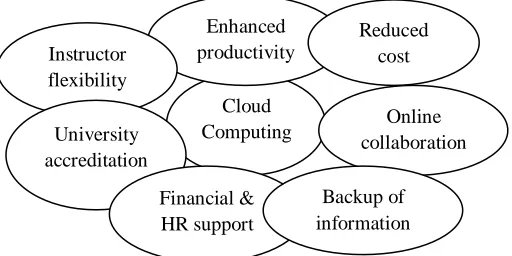
• Enhanced productivity and more efficient educational practices
• Reduced expenditures • Increase in collaborative work • Backup of information
• Support in financial and HR management • Fostering of university accreditation • Promoting instructor flexibility
7.1 Enhanced productivity and more efficient educational practices
One of the primary usages of the cloud is to integrate face-to-face/classroom training and online education with courses offered over the Internet.
7.2 Reduced expenditures
Rather than purchasing individual or institutional software licenses for a few computers, many higher education institutions generally pay for specific software packages to be used online from varied locations.
7.3 Increase in collaborative work
Students and faculty can retrieve information from their individual systems without the need of software or hardware resources. This synchronizing of cloud services enables task distribution, thereby increasing the information quality.
7.4 Backup of information
Cloud providers customarily store multiple copies of the same piece of information in numerous servers around the world. This redundancy ensures immediate access to files with back up safeguards.
7.5 Support in financial and HR management
In some institutions, faculty members can manage their income information online. Cloud services enhance the timely administration of employee-related information to relevant parties, thereby improving the institution’s effectiveness and management efficiency.
7.6 Fostering of university accreditation
Moreover, confidential evaluations such as entrance and placement examinations, student grades, and instructor academic performance surveys need to be communicated instantaneously to authorized users.
7.7 Promoting instructor flexibility
Cloud computing offers instructors the freedom to work outside the classroom. They can review curriculums, prescribe reading materials, administer coursework, and submit grades online; instructors can be more productive in completing the tasks at a time most convenient to them.
Figure 3. Usage of Cloud Computing in Academic Field
8. Areas in which cloud computing can have
an influence in education field:
The areas in which cloud computing can have an influence in education field are as follows:
TABLE 1: INFLUENCING AREAS OF CLOUD COMPUTING IN EDUCATION
Type Explanation
Interactive session
Centralized ability supported by local teachers. Student teacher interactions, sending lectures notes, presentations or answers to queries.
Teamwork
Students and teachers cooperating on projects by building and content distribution. Communication by sending messages or video.
Flexibility
Classrooms and labs can be extended with mobile devices such as smart phones, tablets and virtual desktop technologies to smooth distant access.
Simultaneous assessment
Teaching performance has to be improved based on the feedback of the students and content can be highlighted and updated through electronic media.
Cloud
Computing Online
collaboration Enhanced
productivity Instructor
flexibility
University accreditation
Financial & HR support
Backup of information
3273
9. Issues in Adhering Cloud Computing in the
Academic System
Some of the vital issues are as follows:
9.1 Data Security
To secure data in cloud is the top most concern in academic institutions. A reason for lack of data security is due to the drawbacks of efficient encryption algorithms. Another reason is residual data left behind which becomes accessible to unauthorized parties.
9.2 Privacy Issues
Education institutions face number of difficulties to secure the individual’s data, and the cloud model provides adequate protection of such information.
9.3 Internet Connection
Cloud Computing depends on the fast access of internet. When network bandwidth is inadequate then it is not possible to distribute intricate services.
9.4 Reliability
Reliability is another problem for institutions using the cloud. In failure events recovery plans must be taken accurately. Cloud Service Provider is to be chosen correctly.
10. Security Issues for adopting cloud in
academic field
Issues related to security are the first and foremost concern of every institution using cloud services. Academic institutions are entrusted with secret data. Cloud computing may be unsafe because we can’t safeguard its boundary. Educational institutions have to keenly observe regarding the cloud providers about safeguarding the sensitive data and ensure that the users don’t face any difficulties like data confidentiality, loss of data or data theft. Data integrity, privacy issues, authentication issue, data loss, user-level security and vendor-level security are basic concerns. These fundamental problems can be defined as cloud risks.
11. Cloud Risk Division
Cloud risks have been the biggest concern since the start of the cloud computing era.
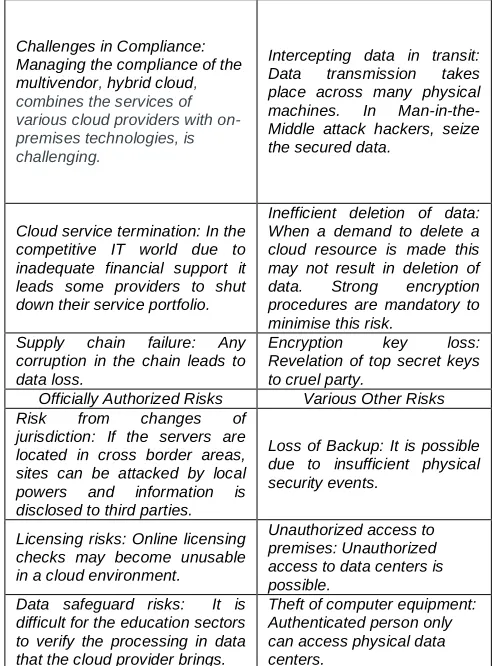
TABLE 2. CLOUD RISK DIVISION
Policy and Organizational Risks Technological Risks
Vendor Lock-in: The situation where the educational institutions are depending on one cloud provider it is called as vendor lock-in problem.
Separation failure: In distributed architecture environment there is sharing of computing resources. This multi-tenancy causes risks. Governance loss: Outsourcing
the services to unauthorized parties leads to the loss of governance.
Resource exhaustions: Insufficient resource may lead to service unavailability problem.
Challenges in Compliance: Managing the compliance of the multivendor, hybrid cloud, combines the services of various cloud providers with on-premises technologies, is challenging.
Intercepting data in transit: Data transmission takes place across many physical machines. In Man-in-the-Middle attack hackers, seize the secured data.
Cloud service termination: In the competitive IT world due to inadequate financial support it leads some providers to shut down their service portfolio.
Inefficient deletion of data: When a demand to delete a cloud resource is made this may not result in deletion of data. Strong encryption procedures are mandatory to minimise this risk.
Supply chain failure: Any corruption in the chain leads to data loss.
Encryption key loss: Revelation of top secret keys to cruel party.
Officially Authorized Risks Various Other Risks Risk from changes of
jurisdiction: If the servers are located in cross border areas, sites can be attacked by local powers and information is disclosed to third parties.
Loss of Backup: It is possible due to insufficient physical security events.
Licensing risks: Online licensing checks may become unusable in a cloud environment.
Unauthorized access to premises: Unauthorized access to data centers is possible.
Data safeguard risks: It is difficult for the education sectors to verify the processing in data that the cloud provider brings.
Theft of computer equipment: Authenticated person only can access physical data centers.
12. Security Management in Cloud
The scope of the security management is to guard the institution from all sorts of threats. The security principle specifies that personal data of faculty, staff and students is protected by sensible protection safeguards against risks like confidentiality, thrashing, deletion, utilization, changes or revelation of data. When the data is stored in cloud environment multiple tenants are sharing single location, so one user’s data is stored with another user’s data, which effects difficulty in data segregation. To segregate the data KNN techniques must be followed. The users should be aware of proper encryption systems to ensure that data in the cloud is appropriately protected.
13. Challenges faced by the Education
Sectors in Developing Countries
3274 has led to layoffs of teaching staff to unimaginable levels.
Teachers and educational institutions are using the traditional teaching methods hence the adoption of new technologies has been slow.
14. Cloud Solves Educational Challenges
The ability of a cloud system to adapt to workload changes and the on-demand offerings make a best fit to address the recent features in education institutions. Higher learning institutions promote an exclusive society to enhance team work across stakeholders located in physically distributed areas. If resources are distributed among education institutions, then there is a great chance that the academic institutions can have better concentration on research and core academic activities. The new learning environment uses innovative technologies and latest teaching tools. Virtual classrooms have become dominant in most of the academic institutions which helps in improving the learning process with experimental experiences.15. Conclusion
Population is growing immensely. So there will be lack of skilled and experienced teachers. From our research study we identified, cloud computing has remarkable relevance in India when it is properly implemented in education sector. Adequate training towards the use of applications of latest teaching methods is necessary so that educators can use the latest cloud computing education technologies. Cloud infrastructure has emerged recently for managing and delivering utilities over the internet. By choosing best service provider, security can be effectively managed in educational cloud. In future mobile technology can be used to get feedback from students in education institutions to improve the learning experience.
References
[1] Abdul Rahman, Shahzad Sarfraz, Umar Shoaib, Ghulam Abbas and Muhammad Atif Sattar (December 2016) Cloud based E-Learning, Security Threats and Security Measures. Indian Journal of Science and Technology. Vol. 9, No. 48, DOI: 10.17485/ijst/2016/v9i48/96166.
[2] Abusfian Elgelany, Weam Gaoud Alghabban (January 2017) Cloud Computing: Empirical Studies in Higher Education A Literature Review. International Journal of Advanced Computer Science and Applications. Vol. 8, No. 10, 2017, pp 121-127.
[3] Aishwarya Srinivasan, Abdul Quadir Md, Vijayakumar.V (2015) Hybrid Cloud for Educational Sector.
[4] 2nd International Symposium on Big Data and Cloud Computing (ISBCC’15) Procedia Computer Science 50, pp 37 – 41.
[5] Amitava Ghosh, Abhishek Chakraborty, Sourav Saha, Ambuj Mahanti (July 2012) Cloud Computing in Indian Higher Education. SAGE Publications. Vol. 1, No. 2, pp 85-95. DOI : 10.1177/2277975213477271
[6] Amol Kale, Rajivkumar Mente (November 2017) Impact of Cloud Computing on Education System. International Journal of Electronics, Electrical and Computational System. Vol. 6, No. 11, pp 139-144.
[7] Anjali Jain, U.S Pandey (July 2013) Role of Cloud Computing in Higher Education.
a. International Journal of Advanced Research in Computer Science and Software Engineering. Vol. 3, Issue 7, July 2013, pp. 966-972.
[8] Aruna.R, Prakasam.S (December 2013) Enhancing Cloud based E- Learning using Knowledge Sharing System. International Journal of Computer Applications (0975 – 8887). Vol. 84, No. 9, pp 26-30.
[9] Asgarali Bouyer, Bahman Arasteh (October 2014) The Necessity of Using Cloud Computing in Educational System. Procedia – Social and Behavioral Sciences 143 (2014) pp 581-585.
Available at
https://cyberleninka.org/article/n/151177/viewer
[10]Atif Ishaq, Muhammad Nawaz Brohi (Dec 2015) Cloud Computing in Education Sector with security and Privacy Issue: A Proposed Framework. International Journal of Advances in Engineering & Technology (IJAET). Vol. 8, Issue 6, pp 889-898. [11]Ayman E. Khedr, Dr. S. A. Kholeif, Shrouk H.
Hessen (April 2015) Enhanced Cloud Computing Framework to Improve the Educational Process in Higher Education: A case study of Helwan University in Egypt. International Journal of Computers & Technology. Vol. 14, No. 6, pp 5814-5823.
[12]Ayush Gaur, Manoj Manuja (March 2014) Implementation framework for Cloud based Education-as-a-service. In 2014 IEEE International Conference on MOOC, Innovation and Technology in Education (MITE). ISBN NO:
978-1-4799-6876-3. Available at
https://ieeexplore.ieee.org/stamp/stamp.jsp?tp=&ar number=7020241
[13]Bo Wang, HongYu Xing (August 2011) The Application of Cloud Computing in Education Informatization. In 2011 International Conference on Computer Science and Service System (CSSS). ISBN NO: 978-1-4244-9763-8.
[14]Chetan Bulla, Basavaraj Hunshal, Sankalp Mehta (July 2016) Adoption of Cloud Computing in Education System: A Survey. International Journal of Engineering Science and Computing. Vol. 6, No. 6, pp 6375-6380.
[15]Deka Ganesh Chandra, Dutta Borah Malaya (March 2012) Role of Cloud Computing in Education. In 2012 International Conference on Computing, Electronics and Electrical Technologies [ICCEET]. ISBN NO:
978-1-4673-0210-4. Available at
https://ieeexplore.ieee.org/stamp/stamp.jsp?arnum ber=6203884
[16]Divya.P, Prakasam.S (June 2015) Effectiveness of Cloud based E-Learning System (ECBELS). International Journal of Computer Applications. Vol. 119, No. 6, pp 29-36.
3275 [18]Fahad A. Alghamdi (January 2018) An Integrated
Cloud model for intelligent E-Learning system. International Journal of Applied Engineering Research. Vol. 13, No. 14, pp 11484-11490. [19]Faisal A. Alshuwaier, Abdullah A. Alshwaier, Ali M.
Areshey (August 2012) Applications of Cloud Computing in Education. In 2012 8th International Conference on Computing and Networking Technology (INC, ICCIS and ICMIC). Available at
https://ieeexplore.ieee.org/stamp/stamp.jsp?tp=&ar number=6418342
[20]Geethamani.G.S, Ranjani.S (February 2018) Preserving Privacy In Public Auditing For Data Storage Security In Cloud Computing. International Journal of Scientific Research in Computer Science, Engineering and Information Technology. Vol. 3, No. 1, pp 1757-1762.
[21]Gomita, Tanuj Manglani (August 2017) Role of Cloud Computing in Modern Education System.
a. International Journal of Engineering Trends and Technology (IJETT). Vol. 50, No. 3, pp 180-183.
[22]Gunasekar Kumar, Anirudh Chelikani (2011) Analysis of Security Issues in Cloud-Based E-Learning.
a. University of Borus. Available at
https://hb.diva-portal.org/smash/get/diva2:1312802/FULL TEXT01
[23]Harsimran Singh Anand, Kamayani (June 2015) Scope of Cloud Computing in Education Sector: A Review. International Journal of Recent Research Aspects. Vol. 2, No. 2, pp 150-152.
[24]Homa Hamidi and Saeed Rouhani (April 2018) The Effects of Cloud Computing Technology on E-Learning: Empirical Study. Robotics & Automation Engineering Journal. Vol. 2, No. 5. Available at
https://pdfs.semanticscholar.org/8756/326cbe7d89 48ddf744fc7e43822323443d6d.pdf
[25]Hongyu Pei Breivold and Ivica Crnkovic (April 2014) Cloud Computing Education Strategies.
a. In Proceedings of 2014 IEEE CSEE&T.
Available at
https://ieeexplore.ieee.org/stamp/stamp.js p?tp=&arnumber=6816778
[26]Hyeong-Jin Kim, Hyeong-Il Kim, Jae-Woo Chang (June 2017)
a. A Privacy-Preserving kNN Classification Algorithm using Yao’s garbled circuit on Cloud Computing.
b. In proceedings of 2017 IEEE 10th International Conference on Cloud Computing (CLOUD). DOI: 10.1109/CLOUD.2017.110.
[27]Ibtissam M rhaoaurh, Chafik Okar, Abdelwahed Namir and Nadia Chafiq (December 2018) Challenges of cloud computing use: A systematic literature review. In proceedings of MATEC Web of Conferences 200, 00007 (2018). Available at
https://pdfs.semanticscholar.org/edf8/1ba16995374 6e7bc523e9e555df1c9a08d93.pdf
[28]Jakia Sultana, Md. Fahami Ahsan Mazmum, Nymatul Jannat Nipa (May 2017)
a. Factors Affecting Cloud Computing Adoption in Higher - Education in Bangladesh: A Case of University of Dhaka. Applied and Computational Mathematics. Vol. 6, No. 3, pp 129-136. [29]Jenny Wang (July 2017) Cloud Computing
Technologies in Writing Class: Factors Influencing Students’ Learning Experience. Turkish Online Journal of Distance Education-TOJDE. ISSN 1302-6488 Vol. 18, No 3. Available at
https://files.eric.ed.gov/fulltext/EJ1147704.pdf
[30]Jolly Upadhyaya, Neelu Jyothi Ahuja, Kapil Dev Sharma (January 2019) Evaluating User Expectations and Quality of service: A Novel Approach to Understanding Cloud Services. International Journal of Recent Technology and Engineering. Vol. 7, No. 5S2, pp 381-385.
[31]Kamal Kant Hiran, Anders Henten, Mahendra Kumar Shrivas, Ruchi Doshi (October 2018) Hybrid EduCloud Model in Higher Education: The case of Sub-Saharan Africa, Ethiopia. In proceedings of 2018 IEEE 7th International Conference on Adaptive Science & Technology (ICAST). Available at
https://ieeexplore.ieee.org/stamp/stamp.jsp?tp=&ar number=8507113
[32]Khalil H. A. Al-Shqeerat, Faiz M.A. AI-Shrouf, Mohammad R. Hassan, Hassen Fajraoui (March 2017) Cloud Computing Security Challenges in Higher Educational Institutes – A Survey. International Journal of Computer Applications. Vol. 161, No. 6, pp 22-29.
[33]Kiran Yadav (February 2014) Role of Cloud Computing in Education. International Journal of Innovative Research in Computer and Communication Engineering. Vol. 2, No. 2, pp 3108-3112.
[34]Krelja Kurelović.E, Rako.S, Tomljanović.J (May 2013) Cloud Computing in Education and Student’s Needs. MIPRO 2013, May 20-24, 2013, Opatija, Croatia, Proceedings of the International
Convention. Available at
https://ieeexplore.ieee.org/stamp/stamp.jsp?tp=&ar number=6596352
[35]Lovedeep Saini, Jyoti, Harpreet kaur.Er (May 2017) Role of Cloud Computing in Education System.
a. International Journal of Advanced Research in Computer Science. Vol. 8, No. 4, pp 345-347.
[36]Maria Teresa Baldassarre, Danilo Caivano, Giovanni Dimauro, Enrica Gentile, and Giuseppe Visaggio (February 2018) Cloud Computing for Education: A Systematic Mapping Study. IEEE Transactions on Education. Available at https://sci-hub.tw/10.1109/te.2018.2796558
3276 [38]Maroof Naieem Qadri, S M K Quadri (June 2018)
Mapping Cloud-based Facilities for Academic Use. International Journal of Distributed and Cloud Computing. Vol. 6, Issue 1, June 2018, pp 19-28. [39]Md Aminur Islam, Faisal Bin Abul Kasem,
Shakib-Uz-Zaman Khan, Md. Tarek Habib, Farruk Ahmed (October 2017) Cloud Computing in Education: Potentials and Challenges for Bangladesh. Vol. 7, No. 5, pp 11-21. International Journal of Computer Science, Engineering and Applications.
[40]Mohammed Ali (November 2018) The Barriers and Enablers of the Educational Cloud: A Doctoral Student Perspective. Open Journal of Business and Management. Available at
https://www.scirp.org/pdf/OJBM_20181116151511 41.pdf
[41]Mohammad Musudur Rahman, Adam Suhaimi, Asadullah Shah (November 2018) A Model of Factors Influencing Cloud Computing Adoption Among Faculty Members and Students of Higher Educational Institutions of Bangladesh. IEEE 5th International Conference on Engineering Technologies & Applied Sciences, 22 - 23 Nov 2018, Bangkok Thailand. ISBN NO: 978-1-5386-7966-1.
[42]Mohsen Attaran, Sharmin Attaran, Bilge Gokhan Celik (October 2017) Promises and Challenges of Cloud Computing in Higher Education: A practical guide for implementation. Vol. 17, No. 6, pp 20-38. [43]Mohssen M. Alabbadi (September 2011) Cloud Computing for Education and Learning: Education and Learning as a Service (ELaaS). In proceedings of 14th International Conference on Interactive Collaborative Learning (ICL2011). ISBN NO: 978
-1-4577-1747-5. Available at
http://citeseerx.ist.psu.edu/viewdoc/download?doi= 10.1.1.458.3925&rep=rep1&type=pdf
[44]Munwar Ali Zardari, Low Tang Jung, Nordin Zakaria (July 2014) K-NN Classifier for Data Confidentiality in Cloud Computing. In proceedings of International Conference on Computer and Information Sciences (ICCOINS). ISBN NO:
978-1-4799-0059-6.Available at
https://ieeexplore.ieee.org/stamp/stamp.jsp?tp=&ar number=6868432
[45]Neelakantan.P (February 2018) A Study on E-learning and Cloud Computing. International Journal of Scientific Research in Computer Science, Engineering and Information Technology. Vol. 3, No. 1, pp 1534-1539.
[46]Neeraj Harjani, Suren Sughand, Twinkle Motwani, Simran Dembla (December 2017) A Revolutionary Change in Education Sector: Cloud Computing. International Journal of Innovative Research in Computer and Communication Engineering. Vol. 5, No. 12, pp 17348-17354.
[47]Nitika Goyal, Deepam Goyal (May 2017) Cloud Computing in Educational Research. International Journal of Recent Engineering Research and Development. Vol. 1, No. 2.
[48]Odeh.M, Garcia-Perez.A & Warwick.K (December 2017) Cloud Computing Adoption at Higher Education Institutions in Developing Countries: A
Qualitative Investigation of Main Enablers and Barriers. International Journal of Information and Education Technology, Vol. 7, No. 12, pp 921-927. [49]Parves Kamal (February 2019) Security of Password Hashing in Cloud. Journal of Information Security. Vol. 10, No. 02, Article ID: 90861, 24 pages.
[50]Pradosh Chandra Patnaik, Saritha Putta, Md. Ismai (October 2014) Role of Cloud Computing to Overcome the Issues and Challenges in E-learning. Journal of Basic and Applied Engineering Research. Vol. 1, No. 7, pp 66-70.
[51]Pranay Kumar.B.V, Sumitha Kommareddy, Uma Rani.N (July 2013) Effective ways Cloud Computing can contribute to Education Success. Advanced Computing: An International Journal. Vol. 4, No. 4, pp 17-32.
[52]Pruthviraj S. Patel, Kailas Patidar, Manoj Yadav, Rishi (February 2018) A Result Paper on Outsourced Revocation of Encryption based on Identity in Cloud Computing. International Journal of Engineering Science and Computing. Vol. 8, No.2, pp 16078-16082.
[53]Rajamohan Parthasarathy, Haw Wai Yee, Seow Soon Loong, Leelavathi Rajamanickam, Preethy Ayyappan (April 2019) Implementation of RSA Algorithm to secure data in Cloud Computing.
International Journal of Innovative Science, Engineering & Technology. Vol. 6, No. 4, pp 61-68.
[54]Rajesh.M (October 2017) A systematic review of cloud security challenges in higher education. The Online Journal of Distance Education and e-Learning. Vol. 5, No. 4. Available at
http://tojdel.net/journals/tojdel/articles/v05i04/v05i0 4-01.pdf
[55]Rajinder Sandhu, Sandeep K. Sood (January 2015) A commercial, benefit driven and secure framework for e-learning in cloud computing. Wiley Periodicals. DOI 10.1002/cae.21621. Available at
https://sci-hub.tw/https://onlinelibrary.wiley.com/doi/pdf/10.10 02/cae.21621#accessDenialLayout
[56]Rajivkumar Mente, Amol Kale (November 2017) Cloud Computing and Its Effects in Various Fields. 12th International Conference on Recent Trends in Engineering, Science and Management (ICRTESM). ISBN:978-93-86171-79-5.Available at
http://data.conferenceworld.in/IETE12/41.pdf
[57]Rania Almajalid (October 2018) A Survey on the Adoption of Cloud Computing in Education Sector.
a. ResearchGate Publications.
[58]Rehana Parveen and Emna Chikhaoui (February 2018) Legal issues and challenges in educational cloud computing in the kingdom of Saudi Arabia. International Journal of Economic Research. Vol. 14, No. 20, pp 357-371.
3277 a. Cloud Computing Adoption Model for
Universities to increase ICT proficiency.
SAGE Publications. DOI:
10.1177/2158244014546461.
https://journals.sagepub.com/doi/pdf/10.11 77/2158244014546461
[61]Saju Mathew (June 2012) Implementation of Cloud Computing in Education – A Revolution. International Journal of Computer Theory and Engineering. Vol. 4, No. 3, pp 473-475.
[62]Samiya Khan, Kashish A. Shakil, Mansaf Alam (December 2016) Educational Intelligence: Applying Cloud-based Big Data Analytics to the Indian Education Sector. In proceedings of 2016 IEEE 2nd International Conference on Contemporary Computing and Informatics (IC3I). ISBN NO:
978-1-5090-5256-1. Available at
https://ieeexplore.ieee.org/stamp/stamp.jsp?tp=&ar number=7917930
[63]Sanasam Bimol, Laithangbam Pushparani Devi, Masih Saikia (June 2014) Achieving Knowledge Management Through Cloud Computing A Case in Higher Education. In proceedings of 2014 International Conference on Computing for Sustainable Global Development (INDIACom).ISBN NO: 978-93-80544-12-0.
Available at
https://sci-hub.tw/https://ieeexplore.ieee.org/document/68281 32/authors#authors
[64]Shadi R.Masadeh, Jamal S.Zraqou, Moutaz Alazab (March 2018) A Novel Authentication and Authorization model based on multiple encryption techniques for adopting secure e-learning system. Journal of Theoretical & Applied Information Technology. Vol. 96, No. 6, pp 1529-1533.
[65]Shahid Ramzan and Dr.Mohd Irfan (July 2016) Cloud Computing and Education- A Technical Review.
a. Journal of Computer Science and Engineering. Vol. 2, No. 7.
[66]Siti Salmah Md Kassim, Mazleena Salleh, Anazida Zainal, Ab. Razak Che Husin (March 2017) Risk tolerance and trust issues in cloud-based E-learning. In proceedings of the 2017 ACM Second International Conference on Internet of things, Data
and Cloud Computing. DOI:
10.1145/3018896.3018973.
[67]Srinivas Reddy.G (April 2013) Security Issues and Threats in Educational Clouds of E-Learning: A review on Security Measures. International Journal of Computer Technology & Applications. Vol. 4, No. 2, pp 312-316.
[68]Stanka Hadzhikoleva, Stoyan Cheresharov, Lambri Yovkov, Emil Hadzhikolev (February 2018) Towards Building Cloud Education Networks. TEM Journal. Vol. 7, No. 1, pp 219-224. Available at
http://www.temjournal.com/content/71/TemJournal February2018_219_224.pdf
[69]Steve Jones, Zahir Irani, Uthayasankar Sivarajah, Peter E. D. Love (April 2017) Risks and rewards of cloud computing in the UK public sector: A reflection on three Organisational case studies. Information Systems Frontiers (2019) 21:359–382.
DOI: 10.1007/s10796-017-9756-0. A Journal of Research and Innovation. Springer International
Publishing. Available at
https://link.springer.com/content/pdf/10.1007%2Fs 10796-017-9756-0.pdf
[70]Subrahmanya Sarma.M, Dr.Srinivas.Y, Abhiram.M, Sahithi Prasanthi.M, Lalitha Ramya M.S. (January 2018) KNN File Classification for Securing Cloud Infrastructure. In the proceedings of 2017 2nd IEEE International Conference on Recent Trends in Electronics Information & Communication Technology. ISBN NO: 978-1-5090-3704-9. [71]Tajinder Singh Sahdev,Murali Krishna
Medudula,Mahim Sagar (August 2014) An Analysis of Barriers for the Adoption of Cloud Computing in Education Sector. SAGE Publications. Vol. 39, No. 3, pp 249-274.
[72]Tanvi Desai, Ms.Ritika Patel, Mr.Pravin Patel (March 2016) Cloud Computing in Education Sector.
a. International Journal for Innovative Research in Science & Technology. Vol. 2, No. 10, pp 191-194.
[73]Tuncay Ercan (January 2010) Effective use of cloud computing in educational institutions. Procedia Social and Behavioral Sciences 2 (2010)
pp 938–942. Available at
https://www.sciencedirect.com/science/article/pii/S 1877042810001709
[74]Upendra Singh, Prashant Kumar Baheti (Nov 2017) Role and Service of Cloud Computing for Higher Education System. International Research Journal of Engineering and Technology. Vol. 4, No. 11, pp 708-711.
[75]Vaishali H Pardeshi (July 2014) Cloud Computing for Higher Education Institutes: Architecture, Strategy and Recommendations for Effective Adaptation. Procedia Economics and Finance, Vol. 11, pp 589 – 599. Available at
https://www.sciencedirect.com/science/article/pii/S 221256711400224X
[76]Visalakshi.M, Dr.Varalakshmi.R (2018) A way for effective learning: E-learning using the cloud computing technology. International Journal of Pure and Applied Mathematics. Vol. 119, No. 10, pp 87-91.
[77]Yousef A. M. Qasem, Rusli Abdullah, Yusmadi Yah Jusoh, Rodziah Atan and Shahla Asadi (May 2019). Cloud Computing Adoption in Higher Education Institutions: A Systematic Review. IEEE Access. Vol. 7, pp 63722-63744.
[78]Yusuf Haider.M, Siva Selvan (July 2016) Confidentiality Issues in Cloud Computing and Countermeasures: A Survey. In proceedings of National Conference on Emerging Computer Paradigms 2016, At NMAMIT.
[79]Zhen-Yu Wu (June 2019) A Secure and Efficient Digital-Data-Sharing System for Cloud Environments. Sensors (Basel, Switzerland). Vol. 19, No. 12: 2817. DOI: 10.3390/s19122817.
Available at
3278 [80] Zulqurnain Ali, Bi Gongbing, Aqsa