The Whole World in Your Hand:
Active and Interactive Segmentation
Artur Arsenio
∗Paul Fitzpatrick
∗Charles C. Kemp
∗Giorgio Metta
∗∗ 1∗
MIT AI Lab
Cambridge, Massachusetts, USA
∗∗
Lira Lab, DIST, University of Genova
Genova, Italy
Abstract
Object segmentation is a fundamental problem in computer vision and a powerful resource for development. This paper presents three embod-ied approaches to the visual segmentation of ob-jects. Each approach to segmentation is aided by the presence of a hand or arm in the prox-imity of the object to be segmented. The first approach is suitable for a robotic system, where the robot can use its arm to evoke object mo-tion. The second method operates on a wear-able system, viewing the world from a human’s perspective, with instrumentation to help detect and segment objects that are held in the wearer’s hand. The third method operates when observing a human teacher, locating periodic motion (fin-ger/arm/object waving or tapping) and using it as a seed for segmentation. We show that ob-ject segmentation can serve as a key resource for development by demonstrating methods that ex-ploit high-quality object segmentations to develop both low-level vision capabilities (specialized fea-ture detectors) and high-level vision capabilities (object recognition and localization).
1.
Introduction
Both the machine vision community and cognitive science researchers recognize objects as a power-ful abstraction for intelligent systems. Likewise, those who study cognitive development have a long history of analyzing the detailed maturation of object related competencies in infants and chil-dren. But despite the acknowledged importance of objects to human cognition and visual percep-tion, our robots continue to be challenged by the
everyday objects that surround them.
Funda-mentally, robots must be able to perceive objects in order to learn about them, manipulate them, and develop the important set of intellectual ca-pabilities that rely on them. In this paper, we demonstrate three embodied methods that allow
1authors ordered alphabetically
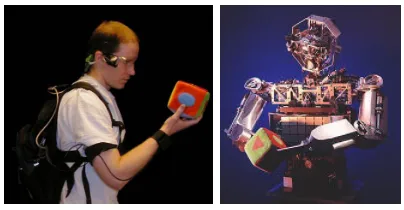
Figure 1: The platforms.
machines to visually perceive the extent of ma-nipulable objects. Furthermore, we show that the object segmentations that result from these meth-ods can serve as a powerful foundation for the development of more general object perception.
(i)Active segmentation for a robot viewing its own actions. A robot arm probes an area, seeking to trigger object motion so that the robot can identify the boundaries of the object through that motion.
(ii)Active segmentation for a wearable system
viewing its wearer’s actions. The system moni-tors human action, issues requests, and uses ac-tive sensing to detect grasped objects held up to view.
(iii) Demonstration-based segmentation for a robot viewing a human’s actions. Segmentation is achieved by detecting and interpreting natural human showing behavior such as finger tapping, arm waving, or object shaking.
Our second argument is that visual object seg-mentation can serve as a powerful foundation for the development of useful object related compe-tencies in epigenetic systems. We support this by demonstrating that when segmentation is avail-able, several other important vision problems can be dealt with successfully – object recognition, object localization, edge detection, etc.
2.
Object perception
What our retinas register when we look at the
world and what we actually believe weseeare
no-toriously different (Johnson, 2002). How does the brain make the leap from sensing photons to ceiving objects? The development of object per-ception in human infants is an active and impor-tant area of research (Johnson, 2003). A central question is that of segmentation or ‘object unity’ – how a particular collection of surface fragments become bound into a single object representation. In our work we focus on identifying or engineer-ing special situations when object unity is simple to achive, and show how to exploit such situa-tions as opportunities for development, so that object unity judgements can be made in novel sit-uations. There is evidence that a similar process occurs in infants. Spelke and others have shown that the coherent motion of an object is a cue that young infants can use to unite surface frag-ments into a single object (Jusczyk et al., 1999). Needham gives evidence that even a brief expo-sure to independent motion of two objects can influence an infant’s perception of object bound-aries in later presentations (Needham, 2001). The ability to achieve object unity does not appear fully-formed in the neonate, but develops over time (Johnson, 2002). In this paper, we explore analogues of this developmental step, and demon-strate that the ability to perceive the boundaries of objects in special, constrained situations can in
fact be automatically generalized to other situa-tions. Elsewhere, we have used this ability as the basis for learning about and exploiting an object affordance (Metta and Fitzpatrick, 2003), and to learn about activities by tracking actions taken on familiar objects (Fitzpatrick, 2003).
Switching our attention from theoretical to practical considerations, decades of experience in computer vision have shown that object segmen-tation on unstructured, non-static, noisy and low resolution images is a hard problem. The tech-niques this paper describes for object segmenta-tion deal with different combinasegmenta-tions of the fol-lowing situations, many of which are classically challenging:
. Segmentation of an object with colors or
tex-tures that are similar to the background.
. Segmentation of an object among multiple
moving objects in a scene.
. Segmentation of fixed or heavy objects in a
scene, such as a table or a sofa.
. Segmentation of objects printed or drawn in
a book or in a frame, which cannot be moved relative to other objects on the same page.
. Insensitivity to luminosity variations.
. Fast operation (near real-time).
. Low resolution images.
The next three sections document three basic active and interactive approaches to segmenta-tion, and then the remainder of the paper shows how to use object segmentation to develop ob-ject localization, recognition, and other percep-tual abilities.
3.
Segmentation on a robot
(a) (b) (c)
Figure 2: Cartoon motivation for active segmentation. Hu-man vision is excellent at figure/ground separation (top left), but machine vision is not (center). Coherent motion is a powerful cue (right) and the robot can invoke it by simply reaching out and poking around.
Aligned motion from before impact Motion in frame immediately after impact
Final segmentation Masking out
prior motion Moment of
impact
Figure 3: This images show the processing steps involved in poking. The moment of impact between the robot arm and an object, if it occurs, is easily detected – and then the total motion after contact, when compared to the motion before contact and grouped using a minimum cut approach (Boykov and Kolmogorov, 2001) gives a very good indication of the object boundary.
Object segmentation is a first step in this pro-gression. To enable it, Cog was given a simple “poking” behavior, whereby it selects locations in its environment, and sweeps through them with its arm (Metta and Fitzpatrick, 2003). If an ob-ject is within the area swept, then the motion gen-erated by the impact of the arm with that object greatly simplifies segmenting that object from its background, and obtaining a reasonable estimate of its boundary (see Figure 3). The image pro-cessing involved relies only on the ability to fixate the robot’s gaze in the direction of its arm. This coordination can be achieved either as a hard-wired primitive or through learning. Within this context, it is possible to collect good views of the objects the robot pokes, and the robot’s own arm.
This choice of activity has many benefits. (i)
The motion generated by the impact of the arm with a rigid object greatly simplifies segmenting that object from its background, and obtaining a reasonable estimate of its boundary (see
Fig-ure 3). (ii) The poking activity also leads to
object-specific consequences, since different ob-jects respond to poking in different ways. For ex-ample, a toy car will tend to roll forward, while a
bottle will roll along its side. (iii)The basic
oper-ation involved, striking objects, can be performed by either the robot or its human companion, cre-ating a controlled point of comparison between robot and human action.
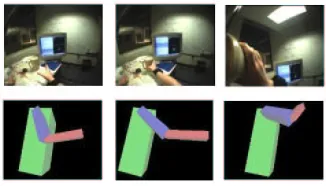
Figure 4: The wearable system monitors the wearer’s point of view (top row) while simultaneously tracking the wearer’s arm (bottom row).
Figure 5: The wearable system currently achieves segmen-tation by active sensing. When the wearer brings an ob-ject up into view (first column), an oscillating light source is activated (second column). The difference between images (third column) is used to compute a mask (fourth column) and segment out the grasped object and the hand from the background via a simple threshold.(fifth column).
4.
Segmentation on a wearable
Wearable computing systems have the potential to measure most of the sensory input and physi-cal output of a person as he or she goes through everyday activities. A wearable system that con-trols a human’s actions while making these mea-surements could take advantage of the wearer’s embodiment and expertise in order to develop more sophisticated perceptual processing.
One of the authors is designing a system named Duo that consists of a wearable creature and a cooperative human (Kemp, 2002). The wearable component of Duo serves as a high-level controller that requests actions from the human through speech, while the human serves as an innate and highly sophisticated infrastructure for Duo. From a developmental perspective the human is analo-gous to a very sophisticated set of innate abilities that Duo can use to bootstrap development. In order for Duo to take full advantage of these abil-ities, Duo must learn to better interpret human actions and their consequences, and learn to ap-propriately request human actions.
cam-0 10 20 30 40 50 60
15 91317 21252933 374145 49535761
x Finger position y finger position
Periodogram of FFTs of oscillating points (x)
0 0.01 0.02 0.03 0.04 0.05 0.06 0.07 0.08 0.09
1 5 9 13 17 21 25 29 33 37 41 45 49 53 57 61
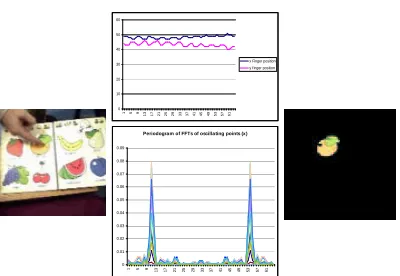
Figure 6: Segmentation based on finger tapping (left). This periodic motion can be detected through a windowed FFT on the trajectory of points tracked using optic flow, and the points implicated in the motion used to seed a color segmen-tation. The segmentation is applied to a frame with the hand absent, grabbed when there is no motion.
era help Duo to view the workspace of the domi-nant arm. The 4 absolute orientation sensors are affixed to the lower arm, upper arm, torso and head of the human, so that Duo may estimate the kinematic configuration of the person’s head and dominant arm. The wearable system makes spoken requests through the headphones and uses the LED array to aid vision (see Figure 4).
Currently, when Duo detects that the arm has reached for an object and picked the object up, Duo asks to see the object better. When a coop-erative person brings the object close to his head for inspection, Duo recognizes the proximity of the object using the arm kinematics, and turns on a flashing array of white LEDs. The illumina-tion clearly differentiates between foreground and background since illumination rapidly declines as a function of depth. By simply subtracting the illuminated and non-illuminated images from one another and applying a constant threshold, Duo is able to segment the object of interest and the hand (see Figure 5). While the human is holding the object close to the head, Duo kinematically monitors head motion and requests that the per-son keep his head still if the motion goes above a threshold. Minimizing head motion improves the success of the simple segmentation algorithm and reduces the need for motion compensation prior to subtracting the images.
5.
Segmentation by demonstration
The two segmentation scenarios described so far operate on first-person perspectives of the world – the robot watching its own motion, or a wear-able watching its wearer’s motion. Now we
de-Figure 7: Periodic motion can also be used to segment an object held by the teacher, if they shake it.
velop a method that is suitable for segmenting objects based on external cues. We assume the presence of a cooperative human or “teacher” who is willing to present objects according to a proto-col based on periodic motion – waving the object, tapping it with one’s finger, etc. (Arsenio, 2002).
5.1 Periodicity detection
For events created by human teachers, such as tapping an object or waving their hand in front of the robot, the periodic motion can be used to help segment it. Such events are detected through two measurements: a motion mask derived by comparing successive images from the camera and placing a non-convex polygon around any motion found, and a skin-tone mask derived by a simple skin color detector. A grid of points are initial-ized and tracked in the moving region. Tracking is implemented through the computation of the optical flow using the Lucas-Kanade pyramidal algorithm. Their trajectory is evaluated using a windowed FFT (WFFT), with the window size on the order of 2 seconds. If a strong periodicity is found, the points implicated are used as seeds for color segmentation. Otherwise the window size is halved and the procedure is tried again for each half. A periodogram is determined for all signals from the energy of the WFFTs over the spectrum of frequencies. These periodograms are then pro-cessed to determine whether they are usable for
segmentation. A periodogram is rejected if one
5.2 Waving the hand/arm/finger
This method has the potential to segment ob-jects that cannot be moved independently, such as objects painted in a book (see Figure 6), or heavy, stationary objects such as a table or sofa. Events of this nature are detected whenever the majority of the periodic signals arise from points whose color is consistent with skin-tone. The al-gorithm assumes that skin-tone points moving pe-riodically are probably projected points from the arm, hand and/or fingers. An affine flow-model is applied to the optical flow data at each frame, and used to determine the arm/hand/finger trajectory over the temporal sequence. Points from these trajectories are collected together, and mapped onto a reference image taken before the waving began (this image is continuously updated until motion is detected). A standard color segmen-tation (Comaniciu and Meer, 1997) algorithm is applied to this reference image, and points taken from waving are used to select and group a set of segmented regions into what is probably the full object. This is done by merging the regions of the color segmented image whose pixel values are close to the seed pixel values, and which are connected with the seed pixels.
5.3 Waving the object
Multiple moving objects create ambiguous
segmentations from motion, while difficult
figure/ground separation makes segmentation harder. The strategy described in this section filters out undesirable moving objects, while pro-viding the full object segmentation from motion. Whenever a teacher waves an object in front of the robot, or sets an oscillating object in motion, the periodic motion of the object is used to seg-ment it (see Figure 7). This technique is trig-gered whenever the majority of periodic points are generic in appearance, rather than drawn from the hand or finger. The set of periodic points tracked over time are sparse, and hence an algo-rithm is required to group then into a meaningful template of the object of interest. An affine flow model is estimated by a least squares minimiza-tion criterion from the optical flow data. The esti-mated model plus covariance matrices are used to recruit other points within the Mahalanobis dis-tance. Finally, a non-convex approximation algo-rithm is applied to all periodic, non skin-colored points to segment the object. Note that this ap-proach is robust to humans or other objects mov-ing in the background – they are ignored as long as their motion is non-periodic.
6.
Building on segmentation
We see object segmentation as the first step on a developmental trajectory towards a robust, well-adapted vision system. It is a key opportunity for many kinds of visual learning:
Learning about low-level features: The seg-mented views of objects can be pooled to train detectors for basic visual features – for example, edge orientation. Once an object boundary is known, the appearance of the edge between the object and the background can be sampled, and each sample labeled with the orientation of the boundary in its neighborhood.
Learning to recognize objects: High-quality segmented views of objects can serve as extremely useful training data for object detection and recognition systems, since they unambiguously label the visual features that are associated with
an object. Often these visual features can be
used to detect, track, and recognize the object in new contexts where the segmentation methods presented here are not applicable.
Learning about object behavior: Once
objects can be located and segmented
from the background, they can be tracked
to learn about their dynamic properties
(Metta and Fitzpatrick, 2003).
6.1 Learning about low-level features
Object segmentation identifies the boundaries
around an object. By examining the
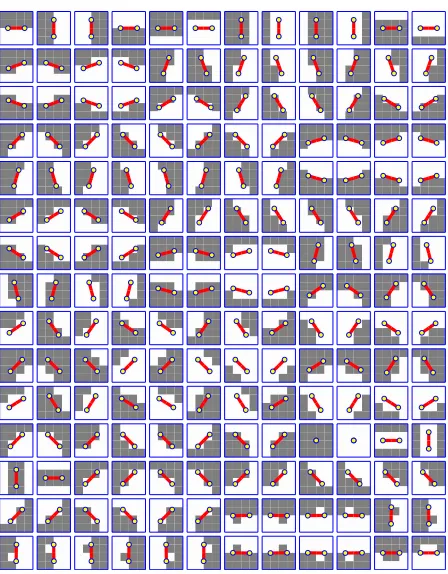
appear-ance of this boundary over many objects, it is possible to build up a model of the appearance
of edges. This is an empirically grounded
Figure 8: The empirical appearance of edges. Each 4×4
grid represents the possible appearance of an edge, quan-tized to just two luminance levels. The line centered in the grid is the average orientation that patch was observed on object boundaries during segmentation. Shown are the most frequent appearances observed in about 500 object segmen-tations.
6.2 Learning to recognize objects
With any of the active segmentation behaviors introduced here, the system can familiarize itself with the appearance of nearby objects in a spe-cial, constrained situation. It is then possible to learn to locate and recognize those objects when-ever they are present, even when the special cues used for active segmentation are not available. The segmented views can be grouped by their ap-pearance and used to train up an object recogni-tion module, which can then find them against background clutter (see Figure 9).
Object recognition is performed using geometric hashing (Wolfson and Rigoutsos, 1997), based on pairs of oriented regions found using the detector developed in Section 6.1. The orientation filter is applied to images, and a simple region growing algorithm divides the image into sets of contigu-ous pixels with coherent orientation. For realtime operation, adaptive thresholding on the minimum size of such regions is applied, so that the number of regions is bounded, independent of scene
com-model view
test image
oriented regions detected and grouped
best match without color
best match with color
Figure 9: A simple example of object localization: finding a circle buried inside a Mondrian. Given a model view (left) of the desired object free from any background clutter, a clut-tered view of the object (second from left) can be searched for the specific feature combinations seen in the model (cen-ter), and the target identified amidst the clutter (right). The features we used combined geometric and color information across pairs of oriented regions (Fitzpatrick, 2003).
plexity. In “model” (training) views, every pair of regions belonging to the object is considered ex-haustively, and entered into a hash table, indexed by relative angle, relative position, and the color at sample points between the regions (if inside the object boundary). When searching for the object, every pair of regions in the current view is compared with the hash table and matches are accumulated as evidence for the presence of the object. As a simple example of how this all works, consider the test case shown in Figure 9. The system is presented with a model view of the cir-cle, and the test image. For simplicity, the model view in this case is a centered view of the object by itself, so no segmentation is required. The pro-cessing on the model and test image is the same; first the orientation filter is applied, and then re-gions of coherent orientation are detected. For the circle, these regions will be small fragments around its perimeter. For the straight edges in the test image, these regions will be long. So find-ing the circle reduces to locatfind-ing a region where there are edge fragments at diverse angles to each other, and with the distance between them gen-erally large with respect to their own size. Even without using color, this is quite sufficient for a good localization in this case. The perimeter of the circle can be estimated by looking at the edges that contribute to the peak in match strength. The algorithm works equally well on an image of many circles with one square, and has been ap-plied to many kinds of objects (letters, compound geometric shapes, natural objects such as a bottle or toy car).
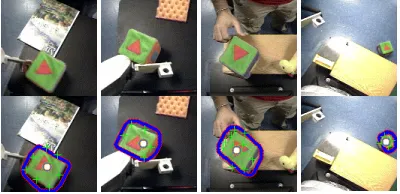
Figure 10: A cube being recognized, localized, and segmented in real images. The image in the first column is one taken when the robot Cog was poking an object, and was used (along with others) to train the recognition system. The image in the remain columns are test images. The border superimposed on the images in the bottom row represents the border of the object produced automatically. Note the scale and orientation invariance demonstrated in the final image.
of the object in the image to be recovered. Fig-ure 10 shows examples of an object (a cube) being located and segmented automatically, without us-ing any of the special segmentation contexts dis-cussed in this paper, except for initial training. Testing on a set of 400 images of four objects poked by the robot, with half the images used for training, and half for testing, gives a recogni-tion error rate of 2%, with a median localizarecogni-tion
error of 4.2 pixels in a 128×128 image (as
de-termined by comparing against the center of the segmented region given by active segmentation). By segmenting the image by grouping the regions implicated in locating the object, and filling in, a median of 83.5% of the object is recovered, and 14.5% of the background is mistakenly included (again, determined by comparison with the re-sults of active segmentation).
In geometric hashing, the procedure applied to an image at recognition time is essentially identi-cal to the procedure applied at training time. We can make use of that fact to integrate training into a fully online system, allowing behavior such as that shown in Figure 11, where a previously unknown object can be segmented through active segmentation and then immediately localized and recognized in future interaction.
6.3 Learning about object behavior
Once individual objects can be recognized, prop-erties that are more subtle than physical appear-ance can be learned and associated with that ob-ject. For a robot, the affordances offered by an object are important to know (Gibson, 1977). In previous work, Cog was given the ability to char-acterize the tendency of an object to roll when
1
2
3
Figure 11: This figure shows stills from a short interaction with Cog. The area highlighted with squares show the state of the robot – the left box gives the view from the robot’s camera, the right shows an image it associates with the cur-rent view. In the first frame, the robot is looking at a cube, which it does not recognize. It pokes the cube, segments it, and then it can recognize the cube in future (frame two) and distinguish it from other objects it has poked such as the ball (frame three).
struck, and was able to use that information to invoke rolling behavior in objects such as a toy car (Metta and Fitzpatrick, 2003).
7.
Discussion and conclusions
also showed that both higher level abilities such as recognition or lower level vision (edge orientation estimation) can benefit from this approach. In the future the developmental mechanism allowing the combination of these hypothetical building blocks into complex behaviors will be the subject of in-vestigation.
Acknowledgements
We would like to thank our anonymous review-ers for their very constructive feedback. Funds for this project were provided by DARPA as part of the “Natural Tasking of Robots Based on Hu-man Interaction Cues” project under contract number DABT 63-00-C-10102, and by the Nip-pon Telegraph and Telephone Corporation as part of the NTT/MIT Collaboration Agreement. Ar-tur Arsenio was supported by a Portuguese grant PRAXIS XXI BD/15851/98.
References
Arsenio, A. (2002). Boosting vision through
em-bodiment and situatedness. InMIT AI
Lab-oratory Research Abstracts.
Ballard, D. H. (1991). Animate vision.Artificial
Intelligence, 48(1):57–86.
Boykov, Y. and Kolmogorov, V. (2001). An ex-perimental comparison of min-cut/max-flow algorithms for energy minimization in vision. In Energy Minimization Methods in Com-puter Vision and Pattern Recognition, pages 359–374.
Comaniciu, D. and Meer, P. (1997). Robust
analysis of feature spaces: Color image
seg-mentation. In IEEE Conference on
Com-puter Vision and Pattern Recognition, San Juan, Puerto Rico.
Fitzpatrick, P. (2003). From First Contact to
Close Encounters: A developmentally deep perceptual system for a humanoid robot. PhD thesis, Massachusetts Institute of Technol-ogy, Department of Electrical Engineering Computer Science, Cambridge, MA.
Freeman, W. T. and Adelson, E. H. (1991). The
design and use of steerable filters. IEEE
Transactions on Pattern Analysis and Ma-chine Intelligence, 13(9):891–906.
Gibson, J. J. (1977). The theory of affordances.
In Shaw, R. and Bransford, J., (Eds.),
Per-ceiving, acting and knowing: toward an eco-logical psychology, pages 67–82. Hillsdale NJ: Lawrence Erlbaum Associates Publishers.
Johnson, S. P. (2002). Development of object perception. In Nadel, L. and Goldstone, R.,
(Eds.),Encyclopedia of cognitive science,
vol-ume 3, pages 392–399. Macmillan, London. Johnson, S. P. (2003). Theories of development
of the object concept. In Bremner, J. G. and
Slater, A. M., (Eds.), Theories of infant
de-velopment. Blackwell, Cambridge, MA. In press.
Jusczyk, P. W., Johnson, S. P., Spelke, E. S.,
and Kennedy, L. J. (1999). Synchronous
change and perception of object unity:
ev-idence from adults and infants. Cognition,
71:257–288.
Kemp, C. C. (2002). Humans as robots. InMIT
AI Laboratory Research Abstracts.
Marjanovi´c, M. J., Scassellati, B., and
Williamson, M. M. (1996). Self-taught
visually-guided pointing for a humanoid
robot. In From Animals to Animats:
Pro-ceedings of 1996 Society of Adaptive
Behav-ior, pages 35–44, Cape Cod, Massachusetts.
Metta, G. and Fitzpatrick, P. (2003). Better
vision through manipulation. Adaptive
Be-havior. In press.
Metta, G., Sandini, G., and Konczak, J. (1999). A developmental approach to visually-guided
reaching in artificial systems. Neural
Net-works, 12:1413–1427.
Needham, A. (2001). Object recognition and object segregation in 4.5-month-old infants.
Journal of Experimental Child Psychology, 78(1):3–22.
Perrett, D. I., Mistlin, A. J., Harries, M. H., and Chitty, A. J. (1990). Understanding the visual appearance and consequence of hand
action. In Vision and action: the control
of grasping, pages 163–180. Ablex, Norwood, NJ.
Sandini, G., Gandolfo, F., Grosso, E., and
Tistarelli, M. (1993). Vision during
ac-tion. In Aloimonos, Y., (Ed.), Active
Per-ception, pages 151–190. Lawrence Erlbaum Associates, Hillsdale, NJ.
Spelke, E. S. (2000). Core knowledge.American
Psychologist, 55:1233–1243.
Wolfson, H. and Rigoutsos, I. (1997). Geometric
hashing: an overview. IEEE Computational