Centre
of
Excellence
for
Nuclear
Materials
Workshop
Materials
Innovation
for
Nuclear Optimized
Systems
December 5-7, 2012, CEA – INSTN Saclay, France
Philippe MAGAUD et al.
CEA (France)
Plasma Facing Components: Challenges for
Nuclear Materials
Workshop organized by:
Christophe
GALLÉ,
CEA/MINOS,
Saclay
–
[email protected]
Constantin
MEIS,
CEA/INSTN,
Saclay
–
[email protected]
Workshop
Materials
Innovation
for
Nuclear
Optimized
Systems
December 5-7, 2012, CEA – INSTN Saclay, France
Plasma Facing Components: Challenges For Nuclear Materials
Philippe MAGAUD
1, Jérôme BUCALOSSI
1, Antonella LI PUMA
2, Marc MISSIRLIAN
1,
Marianne RICHOU
11
CEA-DSM-IRFM, Service Intégration Plasma-Paroi, SIPP (Cadarache, France)
2
CEA-DEN-DM2S, Service d’Etudes des Réacteurs et de Mathématiques Appliqués, SERMA (Saclay, France)
In current fusion devices, the components located in front of plasma, the so-called plasma facing components (PFCs), sustain severe constraints such as high thermal flux (several MW/m²), erosion, flux of particles. The management of this first material interface is critical from a plasma performance point of view. ITER, as nuclear facility, is initiating a new era for fusion, which will be reinforced for a future fusion power plant which will add specific requirements (sufficient lifetime, a cooling system to produce energy, use of low activation material) while increasing nuclear constraints.
The talk will recall in a first part the main requirements of an actively plasma facing components and the main results obtained with low-Z carbon based PFCs (mainly CFC). Experimental feedback from these challenging components is an essential step for the success of the next generation of components, in particular in term of manufacturing or handling intense heat loads.
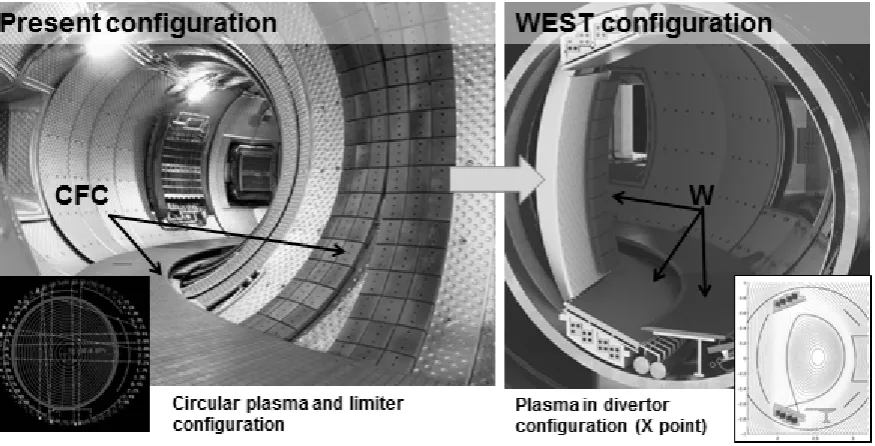
Nuclear safety requirements mainly drive the need of new materials for the nuclear phase of ITER. The tritium retention in carbon based PFCs and the strong erosion are expected to be too high in the Deuterium-Tritium phase with CFC targets, justifying the use of high-Z materials. The evolution toward high-Z materials, with tungsten the most promising, becomes a major challenge for fusion research. Large scale experiences with W have only been obtained recently with the operation of ASDEX-upgrade and JET tokamaks but with non-actively cooled PFCs. ASDEX-upgraded is equipped with W coated carbon PFCs while JET includes W coated carbon PFC and inertially cooled solid W, using in all cases a technology not relevant for ITER. Extensive R&D programmes have been performed in Europe to develop reliable actively PFCs for ITER [1-5]. The state of the art will be presented including specific devices needed to fully qualify, at laboratory scale, designs foreseen for ITER. In order to reduce the risks and anticipate any difficulties ITER may face in terms of manufacturing or operation, it is proposed to update Tore Supra with a full W first wall and divertor, benefitting from the unique long pulse capabilities of the Tore Supra platform, the high installed power and the long history of operation with actively cooled high heat flux components [6]. The main goals of the ‘WEST’ project (W - for tungsten -Environment in Steady-state Tokamak, figure 1) will be presented.
The talk will also address acknowledged gaps in PFCs developments for DEMO, which require extensive studies in different topics, from plasma-surface interaction to engineering including material sciences. Further challenges address simultaneously the higher power density, high-temperature wall, bulk (neutron) and surface (charged particle) accumulated damage. The high neutron fluence expected in a fusion reactor (more than10 dpa/year) will affect erosion and tritium retention properties of materials. Near-surface material properties will be for instance altered by the neutron damage. Such synergistic effects are expected to be important in the DEMO environment and are difficult to be addressed experimentally. A more robust coupling of materials development, including fundamentally studies, with advanced design is required. If tungsten is the most promising material for the plasma-facing, tungsten also offers less favorable properties (recrystallization, which influences the mechanical properties, embrittlement as a result of neutron-induced damages, He-induced sputtering…) that have to be resolved. Only a global approach, including fundamental science, material development, joining/welding techniques, design innovation and a close link with plasma physics is able to reach the necessary level of credibility for operating such components in a fusion environment in an economically reasonable way.
EPJ Web of Conferences 51, 04005 (2013) DOI: 10.1051/epjconf/20135104005
© Owned by the authors, published by EDP Sciences, 2013
Workshop
Materials
Innovation
for
Nuclear
Optimized
Systems
December 5-7, 2012, CEA – INSTN Saclay, France
Fig. 1: The ‘WEST’ project is a major update of Tore Supra to address the issues related to tokamak operation with W actively cooled ITER relevant PFCs. Internal components, presently
in CFC will be updated to W components (ITER technology) and the magnetic plasma configuration (presently circular) will be changed to X-point configuration by installing a set
of poloidal coils inside the lower and upper parts of the vacuum vessel.
References
[1] - M. Missirlian, M. Richou, B. Riccardi, P. Gavila, T. Loarer and S. Constans, The Heat removal capability of actively cooled plasma-facing components for ITER divertor. Physica Scripta, T145 (2011).
[2] - M. Richou, M. Missirlian, B. Riccardi,, P. Gavila, C. Desgranges, N. Vignal, V. Cantone and S. Constans, Fatigue lifetime of repaired high heat flux components for ITER divertor. Fusion Engineering and Design 86 (2011) pp. 1771-1775.
[3] - M. Missirlian, F. Escourbiac, A. Schmidt, B. Riccardi and I. Bobin-Vastra, Examination of high heat flux components for the ITER divertor after thermal fatigue testing. Journal of Nuclear Materials 417 (2011) pp. 597-601.
[4] - D. Serret, M. Richou, M. Missirlian and T. Loarer, Mechanical characterization of W-armoured plasma-facing components after thermal fatigue. Physica Scripta, T145 (2011).
[5] - A. Durocher et al., Infrared thermography inspection of the ITER vertical target qualification prototypes manufactured by European industry using SATIR. Fusion Engineering and Design 84 (2009) 314-318.
Institut de Recherche sur la Fusion par confinement Magnétique (IRFM) CEA Cadarache
13 108 St Paul Lez Durance
MINOS workshop (Saclay, 5-7 december 2012)
Plasma facing components:
challenges for nuclear materials
Ph. Magaud
1
, J. Bucalossi
1
, A. Li Puma
2
,
M. Missirlian
1
, M. Richou
1
1
CEA/IRFM (CADARACHE, FRANCE),
CONTENTS
Fusion basics
From present Plasma Facing Components (PFC)…
.. to PFC for ITER
Toward a fusion reactor
ENERGY FROM NUCLEUS
| PAGE 3 CEA/IRFM | MINOS workshop 5-7 december 2012
B(A,Z) / A
Binding
energy
by nucleon (MeV / nucleon)
Nb of
nucleons (A)
0 1 2 3 4 5 6 7 8 90 50 100 150 200 250
Stable elements
Fe U D T He C ONe Li BeFISSION
Ex : D + T
He + n
(3.6 MeV) + (14 MeV)
FUSION
of
light
nucleus
The fusion of charged
particles needs very high T°
(100 million degrees)
At those T°, matter is a
plasma
FUSION ON EARTH
CEA/IRFM | MINOS workshop 5-7 december 2012
15 10
6
K
(1.5 keV),
10
15
pascal
On SUN & STARS
Confinement = GRAVITY
high T° & pressure for long time
Mass =
2 10
30
kg
Tsurf ~ 5800K
Thermal flux ~ 70 MW/m²
FUSION ON EARTH
| PAGE 5 CEA/IRFM | MINOS workshop 5-7 december 2012
15 10
6
K
(1.5 keV),
10
15
pascal
On SUN & STARS
Confinement = GRAVITY
high T° & pressure for long time
Mass =
2 10
30
kg
1 - Confine the plasma into a magnetic
bottle
MAGNETIC fusion
• Characteristic time (time for plasma to
exhaust power=confinement time ): seconde
• Plasma volume ~ 1000 m
3
with only few g of
fuel (low density)
On EARTH
JET Tokamak
(Joint European
Torus)
Tsurf ~ 5800K
| PAGE 6
FUSION ON EARTH
CEA/IRFM | MINOS workshop 5-7 december 2012
15 10
6
K
(1.5 keV),
10
15
pascal
On SUN & STARS
Confinement = GRAVITY
high T° & pressure for long time
Mass =
2 10
30
kg
1 - Confine the plasma into a magnetic
bottle
MAGNETIC fusion
On EARTH
2 – Use fusion reaction with the highest cross
section
Tsurf ~ 5800K
Thermal flux ~ 70 MW/m²
Cross section (m²)
Energy (keV)
100
1000
Temperature (million K)
10
100
1000
10000
10
-3210
-3110
-3010
-2910
-2810
-27D-T
D-
3He
D-Dp
D-Dn
D-Dp
D-Dn
D + T
4
He + n
Plasma with
NO
impurity to avoid
fuel dilution and radiation losses
(P
brem~f(Z
2))
PLASMA FACING COMPONENTS
| PAGE 7 CEA/IRFM | MINOS workshop 5-7 december 2012
Vacuum vessel
Magnetic system
Heating system
Fuel system
Plasma does not like materials with high
atomic number !!
The fatal fraction of an impurity is the
concentration at which the radiated power
(impurity line radiation and Bremmstrahlung
radiation) exceeds the alpha heating power
C ~ 10
-1W ~ 10
-4PLASMA FACING COMPONENTS
| PAGE 8 CEA/IRFM | MINOS workshop 5-7 december 2012
Vacuum vessel
Magnetic system
Plasma with
NO
impurity to avoid
dilution and radiation losses
(P
brem~f(Z
2))
Heating system
Fuel system
Components in interaction with the plasma = Plasma Facing Components (PFC)
PLASMA FACING COMPONENTS
| PAGE 9 CEA/IRFM | MINOS workshop 5-7 december 2012
Vacuum vessel
Magnetic system
Plasma with
NO
impurity to avoid
dilution and radiation losses
(P
brem~f(Z
2))
Heating system
Fuel system
Tore Supra
PFC = different designs with a
set of different materials
Components in interaction with the plasma = Plasma Facing Components (PFC)
Armor material
~ 6-10 mm
Structural
material
~ 2 mm
~20-25 mm
Compliance
layer
Cooling
Plasma
PLASMA FACING COMPONENTS
| PAGE 10 CEA/IRFM | MINOS workshop 5-7 december 2012
divertor
Plasma
core
Pumping
closed field lines
Confinement is never perfect
management of the deconfined
particles leaving the plasma core on a
specific component:
divertor
heat
and particles removal
Open field lines
Divertor in JET : without and with plasma
Advantage
: Concentrate power and particle exhaust in one location (far from the plasma core)
Confinement is never perfect
management of the deconfined
particles leaving the plasma core on a
specific component:
divertor
heat
and particles removal
PLASMA FACING COMPONENTS
| PAGE 11 CEA/IRFM | MINOS workshop 5-7 december 2012
divertor
Plasma
core
Pumping
closed field lines
Open field lines
Divertor in JET : without and with plasma
Typical heat flux value:
- steady state
10 MW/m²
- transient (<ms)
1-10 GW/m² (ELMs,
misalignment of components…)
sin
0 q
e
WALL AND PLASMA: NOT A QUIET WORLD
| PAGE 12 CEA/IRFM | MINOS workshop 5-7 december 2012
High heat flux
Erosion
in the main plasma interaction area
Production of dusts, deposits
in deposition
/ codeposition area
Toroidal Limiter
(Tore Supra)
Tore Supra : neutraliser finger
Hot deposit (500°C)
Fuel trapping D/C = 1%
Tore Supra : outer limiter
Cold deposit (120°C) D/C = 10%
Dusts/deposits/layers have operational consequences
PRESENT TECHNOLOGIES
| PAGE 13 CEA/IRFM | MINOS workshop 5-7 december 2012
10
100
1000
10000
1000
100
10
1
1000
100
10
Plasma duration (s)
Fusion Power
kW
th
MW
th
Long pulse duration
superconducting magnets,
actively cooled
plasma facing components
, heating and
diagnostics for long pulse…
Tore
Supra,
EAST,
KSTAR
Burning plasma
remote handling, tritium
technology…
JET,
JT60…
1
No tritium no neutron
ITER
ITER =
INTEGRATION
(scientific and technical
demonstration
End of life:
tritium: ~ 20 kg
neutrons: 1-2 dpa
reactor
Reactor
T breeding blanket,
new materials
Reliability, economic
credibility…
End of life: few tritium (g)
and neutrons
| PAGE 14
CEA/IRFM | MINOS workshop 5-7 december 2012
Fusion basics
From present Plasma Facing
Components (PFC)…
| PAGE 15
CEA/IRFM | MINOS workshop 5-7 december 2012
Fusion basics
From present Plasma Facing
Components (PFC)…
… to PFC for ITER
Toward DEMO
CARBON COMPOSITE (CFC) AND COPPER,
IDEAL MATERIALS FOR PRESENT PFC
| PAGE 16 CEA/IRFM | MINOS workshop 5-7 december 2012
CFC has a good plasma compatibility (low atomic number),
a good thermal conductivity : 50-300 W/m.K,
and no melting, highest sublimation point : 3 900 K
C “forgives” occasional overheating
Due to low plasma fluence, drawbacks (erosion) are not an issue for present devices
Threshold for D
Be 3 eV
C 8 eV
W 80 eV
~ 2-3 eV <T
plasma edge<100 eV
15eV <E
ions<500 eV
0.01 0.1 1 10
10-4 10-3 10-2 10-1 100 physical sputtering C W Be
D
+ SPU T TE R IN G YIE L D (at/ion) ENERGY (keV)PRESENT ACTIVELY COOLED TECHNOLGY
CEA/IRFM | MINOS workshop 5-7 december 2012 | PAGE 17
Ex. of long pulse: 6min30S plasma discharge on
Tore Supra (2003), sustained by 3MW of heating
power requiring to exhaust more than 1GJ of
thermal energy during the experiment
CFC
CuCrZr
Copper OFHC
Inox,
cooling=H
2O
(120°C)
Limit = 18 MW/m²
(flat tile)
Limit = 11 MW/m²
(leading edge)
CFC
Laser
treatment
Compliance
layer
(Active Metal Casting, AMC,
© Plansee)
MAIN FEEDBACKS
| PAGE 18 CEA/IRFM | MINOS workshop 5-7 december 2012
Joining is a weak link
From lab-scale to Industry: never a quiet workflow
Carbon retains large amounts of H (D, T)
the
integrated amount of deuterium recovered at the
end of a plasma discharge is generally lower than
the integrated injected amount
Time evolution during a plasma
discharge of the injected (blue) and
exhausted (green) deuterium rate.
The difference between the two is the
instantaneous retention rate (red).
DITS project (Tore Supra, 2007-2010)
- 5h of plasma
- dismantling of part of Tore Supra components
- Post mortem analysis (retention by co-deposition
due to erosion dominates)
| PAGE 19
CEA/IRFM | MINOS workshop 5-7 december 2012
Fusion basics
From present Plasma Facing
Components (PFC)…
ENTERING INTO THE NUCLEAR WORLD
CEA/IRFM | MINOS workshop 5-7 december 2012 | PAGE 20
ITER: 700g inside the vacuum vessel
J. Roth et al., PPCF 50 (2008) 1
A full C wall
reaches tritium limit
(700g) in
less than 30-40 ITER
nominal plasma discharges
A full W wall
reduces tritium
problem, but n-effects need to be
considered (R&D on-going,
modelling…)
Tritium inventory is limited by Safety Authorities
CFC is not relevant for the ITER nuclear phase
reminder:
ITER phase 1 : H-H plasma (non nuclear)
150m
2Tungsten
• Low erosion
• high melting T
• Negligible T retention
Optimise lifetime & T- retention
But high Z & melting
700m
2Beryllium first wall
• low Z
• Oxygen getter
Optimise plasma performance
But large erosion & melting
<5 MW/m²
| PAGE 21 CEA/IRFM | MINOS workshop 5-7 december 2012
ITER
350MJ
A reference design for optimizing plasma performance…and cost
~ 10 MW/m² (SS)
Up to 20MW/m²
(transient)
Full W divertor at the ITER start-up
ITER PFC
See H.
| PAGE 22 CEA/IRFM | MINOS workshop 5-7 december 2012
Outer Baffle (W)
Inner Baffle (W)
Dome
Umbrella (W)
Reflector
Plates (W)
Pumping
Slot
Cassette Body
Inner Vertical
Target (W)
Outer Vertical
Target (W)
Water cooled ( 100°C, 3 Mpa)
Divertor cost>100 M€ (54 cassettes), manufacturing:
6-8 years, installation & commissioning: 1 year
ITER DIVERTOR
TUNGSTEN COMPONENTS R&D
| PAGE 23 CEA/IRFM | MINOS workshop 5-7 december 2012
Summary of thermal fatigue testing under High Heat Flux *
0
1000 c
0
1000 c
0
1000 c
15 MW/m
210 MW/m
2ITER requirement
(Baffle Region)
ITER requirement
(Strike-Point Region)
500c
500c
500c
20 MW/m
2Alteration of surface
No visible damage
Surface Melting
(NO VISUAL DAMAGE)
Extended
(from surface)
(MELTING/FAILURE) Few elementsLongitudinal
(mm)
Cracks
High
roughness
Network
(µm)
cracks
ZOOM (x 12)
(VISUAL DAMAGE)
Localized
(droplets)
Front View Front View Front View* M. Missirlian, PFMC2011
M. Richou (SOFT-2010)
P. Gavila (SOFT-2010)
cycle
ITER requirements achieved at lab-scale (with low margin)
JET ITER-LIKE WALL (ILW) EXPERIMENT
| PAGE 24 CEA/IRFM | MINOS workshop 5-7 december 2012
ITER
2009
2011
Reminder : JET components are
NOT
actively cooled (inertial components)
2880 installable items, 15828
tiles (~2 tones Be, ~2 tones W)
•
Demonstrate sufficiently low fuel retention
•
Develop integrated ITER compatible scenarios for an
all-metal machine
•
Effect of transients (ELMs and disruptions) on ILW
•
Develop control strategies for detecting and limiting
damage…
L. Horton (
SOFT-2012)
To prepare ITER operation, an Iter-like wall was installed in JET
| PAGE 25 CEA/IRFM | MINOS workshop 5-7 december 2012
2012 experimental campaign (main results)
Qualification of new systems including protection wall
system
Beryllium and tungsten
erosion
are
consistent with physical
sputtering
Measured
fuel retention is more than an order of magnitude lower
with the ILW, consistent with predictions made before the wall
was installed
The accumulation of tungsten into the core plasma
limits the
operating space
with the ILW.
Confinement is typically 20% lower than with the carbon wall
Understanding and improving these initial results is a priority for future
experiments
2013 experimental campaign
Assessment of ITER operating scenarios
L. Horton (
SOFT-2012)
JET : operating an
ITER like wall
| PAGE 26 CEA/IRFM | MINOS workshop 5-7 december 2012
AUG : Pioneering
W operation
Physics
: operation of the tokamak with
a tungsten wall (How to use a plasma in a
tungsten environment)
√
plasma
,
x components
Composant W après test
à haut flux (F4E)
(20 MW/m
2, 1000 cycles)
Technology
: test under thermal flux,
fatigue, etc. of the components
x plasma
,
√
components
WEST : First integral test
Component technology at
high flux + long pulse
tokamak environment
√
plasma,
√
components
| PAGE 27 CEA/IRFM | MINOS workshop 5-7 december 2012
WEST (W E
xperiment in
S
teady state
T
okamak)
implementation in Tore
Supra of an divertor using the ITER technologie and a full W wall
Present configuration
CFC
Circular plasma
and limitor
configuration
W
X point plasma
and ITER
divertor
technology
WEST configuration
CEA/IRFM | MINOS workshop 5-7 december 2012 | PAGE 28
Upward VDE
Fy=155kN Mx=-818kN.m
z
y
‘fish’ shaping
(h=0.3mm)
Water inlet outlet
Electrical feeding
°C
Normal operating conditions
| PAGE 28 CEA | 27 JUIN 2012
WEST : filling a gap in tungsten R&D in EU
| PAGE 29
CEA/IRFM | MINOS workshop 5-7 december 2012
Fusion basics
From present Plasma Facing
Components (PFC)…
REACTOR? WHAT IS IT ?
| PAGE 30 CEA/IRFM | MINOS workshop 5-7 december 2012
Different approaches (ARIES studies in US, PPCS in EU, …) and presently no
consensus and no clear roadmap
•
attractiveness
(small is beautiful)
need large extrapolations both in
physics & technologies
•
credibility
low extrapolations from ITER
-8 -6 -4 -2 0 2 4 6 8
0 5 10 15
R(m) Z( m ) A B C D ITER
ARIES (US)
ARIES (US)
PPCS(EU)
PPCS(EU)
PPCS(EU)
NEUTRONS ARE A CONCERN FOR A REACTOR
| PAGE 31 CEA/IRFM | MINOS workshop 5-7 december 2012
Neutron fluence will increase
Yearly
neutron
damage
in
plasma-facing materials (dpa) :
0,5 (ITER)
5-20 dpa (reactor)
material properties will involve under 14MeV fusion neutron: thermal
conductivity, swelling, traps for tritium both on
structural material
s and
PFC
Defect production in
W
and alpha-particle impingement
will create a
new situation
(+ higher Twall) with possible
new radiation induced microstructure in subsurface, which
will determine the in-service behavior of W as armour
material.
New topic which need collaborative work between
materials and plasma communities
COOLING FOR ENERGY PRODUCTION
| PAGE 32 CEA/IRFM | MINOS workshop 5-7 december 2012
Neutron fluence will increase
new materials (R&D on going)
Higher coolant temperature for energy production
ITER : water (100°C, 3MPa)
DEMO :
water
(in: 325 °C, out: 350°C)
Recent results of water-cooled divertor
concepts based on ITER W
monoblock and steels (Eurofer) for
DEMO application, using nuclear
design rules :
HHF is limited to 10
MW/m²
COOLING FOR ENERGY PRODUCTION
| PAGE 33 CEA/IRFM | MINOS workshop 5-7 december 2012
Neutron fluence will increase
new materials (R&D on going)
Higher coolant temperature for energy production
ITER : water (100°C, 3MPa)
DEMO : water (in: 325 °C, out: 350°C)
He
(600°C, 10 MPa)
He cooled divertor, KIT concept
[A. Norajitra, JNM 2011]
Tested à 10 MW/m²
Main concerns: W as structural material,
number of small components (350 000)
and joining
reliability is questionable
Design drives important R&D on
materials
•
Functional gradient material [E.
Autissier,CEA , SOFT2012]
•
Powder Injection Molding [S. Antusch,
KIT, FED 2011]
•
…
W
alloy
W
ODS
Steel
18 mm
POWER EXHAUST IS A CONCERN FOR DEMO
| PAGE 34 CEA/IRFM | MINOS workshop 5-7 december 2012
P
fusion:
500 MW (ITER)
2500-5000 MW
P
exhaust:
150 MW (ITER)
500-1000 MW
Size (major radius) :
6.2 m (ITER)
5.5 m (ARIES) to 10 m (Early DEMO)
S
divertorx 2
x 3 to 7
Heat flux on the divertor will increase
1 ) New plasma configuration (ex:
detached plasma
, radiation mantle..)
If 10 MW/m² in steady state is a limit for the technology
1 – plasma on
the limiter
2 – start of
detachment (and
control of the
instabilities
)
3 – detachment
(T
limiterdecreases)
Radiation not only localized on the divertor (to
be tested and validated on ITER)
POWER EXHAUST IS A CONCERN FOR DEMO
| PAGE 35 CEA/IRFM | MINOS workshop 5-7 december 2012
P
fusion:
500 MW (ITER)
2500-5000 MW
P
exhaust:
150 MW (ITER)
500-1000 MW
Size (major radius) :
6.2 m (ITER)
5.5 m (ARIES) to 10 m (Early DEMO)
S
divertorx 2
x 3 to 7
Heat flux on the divertor will increase
1 ) New plasma configuration (ex: detached plasma, radiation mantle..)
If 10 MW/m² in steady state is a limit for the technology
Super X :
Extend leg on low
field side
2 )
New divertor configuration
to increase S
divertor
Snowfalke
Expand the
low-field region
around X-point
Conventional
Divertor
CONCLUSION
| PAGE 36 CEA/IRFM | MINOS workshop 5-7 december 2012
Plasma facing components are already a challenge but filling the gaps between
present start of the art and ITER is on going
to use W in fusion environment
to mitigate risks in view of ITER operation (JET, WEST…)
Plasma facing components are NOT only a material or a plasma physics or a
technology issue but
an integrated problem
grand scientific challenge involving both material sciences, plasma physics
and innovative design
Good driver for material sciences !!!
Filling the gaps between ITER and a fusion reactor will require a large amount of
R&D
assess materials (W, structural material) in the right physical chemistry range
taken into account nuclear constraints (14 MeV neutrons, tritium)
Commissariat à l’énergie atomique et aux énergies alternatives Centre de Cadarache| 13108 Saint Paul Lez Durance Cedex T. +33 (0)4 42 25 46 59 |F. +33 (0)4 42 25 64 21
Etablissement public à caractère industriel et commercial |RCS Paris B 775 685 019
| PAGE 37