O R I G I N A L R E S E A R C H
Supervised Machine Learning Predictive Analytics For
Triple-Negative Breast Cancer Death Outcomes
This article was published in the following Dove Press journal: OncoTargets and Therapy
Yucan Xu Lingsha Ju Jianhua Tong Chengmao Zhou Jianjun Yang
Department of Anesthesiology, First Affiliated Hospital of Zhengzhou University, Zhengzhou, Henan, People’s Republic of China
Objective:To use machine learning algorithms to predict the death outcomes of patients with triple-negative breast cancer, 5 years after discharge.
Methods: 1570 stage I-III breast cancer patients receiving treatment from Sun Yat-sen Memorial Hospital were analyzed. Machine learning was used to predict the death outcomes of patients with triple-negative breast cancer, 5 years after discharge.
Results:The results showed that platelets, LMR (lymphocyte-to-monocyte ratio), age, PLR (the platelet-to-lymphocyte ratio) and white blood cell counts accounted for a significant weight in the 5-year prognosis of triple-negative breast cancer patients. The results of model prediction indicated that rankings for accuracy among the training group (from high to low) were forest, gbm, and DecisionTree (0.770335, 0.760766, 0.751994, 0.737640 and 0.734450, respectively). For AUC value (high to low), they were forest, Logistic and DecisionTree (0.896673, 0.895408, 0.776836, 0.722799 and 0.702804, respectively). The highest MSE value for DecisionTree was 0.2656, and the lowest MSE value for forest was 0.2297. In the test group, accuracy rankings (from high to low) were DecisionTree, and GradientBoosting (0.748408, 0.738854, 0.738854, 0.732484 and gbm, respectively). For AUC value (high to low), the rankings were GradientBoosting, gbm, and DecisionTree (0.731595, 0.715438, 0.712767, 0.708348 and 0.691960, respectively). The maximum MSE value for gbm was 0.2707, and the minimum MSE value for DecisionTree was 0.2516.
Conclusion: The machine learning algorithm can predict the death outcomes of patients with triple-negative breast cancer 5 years after discharge. This can be used to estimate individual outcomes for patients with triple-negative breast cancer.
Keywords:machine learning, triple-negative breast cancer, 5-year prognosis
Introduction
Breast cancer impairs women’s health worldwide. Among females, it has a global
incidence rate higher than any other malignancy. It is a leading cause of death
among women aged 40–55, behind only lung, gastric, liver, esophageal and
color-ectal cancer. Compared with many developed countries in Europe and North America, the age of breast cancer patients in China is trending downward. The epidemiological characteristics of breast cancer in China vary regionally, according to respective ecological, economic and lifestyle differences.
Triple-negative breast cancer (TNBC) refers to breast cancer with negative estrogen receptor, progesterone receptor and human epidermal growth factor
recep-tor 2.1 It accounts for between 10% and 20% of all breast cancers. TNBC has
unique biological behaviors and clinicopathological features. Its prognosis is worse than most other cancers. Thus, recurrence-free survival and overall survival are
Correspondence: Chengmao Zhou; Jianjun Yang
First Affiliated Hospital of Zhengzhou University No. 1 Jianshe East Road, Henan Province, Zhengzhou City 450000, China Tel +86 187 7675 1816;
+86 137 8353 7619
Email [email protected]; [email protected]
OncoTargets and Therapy
Dovepress
open access to scientific and medical research
Open Access Full Text Article
OncoTargets and Therapy downloaded from https://www.dovepress.com/ by 118.70.13.36 on 25-Aug-2020
low.2TNBC patients are resistant to endocrine therapy and molecular-targeted therapy, and therefore most rely on
chemotherapy.3
Breast cancer, the most common cancer among women, causes approximately 500,000 deaths per annum. Several effective breast cancer treatments are available, but success-ful outcomes still depend on early diagnosis and prevention. Therefore, identifying which breast cancer patients remain high-risk after surgery has been the focus of researchers seeking to curtail breast cancer mortality. However, with the advent of the era of big data, professional medical informa-tion has been integrated into big data, creating condiinforma-tions conducive to the integration of machine learning methods in the medicalfield. Studies4have shown that correct intelli-gent recognition can be realized between different subtypes by analyzing breast ultrasound images through machine learning. Furthermore, diagnostic performance is superior to that of standard visual imaging assessments. Moreover, machine learning can identify the mechanisms of new
TNBC drugs.5 However to date, no research has used
machine learning to study TNBC prognosis. The predictive analysis of breast cancer patient prognosis based on artifi -cial intelligence (machine learning) can also provide refer-ence for clinical patient evaluation, for determining surgical methods, and for developing adjuvant therapies. It can also offer support for the development of treatment plans.
Methods
The original data from Professor Fengxi Su’s articles have been included in BioStudies database. The BioStudies database is a new EMBL-EBI resource that contains descriptions of biological studies, and links to supporting data in other databases (Including Dryad database). And
we have also obtained Professor Fengxi Su’s original data
via the following website: https://www.ebi.ac.uk/biostu
dies/studies/S-EPMC4666347. We conducted a secondary analysis of Professor Fengxi Su’s original data in order to explore the effect of the machine learning algorithms in predicting breast cancer prognosis. We used data from an
xlsx file (pone.0143061.s001.xlsx) collected by this
web-site for research and analysis.
Sample
We collected data from 1,570 patients with stage I-III breast cancer who had been treated at Sun Yat-sen Memorial Hospital between January 2000 and December 2010. Five surveillance algorithms were used as a machine learning model to predict the death outcomes of TNBC
patients, 5 years after discharge. This study evaluated the predictive effects of the machine learning model on the death outcomes of TNBC patients 5 years of discharge. It thus provides a tool to evaluate TNBC patient prognosis.
Data Source
Our exclusion criteria came from previous studies. 1806 patients with stage I-III breast cancer who had been treated at Sun Yat-sen Memorial Hospital between January 2000 to December 2010 were enrolled. Exclusion and inclusion cri-teria were as follows. Patients who had received any treat-ment or had been diagnosed with a metastatic disease prior to surgery or neoadjuvant chemotherapy were excluded. Other exclusion criteria included bilateral breast cancer, male
breast cancer, inflammatory breast cancer and long-term
cortex hormone therapy. Medical records of the included patients were accessible. A total of 1,570 patients met the inclusion criteria of this study. Whole blood counts and white blood cell count differences for all venous blood samples were tested with a blood analyzer. Estrogen receptor (ER), progesterone receptor (PR) and HER2 analysis were per-formed by immunohistochemistry (IHC). Tumors with an ER or PR positive that showed a staining intensity greater than or equal to 10% were considered positive. Patients were classified according to the IHC status of their tumors in the following manner: luminal subtype: ER + and/or PR + and HER2-; HER2 positive subtype: HER2 +; and triple negative subtype: ER-, PR- and HER2-. Patient data were obtained through electronic medical records, which had been entered by breast surgeons. To ensure data quality, one researcher was assigned to collect data, and another to check and
con-firm it.
Overall survival was calculated from the date of patho-logical diagnosis to death (any cause) or date of the last follow-up. Disease-free survival was calculated from the date of pathological diagnosis to local or distant recur-rence, the date of death, or new primary cancer. All
patients were followed up every 3 months for the first 3
years, and then followed annually until recurrence or death. The last date of follow-up for all available patients was July 2014.
Abbreviations: Estrogen receptor (ER), progesterone receptor (PR), neutrophil-to-lymphocyte ratio (NLR), lym-phocyte-to-monocyte ratio (LMR), platelet-to-lymphocyte ratio (PLR); LightGBM (gbm); Accuracy = all predicted dead samples/total samples; Precision = Predicts death as death/All predictions as death; Recall = Predicts Death as
OncoTargets and Therapy downloaded from https://www.dovepress.com/ by 118.70.13.36 on 25-Aug-2020
Positive/All Positive True Death; f1_score= Accuracy * recall * 2/(accuracy+recall).
The Machine Learning Algorithm
Logistic regression is a process by which a cost function is
established for a regression or classification problem.
Then, the optimal model parameters are solved iteratively through the optimization method, and then tested to verify the quality of the solved model.
A decision tree is a predictive model which represents a mapping relationship between object properties and object values. Each node in the tree represents an object; each forked path represents a possible attribute value; and each leaf node corresponds to the object value represented by the path from the root node to the leaf node. A decision tree only has one output. If a complex output is desired, an independent decision tree can be created to handle differ-ent outputs. The decision tree is a common technique in data mining, and it can also be used for data analysis and prediction.
Random forests, also known as random decision for-ests, are collection learning methods that can be used for classification, regression, and other tasks.“Random forest”
can be understood literally: the focus is on “random”and
“forest”. “Random” indicates random sampling and
fea-tures, and “forest” refers to a forest of multiple decision
trees. A single decision tree may cause over-fitting
pro-blems, but these can be addressed with the aggregation results of multiple independent decision-making trees. Therefore, random forest is an integrated learning method. In the Gradient Boosting framework, the most common base learner is the decision tree. The combination of these two has made the gradient boosted decision tree (GBDT) algorithm famous. GBDTs have 3 features. Firstly, the trees that construct GBDTs are regression decision trees. Secondly, GBDTs use gradient iterative gradient boosting. Thirdly, GBDTs use shrinkage technology.
LigthGBM is a new member of the boosting collection
model. It is as efficient as xgboost in implementing GBDT,
and in many other aspects, outperforms it. The principles of LigthGBM, GBDT, and xgboot are similar, and they each use the negative gradient of the loss function as an approximate value of the residual of the current decision tree to fit the new decision tree.
Statistical Analysis
The measurement data were expressed in the form of mean standard deviation, and the counting data were expressed in
the form of example number (percentage). The data were analyzed with R (version 3.6.0,https://www.r-project.org/) and relevant statistical packages. Obvious outliers were
deleted, and the missing variable values were filled with
multiple imputation. The train_test_split function of the sklearn package in Python (Python Software Foundation, version 3.6) was used to randomly group the data into a training set and a verification set at an 8:2 ratio. This was used to repeat the training of the model to verify its stability. Scikit Learning (https://github.com/scikit-learn/scikit-learn)] was used for machine learning. By using Python 3.6, model parameter range was preset based on previous application experience, and the model classification results were reported
with the classification_report function. The matplotlibAPI
provided support for mapping to draw the ROC curve
pre-dicted by each model. The overall classification effect of
each model was evaluated by the area under the curve (AUC), and the classification effect of the cut points selected
by the model was described with accuracy and F1-score.6
Mean square error refers (MSE) to the expected value of the square of the difference between the estimated value of the parameter and the true value of the parameter. MSE can evaluate the degree of change in the data. The smaller the MSE value, the more accurate the prediction model was at describing the experimental data. AUC values were inter-preted as: 0.5–0.7: low effect; 0.7–0.85: general effect; 0.85– 0.95: good effect; 0.95–1: the effect was very good.
Background Information
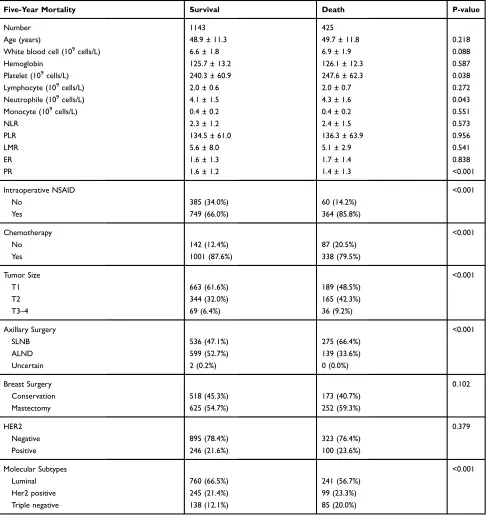
The sample contained 1,143 patients with triple-negative breast cancer who had survived 5 years after discharge, and 425 patients who died 5 years after discharge. There was a statistical difference in PLATELET between the two
groups, with a P-value of 0.038. The two groups’average
tumor size also showed a significant statistical difference, p < 0.001. There was also a significant statistical differ-ence in NSAID medication between the two groups, P < 0.001. The NLR, PLR and LMR values of the two groups had no statistical difference, P-value > 0.05 (See in
Table 1).
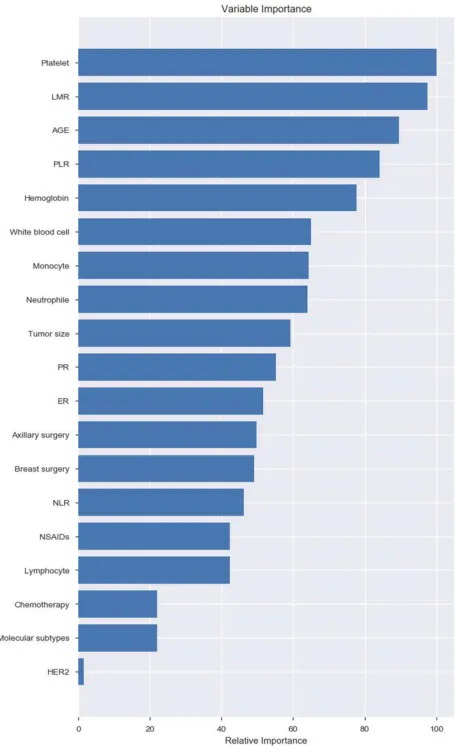
The death outcome for triple-negative breast cancer 5 years after discharge was the dependent variable (0 = no, 1 = yes), and all 19 factors were independent variables for LightGBM algorithm analysis. The results showed that platelets, LMR, age, PLR and white blood cell counts influenced 5-year prog-nosis and death of triple-negative breast cancer patients.
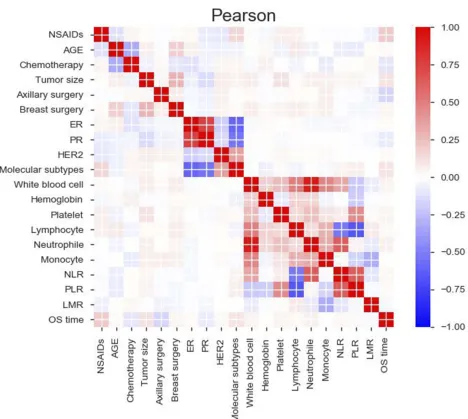
Figure 1 presents the positive correlation between age, NSAID, lymphocyte count and 5-year prognosis and death
OncoTargets and Therapy downloaded from https://www.dovepress.com/ by 118.70.13.36 on 25-Aug-2020
for breast cancer. Chemotherapy and PR are each negatively correlated with 5-year prognosis and death. (See inFigures 1
and2)
Aflow chart of data processing by machine learning is
shown inAppendix Figure 1.
Thefinal parameters through which the prediction results of the machine learning model passed were: Logistic
regression-penalty=‘l2ʹ, tol=0.0001, C=0.7, fit_intercept=
True, intercept_scaling=1, class_weight=None,
max_i-ter=100, multi_class=“ovr”, verbose=0, warm_start=False,
n_jobs=−1; GradientBoosting-learning_rate=0.01,
n_estima-tors= 100, min_samples_split=10, min_samples_leaf=1,
sub-sample=0.5, max_depth=5; gbm-boosting_type= “gbdt”,
reg_alpha= 0.001, reg_lambda= 0.8, learning_rate=0.1,
Table 1Baseline Data
Five-Year Mortality Survival Death P-value
Number 1143 425
Age (years) 48.9 ± 11.3 49.7 ± 11.8 0.218
White blood cell (109cells/L) 6.6 ± 1.8 6.9 ± 1.9 0.088
Hemoglobin 125.7 ± 13.2 126.1 ± 12.3 0.587
Platelet (109cells/L) 240.3 ± 60.9 247.6 ± 62.3 0.038
Lymphocyte (109cells/L) 2.0 ± 0.6 2.0 ± 0.7 0.272
Neutrophile (109cells/L) 4.1 ± 1.5 4.3 ± 1.6 0.043
Monocyte (109cells/L) 0.4 ± 0.2 0.4 ± 0.2 0.551
NLR 2.3 ± 1.2 2.4 ± 1.5 0.573
PLR 134.5 ± 61.0 136.3 ± 63.9 0.956
LMR 5.6 ± 8.0 5.1 ± 2.9 0.541
ER 1.6 ± 1.3 1.7 ± 1.4 0.838
PR 1.6 ± 1.2 1.4 ± 1.3 <0.001
Intraoperative NSAID <0.001
No 385 (34.0%) 60 (14.2%)
Yes 749 (66.0%) 364 (85.8%)
Chemotherapy <0.001
No 142 (12.4%) 87 (20.5%)
Yes 1001 (87.6%) 338 (79.5%)
Tumor Size <0.001
T1 663 (61.6%) 189 (48.5%)
T2 344 (32.0%) 165 (42.3%)
T3–4 69 (6.4%) 36 (9.2%)
Axillary Surgery <0.001
SLNB 536 (47.1%) 275 (66.4%)
ALND 599 (52.7%) 139 (33.6%)
Uncertain 2 (0.2%) 0 (0.0%)
Breast Surgery 0.102
Conservation 518 (45.3%) 173 (40.7%)
Mastectomy 625 (54.7%) 252 (59.3%)
HER2 0.379
Negative 895 (78.4%) 323 (76.4%)
Positive 246 (21.6%) 100 (23.6%)
Molecular Subtypes <0.001
Luminal 760 (66.5%) 241 (56.7%)
Her2 positive 245 (21.4%) 99 (23.3%)
Triple negative 138 (12.1%) 85 (20.0%)
Abbreviations:ER, Estrogen receptor; PR, progesterone receptor; NLR, neutrophil-to-lymphocyte ratio; LMR, lymphocyte-to-monocyte ratio; PLR, the platelet-to-lymphocyte ratio; ALND, axillary lymph node dissection; SLNB, Sentinel lymph node biopsy for breast cancer.
OncoTargets and Therapy downloaded from https://www.dovepress.com/ by 118.70.13.36 on 25-Aug-2020
max_depth=1, n_estimators=100, and objective=“binary” (SeeAppendix Table 1).
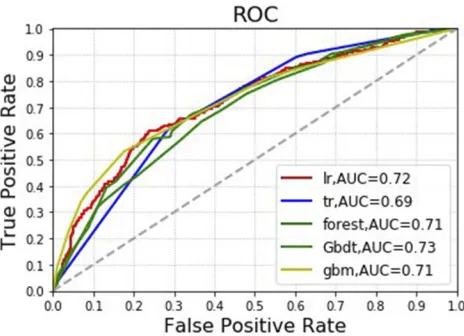
The model’s prediction results show that in the training group, accuracy, from highest to lowest, went forest, gbm, gradientboost, Logistic and DecisionTree (distribution: 0.770335, 0.760766, 0.751994, 0.737640 and 0.734450). AUC value from highest to lowest was forest, gbm,
gra-dientboost, Logistic and DecisionTree (distribution:
0.896673, 0.895408, 0.776836, 0.722799 and 0.702804). The highest MSE value for DecisionTree was 0.2656, and the lowest MSE value for forest was 0.2297. Forest had the highest precision value (1) and DecisionTree had the lowest precision value (0.518325). The highest recall value for DecisionTree was 0.291176, and the lowest recall value
for gbm was 0.123529. The highest f1_score value for DecisionTree was 0.372881, and the lowest f1_score
value for gbm was 0.218750 (SeeTable 2andFigure 3).
In the test group, accuracy, from highest to lowest, went DecisionTree, forest, Logistic, gradientboost and gbm (dis-tribution: 0.748408, 0.738854, 0.738854, 0.732484 and 0.729299). AUC value from highest to lowest was gradient-boost, Logistic, forest, gbm and DecisionTree (distribution: 0.731595, 0.715438, 0.712767, 0.708348 and 0.691960). The maximum MSE value for gbm was 0.2707, and the minimum MSE value for DecisionTree was 0.2516. Forest’s precison value was 1 at its highest and gbm’s preci-sion value was 0.500000 at its lowest. The highest recall value for DecisionTree was 0.294118, and the lowest recall
Figure 1Correlation analysis of various factors.
OncoTargets and Therapy downloaded from https://www.dovepress.com/ by 118.70.13.36 on 25-Aug-2020
value for gbm was 0.023529. The highest f1_score value for DecisionTree was 0.387597, and the lowest f1_score value
for gbm was 0.044944 (SeeTable 3andFigure 4).
Discussion
The continuous clinical trials of TNBC and the publication of research results have resulted in several breakthroughs
in the systemic treatment of advanced TNBC.7,8Moreover,
with advancing genetic testing technology, the genotyping
of TNBC has also been clear, but the efficient therapy is
still absent.9TNBC patients have bleak prognosis—the
5-year survival rate is below 15%, and the time to recurrence is short. Death peaks 5 years after diagnosis. The inci-dence of brain metastases in patients is high, so patients
may die of rapid metastasis.10 Therefore, a valid
evalua-tion method is important for TNBC prognosis.
In our study, considering the accuracy, precision and AUC of the training group and the test group, the forest algorithm came infirst in overall performance; the logistic algorithm was the most stable. Judging by AUC value only, forest and gbm performed best in the training group. In the training group and the test group, the AUC values of Logistic, forest, gradient boost and gbm algo-rithms were all above 0.7, which can predict the death outcome of triple-negative breast cancer 5 years after dis-charge. At the same time, the results of the LightGBM algorithm show that platelets, LMR, age, PLR and white
blood cell counts influence the death outcome of
triple-negative breast cancer 5 years after discharge; age, NSAID and lymphocyte count are positively correlated with the death outcome of triple-negative breast cancer 5 years after discharge; chemotherapy and PR are negatively cor-related with the death outcome of triple-negative breast cancer 5 years after discharge.
Lymphocytes are involved in immune response. The stronger the local immunological effect, the less favorable the tumor growth and metastasis. Conversely, the stronger the local immunosuppressive effect, the more favorable the
tumor invasion and metastasis.11 Tumor-infiltrating
lym-phocytes (TIL) are important immune cells in tumors, and low lymphocyte counts are thought to be responsible for the lack of immunological response that leads to low survival rates for various cancers.12,13Higher peripheral lymphocyte counts predict lower mortality in TNBC that may be cured early. This suggests that immune function can enhance early TNBC treatment.14This is similar to the results in our study.
Figure 2Variable importance of features included in the machine learning algo-rithm for predicting triple-negative breast cancerfive-year mortality.
Table 2Forecast Results For Training Group
Accuracy Precision Recall f1_score AUC MSE
Logistic 0.737640 0.551402 0.173529 0.263982 0.722799 0.2624
DecisionTree 0.734450 0.518325 0.291176 0.372881 0.702804 0.2656
Forest 0.770335 1.000000 0.152941 0.265306 0.896673 0.2297
GradientBoosting 0.751994 0.737705 0.132353 0.224439 0.776836 0.2480
gbm 0.760766 0.954545 0.123529 0.218750 0.895408 0.2392
OncoTargets and Therapy downloaded from https://www.dovepress.com/ by 118.70.13.36 on 25-Aug-2020
As part of the inflammatory response, thrombocytosis is common in cancer patients. Platelets in solid tumors promote tumor cell growth by secreting various angiogenic and tumor growth factors. In addition, platelets protect cancer cells from natural killer-mediated cleavage, and promote distant
metas-tasis by activating the Smad and NF-κB pathways.15 The
meta-analysis reported by Wei S et al16 suggests that
pre-operative PLR might be an independent risk factor in
pan-creatic cancer prognosis. A meta-analysis by Zhang et al17
including 19 articles and 6,314 esophageal cancer patients concluded that PLR might be an important prediction bio-marker in esophageal cancer patients. Additionally, LMR is a poor predictor of luminal A and HER-2 overexpressed TNBC with molecular subtype distribution different from
PLR.18Our results reached the same conclusion.
Studies have shown that regular NSAID use improves
colorectal cancer survival rates.19 However, studies have
shown that the use of NSAID is associated with increased endometrial cancer-specific mortality, especially in patients with type I tumors.20In our study, we found a positive correla-tion between the use of NSAID and the death outcome of TNBC patients 5 years after discharge.
The hematopoiesis age of patients at the onset of TNBC determines the aggressiveness and progression of the
tumor.21TNBC in elderly patients is a subtype of invasive
breast cancer, but chemotherapy intervention is necessary regardless of age.22Our results show a negative correlation between chemotherapy and death outcomes among TNBC patients 5 years after discharge.
Nomograms are a traditional statistical method for eval-uating breast cancer prognosis. After a review of previous
studies23–27 in which nomograms were used to predict
breast cancer prognosis, we found that the nomogram pre-diction established by Wen et al performed the best, with a value of 0.789. The random forest algorithm in our study had a maximum value of 0.896673. Moreover, the advan-tage of machine learning algorithms lies in their capacity to automatically process large samples of data, learn automa-tically, and optimize algorithms based on past experience, thus performing better on the ensuing prediction.
With the explosive growth of medical data, machine learn-ing has gained 5 distinct advantages over traditional statistical analysis. (1) Precision; Machine learning uses data to identify an optimized decision engine to solve problems. With the increase in data, precision is improved. (2) Automation; Since the results can only be effective and abandoned, machine learning automatically learns new patterns. This means that users can embed machine learning directly into
automatic workflows. (3) Speed; Machine learning produces
results within milliseconds upon data entry, allowing the sys-tem to react in real time; many data-driven problems can be solved with machine learning. (4) Wide selectivity; Machine learning models are built from their own data and can be optimized with any evaluation criteria. (5) Large-scale proces-sing capacity; As the business continues to evolve, machine learning can manage data growth issues. Some machine learn-ing algorithms are able to process large amounts of data with
cloud computing. Moreover, many recent studies28,29 have
indicated that machine learning can predict early biochemical recurrence after robot-assisted prostatectomy. Additionally, a
Figure 3Machine learning algorithm for predictingfive-year mortality for triple-negative breast cancer patients in the training group (forest, gbm, gradientboost (Gbdt), Logistic (lr) and DecisionTree (tr)).
Table 3Forecast Results For Testing Group
Accuracy Precision Recall f1_score AUC MSE
Logistic 0.738854 0.578947 0.129412 0.211538 0.715438 0.2611
DecisionTree 0.748408 0.568182 0.294118 0.387597 0.691960 0.2516
forest 0.738854 1.000000 0.035294 0.068182 0.712767 0.2611
GradientBoosting 0.732484 0.555556 0.058824 0.106383 0.731595 0.2675
gbm 0.729299 0.500000 0.023529 0.044944 0.708348 0.2707
OncoTargets and Therapy downloaded from https://www.dovepress.com/ by 118.70.13.36 on 25-Aug-2020
prognostic genome for patients with epithelial ovarian cancer has been developed through a machine learning model.
This study has both advantages and disadvantages. Machine learning modeling is a new technology that has not been widely used in TNBC prognosis. However, machine learning algorithms have been applied to complex situations with successful results. For example, machine learning mod-els based on texture features extracted by wavelet transform can improve the ability to distinguish TNBC from benign
fibrous adenomas.30Our results suggest that this technology has the potential to improve TNBC prognosis in the future. Nonetheless, this is a hypothesis generation study, and exter-nal validation of the model is critical to validating its utility. The limitation of this study is its retrospective data collection, and as such, our research may be biased because of incom-plete data. Also, this study only focused on 5-year prognosis, and did not address longer-term prognosis.
Conclusion
In summary, platelets, LMR, age, PLR, and white blood cell counts may be associated with death outcomes in TNBC patients 5 years after discharge. Machine learning modeling techniques can produce better predictive models for 5-year death outcomes in TNBC patients. These tech-niques may help in estimating individual outcomes and selecting better therapies for TNBC patients.
Ethics Approval And Consent To
Participate
The ethics approval for the original study by Professor Fengxi Su came from Sun Yat-sen Memorial Hospital.
Consent For Publication
All consent of the personal data was obtained from the corresponding person.
Availability Of Data And Material
The datasets used and/or analysed for the present study are available from the corresponding author upon reasonable request.
Acknowledgements
Professor Fengxi Su’s previously published articles have
shown that preoperative NLR elevation is an independent prognostic biomarker of disease-free survival and overall sur-vival in TNBC. At the same time, in order tofind, reuse and quote the research data freely, the data from this retrospective analysis article is also included in the BioStudies database31 (https://www.ebi.ac.uk/biostudies/studies/S-EPMC4666347). We are grateful to Professor Fengxi Su for sharing his data32 and allowing us to use them for research.
Author Contributions
All authors contributed to data analysis, drafting or revising the article, gavefinal approval of the version to be published, and agree to be accountable for all aspects of the work.
Funding
This study was supported by grants from the National Natural Science Foundation of China.
Disclosure
The authors report no conflicts of interest in this work.
References
1. Wang Y, Zhang T, Kwiatkowski N, et al. CDK7-dependent transcrip-tional addiction in triple-negative breast cancer. Cell. 2015;163 (1):174–186. doi:10.1016/j.cell.2015.08.063
2. Barbie TU, Alexe G, Aref AR, et al. Targeting an IKBKE cytokine network impairs triple-negative breast cancer growth.J Clin Invest. 2014;124(12):5411–5423. doi:10.1172/JCI75661
3. OShaughnessy J, Osborne C, Pippen JE, et al. Iniparib plus chemother-apy in metastatic triple-negative breast cancer. New Eng J Med. 2011;364(3):205–214. doi:10.1056/NEJMoa1011418
4. Wu T, Sultan LR, Tian J, et al. Machine learning for diagnostic ultrasound of triple-negative breast cancer.Breast Cancer Res Treat. 2019;173:365–373. doi:10.1007/s10549-018-4984-7
5. Athreya AP, Gaglio AJ, Cairns J, et al. Machine learning helps identify new drug mechanisms in triple-negative breast cancer. IEEE Trans Nanobiosci.2018;17:251–259. doi:10.1109/TNB.2018.2851997 6. Powers DM. Evaluation: from precision, recall and F-measure to ROC,
informedness, markedness and correlation.Mach Learn Technol.2011;2 (1):37–63.
7. O’Sullivan H, Collins D, O’Reilly S. Atezolizumab and nab-paclitaxel in advanced triple-negative breast cancer.N Engl J Med.2019;380:986.
Figure 4Machine learning algorithm for prediction offive-year mortality for triple-negative breast cancer patients in the testing group (forest, gbm, gradientboost (Gbdt), Logistic (lr) and DecisionTree (tr)).
OncoTargets and Therapy downloaded from https://www.dovepress.com/ by 118.70.13.36 on 25-Aug-2020
8. Denkert C, Liedtke C, Tutt A, et al. Molecular alterations in triple-negative breast cancer-the road to new treatment strategies.Lancet. 2017;389:2430–2442. doi:10.1016/S0140-6736(16)32454-0 9. Lehmann BD, Bauer JA, Chen X, et al. Identification of human
triple-negative breast cancer subtypes and preclinical models for selection of targeted therapies. J Clin Invest. 2011;121(7):2750. doi:10.1172/JCI45014
10. Abdulkarim BS, Cuartero J, Hanson J, et al. Increased risk of locor-egional recurrence for women with T1-2N0 triple-negative breast cancer treated with modified radical mastectomy without adjuvant radiation therapy compared with breast-conserving therapy.J Clin Oncol.2011;29(21):2852–2858. doi:10.1200/JCO.2010.33.4714 11. Pauken KE, Wherry EJ. Overcoming T cell exhaustion in infection
and cancer. Trends Immunol. 2015;36(4):265–276. doi:10.1016/j. it.2015.02.008
12. Hoffmann TK, Dworacki G, Tsukihiro T, et al. Spontaneous apoptosis of circulating T lymphocytes in patients with head and neck cancer and its clinical importance.Clin Cancer Res.2002;8(8):2553–2562. 13. Vayrynen JP, Tuomisto A, Klintrup K, et al. Detailed analysis of
inflammatory cell infiltration in colorectal cancer. Br J Cancer. 2013;109(7):1839–1847. doi:10.1038/bjc.2013.508
14. Afghahi A, Purington N, Han SS, et al. Higher absolute lymphocyte counts predict lower mortality from early-stage triple-negative breast cancer. Clin Cancer Res. 2018;24:2851–2858. doi:10.1158/1078-0432.CCR-17-1323
15. Schlesinger M. Role of platelets and platelet receptors in cancer metastasis.J Hematol Oncol.2018;11:125. doi:10.1186/s13045-018-0669-2
16. Song W, Tian C, Wang K, et al. Preoperative platelet lymphocyte ratio as independent predictors of prognosis in pancreatic cancer: a systematic review and meta-analysis. PLoS One. 2017;12(6): e0178762. doi:10.1371/journal.pone.0178762
17. Zhang X, Wang Y, Zhao L, et al. Prognostic value of platelet-to-lymphocyte ratio in oncologic outcomes of esophageal cancer: a systematic review and meta-analysis. Int J Biol Markers. 2018; 33:335–344.
18. Zenan H, Zixiong L, Zhicheng Y, et al. Clinical prognostic evaluation of immunocytes in different molecular subtypes of breast cancer.J Cell Physiol.2019;234:20584–20602. doi:10.1002/jcp.v234.11 19. Coghill AE, Newcomb PA, Campbell PT, et al. Prediagnostic
non-ster-oidal anti-inflammatory drug use and survival after diagnosis of colorectal cancer.Gut.2011;60:491–498. doi:10.1136/gut.2010.221143
20. Brasky TM, Felix AS, Cohn DE, et al. Nonsteroidal anti-infl amma-tory drugs and endometrial carcinoma mortality and recurrence.J Natl Cancer Inst.2017;109:1–10.
21. Marsh T, Wong I, Sceneay J, et al. Hematopoietic age at onset of triple-negative breast cancer dictates disease aggressiveness and pro-gression.Cancer Res. 2016;76:2932–2943. doi:10.1158/0008-5472. CAN-15-3332
22. Königsberg R, Pfeiler G, Klement T, et al. Tumor characteristics and recurrence patterns in triple negative breast cancer: a comparison between younger (<65) and elderly (≥65) patients. Eur J Cancer. 2012;48:2962–2968. doi:10.1016/j.ejca.2012.04.019
23. Wen J, Yang Y, Liu P, et al. Development and validation of a nomogram for predicting survival on the base of modified lymph node ratio in breast cancer patients.Breast.2017;33:14–22. doi:10. 1016/j.breast.2017.01.017
24. Shunrong L, Zhao J, Zhu L, et al. Development and validation of a nomogram predicting the overall survival of stage IV breast cancer patients.Cancer Med.2017;6:2586–2594. doi:10.1002/cam4.1224 25. Lai J, Pan Z, Chen P, et al. Development and validation of a
nomo-gram incorporating axillary lymph node ratio to predict survival in node-positive breast cancer patients after neoadjuvant chemotherapy. Jpn J Clin Oncol.2019;49:22–28. doi:10.1093/jjco/hyy181 26. Li X, Huang H, Lin Q, et al. Validation of a breast cancer nomogram to
predict lymphedema in a Chinese population.J Surg Res.2017;210:132– 138. doi:10.1016/j.jss.2016.11.009
27. Xiong Z, Deng G, Huang X, et al. Score for the survival probability in metastasis breast cancer: a nomogram-based risk assessment model.Cancer Res Treat.2018;50:1260–1269. doi:10.4143/crt.2017. 443
28. Wong NC, Lam C, Patterson L, et al. Use of machine learning to predict early biochemical recurrence after robot-assisted prostatect-omy.BJU Int.2019;123:51–57. doi:10.1111/bju.14477
29. Lu T-P, Kuo K-T, Chen C-H, et al. Developing a prognostic gene panel of epithelial ovarian cancer patients by a machine learning model.Cancers (Basel).2019;11(2). doi:10.3390/cancers11020270. 30. Moon WK, Huang Y-S, Lo C-M, et al. Computer-aided diagnosis for
distinguishing between triple-negative breast cancer andfi broadeno-mas based on ultrasound texture features.Med Phys.2015;42:3024– 3035. doi:10.1118/1.4921123
31. Sarkans U, Gostev M, Athar A, et al. The BioStudies database-one stop shop for all data supporting a life sciences study.Nucleic Acids Res.2018;46:D1266–D1270. doi:10.1093/nar/gkx965
32. Jia W, Wu J, Jia H, et al. The peripheral blood neutrophil-to-lympho-cyte ratio is superior to the lymphoneutrophil-to-lympho-cyte-to-mononeutrophil-to-lympho-cyte ratio for pre-dicting the long-term survival of triple-negative breast cancer patients. PLoS One. 2015;10:e0143061. doi:10.1371/journal.pone. 0143061
OncoTargets and Therapy
Dovepress
Publish your work in this journal
OncoTargets and Therapy is an international, peer-reviewed, open access journal focusing on the pathological basis of all cancers, potential targets for therapy and treatment protocols employed to improve the management of cancer patients. The journal also focuses on the impact of management programs and new therapeutic
agents and protocols on patient perspectives such as quality of life, adherence and satisfaction. The manuscript management system is completely online and includes a very quick and fair peer-review system, which is all easy to use. Visit http://www.dovepress.com/ testimonials.php to read real quotes from published authors.
Submit your manuscript here:https://www.dovepress.com/oncotargets-and-therapy-journal
OncoTargets and Therapy downloaded from https://www.dovepress.com/ by 118.70.13.36 on 25-Aug-2020