United Kingdom Vol. IV, Issue 8, August 2016
Licensed under Creative Common Page 223
http://ijecm.co.uk/
ISSN 2348 0386
COP21 PROCESS: IMPLEMENTATION OR MANAGEMENT
STRATEGY APPROACH
Jan-Erik Lane
Fellow, Public Policy Institute in Belgrade, Serbia [email protected]
Abstract
The COP21 process will be a unique set of phenomena, once it gets underway. It is global
governance for the whole of this century, with all governments or states plus several IGO:s and
NGO:s. Guiding the enormous endeavour of more or less complete decarbonisation of energy
consumption in general and the world economy in particular is three simple goals: halting the
growth in CO2:s, and reducing CO2:s with 40 % until 2030, as well as reach close to 100%
reduction in CO2:s sometime around 2075. The social sciences must pose the question:
achievable? And inquire into the means to be employed for the accomplishments of real
outcomes that fulfil the goals. While the natural sciences continue to reduce uncertainty about
climate change, the social sciences are going to be asked about technologies: Will it be the
implementation approach from the policy sciences (Wildavsky) or the management framework
with its strategies safari (Minzberg)? In this paper, I will start from economist Knight's distinction
between uncertainty and risks pinning down how immensely complicated and difficult the
COP21 project will be, both globally and in single countries. Complete failure cannot be
excluded, because decarbonisation is to be maximised under the powerful restriction of
continued economic development and growth, requiring more and more energy.
Keywords: Global Warming, Decarbonisation, Implementation Theory, Management Strategy,
Wildavsky, Minzberg, Energy Dependency Types, GDP-CO2 Links, Energy Mixes, Carbon
Licensed under Creative Common Page 224
INTRODUCTION
Mankind divides itself into two opposing groups with regard to the basic attitude towards global warming (GW), as it is reported upon daily in news media and discussed in scientific journals. On the one hand, various groups of people show more and more concern about the effects in this century:
- people in the Third World fearing that more of heat will much reduce job effort; - farmers feeling the threat of more of long periods of drought;
- fisherman observing the increased ocean temperatures with much fear; - governments doubting the future access to water in their dams and rivers;
- women disliking the talk about the risks for their children in the future i.e. homo sapiens annihilation.
On the other hand, it is business as usual: more airplanes, cars and ocean transportation, more of use of shale oil and gas, new coal fired power stations, shut down of nuclear facilities as well as mega constructions and buildings, burning cement. The human race increases fast and so its appetite for the American life style, which is heavily energy driven.
Meanwhile, the scientific debate about the existence and strength of the climate change process continuous, with some still forthcoming to entirely challenge the predominant view. Thus, there is still on lingering uncertainty about what is going on. Evidently, scientists look upon the risks involved differently. A few politicians declare their grave doubts, but the global governance of COP21 Agreement has decided to embark upon three objectives:
- stop the increase in CO2 emissions by 2020; - reduce these emissions by 40% in 2030;
- decarbonise the world economy in the second half of this century.
Now, the core set of questions deals with how these 3 goals are to be promoted, by what activities and by whom? They may be approached by means of two alternative social science frameworks: implementation theory or management theories. Yet, there are no sure answers in neither approaches. The climate change problematic is entirely new and there are numerous unknowns. Thus, we are back to the concept(s) of uncertainty.
Licensed under Creative Common Page 225 augmenting the risks from a traumatic UK break-up. The global warming problem has a neat solution – reduce greenhouse gases – but the technology to do that is not fully known, given the
existing constraints of rapid human population growth and the unstoppable drive for economic growth or development.
Uncertainty and Risks
Climate harbours both uncertainty and risks. We do not know exactly what is going on and how grave it is. And the estimation of the risks for mankind runs all the way from 1-2 degrees warmer in some regions of the globe to total extinction of the Cro Magnons in a hundred years.
The concepts of uncertainty and risk are not on the level or order. Uncertainty carries no inherent connotation of the negative, or losses, because one may be uncertain about future prospects, opportunities or the positive, gains. On the contrary, the notion of risk is logically on the negative side, meaning future losses. Uncertainty may simply mean: I do not know, whereas risk entails I may lose much.
The classical analysis of these concepts come from economist Knight, who wrote this famous passage: "Uncertainty must be taken in a sense radically distinct from the familiar notion of Risk, from which it has never been properly separated.... The essential fact is that 'risk' means in some cases a quantity susceptible of measurement, while at other times it is something distinctly not of this character; and there are far-reaching and crucial differences in the bearings of the phenomena depending on which of the two is really present and operating.... It will appear that a measurable uncertainty, or 'risk' proper, as we shall use the term, is so far different from an unmeasurable one that it is not in effect an uncertainty at all." (Knight, 2002; reprint of 1921 edition; page 19).
Knight's distinction between ignorance and calculable losses, or probabilities on the negative side, has been debated at some length, but no one has pointed out that it is not exhaustive. In addition, we have the following meanings, for instance in relation to climate change:
- objective and subjective uncertainty: climate change processes may be stochastic, in the short or long run, meaning that periods of warming and cooling follow each other in an indeterminate fashion, as we do not know all the mechanisms of negative and positive feed-backs involved; or it is all a matter of subjective uncertainty, meaning that we are simply ignorant lacking a theory about the determinate properties of the global warming process; - objective or subjective risks: when risks are objective, they stem from real frequencies in the
Licensed under Creative Common Page 226 Now, the global warming process involves all of these forms of uncertainties and risks, natural scientists over-exaggerates or under-exaggerates the uncertainties and risks, and social scientists fail to point out how utopian global governance is due to the logic of collections – the most important discovery in politics and economics in the 20th century.
Two Perspectives on the Cop21 Process and its Outcome
Governments under the pressure from IGO;s and NGO;s are starting to handle their obligations under the COP21, while the private sector or market actors only look upon it as a set of opportunities. To promote the 3 objectives in COP21, one may consult implementation theory with Aaron Wildavsky or management strategy with Henry Minzberg or really various strategy concepts.
The logical starting-point for both approaches, the public sector one and the private sector one, is Weber's fundamental insight into social systems, namely the distinction between action and behaviour. Let us quote from the unsurpassably greatest ever social scientist, who mastered not only German economics, the new sociology, practical jurisprudence and the philosophy of science, where he in one of his early methodological essays introduces the means-end approach:
“Every thoughtful reflection on the ultimate elements of meaningful human action is immediately tied to categories of means and purposes.” (Page: 155 in Turner (1992))
Without the concept of intention, action collapses into behaviour, as with American behaviouralism. COP21 is ununderstandable without the concepts of ends and means -“Sinnzusammenhaenge”. To these terms, Wildavsky added outcomes and Minzberg strategy or
strategies.
Policy Implementation
In Wildavsky's theory of public administration and public policy-making, all hinges upon the distinction between outputs/activities on the one hand and outcomes or real results on the other hand. COP21 is just meeting (costly!) and talking (cheap!) so far. Halting climate change is a goal that can only realized the measures on the existence of greenhouse gases turn around and start declining. All else is just theater by political elites and bureaucrats trying to convince ordinary people that things are done and we are heading in the right direct: “Speaking truth to power”, Wildavsky identified the crucial task of the policy sciences repeating Weber on
objectivity and value neutrality in scientific enquiry.
Licensed under Creative Common Page 227 them that policy implementation is far more difficult and complicated political business. Thus, we have:
- ends are not only partial, incomplete and ambiguous but tend to be redefined: COP21 targets only CO2 emissions but there are other emissions that are equally or more detrimental, like like CFCs and HCFCs or HFOs AND HFCs in air conditioners or air coolers.
- means are often based upon serious mistakes or omissions in beliefs, and they also tend to change over time; reductions in nuclear capacity may lead to more of natural gas burning; solar- and wind power may be unreliable, calling for fossil fuel back ups; water power may exhaust itself.
- outcomes often deviate from beliefs or hopes about results, and some outcomes are clearly dysfunctional; gigantic solar panel plats may foster terrorism; more of electricity production may lead to less, as water resources is declining; cutting emissions may require more energy that increases emissions – the Catch-22; renewable energies only reduce emissions
if bio-mass is replenished fully; air-conditioners reducing global warming inside lead to global warming outside; etc.
- implementation is dynamic, as ends, means and beliefs change due to learning about mistakes and faulty results; one single policy for 195 governments for some 100 years is utopian.
- the policy-implementation process is always peace-meal and never holistically encompassing, as ends are revised, means improved and beliefs about outcomes evaluated and reconsidered.
- one shot implementation – let us fix the problem once and for all – is a mere figment of the imagination.
Thus, one must argue that implementation of policy is messy and transaction costs heavy. The COP21 process with its decentralized approach cannot avoid these difficulties, reducing the probability of policy success, if now climate change is so an ominous threat or challenge.
Given the findings in the implementation literature that entail difficulty, retries, learning and the need for the policy fixers of P. Sabatier, one may wish to turn to quite another social science framework, namely management theory (ies), which also has the Weberian roots in the means-end paradigm.
Strategy in GW Management
Licensed under Creative Common Page 228 War II. The recent addition of asymmetric information hypotheses has strengthen the strategy perspective immensely in the social sciences. Now, management theory may be empirically realistic or instrumentally rational. The various country governments and the IGO;s and NGO:s involved in COP21 would, of course, look for instrumentally based hypothesis about the relevant strategies to be successful in global warming coordination.
The elaboration of technologies for reducing CO2:s must take into account the collective action problematic: - free riding or reneging: the N-1 question; - non-appropriation: the 1/N question.
Basically, each country has an incentive to do less in global coordination once it is sure the others will comply. Moreover, no country would by itself allocate CO2 reductions voluntarily once it is certain the others will hesitate to comply or fail to comply. Overcoming these 2 collective actions difficulties in all their variations is extremely important in global coordination. It cannot be achieved by merely altruistic attitudes towards the dilemma, as Ostrom (1990) has claimed. There must be a hobbesian mechanism. but how in a world of sovereign states? The Ostrom strategy for achieving co-ordination – voluntary co-operation and mutual contracting – may certainly occur sometimes, but it does not constitute a sub-game perfect Nash equilibrium. This entail that COP21 must build up an enforcement structure.
The Task: Constrained Maximisation
COP21 sets out to maximise global decarbonisation given the restriction that economic development must continue delivering more and more of affluence to a growing world population where billions live in despicable poverty. Thus, we have:
(I) Decarbonisation (D) = - (coals + oil + natural gas) + (solar + wind + water power) – traditional
renewables + modern biomass;
(II) Economic development (EG) > population growth or > 3-4 per cent.
Thus, COP21 must maximise D (I) subject to EG (II). Feasible? How to manage this max D subject to EG?
Licensed under Creative Common Page 229 aggregates will be pinned down. Examining the nations of the world, their situation with regard to COP21 is uniquely determined by the following:
<gdp-co2 link, energy consumption pattern>.
COUNTRIES WITH INCREASING OR FLATTENING CO2 EMISSIONS
Asia
How, then about CP2 emissions from human activities in Asian countries, mainly of en economic import? Start with Figure 1. The link between total CO2 emissions and overall GDP is to be found in the early 1990s for Asia, as the richer countries pollute more than the poorer ones. Yet, the connection is not very strong. Figure 1 shows how things developed during the two decades of mainly quick economic development and the spread of the Asian economic miracle from the 4 tigers to almost all Asian countries, especially the giants, viz China, India and Indonesia.
Figure 1: The 2014 Situation: Total GDP and CO2 in Asian Countries (y = 1,02x, R² = 0,91) Tod
CO2 emissions are much larger for all Asian countries, following the increase in economic output, or GDP closely. These enormous emissions of CO2 put the Asian region in the top most polluted regions in the world, besides North America and The EU. The consequences are visible in the huge cities in Asia, where smog levels have skyrocketed, hurting the health of ordinary people, like in Delhi, Beijing and Bangkok, etc.
Licensed under Creative Common Page 230 One finds that the emissions of CO2:s follows economic development closely in many countries, like China, South Koreas and most Latin American countries. The basic explanation is population growth and GDP growth – more people breathing and searching for higher life style.
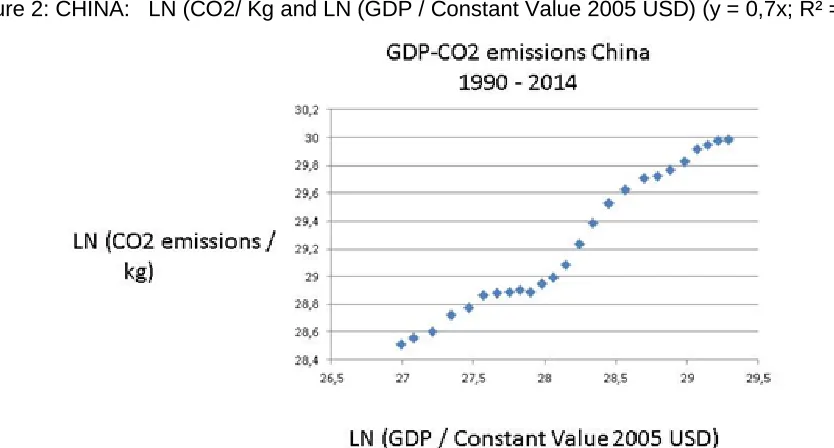
Take the case of China, whose emissions are the largest in the world, totally speaking (Figure 2). Interestingly, China has begun a fundamental change of its energy policy in 2015, reacting to mostly domestic demands for cleaner air and environment.
Figure 2: CHINA: LN (CO2/ Kg and LN (GDP / Constant Value 2005 USD) (y = 0,7x; R² = 0,97)
The sharp increase in CO2:s in China reflects not only the immensely rapid industrialization and urbanization of the last 30 years, but also its problematic energy mix (Figure 3), which is now up for overhaul.
Figure 3. China energy consumption 2104
Licensed under Creative Common Page 231 Almost 70 per cent of the energy consumption comes from the burning of coal with an additional 20 per cent from other fossil fuels. The role of nuclear and renewable energy sources except hydro power is very small indeed. This energy mix makes China very vulnerable to demands for radically cutting CO2 emissions: use other energy sources or massive installation of highly improved filters for carbon capture? It is true that China has turned to wind power, solar power and nuclear power massively recently, but the task of achieving a 40% reduction is enormous. China evidently hopes to respect its COP21 commitments while still enjoying an economic growth rate of above 5%, but it is realistic? New coal plants have actually been opened recently, replacing out-dated old ones in order to propel growth. China bets much upon solar power, but it also aims to augment its energy consumption considerably during the 21rst century.
It should be pointed out that several small countries have much higher emissions per capita than China. This raises the enormously difficult problematic of fair cuts of emissions. Should the largest polluters per capita like the rich Gulf States cut most or the biggest aggregate polluters, like emerging economies China, India and Indonesia for instance? At COP21 this issue about redistribution was resolved by the proposed creation of a super fund to assist energy transition and environment protection in developing counties, as proposed early by economist Stern (2007)
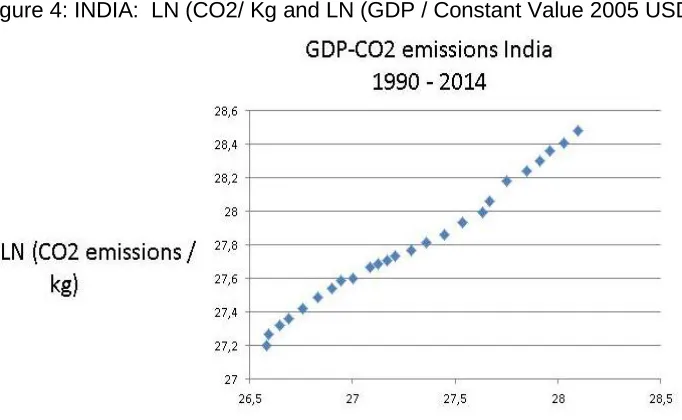
India is even more negative than China to cut CO2 emissions, as it is in an earlier stage of industrialization and urbanization. Figure 4 shows the close connection between emissions and GDP for this giant nation.
Licensed under Creative Common Page 232 India needs cheap energy for its industries, transportation and heating as well as air conditioning, meaning it aims strongly at electrification. From where will this power come? India has water power and nuclear energy, but relies most upon coal, oil and gas as power source. It has strong ambitions for the future expansion of energy, but how is it to be generated, the world asks. India actually has one of the smallest numbers for energy per capita, although it produces much energy totally. Figure 5 shows its energy mix where renewables play a bigger role than in China. However, the renewables in India may lead to deforestation and considerable pollution.
Figure 5. Primary energy demand in India by fuel
Source: http://www.eia.gov/beta/international/analysis.cfm?iso=IND
India needs especially electricity, as 300 million inhabitants lack access to it. The country is heavily dependent upon fossil fuels (70 per cent), although to a much less extent than China. Electricity can be generated by hydro power and nuclear power, both of which India employs. Yet, global warming reduces the capacity of hydro power – water shortages - and nuclear power
meets with political resistance. Interestingly, India uses much biomass and waste for electricity production, which does not always reduce CO2 emissions. India’s energy policy will be closely
watched by other governments and NGO:s after 2018. The constant tension between the demand for economic growth on the one hand and environmental protection on the other hand is sharply portrayed in Ramesh (2015).
One may guess correctly that countries that try hard to “catch-up” will have increasing
emissions. This was true of China and South East Asian countries. Let us look at three more examples, like e.g. giant Indonesia – now the fourth largest emitter of CO2:s in the world (Figure
Licensed under Creative Common Page 233 Figure 6: INDONESIA: LN (CO2 / Kg and LN (GDP / Constant Value 2005 USD)
Indonesia is a coming giant, both economically and sadly in terms of pollution. Figure 6 reminds of the upward trend for East Asia, such as Thailand and Malaysia. However, matters are even worse for Indonesia, as the burning of the rain forests on Kalimantan and Sumatra augments the CO2 emissions very much. Figure 7 presents the energy mix for this huge country in terms of population and territory.
Figure 7: INDONESIA: Energy mix 2009
Source: (http://missrifka.com/energy-issue/recent-energy-status-in-indonesia.html)
Licensed under Creative Common Page 234 between GDP and emissions also in countries in Asia with a most advanced economy. See Figure 8 for South Korea.
Figure 8: SOUTH KOREA: LN (CO2 / Kg and LN (GDP / Constant Value 2005 USD) (y = 0,65x + 9,19; R² = 0,96)
Figure 9. South Korea total primary energy consumption by fuel type, 2012
Source: BP stat review of World energy 2014
Licensed under Creative Common Page 235 the country is a world leader in plant constructions. Reducing its hefty GHG emissions, South Korea will have to rely more upon renewable energy sources, as well as reducing coal and oil for imported gas or LNGs.
Among the above countries that are giant polluters in terms of CO2, China and South Korea uses mainly fossil fuels for energy consumption, whereas India also employs renewable and hydro power, lacking in the other two countries. South Asia, East Asia and South East Asia play a most critical role in the COP21 implementation process. They are responsible for almost 50 per cent of the CO2 emissions. And they plan to increase their energy consumption enormously in the next decades. They hope for carbon neutral energy sources, replacing solids and fossil fuels like oil and gas, turning to solar and atomic power. The investment needs are truly immense and based upon a quite aggressive growth argument, bypassing the idea of a sustainable economy (Sachs, 2015). However, it is certain that these goals are not in conformity with COP21.
Middle East
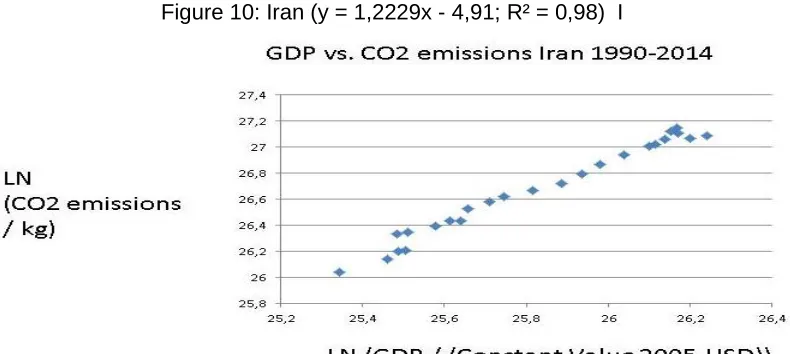
Countries may rely almost exclusively upon petroleum and gas mainly – see Iran in Figure 10
for instance. CO2 emissions have generally followed economic development in this giant country, although there seems to be a planning out recently, perhaps due to the international sanctions against its economy.
Figure 10: Iran (y = 1,2229x - 4,91; R² = 0,98) I
Licensed under Creative Common Page 236 Figure 11. Iran’s total primary energy consumption, share by fuel 2013
Source: BP stat review of World energy 2014
One understands why an emerging economy like Iran wants atomic power. It would allow them inter alia to sell their fossil fuels on the market. But the problems for international governance of this energy policy have been most costly in terms of transaction costs. Iran would defend their position with the standard economic growth argument (de Bruyn, 2012; Eriksson, 2013).
When analysing Iran coming back into the energy markets, one may compare this powerful country with Saudi Arabia in decline. Figure 12 shows its sole reliance upon oil, where it no longer holds a dominant position, neither in the global market or in terms of total future resources. The shale roch revolution has damaged Saudi Arabia's interests, as it is no longer a price setter with the OPEC.
Licensed under Creative Common Page 237 The overall energy situation for this kingdom has no doubt worsened with the shale oil and gas revolution. With the idea of a HUBBERT peak gone entirely, the Saudis will not get that enormous economic rent. Instead, they must cut down on luxury spending and look for alternative energy sources (Figure 13). But how much will the country invest in solar parks or wind power, when oil is still cheaper and more efficient?
Figure 13. Energy consumption mix, Saudi Arabia 2008
Source: EIA int. energy stat. 2008
Saudi Arabia is a high polluter, and it needs to take COP21 very seriously, moving to solar power and nuclear investments. But it will be costly. Actually, all of the super rich Gulf states emit lots of CO2 per capita to maintain their life style of massive electricity consumption per capita and pharaonic building. Saudi Arabia like other OPEC countries as well as Russia have to develop a management strategy that takes into account the arrival of huge shale oil and gas deposits over the world and declining rent from old type oil production and sale.
Latin America
Latin America has experienced a period of economic development for a few decades now, resulting in considerable rates of economic growth. It is true that countries have benefited differently from this process, linked with the turn to democracy. But in any case, we may expect to find growing emissions of greenhouse gases, similar to what has been found on the global level and in Asian countries for example.
Licensed under Creative Common Page 238 Figure 14: GDP-COP in Latin America in 2014 (y = 0,9403x, R² = 0,9136)
The countries with the lowest total emissions of CO2 were: Paraguay, Uruguay and Bolivia, while the largest emitters included Brazil, Mexico and Argentina. We have to look especially at Uruguay, scoring surprisingly low with a fairly advanced economy. The economy progress after 2000 has been conducive to more of CO2 emissions in all countries selected here. Thus, Latin America faces the same growth-emissions problematic as Asia, namely how to secure economic development while reducing CO2:s, according to CP21.The countries with the lowest per capita emissions of CO2 were Paraguay, Colombia and Bolivia, while the largest emitters included Venezuela, Argentina and Chile in terms of CO2:s per capita. The pattern is a different one, although emissions/capita follows GDP/capita. Argentina just as Venezuela certainly has a CO2 problematic, although it does not rank high on total emissions. Taking population size into account changes the picture, but the 40% reduction goal still obtains whatever emission measure one employs.
Brazil has for a long time been in the forefront of environmental concerns. On the one hand, it has paved the way for an alternative to the oil dominance in transportation by developing a domestic biomass industry on large scale. The ethanol is derived from immense sugar plantations and it has reduced oil dependency, especially when international petrol prices have skyrocketed. On the other, there is the constant worry that Brazilian governments are ineffective in protecting the lungs of the Planet Earth, the giant rain forest in the Amazon.
Licensed under Creative Common Page 239 Figure 15: GDP-CO2 in Brazil: y = 1,02x R² = 0,95
The trend in Brazil for CO2:s is like that in for example Argentina: up and up. When the burning of the rain forest is added, then Brazil is one of the largest CO2 emitter in the world. The country may reply that its energy mix and its huge forests and bio-mass plantations decrease CO2:s by consuming carbon (Figure 16).
Figure 16: Energy mix of Brazil, 2013
Source: http://euanmearns.com/brazil-samba-energy/
Licensed under Creative Common Page 240 One can hardly say that it will easy for Brazil to live up to its COP21 commitments, despite its comparatively low dependence upon fossil fuels. Its large hydro power supply is vulnerable to drought, as rivers could well dry up. And then one must add the political difficulties in managing the oil and gas reserves properly in giant enterprise Petrobas. The huge Mato Grosso could be used for renewable energy generation. For Mexico holds the following situation:
Figure 17: GDP-CO2 in Mexico: y = 0,77x; R² = 0,98
The close link between economic development and CO2 is discernible in the data, but the emissions' growth seems to stagnate in the last years. This is of course a promising sign, whether it is the start of a COP21 inspired 40% reduction in CO2:s remains to be seen. I doubt so, but let us inquire into the energy mix of this huge country that is of enormous economic importance to both North and South America (Figure 17).
Figure 18: Energy mix for Mexico, 2014
Licensed under Creative Common Page 241 Few countries are so dependent upon fossil fuels as Mexico. One find the same patter with the Gulf States. The Mexican government must start now to reduce this dependency, by for instance eliminating coal and bringing down petroleum, instead betting upon solar, wind and nuclear power. Mexico will face severe difficulties with the 40% reduction target in COP21. It has a fast growing population with many in poverty and an expanding industry sucking electricity. Can economic growth and decarbonisation go together here?
North America
Although Canada is a major emitter of GHG:s as well as one of the world’s largest fossil fuel
producer – oil sands, it has managed to stem the increase in emissions for the most recent years, i.e. halting the augmentation, at least for a time (Figure 18). Figure 19 may be invoked to explain this, showing a very mixed energy consumption pattern with lots of different energy sources.
Figure 19: CANADA: LN (CO2 / Kg and LN (GDP / Constant Value 2005 USD) (y = 0,41x + 15,7; R² = 0,85)
Licensed under Creative Common Page 242 Figure 20. Canada Energy Consumption Mix
Source: Foreign affairs and int. trade, Canada, 2006
Canada has not yet like the US managed to turn this link downwards. The collapse of the oil price should make Canada invest more in water and modern renewable or atomic power, but uncertainty prevails about the future of the oil sands, viz. more of that?
Africa
Looking at the African continent from the COP21 perspective, two things must be emphasized. Firstly, some countries still lean on traditional renewable reflecting low economic development. Second, the population predictions for the continent are extremely high meaning that it will need colossal amounts of energy in this century. New renewable cannot deliver all of that at the same time as decarbonisation is to proceed. We displays the connection between GDP and CO2:s around 1990 for a selection of African nations.
Licensed under Creative Common Page 243 When we look at the same factors in 2014, the link has been strengthened considerably (Figure 21).
Figure 22: GDP-CO2 2014 (y = 1,47x, R² = 0,93)
The finding is that African nations face the same problematic as countries on the other continents. They must reduce CO2:s while maintaining economic development. What this dilemma entails appears clearly when a few African nations are explored below according to the theoretical framework above.
One of the promising nations in Africa is Ghana, housing both democracy and positive economic development. Figure 23 shows its GDP-CO2 picture for the last two decades, when things have gone well and peacefully.
Figure 23: Ghana: GDP-CO2: y = 1,17x, R² = 0,94
Licensed under Creative Common Page 244 There is a very strong connection between GDP and CO2 emissions in Ghana. One would like to examine its energy mix in order to understand this. Figure 24 present the energy consumption pattern in Ghana.
Figure 24. Ghana Energy Mix, 2012
Source: http://climateanswers.info/2015/10/ghana-climate-and-energy-statistics/
Ghana needs both electricity in its many villages and petrol for transportation. Figure 24 shows that oil is used abundantly, but there is also much hydro power. Yet, 50 per cent of the power comes from bioenergy and waste, which is classified as old renewable. These kinds of traditional renewable are to be found in almost all sub-sahara Africa countries. And they create large CO2 emissions, which is why there is this close link between GDP and CO2:s here. Look now at Kenya in Figure 25.
Figure 25: Kenya: y = 1,08x, R² = 0,95 As a matter of fact, Kenya’s curve for GDP and CO2:s
Licensed under Creative Common Page 245 Figure 26: Kenya: Energy Mix
Source: http://investeddevelopment.com/blog/2012/08/energy-in-kenya-and-the 6-potential-for-renewables/
These renewable are not all carbon neutral, meaning hey include charcoal and dung besides the normal renewable like solar, wind and thermal power. One may expect that countries with the possession of big rivers resort to hydro power, like Senegal, Niger, Nigeria, Kango, Angola and East African states, but the trend in Figure 26 do not suit COP21. Hydro power has been launched as a solution for several African countries to comply with COP21, perhaps helped mainly by China, building dams in Ethiopia and Sudan for instance. Some say that more than 200 hydro power stations are to be constructed in the next decade in Africa, Latin America, and Asia, but it is wishful thinking to some extent.
Licensed under Creative Common Page 246 Figure 27. Algeria primary energy consumption
Source: http://euanmearns.com/post-peak-algeria/
Although Algeria may trust in the availability of future fossil fuels resources, it still faces the demand for a 40% reduction of its CO2 emissions. They have thus far followed the economic progress.
One would naturally suggest solar energy as a viable alternative to the heavy dependence upon fossil fuels in Algeria, given its immense Saharan territory. Yet, also Algeria has been plagued by the attacks of terrorists or looters. Giant solar parks would be easily knocked out.
The COP21 framework outlines the three main goals for the 21rst century in order to keep Planet Earth habitable. Thus, these 3 objectives are now accepted as desirable, but scholars now question whether they are feasible, at least without massive costs or economic decline and global depression (Sachs, 2015). A few countries are almost completely dependent upon coal. How will they implement the COP21 goals? Look at South Africa. Emissions are high, because South Africa uses a lot of coal to generate electricity. Decarbonisation will be difficult and costly. The reliance upon coal in this largest economy in Africa is stunning.
Licensed under Creative Common Page 247 Figure 28: Energy Consumption in RSA, 2012
Does the RSA have the resources and motivation to cut the coal consumption radically and move to solar energy for instance? Or could the RSA renege – the always available option in collective action endeavours.
The African continent is so heavily dependent upon solids that implementing the COP21 objectives will prove exceedingly problematic, especially without support from the super fund. Some nations rely almost exclusively upon oil and gas or coal, whereas others depend upon wood, charcoal and dung. Hydro power is exploited, but will water suffice for instance in the Nile Delta that several countries share? Atomic power is completely lacking. The solar power plant is the only way out in order to reduce solids and oil and gas. Modern renewables must replace traditional ewnewables, like in South Asia.
COUNTRIES WITH FALLING CO2 MISSIONS
Licensed under Creative Common Page 248 Figure 29: USA: LN (CO2 / Kg and LN (GDP / Constant Value 2005 USD) (y = -0,32x + 36,7; R²
= 0,49)
Recently, the level of GHG emission has been reduced significantly in the US. It reflects no doubt the economic crisis that began 2007, but the US remains the second largest polluter in the world, reflecting that it cannot draw upon a mixed bag of energies (Figure 30). Per capita GHG:s is of course very high for the USA. As the economy now starts to accelerate, emissions are bound to go up again, especially as solar and wind power has its limitations compared with shale oil and gas.
Figure 30. USA energy consumption mix, 2011
Source: US energy information administration, 2011
The US is heavily dependent upon fossil fuels, or some 89 per cent comes there from. What is changing is the more and more of energy is produced within the US and no longer imported from outside – the shake oil and gas revolution. Further reduction of GHG:s will meet with firm
Licensed under Creative Common Page 249 The advent of shale oil and gas has changed the entire energy markets, lowering the price of oil most substantially. This implies not only that there will be no Hubbert peak oil for the world, but also that switching to renewable energy source will be extremely expensive, relatively speaking.
Another interesting country is the largest EU economy, namely Germany. Figure 31 shows a marked as well as remarkable decrease in GHG emissions – Energiwende.
Figure 31: GERMANY: LN (CO2 / Kg and LN (GDP / Constant Value 2005 USD) (y = -0,69x + 47,3; R² = 0,88)
The German data shows a consistent decreasing trend, which is not to be found with many countries, if at all. How come this German exceptionalism? Germany needs massive amounts of energy, but it decided to phase out nuclear power. Can really the domestic employment of renewable satisfy this gigantic demand (Figure 32)?
Figure 32. German energy consumption, 2012
Licensed under Creative Common Page 250 happen with the nuclear power stations are phased out in 2022 is that most likely the GHG emissions will start going up again. To replace nuclear power with solar and wind power will be difficult to say the least. Already, Germany uses more coal from Columbia and gas from Russia. The question coal is very politicised in the Republic, but many do not realise that burning waste or biomass is not much of improvement.
Finally, let us do France with its globally speaking nuclear uniqueness, which though seems to be on the retreat in several ways, also in construction abroad where South Korea is more aggressively successful.
Figure 33: France (y = -0,13x + 30,4; R² = 0,08)
Nuclear power reduces greenhouse gases but creates another form of pollution, namley radioactive waste. The environmental movement fights both, but this may be too much. Perhaps the greenhouse gases are the worst, because they cannot be controlled or buried for thousands of years? France opts for both decarbonsation and denuclearisaton. Possible?
Licensed under Creative Common Page 251 One may also mention Sweden as an example of successful turn around of the fundamental GDP – CO2 link. However, strangely enough it also cuts down on nuclear power, betting on mainly wind and biomass. Yet a few maypies do not create a summer. Most countries in the world have NOT begun their COP21 project.
CONCLUSIONS
In the country findings above, we have two sets of countries from the COP21 perspective, namely radial decardonisation (D), namely: those with an increasing or stalling link between GDP and CO2:s and, those with a declining link between GDP and CO2.
I would argue that radical decarbonisation according to the COP21 approach is only feasible in the second set of nations, if indeed at all. The reason for this conclusion is the economic growth restraint. Energy is as a matter of fact projected to be increased a lot in this century. The first set of nations will target economic development by keeping lots of fossil fuel or traditional renewable besides turning to modern renewable. Whether the second set will actually achieve full decarbonisation is very uncertain, although they are more into modern renewable and atomic power than the first set. The more diverse the set of energy sources today, I claim, the easier decarbonisation will be. We have again two sets: those almost totally reliant upon fossil fuels or lignite/charcoal and, those drawing much upon hydro plants and nuclear power. The solar and wind power revolution is well under way in several countries, but these sources of energy cannot accomplish the enormous decarbnisation alone. Nuclear is diminished in several countries, which is a mistake from the COP21 point of view. While unrealistic hopes are put upon water power – 300 dams or more are to be built despite increasing water scarcity, the technologies to suck up CO2:s somehow remain stuck in tiny development models.
Mankind is no doubt in for experiencing the natural effects of climate change, and the Third World will no doubt have the carry the brunt of the negative. The IEA projections about future “energy needs” are simply not in agreement with COP21 process.
Figure 35: Energy predictions or needs
Licensed under Creative Common Page 252 It should be pointed out that we are really not talking about “needs” here. It is merely standard projections from past energy “needs”, viz. the energy consumption pattern. If COP21 is to be
implemented, then another completely new management strategy for energy provision must be elaborated globally. Otherwise, the demand for economic development will trump environmental sustainability, as wind and solar power could not possibly substitute for all fossil fuels and deliver all this new projected energy. Yet, it not likely that global players bet upon the sustainable economy of Sachs, which sacrifices the growth constraint, simply cutting back fossil fuels consumption until the COP21 objectives are met.
REFERENCES
BP Energy Outlook 2015
de Bruyn, S.M. (2012) Economic Growth and the Environment: An Empirical Analysis. Berlin: Springer. Energy Information Administration. Washington, DC.
Energy Information Administration (EIA) 2015 Annual Energy Outlook (http://www.eia.gov/forecasts/aeo/index.cfm)
Eriksson, C. (2013) Economic Growth and the Environment: An Introduction to the Theory. Oxford: OUP. Eurostat: Demographic Statistics
EU Joint Research Centre Emission Database for Global Atmospheric Research - http://edgar.jrc.ec.europa.eu/overview.php
International Energy Agency (IEA) (2015) World Energy Outlook (http://www.iea.org/bookshop/700-World_Energy_Outlook_2015)
Knight, F. (1921) Risk, Uncertainty and Profit. New York: Houghton Mifflin.
Mazmanian, D.A. and P. A. Sabatier (1989) Implementation and Public Policy Paperback. Lanham, MD: UPA.
Minzberg, H. et al (1998) Strategy Safary. New York: Pearson. OECD National Accounts data files
Ostrom, E. (1990) Governing Common Pools. Cambridge: Cambridge U.P.
Population and Vital Statistics Report (various years), Census reports and other statistical publications from national statistical offices
Pressman, J. and A. Wildavsky (1973, 1984) Implementation. Berkeley: University of California Press. Pressman, J. and A. Wildavsky (1973, 1984) Implementation. Berkeley: University of California Press. Ramesh, J. (2015) Green Signals. Oxford: OUP.
Sabatier P.A. (1993), Policy Change and learning : An Advocacy Coalition Approach, Boulder, CO, Westview
Sabatier, P.A. (1998) ”The advocacy coalition framework: revisions and relevance for Europe,” in Journal of European Public Policy. Volume 5, Issue 1: pages 98-130.
Sachs, J (2015) The Age of Sustainable Development. New York: Columbia University Press.
Licensed under Creative Common Page 253 Sachs, J. (August 10th, 2015) “Sustainable Development for Humanity’s Future” (http://jeffsachs.org/2015/08/sustainable-development-for-humanitys-future/)
Sachs, J. (August 10th, 2015) “Sustainable Development for Humanity’s Future” (http://jeffsachs.org/2015/08/sustainable-development-for-humanitys-future/) Asian Development Bank. Secretariat of the Pacific Community: Statistics and Demography Program,
Stern, N. (2007) The Economics of Climate Change. Oxford: OUP. Stern, N. (2007) The Economics of Climate Change. Oxford: OUP>
Turner, C. (1992) Modernity and Politics in the Work of Max Weber. London: Routledge
UN Framework Convention on Climate Change
http://unfccc.int/ghg_data/ghg_data_unfccc/time_series_annex_i/items/3814.php
United Nations Population Division: World Population Prospects, United Nations Statistical Division. Weber, M. (1922) Gesammelte Aufsaetze zur Wissenschafslehre. Tuebingen: Mohr.
Wildavsky, A. (1979, 1987) Speaking Truth to Power. Piscataway: Transaction Publishers. World Bank national accounts data - data.worldbank.org