©2015 JNAS Journal-2015-4-6/725-731 ISSN 2322-5149 ©2015 JNAS
An experimental study of PV/T Combi with water
and air heating system
M.Y. Othman
2, Mussalim A.S. Tabook
2*, K. Sopian
1, M.H. Roslan
1and Z. Ibarahim
21- Solar Energy Research Institute, Universiti Kebangsaan Malaysia, 43600 Bangi, Selangor, Malaysia 2- Faculty of Science and Technology, Universiti Kebangsaan Malaysia, 43600 Bangi, Selangor, Malaysia
Corresponding author: Mussalim A.S. Tabook
ABSTRACT: A hybrid photovoltaic thermal (PV/T) solar collector system is well-known on its capability to generate electrical and thermal energy, simultaneously. In spite of having water and air type of heat removal system separately, both can be combined together to form as a water and air heating system as one unit. This paper present the combination of both scheme integrated into the conventional PV/T system. An experimental expression of temperature of solar cell, water, air and overall thermal efficiency of this system has been determined. A major components involved in fabricating the system include two transparent photovoltaic module connected in parallel, double pass flat plat collector, copper water tube and storage tank. Indoor testing of the collector indicated that at radiation level of 800 W/m2, the outlet
temperature is 24.4oC when air and water flow rate is set to 0.05 kg/s and 0.02 kg/s, respectively. The
electrical efficiency of the collector is 17% with average output electrical power of 145 W. The overall thermal efficiency of the PV/T Combi system is 70%, when the experiment was carried for a period of 120 minutes. The upgrading system could offer better performance of PV/T technology as well as to enhance higher efficiencies.
Keywords: Water and air heating system, PV/T Combi, transparent PV, double pass collector, overall
efficiency.
INTRODUCTION
The rapid development of socioeconomic and humankind activities have brings to the uncontrolled environmental changes which contribute to greenhouse gases (GHG) emission and pivotal global warming (Lonngren & Bai 2008). In addition to that, a decreasing tendency on global energy consumptions also has been interrupted in the past 20 years due to the introduction of new electrical equipment with the purpose of improving people’s quality of life. The demand of fossil fuel energy has grown steadily due to increased in industrial activities and development of nations. However, according to British Petroleum (BP 2013) and International Energy Agency (IEA 2011) report, the production of oil and natural gases are developed decreasing trends from year 2010 towards 2050.
Concerns about energy security, impact on environment and sustainability of high world oil prices support has allow human race to expand the use of nuclear power and renewable energy sources (RES) over the projection. Nevertheless, due to nuclear disasters at Fukushima Daiichi power plants in 2011, people became aware of the benefit of RES for the environment and the importance of promoting other source of energy are increasing ever since. The literature on hybrid PV/T systems includes several works and Martin Wolf was known to be the pioneer on this arena (Wolf 1976). The research and development is then rose up all over the world with various innovative technology have been made. Among the first and inspired were experimental analysis done by (Kern & Russell 1978) and mathematical modelling by (Florschuetz 1979). Following them, (Lalovic 1986) proposes a novel transparent type cell as a low cost PV/T improvement.( Garg & Adhikari 1999) present same aspects of a water type PV/T system and by (Bergene & Lovvik 1995) show results for the liquid type PV/T systems.
726
and tested. They are differing by the arrangement of water and air absorber inside the collector. (Assoa . 2007) presented a steady-state two-dimensional thermal modelling idealised from sheet-and-tube concept while the experimental method is done by (Zondag . 2003). Another research work is done by (Bakar . 2013) which performing mathematical modelling for single pass air channel of PV/T Combi system with additional fins at the rear surface on the air channel.In this paper, the development of this combine system is motivated by its capability to provide higher efficiency than individual PV and thermal collector which reflect on shortened the payback period of the system. This study also highlights the possibility of PV/T Combi system on producing three applications whereas electrical generator, air and water heating system are compiled together and yield simultaneously. Furthermore, analysis of PV/T Combi system from others also shows significant response on electrical and thermal performance reported by (Hamid . 2014).
The objective of this paper is to study the performance of double pass air collector with additional of water absorber with transparent double-glazed PV solar cells. The design of PV/T Combi system is also presented. The present study reported in this thesis focused on the aspects of combination of the PV/T flat plate collector system, which was designed to produce electricity, heat water and air at the same time. The study aimed to achieve the following specific research objectives:
1. To design and fabricate a PV/T solar collector which produces electricity and heat (air and water) simultaneously.
2. To study the performance of the collector design of the double pass air and water collector with transparent PV solar cell.
3. To evaluate the performance of the whole PV/T collector system.
2. Configuration of the PV/T Combi system
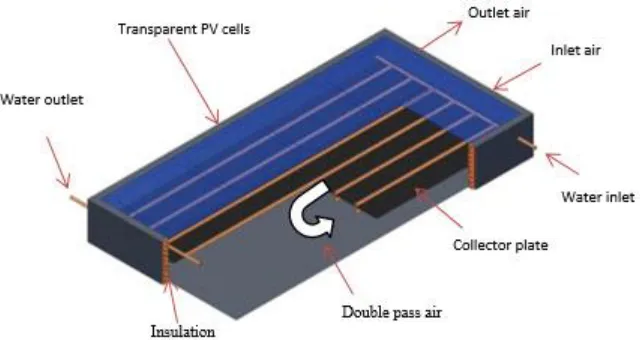
The solar collector build and tested in Solar Energy Laboratory, Faculty of Science and Technology, University Kebangsaan Malaysia is a double pass air channel PV/T collector embedded with water tube on top and bottom of the collector plate. The design concept of this combination absorber is shown in Fig.1. Basic components of the collector namely transparent PV module, collector frame, collector plate completed with water tube and insulator. Specifications of this unit are given in Table 1.
A transparent PV module SPT-30M-80B is attached at the top part of the design system. Instead of absorb and convert sunlight to electricity energy on the solar cells surface, it is also allows the light passing through to reach the collector plate. Hence, thermal energy associated with PV module and heat trap at the air channel are absorbed by air and water absorber. The module also is important acts as the glass cover for collector system. The electrical properties of PV panel given from the manufacturer are shown in Table 2 and Fig 2. The design of PV/T combination system that is consist in a transparent PV cell as a cover. The air flow in double bass in two channels and a water flow in copper water tubes also in upper and lower channel. The purpose of this system to produces three applications in one system as reported by (Tabook . 2014a). The whole absorber and the transparent PV module are encased on side and bottom with two sheet of aluminium painted with black paint sandwiched between fibre glass. The selection of both materials is not only to reduce the heat loss to environment, but it is also cost saving. The black paint is to enhance the proportion of heat absorption and reduce the reflection of radiation.
727
Table 1. Specifications of solar collector PV/T Combination
No. Components Dimensions
1. Collector frame 123.0 cm x 240.0 cm x 15.5 cm 2. Collector plate 123.0 cm x 232.0 cm x 0.015 cm 3. PV module 120.0 cm x 100.0 cm
4. Thickness of insulator 5.5 cm 5. Diameter of water tube 1.9 cm 6. Quantity of water tube 9
Table 2. Typical electrical characteristics of transparent PV module
No. Electrical performance under STC Properties 1. Rated maximum power (Pmax) 80 W 2. Current at Pmax (Imp) 5.26 A 3. Voltage at Pmax (Vmp) 15.2 V 4. Short-circuit current (Isc) 5.9 A 5. Open-circuit voltage (Voc) 19.9 V
6. Dimensions 1200 mm x 1000 mm 7. Glass thickness 3.2 mm
8. Cell number 30 pieces
9. Weight 20 kg
All technical data at standard test condition (STC) AM = 1.5; E = 1000 W/m2; Tc = 25 oC
Figure 2. Photograph of transparent PV module
728
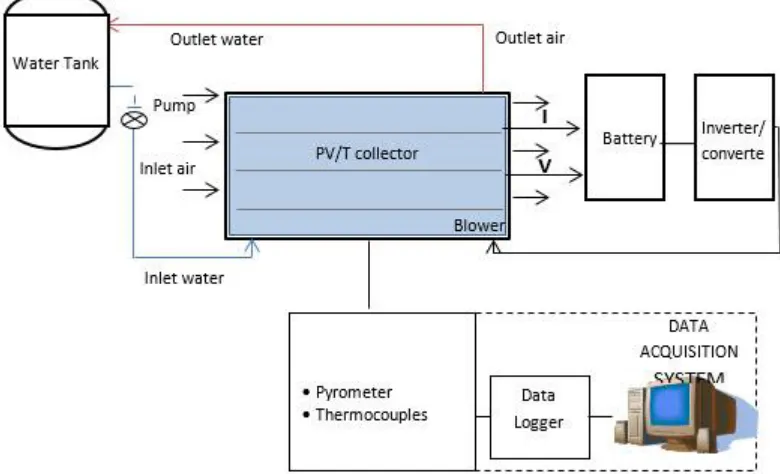
Figure 3. The full schematic diagram of data acquisition system in PVT system
Other than the collector, the PV/T Combi system also comprised of water storage tank, battery storage, data acquisition (DAQ) system and converter/inverter that linked to the load. The data logger modules involved in the testing are thermocouples and pyranometer. Eight thermocouples T- type is used to locate the temperature reading at every location as shown in Table 3. They are connected directly to the computer system, equipped with software to gathered and collect data from the experimental setup. A silicone gel and aluminium adhesive are used to close any holes at every corner in all parts of the collector system. The experiment is carried out in laboratory with manipulated variable parameters. Solar radiation from solar simulator is range from 350 W/m2 to 800 W/m2. Fluid
mass flow rate also is varies from 0.01 kg/s to 0.10 kg/s. The following responding parameters were measured during the experimentations as shown in Table 3 below.
Table 3. Parameters to determine the channel for data collection in the test
Hub Module Channel Parameter
T1 Fluid inside the system (Air +Water) (Tf) T2 Collector Plate (Tp)
T3 Inlet water (Twi) T4 Outlet water (Two) COM 1 4018-1 T5 Water tank (TTa)
T6 Inlet air (Tai) T7 Outlet air (Tao)
COM 2 Multimeter Ammeter
4018-2 T8 T9 S1 S2
PV cell temperature (TPV) Pyranometer
Current Voltage
3. Evaluation of corresponding data
During the tests, the electrical output of PV modules was connected to a load, simulating the real system operation. Values of current, I and voltage, V were recorded under ambient conditions, by using I-V curve. The electrical efficiency, ηel for system aperture area, Ac is calculated using relation:
m m el
c
I V
A G
729
Useful energy, Qu generally derived by Hottel-Whillier- Bliss equation is used to complete the calculation ofthermal conductivity, ηth. The efficiency is defined as a ratio of total useful energy of both air and water heat exchanger
to the total incident solar radiation is calculated using equation below:
u p o i
Q
m C
T
T
(2)
( ) ( )
u air u water th c
Q
Q
A G
(3)where
m
is fluid mass flow rate, Cp is heat removal fluid specific heat and (To – Ti) is the change of temperature. IfQu is the quantity of heat collected by the water, then the heat balance equation for the collector is given as
u c R L o i
Q
A F
G
U
T
T
(4)
with UL is the heat loss coefficient, FR is the heat removal factor which is calculated by
'
1 exp
w L c
R
L c
w
mC
U A F
F
U A
mC
(5)where F’ is the collector efficiency factor. Since water is flow in circular tubes in the testing, it is then calculated
from the following equation
'
1
1
1
1
L
t
fi t b L
U
F
m
W
Dh
DK
C
U
D
W
D
(6)where W is collector width, D is collector depth, hfi is heat transfer coefficient of fluid. The bond conductance, Cb can
be calculated as
b b
bk
C
(7)with kb is the bond thermal conductivity, γ is the bond average thickness and b is the bond width.
.
RESULTS AND DISCUSSION
730
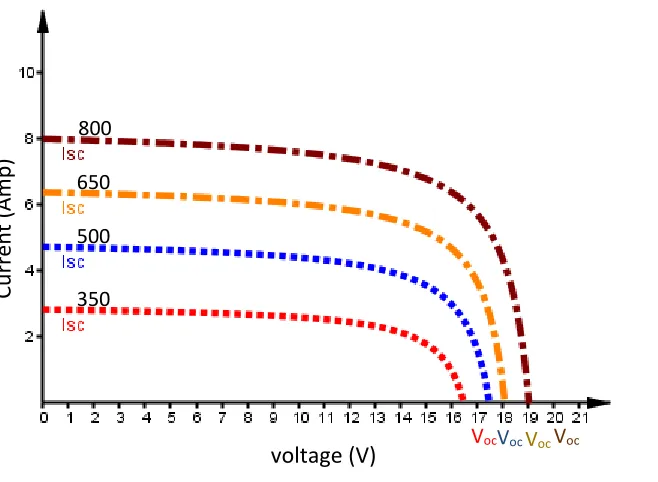
Experimental variables are water flow rate, which is set to 0.02, 0.04, 0.06, 0.08 and 0.10 kg/s, air flow rate at 0.01, 0.02, 0.03, 0.05 and 0.07 kg/s setting and solar radiation controlled at ranging levels of 350, 550, 650 and 800 W/m2.The electrical efficiency of our PV module can be defined by the equation (1) which has been previously discussed. Table 4. Shows the result of the PV module electrical efficiency. The open circuit voltage (Voc), and short
circuit current (Isc) were also measured as shown in Figure 4.
Table 4. Characteristic of PV module with various solar radiations
Solar radiation (W/m2) Current Isc (Amp) Voltage V oc (V)
Maximum power Pmax(W)
Fill Factor (FF)
Electrical efficiency, ηel (%)
350 3.0 16.0 48.0 0.738 13.71
500 5.0 17.6 88.0 0.730 17.60
650 6.6 18.0 118.8 0.721 18.30
800 8.0 19.0 159.6 0.715 19.95
Figure 4. The (Voc) and (Isc) curves of PV modules under various solar radiations
The increasing of solar intensity results an increment on the maximum power of solar cells, the fluid outlet temperature, the combination of useful energy and the electrical efficiency. Nevertheless, the impact shows an opposite behaviour to the combination of thermal efficiency.
The overall evaluation indicated that when both fluid mass flow rate and solar radiation are set to maximum setting, the calculated electrical and thermal efficiency achieved the highest value for both medium. The best results obtained for both efficiencies are at 0.05 kg/s air mass flow rate and 0.02 kg/s water mass flow rate. The total thermal efficiency of the Combi system is 76% with an average outlet temperature of 27.4oC. The electrical efficiency is found
at 17% with average electrical power of 145 W, during the time period of 90 minutes at 800 W/m2 solar intensity as
shown in Table 5 and Figure 5.
Table 5. Results of water and air heating on PV/T Combi system
Solar radiation, G (W/m2)
Maximum power, Pmax (W)
Change of temperature ΔTcombi
Total useful energy, Qcombi (J)
Total thermal efficiency, ηth (%)
Electrical efficiency, ηel (%)
350 48.0 12.0 743.80 73.79 12.0
500 88.0 16.2 1022.0 70.97 14.6
650 118.8 20.5 1717.3 70.25 16.4
800 159.6 24.8 1926.6 70.09 17.6
.
C
u
rre
n
t
(Amp
)
voltage (V)
Voc
V
ocVoc
V
oc731
CONCLUSIONThe evaluation of PV/T Combi system in terms its electrical and thermal efficiency has been presented. The responding results are affected by the manipulation of solar intensity and mass flow rate of air and water. The increment of solar intensity contributes to enhancement of outlet temperature of both fluid and electrical power of the whole system. Mass flow rate play an important factor for cooling effect on PV solar cells by reducing the outlet temperature in the channel and tubes.
The upgrading system by combining both type of heat carrier mode is to offer better performance of PV/T technology as well as to gain higher efficiencies. The combination of two systems is also to cover the limitations and weaknesses of independent PV/T water and air heat collector systems. In terms of economy aspect, the combination as one unit system offer low construction cost and offer short payback time period.
Acknowledgement
The author would like to thank Faculty of Science and Technology (FST), University Kebangsaan Malaysia and Ministry of Science, Technology and Innovation Malaysia for funding this research project through the grant PRGS/1/11/TK/UKM/01/12 and UKM-DLP-2011-053. We also would like to express our gratitude to the referees and the editor for their helpful comments.
REFERENCES
Assoa YB, Menezo C, Fraisse G, Yezou R and Brau J. 2007. Study of a new concept of photovoltaic-thermal hybrid collector. Solar Energy; 81:1132-43.
Bakar MNA, Othman M, Din M, Manaf NA and Harimi H. 2013. Design concept and mathematical model of a bi-fluid photovoltaic/thermal (PV/T) solar collector. Paper presented at the World Renewable Energy Congress, Murdoch University, Perth, Australia.
Bergene T and Lovvik OM. 1995. Model calculations on a flat plate solar heat collector with integrated solar cells. Solar Energy; 55(6):453-62.
BP, Statistical Review of World Energy. 2013. Energy Information Administration EIA Available from〈www.eia.gov/cfapps/ipdbproject/IEDIndex3.cfm?tid=44 energy_2013.pdf〉.
Florschuetz LW. 1979. Extension of the Hottel-Whillier model to the analysis of combined photovoltaic/thermal flat plate collectors. Solar energy; 22:361-6.
Garg HP and Adhikari RS. 1999. Performance analysis of a hybrid photovoltaic/thermal (PV/T) collector with integrated CPC troughs. International Journal of Energy Research; 23:1295-1304.
Hamid SA, Othman MY, Sopian K and Zaidi SH. 2014. An overview of photovoltaic thermal combination (PV/T Combi) technology. Renewable and Sustainable Energy Reviews; 38:212-22.
Kern JE and Russell MC. 1978. Combined photovoltaic and thermal hybrid collector systems. In: Proceedings 13th IEEE photovoltaic specialists. Washington DC, USA; p.1153-1157.
Lalovic B. 1987. A hybrid amorphous silicon photovoltaic and thermal solar collector. Solar cells; 19:131-8. Lonngren KE and Bai EW. 2008. On the global warming problem due to carbon dioxide. Energy Policy; 38:1567-8.
Tabook MA , Othman MY, Sopian K and Ruslan MH. 2014a. A Review Paper on PV/T Combination Flat Plate Collector System and Design. World Essays Journal, 1(1):1-5.
Tabook MA, Othman M, Sopian K and Ruslan M. 2014b. Developing A New Design Of PV/T Combination Flat Plate Collector System. Applied Science Report, 2 (1), 27-31.
Tabook MA , Othman MY, Sopian K and Ruslan MH. 2014c. Double glass PV cell efficiency in PV/T combination water and air heating flat plate collector system. Journal of Novel Applied Sciences JNAS Journal, 3 (S2): 1629-1634.
Tripanagnostopolous Y, Nousia TH and Souliotis M. 2001. In: Proceeding of the 17th European PV Solar Energy Conference.
Munich, Germany; p. 2515-18.
Wolf M. 1976. Performance analyses of combined heating and photovoltaic power systems for residences. Energy Conversio; 116:79-90.
www.bp.com/content/dam/bp/pdf/statistical-review/statistical_review_of_world_