41 International journal of Medical Investigation
Review article
Illness behaviour: normal to abnormal- a selective systematic review of
research from india
Geetha Desai
1, Gayatri Saraf
2, Santosh K Chaturvedi
31-Department of Psychiatry, NIMHANS, Bangalore, India
2- Senior Resident, Bhopal Memorial Hospital and Research Centre, Bhopal, India
3- FRCPsych, Professor, Department of Psychiatry, NIMHANS, Bangalore, India
Corresponding author: Geetha Desai Email: [email protected]
Abstract
Objective: Illness behaviour is an important concept studied across various medical conditions. It determines the
ways person respond and react to their health status and has significant impact on the health systems and individual. However, there are no systematic reviews on this important topic. To do a selective systematic review of researches done in India on illness behaviours across different health conditions.
Methods: Journal articles were identified through search on the PubMed, Medline, PsychInfo electronic databases
from 1970 to 2015 with the search terms (Illness behaviour, India, Abnormal illness behaviour). The full articles were reviewed to identify measures used and important findings were extracted and summarised.
Results: There were 15 studies which were based on patients and two review articles (non-systematic). The studies
on illness behaviour focused on somatoform disorders, tuberculosis and stroke. Scales used for assessment included Illness Behaviour Questionnaire (IBQ), Illness Behaviour Assessment Schedule (IBAS) and Screening for Illness Behaviour Questionnaire (SIBQ). No studies were found on intervention for abnormal illness behaviour.
Conclusion: Illness behaviours are an important aspect of somatoform disorders. It is difficult to draw conclusions
due to relatively small number of studies. More studies including randomised control designs are needed to understand patterns of illness behaviour across disorders.
Keywords: Illness behaviour, somatoform disorders, multiple somatic complaints, systematic review, India. .
Introduction
The concept of Illness behaviour was introduced by Mechanic in 1962 (1) . Illness Behaviour is defined as `the ways in which given symptoms may be differentially perceived, evaluated and acted (or not acted) upon’. Mechanic further described illness behaviour as 'the varying perceptions, thoughts feelings and acts, affecting the personal and social meaning of symptoms, illness, disabilities and their consequences. In 1964, Parsons (2) described the concept of sick role, which has some overlap with the concept of illness behaviour. The sick role is characterized by features, such as recognition that the individual is not held responsible for the primary illness, normal social functioning is modified proportionate to the severity of the illness, the ill
person is obligated to strive to return to a healthy state, for the above the person has to seek help and cooperate in the process of getting well. Sick roles are dynamic, changing with severity and phase of illness. The person may move in and out or between various phases. Also, what may be acceptable at one stage may be abnormal in another.
On the other hand, in 'normal' illness behaviour the type of sick role accepted or sought by the patient is proportionate to the clinician’s assessment of objective pathology and congruent with the sick role assumed. However, if the patient’s illness behaviour is disproportionate to the clinician’s assessment of objective pathology and patient persists in the sick role then this is a form of abnormal illness
42 International journal of Medical Investigation behaviour. The concept of abnormal illness
behaviour [AIB] was introduced in 1969 by Issy Pilowsky (3). AIB is also known as Dysnosognosia. The elements of definition of AIB are as follows are the persistence of a maladaptive mode of experiencing, perceiving, evaluating, and responding to one’s own health status, despite the fact that a doctor has provided a lucid and accurate appraisal of the situation and management to be followed (if any), with opportunities for discussion, negotiation, and clarification, based on adequate assessment of all relevant biological, psychological, social and cultural factors.
Illness behaviour has been studied in different populations. . The groups that have been studied include general practice (4-7), Myocardial Infarctions patients (8, 9), patients with arthritis (10,11), and patients with chronic fatigue syndrome (12,13), patients with stroke (14), Cancer (15) , HIV (16), Multiple sclerosis (17) ,chronic pain ( 18-22) and in psychiatric patients (23-25).
Illness behaviour has been measured by using various measures which include Illness Behaviour questionnaire (IBQ) (26), Screening for abnormal Illness Behaviour Questionnaire, SIBQ (27, 28) , Illness Behaviour Assessment Schedule (IBAS) (29) and Illness Attitude scales (30). The role of abnormal illness behaviour in patients can significantly impact on health behaviours ranging from denial to excessive help seeking. Most of the studies that have been conducted are form different parts of the world.
The current review was done to draw conclusions of patterns of illness behaviour in different conditions, within India
Aim of the review
Aim of this review was to understand different perspectives of Illness behaviour in subjects with different health conditions within India in order to have a better understanding and clear definition about this concept. In this way, this is a selective systematic review, focussing in Indian studies.
The main objectives of this review were
To conduct a systematic review on studies and other articles regarding Illness behaviour, identify the different measures used and findings of studies on Illness behaviour in Indian setup.
Methods
The methods involve a selective systematic review of the information available on illness behaviour, health anxiety, abnormal illness behaviour in India. This is based on published literature on this subject. The following steps of conducting Systematic Reviews were adopted:
1. Defining the appropriate question: What
are the patterns of illness behaviour in various clinical populations in India.
2. Searching the literature: The literature
search was be performed systematically by the search of websites Medline/Pubmed, and additional hand search from the five commonest Indian journals which publish psychiatric articles like, Indian Journal of Psychiatry, Indian Journal of Psychological Medicine, NIMHANS Journal, Indian Journal of Social Psychiatry and Archives of Indian Psychiatry. The keywords systematic review and illness behaviour did not yield any articles. The keywords to be used for literature search were ‘Illness behaviour, Abnormal Illness behaviour, Health Anxiety, Sick role, Illness behaviour Questionnaire. Articles based on studies done in Indian population only were included.
3. Inclusion criteria for studies: Studies based
on adult subjects [above 16 years], from Indian community, general population sample only were included.
4. Assessing the Studies: Once all possible
study reports are identified and collected, each study will be assessed for eligibility for inclusion, study quality and reported findings.
5. Combining the results: The findings from
the individual research studies will be compiled, both qualitatively and quantitatively, and the research findings will be tabulated. Meta-analysis will not be done at this stage. However, relevant sub group analysis will be attempted where ever feasible.
6. Placing the findings in context: The
findings from the studies will be discussed to put them in context, clinical relevance of illness behaviour, impact of illness behaviour on health resources.
7. Report preparation: A structured report
was prepared stating aims, describing the methods, inclusion and exclusion criteria, and summarizing main findings on Illness behaviours in the Indian setting.
Results
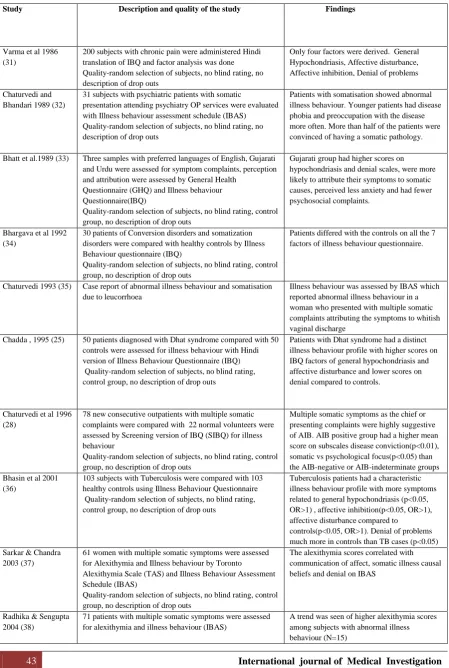
The details of the studies are provided in Table 1. The studies were from diverse backgrounds including psychiatric outpatients with somatic symptoms or chronic pain (10), Asians in United Kingdom (1), Dhat syndrome (2), Tuberculosis (2), stroke (1) and some case reports (3) and one commentary. There were two narrative review articles on illness behaviours which have not been included in the above table as they were not patient based reports. (45, 46)
43 International journal of Medical Investigation Table 1: Details of the studies on illness behaviour
Study Description and quality of the study Findings
Varma et al 1986 (31)
200 subjects with chronic pain were administered Hindi translation of IBQ and factor analysis was done Quality-random selection of subjects, no blind rating, no description of drop outs
Only four factors were derived. General Hypochondriasis, Affective disturbance, Affective inhibition, Denial of problems
Chaturvedi and Bhandari 1989 (32)
31 subjects with psychiatric patients with somatic
presentation attending psychiatry OP services were evaluated with Illness behaviour assessment schedule (IBAS) Quality-random selection of subjects, no blind rating, no description of drop outs
Patients with somatisation showed abnormal illness behaviour. Younger patients had disease phobia and preoccupation with the disease more often. More than half of the patients were convinced of having a somatic pathology.
Bhatt et al.1989 (33) Three samples with preferred languages of English, Gujarati and Urdu were assessed for symptom complaints, perception and attribution were assessed by General Health
Questionnaire (GHQ) and Illness behaviour Questionnaire(IBQ)
Quality-random selection of subjects, no blind rating, control group, no description of drop outs
Gujarati group had higher scores on hypochondriasis and denial scales, were more likely to attribute their symptoms to somatic causes, perceived less anxiety and had fewer psychosocial complaints.
Bhargava et al 1992 (34)
30 patients of Conversion disorders and somatization disorders were compared with healthy controls by Illness Behaviour questionnaire (IBQ)
Quality-random selection of subjects, no blind rating, control group, no description of drop outs
Patients differed with the controls on all the 7 factors of illness behaviour questionnaire.
Chaturvedi 1993 (35) Case report of abnormal illness behaviour and somatisation due to leucorrhoea
Illness behaviour was assessed by IBAS which reported abnormal illness behaviour in a woman who presented with multiple somatic complaints attributing the symptoms to whitish vaginal discharge
Chadda , 1995 (25) 50 patients diagnosed with Dhat syndrome compared with 50 controls were assessed for illness behaviour with Hindi version of Illness Behaviour Questionnaire (IBQ) Quality-random selection of subjects, no blind rating, control group, no description of drop outs
Patients with Dhat syndrome had a distinct illness behaviour profile with higher scores on IBQ factors of general hypochondriasis and affective disturbance and lower scores on denial compared to controls.
Chaturvedi et al 1996 (28)
78 new consecutive outpatients with multiple somatic complaints were compared with 22 normal volunteers were assessed by Screening version of IBQ (SIBQ) for illness behaviour
Quality-random selection of subjects, no blind rating, control group, no description of drop outs
Multiple somatic symptoms as the chief or presenting complaints were highly suggestive of AIB. AIB positive group had a higher mean score on subscales disease conviction(p<0.01), somatic vs psychological focus(p<0.05) than the AIB-negative or AIB-indeterminate groups Bhasin et al 2001
(36)
103 subjects with Tuberculosis were compared with 103 healthy controls using Illness Behaviour Questionnaire Quality-random selection of subjects, no blind rating, control group, no description of drop outs
Tuberculosis patients had a characteristic illness behaviour profile with more symptoms related to general hypochondriasis (p<0.05, OR>1) , affective inhibition(p<0.05, OR>1), affective disturbance compared to
controls(p<0.05, OR>1). Denial of problems much more in controls than TB cases (p<0.05) Sarkar & Chandra
2003 (37)
61 women with multiple somatic symptoms were assessed for Alexithymia and Illness behaviour by Toronto
Alexithymia Scale (TAS) and Illness Behaviour Assessment Schedule (IBAS)
Quality-random selection of subjects, no blind rating, control group, no description of drop outs
The alexithymia scores correlated with communication of affect, somatic illness causal beliefs and denial on IBAS
Radhika & Sengupta 2004 (38)
71 patients with multiple somatic symptoms were assessed for alexithymia and illness behaviour (IBAS)
A trend was seen of higher alexithymia scores among subjects with abnormal illness behaviour (N=15)
44 International journal of Medical Investigation
Study Description and quality of the study Findings
Quality-no details on selection of subjects, no blind rating, no control group, no description of drop outs
Perme et al 2004 ( 39)
29 patients with Dhat syndrome, 32 medical controls were assessed using
Somatization Screening Index (SSI), the screening version of the Illness Behaviour Questionnaire (SIBQ), Somatosensory Amplification Scale (SAS), Whitley Index
(WI) and Chalder Fatigue Scale
Quality-random selection of subjects, no blind rating, control study, no description of drop outs
Dhat patients scored significantly higher on the SSI, WI and SIBQ than controls. Dhat syndrome patients had
higher scores on measures of hypochondriacal beliefs, abnormal illness behaviour, somatic symptoms and fatigue as compared to controls.
Chaturvedi et al 2012 (40)
Case report of patient with asneezia assessed illness behaviour by IBQ
High scores on disease conviction, somatic focus, gross affective disturbance, rejection of psychological explanation,
denial of life stress, and irritability. Scores on Hypochondriasis subscale were also high Ali et al 2013 (41) 82 patients with Tuberculosis and 82 with other respiratory
disorders were compared for illness behaviour by IBQ Quality-random selection of subjects, no blind rating, control study, no description of drop outs
Low socio-economic status lead to more illness behaviour in TB patients. Among TB patients, illness behaviour was more in patients who were married, lived in joint families and were living in rural areas.
Desai et al 2013 (42) Case report of patient with post orgasmic illness syndrome assessed illness behaviour by IBQ
The IBQ scores indicated high levels of general hypochondriasis (6/9), disease conviction (6/6), high scores on affective distress, irritability and affective inhibition. There (pilowsky, 1969)
was high level of denial of significant stressors. Desai & Chaturvedi
2014 (43)
Fibromyalgia and illness behaviour (comments) It highlighted the dilemmas of illness behaviour in fibromyalgia
Desai et al 2014 (44) 8 Subjects admitted to neurorehabilitation centre were assessed for abnormal illness behaviour by SIBQ
Quality-purposive sampling, no blind rating, no control group, no description of drop outs
The mean score of SIBQ was 6.125 ± 1.35. With the cut off score of 7, five subjects had abnormal illness behavior
Regarding the quality of the studies six were studies with control groups, either of healthy normal (5) or with medical controls (1) or respiratory disease (1). Two studies conducted factor analysis. The factors on IBQ found were as follows. In a study on adaptation of IBQ after translation in Chronic pain syndromes, the factors found were General Hypochondriasis, Affective disturbance, Affective Inhibition, and Denial.
In a recent study on factor analysis of IBQ on subjects with chronic pain and somatic symptoms the factors identified were Health concerns, Affective disturbances with Psychosocial stressors, Affective Inhibition and Bodily Distress (47). The commonest instruments for assessment of illness behaviour in these studies were illness behaviour questionnaire (7), Illness Behaviour Assessment Schedule (IBAS) (2), Screening for
Illness Behaviour Questionnaire (2) and Whitley’s Index (1).
This review indicates that the commonest patterns of illness behaviour noted were hypochondriasis (6) preoccupation with disease/ somatic disease conviction (6) affective disturbance (3), affective inhibition (2) and disease phobia (1). Denial as a form of illness behaviour was noted to be high in three studies and low in two studies. One study used total illness behaviour score and it is not possible to comment on the pattern.
Discussion
The findings from this systematic review are difficult to interpret due to limited number of studies on illness behaviour, and in different conditions like somatization, dhat syndrome, tuberculosis and chest diseases. There should be larger number of studies
45 International journal of Medical Investigation on these disorders to enable us to make justifiable
conclusions. These studies on Dhat syndrome and somatoform disorders indicate that these are the disorders where abnormal illness behaviour is expected. It was a pleasant surprise to find two studies on tuberculosis and respiratory diseases. It might be that the latter diseases were studied because drug compliance for TB and chest diseases is influenced by illness behaviour.
It might actually be of relevance to study illness behaviour in such disorders which are chronic and where compliance and adherence are major factors for management. One could recommend that illness behaviour be further studied in Cardiovascular, rheumatological and immunological disorders. There are no systematic reviews on illness behaviours in the literature, however narrative reviews on abnormal illness behaviour pertaining to theoretical constructs, factors influencing illness behaviour and assessment have been published (48,49, 50). Studies from different countries on illness behaviour have focussed on various medical and psychiatric conditions unlike Indian setting where studies have focussed predominantly on somatoform disorders.
Another observation of this selective systematic review is the confirmation of hypochondriasis and somatic disease conviction. These are improtant parts of abnormal illness behaviour and can only be addressed by appropriate assessment and communciation by the physicians.
Interestingly, Denial has emerged as a factor which is diagonally opposite in the various studies. Some studies specially on somatic symptoms report denial to be present, however a study on Dhat syndrome and another on Tuberculosis indicated low scores on Denial. This is not surprising for Dhat syndrome where the occurrence of symptom is attributed to loss of semen/ vital fluid and not psychosocial stressors. Likewise, Denial of problems was much less in persons with Tuberculosis as compared to healthy controls which might be due to occurrence of psychosocial stressors being perceived more by healthy controls rather than person with tuberculosis.
The findings of the review are of significance as six of the studies had a control group giving a higher quality score to the studies. The three case reports only indicate a trend towards abnormal illness behaviour and encourage further studies.
Studies on factor analysis of IBQ are of great significance as they indicate different factor structures in different studies. It is difficult to interpret this observation, however one would suggest that factor analysis be performed for each study. Alternatively, there is a need to develop indigenous illness behaviour questionnaire starting
with qualitative studies to identify items of relevance in Indian studies.
Conclusion
Illness behaviour definitely emerges as important variable in health care of persons with not only bodily symptoms but also those with chronic diseases with adherence problems. Comorbid mental health conditions like depression, anxiety and somatoform disorders are likely to influence the pattern of illness behaviours. It is difficult to conclude from this selective systematic review and more studies would help in future to delineate definitive patterns of illness behaviour. The low number of studies on this topic, and the observations in this selective review indicate the need of many more studies on patterns of ill ness behaviour, which would lead to a more comprehensive systematic review. It is necessary to conduct systematic reviews across different settings and disorders on persons with bodily symptoms and illness behaviour.
References
1. Mechanic D. The concept of illness behavior. J Chronic Dis. 1962 Feb;15:189-94. 2. Parsons T. Social structure and Personality London: 1964; Collier MacMillan
3. Pilowsky I. Abnormal illness behaviour. Br J Med Psychol. 1969; 2: 347-51.
4. Pilowsky I, Smith QP, Katsikitis M. Illness behaviour and general practice utilization: a prospective study. J Psychosom Res.
1987;31(2):177-83.
5. Fava GA, Zielezny M, Pilowsky I, Trombini G. Patterns of depression and illness behaviour in general hospital patients. Psychopathology.1984;17(3):105-9.
6. Fava GA, Pilowsky I, Pierfederici A,
Bernardi M, Pathak D. Depressive symptom and abnormal illness behavior in general hospital
patients. Gen Hosp Psychiatry 1982; 4(3): 171-8. 7. Scicchitano J, Lovell P, Pearce R, Marley J, Pilowsky I. Illness behavior and somatization in general practice. J Psychosom Res. 1996
Sep;41(3):247-54.
8. Byrne DG, Whyte HM. Dimensions of illness behaviour in survivors of myocardial infarction. J Psychosom Res. 1978;22(6):485-91. 9. Pilowsky I, Spence ND, Waddy JL. Illness behaviour and coronary artery bypass surgery. J Psychosom Res. 1979; 23: 39-44.
10. Ahern MJ, McFarlane AC, Leslie A, Eden J. Illness behaviour in patients with arthritis. Ann Rheum Dis. 1995;54:245-50.
11. Murphy S, Creed F, Jayson MIV. Psychiatric disorders and illness behaviour in
46 International journal of Medical Investigation rheumatoid arthritis. Br J Rheumatol 1988;
27:357-363.
12. Schweitzer R, Robertson DL, Kelly B, Whiting J. Illness behaviour of patients with chronic fatigue syndrome. J Psychosom Res. 1994;38:41-9.
13. Trigwell P, Hatcher S, Johnson M, Stanley P, House A. Abnormal illness behaviour in chronic fatigue syndrome and multiple sclerosis. BMJ. 1995;311:15-8.
14. Clark MS, Smith DS. Abnormal illness behaviour in rehabilitation from stroke. Clin Rehabil. 1997 May;11(2):162-70.
15. Grassi L, Rosti G. Psychiatric and psychosocial concomitants of abnormal illness behaviour in patients with cancer. Psychother Psychosom. 1996; 65:246-252
16. Grassi L, Righi R, Makoui S, Sighinolfi L, Ferri S, Ghinelli F. Illness behaviour, emotional stress and psychosocial factors among
asymptomatic HIV infected patients. Psychother Psychosom. 1999; 68:31-38.
17. Merz EL, Malcarne VL, Roesch SC, Shariff R, Harper BE, Draeger HT et al. Measuring illness behavior in patients with systemic
sclerosis. Arthritis Care Res. 2013; 65(4): 585-593. 18. Joyce PR, Bushnell JA, Walsh JW, Morton JB. Abnormal illness behavior and anxiety in acute non-organic abdominal pain. Br J
Psychiatry. 1986;159: 57-62.
19. Keefe FJ, Crisson JE, Maltbie A, Bradley L, Gil KM. Illness behavior as a predictor of pain and overt behavior patterns in chronic low back pain patients. J Psychosom Res. 1986;30:543-51 20. Pilowsky I, Chapman R, Bonica JJ. Pain, depression and illness behaviour in a pain clinic population. Pain. 1977; 4: 183-92.
21. Pilowsky I, Katsikitis M. A classification of illness behaviour in pain clinic patients. Pain. 1994;57:91-4.
22. Pilowsky I, Spence ND. Patterns of Illness behaviour in patients with Intractable pain. J Psychosom Res. 1975; 19; 279-287.
23. Guo Y, Kuroki T, Koizumi S. Abnormal illness behavior of patients with functional somatic symptoms: relation to psychiatric disorders. Gen Hosp Psychiatry. 2001; 23: 223-229
24. Chaturvedi SK, Bhandari S, Rao S. Illness behaviour assessment of psychiatric patients with somatic presentation. Indian J Psychiatry. 1988 Apr;30(2):205-8.
25. Chadda RK. Dhat syndrome: is it a distinct clinical entity? A study of illness behaviour characteristics. Acta Psychiatr Scand. 1995 Feb;91(2):136-9.
26. Pilowsky I and Spence ND. Manual for the Illness behaviour questionnaire (IBQ). 2nd
edition, Adelaide, South Australia: University of Adelaide. 1983a.
27. Pilowsky I, Murrell TG, Gordon A. The development of a screening method for abnormal illness behaviour. J Psychosom Res. 1979;23(3):203-7.
28. Chaturvedi SK, Bhandari S, Beena MB, Rao S. Screening for abnormal illness behaviour. Psychopathology. 1996;29(6):325-30.
29. Pilowsky I, Bassett D, Barrett R, Petrovic L, Minniti R. The Illness Behavior Assessment Schedule: reliability and validity. Int J Psychiatry Med. 1983-1984; 13(1):11-28.
30. Rief W, Ihle D, Pilger F. A new approach to assess illness behaviour. J Psychosom Res. 2003; 54:405–14.
31. Varma VK, Malhotra A, Chaturvedi SK. Illness behaviour questionnaire (IBQ): translation and adaptation in India. Indian J Psychiatry. 1986; 28:41-46.
32. Chaturvedi SK, Bhandari S, Rao S. Illness behaviour assessment of psychiatric patients with somatic presentation. Indian J Psychiatry. 1988 Apr;30(2):205-8.
33. Bhatt A, Tomenson B, Benjamin S. Transcultural patterns of somatization in primary care: a preliminary report. J Psychosom Res. 1989 Dec 31;33(6):671-80.
34. Bhargava SC, Mahla VP, Dogra R. Study of illness behaviour in hysterical patients. Indian J psychiatry. 1992;34(1):21.
35. Chaturvedi SK. Abnormal illness behaviour and somatisation due to leucorrhoea. Psychopathology. 1993;26(3-4):170-2.
36. Bhasin SK, Mittal A, Aggarwal OP, Chadha RK. Illness behaviour of tuberculosis patients undergoing DOTS therapy: A case-control study. Indian J Tuberc. 2001; 48(2):81-6.
37. Sarkar J, Chandra P. Alexithymia and illness behaviour among female Indian outpatients with multiple somatic symptoms. Indian J Psychiatry. 2003 Oct;45(4):229.
38. Radhika CR, Sengupta S. Alexithymia and illness behaviour among female Indian outpatients with somatic symptoms, Sarkar J. and Chandra P. Indian Journal of Psychiatry, Vol. 45, No. IV, 229-233. Indian J Psychiatry. 2004 Jan;46(1):84. 39. Perme B, Ranjith G, Mohan R,
Chandrasekaran R. Dhat (semen loss) syndrome : a functional somatic syndrome of the Indian
subcontinent?. Gen Hosp Psychiatry 2005; 27: 215-217
40. Chaturvedi SK, Desai G, Sharma MK. Asneezia – a medically unexplained symptom & abnormal illness behaviour: Review of literature & a case report. Arab Journal of Psychiatry, 175-177, 23(2), 2012.
47 International journal of Medical Investigation 41. Ali M, Imam F, Mallik S, Mehra RK,
Kumar P, Garg A. Effect of Social Factors on Tuberculosis Patients: A Comprehensive Illness Behaviour Study. Indian Journal of Pharmacy Practice. 2013;6(2).
42. Desai G, Sharma M & Chaturvedi SK. Medically unexplained symptoms explained! A case of post orgasmic illness syndrome. Indian Journal of Medical Case Reports, 2 (1), 18-20, 2013.
43. Desai G, Chaturvedi SK. Fibromyalgia and abnormal illness behaviour-a Catch 22. Indian Journal of Pain 25 (2), , 2014
44. Desai G, Waghmare A, Chaturvedi SK. Assessing abnormal illness behaviour in post stroke patients-a preliminary report. Indian J Psychol Med. 2014 Oct; 36(4): 397-9. p
45. Chaturvedi SK, Desai G, Shaligram D. Somatoform Disorders, Somatization And Abnormal Illness Behaviour Int Rev Psychiatry. 2006: 18(1) :75-80.
46. Duddu V, Isaac MK, Chaturvedi SK. Somatization, somatosensory amplification, attribution styles and illness behaviour: a review. Int Rev Psychiatry. 2006 Jan 1;18(1):25-33.
47. Desai G. Patterns of illness behaviour among subjects with chronic non organic pain. Unpublished Dissertation submitted to National Institute of Mental Health and Neuro Sciences (NIMHANS), Deemed University. 2015.
48. Young JT. Illness behavior: a selective review and synthesis. Sociology of Health & Illness 2004; 26:1–31.
49. Sirri L, Fava GA, Sonino N. The unifying concept of illness behavior. Psychother Psychosom. 2013;82(2):74-81
50. Pilowsky I. Aspects of abnormal illness behavior. Indian J Psychiatry. 1993 Jul;35(3):145-50.