Reimagine E-learning: a proposal for a 21st learning
framework
L.
Caporarello
1,*, A. Giovanazzi
2and B. Manzoni
11SDA Bocconi School of Management, and Department of Management and Technology, Bocconi University, Milano, Italy 2Bocconi University, Milano, Italy
Abstract
Keywords: E-learning, learning, future of learning, learning trends, tech-based learning, non tech-based learning, content analysis, case studies
Received on 30 November 2017, accepted on 13 December 2017, published on 19 December 2017
Copyright © 2017 L. Caporarello et al., licensed to EAI. This is an open access article distributed under the terms of the Creative Commons Attribution licence (http://creativecommons.org/licenses/by/3.0/), which permits unlimited use, distribution and reproduction in any medium so long as the original work is properly cited.
doi: 10.4108/eai.19-12-2017.153489
*Corresponding author. Email:[email protected]; authors are listed in alphabetical order
1. Introduction
In recent years, we witnessed a sharp rise in publications, as well as conference sessions, research reports and working papers related to the concept of learning [1]. The growing number of publications may imply that a greater understanding of the learning phenomenon is in act, but it is not always the case. There is a variety of conceptualizations and interpretations of learning, which occurs in multiple forms. On the one hand this variety has contributed to the richness of existing research, on the other hand it has increased, rather than reduced, the need for more clarity to advance further [2].
This increase is particularly boosted by a technological shift, which is occurring in the learning landscape [3, 4]. Indeed, technology has determined the rise of a number of learning methodologies and processes. Among these, the most explored one is “E-learning” [5], whose meaning is quickly evolving over time [6].
Apart from a few exceptions, which however adopted a more narrow scope on blended learning [7] and online learning [5], there is a lack of contributions providing a comprehensive overview of the phenomenon.
In this article, we take on the challenge of giving order to the multiplicity of terms and definitions around some concepts related to learning over the last twenty years, with the purpose to provide clarity among the different definitions and to propose a fruitful agenda for future research.
The remainder of this article is organized as follows. The second section describes the method we used to select the most cited article related to the concept of learning. In the third section we provide clarity about the complex definitions landscape of the most cited learning terms in the literature. In the forth section we discuss the use of these terms over the years and we depict some trends. In the fifth section we propose a framework for a learning model, which organizes the terms into models, modes and
on e-Learning
Research Article
methodologies and which clarifies interactions and interdependencies among them. In the sixth section we describe how instructional designers and instructors can apply this framework to design and deliver a course. To do so we use three case studies at the executive education level. Finally we conclude with some implications for future research as well as for practitioners.
2. Content analysis: overview of the
method
To ensure theoretical transparency, reliability, and validity, we followed a structured content analysis process
[8] about learning. We developed our sample by searching for “learning” on Google Scholar over a time frame of the last twenty years, and then listing what terms were used in combination with it.
We sampled articles, books, book chapters and conference proceedings. We did not take into considerations theses and unpublished materials. Although some authors argue that highly cited papers are not always indicative of impactful research [9], it is reasonable to consider that high citation rates do reflect a certain level of quality [10], thus we filtered for those cited at least 20 times. This resulted in 3,616 publications from 1997 to 2016, including 2,874 articles, 229 books, 56 book chapters and 457 conference proceedings, and in a list of 16 different terms: active learning, asynchronous learning, blended learning, cooperative learning, distance learning, e-learning, face-to-face learning, game-based learning, informal learning, mobile learning, non-formal learning, online learning, personalized learning, problem- based learning, project-based learning and synchronous learning.
3. Shedding light on multiple ways of
learning
Our analysis reveals a complex variety of conceptual definitions around learning. As table 1 shows, the 16 selected learning terms have different meanings but they also present an unfocused richness in the sense that definitions are sometimes confused [7, 11, 12], in overlap [13, 14] or combinable [15, 16].
First, confusion exists about many terms that remain poorly defined or “ill-defined” [28]. For example, face-to- face learning is hardly defined in the literature: despite being the most traditional and common way of learning, its definition is somehow given for granted across the articles dealing with it [49]. Several authors point out that there is “either no clear definition or a very vague reference to […] terms such as online course/learning, based learning, web-based training, learning objects or distance learning believing that the term can be used synonymously” [2]. For example problem-based learning
has been described both as a method [86] and as an educational strategy [11]. This lack of clarity is particularly evident for all the tech-based learning terms: confusion persists about blended learning [28], online learning [7], mobile learning [65] and e-learning [12].
For example, blended learning is defined as “the thoughtful integration of classroom face-to-face learning experiences with online learning experiences” [27] as well as “a description of particular forms of teaching with technology” [28]. Even project-based learning is described as “the theory and practice of utilizing real- world work assignments on time-limited projects to achieve mandated performance objectives and to facilitate individual and collective learning” [87] as well as “a student-driven, teacher-facilitated approach to learning. Learners pursue knowledge by asking questions that have piqued their natural curiosity. The genesis of a project is an inquiry” [88]. Mobile learning is also interpreted as either the learner or the device being mobile [65]. Finally, with regard to e-learning “although [it] has become a hot topic in training and education organizations around the globe, there is considerable variance in opinion about just what it is” [1].
Secondly, overlap in terms of meaning is evident across different concepts. For example cooperative learning and game-based learning are sometimes described similarly, in the sense that authors stress the fact of working together to accomplish goals or to develop an end product within a play framework [13, 14, 37, 54]. Mobile learning is seen as a more recent version of distance learning [2]. Online learning is also seen as a form of distance education where technology mediates the process [7]. E- learning often overlaps with most of the other learning terms here studied [1, 30, 78].
Finally, combinations occur with many terms. For example, blended learning is often combined with synchronous learning [15], mobile learning with synchronous learning [16], informal learning [67] or game-based one [57]; distance learning with synchronous learning [16], cooperative learning with distance learning [34, 84]. Problem-based learning is frequently addressed as a specific type of active learning [18], as well as project-based learning [87]. With regard to e-learning specifically, the term is often combined with personalized learning [78], mobile learning [16], synchronous learning [16], online learning [30], distance learning [30], and
asynchronous learning [1].
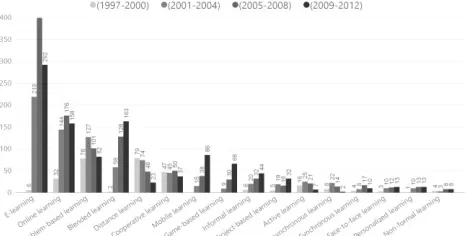
Blended learning, online learning but especially e- learning are the mainstream learning terms of the past fifteen years (see Figure 1††).
E-learning is the top trend learning term, but instead of growing up, it is decreasing in relative use, suggesting that it will not be probably on the edge in the future, at least not as in the past. Online learning increased a lot, reaching stability in the period 2009-2012. Finally, distance learning, that was the top mainstream learning term of the last years of the nineties, and according to many expected to grow [43], has been clearly replaced by the rapid growth of informal learning, game-based learning, mobile learning and, above all, blended learning.
Figure 1 - The use of learning terms over the years (1997-2012)
The past four years (2013-2016) show similarities as well as differences with the previous ones (Figure 2).
Figure 2 - The most recent trends (2013-2016)
E-learning remains the top first topic with 22.22% of citations. Mobile learning (16.26%) and blended learning (15,45%) are growing fast in terms of interest, as well as online learning (12.74%). Game based, problem based and informal learning are also debated terms in the literature and this possibly suggest the importance of
†† Citations after 2012 are not included because the number drops not a matter of less interest in the topic but as a matter of shorter time available for citations.
providing learning experiences which help participants and students “solve” real problems.
If we compare the “1997-2012 top terms list” with the “2013-2016 top terms list” (Table 2), we can see that blended learning, project-based and active learning have moved up, yet the really big move is the one of mobile learning (+5 places in the ranking) and game-based learning (+3 places). Distance learning has instead significantly moved down losing 6 places. In general we can see that the landscape is changing in favour to a more gamified and informal approach.
Table 2. Learning terms moving up and down in the ranking of the most cited ones
Number of places up
or down
Learning terms moving up and down in the ranking of the most cited ones
(1997-2012 vs. 2013-2016)
+5 Mobile learning
+3 Game-based learning
+2 Face-to-face learning Informal learning;
+1 Blended learning; Project-based learning; Active learning
0 E-learning; Synchronous learning; Personalized learning
-2 Online learning; Cooperative learning; Asynchronous learning
-3 Problem-based learning
-6 Distance learning
Another interesting trend in the literature is related to the fact that the top cited learning concepts are tech-based, showing how technology is radically changing the face of organizations [24, 50, 64].
Tech-based learning includes those terms where the use of technology is embedded and inevitable. Given this definition blended learning, e-learning, mobile learning, Online learning are tech-based concepts. The other 12 concepts are classified as non tech-based ones even if some of them can also rely on technology but it is not a “must have”.
Figure 3 shows that the citations of non tech-based learning have not increased from 1997 to 2008 and they have even decreased from 2009 onwards. Moreover, until the beginning of the new millennium, articles discussing non tech-based learning terms were up to six time more than the tech-based ones, while from 2005 onwards tech- based articles doubled the non tech-based ones, with an outstanding growth of 641% in only 10 years.
Figure 3 - Trends in using non tech-based and tech- based learning terms in the academic literature (1997-2012)
5. A proposed comprehensive learning
framework
In this section we intend to provide an answer to the following two questions: “Why are confusion and overlap about learning terms still in place?”; “Why can we combine some learning terms and not others?”. Referring to the first question, we argue that terms mean different things and that they are not all at the same level, even if they all include learning in their definition. Referring to the second question, we argue that we can combine terms across different levels and not within levels.
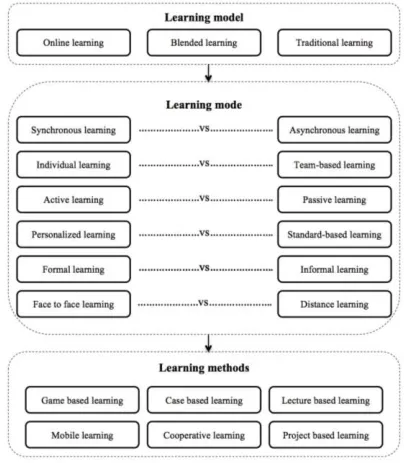
Thus, we intend to propose a learning framework (Figure 4) that organizes the different learning concepts into different levels.
Figure 4 - A comprehensive learning framework
The first level is the one of the learning model which is the set of general principles based on which an entire course is built upon. According to our interpretation of the literature,
The second level is the one of the modes which is composed by at least six couples of terms: synchronous vs. asynchronous, individual vs. team based, active vs. passive, personalized vs. standardized, face-to-face vs. distance, formal vs. informal learning. These couples of modes are dichotomies in the sense that within each couple of terms either we choose one mode or another. Within a course, a session cannot be synchronous and asynchronous or active and passive at the same time.
The difference between models and modes is that while in a course we can only have one learning model, we can have multiple modes, provided that we respect the dichotomies. For example, in a blended learning course (which cannot be online or traditional if blended) we can have sessions in a face to face learning mode and others in a distance learning mode; however, each session can also be multi-mode that means for example based at the same time on a face-to-face, active and individual learning approach.
The final level is the one of methods, where we can have at least six concepts. As for the modes, also for the methods we can have multiple learning methods within the same session and course. For example, a session can combine a game-based and a lecture based learning method.
Interactions and combinations can occur between terms across different levels (model-modes-methods) and, except for the model level, also within the levels. For example, a course can be based on a traditional or online or blended learning model. Given the chosen model, in terms of modes the sessions can be synchronous or asynchronous, they can require an individual learning or a team-based learning and they can involve participants in a more active or passive learning process. Different sessions can rely on different modes. Regarding the methods, they can also be combined within the same session, which can for example be case based and lecture based at the same time.
One learning concept – e-learning – eludes the categorization presented in this framework. In fact E- learning can result from different mixes of models, modes and methods. Blended learning, as well as online learning, is part of e-learning. Likewise, all other types of learning (e.g. active learning, formal learning, cooperative learning) can occur via learning. This makes the concept of e-learning, which is also the most diffused one in the literature, much more pervasive in the framework than any other term. This possibly suggests that, given the recent significant technological shift, e-learning and Learning are converging into the same concept.
6. The framework in practice: three case
studies from executive education
programs
In this section, we present three case studies‡‡ that exemplify how the proposed framework can be applied to the design of executive education initiatives. The first case study is an example of a program entirely taught online in terms of learning model.
Table 1. Exemplary definitions of learning concepts
Learning
concepts Exemplary quotations Exemplary references1
Active learning “Any instructional method that engages students in the learning process” [17]. “In active learning, the processing of knowledge also requires a problem solving orientation, a critical
approach and an evaluation of knowledge” [18] [17–21]
Asynchronous learning
“The use of the Internet to deliver anytime, anywhere” [22].
“In asynchronous settings, learning is self-paced, and users have access to previous activities
contributed by others from the same group” [23]. [22–25]
Blended learning
“A learning program where more than one delivery mode is being used with the objective of optimizing the learning outcome and cost of program delivery” [26].
“The thoughtful integration of classroom face-to-face learning experiences with online learning experiences” [27].
“A description of particular forms of teaching with technology. However, […] it remains ill-defined” [28].
[2, 28–32]
Cooperative learning
“A “catch all “phrase for group learning” [33].
“A structured form of group work where students pursue common goals while being assessed individually” [17].
“Distance learning has made possible several innovative means to include Cooperative learning in virtual pedagogical settings” [34].
[13, 17, 33– 37]
Distance learning
“Some authors will provide either no clear definition or a very vague reference to other terms such as online course/learning, web-based learning, web-based training, learning objects or distance learning believing that the term can be used synonymously” [2].
“[It] can be integrated into different learning situations, where distance equals either space or time; it can be a complement or a supplement to non-remote situations such as classroom or regular campus situations” [38].
[38–44]
E-learning
“Technology-based learning in which learning materials are delivered electronically to remote learners via a computer network [45].
“People now think of e-learning as an instructional approach, whereas e-learning is actually a delivery platform with an interesting set of capabilities” [12].
“All forms of electronically supported or mediated learning and teaching” [30].
[4, 12, 42, 46–48]
Face-to-Face
learning “A learning process where learners and experts are present physically in same place at same time” [49]. [25, 49–52]
Game-based learning
“[It] refers to the borrowing of certain gaming principles and applying them to real-life settings to engage users” [53].
“[It] is similar to problem based learning (PBL), wherein specific problem scenarios are placed within a play framework” [54].
[14, 54–58]
Informal learning
“It is learning that rests primarily in the hands of the learner and happens through observation, trial and error, asking for help, conversing with others, listening to stories, reflecting on a day's events, or stimulated by general interests” [59].
“All learning that occurs outside the curriculum of formal and non-formal educational institutions and
programs” [60]. [61–64]
Mobile learning
“Exactly what we mean by mobile learning is the subject of some debate. Does mobile learning refer to the mobility of learners - the idea that one can learn anytime and anywhere - or to the
portability/mobility of mobile devices themselves?” [65].
“Learning across multiple contexts, through social and content interactions, using personal electronic devices” [66].
“[It] can emphasize those unique attributes that position it within informal learning, rather than formal” [67].
[65, 67–70]
Non-formal learning
“An umbrella that gather corresponding theories on activity and inherent concepts related to ludic activities motivated by curiosity, exploration, play and aesthetics rather than externally defined tasks” [71].
“[It] encompasses informal learning which can be described as unplanned learning in work situations and elsewhere, but also includes planned and explicit approaches to learning introduced in work organisations and elsewhere, not recognised within the formal education and training system” [72]. “Out-of-school learning that is unstructured and does not follow a specific curriculum, such as a visit to a museum or science exhibit. […] has a specific structure and is connected to some kind of a syllabus or curriculum” [73].
[71–75]
Online learning
“Online and traditional distance education approaches do share common attributes, including the emphasis on “any time — any place” learning” [7].
“A form of distance education where technology mediates the learning process, teaching is delivered completely using the Internet, and students and instructors are not required to be available at the same time and place” [7].
“A more recent version of distance learning” [42].
[7, 42, 76, 77]
Learning
concepts Exemplary quotations Exemplary references2
Personalized learning
“Personalized learning aims to develop individualized learning programs for each student with the intent to engage him/her in the learning process to optimize each child’s learning potential and success”. [78].
“It advocates that instruction should not be restricted by time, place or any other barriers, and should be tailored to the continuously modified individual learner’s requirements, abilities, preferences,
background knowledge, interests, skills, etc” [79].
[78–83]
Problem-based learning
“A student-centred approach to learning which enables the students to work cooperatively in small groups for seeking solutions to situations/problems” [84].
“Problem based learning is an educational strategy. A method to organize the learning process in such a
manner that the students are actively engaged in finding answers by themselves” [11]. [11, 84–86]
Project-based learning
“The theory and practice of utilizing real-world work assignments on time-limited projects to achieve mandated performance objectives and to facilitate individual and collective learning” [87].
“A student-driven, teacher-facilitated approach to learning. Learners pursue knowledge by asking questions that have piqued their natural curiosity. The genesis of a project is an inquiry. Students develop a question and are guided through research under the teacher’s supervision. Discoveries are illustrated by creating a project to share with a select audience” [88].
[11, 87–89]
Synchronous learning
“Learning and teaching where remote students participate in face-to-face classes by means of rich-media synchronous technologies such as video conferencing, web conferencing, or virtual worlds” [15]. “[It] requires teachers and students to work together, albeit at a specific time, and focuses on
reconstructing the traditional in-class learning environment over the Internet” [16]. [15, 16, 90, 91]
The program is a management academy developed for a company operating in the logistic industry targeted to around 1300 employees. The entire program lasts approximately 10 months.
The program starts with a “check-up” which is a self- assessment allowing participants to test their knowledge about management. This check-up is an example of asynchronous, individual, personalized and distance learning in term of modes: each participant solves an online case study at any time within a timespan. At the end, he/she gets an individual personalized report summarising his/her own scores and suggesting areas of improvement. In terms of methods, this check-up relies upon the use of a case-based and game case-based learning. The second step of the Academy offers 5 modules on 5 specific topics. Each module includes an average of 5 online video classes with individual readings, self- assessments and discussion boards. In terms of modes, these are examples of asynchronous and individual learning where self-assessments allow for participants being active in their learning. In terms of methods, each video includes lectures, case discussions and short simulations.
The second case study is an example of a program based on a blended learning model. The program is developed for a financial services company. It is an 18 month-long master in finance and it is aimed at 40 employees.
The program is structured in 12 modules, where most of them are designed according to the blended learning model, which includes both online and face-to-face activities. Each learning module includes some online activities and face-to-face classes. The online activities include 2 hours for live office hours (synchronous sessions) and 8 asynchronous sessions through pre-recorded online classes with an average length of 15’ each. The synchronous sessions are an example of team-based learning because the learning process leverages on the interactions between the participants and facilitated by the instructor. The asynchronous sessions are instead an example of individual
learning because each participant can attend them when they prefer within a set timespan. Individual learning is also often fostered with individual graded assignments. With regards to the methods, each synchronous session includes a small lecture, a case-based discussion and a cooperative learning phase on group discussions and team-based graded assignments. Similarly, asynchronous sessions are also a mix of lectures, case discussions, web-based simulations, project work assignments.
The face-to-face class consists of 1 day of synchronous training with an instructor. In terms of mode, each day guarantees an active learning thanks to the combination of different learning methods (lectures, case studies, games – including role plays and simulations – action plan and project works).
The third case study is an example of a training program delivered according to a traditional learning model, which is entirely face-to-face with no online components. The program is targeted to 50 creative professionals and it aims at developing their leadership skills through a 4-days course. These 4 days are distributed over two months in two modules of two days each. In terms of modes, each module is characterised for synchronous, face-to-face, formal, active and team-based learning: participants get engaged in activities, which foster feedbacks from the peers and the instructor. Instructors rely on different methods including lectures, case studies and role-plays about effective one to one and one to many communications, and project-based learning opportunities (art lab, self-portrait experiential activities).
7. Conclusions
This paper aims at providing both a research and a managerial contribution in the field of learning.
From a research point of view, we shed light on the multiplicity of the most diffused learning-related concepts clarifying their meanings, showing their use over the past 20 years, highlighting major trends and presenting how the learning landscape is changing. We show that a technological shift occurred in academic research on learning, making scholars being increasingly interested in tech-based terms such as blended learning, online learning, mobile learning and of course e-learning. From a managerial point of view, we offer instructional designers and lecturers a comprehensive and detailed overview of all the available learning models, modes and methods they can use to design a course. We make these different possibilities clear in terms of definitions of the single learning terms and possible combinations between them. Through three real case studies we also exemplify how the different elements of the proposed framework can be used and combined to maximize the effectiveness of participants’ learning experience.
References
[1] Fallon C, Brown S (2016) e-Learning Standards: A Guide to Purchasing, Developing, and Deploying Standards- Conformant E-Learning. CRC Press.
[2] Moore N, Gilmartin M (2010) Teaching for better learning: A blended learning pilot project with first-year geography undergraduates. J Geogr High Educ 34:327–344.
[3] Garrison DR (2011) E-learning in the 21st century: A framework for research and practice. Taylor & Francis. [4] Welsh ET, Wanberg CR, Brown KG, Simmering MJ
(2003) E-learning: emerging uses, empirical results and future directions. Int J Train.
[5] Siemens G, Gasevic D, Dawson S (2015) Preparing for the digital university.
[6] Caporarello L, Iñesta A (2016) Make blended learning happen: conditions for a successful change process in higher education institutions. ICST Trans E-Educ E-Learn 3:e2.
[7] Joksimović S, Kovanović V, Skrypnyk O, et al (2015) The
history and state of online learning. Prep Digit Univ 93– 122. [8] Krippendorff K (2012) Content Analysis: An Introduction to
Its Methodology. SAGE.
[9] Waltman L, van Eck NJ, Wouters P (2013) Counting publications and citations: Is more always better? J Informetr 7:635–641. doi: 10.1016/j.joi.2013.04.001
[10] White HD (1990) Author co-citation analysis: Overview and defense. Sch Commun Bibliometr 84:106.
[11] Kolmos A (2009) Problem-Based and Project-Based
Learning. In: Skovsmose O, Valero P, Christensen OR (eds)
Univ. Sci. Math. Educ. Transit. Springer US, pp 261– 280. [12] Allen MW (2016) Michael Allen’s guide to e-learning:
Building interactive, fun, and effective learning programs for any company. John Wiley & Sons
[13] Johnson DW, Johnson RT, Stanne MB (2000) Cooperative learning methods: A meta-analysis.
[14] Sung H-Y, Hwang G-J (2013) A collaborative game-based learning approach to improving students’ learning performance in science courses. Comput Educ 63:43–51.
[15] Bower M, Dalgarno B, Kennedy GE, et al (2015) Design and implementation factors in blended synchronous learning environments: Outcomes from a cross-case analysis. Comput Educ 86:1–17.
[16] Huang Y-M, Kuo Y-H, Lin Y-T, Cheng S-C (2008) Toward interactive mobile synchronous learning environment with context-awareness service. Comput Educ 51:1205–1226. [17] Prince M (2004) Does active learning work? A review of the
research. J Eng Educ 93:223–231.
[18] Niemi H (2002) Active learning—a cultural change needed in teacher education and schools. Teach Teach Educ 18:763– 780.
[19] Jensen JL, Kummer TA, Godoy PD d M (2015) Improvements from a Flipped Classroom May Simply Be the Fruits of Active Learning. CBE-Life Sci Educ 14:ar5. [20] Roach T (2014) Student perceptions toward flipped learning:
New methods to increase interaction and active learning in economics. Int Rev Econ Educ 17:74–84.
[21] Michael J (2006) Where’s the evidence that active learning works? Adv Physiol Educ 30:159–167.
[22] Hiltz SR (1997) Impacts of college-level courses via asynchronous learning networks: Some preliminary results. J Asynchronous Learn Netw 1:1–19.
[23] Northey G, Bucic T, Chylinski M, Govind R (2015) Increasing student engagement using asynchronous learning. J Mark Educ 37:171–180.
[24] Rovai AP (2000) Building and sustaining community in asynchronous learning networks. Internet High Educ 3:285– 297.
[25] Ocker RJ, Yaverbaum GJ (1999) Asynchronous computer- mediated communication versus face-to-face collaboration: Results on student learning, quality and satisfaction. Group Decis Negot 8:427–440.
[26] Singh H, Reed C, others (2001) A white paper: Achieving success with blended learning. Cent Softw 1:1–11.
[27] Garrison DR, Kanuka H (2004) Blended learning: Uncovering its transformative potential in higher education. Internet High Educ 7:95–105.
[28] Oliver M, Trigwell K (2005) Can “blended learning”be redeemed? E-Learn Digit Media 2:17–26.
[29] Porter WW, Graham CR, Spring KA, Welch KR (2014) Blended learning in higher education: Institutional adoption and implementation. Comput Educ 75:185–195.
[30] Al-Qahtani AA, Higgins SE (2013) Effects of traditional, blended and e-learning on students’ achievement in higher education. J Comput Assist Learn 29:220–234.
[31] Moore MG (2005) Editorial: Blended learning. Am J Distance Educ 19:129–132.
[32] Graham CR (2013) Emerging practice and research in blended learning. Handb. Distance Educ. 3.
[33] Pedersen JE, Digby AD (2014) Secondary Schools and Cooperative Learning: Theories, Models, and Strategies. Routledge.
[34] Kupczynski L, Mundy MA, Goswami J, Meling V (2012)
Cooperative Learning in Distance Learning: A Mixed Methods Study. Online Submiss 5:81–90.
[35] Capar G, Tarim K (2015) Efficacy of the Cooperative Learning Method on Mathematics Achievement and Attitude: A Meta-Analysis Research. Educ Sci Theory Pract 15:553–559.
[36] Millis BJ, Cottell PG (1997) Cooperative Learning for Higher Education Faculty. Series on Higher Education. Oryx Press.
[38] Dijkstra S (2014) Instructional Design: International
Perspectives II: Volume I: Theory, Research, and
Models:volume Ii: Solving Instructional Design Problems. Routledge.
[39] Shukla N, Hassani H, Casleton R (2014) A Comparison of Delivery Methods for Distance Learning Mathematics Courses. SoTL Commons Conf.
[40] Simpson O (2013) Supporting students in online open and distance learning. Routledge.
[41] Lockwood F (2013) Open and distance learning today. Routledge
[42] Moore MG, Kearsley G (2011) Distance education: A systems view of online learning. Cengage Learning. [43] Galusha JM (1998) Barriers to learning in distance
education.
[44] Porter LR (1997) Creating the virtual classroom: Distance learning with the Internet. John Wiley & Sons, Inc. [45] Zhang D (2005) Interactive multimedia-based e-learning:
A study of effectiveness. Am J Distance Educ 19:149–162. [46] McCutcheon K, Lohan M, Traynor M, Martin D (2015) A systematic review evaluating the impact of online or blended learning vs. face-to-face learning of clinical skills in undergraduate nurse education. J Adv Nurs 71:255–270. [47] Tavangarian D, Leypold ME, Nölting K, et al (2004) Is e- Learning the Solution for Individual Learning?. Electron J E-Learn 2:273–280.
[48] Govindasamy T (2001) Successful implementation of e- learning: Pedagogical considerations. Internet High Educ 4:287–299.
[49] Singh AK, Yusoff MA, Oo N (2009) A comparative study between traditional learning and E-Learning. In: Proc. Teach. Learn. Open Forum 2009. CSM, Sarawak, pp 1–7. [50] Castaño‐ Muñoz J, Duart JM, Sancho‐ Vinuesa T (2014)
The Internet in face‐ to‐ face higher education: Can interactive learning improve academic achievement? Br J Educ Technol 45:149–159.
[51] Clegg T, Yip JC, Ahn J, et al (2013) When face-to-face fails: Opportunities for social media to foster collaborative learning. Tenth Int. Conf. Comput. Support. Collab. Learn. [52] Artino AR (2010) Online or face-to-face learning? Exploring
the personal factors that predict students’ choice of instructional format. Internet High Educ 13:272–276. [53] Pho A, Dinscore A (2015) Game-based learning. Tips Trends [54] Ebner M, Holzinger A (2007) Successful implementation of user-centered game based learning in higher education: An example from civil engineering. Comput Educ 49:873– 890. [55] Hamari J, Shernoff DJ, Rowe E, et al (2016) Challenging games help students learn: An empirical study on engagement, flow and immersion in game-based learning. Comput Hum Behav 54:170–179.
[56] Tobias S, Fletcher JD, Wind AP (2014) Game-based learning. In: Handb. Res. Educ. Commun. Technol. Springer, pp 485–503.
[57] Huizenga J, Admiraal W, Akkerman S, Dam G ten (2009) Mobile game‐ based learning in secondary education: engagement, motivation and learning in a mobile city game. J Comput Assist Learn 25:332–344.
[58] Papastergiou M (2009) Digital game-based learning in high school computer science education: Impact on educational effectiveness and student motivation. Comput Educ 52:1–12. [59] Dabbagh N, Kitsantas A (2012) Personal Learning
Environments, social media, and self-regulated learning: A natural formula for connecting formal and informal learning. Internet High Educ 15:3–8.
[60] Schugurensky D (2000) The forms of informal learning: Towards a conceptualization of the field.
Members’ Informal Learning and Team Commitment. J Manag 41:987–1016.
[62] García-Peñalvo FJ, Conde MÁ (2014) Using informal learning for business decision making and knowledge management. J Bus Res 67:686–691.
[63] Cox MJ (2013) Formal to informal learning with IT: research challenges and issues for e‐ learning. J Comput Assist Learn 29:85–105.
[64] Marsick VJ, Watkins KE (2001) Informal and incidental
learning. New Dir Adult Contin Educ 2001:25–34.
[65] Hockly N (2013) Mobile learning. ELT J 67:80–84. doi: 10.1093/elt/ccs064
[66] Crompton H (2014) A diachronic overview of technology contributing to mobile learning: A shift towards student- centred pedagogies. Increasing Access 7.
[67] Traxler J (2009) Current state of mobile learning. Mob Learn Transform Deliv Educ Train 1:9–24.
[68] Sharples M, Spikol D (2017) Mobile Learning. In: Duval E, Sharples M, Sutherland R (eds) Technol. Enhanc. Learn. Springer International Publishing, pp 89–96.
[69] Jones AC, Scanlon E, Clough G (2013) Mobile learning: Two case studies of supporting inquiry learning in informal and semiformal settings. Comput Educ 61:21–32.
[70] Martin F, Ertzberger J (2013) Here and now mobile learning: An experimental study on the use of mobile technology. Comput Educ 68:76–85.
[71] Petersson E (2006) Non-formal learning through ludic engagement within interactive environments. Malmö högskola, Lärarutbildningen.
[72] Bjornavold J (2000) Making Learning Visible:
Identification, Assessment and Recognition of Non-Formal Learning in Europe. ERIC.
[73] Garner N, Hayes SM, Eilks I (2014) Linking Formal and Non-Formal Learning in Science Education – A Reflection from Two Cases in Ireland and Germany. Sisyphus - J Educ 2:10–31.
[74] Gallacher J, Feutrie M (2003) Recognising and Accrediting Informal and Non‐ formal Learning in Higher Education: an analysis of the issues emerging from a study of France and Scotland. Eur J Educ 38:71–83.
[75] Colley H, Hodkinson P, Malcolm J (2002) Non-formal learning: mapping the conceptual terrain, a consultation report.
[76] Shea P, Bidjerano T (2014) Does online learning impede degree completion? A national study of community college students. Comput Educ 75:103–111.
[77] Huang H-M (2002) Toward constructivism for adult learners in online learning environments. Br J Educ Technol 33:27–37.
[78] Lin CF, Yeh Y, Hung YH, Chang RI (2013) Data mining for providing a personalized learning path in creativity: An application of decision trees. Comput Educ 68:199–210. [79] Sampson D, Karagiannidis C, Cardinali F (2002) An
architecture for web-based e-learning promoting re-usable adaptive educational e-content. Educ Technol Soc 5:27– 37.
[80] Kong SC, Song Y (2015) An experience of personalized learning hub initiative embedding BYOD for reflective engagement in higher education. Comput Educ 88:227– 240.
[81] Huang Y-M, Liang T-H, Su Y-N, Chen N-S (2012) Empowering personalized learning with an interactive e- book learning system for elementary school students. Educ Technol Res Dev 60:703–722.
[83] Chen C-M (2008) Intelligent web-based learning system with personalized learning path guidance. Comput Educ 51:787–814.
[84] Kong L-N, Qin B, Zhou Y, et al (2014) The effectiveness of problem-based learning on development of nursing students’ critical thinking: A systematic review and meta- analysis. Int J Nurs Stud 51:458–469.
[85] Walker AE, Leary H, Hmelo-Silver CE, Ertmer PA (2015) Essential Readings in Problem-based Learning. Purdue University Press.
[86] Wood DF (2008) Problem based learning. BMJ 336:971. [87] DeFillippi RJ (2001) Introduction: Project-Based
Learning, Reflective Practices and Learning. Manag Learn 32:5–10.
[88] Bell S (2010) Project-Based Learning for the 21st
Century: Skills for the Future. Clear House J Educ Strateg Issues Ideas 83:39–43.
[89] Boss S, Krauss J (2014) Reinventing Project-Based Learning: Your Field Guide to Real-World Projects in the Digital Age. International Society for Technology in Education.
[90] Young TP, Bailey CJ, Guptill M, et al (2014) The flipped classroom: a modality for mixed asynchronous and synchronous learning in a residency program. West. J. Emerg. Med. 15.