Investigation of multi-criteria method
for the assessment of sustainable
develop-ment: The case of Lithuania
R
OBERTAK
AREIVAITŜDepartment of Economics, Faculty of Social Sciences, Šiauliai University,
Architektu st. 1, LT-78366, Šiauliai, Lithuania E-mail address: [email protected]
Abstract
The process of implementing sustainable development started at the end of the 20th
century with the aim to balance economic, social and environmental development and minimize damage to humans and the environment. Nowadays, when new economic pro-blems emerge social interest groups lobby, environmental standards are raised, sustainable development becomes an integral part of democratic society and is a particularly relevant object of scientiÞ c investigations. Taking into consideration the aspect of sustainable
deve-lopment complex assessment, the research problem can be formulated as follows: how to assess sustainable development comprehensively? This research, according to statistical data analysis (Lithuania’s case), identiÞ es multi-criteria method (SAW) as the best method
of analyzing sustainable development from the approach of different dimensions (econo-mic, social and environmental).
According to the results of SAW method, it can be noted that when a country is impro-ving economic indicators, environmental indicators usually decrease, which in turn deter-mines the characteristics of the social dimension slight decrease.
Keywords: multi-criteria method, sustainable development, complex assessment, SAW method.
Introduction
In the scientiÞ c literature (Du Pisani, 2006; Kates, Parris, & Leiserowitz, 2005; Estes, 1993; Pearce, & Atkinson, 1998) authors often use the United Nations Envi-ronment and Development Commission’s presented deÞ nition of sustainable development: sustainable development as development that meets the needs of the current period, without risk to future generations to meet them. That means that economic development meets the environmental requirements. J. R. Engel, and J. G. Engel (1990) gives a broader approach to sustainable development. They argue that sustainable development is a human activity that contributes to the development of the community on Earth. P. Dasgupta (2007) says that sustainable development is a kind of economic program in which the welfare of current and future generations is becoming more important and relevant.
P. Hjorth, and A. Bagheri (2006) argue that R. Solow describes sustainability as production capacity in the long term and D. W. Pearce, E. Barbier, and A. Markan-dya (1990) notes that the development is as social goals, which society is trying to maximize by using general indicators: increase of real income per capita; improve-ment of hygiene and dietary conditions, education, access to resources, equitable distribution of wealth and freedom.
H. T. Odum (1994) provides another approach to sustainable development. He argues that the real world is always changing. If the difference is positive, then the sustainability can be as natural capital (environment) management. Therefore, sustainability can only be understood as the process of adaptation to change, a lot of emphasis on the management and standards setting. I emphasize, however, that although sustainable development really is a dynamic process, to “insert” sustainable development in certain “frames” (or standards) is more or less impos-sible. It is also impossible to predict what will happen in the future, because any negative changes can unbalance all calculations or forecasts. Therefore, the pro-cess of normalization of sustainable development is unlikely to help because the situation both domestically and around the world is constantly changing, and it cannot be predicted precisely. That is why the aim of my research is to Þ nd out how we can identify the sustainable development and how we can measure and evaluate this process. In the article I used SAW method as one of the most frequ-ently used methods in the social sciences. This method will help me to make an analysis and to evaluate the situation of sustainable development in Lithuania.
Literature review
Sustainable development in Lithuania mostly analyzes R. ÿiegis (2004a, 2004b, 2004c; 2009a, 2009b) and with co-authors (ÿiegis, & Gavenauskas, 2005a; ÿiegis, Ramanauskienŝ, & Martinkus, 2009; ÿiegis, Tamošiƈnas, Ramanauskienŝ, & Navickas, 2010; and et al.). Various aspects of sustainable development emphasi-zes D. Štreimikienŝ (Štreimikienŝ, & Kovaliov, 2007; Štreimikienŝ, ÿiegis, & Jan-kauskas, 2007), J. Staniškis (Staniškis, ArbaĀiauskas, & Stasiškienŝ, 2008) and other scientists. Although Lithuanian scientists and scientists of the world (Fanelli, 2007; Hacking, & Guthrie, 2008; Lee, 2001; Nader, Salloum, & Karam, 2008; Wilson, Tyedmers, & Pelot, 2007) analyze sustainable development issues and focus on sustainable development assessment, but there is no fully formulated uniÞ ed methodology that would allow the country to assess the sustainability.
produc-tion, Social Inclusion, Demographic changes, Public health, Climate change and energy, Sustainable transport, Natural Resources, Global partnership and Good governance.
The National Strategy for Sustainable Development in Lithuania was approved in 2003. In 2006 the EU Council adopted a renewed EU Sustainable Development Strategy and obliged Member States to carry out the relevant national sustainable development strategy, so Lithuanian National Sustainable Development Strategy was updated in 2009. This new national sustainable development strategy conta-ins 84 indicators of sustainable development. Sustainable development indicators are divided into three main sustainable development sectors: environmental (17 indicators), economic development (Þ gure 31) and social development (27 indica-tors) (National strategy for sustainable development, 2011).
After the evaluation of literature review, I can state that there is no uniÞ ed methodology for the establishment of indicators, because in the world there are more than 500 indicators of sustainable development (if we count both less and more developed countries). So to set the sufÞ cient number of indicators is very
important if we want to analyze a country’s sustainable development situation.
Multi-criteria assessment methodology
For the evaluation of sustainable development multi-criteria methods are very important, because then the assessment is performed by various economic, social, environmental and other aspects. Multi-criteria methods can solve problems ari-sing from the different priorities of the people in a decision-making processes.
According to V. Belton, and T. J. Steward (2002), multiple analysis can still choose the optimal solution even if there are conß icting criteria. Therefore, multi-criteria
methods are suitable for sustainable development assessment because of different conß icting criteria (ÿiegis, Tamošiƈnas, Ramanauskienŝ, & Navickas, 2010).
In the scientiÞ c literature (Sage, 1977; Chankong, & Haimes, 1983; French,
Simpson et al, 1998; Hwang, & Lin, 1987; Triantaphyllou, 2000; Zimmermann, 2000) multi-criteria decision-making methods are usually divided into two cate-gories: Multi-attribute decision-making (MADM), which solves tasks in a discrete space, and Multi-objective decision-making (MODM), which deals with vectorial crest problems on a continuous decision space. Z. Turskis, E. K. Zavadskas, and F. Peldschus (2009) emphasize, that alternatives of multi-criteria assessment can be described by quantitative (measurable) indicators, qualitative (identiÞ ed by
expert survey or other form of scale). Some methods can be described by verbal (lexicographical) indicators.
ScientiÞ c literature (Zavadskas, Turskis, Tamošaitienŝ, & Marina, 2008a,
by Similarity to Ideal Solution method (Hwang, & Yoon, 1981; Zavadskas, Zaka-reviĀius, & AntucheviĀienŝ, 2006); VIKOR - Compromise ranking method (Zavad-skas, & AntucheviĀienŝ, 2007); COPRAS - Complex Proportional Assessment method (Zavadskas, Kaklauskas, Peldschus, & Turskis, 2007); Game theory (Peldschus, & Zavadskas, 2005; AntucheviĀienŝ, Turskis, & Zavadskas, 2006) and other multi--criteria evaluation methods.
For the assessment of sustainable development there is one mostly used multi--criteria method SAW (GineviĀius, & Podvezko, 2004a, 2004b, 2005, 2007a, 2007b,
2008a, 2008b; UstinoviĀius, & Zavadskas, 2004). The main criteria (or index)
S
j is the sum of the weighted normalized values and shows the best alternative:¦
m iij i
j
w
r
S
1
~
; (1)
where: wi – the weight of i-th criterion;
r
~
ij – normalized i-th criterion‘s value for j-th object.SAW method applies the „classical“ normalization using this formula
(Ginevi-Āius, & Podvezko, 2007a, b):
¦
n j ij ij ijr
r
r
1~
, when:
¦
n j ij
r
11
~
. (2)The largest value of the criterion
S
j corresponds to the best alternative.For the using SAW method, Þ rst, we have to make normalized matrix
R
~
of decision (or indicators). Each indicator has a different rate, units, so normalized matrix will include these elements:»
»
»
»
¼
º
«
«
«
«
¬
ª
n m n n m mr
r
r
r
r
r
r
r
r
R
~
...
~
~
...
...
...
...
~
...
~
~
~
...
~
~
~
2 1 2 2 2 2 1 1 12 11; (3)
where: i=1, 2, …, m; j=1, 2, …, n; n – the number of alternatives; m – the number of indicators.
signiÞ cance of an improving situation (eg., The gross domestic product,
inve-stment, level of education), and other indicators (eg., The unemployment rate, the energy intensity of deaths) increase indicate a worse situation. Therefore, in SAW method minimizing indicators should be reorganized to maximizing. C. L. Hwang, and K. S. Yoon (1981); R. GineviĀius, and V. Podvezko (2007a) propose to do this using the following formula.
ij ij j ij
r
r
r
min
ˆ
; (4)where:
r
ˆ
ij – maximized i-th criterion‘s value;ij j r
min – minimum i-th criterion‘s
value (
min
!
0
ijj
r
).In most cases, minimum i-th criterion‘s value cannot be equal to 0 or a nega-tive. If there is negative value of the indicator (eg., perhaps in the country was deß ation or household savings rate in a given period is negative), so the value of this indicator should be recalculated according to the following formula:
1
min
'
ijj ij
ij
r
r
r
; (5)where: rij – i-th criterion‘s value; rijc –shifted i-th criterion’s value for j-th object.
A review of SAW methodology helps to evaluate a country’s situation and to identify what kind of indicators we need (i.e. in Lithuania’s case). It can be noted that for the assessment of sustainable development various indicators were
selec-ted: from economic dimension - real GDP per capita; investment rate; real labour
productivity growth per hour worked; total unemployment rate; electricity
con-sumption of households; energy dependence; from social dimension - persons
at--risk-of-poverty after social transfers; inequality of income distribution; lower secondary educational attainment; total fertility rate; death rate due to chronic
diseases; and from environmental dimension - greenhouse gas emissions; share of
renewable resources in gross Þ nal energy consumption; average CO
2 emissions
per km from new passenger cars; waste generation and treatment; water exploita-tion index. An analysis was for the period of 2004-2013.
Analysis of sustainable development in Lithuania
Based on the set of sustainable development indicators, sustainable develop-ment assessdevelop-ment in Lithuania was done for the period of 2004-2013. The results of
Tab.1. The results of SAW method
2004 2005 2006 2007 2008 2009 2010 2011 2012 2013 Sj
(SAW) 0,07639 0,07944 0,08424 0,09357 0,12032 0,08652 0,09103 0,11074 0,12473 0,13302
Rank 10 9 8 5 3 7 6 4 2 1
GDP, mln. EUR
18237,7 21002,4 24079,2 29040,7 32696,3 26934,8 28001,3 31247,3 33314 34955,6
GDP growth rate, %
- 15,16 14,65 20,61 12,59 -17,62 3,96 11,59 6,43 4,93
Source: own research
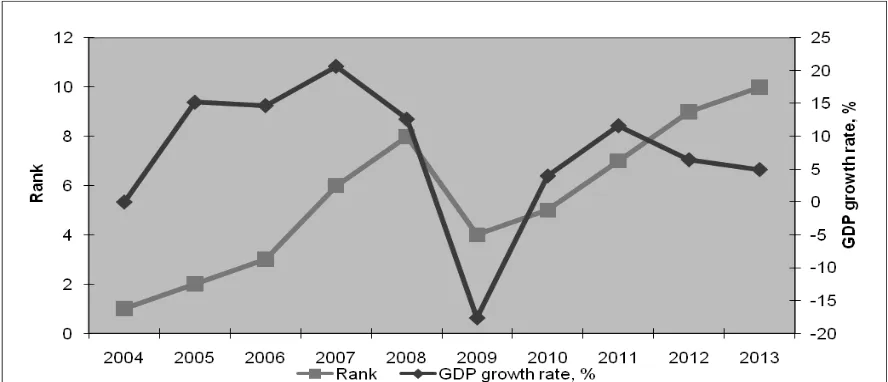
According to the results of SAW method, the worst position was for the period 2004-2006 (the highest ranks), and the best position was in 2013 (with lowest ranks). In order to compare the rank with GDP growth rates, it was necessary to recalculate the positions of ranks, i.e. in a good position to create the maximum rank and a bad position - lowest rank.
Fig. 1. Recalculated ranks of SAW method and GDP growth rates dynamics
Source: own research
According to recalculated ranks of SAW method and GDP growth rates, the period of 2004-2005 associated with Lithuania’s accession to the European Union and NATO. Ranks of SAW method increased, which reß ects positively all the
events that occurred during this period. However, it is noted that government expenditures on social issues in 2006 were lower than in 2005. That shows that the improvement in the social Þ eld is not the main direction of government
appro-priations (Lithuanian Macroeconomic Review, 2005).
In the period of 2006-2007 Lithuania tried to become a full member of the euro area, it improved macroeconomic indicators, but in 2007 Lithuania was not able to adopt the euro because of inß ation, which did not meet the speciÞ ed level. During
rapid growth of real estate prices. Therefore, such ß uctuations also reß ected in the
ranks of multi-criteria method.
The period of 2008 was related with the US Þ nancial crisis, which led to further
deterioration of economic indicators and declines not only in Lithuania, but also in other parts of the world. In 2009 GDP growth was negative, which means a decrease in GDP. All indicators (economic, social and environmental) decreased and showed especially bad positions in the labour market. However, in 2010 the Lithuanian economy has started to recover, sustainable development indicators changed for the better. Although since 2012 GDP growth slowed down, but it shows that from the developing country Lithuania becomes more developed (as we know, more developed countries’ GDP growth rate usually slow down, and that is a normal process).
Multi-criteria evaluation also showed that ranks ß uctuated in the same
direc-tion as GDP. It can be concluded that the economic downturn has affected the sustainable development (negatively), but only because of this attention was drawn to environmental problems, the public welfare, and the most important instrument became institutions and regulation.
Conclusions
Summing up the results of sustainable development, it should be mentio-ned that the assessment of sustainable development is appropriate for the SAW method. The reliability of this method shows two main aspects. First of all, on the basis of mathematical logic, SAW method result (factor) ranking from 0 (worst situation of the country) to 1 (the best situation of the country). Second, in the world SAW method is popular, there are a lot of researches and foreign practices of the use of SAW method, so the frequency shows that the method is the best and most appropriate in sustainable development assessment.
Analyzing the situation in Lithuania it was noted that the bad situation in the Þ eld of sustainable development was in 2004-2006 and the economic crisis
in 2009. However, in spite of all the difÞ culties, Lithuanian economy since 2010
References
AntucheviĀienŝ, J., Turskis, Z., & Zavadskas, E. K. (2006). Modelling renewal of construction objects applying methods of the game theory. Technological and Economic Development of Economy, 12(4), 263–268.
Belton, V., & Steward, T. J. (2002). Multiple Criteria Decision Analysis: An Integrated Approach. Springer Science+Business Media Dordrecht.
Brauers, W. K., & Zavadskas, E. K. (2006). The MOORA method and its application to privatization in a transition economy. Control and Cybernetics 35(2), 443–468.
Brauers, W. K., Zavadskas, E. K., Peldschus, F., & Turskis, Z. (2008). Multi-objective decision-making for road design. Transport 23(3), 183–192.
Chankong, V., & Haimes, Y. Y. (1983). Multiobjective decision-making – theory and methodology. New York: North-Holland.
ÿiegis, R. (2004a). Economics and environmental. Sustainable development management. Kaunas: Vytautas Magnus University Press.
ÿiegis, R. (2004b). Sustainable agriculture: Economic aspects. Ekonomika 68, 7-23. ÿiegis, R. (2004c). The new approaches towards sustainability. Tiltai 2(27), 65-70.
ÿiegis, R. (2009a). Sustainable development dimensions and stages. Modelling the European future: inte-grating the old and the new. The 4th ScientiÞ c volume, 139-143.
ÿiegis, R. (2009b). Development of sustainable agriculture in Lithuania. Vadybos mokslas ir studijos – kaimo verslƌ ir jƌ infrastruktƈros plŝtrai 16 (1). Retrieved from http://baitas.lzuu.lt/~mazylis/ julram/16/30.pdf.
ÿiegis, R., & Gavenauskas, A. (2005a). The management of sustainable development: ethical aspects.
Tiltai 4, 31-38. Retrieved from http://etalpykla.lituanistikadb.lt/fedora/objects/LT-LDB--0001:J.04~2005~1367151313994/datastreams/DS.002.0.01.ARTIC/content.
ÿiegis, R., Ramanauskienŝ, J., & Martinkus, B. (2009). The concept of sustainable development and its use for sustainability scenarios. Engineering economics 2(62), 28-37.
ÿiegis, R., Tamošiƈnas, T., Ramanauskienŝ, J., & Navickas, K. (2010). Darnaus industriniƌ zonƌ vysty-mosi vertinimas [Sustainable industrial development zone evaluation]. Šiauliai: Šiauliai Uni-versity Press.
Dasgupta, P. (2007). Measuring Sustainable Development: Theory and Application. Asian Development Review 24(1), 1-10.
Du Pisani, J. A. (2006). Sustainable development – historical roots of the concept. Environmental Sciences 3(2), 83-96.
Engel, J. R., & Engel, J. G. (1990). Ethics of environment and development: Global challenge, international response.London: Belhaven Press, Tucson: University of Arizona Press.
Estes, R. J. (1993). Toward Sustainable Development: From Theory to Praxis. Social Development Issues 15(3), 1-23.
Faneli, D. (2007). The world is moving away from sustainable development. The New Scientist 196(2624), 10-20.
French, S., Simpson, L., Atherton, E., Belton, V., Dawes, R., Edwards, W., Hamalainen, R. P., Larichev, O., Lootsma, A., Pearman, A., & Vlek, C. (1998). Problem formulation for Journal of Multi--Criteria Decision Analysis: report of a workshop. Journal of Multi-Criteria Decision Analysis 7(5), 242–262.
GineviĀius, R., & Podvezko, V. (2004a). Complex evaluation of the use of Information Technologies in the Countries of Easters and Central Europe. Journal of Business Economics and Management 5(4), 183–191.
GineviĀius, R., & Podvezko, V. (2004b). Quantitative evaluation of corporate strategic potential. Busi-ness: theory and practice 5(1), 3–9.
GineviĀius, R., & Podvezko, V. (2005). The formation of multicriteria evaluation indicator system. Busi-ness: theory and practice 6(4), p. 9–12.
GineviĀius, R., & Podvezko, V. (2007a). Complex assessment of sustainable development of state regions with emphasis on ecological and dwelling conditions. Ecology 53 (Supplement), 41-48. GineviĀius, R., & Podvezko, V. (2007b). The effect of complex evaluation the reliability of calculation
GineviĀius, R., & Podvezko, V. (2008a). The problem of compatibility of various multiple criteria eva-luation methods. Business: theory and practice 9(1), 73-80.
GineviĀius, R., & Podvezko, V. (2008b). A feasibility study of multicriteria methods‘ application to quantitative evaluation of social phenomena. Business: theory and practice 9(2), 81-87.
GineviĀius, R., Podvezko, V., & Bruzgŝ, Š. (2008). Evaluating the effect of state aid to business by mul-ticriteria methods. Journal of Business Economics and Management 9(3), 167–180.
Hacking, T., & Guthrie, P. (2008). A framework for clarifying the meaning of Triple Bottom-Line, Inte-grated and Sustainability Assessment. Environmental Impact Assessment Review 28(2-3), 73-89. Hjorth, P., & Bagheri, A. (2006). Navigating towards sustainable development: A systems dynamics
approach. Futures 38, 74-92.
Hwang, C. L., & Yoon, K. S. (1981). Multiple Attribute Decision-Making/Methods and Applications. Berlin: Springer-Verlag.
Hwang, C. L., & Lin, M. J. (1987). Group decision-making under multiple criteria. Berlin: Springer-Verlag. Kalibatas, D., & Turskis, Z. (2008). Multicriteria evaluation of inner climate by using MOORA method.
Information Technology and Control 37(1), 79–83.
Kates, R. W., Parris, T. M., & Leiserowitz, A. A. (2005). What is sustainable development? Goals, indi-cators, values and practice. Environment: Science and Policy for Sustainable Develop-ment 47(3), 8–21.
Lee, K. N. (2001). Human–Environment Relationship: Indicators. In: Smelser, N. J., & Baltes, B. (Eds.)
International Encyclopedia of the Social and Behavioural Sciences, 7045-7050. The Netherlands: Else-vier, Amsterdam.
Lithuanian Macroeconomic Review (2005). No. 3(23), Retrieved from http://www.seb.lt/pow/con-tent/seb_lt/pdf/lt/lma23.pdf.
National strategy for sustainable development (2011), Retrieved from http://www.am.lt/VI/index. php#a/8084.
Nader, M. R., Salloum, B. A., & Karam, N. (2008). Environment and sustainable development indica-tors in Lebanon: A practical municipal level approach. Ecological Indicators 8(5), 771-777. Odum, H. T. (1994). The energy of natural capital. In: Jansson, A.M., Kolke, C., & Costanza, R. (Eds.)
Investing in Natural Capital, 200–212. Island Press.
Pearce, D., & Atkinson, G. (1998). The concept of sustainable development: an evaluation of its use-fulness ten years after Brundtland. CSERGE Working Paper PA 98-02, Retrieved from http:// citeseerx.ist.psu.edu/viewdoc/download?doi=10.1.1.116.8122&rep=rep1&type=pdf.
Pearce, D.W., Barbier, E., & Markandya, A. (1990). Sustainable Development: Economics and Environment in the Third World. UK: Biddles Ltd., Guildford and King’s Lynn.
Peldschus, F., & Zavadskas, E. K. (2005). Fuzzy matrix games multi-criteria model for decision-making in engineering. Informatica 16(1), 107–120.
Sage, A. P. (1977). Methodology for large scale systems. New York: McGraw-Hill.
SivileviĀius, H., Zavadskas, E. K., & Turskis, Z. (2008). Quality attributes and complex assessment methodology of the asphalt mixing plant. Baltic Journal of Road and Bridge Engineering 3(3), 161–166.
Staniškis, J. K., ArbaĀiauskas, V., & Stasiškienŝ, Ž. (2008). Strengthening corporate commitment to sustainable development: Lithuanian approach. 1st Global Cleaner Production Conference and Exhibition, 1-9.
Štreimikienŝ, D., ÿiegis, R., & Jankauskas, V. (2007). Darnus energetikos vystymasis [Sustainable energy development]. Vilnius: Vilnius University Press.
Štreimikienŝ, D., & Kovaliov, R. (2007). Business and implementation of sustainable development.
Management of organizations: systematic research 41, 151-168.
Triantaphyllou, E. (2000). Multi-criteria decision-making methodologies: A comparative study (Applied Opti-mization). Volume 44. Dordrecht: Kluwer Academic Publishers.
Turskis, Z., Zavadskas, E. K., & Peldschus, F. (2009). Multi-criteria Optimization System for Decision Making in Construction Design and Management. Engineering Economics 1(61), 7-17.
UstinoviĀius, L., & Zavadskas, E. K. (2004). Statybos investicijƌ efektyvumo sistemotechninis ůvertinimas
[Decision support system in construction]. Vilnius: Technika.
Zavadskas, E. K., & AntucheviĀienŝ, J. (2007). Multiple criteria evaluation of rural building’s regenera-tion alternatives. Building and Environment 42(1), 436–451.
Zavadskas, E. K., Kaklauskas, A., Peldschus, F., & Turskis, Z. (2007). Multi-attribute assessment of road design solutions by using the COPRAS method. The Baltic Journal of Road and Bridge Engineering 2(4), 195–203.
Zavadskas, E. K., Turskis, Z., Tamošaitienŝ, J., & Marina, V. (2008a). Multicriteria selection of project managers by applying grey criteria. Technological and economic development of economy 14(4), 462–477.
Zavadskas, E. K., Turskis, Z., Tamošaitienŝ, J., & Marina, V. (2008b). Selection of construction Project managers by applying COPRAS-G method. Computer Modelling and New Technologies 12(3), 22–28.
Zavadskas, E. K., ZakareviĀius, A., & AntucheviĀienŝ, J. (2006). Evaluation of ranking accuracy in mul-ticriteria decisions. Informatica 17(4), 601–618.