Saidulu et al. J Sci Res Pharm, 2017;6(8):79-83
World Inventia Publishers
J
ournal of
S
cientific
R
esearch in
P
harmacy
http://www.jsrponline.com/
Vol. 6, Issue 8, 2017 ISSN: 2277-9469
USA CODEN: JSRPCJResearch Article
PHARMACOLOGICAL AND PHARMACOGNOSTICAL EXTRACTION AND EVALUATION FOR ANTI ULCER, ANTI
OXIDANT ACTIVITY OF BEETAVULGARIS EXTRACTS IN EXPERIMENTAL ANIMALS
Saidulu Soppari 1*, Mujeeb Ur Rahman 2
* 1 Research Scholar, Department of Pharmacology, Sunrise University, Alwar, Rajasthan, INDIA. 2 Department of Life Science, Sunrise University, Alwar, Rajasthan, INDIA.
Received on: 16-07-2017; Revised and Accepted on: 03-08-2017
ABSTRACT
P
eptic ulcer disease is a serious gastrointestinal disorder that requires well targeted therapeutic strategy. A number of drugs including proton pump inhibitors and H2 receptor antagonists are available for the treatment of peptic ulcer, but clinical evaluation of these drugs has shown incidence of relapse, side effects and drug interactions. This has been rational for the development of new anti ulcer drugs and search for novel molecules has been extended to herbal that offer better protection and relapse. The present study is to evaluate the anti ulcer activity by using herbal remedy beta vulgaris. The ethanolic extract of beta vulgaris treated groups shows a significant effect when compared to control group animals which indicating that the plant having the anti ulcer activity. And also the results showed that the ethanolic extract of the beta vulgaris having the antioxidant activity. The acute toxicity study conducted for ethanolic extract of beta vulgaris indicates that safe up to 2000mg/kg body weight. Ulcer can minimize by some life style changes like, avoid eating at least two hours before bed time and whatever foods might cause discomfort, such as alcohol, caffeine beverages (coffee and pop), fatty foods, and highly seasoned foods. It is important to try to stop smoking, since smoking has been linked to ulcer formation, reduced healing, and ulcer recurrences. Also try to minimize stress in life. Stress may worsen ulcer symptoms.KEYWORDS: Beta Vulgaris, Antioxidant, Anti Ulcer, Ethanolic etc.
INTRODUCTION
P
eptic ulcer is one of the major gastro-intestinal disorders. Peptic ulcer is a lesion of gastric or duodenal mucosa, it occur due to an imbalance between the offensive (gastric acid secretion) and defensive (gastric mucosal integrity) factors [1]. Most injurious agents such asacid, pepsin, bile acids, food ingredients, bacterial products and certain drugs and pathological condition such as Zollinger –Ellison Syndrome, they cause the ulcers in gastric or duodenal mucosa [2]. The erosion on
the stomach, it is referred to as a gastric ulcer. If it is in the duodenum (the part of the small intestine just after the stomach), it is called a duodenal ulcer.
Peptic ulcer disease is a worldwide problem, affecting about 1 in 10 people. In the early 20th century peptic ulcers were thought to be caused by emotional stress and spicy foods. Peptic ulcer is more Occurs frequently in men than in women. After 45 years of age peoples have less sex differences probably because the incidence of ulcer increases in post menopausal women. The ulcer differences between sexes are related in some way to sex hormones and that the female sex hormones protect against ulceration [3]. Duodenal ulcers are more
common than gastric ulcers and usually occur in people aged fewer than 50.Gastric ulcers are more common in people aged over 50. Duodenal ulcers are the most common ulcers found in the Western world. In 1982, Australian doctors Robin Warren and Barry Marshall first discovered a link between ulcers and H. Pylori [4].
Usually Ulcer occurs by many causative agents. But now a day’s ulcer is mainly caused by five reasons.
*Corresponding author:
Saidulu Soppari
Research Scholar,
Department of Pharmaceutics,
Sunrise University, Alwar, Rajasthan, India.
* E-Mail:[email protected]
1. Alcohol consumption 2. NSAIDs consumption 3. Smoking consumption 4. Skipped meals and poor sleep
Multiple mechanisms of protective action and anti-oxidant properties of drugs are minimizing tissue injury in human disease. Absolute ethanol induced gastric lesions in stomach. Gastric lesion is accompanied with the formation of the free radicals (FRs) and reactive oxygen species (ROs). These radicals in particular seem to play an important role in ulcerative and erosive lesions of the gastrointestinal tract. Therefore, treatment with anti-oxidants and FR scavengers can decrease ethanol induced gastric mucosal damage
Anti Oxidant Activity:
Free radicals in Health and Disease: A free radical is defined as any molecular species that contains an unpaired electron in the atomic orbital [5, 6]. Radicals are highly reactive that either donate an electron to
or extract an electron from other molecules, and therefore, behave as oxidants or reductants. As a result of their high reactivity, most radicals have a very short half life (10-6 seconds or less) in biological systems [7, 8]. The most important free radicals produced in the body
are oxygen derivatives, particularly superoxide and the hydroxyl radical. Examples of free radicals and reactive oxygen species include: superoxide anion radical, hydroxyl radical, nitric oxide, thiyl radical, trichloromethyl radical, hypochlorite radical, hypochlorous acid, and also some potentially dangerous non-radicals such as hydrogen peroxide, singlet oxygen, hypochlorous acid and ozone. Radical production in the body occurs by both endogenous and environmental factors.
to a variety of products including short chain aldehydes such as malondialdehyde or 4-hydroxynonenal, alkanes and alkenes, conjugated dienes and a variety of hydroxides and hydroperoxides [9-13]. Oxidative
damage to proteins and nucleic acids similarly gives rise to a variety of specific damage products as a result of modifications of amino acids or nucleotides [14-16]. Such oxidative damage might also
lead to cellular dysfunction and contribute to the pathophysiology of a wide variety of diseases.
Oxidative stress has been implicated in the etiology of a host of degenerative diseases including cardiovascular disease, diabetes, cancer, alzheimer's disease, neurodegenerative disorders and in aging [17, 18]. In addition, they also play a role not only in acute
conditions such as trauma, stroke and infection but also in physical exercise and stress [20, 21].
Since free radicals are causally involved in the disease state, it is believed that antioxidants should be effective in preventing or delaying their occurrence. Indeed, investigations at the cellular, tissue and whole animal level as well as epidemiological studies, strongly support the concept that nutritional antioxidant status is inversely related to the occurrence of free radical–mediated diseases.
MATERIALS AND METHODS
Materials:
Aspirin, Standard drug ranitidine, 0.01N NaOH, phenolphthalein indicator, Topfer's reagent, 80% ethanol, Formalin, gum acacia, Anaesthetic ether obtained from Zeal chemicals, wargal. Benedict’s reagent, barfoed’s reagent, million’s regent, wager’s regent, Hager’s regent. Mayer’s regent.
Beet roots (Beta vulgaris L.) were purchased from local markets in wargal. It was identified and authentificated by Professor Dr. Md. Mustafa, Department of botany, Kakatiya university, Wargal, AP.
Animals:
Healthy wistar albino rats weighing between 200-250g were used for the study. The animals were procured from Sainath agencies, laboratory animals, Hyderabad and the animals were kept in polypropylene cages (6 in each cage) and animals were acclimatized to our lab environment for about a week prior to the study, so that they could adapt to the new environment. Animal house were maintained under standard hygienic conditions, at 25 ± 20C, humidity (60 ± 10 %)
with 12 hrs day and night cycle, with food and water ad libitum. The experiments were carried out prior approval from Institutional Animal Ethical Committee (IAEC).
Methodology: Acute Toxicity Studies:
The acute toxicity was determined on female albino rats by fixed dose method of OECD Guide line no 420 given by CPCSEA. Groups of 6 rats were administered test drug by oral route at a dose of 2000, 300mg/kg (6 animals in each dose) and mortality was observed after 24 hr. The safe dose was found to be mg/kg body weight. For this study two doses were selected.
Pylorus- ligation induced gastric ulcer:
The albino rats were randomly divided into four groups of six animals each. Animals were fasted for 24 h before experiment but with free access to water.
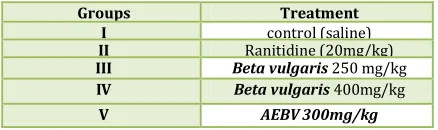
Table No. 1: Experimental design of Pylorus- ligation induced gastric ulcer
Groups Treatment
I control (saline)
II Ranitidine (20mg/kg)
III Beta vulgaris 250 mg/kg
IV Beta vulgaris 400mg/kg
V AEBV 300mg/kg
In vitro Antioxidant activity
DPPH free radical-scavenging activity:
The methanolic solution of DPPH (0.1 mM, 1 ml) was incubated with 3 ml of different concentrations of the root extract ranging from 10-100 µ g/ml. Incubation was carried out at room temperature (250C) for 30 min. For each concentration, the assay was run in triplicate. At the end of the incubation period, the optical density of each sample was determined at 517 nm. Ascorbic acid solution was used as a standard. EC50 values (concentration required to scavenge 50% of the free radicals) for both ascorbic acid and the root extract were determined. The radical scavenging activity of the tested sample was expressed as an inhibition percentage (IP) [102].
DPPH Scavenged (%) = (ADPPH – Atest / ADPPH) × 100
Where,
ADPPH is the absorbance of the 0.1 mM of DPPH solution and Atest is the absorbance in the presence of the extract or ascorbic acid.
IC50 value was determined from the graph obtained using standard ascorbic acid by using the “y = mx + c” formula from the slope of the graph.
RESULTS
Table No. 2: Phytochemical Analysis.
Phytoconstituents Present or Absent Carbohydrates Present
Glycosides Present
Fats Present
Gums & mucilages Absent Proteins & amino acids Present Saponins Present Tannins & Phenolic
compounds Present Phytosterols Absent Flavonoids Present Alkaloids Absent
Effect of ethanolic extract of Beta vulgaris in pylorus ligation induced gastric ulcer:
Table No. 3: Effect of ethanolic extract of Beta vulgaris on ulcer index and %ulcer protection in pylorus ligation induced gastric ulcer
Groups (n=5) Treatment UI % ulcer protection I Toxic control 11.99±0.6009 0.00 II Standard 8.532±0.4944** 28.840
III Beta vulgaris 250 mg/kg 10.732±1.138ns 10.49
IV Beta vulgaris 400mg/kg 8.66±0.6667** 27.77
V AEBV 300 mg/kg 9.65±0.7265** 9.156
Values express as mean ± SEM; n=6 in each group, statistical comparisons as follows: significant at P<0.01** compared to control group, P>0.05 ns-non significant.
Pylorus ligation parameters:
a. Volume of gastric content:
In pylorus ligation induced gastric ulcer model the gastric content volume high (3.2±0.1291) in control group. Gastric content
volume siginificantly decreases in ethanolic extract of beta vulgaris at 250 (2.433±0.233) and 400mg/kg (2.15±0.1945) doses. Gastric content volume siginificantly decreases in standard group (1.983±0.113) compared control group.
Table No. 4: Effect of ethanolic extract of Beta vulgaris on gastric content volume
Groups Treatment Volume of gastric content
I Control 3.2±0.1291
II Standard 1.983±0.113**
III Beta vulgaris 250 mg/kg 2.433±0.233**
IV Beta vulgaris 400mg/kg 2.15±0.1945**
V AEBV 300 mg/kg 2.256±0.895**
Values express as mean ± SEM; n=6 in each group, statistical comparisons as follows: significant at P<0.01** compared to control group.
b. Volume of Gastric juice:
In pylorus ligation induced gastric ulcer model the Gastric juice volume high (2.133±0.1022) in control group. Gastric juice volume significantly decreases in ethanolic extract of beta vulgaris at 250
(1.4±0.2817) and 400mg/kg (1.183±0.1327) doses. Gastric juice volume significantly decreases in standard group (1.4±0.2817) compared control group.
Table No. 5: Effect of ethanolic extract of Beta vulgaris on gastric juice volume
Groups Treatment Volume of Gastric juice
I Control 2.133±0.1022
II Standard 0.95±0.08466**
III Beta vulgaris 250 mg/kg 1.4±0.2817*
IV Beta vulgaris 400mg/kg 1.183±0.1327**
V AEBV 300 mg/kg 1.1050±0.895**
Values express as mean ± SEM; n=6 in each group, statistical comparisons as follows: significant at P<0.01**, p<0.05* compared to control group.
c. PH:
In pylorus ligation induced gastric ulcer model the Gastric juice PH low (1.865±o.1018) in control group. Gastric juice pH significantly increases in ethanolic extract of beta vulgaris at 250
(2.8±0.1932) and 400mg/kg (3.46±0.1936) doses. Gastric juice PH siginificantly increases in standard group (4±0.1238) compared control group.
Table No. 6: Effect of ethanolic extract of Beta vulgaris on gastric juice PH
Groups Treatment pH
I Control 1.865±0.1018
II Standard 4±0.1238**
III Beta vulgaris 250 mg/kg 2.8±0.1932**
IV Beta vulgaris 400mg/kg 3.46±0.1936**
V AEBV 300 mg/kg 3.10±0.895**
Values express as mean ± SEM; n=6 in each group, statistical comparisons as follows: significant at P<0.01** compared to control group.
d. Total acidity (mEq/lit):
In pylorus ligation induced gastric ulcer model the total acidity high (705±1.478) in control group. Total acidity significantly
decreases in ethanolic extract of beta vulgaris at 250 (162.5±1.315) and 400mg/kg (52.8±0.2358) doses. Total acidity significantly decreases in standard group (44.6±0.2186) compared toxic control group.
Table No. 7: Effect of ethanolic extract of Beta vulgaris on total acidity
Groups Treatment Total acidity(mEq/lit)
I Control 705±1.478
II Standard 44.6±0.2186**
III Beta vulgaris 250 mg/kg 162.5±1.315**
IV Beta vulgaris 400mg/kg 52.8±0.2358**
V AEBV 300 mg/kg 125.10±0.895**
Values express as mean ± SEM; n=6 in each group, statistical comparisons as follows: significant at P<0.01** compared to toxic control group.
e. Free acidity (mEq/lit):
In pylorus ligation induced gastric ulcer model the free acidity high (283±2.171) in control group. Free acidity significantly
Table No. 8: Effect of ethanolic extract of Beta vulgaris on free acidity
Groups Treatment Free acidity(mEq/lit)
I Control 283±2.171
II Standard 24±0.1880**
III Beta vulgaris 250 mg/kg 66.3±0.4447**
IV Beta vulgaris 400mg/kg 21.76±0.2088**
V AEBV 300 mg/kg 25.10±0.895**
Values express as mean ± SEM; n=6 in each group, statistical comparisons as follows: significant at P<0.01**compared to toxic control group
In Vitro Anti oxidant activity:
Table No. 9: In vitro Antioxidant Activity of various Extractives of Beta vulgaris in differentMethods
Extractives / Standard IC50 values ± SEM (µ g/ml)*
Nitric Oxide H2O2 DPPH ABTS
Pet. Ether 130.6 ± 1.76 188.0 ± 1.15 >500 18.0 ± 1.15 Chloroform 83.0 ± 3.60 91.33 ± 3.5 >500 14.0 ± 1.15 Ethyl Acetate 74.66 ± 2.40 76.0 ± 1.15 11.0 ± 1.73 6.66 ± 0.66 Aqueous Alcohol 77.0 ± 1.0 70.0 ± 1.76 5.33 ± 0.66 15 ± 1.73
Water 90.0 ± 4.6 141.33 ± 2.40 10.66 ± 0.66 18.0 ± 1.15 Rutin 65.0 ± 0.57 35.33 ± 1.33 2.66 ± 0.66 0.52 ± 0.05 Ascorbic Acid - 180.66 ± 1.76 3.90 ± 0.57 11.25 ± 0.49 * All values are average of three determinations, mean ± SEM
Fig. 1: In Vitro Antioxidant Activity of the various Extractives of Beta vulgaris
In Vitro Antioxidant Activity of the various Extractives of Beta vulgaris:
The percentage scavenging of nitric oxide, H2O2, DPPH and
ABTS radicals by the different extractives of Beta vulgaris and
standards used at various concentrations are presented in Fig. 1 and 2 . The percentage inhibition increased with increasing concentrations of the extractives used in all the methods.
Among the five extractives tested for in vitro antioxidant activity, the aqueous alcoholic extractives of Beta vulgaris leaves exhibited potent antioxidant activity with low IC50 values in the scavenging of DPPH and hydrogen peroxide.
The IC50 values were found to be 5.33 ± 0.66 and 70.0 ± 1.76 µ g/ml respectively for DPPH and H2O2 methods. However, the
petroleum ether and chloroform extractives did not exhibit potent antioxidant activity in the DPPH method. In the nitric oxide method, all samples exhibited moderate antioxidant activity with IC50 values of 130.6 ± 1.76, 83.0 ± 3.60, 74.66 ± 2.40, 77.0 ± 1.0 and 90 ± 4.6 µ g/ml respectively for petroleum ether, chloroform, ethyl acetate, aqueous alcohol and water extractives.
In ABTS method all extractives exhibited potent antioxidant activity with low IC50 values which were found to be higher or comparable with those obtained for the standards.
CONCLUSION
I
n conclusion, the ethanolic extract of Beta Vulgaris treated groups shows a significant effect when compared to control group animals which indicating that the plant having the anti ulcer activity. And also the results showed that the ethanolic extract of the Beta Vulgaris having the antioxidant activity. The acute toxicity study conducted for ethanolic extract of beta vulgaris indicates that safe up to 2000mg/kg body weight.Ulcer can minimize by some life style changes like, avoid eating at least two hours before bed time and whatever foods might cause discomfort, such as alcohol, caffeine beverages (coffee and pop), fatty foods, and highly seasoned foods. It is important to try to stop smoking, since smoking has been linked to ulcer formation, reduced healing, and ulcer recurrences. Also try to minimize stress in life. Stress may worsen ulcer symptoms.
REFERENCES:
1. Poonam Dharmani, Vijay Kumar Kuchibhotla, Rakesh
Maurya, Sudhir Srivastava, Sharad Sharma, Gautam Palit. Evaluation of anti-ulcerogenic and ulcer-healing properties of Ocimum sanctum Linn. J Ethnopharmacol2004;93:197–206. 2. Jyoti Gupta1, Dinesh Kumar, Ankit Gupta. Evaluation of gastric
anti-ulcer activity of methanolic extract of Cayratia trifolia in experimental animals. Asian Paicfic Journal of Tropical Disease
2012;99-102.
3. Blaser MJ. Gastroenterology. 1987;93:317-83.
4. Soll AH and Berglindn T. Physiology of isolated gastric glands and pareital cell; receptor and effectors regulating function “Physiology of the gastro Intestinal Tract, 2nd edition, 1987;883-908.
5. Luis Bujanda MD. The Effects of Alcohol Consumption upon the
Gastrointestinal Tract. The American Journal of
Gastroenterology,2000;95(12):3374-3382.
6. Vikas Dhikav, Sindhu Singh, Swati Pande, Atul Chawla, Kuljeet Singh Anand. Non- Steroidal Drug-induced Gastrointestinal Toxicity Mechanisms and Management. Journal, Indian Academy
of Clinical Medicine2003;4(4):315-322.
7. Namiot, Kemona, Namiot Z.Smoking habit and gastritis histology. Advances in Medical Sciences2007;52:191-195.
8. Mitsuru Moriya, Akira Uehara, Toshikatsu Okumura, Mitsuaki Miyamoto and Yutaka Kohgo. Stress-induced hemorrhagic gastric ulcer after successful Helicobacter pylori eradication two case reports. Journal of Medical Case Reports2011;5:252, pp1-3. 9. Mohammed Safwan Ali Khan, Syed Ahmed Hussain, Abdul
Manan Mat Jais, Zainul Amiruddin Zakaria1 and Mohib Khan. Anti-ulcer activity of Ficus religiosa stem bark ethanolic extract in rats. Journal of Medicinal Plants Research 2011 ;5(3):354-359.
10. http://www.zentiva.com/default.aspx/en/consumers/glossary/ group-indication
11. SK. Gupta and IJ. Singhvi. Herbal and Hepatoprotective drugs acting on Peptic Ulcer and Liver Disease: A Review. IJPT
2011;3(1):824-853.
12. Marhuenda E, Alarcon de la Lastra C, Martin MJ. Antisecretory and gastroprotective effects of aescine in rats. Gen. Pharmacol
1994;25:1213-1219.
13. http://www.botanical.com/botanical/mgmh/b/beetro28.html 14. Kanner J, Harel S, Granit R. Betalains: a new class of dietary
cationized antioxidants. J Agric Food Chem 2001;49:5178–5185. 15. Kapadia GJ, Azuine MA, Sridhar R, Okuda Y, Tsuruta A, Ichiishi E,
Mukainake T, Takasaki M, Konoshima T, Nishino H, Tokuda H. Chemoprevention of DMBA-induced UV-B promoted, NOR-1-induced TPA promoted skin carcinogenesis, and DEN-NOR-1-induced phenobarbital promoted liver tumors in mice by extract of beetroot. Pharmacol Res 2003;47:141–148.
16. Ranju Pal1, Kundlik Girhepunje1, Hitesh Gevariya1, Thirumoorthy N. Hepatoprotective activity of Beta vulgaris against CCl4 induced acute hepatotoxicity in rats. Archives of Applied Science Research2010;2(1):14-18
17. Swati Jain, Vipin Kumar Garg and Pramod Kumar Sharma.
Anti-Inflammatory Activity of Aqueous Extract of Beta Vulgaris L. Journal of Basic and Clinical Pharmacy2011;2(2):83-86. 18. Anita Singh, Vipin Kumar Garg, Pramod Kumar Sharma, Surbhi
Gupta. Wound Healing activity of Ethanolic Extract of Beta Vulgaris. Pharmacologyonline 1 2011;1031-1038.
19. Jasna M. Canadanovic-Brunet, Sajama S. Savatovic, Gordana S. Cetkovic, Jelena J. Vulic, Sonja M. Dj ilas, Sinisa L. Markov and Dragoljub D. Cvetkovic Czech, Antioxidant and Antimicrobial Activities of Beet Root Pomace Extracts. J Food Sci
2011;29(6):575–585.
20. Ashok Agarawal, Sunil Bavaskar, Pankaj Salunkhe, Nadeem Manyar, Dnysheswar Kale, Pravin Kawitkwar. Beta vulgaris: a dearth of anti depressant activity in mice. Journal of Pharmaceutical Negative Results 2010;1(2):55-57.
21. Aaishwarya Deshmukh1, Jayvadan Patel, Ashish Prajapati, Mansi Vaghela, Hardik Goswami. Cerebroprotective effects of extract of Beta vulgaris (C.) in middle cerebral artery occlusion (MCAO)-induced cerebral ischemia. Phytopharmacology
2011;1(5):138-147.
How to cite this article:
Saidulu Soppari, Mujeeb Ur Rahman. PHARMACOLOGICAL AND PHARMACOGNOSTICAL EXTRACTION AND EVALUATION FOR ANTI ULCER, ANTI OXIDANT ACTIVITY OF BEETAVULGARIS EXTRACTS IN EXPERIMENTAL ANIMALS. J Sci Res Pharm 2017;6(8):79-83.
Conflict of interest: The authors have declared that no conflict of interest exists.