R E S E A R C H
Open Access
Hidost: a static machine-learning-based
detector of malicious files
Nedim Šrndi´c
1*and Pavel Laskov
2Abstract
Malicious software, i.e., malware, has been a persistent threat in the information security landscape since the early days of personal computing. The recent targeted attacks extensively use non-executable malware as a stealthy attack vector. There exists a substantial body of previous work on the detection of non-executable malware, including static, dynamic, and combined methods. While static methods perform orders of magnitude faster, their applicability has been hitherto limited to specific file formats.
This paper introduces Hidost, the first static machine-learning-based malware detection system designed to operate onmultiple file formats. Extending a previously published, highly effective method, it combines the logical structure of files with their content for even better detection accuracy. Our system has been implemented and evaluated on two formats, PDF and SWF (Flash). Thanks to its modular design and general feature set, it is extensible to other formats whose logical structure is organized as a hierarchy. Evaluated in realistic experiments on timestamped datasets comprising 440,000 PDF and 40,000 SWF files collected during several months, Hidost outperformed all antivirus engines deployed by the website VirusTotal to detect the highest number of malicious PDF files and ranked among the best on SWF malware.
Keywords: Machine learning, Security, Malware detection, File formats, PDF, SWF
1 Introduction
One of the most effective tools for breaking into computer systems remains malicious software, i.e., malware. While being a well-known plague since the dawn of personal computing, malware has developed several insidious traits in the recent decade to serve the needs of criminal busi-ness. One of them is the infection of files in well-known formats used to exchange documents between businesses and individuals. Such infection offers the following bene-fits to attackers:
1. It is easier to lure users into opening documents than into launching executable programs.
2. A steady stream of new vulnerabilities has been observed in the recent years in document viewers due to their high complexity caused, in turn, by the complexity of document formats.
*Correspondence: [email protected]
1Cognitive Systems, Department of Computer Science, University of Tübingen,
Sand 1, 72076, Tübingen, Germany
Full list of author information is available at the end of the article
3. Flexibility and versatility of document formats offer ample opportunities for obfuscation of embedded malicious content.
The same features also hinder the identification of mali-cious documents and increase the computational burden on the detection tools.
The favorite formats used by attackers are PDF (target-ing Adobe Reader), Flash (target(target-ing Adobe Flash Player), and Microsoft Office files [1, 2]. In 2012, the pioneer-ing exploit kit Blackhole targeted Java, PDF, and Flash files, and its successors have continued this practice [3]. In 2013, the non-executable malware delivered through the web was dominated by PDF and Flash files targeting Adobe Reader and Microsoft Office applications [2]. Flash has seen wide deployment recently for malicious adver-tising, i.e., placement of malware on legitimate web sites by means of advertising networks. Even some of the most prominent web sites have fallen victims to such attacks [3]. Although prevalently used for redirection to sites serving exploit kits, it is not uncommon for Flash files to target Flash Player directly.
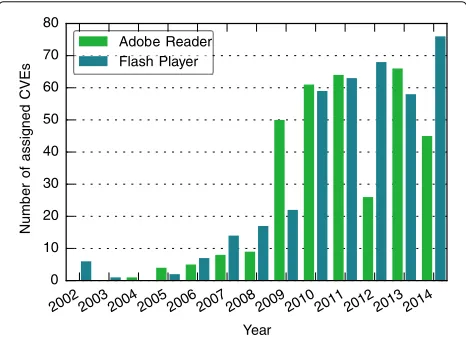
Non-executable files are especially popular as a means for targeted attacks. Recent years have brought a range of high-profile targeted attacks against governments and industry, and they are getting more common and ever stealthier. The Miniduke targeted attack campaign against European government agencies used sophisti-cated PDF files exploiting an Adobe Reader zero-day vulnerability. Four different zero-day vulnerabilities in Microsoft Office were used in the Elderwood attack against the defense industry. The group APT1 or Com-mentCrew used 0-day vulnerabilities in Adobe Reader and Microsoft Office against government and industry targets [4]. Among the recorded 24 0-day discovered in 2014, 16 targeted Adobe Reader and Flash Player (cf. Fig. 1), while Microsoft Word files dominated the list of file types used for targeted attacks [1, 5]. In the first 9 months of 2015, 8 out of top 10 vulnerabilities lever-aged by exploit kits were reported to be Flash Player vulnerabilities [6].
The main difficulty in detecting malicious non-executable files is the necessity to understand complex formats. While such difficulty is marginalized in the meth-ods based on dynamic analysis, i.e., rendering a file in an instrumented sandbox, such methods are in general rather slow. Static analysis methods, known for their high perfor-mance, usually deploy ad hoc, format-specific detection techniques which do not generalize across the formats. To alleviate this problem, we propose anew static anal-ysis method with the potential of being more portable across formats. Our experiments demonstrate that, with the incorporation of an appropriate format parser, it can be applied to both PDF and Flash files. Before presenting the main features of the proposed method, we review the related work.
2002 2003 2004 2005 2006 2007 2008 2009 2010 2011 2012 2013 2014 Year
0 10 20 30 40 50 60 70 80
Numb
er
of
assigned
CVEs
Adobe Reader Flash Player
Fig. 1CVEs with the phrases “Adobe Reader” or “Flash Player” in their description
1.1 Related work
Early work on PDF malware detection focused on n-gram analysis [7, 8] of PDF files on disk. However, PDF is a complex file format [9]. PDF files, especially malicious ones, routinely employ obfuscationin the form of com-pression, the use of different encodings and even encryp-tion. Thus, only full-fledged PDF parsers can properly deobfuscate them. The n-gram approach is in this regard overly simplistic. The first method utilizing a PDF parser was PJScan [10]. It employed anomaly detection based on lexical properties of JavaScript code embedded inside PDF files. However, it could not handle JavaScript code loaded at run time or malware that does not use JavaScript in the first place. Two simple learning-based methods were proposed subsequently, Malware Slayer [11] and PDFrate [12], both utilizing heuristic features based on raw bytes of PDF files. All methods presented so far are commonly referred to as static because they do not perform exe-cution or emulation of any part of a PDF file. They can be divided into deep and shallow methods, depending on whether their parsing of PDF files conforms to the PDF Standard [9] (deep) or not (shallow). PJScan is the only deep method presented so far. A common vulnerability of shallow methods is the relative ease of falsification of the PDF physical structure, demonstrated on the example of PDFrate [13]. A common shortcoming of allpure static methods is their inability to detect dynamically loaded threats, e.g., when the analyzed file does not contain attack code but instead loads it over the network or from another file.
Along with the described static methods, dynamic
and a threat designed for that specific version will go undetected.
As an attempt to achieve the speed of static approaches with the accuracy of dynamic ones,combined static and dynamicmethods were subsequently developed. MDScan performs static JavaScript extraction and dynamic code execution [21], but the complexity of emulation of the PDF JavaScript API with undocumented features pro-hibits a complete and error-free solution. MPScan, on the other hand, hooks into Adobe Reader for flawless JavaScript extraction and deobfuscation but performs static exploit detection [22]. Due to its design, it is suit-able for malware detection only on a single version of Adobe Reader, and its dynamic component takes seconds to run.
In contrast to fully automated methods presented so far, Nissim et al. propose to use anactive learningapproach, where a human expert manually labels interesting sam-ples for a machine learning algorithm, with the goal of keeping the detector up-to-date with the newest threats [23]. They outline a design with a combination of signa-ture detection and multiple methods described so far but leave its implementation and evaluation for future work. For a more detailed survey of many of the mentioned PDF malware detection methods, we refer the reader to [23].
Compared to PDF, research on detecting Flash mal-ware has been scarce with only two methods proposed in the recent years. The OdoSwiff system from 2009 used a heuristics-based approach on features obtained with both static and dynamic analysis [24]. It was suc-ceeded in 2012 by FlashDetect, which upgraded its detec-tion from Acdetec-tionScript 2 to Acdetec-tionScript 3 exploits and replaced its threshold-based approach with a Naive Bayes classifier [25]. Both methods are based on an empirical approach, striving to encode the knowledge of domain experts, i.e., malware analysts, about existing ways of the SWF exploitation. These expert features perform very well. For example, FlashDetect’s machine learning clas-sifier was evaluated using a training dataset comprising only 47 samples of each class, but even this small sam-ple size was enough to achieve a high detection accu-racy. However, as the authors point out, some employed heuristics-based features are not robust against commit-ted evaders. Furthermore, embedded malware may detect the employed dynamic execution environment based on its difference to Adobe Flash Player, covering its behav-ior as a reaction. In contrast, the method proposed herein uses a data-driven approachinstead of expert features, and its detection is based on the structural differences between benign and malicious SWF files. By remaining exploit-agnostic, it remains open to novel attacks, its static approach leads to faster execution and is not vulnerable to run-time evasion.
1.2 Contributions
The proposed detection method is based on the analy-sis of hierarchical document structure and is henceforth abbreviated as Hidost. It is an extension of previous work published by Šrndi´c and Laskov in [26], herein referred to as SL2013. The novelty introduced in SL2013 was the use oflogical structurefor characterization of malicious and benign PDF files. PDF logical structure is a high-level con-struct defined by the PDF Standard that organizes basic PDF building blocks into a functional document. Results published in [26] show that properties of malicious files such as the presence of JavaScript and minimal use of benign content can be accurately determined from their logical structure. As a deep static method, SL2013 is less affected by PDF obfuscation and physical structure falsifi-cation that plague shallow methods. Evaluated on a real-world dataset comprising 660,000 PDF files, SL2013 has demonstrated a combination of detection performance and throughput that remains unrivaled among antivirus engines and published scientific work. Nevertheless, in a realistic sliding window experiment on timestamped data, the detection performance of SL2013 was shown to be inconsistent. Its feature definition created a blind spot exploitable by evaders and its oversized feature set created difficulties for more memory-intensive machine learning classifiers than the employed support vector machine.
Hidost inherits all the advantages of SL2013. It main-tains the nearly perfect detection performance and high throughput on PDF files that tailored SL2013 for central-ized deployment on busy networks. As a further advan-tage of a deep static approach, Hidost is immune to PDF obfuscation and physical structure falsification.
Hidost furthermore addresses certain shortcomings of SL2013 we have discovered later. In particular, we devel-oped structural path consolidation (SPC), a technique used to merge similar features. Such consolidated fea-tures better preserve the semantics of logical structure and reduce the dependency of the feature set on the spe-cific dataset. The benefits of SPC are threefold: (a) the attack surface for evasion is reduced; (b) changes in fea-ture set over time are limited; and (c) the number of features is drastically reduced. Together, these improve-ments render Hidost much more secure and practical than SL2013.
content as well, enabling a higher degree of precision on formats with less discriminative structure such as SWF.
To demonstrate the excellent detection performance of Hidost, we experimentally evaluate it for two formats: PDF and SWF. Our evaluation protocol is intended to model the practical deployment of a data-driven detection method and to account for a natural evolution of mali-cious data. In our protocol, a detection model is trained on a fixed-size window of data and is deployed for a limited time period. Once the model is deemed to be too old, it is re-trained on another window of more recent data and again evaluated for a limited time period. Unlike the clas-sical cross-validation methods common in evaluation of machine learning algorithms, our experimental protocol accounts for a temporal nature of data in security appli-cations and never predicts the past data from the future one.
In summary, the main contributions of this paper are as follows:
• A static machine-learning-based malware detector, Hidost, the first such system applicable to different file formats based on their logical structure and content.
• An experimental evaluation of Hidost on two formats, PDF and SWF, designed to reflect the operational environment of a malware detector, performed on a dataset of 440,000 PDF files and unprecedented 40,000 SWF files. In our evaluation, Hidost outperformed all antivirus engines at VirusTotal on PDF and ranked among the best on SWF files.
• A prototype implementation of Hidost for two file formats, PDF and SWF, released as Open Source software.
• Source code required to reproduce this work, including experiments and plots, released as Open Source Software.
• Datasets required to reproduce this work.
1.3 Outline
The structure of this paper is as follows. File formats that Hidost is applicable to, i.e., hierarchically structured file formats, are described in Section 2, along with a detailed introduction to logical structures of PDF and SWF. Hidost’s system design is described in Section 3 which covers extraction of structural elements from PDF and SWF formats, feature definition, selection, and com-paction as well as learning and classification. The exper-imental evaluation, including the description of datasets and experimental protocols, as well as a discussion of results, is presented in Section 4. We discuss Hidost’s extension to other file formats and present a conceptual design for its application to office file formats OOXML
and ODF in Section 5. Finally, Section 6 presents conclu-sions and outlines open questions for future work.
2 Hierarchically structured file formats
File formats are developed as a means to store a physical representation of certain information. Some formats, e.g., text files, do not have any logical structure, but others, e.g., HTML, do. HTML files are a physical representation of logical relationships between HTMLelements. As the example in Fig. 2 shows, in an HTML file, a pelement might be a descendant of thebodyelement, which in turn has thehtmlelement as its parent.
HTML elements have a logical structure in the form of a hierarchy. Work presented in this paper is concerned with the detection of malware inhierarchically structured file formats. The physical layout of the file format, which can substantially deviate from its logical layout, is irrelevant for the operation of the proposed method. Examples of hierarchically structured file formats include:
• Portable Document Format (PDF) • SWF File Format (SWF)
• Extensible Markup Language (XML) • Hypertext Markup Language (HTML)
• Open Document Format (ODF), an XML-based format for office documents
• Office Open XML (OOXML), a different XML-based format for office documents
• Scalable Vector Graphics (SVG), an XML-based format for vector graphics
In the following, we describe the hierarchical logical structure of two file formats implemented in Hidost, PDF, and SWF.
2.1 Portable Document Format (PDF)
This section was copied (with adaptation) from [26], copy-righted by the Internet Society.
Portable Document Format(PDF) is an open standard published as ISO 32000-1:2008 [9]. The syntax of PDF comprises these four main elements:
• Objects. These are the basic building blocks in PDF. • File structure. It specifies how objects are laid out and
modified in a PDF file.
• Document structure. It determines how objects are logically organized to represent the contents of a PDF file (text, graphics, etc.).
• Content streams. They provide a means for efficient storage of various parts of the file content.
There are nine basic object types in PDF. Simple object types are Boolean, Numeric, String, and Null. PDF strings have bounded length and are enclosed in parentheses “(” and “)”. The type Name is used as an identifier in the description of the PDF document structure. Names are introduced using the character “/” and can contain arbi-trary characters exceptnull(0×00). The aforementioned five object types will be referred to asprimitivetypes in this paper. An Array is a one-dimensional ordered col-lection of PDF objects enclosed in square brackets, “[” and “]”. Arrays may contain PDF objects of different type, including nested arrays. A Dictionary is an unordered set of key-value pairs enclosed between the symbols “<<” and “>>”. The keys must be name objects and must be unique within a dictionary. The values may be of any PDF object type, including nested dictionaries. A Stream object is a PDF dictionary followed by a sequence of bytes. The bytes represent information that may be compressed or encrypted, and the associated dictionary contains infor-mation on whether and how to decode the bytes. These bytes usually contain content to be rendered but may also contain a set of other objects. Finally, an Indirect object is any of the previously defined objects supplied with a unique object identifier and enclosed in the keywords objandendobj. Due to their unique identifiers, indirect objects can be referenced from other objects viaindirect references.
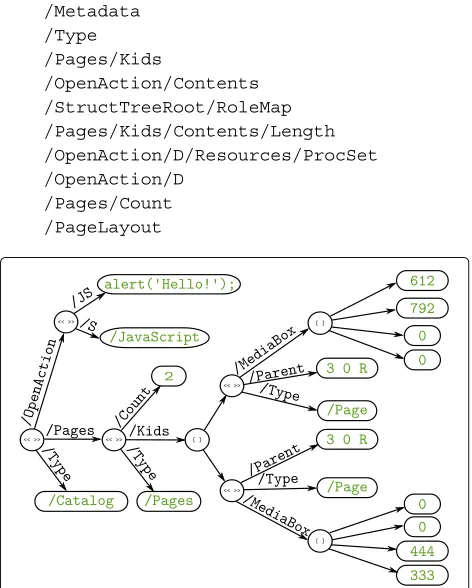
The syntax of PDF objects is illustrated in a simpli-fied exemplary PDF file shown in Fig. 3. It contains four indirect objects denoted by their two-part object iden-tifiers, e.g., 1 0 for the first object, and the obj and endobjkeywords. These objects are dictionaries, as they are surrounded with the symbols “<<” and “>>”. The first one is theCatalogdictionary, denoted by itsTypeentry which contains a PDF name with the valueCatalog. The Catalog has two additional dictionary entries:Pagesand
OpenAction.OpenAction is an example of a nested dic-tionary. It has two entries:S, a PDF name indicating that this is a JavaScript action dictionary, andJS, a PDF string containing the actual JavaScript script to be executed: alert(’Hello!’);.Pages is an indirect reference to the object with the object identifier3 0: the Pages dic-tionary that immediately follows the Catalog. It has an integer,Count, indicating that there are two pages in the document, and an array Kidsidentifiable by the square brackets, with two references to Page objects. The same object types are used to build the remaining Page objects. Notice that each of the Page objects contains a backward
Fig. 3Raw content of an example PDF file. Formatted for easier reading. Details omitted for brevity. Primitive data types and references arecolored green
reference to the Pages object in theirParententry. Alto-gether, there are three references pointing to the same indirect object,3 0, the Pages object.
point to other objects anywhere in the document struc-ture. This graph can be reduced to a proper tree, called a
structural tree, as will be elaborated in Section 3.4, and we will therefore limit ourselves to considering the PDF doc-ument structure in its simplified, tree form, as illustrated in Fig. 4.
The root node in the document structure is a special PDF dictionary with the mandatoryTypeentry contain-ing the name Catalog. Any object of a primitive type constitutes a leaf, i.e., terminal node, in the document structure.
We define a path in the PDF structural tree as a sequence of edges starting in the Catalog dictionary and ending with an object of a primitive type. For example, in Fig. 4 there is a path from the root, i.e., leftmost, node through the edges named /Pagesand /Countto the terminal node with the value 2. This definition of a path in the PDF document structure, which we denote aPDF structural path, plays a central role in our approach. We print paths as a sequence of all edge labels encountered during path traversal starting from the root node and end-ing in the leaf node. The path from our earlier example would be printed as/Pages/Count.
The following list shows exemplary structural paths from real-world benign PDF files:
/Metadata /Type /Pages/Kids
/OpenAction/Contents /StructTreeRoot/RoleMap /Pages/Kids/Contents/Length /OpenAction/D/Resources/ProcSet /OpenAction/D
/Pages/Count /PageLayout
Fig. 4Structural tree of the PDF file depicted in Fig. 3. Dictionaries are illustrated using the symbol “<< >>”, arrays using “square brackets”. Cycles were omitted for simplicity
Our investigation shows that these are the structural paths whose presence in a file is most indicative that the file is benign or alternatively, whose absence indicates that a file is malicious. For example, malicious files are not likely to contain metadata in order to minimize file size, they do not jump to a page in the document when it is opened and are not well-formed so they are missing paths such as /Typeand/Pages/Count.
The following is a list of structural paths from real-world malicious PDF files:
/AcroForm/XFA /Names/JavaScript /Names/EmbeddedFiles /Names/JavaScript/Names /Pages/Kids/Type
/StructTreeRoot /OpenAction/Type /OpenAction/S /OpenAction/JS /OpenAction
We see that malicious files tend to execute JavaScript stored within multiple different locations upon open-ing the document and make use of Adobe XML Forms Architecture (XFA) forms as malicious code can also be launched from there.
2.2 SWF file format
SWF File Format (SWF, pronounced swiff) is a propri-etary binary file format, its specification is published in [27]. SWF files consist of a header and a sequence of tags, i.e., data structures with values for predefined fields. There are 65 different types of tags specified, each defining its own set of fields with different names and data types. Some of the basic SWF data types are [27]:
• 8-, 16-, 32-, and 64-bit integers, both signed and unsigned, arrays of these types and integers with a variable number of bytes
• Fixed- and floating-point numbers of different widths and precisions
• Integer and fixed-point numbers with widths that are not exponents of 2
• Strings
• Data structures such as 24- and 32-bit color records, rectangle records, 2D transformation matrices, etc.
Fig. 5Hexadecimal view of a toy SWF file.Left columncontains hexadecimal addresses of first bytes of every row
was produced using theConsoleDumperclass from the SWFRETools toolkit [28], an open-source Java toolkit for reverse-engineering SWF files.
The illustration skips the file header as it is not used in our method. It shows 5 SWF tags separated by dot-ted lines: twoSetBackgroundColortags at bytes0×14and 0×1B, twoShowFrametags at bytes0×19and0×20and an End tag at byte 0×22. Tags of a SWF file are laid out sequentially. Every tag has a header with an unsigned 16-b little-endianTagCodeAndLengthfield that comprises a 10-byte tag type identifier and a 6-b tag length field,
Fig. 6SWF file depicted in Fig. 5, decoded. Values arecolored green.
Every linestarts with a hexadecimal number betweensquare brackets, denoting the offset, in bytes, of the tag field specified in the given line from the beginning of the SWF file
with an optional wider length field for tags longer than 62 B.
The first tag in this file is used to set the background color of the display. It is a simple tag, defining three unsigned 1-B values of the red (0×AA = 170), green (0×BB=187), and blue (0×CC=204) color components. The second tag makes the content of the canvas render on screen for the duration of one frame. Following this, the background color is set to #112233 and the screen is refreshed one more time. The last tag signals the end of the file.
Figure 7 illustrates a logical view of our example SWF file in which the file is structured as a tree. It closely follows the layout presented in the decoded SWF file of Fig. 6. Every tag is represented by a tree node and is a direct descendant of the abstract root node. The edge from the root to the tag node is labeled by the tag type name, in our case SetBackgroundColor, ShowFrame,andEnd. Descendants of tag nodes are its header and fields. Headers are connected with an edge simply labeled Header. The edges leading to the fields are labeled by their names, e.g., BackgroundColor. The values of tags’ fields are represented as leafs, e.g., the value of theredfield of the firstSetBackgroundColor
tag, 170.
We define a path in the SWF structural tree, analo-gous to the path in the PDF structural tree, as a series
of edges starting in the abstract root node and end-ing in a leaf node. For example, there is a path from the root node through the edges labeledEnd,Header, and TagAndLength ending in the leaf node with the value 0. For better readability and consistency with PDF, we prepend the forward slash symbol “/” to every edge label when printing a path; hence, the path in question prints as/End/Header/TagAndLength.
In the following section, we describe how the logical structures of PDF and SWF files are processed for use by learning algorithms and describe the system design of Hidost.
3 System design
Hidost has been designed as a malware detection system capable of learning to discriminate between malicious and benign files based on their logical structure. Due to the semantic heterogeneity of various file formats, it is hard to imagine a single format to act as a “common denom-inator” for all conceivable hierarchically structured file formats. Yet, our design clearly separates format-specific processing steps from the detection methodology. As a result, our method, currently tested on PDF and SWF formats, can be extended to other formats by implement-ing the format-specific components without rebuildimplement-ing its general framework. The proposed method was imple-mented as a research prototype, and its feature extrac-tion subsystem was published as open source software [29]. The published code comprises a toolset for fea-ture extraction from PDF (implemented in C++) and SWF files (implemented in Python and Java). Experiment reproduction code is published separately, as described in Section 4.
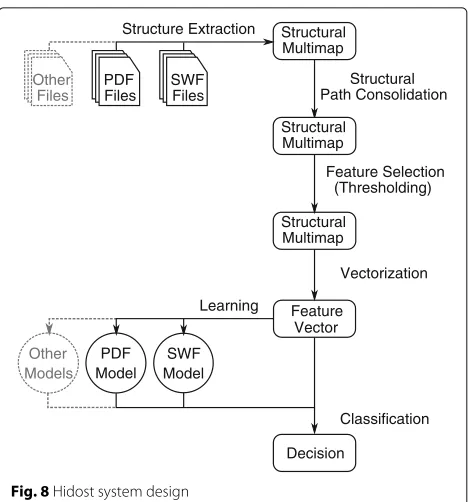
The system design of Hidost is illustrated in Fig. 8. There are six main stages in Hidost: structure extraction, structural path consolidation, feature selection, vector-ization, learning, and classification. Structure extraction transforms the structural features of specific formats into a common data structure—structural multimap— representing paths in the structural hierarchy. Structural path consolidation is intended to transform structural paths into a more general form, removing artifacts. Feature selection is concerned with finding the mini-mum set of features required for a successful machine learning application. Vectorization transforms structural multimaps into numeric vectors processed by machine learning methods. Learning generates a discriminative model of malicious and benign files based on their properties encoded in feature vectors. Finally, classifi-cation makes a decision whether a previously unseen sample is malicious or benign based on the learned model.
In the following subsections, the main stages of our approach are presented in detail.
PDF Files
Structural Multimap
Feature Vector
Decision PDF
Model SWF Model
Learning
Classification SWF
Files Other
Files
Other Models
Structural Path Consolidation Structure Extraction
Structural Multimap Structural Multimap
Feature Selection (Thresholding)
Vectorization
Fig. 8Hidost system design
3.1 File structure extraction
The first step of our method transforms files into a more abstract representation, their logical structure. This step is essential to our approach because it achieves two key goals: (a) use of logical structure for discrimination between malicious and benign files and (b) applicability to multiple file formats.
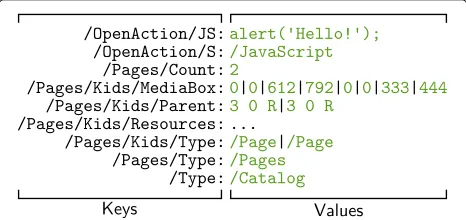
A suitable representation for the logical structure of hierarchically structured file formats is astructural mul-timap. A multimap is a generalization of the common map data structure, also known as a dictionary or associative array. While maps provide a mapping between a key and a corresponding value, multimaps map a key to aset of val-ues. A structural multimap is a multimap that maps every structural path of a structural tree to the set of all leafs that lie on the given path. In map terminology, the struc-tural paths represent the keysand sets of all leafs that a path maps to represent thevaluesof the map. An example structural multimap is illustrated in Fig. 9. Multiple values for the same key are delimited using vertical bar symbols “|”. Hidost uses a simplified form of structural multimaps presented later in this section.
Fig. 9A complete structural multimap of the PDF file depicted in Fig. 3. This type of structural multimap is not used in Hidost but rather illustrated as an instructive example
Implementation of structure extraction for PDF and SWF is presented in the following two sections.
3.1.1 PDF
The PDF logical structure is organized as a directed rooted cyclic graph. To transform it into a structural mul-timap, it is first necessary to reduce the graph to a directed rooted tree instead. This is achieved by removing all cycles from the graph. There is a cycle in the PDF logical struc-ture when an indirect reference from a tree node at depth
dRpoints to a tree node lying on the same path at a depth
dT < dR. An example is shown in Fig. 3: the indirect
ref-erence at the path/Pages/Kids/Parentwith depth 3 points to the dictionary located at/Pageswith depth 1, lying on the same path. Indirect references may also cause inconsistencies in extracted tree structures. When two indirect references located at different paths reference the same object, it is ambiguous which is the “true” one.
Both described problems—cycles in the structural graph and multiple references—are implicitly solved with a simple procedure based on the breadth-first search (BFS) algorithm. A robust PDF parser is required to nav-igate the PDF structure of obfuscated or malformed PDF files. Hidost utilizes the open-source Poppler PDF render-ing library [30], version 0.18.4. The procedure starts by locating the root node of the file structure, i.e., the Cat-alog dictionary. Then, it performs a breadth-first search on the entire file structure graph, inserting all pairs(p,l), wherepis a structural path andlis a leaf node located on the pathp, into the resulting structural multimap. Cycles are avoided by skipping indirect references that point to previously visited objects and treating them as leaf nodes instead. Child node enumeration in alphabetical order ensures the consistent resolution of multiple references the same node, so that every traversal of a PDF file’s structural graph produces the same structural multimap.
To be more precise, Hidost does not use full struc-tural multimaps but a simplification thereof. This sim-plification concerns the treatment of non-numeric data
types, i.e., all types except integers, real numbers, and Booleans. Strings, PDF names, and other non-numeric types, all convertible to strings, are replaced with a con-stant value, 1. Binarization of non-numeric values can be seen by comparing Figs. 9 and 10. This choice of treatment is a trade-off between fully discarding non-numeric val-ues and performing their extensive evaluation. Different approaches to the treatment of string-like data types have been proposed in related work, from static, e.g., embed-ding strings in metric spaces [10, 31], characterizing them with simple properties such as their length, entropy, or distribution of keywords [11, 12] or testing them for valid CPU instructions [15], to dynamic, e.g., CPU emulation of strings [14, 21] or their execution [19, 20, 22]. How-ever, all these approaches either conflict with the desired static system design (dynamic evaluation), decrease com-putational performance (string embedding and testing for CPU instructions), or are easily evadable (simple string properties).
The positive effect of the use of binarized non-numeric values compared to their complete omission was experi-mentally confirmed. The effects of migrating from purely binary features used by SL2013 to numerical in Hidost are evaluated in Section 4.3.4.
3.1.2 SWF
The SWF logical structure is more straightforward to extract than PDF as it contains no cycles or ambigu-ities. The approach implemented in Hidost begins by employing the ConsoleDumper class of the SWFRE-Tools toolkit to parse the SWF file and produce its textual depiction, such as the one in Fig. 6. Parsing the output generated by this tool suffices to extract the SWF logi-cal structure. Every line of the textual output that starts with zero or more spaces followed by an opening square bracket “[” contains a tag or field name that represents one edge in the structural tree. The distance of this edge from the root node is encoded as the number of spaces before the bracket, divided by 2. Consequently, a line with a bracket preceded by no spaces signals the beginning of a new tag. By keeping track of the most recent edges parsed
at each level in the hierarchy, it is possible to reconstruct the entire path to the edge in the current line. Finally, if the edge name is succeeded by a colon, then this edge rep-resents a tag field and the remainder of the line encodes that field’s value, i.e., a leaf in the structural tree. The pair (p,v), where pis the path at the current line and v the parsed value, is then inserted into the structural multimap. Strings and other non-numeric types are binarized in the same way as with PDF.
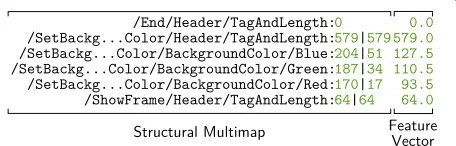
The structural multimap corresponding to the SWFRE-Tools output of Fig. 6 is illustrated on the left-hand side of Fig. 11. The following section describes the second pro-cessing step of our method, structural path consolidation.
3.2 Structural path consolidation
The syntactic richness and flexibility of many file formats enable semantically equivalent but syntactically different structures. Such syntactic polymorphism may decrease the detection accuracy and, furthermore, provide a pos-sibility for an attacker to fully avoid detection of specific files. To address this problem, we have developed a heuris-tic technique for consolidation of structural paths which reduces polymorphic paths to somewhat consistent repre-sentation. This technique can be best exemplified for the PDF format.
We have observed that many paths common among PDF files exhibit structural similarities to other paths. In fact, we were able to identify groups of paths simi-lar to each other but not identical. Paths in these groups exhibited a similarity in one of two ways. Paths in some groups were identical except for exactly one customiz-able path component, while paths in other groups shared a common repetitive subpath. Importantly, however, all paths in a group of similar paths refer to objects with the same purpose, i.e., the same semantic meaning, in PDF. For example, the paths /Pages/Kids/Resources
and /Pages/Kids/Kids/Resources have a
com-mon repetitive subpath, /Kids, but both refer to PDF dictionaries that have the same purpose—to pro-vide a name for resources required to render a page of a PDF file. Semantically, it is irrelevant which path the structure extraction algorithm took before it visited a page’s resource dictionary—all resource
Fig. 11Structural multimap and feature vector of the SWF file depicted in Fig. 5
dictionaries have the same semantic meaning. Likewise, the paths /Pages/Kids/Resources/Font/F1 and /Pages/Kids/Resources/Font/F42only differ in the last path segment, which the PDF Standard mandates to be user-defined, but both refer to Font dictionaries describing fonts for use in the PDF file. Again, regard-less of the concrete name a specific PDF writer gives to a font dictionary, all font dictionaries are semantically equivalent.
The existence of semantically equivalent path groups questions the utility of SL2013 feature definition which treats every path as a distinct feature. It is more mean-ingful to preserve the semantics of paths by consoli-dating all semantically equivalent paths to one feature. This idea, calledstructural path consolidation(SPC), was implemented in Hidost and experimentally evaluated in Section 4.3.3.
The implementation of SPC is based on the substi-tution of key path components using regular expres-sions. Repetitive subpaths are completely removed from the path. For example, both paths indicated above as examples with a common repetitive subpath would be consolidated into the path /Pages/Resources, removing the repetitive subpath /Kids. On the other hand, user-defined path components areanonymized, i.e., replaced with the placeholder path component /Name. For instance, both paths from the example above with user-defined font names would be consolidated into the path/Pages/Kids/Resources/Name(if the rule concerning repetitive paths was not applied beforehand, of course). Table 1 lists SPC rules employed in Hidost for PDF, implemented using the BOOST.REGEX library. Every rule comprises two regular expressions: one is used to search for a pattern to replace (left) and the other to determine the replacement string (right).
A single consolidation rule can be applied to mul-tiple groups of semantically equivalent paths. For example, the paths /Pages/Kids/Resources and /Pages/Kids/MediaBoxcan be consolidated by the same rule, but the resulting paths/Pages/Resources and/Pages/MediaBoxstill belong to separate groups and are, therefore, two different features.
Table 1PDF structural path consolidation rules
Search regular expression Substitute regular expression
1. /Resources/(ExtGState|ColorSpace|Pattern|Shading| XObject|Font|Properties|Para)/[ˆ/]+
/Resources/\1/Name
2. ˆPages/(Kids/|Parent/)*(Kids$|Kids/|Parent/|Parent$) Pages/
3. /(Kids/|Parent/)*(Kids$|Kids/|Parent/|Parent$) /
4. (Prev/|Next/|First/|Last/)+ <empty string>
5. ˆNames/(Dests|AP|JavaScript|Pages|Templates|IDS| URLS|EmbeddedFiles|AlternatePresentations| Renditions)/(Kids/|Parent/)*Names
Names/\1/Names
6. ˆStructTreeRoot/IDTree/(Kids/)*Names StructTreeRoot/IDTree/Names
7. ˆ(StructTreeRoot/ParentTree|PageLabels)/(Kids/| Parent/)+(Nums|Limits)
\1/\3
8. ˆStructTreeRoot/ParentTree/Nums/(K/|P/)+ StructTreeRoot/ParentTree/Nums/
9. ˆ(StructTreeRoot|Outlines/SE)/(RoleMap| ClassMap)/[ˆ/]+
\1/\2/Name
10. ˆ(StructTreeRoot|Outlines/SE)/(K/|P/)* \1/
11. ˆ(Extensions|Dests)/[ˆ/]+ \1/Name
12. Font/([ˆ/]+)/CharProcs/[ˆ/]+ Font/\1/CharProcs/Name
13. ˆ(AcroForm/(Fields/|C0/)?DR/)(ExtGState|ColorSpace| Pattern|Shading|XObject|Font|Properties)/[ˆ/]+
\1\3/Name
14. /AP/(D|N)/[ˆ/]+ /AP/\1/Name
15. Threads/F/(V/|N/)* Threads/F
16. ˆ(StructTreeRoot|Outlines/SE)/Info/[ˆ/]+ \1/Info/Name
17. ColorSpace/([ˆ/]+)/Colorants/[ˆ/]+ ColorSpace/\1/Colorants/Name
18. ColorSpace/Colorants/[ˆ/]+ ColorSpace/Colorants/Name
19. Collection/Schema/[ˆ/]+ Collection/Schema/Name
and convert linked lists to shallow sets (4) in order to cre-ate a generic, unified view of their elements, all on the same level. We refer the reader to the PDF Standard [9] for a detailed explanation of these branches of the PDF document structure.
Due to the relatively shallow SWF logical file structure and the barring of user-defined path components, only two SPC rules were compiled for this format, listed in Table 2, both for handling repetitive subpaths.
No attempt was made to compile a complete list of SPC rules. Especially for PDF, there is ample opportunity for further anonymization and flattening of hierarchies such as name trees and number trees not covered in our rules. In general, to extend the list, it is advised to read the PDF Standard looking for places in the PDF document struc-ture where user-defined names are allowed or where there
Table 2SWF structural path consolidation rules
Search regex Substitute regex
(DefineSprite/ControlTags/){2,} DefineSprite/ ControlTags/
(Symbol/Name/){2,} Symbol/Name/
is a well-defined list or hierarchy. However, even this lim-ited set of rules provides the following crucial benefits compared to SL2013:
• Reduced attack surface. Without SPC, every distinct path with an occurrence count above a threshold constitutes a feature. An attacker striving to evade detection may in that case perform ahiding attack by concealing a malicious payload at a custom path different from any in the feature set. For example, a path to a font with a long, randomly generated name is highly unlikely to have been encountered before. A malicious payload inserted there would invisible to the detector that does not have this particular path in its feature set. In case of SWF, where user-defined paths are disallowed, payloads may be concealed in very deep hierarchies, not encountered in “normal” files. PDF also suffers from this vulnerability. Hiding attacks are cheap to implement and the primary weakness of SL2013. This avenue for evasion is closed in Hidost with the use of consolidated paths.
often changes in time. This is especially true in security applications, where defenders are forced to adapt to unpredictable changes in attacks. This problem is known in machine learning asconcept drift [32] and has recently started to attract interest in security literature [33].
The continual change in data renders classifiers ever more outdated as time progresses since their training. Therefore, the need arises for regular updates to the learning model, i.e., periodic classifier retraining. With data-dependent features such as in this work, it is advisable to perform feature selection anew before every retraining in order to better adapt to concept drift. Periodic feature selection causes the
obsolescence of existing features and addition of new ones between two retraining periods. We refer to changes in the feature set caused by periodic feature selection asfeature set drift. PDF is more susceptible to feature set drift than SWF due to the flexibility of its structural path definition. As Section 4.3.3 shows, SPC is effectively used to reduce feature set drift in Hidost.
• Feature space dimensionality reduction. Finally, SPC has a tremendous impact on the total number of features. Feature space dimensionality directly affects the running time and memory requirements of learning algorithms. In our PDF experiments with periodic retraining, the average feature set size was reduced by an impressive 88 %, from 10,412.5 to 1237.4 features per training. However, there are limits in the effectiveness of SPC against manually crafted paths. Because it knows no notion of a semantically valid path, SPC cannot handle
unforeseen cases, e.g., arbitrary names in the Catalog dictionary. To tackle this final “blind spot” in the coverage of the PDF logical structure, a whitelisting approach would be required with its complete and up-to-date representation—a model of the entire structure—which is out of scope of this work.
The reduced attack surface and limited feature set drift represent an important contribution to the operational security of Hidost as a machine-learning-based detector. Massively reduced feature count enables its application on even bigger datasets. Together, the described improve-ments bring Hidost a big step towards applicability in a real-world, operational environment as an accurate, reli-able, and secure malicious file detector.
3.3 Feature selection
Despite the reduction of syntactic polymorphism via structural path consolidation, there may still exist paths that occur very infrequently in the observed data. Using such paths for building discriminative models increases
the dimensionality of the input space without improving classification accuracy. Therefore, feature selection—as it is common in other machine learning applications—has to be carried out to limit the impact of rare features. Before presenting the specific feature selection techniques, we discuss the reasons why rare features occur in the two formats studied in detail in the paper.
The SWF file format specification [27] strictly defines the names of all tags and all their fields, prohibiting customization. Therefore, Hidost’s feature set for SWF theoretically comprises every structural path defined by the SWF specification. However, in practice, no effort has been made to enumerate all paths in the SWF logi-cal structure. Instead, the feature set comprises all paths
observedin the training dataset, a total of 3177.
In contrast, the PDF file format specification [9] allows the use of user-defined names in any PDF dictionary, essentially enabling an unlimited number of different paths. Our data indicates that this PDF feature is widely used in practice as we have observed over 9 million dis-tinct PDF structural paths. However, 23 of these paths do not occur in more than one file. These and other paths that occur in a small percentage of the dataset are consid-ered anomalous. Therefore, the original SL2013 method selected the PDF paths which occur in more than a fixed number of training files, i.e., 1000, for its feature set. This threshold controls the trade-off between detection accu-racy (more paths) and model simplicity (less paths) and may be freely adjusted.
After SPC and before every training in our periodic retraining experimental protocol, we applied the same occurrence threshold, i.e., 1000 files, which corresponds to around 1 % of the training set size. This is in contrast with SL2013, where feature selection was performed “in hindsight”, once for the entire dataset.
3.4 Vectorization
Structural multimaps are a suitable representation of PDF and SWF logical file structure but they cannot be directly used by machine learning algorithms. They first need to be transformed into feature vectors, i.e., points in the
Booleans are reduced to their means, not medians. Mean preserves more information about Booleans than median, which can only be 0,12, or 1, and there is no possibility of outliers. This exception is not implemented for PDF as its logical structure has relatively few boolean values.
Structural maps are transformed into feature vectors f∈RNby reserving a separate dimension for each specific structural path and using values from structural maps as values of specific dimensions. The mapping of individual structural paths to dimensions of feature vectors is defined before feature extraction and during feature selection and is applied uniformly to all structural maps prior to both training and classification. Consequently, a specific struc-tural path corresponds to the same dimension in every feature vector, enabling the learning algorithms to make sense of the feature vectors.
The ordered collection of all features used by a learning algorithm is itsfeature set. Figures 10 and 11 illustrate fea-ture vectors obtained from a PDF and a SWF structural multimap, respectively. They show a simple case when the feature set is identical to the set of keys in the struc-tural multimap and every value of the feature vector is assigned. In practice, however, files usually do not contain all structural paths present in the feature set and the cor-responding values in the feature vectors are set to zero. In summary, a feature vector corresponding to a structural multimapmis a pointf=f1,f2,. . .,fNin feature spaceRN
with specific values defined as
fi=
median(m[pi]), pi∈m
0, otherwise ∀i∈1,N (1)
Here,pidenotes theith path in the feature set andm[pi]
denotes the value in a multimap massociated with that path.
3.5 Learning and classification
The stages presented so far transform samples, i.e., files, into feature vectors suitable as input for machine ing algorithms. The choice of a concrete machine learn-ing classifier depends on a multitude of parameters, e.g., dataset size, feature space dimensionality, available computational resources, robustness against adversar-ial attacks, etc., and classifiers are tailored for different uses. The published implementation of Hidost therefore does not comprise learning and classification subsystems. Instead, its output can be used with the reader’s classi-fier of choice. For experiments presented in this paper, the Random Forest implementation of the open-source scikit-learn Python machine learning library [34], version 0.15.0b2, was utilized. This part of Hidost was published separately, as part of experimental reproduction code, as detailed in the following section.
Random Forest [35] is an ensemble classifier. It is trained by growing a forest of decision trees using CART method-ology. Each of thetRFtrees is grown on its own fixed-size random subset of training data drawn with replacement. At every branching of a tree during training, the feature providing the optimal split is selected from a random sub-set comprising fRF features not previously used for this tree. During classification, the decision of every tree is counted as one vote and the overall outcome is the class with the majority of votes. Random Forests are known for their excellent generalization ability and robustness against data noise. For the experimental evaluation, forest size was set to 200 trees and all other parameters to their scikit-learn defaults.
4 Experimental evaluation
An extensive experimental evaluation was performed to assess the detection performance of Hidost and com-pare it to related work. Entire source code and datasets needed to reproduce all experiments and plots have been published as open-source software [36].
4.1 Experimental datasets
Experiments were run on two datasets, one for each file format. Both were collected from VirusTotal [37], a website that performs an analysis of files uploaded by Internet users using many antivirus engines. VirusTo-tal provides detection results to researchers, enabling us to compare Hidost’s detection performance to that of deployed antivirus engines. In our experiments, we con-sider those files malicious that were labeled as malicious by at least fiveantivirus engines and those files benign that were labeled benign by all antivirus engines. The remaining files, labeled by one to four antivirus engines as malicious, are discarded from the experiments because of the high uncertainty of their true class label.
Our PDF dataset comprises 439,563 (446 GiB) files, 407,037 (443 GiB) benign and 32,567 (2.7 GiB) malicious. They were collected during 14 weeks, between July 16 and October 21, 2012. This is the same dataset used for the10Weeksexperiment in [26], enabling a direct comparison with that work.
The SWF dataset was collected between August 1, 2013 and March 8, 2014 and comprises 40,816 (14.2 GiB) files, 38,326 (14.1 GiB) benign and 2490 (190 MiB) malicious. The VirusTotal SWF data had a benign-to-malicious ratio of around 52:1 during the collection period; therefore, a random subsampling of benign data was performed to approximately match the ratio with that of PDF data.
4.2 Experimental protocol
realistic conditions and (b) to enable the comparison of Hidost’s detection performance on PDF to its predecessor, SL2013. To this end, we adopt the experimental protocol of the10Weeksexperiment from the same publication.
The 10Weeks experiment attempts to approximate a real-world, operational environment of a malware detec-tion system exposed to attacks that change and adapt in time. For that purpose, it employs periodic retraining and evaluation. Training and evaluation datasets are assem-bled in a sliding window fashion, i.e., for every week of evaluation data, the classifier is trained on the previous 4 weeks of training data.
In order to follow the protocol of the10Weeks experi-ment as closely as possible, the two experiexperi-mental datasets were partitioned as follows. The time period in which the files were collected was divided into 14 smaller, con-secutive time periods. For PDF, every period was exactly 1 week long, for SWF 15 days, the last one 25 days. Every time period was assigned a bucket, and every file was put into one of the buckets, according to the time period when it was first seen. Then, the sliding window approach was applied, joining four consecutive buckets into a training dataset and using the following bucket as the corresponding evaluation dataset, resulting in 10 data partitions for periodic retraining. Before every retraining, i.e., every week for PDF, every 15 days for SWF, all four steps of feature extraction (i.e., structure extraction, SPC, feature selection, and vectorization) were applied to the training dataset.
Thus, generated PDF file partitioning is identical to the one used in [26], and the SWF dataset follows the same design. The datasets are illustrated in Figs. 12, 13, and 14. Every retraining event is labeled by the date of training, i.e., the day that marks the beginning of data collection for the evaluation period.
Aug 13
Aug 20
Aug 27
Sep 03
Sep 10
Sep 17
Sep 24
Oct01Oct08Oct15
Date (2012) 0.0
0.2 0.4 0.6 0.8 1.0 1.2 1.4 1.6
Samples
× 105
Fig. 12PDF dataset. Legend in Fig. 13
Sep 30
Oct15Oct30Nov 14
Nov 29
Dec 1 4
Dec 29
Jan 13
Jan 28
Feb 1 2
Date (2013 - 2014) 0.0
0.5 1.0 1.5 2.0 2.5
Samples
× 104
Benign training Malicious training Benign evaluation Malicious evaluation
Fig. 13SWF-Normal dataset. Malicious training samples older than four time periods are discarded
While the benign-malicious class ratio for PDF is approximately equal throughout all time periods, the dis-tribution of malicious and benign SWF files in time is highly skewed, as visible in Figs. 13 and 14. As much as 70 % of malicious SWF files in the SWF-Normal dataset were collected before the first evaluation period, while less than 10 % of benign SWF files occur before the fifth eval-uation period. The result is a high class imbalance in most training and evaluation datasets. In order to quantify the effect of high class imbalance on detection performance, we generated another data partitioning just for SWF data, labeled SWF-KeepMal and illustrated in Fig. 14, in which malicious training samples older than four periods are not discarded. Instead, they are used for training in all sub-sequent periods. By discarding old benign samples and keeping malicious ones throughout the experiment, the class imbalance in training datasets is greatly reduced.
Sep 30
Oct15Oct30Nov 14
Nov 29
Dec 14
Dec 29
Jan 13
Jan 28
Feb 1 2
Date (2013 - 2014) 0.0
0.5 1.0 1.5 2.0 2.5
Samples
× 104
0.992 0.994 0.996 0.998 1.000 Area under ROC 0.93 0.94 0.95 0.96 0.97 0.98 0.99 1.00 Accuracy SL2013 reproduction SL2013 + Random Forest Hidost binary Hidost numerical 0.60 0.65 0.70 0.75 0.80 0.85 0.90 0.95 1.00 T rue p o sitive rate Aug 13 Aug 20 Aug 27 Sep 03 Sep 10 Sep 17
Sep 24Oct01Oct 0 8
Oct 1 5 Date (2012) 0.0000 0.0005 0.0010 0.0015 0.0020 0.0025 0.0030 0.0035 F a lse p ositive rate
Fig. 15Results on PDF data. Performance of SL2013 with an SVM and Random Forest classifier compared to Hidost with binary and numerical features
4.3 Experimental results
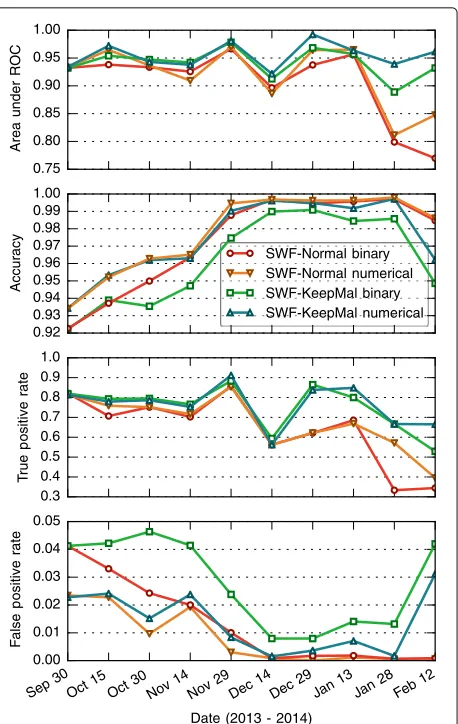
Experimental results of different methods operating on PDF and SWF data are illustrated in Figs. 15 and 16, respectively. The methods are compared in four per-formance indicators typical for classification tasks: true (TPR) and false positive rate (FPR), accuracy, and area under receiver operating characteristic (AUROC). AUROC, similar to the area under the precision-recall curve, is a good detection performance indicator for both balanced and unbalanced datasets. Due to the stochastic nature of the algorithm, mean values of 10 independent runs are plotted for all Random Forest experiments. The variance of these experiments was omitted from the plots due to its very low value. SL2013 employs a support vector machine (SVM) classifier, a deterministic algo-rithm; therefore, its results are obtained from a single experimental run. 0.75 0.80 0.85 0.90 0.95 1.00 Area under ROC 0.92 0.93 0.94 0.95 0.96 0.97 0.98 0.99 1.00 Accuracy SWF-Normal binary SWF-Normal numerical SWF-KeepMal binary SWF-KeepMal numerical 0.3 0.4 0.5 0.6 0.7 0.8 0.9 1.0 T rue p ositive rate Sep 30 Oct 15 Oct 30 Nov 14 Nov 29 Dec 14 Dec 29
Jan13Jan28Feb 1 2
Date (2013 - 2014) 0.00 0.01 0.02 0.03 0.04 0.05 F alse p ositive rate
Fig. 16Results on SWF data. Performance of Hidost with both binary and numerical features on two SWF datasets, SWF-Normal, and SWF-KeepMal
Figure 15 shows results for different variants of Hidost and SL2013 on PDF data. Along with the accurate repro-duction of SL2013, the same method is evaluated using a Random Forest classifier instead of the SVM. Hidost is shown with both binary and numerical features. These two variants of Hidost are also shown in Fig. 16 on SWF datasets SWF-Normal and SWF-KeepMal.
4.3.1 Classification performance
for all methods, including the SVM. The maximum differ-ence between any two methods in AUROC in a given time period is a mere 0.006, and all methods have an AUROC above 0.99 in every period. It can be concluded that Hidost achieves the excellent classification performance of its predecessor, SL2013, on PDF data.
Hidost’s performance on SWF data is not on par with its success on PDF. Although the mean detection accu-racy lies above 95 %, as seen in Fig. 16, accuaccu-racy is not a meaningful performance indicator due to the large class imbalance of 15:1 in favor of benign samples in the SWF dataset. The class imbalance is even greater in the datasets of individual time periods, shown in Figs. 13 and 14, especially in the case of SWF-Normal.
The effect of class imbalance is clearly reflected in the results. Applied on SWF-KeepMal, where malicious training samples are accumulated over time, Hidost has an overall much higher AUROC than on SWF-Normal, where malware is discarded after four periods. The true positive rate on SWF-KeepMal in the early stages, when the classes are more balanced, is 5 to 10 % higher than on SWF-Normal. Starting from December 29, after a
sharp increase of class imbalance, the advantage jumps to around 20 %—a tremendous improvement. Access to more malicious training data also increased the false pos-itive rate, but the increase for the variant with numerical features remained within bounds, except for the last time period. These findings clearly show Hidost’s potential for further improvement of detection performance, given a greater availability of malicious SWF training data. How-ever, as the SWF dataset only comprises 2,490 malicious samples, it is impossible to accurately quantify the poten-tial for improvement.
4.3.2 Comparison to antivirus engines
In order to get an estimate of Hidost’s detection perfor-mance under day-to-day, realistic operational conditions, it is necessary to put it into a wider perspective. A direct comparison with antivirus engines, widely used malware detectors most persons rely on for their security, provides such a reality check. We compare the detectors in terms of their true positive count, i.e., the number of malicious samples they have correctly labeled, in the course of our experiments. By definition of our ground truth, samples
0 5000 10000 15000 20000 25000
True positive count Kingsoft
SUPERAntiSpyware NANO-AntivirusByteHero TheHackerAntiy-AVL Agnitum eScan VBA32
Panda ViRobot Rising VirusBuster CAT-QuickHeal Jiangmin TotalDefense AhnLab-V3eSafe ClamAV K7AntiVirus MicroWorld-eScan PCTools Symantec EmsisoftNorman TrendMicro
VIPRE Fortinet F-Prot McAfee-GW-Edition TrendMicro-HouseCall CommtouchF-Secure
AvastAVG McAfeeIkarus Microsoft
AntiVir nProtect DrWeb Comodo BitDefender Kaspersky ESET-NOD32 GData Sophos HidostTotal
0 100 200 300 400 500 600 700
True positive count Kingsoft
CMC Qihoo-360 Panda K7AntiVirus K7GW ClamAV ViRobot PCTools Antiy-AVLBkav TotalDefenseRising F-Prot CAT-QuickHealAhnLab-V3 ESET-NOD32McAfee Jiangmin Comodo Commtouch Agnitum DrWeb VBA32 Ad-Aware McAfee-GW-Edition TrendMicro-HouseCall VIPREIkarus Symantec TrendMicro NANO-Antivirus Norman Fortinet Emsisoft nProtect F-Secure BitDefenderAVG MicroWorld-eScan MicrosoftGData KasperskyHidost Sophos AntiVirAvast Total
labeled malicious by at most four antivirus engines are fil-tered out. Therefore, the antivirus engines do not have false positives and cannot be compared in that sense.
Figure 17 shows the results achieved by Hidost (average of 10 experimental runs) and antivirus engines deployed by VirusTotal on both PDF and SWF files. Antivirus detec-tion results were collected after the experiments were over and not immediately after each new file was submit-ted to VirusTotal. This provided antivirus engines with the opportunity to update their detection mechanisms in the meantime and correctly detect any file resubmit-ted between its initial submission and the time when the detection results were collected.
Nevertheless, Hidost ranks among the best overall. Its PDF detection rate is unsurpassed, and even the SWF true positive count, comparatively much worse than PDF “on paper”, ranks among the best when compared to estab-lished products under realistic conditions.
4.3.3 Effects of structural path consolidation
SPC is one of the main novelties in Hidost with respect to SL2013; therefore, an evaluation of its effects on the per-formance of the system is only fitting. Figure 15 demon-strates that SPC does not affect detection performance, neither positively nor negatively. Results of SL2013 (no SPC) are virtually identical on PDF to those of Hidost (with SPC) when the same Random Forest classifier is utilized. Effects on SWF are negligible because its rigid logical structure disallows user-defined paths, resulting in minimal necessity for SPC.
However, SPC has a strong positive effect on feature set drift. Figure 18 illustrates feature set drift in our experiment with periodic retraining and periodic feature selection on PDF data. It can be observed that in the first half of our 10-week experiment, the feature set had been expanded with up to 9 % of new features per week, while in the second half, many features were found obsolete and were removed from the feature set. Feature removal is especially high in week 8, when almost a fifth of all fea-tures from the previous week were deleted when SPC was not used. On the other hand, when utilizing SPC, the over-lap between feature sets of consecutive weeks was well above 90 % throughout the entire experiment. Overall, the introduction of SPC in Hidost reduced feature set drift by around 50 %.
4.3.4 Effects of numerical features
Another novelty introduced in Hidost is the use of numer-ical instead of binary features, reflecting the transition from learning on pure structure to learning on structure coupled with content. Here, we evaluate the impact of numerical features on performance.
On PDF, the difference between binary and numerical features is insignificant, as shown in Fig. 15. On the other
hand, the effect on SWF is largely positive. As shown in Fig. 16, numerical consistently outperformed binary fea-tures on both SWF datasets. They showed the highest influence on false positive rate, reducing it by as much as 50 %. TPR and AUROC also showed a significant overall improvement.
The cause of the discrepancy between results for the two file formats might lie in the nature of attacks against them. Malicious PDF files often use features uncommon in benign files, i.e., theirstructureis different, while mali-cious SWF files mostly base their attacks on different val-ues, i.e.,content, at specific paths, although these paths are also common among benign files. While binary features suffice to describe logical structure, the added expressive power of numerical features enables the description, and consequently detection, of both structure- and content-based attacks.
4.4 Reproduction of SL2013 results
Results of all performance evaluation experiments pub-lished in SL2013 [26] were accurately reproduced using the original RBF SVM withC=12 andγ =0.0025. How-ever, when attempting to reproduce the evasion robust-ness evaluation experiment, we have discovered a flaw in
0.00 0.02 0.04 0.06 0.08 0.10
New
features
Without SPC With SPC
0.00 0.05 0.10 0.15 0.20
Obsolete
features
2 3 4 5 6 7 8 9 10
Retraining period 0.80
0.85 0.90 0.95 1.00
Unchanged
features
the source code of the mimicry attack used against the RBF SVM. Namely, instead of mimicking the most benign sample in the benign set, the flaw caused the most benign sample in the malicious set to be used as the mimicry target. Thus, generated attack dataset was successfully detected as such by the RBF SVM. Upon discovering this flaw, we removed it and performed a corrected experi-ment. This time, the attack was highly successful and the accuracy fell to 50 %. We therefore retract the results of the mimicry attack experiment published in [26] and see the success of the corrected attack as evidence against the robustness of RBF SVM in an adversarial environment. Robustness guarantees for Random Forests remain a topic for future research.
5 Discussion
The main novelty introduced by Hidost is its applicability to multiple file formats, implemented and experimentally confirmed on PDF and SWF. Its application to other hier-archically structured file formats, e.g., XML, HTML, ODF, OOXML, and SVG, requires the instrumentation of an existing parser or the development of a new one, one for each file format. Given the ability to parse a specific file format, incorporating it into Hidost amounts to develop-ing a structure extraction module. It is this step that has to be specialized for every file format. In the following, we discuss file structure and content extraction for various hierarchically structured file formats.
XML and the related HTML and SVG have a very clear and well-defined hierarchical structure that rep-resents one of the cornerstones of these formats. For example, Fig. 2 depicts an HTML file with the path /html/body/p. Furthermore, there exists a number of mature open-source parsers for XML files. We estimate it to be very simple to implement the extraction of both logical document structure and content from XML files.
Although based largely on XML, ODF and OOXML generally combine multiple XML files into a ZIP archive and therefore require some additional processing. Both formats prescribe a set of files and directories in which content, layout, and metadata are separately organized. The formats differentiate between textual and graphical content; textual being stored alongside logical structure in XML files and graphical in separate files within the directory hierarchy. We observe that the files and directo-ries are themselves organized hierarchically and that the remaining logical structure is described in XML files. The following shows a simplified file and directory layout in an ODF file:
.
|-- content.xml |-- manifest.rdf |-- META-INF
| \-- manifest.xml
|-- meta.xml |-- mimetype
|-- settings.xml |-- styles.xml \-- Thumbnails
\-- thumbnail.png
We consider the directory hierarchy to be the top level of the logical structure. In it, the root directory of the ZIP archive represents the root node of the entire structural hierarchy. XML files can be viewed as sub-trees rooted at the corresponding nodes in the file system hierarchy. For example, ODF prescribes that the file meta.xml, depicted in Fig. 19, resides within the root directory and has a set of XML tags describing document meta-data. Given this structure, the path to the dc:creator
tag would be:
/meta.xml/office:document-meta/office:meta
→ /dc:creator
By treating the directory hierarchy as the top level of the logical structure and XML files as sub-trees beloning to it, we ensure the complete and unambiguous extraction of logical structure. Compared to PDF and SWF, we prepend the file system path of a given XML file, relative to the root of the ZIP archive, to structural paths extracted from the file itself.
Multiple parsers for ODF and OOXML exist, of which some are open-source. We believe that it would be possi-ble, with moderate effort, to develop structure extraction modules for both formats. Furthermore, in many cases, completely benign OOXML files are used as containers for embedding malicious SWF files and Hidost can already handle them.
Structural path consolidation is the second and final format-specific step in Hidost and requires some tuning. We expect that different formats have different require-ments for SPC and acknowledge the necessity for deeper understanding of file formats for SPC rule development. The variety of SPC rules for PDF versus SWF corroborates this hypothesis.
Finally, Hidost’s applicability to a given file format does not imply its effectiveness on it. For example, despite our firm belief that extending Hidost to XML is straightfor-ward, its effectiveness, measured in its ability to detect malware disguised in XML files, can only be evaluated experimentally. However, its use of both structure and content for modeling makes it more likely to be successful.
6 Conclusions
In this paper we introduced Hidost, a machine-learning-based malware detection system. It represents an exten-sion of a previously published method, SL2013 [26]. Hidost is the first static machine-learning-based malware detector designed to operate on multiple file types. It
accomplishes this by making a model of malicious and benign samples based on their structure and content.
Evaluated on a real-world dataset in a realistic experi-ment with periodic retraining spanning multiple months, Hidost outperformed all antivirus engines deployed by the website VirusTotal and detected the highest number of malicious PDF files. It also ranked among the best on SWF malware. Compared to its predecessor, SL2013, it is much less vulnerable to malware hiding in obscured parts of PDF files. Hidost also became more robust against the continual adaptation of malware to updated defense through periodic retraining. Finally, its greatly reduced feature set dimensionality enables its efficient application on very large datasets.
A logical next step for Hidost is its implementation and evaluation on other hierarchically structured file formats. Of particular significance would be an application to for-mats used by Microsoft Office, as they are widely used for recent targeted attacks. A conceptual design for this appli-cation was proposed in this paper. Looking beyond, the development of more advanced string handling methods might prove indispensable to enable detection of malware in formats whose logical structure and numerical content do not provide enough discriminative power.
Acknowledgements
We acknowledge support by Deutsche Forschungsgemeinschaft and Open Access Publishing Fund of University of Tübingen.
Authors’ contributions
NS participated in conceiving and designing the study, implemented the method, participated in the data collection, carried out the experiments, and drafted the manuscript. PL participated in conceiving and designing the study, the system design, and the data collection and helped draft the manuscript. Both authors read and approved the final manuscript.
Competing interests
The authors declare that they have no competing interests.
Author details
1Cognitive Systems, Department of Computer Science, University of Tübingen, Sand 1, 72076, Tübingen, Germany.2Munich Office, European Research Center, Huawei Technologies Duesseldorf GmbH, Riessstr. 25 D-3.OG, 80992 München, Germany.
Received: 29 November 2015 Accepted: 7 September 2016
References
1. Symantec, 2014 Internet Security Threat Report, Volume 19 (2014). https://www.symantec.com/content/en/us/enterprise/other_resources/ b-istr_main_report_v19_21291018.en-us.pdf. Accessed 13 Apr 2015 2. Cisco, 2014 Annual Security Report (2014). http://www.cisco.com/web/
offer/gist_ty2_asset/Cisco_2014_ASR.pdf. Accessed 13 Apr 2015 3. Sophos, Security Threat Report 2014 (2014).
http://www.sophos.com/en-us/medialibrary/pdfs/other/sophos-security-threat-report-2014.pdf. Accessed 13 Apr 2015
4. Symantec, 2014 Internet Security Threat Report, Volume 19, Appendix (2014). https://www.symantec.com/content/en/us/enterprise/ other_resources/b-istr_appendices_v19_221284438.en-us.pdf. Accessed 13 Apr 2015