2838
MATHEMATICAL TRANSFORMATIONS WITH SPIHT
ALGORITHM FOR STEGANOGRAPHY TECHNIQUES
1NAJI MUTAR SAHIB, 2TAHA MOHAMMAD HASAN, 3MENA MOHAMMED ABOOD 1Department of Computer Sciences, College of Science, Diyala University, Diyala, Iraq
2Department of Computer Sciences, College of Science, Diyala University, Diyala, Iraq
3Department of Computer Sciences, College of Science, Diyala University, Diyala, Iraq
E-mail: 1 [email protected], 2[email protected] , 3[email protected]
ABSTRACT
Due to the rapid and immense development within information transmission and communications, there is a growing need for the usage of steganography techniques which greatly stimulated the emergence of intensive research activities to study steganography. The current paper submits a new system for steganography technique which relies on discrete transforms with SPIHT (Set Partition in Hierarchical Trees) algorithm. The system is able to hide secret massages in a colored cover image. This picture is split up into pixel blocks in the ratio 8x8. Haar wavelet transforms, DCT (Discrete Cosine Transform) and SPIHT algorithm are in turn used on each lock in order to get our (LIP) list, which points out the unnecessary pixels, which represent the optimum locations for hiding the secrete massage. The paper presented two ways for hiding, the first is in (band Blue) and the second is in (band Blue and Green), and we made a comparison between the results of the two methods. Another approach, which is based off of DWT (Discrete Wavelet Transform) as well as Haar wavelet transforms with SPIHT algorithm, is also presented in this paper. The two approaches were compared through capacity, correlation, PSNR and MSE.
Keywords:Steganography, DCT, DWT, Haar Wavelet Transform, SPIHT Algorithm.
1. INTRODUCTION
Today, information security becomes one of the most significant aspects of communication and information technology because of the massive height of the WWW and the copyright laws. Cryptography was produced as a technique for securing the privacy of information. Unfortunately, sometimes it is insufficient to maintain the contents of a message secretly, so other means may also be needful to maintain the secrecy of the message, and the term responsible for this is called steganography [1].
Steganography is one of the most and secure effective data communications. It protects the secret messages by embedding them into digital media and making them invisible and inconspicuous to eavesdroppers [2]. In contrast to the classical cryptography which results in hiding the content of secret messages being exchanged between the two sides of communication, steganography aims to hide
not only the content but also its very existence. Therefore, it offers a better security in many ways. There are couple other technologies that are connected in a close manner to steganography are fingerprinting and watermarking [3] which involve the information embedded in some media. Mainly, these technologies concerned with protecting intellectual property; hence, the requirements of algorithms are different than steganography requirements [4]. The type of information covered by objects when using watermarking technique are usually an ownership for the purpose of copyright protection or signature to signify origin [5]. On the other hand, the use of fingerprinting involves unique, different marks embedded in distinct copies of the carrier objects which are supplied to different customers [4].
stego-2839 image, after the secret message is embedded, a public channel will carry it to a particular receiver.
Generally, two approaches exist for image steganography, the first is spatial domain technique, while the second technique is frequency domain. In image steganography, the cover image is where the secrete data is embedded.
One of the most common and understandable known method is Least Significant Bit (LSB) technique, where the secret data takes the place of LSB of the cover image [7]. However, this technique for secret data hiding is considered to be inefficient due to the loss of data that occurs after file transformation [8]. A new method has been introduced, it is based on (DCT) Discrete Cosine Transform transformation [9]. The major focus was on increasing the capacity of hiding the secret data.
2. AIM, OBJECTIVES AND EXPECTED RESULTS
The aim of the paper is to provide a new algorithm that includes two different approaches to hide information in binary media based on a discrete mathematical transform and SPIHT algorithm The objective with the paper are to:
Obtaining high security for information, efficiency and performance of the proposed algorithm
Evaluate different kinds of information carriers, i.e., file formats, in respect of efficiency and performance.
Identify detection methods for different carriers and media.
The expected results with this paper are to show the possibilities and threats with steganography. The result shall give an indication about the strength of hiding data in streaming media.
3. LITERATURE SURVEY
Chu, Y.P., et al [2004] [10]: a VQ compressing process is applied with the intention to compress a secret gray-level picture as a pre-embedding procedure. The next step is the encryption process which is taken out on the secret image as mentioned before. Next the image is embedded into DWT coefficients of the cover image. In the event that the stego-image is damaged, yet the
PSNR is still below 36dB, a recovery strategy for the mentioned image is undergone. Mythreyi S, et al [2007] [11]: the Gabor
coefficient of the picture is changed so that the secret messages may be embedded in the proposed steganography scheme.
Abdelwahab and Hassan [2008] [12]: both the secret messages and the images go through the DWT process which involves hiding data within the DWT domain. One aspect considered to be a drawback however, is that the data extracted differs from the embedded data.
Bao P. and Ma X. [2005] [13]: taking the the singular value decomposition in the wavelet domain of an image in order to embed a watermark.
Maity S.P. and Kundu M.K. [2004] [14]: A billed technique for applying watermarks is proposed to embed redundantly in the multilevel wavelet coefficients of the RR and LL band of the cover image. It is said that the scheme has robustness and the ability of detecting how severe any given external attack which has already happened in the watermarked image, however the value of
PSNR is not very high.
4. SPIHT ALGORITHM
In 1996 William Pearlman and Amir Said developed the SPIHT algorithm [15] (Set Partitioning into Hierarchical Trees). This compression algorithm is based on the following concepts:
The partial order of the transformed elements from the images magnitude as well as passing on the ordered information. The transmission of ordered bit plane. To what extent the degree of similarity is
found to be in regards to the coefficient as well as various levels of the wavelet is applied. Each must describe the same point of origin.
4.1 The Spatial Orientation Tree
2840 of representation. This in turn owns more detailed resolution. As has been shown, there are two directions which this can go in: either there are four descendants (represented as leaves), or zero. The descendants make up a group of (2 × 2) coordinates which are adjacent. The highest nodes, in accordance
with the hierarchy, represent the only exceptions, where there were no descendants for the coordinates in the low – low band. The coordinates which are within one wavelet level match up with the nodes at the same hierarchy level
4.2 The SPIHT Algorithm
These are the coordinate sets which play an essential part in the SPIHT algorithm [15], [17]:
H (i, j) coordinate set representing tree roots, the nodes which are in the highest level of all the wavelets
O (i, j) = {(2i, 2j), (2i, 2j +1), (2i+1, 2j), (2i+1, 2j +1)}, the coordinates representing the node’s children (i, j)
D (i, j) represents all the descendants of node (i, j)
L (i, j) = D (i, j) \ O (i, j) representing all descendants, excluding the children of node (i,j).
The usage of this function is to indicate the significance of specific coordinates T.
1 , | , | 2
0 , (1)
In order to make significant information stored, three ordered sets are utilized:
The coordinates in LIP, the list of insignificant pixels, are not so vital in regards to the current threshold.
On the other hand, important or relevant coordinates of the coefficients (in regards
to the current threshold), are placed in the list LSP which contains significant pixels. The list LIS contains the location points of
the roots from insignificant sub trees. The coefficients in LIS are all refined in a compression stage, and those that are shown to be important or relevant after this procedure are taken from LIP a placed in
LIS.
5. MATHEMATICAL TRANSFORMS
5.1 DCT
2841 visibility of the image. The following equation defines a common equation for a 1D (N data items)
[image:4.612.163.470.134.292.2]DCT: [18] [19].
Figure 2: Discrete Cosine Transformation of Images [17].
Although the following is a valid representation of the1D (N data items) DCT:
∑ ⋀ cos 2 1 (2)
The most commonly used equation for a 2D (N by M
image) DCT is given by the following equation:
,
∑ ∑ ∑ ⋀ ⋀ . cos 2
1 cos 2 1 , (3)
5.2. WT
Wavelet transforms (WT) refer to the conversion of spatial domain data to frequency domain data. The global frequency distribution of the time signal x(t) is obtained by the Fourier transformed signal XFT (f). In order to reconstruct the original signal, the inverse Fourier transform can be used [20]:
(4)
(5)
Previously, before wavelet transformation, Fourier transformation (FT) was the most common and well-known method for this purpose. With its ability to receive both frequency and real time data from a signal, the Short Time Fourier Transform (STFT) surpassed the FT method in terms of what it could achieve. A windowing concept is used in FT along with STFT concept. In this instance, FT is applied to a section of the signal which is covered by a window, where the window over the signal.
, ∗ (6)
The local analysis in the wavelet transformation is considered its advantage over the Fourier method.
The process of analyzing the wavelets, as specified above, is able to uncover essential data such as breakdown points, discontinuities, and more, in a much clearer way than its counterpart.
Two orthogonal functions form the start of a wavelet basis set: the so called father wavelet or scaling function (t) and the mother wavelet or wavelet function ψ(t), a complete basis set is obtained by undergoing a scaling and translation process using the means of these two mentioned functions. These transformations are expressed with the following equation:
, ∗, (7)
Where the * represents the complex conjugate symbol as well as mother wavelet or wavelet function refers to the function ψ.
Discrete transformation of wavelets as well as continuous transformation are the two methods with which the wavelet transformation can be implemented. Continuous wavelet transforms (CWT) can be defined by:
, | | . ∗ (8)
The transformed signal (XWT, s) is a function of the translation parameter and the scale parameter s.ψ is representative of the so called mother wavelet,the *
2842
6. THE PROPOSED SYSTEM
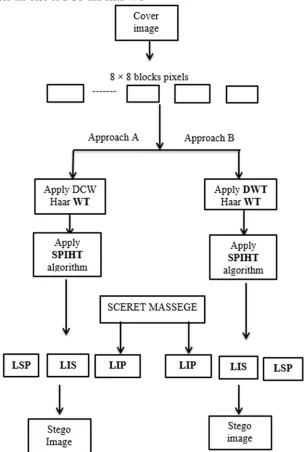
The proposed system includes two approaches to hide a secret message in the final image.The first approach (A)uses the base of DCT and Haar WT
with the SPIHT algorithm, and the approach (B) is based on DWT and Haar WT with SPIHT
[image:5.612.154.461.137.589.2]algorithm, as shown in Figure (3)
Figure 3: The Proposed System
6.1 Approach A
Part 1: Haar wavelet and DCT transform implementation:
In this part, the colored picture is split up into several bo8 x 8 block of pixels. We have used DCT in order to convert the 8 x 8 blocks from its spatial to
2843
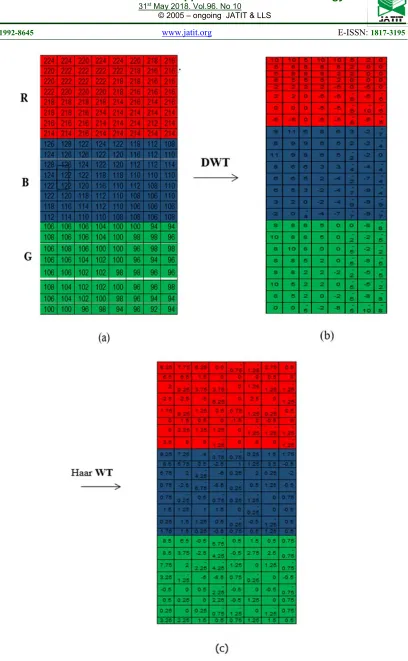
Figure 4: DCT Implementation (A) Image Data Before DCT (B) After DCT
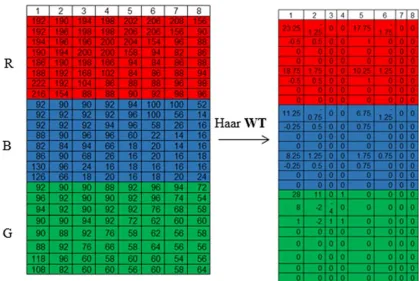
In order to fulfill the requirement of SPIHT algorithm, the block depicted in figure (4) should be processed by a Haar wavelet filter, Figure (5)
[image:6.612.90.509.425.706.2]2844
Part 2:SPIHT algorithm implementation.
Select the blocks from the previous part that satisfy the SPIHT algorithm conditions. Apply the SPIHT
algorithm on these blocks, to get three lists LIP, LIS
and LSP where:
LIP: the track of the pixels which are to be worked out is kept by this list.
LIS: the list reduced the computation power due to clustering only relative coordinate and set them ready for further processing.
LSP: stores the track of each pixel that has already been evaluated or needs to be re-evaluated is kept within this list.
Part 3 (steganography)
LIP To start implementing steganography, locations are extracted from LIP dropped onto the cover image, In which data is to be embedded. There are two methods to perform the process of hiding the secret messages:
1. Hide the LSB in the band blue.
2. Hide the LSB in the [band blue, band green].
Embedding Algorithm
Input: An mx n color picture and a message which must remain secret.
Output: An m x n stego image.
Step 1: Write text message and convert it in binary.
Step 2: Select color cover image.
Step 3: The color cover picture is split up into blocks of pixels in the size 8 x 8.
Step 4: DCT and Haar wavelet transform are applied to each block.
Step 5: Choose the blocks that achieved the highest value in the location (0, 0).
Step 6: Apply SPIHT algorithm, to get LIP, LIS
and LSP.
Step 7: LIP location are taken from each block, which was nominated by the previous step.
Step 8: The location obtained in the previous step are drawn on the cover image location. The locations obtained are used to hide the secret message.
Step 9: Separate the band red, band green and band blue from the selected locations.
Step 10: Calculate LSB of each location in band blue (obtained from the previous step) and change it for each part of the encrypted message.
Step 11: Write the stego-image.
Remake:
1. No changes are occurred by the Band red and it is considered the key of the algorithm when a secret message is retrieved.
2. When use the [band green, band blue] in hiding, the same algorithm above just step 10, when replacing the band blue with the [band blue, band green].
Retrieval algorithm Input: An m x n stego image.
Output: A message which remains secretavie
Step 1: Stego image is read
Step 2: The picture is split up into 8 x 8 block of pixels.
Step 3:DCT and Haar wavelet transform are applided to each block
Step 4: Choose the blocks that achieved the highest value in the location (0, 0)
Step 5: Apply SPIHT algorithm, get LIP, LIS and
LSP.
Step 6: Separate the blue, red and green locations band from the selected locations (LIP)
Step 7: Calulate LSB of each location in band blue.
6.2 Approach B
After being split up into 8 X 8 blocks of pixels, DWT
2845
2846
SPIHT algorithm is applied to the resulting blocks which achieves a higher condition in the location (0, 0), to get LIP, LIS and LSP. Actions to hide the secret message are performed same to approach A.
7. PERFORMANCE MATRICES
We compare the performance level of the individual methods using the mean square error peak signal to the computation time and noise ratio.
7.1 The Mean Square Error
The Mean Square Error (MSE) and the Peak Signal to Noise Ratio (PSNR), are used in order to compare the image compression. The MSE represents the accumulated squared error within the original image and the compressed image.
Mean Square Error =
sum(sum(error))) ^2/size (original image) (9)
7.2 Peak Signal to Noise Ratio
The mean-squared error is found first using the equation, as stated below, to compute the peak signal to noise ratio(PSNR),
Then the block computes the PSNR using this equation:
PSNR=10*log10(255*255/Mean Square Error)
(10)
8. RESULTS AND ANALYSES
The simulation of the findings was performed
using Visual Basic 2013 programming language. This paper discusses the performance of mathematical transforms with SPIHT algorithm for steganography techniques. Applying the SPIHT algorithm makes it possible to enhance the PSNR with decreased mean square error. Previous works are compared with the findings and outcomes found within this paper. The SPIHT algorithm was implemented for 100 iterations. After the iterations are carried out, a higher value for PSNR is obtained. In compression with DWT, the DCT technique using SPIHT algorithm with band (1) generated the maximum PSNR, but because DWT hiding is undergone using an approximation of the coefficient, it is much safer as well as less prone to attacks.335 characters must be used in order to hide the message in trial pictures.
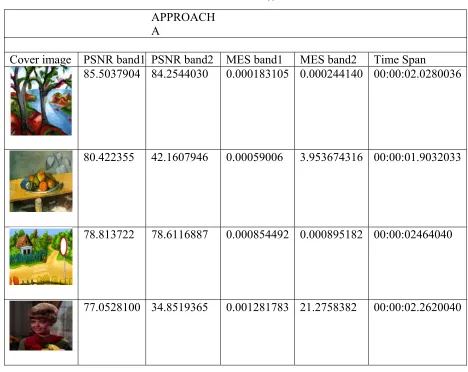
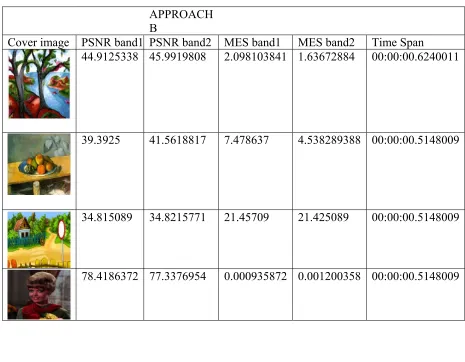
Through the results described in the table 1, showing that PSNR, MES, and Time of approach A (DCT based SPIHT algorithm), and the results described in
2847
Cover image Secret
message
Stege
imag
approach
A
band 1
Stege
imag
approach
A
band 2
Stege
imag
approach
B
band 1
Stegeo image
Pproach B
band 2
Hellow
My dear
How
ar
you
[image:10.612.90.525.99.468.2]I am ver
happy
2848
Table 1: PSNR, MSE and TIME Approach A
APPROACH
A
Cover image PSNR band1 PSNR band2 MES band1
MES band2
Time Span
85.5037904 84.2544030
0.000183105 0.000244140 00:00:02.0280036
80.422355
42.1607946
0.00059006
3.953674316 00:00:01.9032033
78.813722
78.6116887
0.000854492 0.000895182 00:00:02464040
2849
Table 2: PSNR, MSE and TIME Approach B
APPROACH
B
Cover image PSNR band1 PSNR band2 MES band1
MES band2
Time Span
44.9125338 45.9919808
2.098103841 1.63672884
00:00:00.6240011
39.3925
41.5618817
7.478637
4.538289388 00:00:00.5148009
34.815089
34.8215771
21.45709
21.425089
00:00:00.5148009
78.4186372 77.3376954
0.000935872 0.001200358 00:00:00.5148009
Figure 8: Result PSNR and MES Band 1approach A Figure 9: Result PSNR and MES Band 2 approach A
0 20 40 60 80 100
1 2 3 4 MES 2
PSNR 2
0 20 40 60 80 100
1 2 3 4 MES 2
[image:12.612.84.555.155.475.2]2850
[image:13.612.87.306.250.640.2]Figure 10: Result PSNR and MES Band 1 of approach B
Figure 11: Result PSNR and MES Band 2 of Approach B
Figure 12: Graphical Comparison of PSNR
Figure 13: Graphical Comparison of MSE
Figure 14: Comparison of Computation Time (in seconds)
9. CONCLUSION
The basic steganography techniques are compared in this paper. The DCT based SPIHT technique (approach A) gives better Performance compared to the DWT based SPIHT technique (approach B). The SPIHT is analyzed in this paper on DCT, the PSNR result was better when compared with others. Hence, the performance is enhanced by the SPITH algorithm with significant SPNR. Through implementing the technique of SPIHT, the DCT gives a very good payload capacity. The use of DCT in SPIHT provides high PSNT, but more time is consumed by DCT compared to DWT. Based on that, the future works will be about to decrease the computation time with an improved PSNR.
10. CONTRIBUTION
A new algorithm has been used to implement steganography which is SPIHT algorithm, the proposal of this paper was built upon using the power of this algorithm to hide data in different wave left levels that describes the same origin; the due to the capability of SPIHT Algorithm to reveal these levels.
2851
REFERENCES:
[1]H. N. Abed, N. H. Hassoon, A. L. Ahmed and I. S. Albayaty ,"Hiding Information in an Image Based on Bats Algorithm", Iraqi Journal of Information Technology, vol 8, No2 ,pp 128-141, 2018.
[2] Tian, Lei; Zhou, Ke; Jiang, Hong; Liu, Jin; Huang, Yongfeng; and Feng, Dan, "An M-Sequence Based Steganography Model for Voice over IP" (2008). CSE Technical
reports. Paper 68.
[3] Cheddad, Abbas, Joan Condell, Kevin Curran, and Paul Mc Kevitt. "Digital image steganography: Survey and analysis of current methods." Signal Processing 90, no.
3 (2010): 727-752.
[4] T Morkel, JHP Eloff and MS Olivier, "An Overview of Image Steganography," in Proceedings of the Fifth Annual Information Security South Africa Conference
(ISSA2005), Sandton, South Africa,
June/July 2005 (Published electronically) [5] Marvel, L.M., Boncelet Jr., C.G. & Retter, C.,
“Spread Spectrum Steganography”, IEEE
Transactions on image processing, 8:08,
1999
[6] Anderson, R.J. & Petitcolas, F.A.P., “On the limits of steganography”, IEEE Journal of selected Areas in Communications, May 1998 .
[7] C.S. Lu, “Multimedia security: steganography and digital watermarking techniques for protection of intellectual property”. Artech House, Inc. (2003).
[8] J.J. Chae and B.S. Manjunath, “Data hiding in Video” Proceedings of the 6th IEEE International Conference on Image
Processing, Kobe, Japan (1999).
[9] Provos, N., Honeyman, P., “Hide and Seek: An Introduction to Steganography” IEEE
Security & Privacy Magazine 1 (2003).
[10] Chu, Y.P., Guo, S.W., Chan, Y.K. and Wu, H.C. “Image Hiding Based on a Hybrid Technique of VQ Compression and Discrete Wavelet Transform”, International Computer Symposium, 313-317 ,2004. [11] Mythreyi S and Vaidehi V. “Gabor
Transform based Image Steganography”, IETE Journal of Research, 53(2):. 103 – 112,2007.
[12] A.A. Abdelwahab, L.A. Hassan. “A discrete wavelet transform based technique for image data hiding”, in: Proceedings of 25th National Radio Science Conference, Egypt, 2008.
[13] Bao, P and Ma, X. “Image Adaptive Watermarking Using Wavelet Domain Singular Value Decomposition”, IEEE Transaction on Circuits and Systems for Video Technology, 15(1):2005
[14] Maity S.P. and Kundu M.K., “A Blind CDMA Image Watermarking Scheme in Wavelet Domain” IEEE International Conference:2633 – 2336,2004.
[15] A. Said and W. A. Pearlman, "A New fast and efficient image codec based on set partitioning in hierarchical trees", IEEE Transaction On Circuits and Systems for Video Technology, vol. 6, no.3 pp 243-250, Jun. 1996.
[16] Tobias Blaser, Stephan Senn, Philipp Stadelmann,“Wavelet-based Compression using the SPIHT Algorithm”,Chip Design Project, 1st April 2006.
[17] F. Khélifi N. Doghmane And T. Bouden, “Compression Of The Color Images By
SPIHT Technique”, 0-7803- 8482-2©2004 IEEE.
[17] MamtaJuneja, Parvinder Singh Sandhu, “Designing of Robust Image Steganography Technique Based on LSB Insertion and Encryption”, International Conference on Advances in Recent Technologies in Communication and Computing, 2009. [19] K.B. Shiva Kumar, K.B. Raja, R.K.
Chhotaray, Sabyasachi Pattnaik, “Coherent Steganography using Segmentation and
DCT”, IEEE-978-1-4244- 5967-4/10/$26.00 ©2010.”
[20] Mrs. Archana S. Vaidya, Pooja N. More., Rita K. Fegade, Madhuri A. Bhavsar, Pooja V. Raut, GES’s R. H. Sapat College of Engineering, Management Studies and Research, Nashik, “Image Steganography
using DWT and Blowfish Algorithms”,
IOSR Journal of Computer Engineering (IOSR-JCE) e-ISSN: 2278-0661, p- ISSN: 2278-8727 Volume 8, Issue 6 (Jan. - Feb. 2013), PP 15-19
[21] Chui, C. K. (Ed.). Wavelets: A Tutorial in
Theory and Applications. San Diego, CA:
![Figure 2: Discrete Cosine Transformation of Images [17].](https://thumb-us.123doks.com/thumbv2/123dok_us/8903519.955843/4.612.163.470.134.292/figure-discrete-cosine-transformation-of-images.webp)