INTRODUCTION
Helicobacter pylori is a Gram-negative bacterium found on the luminal surface of the gastric epithelium. The bacterium induces chronic inflammation of the underlying mucosa and typically infects the stomach in the first few years of life. It was isolated for the first time by Marshall and Warren [1]. It survives in the acidic environment of the gastric mucosa and causes gastritis, peptic ulcers, mucosa-associated lymphoid tissue lymphoma, and gastric cancer [2]. Therefore, the erad-ication of H. pylori can markedly lower gastric and duodenal ulcer recurrence and allowing the treatment of mucosa-as-sociated lymphoid tissue lymphoma [3]. The first-line choice of treatment for H. pylori infection in the United States and
Europe consists of a conventional triple therapy, in which a proton pump inhibitor (PPI), clarithromycin, and amoxicil-lin are administered for 7-14 days [4-6]. Conventional triple therapy is also recommended as a first-line therapy by Asian-Pacific and Brazilian Consensus Groups [7,8]. However, over the past few years, the efficacy of conventional triple ther-apy has decreased, with eradication rates of <80%, especially in the region with high clarithromycin resistance, including Turkey [9-12]. Decreased eradication rates are due primarily to increased bacterial resistance to clarithromycin, indicating the need for new first-line treatments.
Instead of conventional triple therapy, bismuth-contain-ing quadruple therapy (QT), concomitant therapy (CT), and sequential therapy (ST) can be used. Bismuth-containing QT, CT, and ST are more effective than conventional triple ther-apy [5,13-16]. However, the comparison between the erad-ication rates of these therapies has been controversial, and almost no studies have compared all of these therapies, either. Through this prospective, randomized controlled clinical trial, *Corresponding author: Ayse Kefeli, Department of Gastroenterology,
Siirt State Hospital, Siirt, Turkey. Tel.: +905054506997. E-mail: [email protected]
Submitted: 29 July 2015 / Accepted: 21 October 2015
Comparison of three different regimens against
Helicobacter pylori
as a first-line treatment: A randomized
clinical trial
Ayse Kefeli1*, Sebahat Basyigit2, Abdullah Ozgur Yeniova3, Tarık Tayfur Kefeli4, Muzaffer Aslan5, Ozlem Tanas6
1Department of Gastroenterology, Siirt State Hospital, Siirt, Turkey, 2Department of Gastroenterology, Kecioren Training Hospital, Ankara, Turkey, 3Department of Gastroenterology, Gaziosmanpasa University, Tokat, Turkey, 4Department of Family Health Care, Kilis Family Health Care Center,
Siirt, Turkey, 5Department of Cardiology, Siirt State Hospital, Siirt, Turkey, 6Department of Pathology, Siirt State Hospital, Siirt, Turkey
ABSTRACT
Treatments with bismuth-containing quadruple therapy (QT), sequential therapy (ST), or concomitant therapy (CT) have been proposed as empirical first-line regimens for Helicobacter pylori. We compared the efficacy and tolerability of 10 days bismuth-containing quadruple QT, 10 days ST, and 10 days CT with as first-line treatments for H. pylori in a randomized crossover study. The subjects were randomly divided into three groups. The first 130 patients were treated with rabeprazole, bismuth potassium citrate, metronidazole, and tetracycline for 10 days. The second 130 patients in the sequential group were treated with rabeprazole and amoxicillin for 5 days, and then rabeprazole, clarithromycin, and metronidazole for an additional 5 days. The last 130 patients in the concomitant group were treated with rabeprazole, amoxicillin, clarithromy-cin, and metronidazole for 10 days. H. pylori eradication was confirmed by urea breath test at 6 weeks. The primary outcome was eradication rates of first-line treatment by intention to treat and per protocol (PP) analyzes. There was no difference between the average ages and the male/female ratio of the groups. The PP analysis was performed on 121, 119, and 118 patients in the QT, ST, and CT groups, respectively. In the PP analysis, the successful eradication 94.2% (114/121), 95.0% (113/119), and 95.8% (113/118) the QT, ST, and CT groups, respectively. There was no significant difference among the three groups (p = 0.86). 10 days QT, ST, and CTare highly effective as empirical first-line therapies for H. pylori
in the region with high clarithromycin resistance.
KEY WORDS: Helicobacter pylori; quadruple therapy; sequential therapy; concomitant therapy
we compared the eradication rate of bismuth-containing QT, ST, and CT.
MATERIALS AND METHODS
Patients
From October 2013 to October 2014, this study was under-taken at Siirt State Hospital. The study subjects were patients with gastric symptoms and confirmed gastritis, with gastric and duodenal ulcers on esophagogastroduodenoscopy. The subjects were between 17 and 75 years of age. Women who were pregnant or lactating, patients previously treated with H. pylori eradication therapy, patients who previously under-went gastric surgery, patients with malignant neoplasms, and patients with other severe concomitant diseases were all excluded.
A total of 390 subjects underwent esophagogastroduode-noscopy, were biopsied and had diagnosed H. pylori infection confirmed with Giemsa stain. The subjects were randomly divided into three groups using a table of random numbers. The first group was treated with rabeprazole, amoxicillin, tetracycline, and bismuth substrate (the bismuth-containing quadruple group). The second group was treated with rabep-razole and amoxicillin followed by rabeprabep-razole, clarithromy-cin, and metronidazole (the sequential group). The last group was treated with rabeprazole, amoxicillin, clarithromycin, and metronidazole (the concomitant group). 6 weeks after the treatment period and at least 2 weeks with no administration of PPIs, we confirmed H. pylori eradication using C13-urea breath tests. To confirm patient compliance, we asked the patients to bring their remaining medication and counted the rest of their pills. Patients with a compliance of <80% were excluded from the study per protocol (PP) analysis (Figure 1).
Demographic information, history of smoking, alco-hol consumption, previous upper gastrointestinal bleeding and endoscopic findings including, gastritis, erosions, and the presence or absence of bulbar deformity were recorded questionnaires.
H. pylori
eradication
The first 130 patients were treated with rabeprazole 80 mg (40 mg/b.i.d), bismuth potassium citrate 440 mg (220 mg/b.i.d), metronidazole 1.5 g (500 mg/t.i.d), and tetra-cycline 1.5 g (500 mg/t.i.d) for 10 days. The second 130 patients in the sequential group were treated with rabeprazole 80 mg (40 mg/b.i.d) and amoxicillin 2.0 g (1000 mg/b.i.d) for 5 days, then rabeprazole 80 mg (40 mg/b.i.d), clarithromycin 1.0 g (500 mg/b.i.d), and metronidazole 1.5 g (500 mg/t.i.d) for an additional 5 days. The last 130 patients in the concomitant group were treated with rabeprazole 80 mg (40 mg/b.i.d.), amoxicillin 2.0 g (1000 mg/b.i.d), clarithromycin 1.0 g (500 mg/b.i.d), and metronidazole 1.5 g (500 mg/t.i.d) for 10 days. Rabeprazole was taken before the meals; other drugs were taken after the meals.
Compliance and adverse drug reaction
We interviewed patients to investigate compliance and the adverse effects of the drugs, including abdominal bloating, abdominal pain, bitter taste, constipation, dizziness, epigastric pain, general weakness, halitosis, headache, loose stool, loss of appetites, nausea, oral ulcer, skin eruption, sleeping tendency, and vomiting. The term “<80% compliance” was described as termination of the therapy before the 8th day due to adverse
drug reaction.
Statistical analysis
The results of this study were analyzed in an intention to treat (ITT) population and a PP population. IBM SPSS soft-ware for Windows (version 19.1; SPSS Inc., Chicago, IL, USA), was used for the statistical analyzes, in which the eradication rate was analyzed by the c2 test. p < 0.05 were deemed
sta-tistically significant. We compared the eradication rate of the quadruple group and the other two groups using the c2 test,
and the three tests were Bonferroni corrected. We presumed that the eradication rate of the CT to be 90% and that the erad-ication rate of sequential and QT was 90%. To calculate the
ITT eradication rates, everyone who entered the study was considered, and to calculate PP eradication rates, only those who completed the entire protocol with more than 80% com-pliance to treatment were considered. By setting the signifi-cance level to p < 0.05, the statistical power to 90% and the drop-out rate to 10%, we calculated a need for 130 patients in each group.
RESULTS
Patient characteristics
There was no difference (p = 0.8) between the average ages of the groups, which were 37.17 ± 12.6, 36.70 ± 13.9, and 37.61 ± 13.0 in the QT, ST, and CT groups, respectively. The male ratios were 52.3, 53.8, and 53.8 (p = 0.9), respectively. Gastric ulcers and duodenal ulcers and gastritis were, respec-tively, confirmed in 10.8%, 17.7%, and 71.5% of the QT group patients; in 9.2%, 14.6%, and 76.2% of the ST group patients; and in 9.2%, 13.1%, and 77.7% of the CT group patients. There was no significant difference among the three groups (p = 0.82) (Table 1).
Eradication rate for first-line treatment
The PP analysis was performed on 121, 119, and 118 patients in the quadruple, sequential, and concomitant groups, respec-tively. We excluded patients who did not receive a C13-urea breath test (5, 6, and 5 patients, respectively) and patients with less than an 80% compliance level (4, 5, and 7 patients, respectively). In the PP analysis, the successful eradication rate in the QT group was 94.2% (114/121) (95% confidence interval [CI] 0.48 and 0.67), the eradication rate in the ST group was 95.0% (113/119) (95% CI 0.78 and 0.92), and in the CT group was 95.8% (113/118) (95% CI 0.61 and 0.86) of patients experi-enced successful. There was no significant difference among the three groups (p = 0.86) (Table 2).
In the ITT analysis, the eradication rates were 87.7% (114/130) (95% CI 0.58 and 0.79), 86.9% (113/130) (95% CI 0.39 and 0.63), and 86.9% (113/130) (95% CI 0.61 and 0.83) in the QT, ST, and CT groups, respectively. There was no signif-icant difference among the three groups (p = 0.91) (Table 2).
Adverse drug reaction
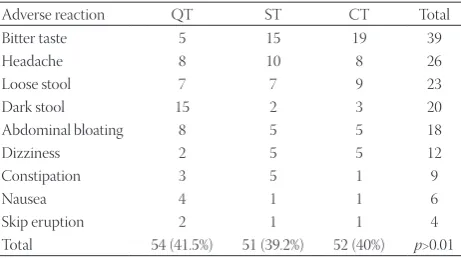
157 of those 390 patients reported minor adverse drug reactions. The percentages of patients with adverse reactions were 41.5% in the QT group (54/130), 39.2% in the ST group (51/130), and 40% in the CT group (52/130) (p > 0.05).
In order of frequency, bitter taste, loose stool, headache, dark stool, and abdominal bloating were the most common adverse reactions in all study group. Dark stool, abdomi-nal bloating, and headache were the most common adverse
reactions in the QT group. Bitter taste, headache, and loose stool were the most common events in the sequential group and in the ST group. Bitter taste, loose stool, and headache were the most common adverse reactions in the CT group. However, these developments were not statistically signifi-cant, and there were no major adverse reactions (Table 3).
DISCUSSION
In regions with high clarithromycin resistance (higher than 20%), QT should be recommended as a first-line therapy if bismuth is available in that particular area [5]. As previously mentioned, the use of standard triple therapy is not satisfac-tory for achieving a low eradication rate, although the effi-cacy of this therapy has been improved with the addition of
TABLE 1. Characteristics of patients n (%)
Characteristics QT ST CT p values Age (years) 37.1±12.6 36.7±13.9 37.6±13 p=0.8 Gender
Male 68 (52.3) 70 (53.8) 70 (53.8) p=0.9 Female 62 (47.7) 60 (46.2) 60 (46.2)
Diagnosis
Gastric ulcer 14 (10.8) 12 (9.2) 12 (9.2) p=0.8 Duodenal ulcer 23 (17.7) 19 (14.6) 17 (13.1)
Gastritis 93 (71.5) 99 (76.2) 101 (77.7) QT: Quadruple treatment; ST: Sequential treatment; CT: Concomitant treatment
TABLE 2. Eradication rates of H. pylori
Groups Patients (n) Eradication rate (%) p values PP
QT 114/121 94.2 p=0.86
ST 113/119 95
CT 113/118 95.8
ITT
QT 114/130 87.7 p=0.91
ST 113/130 86.9
CT 113/130 86.8
QT: Quadruple treatment; ST: Sequential treatment; CT: Concomitant treatment; PP: Per protocol; ITT: Intention to treat, H. pylori: Helicobacter pylori
TABLE 3. Incidence of adverse drug reactions (n)
Adverse reaction QT ST CT Total
Bitter taste 5 15 19 39
Headache 8 10 8 26
Loose stool 7 7 9 23
Dark stool 15 2 3 20
Abdominal bloating 8 5 5 18
Dizziness 2 5 5 12
Constipation 3 5 1 9
Nausea 4 1 1 6
Skip eruption 2 1 1 4
bismuth. Xu et al. reported that 7 days of standard triple ther-apy plus bismuth increased the eradication rate from 66.67% to 82.09% according to ITT analysis [17]. When the treatment was extended to 14 days, the ITT eradication rate reached 93.7% compared with 80.0% after 7 days of treatment, which suggested that the addition of bismuth can overcome H. pylori resistance to clarithromycin [18]. In addition, in this study, the eradication rate of bismuth-containing QT for 10 days was 94.2% in Turkey where a high frequency of metronidazole and clarithromycin resistance has been observed [19,20]. Many prospective studies were recently performed, and all of these regimens seem to be highly effective in the eradication of H. pylori [11,17,18,21-24].
Although, QT is a highly effective regimen that could be recommended as a first-line therapy, bismuth is not available in many developed countries due to its potential nephrotoxicity [25-27]. However, the results of a meta-anal-ysis that included 35 randomized controlled trials involving 4763 patients detected no statistically significant difference in the total number of adverse events after the use of bis-muth. Bismuth is safe and well-tolerated for the treatment of H. pylori. Moreover, with the availability of new single (three in one) capsule-containing bismuth substrate, metronidazole, and tetracycline, the number of tablets needs to be taken in the bismuth quadruple group will be substantially decreased and this will also likely increase drug compliance [28]. The only adverse event that occurred with significant frequency was dark stools [29]. In this study, the most adverse reaction of QT was the dark stool, too. Clinicians should, however, avoid the prescription of bismuth as a gastric mucosa protectant for long-term use.
ST has been reported to be more effective than standard triple therapy in many Asian countries. There was a differ-ence among the eradication rates of ST in several countries, with 95%, in Thailand [30]; and 89%, in China [31]. In Turkey, previous studies that compared triple therapy and ST have showed various PP eradication rates ranging from 57% in ST to 88% [31-35].
Several studies showed that both ST and QT were highly effective and no difference in the eradication rate [36,37]. In addition, this study showed that eradication rates of QT and ST therapies were similar, too. The shortcoming of ST is just that the medications change during treatment and patients to consider it difficult to take the medicines.
CT involves the simultaneous use of a PPI and three types of antibiotics, although it could cause antibiotic abuse and unnecessary resistance. There was no difference in the effect of CT in clarithromycin-sensitive and resistant groups [38] as well as in metronidazole-sensitive and resistant groups [39]. Several studies showed that there was no differ-ence in the effectiveness of CT and ST in clarithromycin and
metronidazole-sensitive or resistant groups [40,41]. Moreover, this study showed that eradication rates of these two therapies were similar, too. Compared with ST, a benefit of CT is that the patient considers this treatment option simpler and shorter than the other options [42].
Our study directly compared QT, ST, and CT. When it was first conceived, the standard duration of ST was 10 days hence the other 2 arms were 10 days to be comparable. A longer treatment duration (14 vs. 7 days) has been shown to achieve higher treatment success in a meta-analysis. Our results showed that all three regimens were highly effective, with PP eradication rates of 94.2-95.8%. The lower ITT rate was due to the assumption that all patients who did not return for 13C-UBT failed treatment. Even so, ITT rate was 86.9%, 87.7%, and 86.9%, this rate was acceptable. These results suggest that all three regimens may be used, and given the convenience of ITT compared to ST and CT; TT still has an important role. These results support the conclusion of a retrospective study [43].
The PPI, rabeprazole was selected because we wanted to minimize the effect of CYP2C19 in locations where the homo-zygous extensive metabolizer of CYP2C19 was low, and the poor metabolizer was high.
The recent increase in clarithromycin resistance has markedly increased the number of targeted, prospective, multicenter, and randomized clinical trials. We compared all three of the therapies currently in use. This research was com-pleted in a short period of time to minimize antibiotic resis-tance influenced by other factors and re-infection. Moreover, strength of this study was set in a location with a high preva-lence of H. pylori and gastric cancer.
Another limitation of this study was that more accurate eradication rates could be obtained if we tested for H. pylori infection using two different methods and defined infection as positivity in both tests. Successful eradication would be defined as negative results for both tests, at which point a more accurate eradication rate could be assessed. To com-plement these data, we biopsied four in the different gastric mucosa, two in the gastric antrum and two in the gastric body and the samples were stained with Warthin–Starry. We also used the C13-urea breath test, which has a 98% accuracy rate.
CONCLUSION
DECLARATION OF INTERESTS
The authors declare no conflict of interest.
REFERENCES
[1] Cogo LL, Monteiro CL, Miguel MD, Miguel OG, Cunico MM, Ribeiro ML, et al. Anti-Helicobacter pylori activity of plant extracts traditionally used for the treatment of gastrointestinal disorders. Braz J Microbiol 2010;41(2):304-9.
http://dx.doi.org/10.1590/S1517-83822010000200007.
[2] McColl KE. Clinical practice. Helicobacter pylori infection. N Engl J Med 2010;362(17):1597-604.
http://dx.doi.org/10.1056/NEJMcp1001110.
[3] Hentschel E, Brandstätter G, Dragosics B, Hirschl AM, Nemec H, Schütze K, et al. Effect of ranitidine and amoxicillin plus metronida-zole on the eradication of Helicobacter pylori and the recurrence of duodenal ulcer. N Engl J Med 1993;328(5):308-12.
http://dx.doi.org/10.1056/NEJM199302043280503.
[4] Chey WD, Wong BC. Practice Parameters Committee of the American College of Gastroenterology. American College of Gastroenterology guideline on the management of Helicobacter pylori infection. Am J Gastroenterol 2007;102(8):1808-25.
http://dx.doi.org/10.1111/j.1572-0241.2007.01393.x.
[5] Malfertheiner P, Megraud F, O’Morain C, Bazzoli F, El-Omar E, Graham D, et al. Current concepts in the management of
Helicobacter pylori infection: The Maastricht III Consensus Report. Gut 2007;56(6):772-81.
http://dx.doi.org/10.1136/gut.2006.101634.
[6] Fock KM, Katelaris P, Sugano K, Ang TL, Hunt R, Talley NJ, et al.
Second Asia-Pacific Consensus Guidelines for Helicobacter pylori
infection. J Gastroenterol Hepatol 2009;24(10):1587-600. http://dx.doi.org/10.1111/j.1440-1746.2009.05982.x.
[7] Chung JW, Lee GH, Han JH, Jeong JY, Choi KS, Kim do H, et al. The trends of one-week first-line and second-line eradication therapy for Helicobacter pylori infection in Korea. Hepatogastroenterology 2011;58(105):246-50.
[8] Coelho LG, Maguinilk I, Zaterka S, Parente JM, do Carmo Friche Passos M, Moraes-Filho JP. 3rd Brazilian Consensus on Helicobacter
pylori. Arq Gastroenterol 2013;50(2):S0004-28032013005000113. [9] Jodlowski TZ, Lam S, Ashby CR Jr. Emerging therapies for the
treatment of Helicobacter pylori infections. Ann Pharmacother 2008;42(11):1621-39.
http://dx.doi.org/10.1345/aph.1L234.
[10] Dib J Jr, Alvarez B, Mendez L, Cruz ME. Efficacy of PPI, levo-floxacin and amoxicillin in the eradication of Helicobacter pylori
compared to conventional triple therapy at a Venezuelan hospital. Arab J Gastroenterol 2013;14(3):123-5. http://dx.doi.org/10.1016/j. ajg.2013.09.001.
[11] Cho DK, Park SY, Kee WJ, Lee JH, Ki HS, Yoon KW, et al. The trend of eradication rate of Helicobacter pylori infection and clini-cal factors that affect the eradication of first-line therapy. Korean J Gastroenterol 2010;55(6):368-75.
http://dx.doi.org/10.4166/kjg.2010.55.6.368.
[12] Nadir I, Yonem O, Ozin Y, Kilic ZM, Sezgin O. Comparison of two different treatment protocols in Helicobacter pylori eradication. South Med J 2011;104(2):102-5.
http://dx.doi.org/10.1097/SMJ.0b013e318200c209.
[13] Liang X, Xu X, Zheng Q, Zhang W, Sun Q, Liu W, et al. Efficacy of bismuth-containing quadruple therapies for clarithromycin-, metronidazole-, and fluoroquinolone-resistant Helicobacter pylori
infections in a prospective study. Clin Gastroenterol Hepatol 2013;11(7):802-7.e1.
[14] Gatta L, Vakil N, Leandro G, Di Mario F, Vaira D. Sequential ther-apy or triple therther-apy for Helicobacter pylori infection: Systematic review and meta-analysis of randomized controlled trials in adults and children. Am J Gastroenterol 2009;104(12):3069-79.
http://dx.doi.org/10.1038/ajg.2009.555.
[15] Essa AS, Kramer JR, Graham DY, Treiber G. Meta-analysis: Four-drug, three-antibiotic, non-bismuth-containing “concomitant therapy” versus triple therapy for Helicobacter pylori eradication. Helicobacter 2009;14(2):109-18.
http://dx.doi.org/10.1111/j.1523-5378.2009.00671.x.
[16] Heo J, Jeon SW. Changes in the eradication rate of conventional triple therapy for Helicobacter pylori infection in Korea. Korean J Gastroenterol 2014;63(3):141-5.
[17] Xu MH, Zhang GY, Li CJ. Efficacy of bismuth-based quadruple therapy as first-line treatment for Helicobacter pylori infection. Zhejiang Da Xue Xue Bao Yi Xue Ban 2011;40(3):327-31.
[18] Sun Q, Liang X, Zheng Q, Liu W, Xiao S, Gu W, et al. High effi-cacy of 14-day triple therapy-based, bismuth-containing quadru-ple therapy for initial Helicobacter pylori eradication. Helicobacter 2010;15(3):233-8.
http://dx.doi.org/10.1111/j.1523-5378.2010.00758.x.
[19] Agel E, Durmaz B, Tevfik MR, Asgın R. The isolation rate and anti-biotic resistant pattern of Helicobacter pylori in dyspeptic patients. Turk J Med Sci 2000;30:143-6.
[20] Goral V, Fadile YZ, Gül K. Antibiotic resistance in Helicobacter pylori infection. Clin Gastroenterohepatol 2000;11:87-9.
[21] Agah S, Shazad B, Abbaszadeh B. Comparison of azithromy-cin and metronidazole in a quadruple-therapy regimen for
Helicobacter pylori eradication in dyspepsia. Saudi J Gastroenterol 2009;15(4):225-8.
http://dx.doi.org/10.4103/1319-3767.56091.
[22] Rogha M, Pourmoghaddas Z, Rezaee M, Shirneshan K, Shahi Z. Azithromycin effect on Helicobacter pylori eradication: Double blind randomized clinical trial. Hepatogastroenterology 2009;56(91-92):722-4.
[23] Zullo A, De Francesco V, Scaccianoce G, Manes G, Efrati C, Hassan C, et al.Helicobacter pylori eradication with either quadru-ple regimen with lactoferrin or levofloxacin-based triquadru-ple therapy: A multicentre study. Dig Liver Dis 2007;39(9):806-10.
http://dx.doi.org/10.1016/j.dld.2007.05.021.
[24] Zheng Q, Chen WJ, Lu H, Sun QJ, Xiao SD. Comparison of the efficacy of triple versus quadruple therapy on the eradica-tion of Helicobacter pylori and antibiotic resistance. J Dig Dis 2010;11(5):313-8. http://dx.doi.org/10.1111/j.1751-2980.2010.00457.x. [25] Cengiz N, Uslu Y, Gök F, Anarat A. Acute renal failure after overdose
of colloidal bismuth subcitrate. Pediatr Nephrol 2005;20(9):1355-8. http://dx.doi.org/10.1007/s00467-005-1993-7.
[26] Huwez F, Pall A, Lyons D, Stewart MJ. Acute renal failure after over-dose of colloidal bismuth subcitrate. Lancet 1992;340(8830):1298. http://dx.doi.org/10.1016/0140-6736(92)93005-8.
[27] Noach LA, Eekhof JL, Bour LJ, Posthumus Meyjes FE, Tytgat GN, Ongerboer de Visser BW. Bismuth salts and neurotoxicity. A ran-domised, single-blind and controlled study. Hum Exp Toxicol 1995;14(4):349-55.
http://dx.doi.org/10.1177/096032719501400405.
[28] Malfertheiner P, Bazzoli F, Delchier JC, Celiñski K, Giguère M, Rivière M, et al.Helicobacter pylori eradication with a capsule con-taining bismuth subcitrate potassium, metronidazole, and tetra-cycline given with omeprazole versus clarithromycin-based triple therapy: A randomised, open-label, non-inferiority, phase 3 trial. Lancet 2011;377(9769):905-13.
http://dx.doi.org/10.1016/S0140-6736(11)60020-2.
[29] Ford AC, Malfertheiner P, Giguere M, Santana J, Khan M, Moayyedi P. Adverse events with bismuth salts for Helicobacter pylori eradication: Systematic review and meta-analysis. World J Gastroenterol 2008;14(48):7361-70.
http://dx.doi.org/10.3748/wjg.14.7361.
[30] Sirimontaporn N, Thong-Ngam D, Tumwasorn S, Mahachai V. Ten-day sequential therapy of Helicobacter pylori infection in Thailand. Am J Gastroenterol 2010;105(5):1071-5.
http://dx.doi.org/10.1038/ajg.2009.708.
[32] Yakut M, Çinar K, Seven G, Bahar K, Özden A. Sequential therapy for
Helicobacter pylori eradication. Turk J Gastroenterol 2010;21(3):206-11. [33] Demir M, Ataseven H. The effects of sequential treatment as a
first-line therapy for Helicobacter pylori eradication. Turk J Med Sci 2011;41(3):427-33.
[34] Sezgin O, Altintas E, Nayir E, Uçbilek E. A pilot study evalu-ating sequential administration of a PPI-amoxicillin followed by a PPI-metronidazole-tetracycline in Turkey. Helicobacter 2007;12(6):629-32.
http://dx.doi.org/10.1111/j.1523-5378.2007.00547.x.
[35] Uygun A, Kadayifci A, Yesilova Z, Safali M, Ilgan S, Karaeren N. Comparison of sequential and standard triple-drug regimen for
Helicobacter pylori eradication: A 14-day, open-label, randomized, prospective, parallel-arm study in adult patients with nonulcer dys-pepsia. Clin Ther 2008;30(3):528-34.
http://dx.doi.org/10.1016/j.clinthera.2008.03.009.
[36] McNicholl AG, Marin AC, Molina-Infante J, Castro M, Barrio J, Ducons J, et al. Randomised clinical trial comparing sequential and concomitant therapies for Helicobacter pylori eradication in routine clinical practice. Gut 2014;63(2):244-9.
[37] Liu KS, Hung IF, Seto WK, Tong T, Hsu AS, Lam FY, et al. Ten day sequential versus 10 day modified bismuth quadruple therapy as empirical firstline and secondline treatment for Helicobacter pylori
in Chinese patients: An open label, randomised, crossover trial. Gut 2014;63(9):1410-5.
http://dx.doi.org/10.1136/gutjnl-2013-306120.
[38] Webber MA, Piddock LJ. The importance of efflux pumps in bacte-rial antibiotic resistance. J Antimicrob Chemother 2003;51(1):9-11. http://dx.doi.org/10.1093/jac/dkg050.
[39] Okada M, Nishimura H, Kawashima M, Okabe N, Maeda K, Seo M, et al. A new quadruple therapy for Helicobacter pylori: Influence of resistant strains on treatment outcome. Aliment Pharmacol Ther 1999;13(6):769-74.
http://dx.doi.org/10.1046/j.1365-2036.1999.00551.x.
[40] Wu DC, Hsu PI, Wu JY, Opekun AR, Kuo CH, Wu IC, et al.
Sequential and concomitant therapy with four drugs is equally effective for eradication of H. pylori infection. Clin Gastroenterol Hepatol 2010;8(1):36-41.e1.
[41] Hsu PI, Wu DC, Chen WC, Tseng HH, Yu HC, Wang HM, et al.
Randomized controlled trial comparing 7-day triple, 10-day sequential, and 7-day concomitant therapies for Helicobacter pylori
infection. Antimicrob Agents Chemother 2014;58(10):5936-42. http://dx.doi.org/10.1128/AAC.02922-14.
[42] Dos Santos AA, Carvalho AA. Pharmacological therapy used in the elimination of Helicobacter pylori infection: A review. World J Gastroenterol 2015;21(1):139-54.
[43] Ang TL, Wang L, Ang D, Chiam P, Fock KM, Teo EK. Is there still a role for empiric first-line triple therapy using proton pump inhibitor, amoxicillin and clarithromycin for Helicobacter pylori
infection in Singapore? Results of a time trend analysis. J Dig Dis 2013;14(2):100-4.