DEVELOPING A CLOUD BASED E-LEARNING
FRAMEWORK FOR HIGHER EDUCATION
INSTITUTIONS (HEI)
Laxman Singh Rajput
1, Dr. Bharat Singh Deora
21
Research Scholar,
2Assistant Professor, Faculty of Computer Science,
JRN Rajasthan Vidyapeeth (Deemed) University, Udaipur (India)
ABSTRACT
Cloud computing in an academic environment such as university will be benefitted by every students, faculties,
administrators and research scholars. Most of the universities infrastructures are underutilized and in some
cases over utilization of resources occurs in order to balance the usage of the resources we need an elastic
technology. Use of Cloud computing on universities has many benefits such as accessing the file storages,
databases, educational resources, research applications and tools anywhere, anytime on demand. Furthermore, cloud computing reduces universities’ IT complexity and cost. Based on literature review, expert panel
discussion, the present study proposed a framework for designing academic cloud in Higher Education
Institutions (HEI). The main goal of an academic cloud is to manage effectively the technological needs of
universities such as delivery of software, providing of development platform, storage of data, and computing.
Keywords: E-learning, Cloud computing, HEI, framework
I. INTRODUCTION
1.1
THE CLOUD PHILOSOPHY
Cloud computing technologies have changed the way applications are developed and accessed. They are aimed
at running applications as services over the Internet on a scalable infrastructure. Many applications such as word
processing, spreadsheets, presentations, databases and more can all be accessed from a web browser, while the
software and files are housed in the cloud. Clouds are developed to address Internet-scale computing problems
where some assumptions are different from those of the Grids. Clouds are usually referred to as a large pool of
computing and/or storage resources, which can be accessed via standard protocols via an abstract interface. The
major players in the field of Cloud Computing are Google, Microsoft, Amazon, Yahoo, IBM and Intel. Cloud
Computing applications are mainly intended to help companies and individuals to stretch resources and work
smarter by moving everything to the cloud.
The main characteristics of Cloud Computing as a specialized distributed computing paradigm are the following
Scalability and elasticity. Cloud resources can be dynamically ("on-demand") delivered in real-time on a
fine-grained and self-service basis. Users are able to re-provision with technological infrastructure
resources;
Economies of scale. It is claimed to be free of charge or low cost even for hardware upgrades. Capital
expenditure is converted to operational expenditure in a public cloud delivery model. The cost of licensing
different software packages is moved to the data center level and there is no need to upgrade the local
system when new service packs or patches are released. Also the infrastructure is centralized in low cost
locations (such as real estate, electricity, etc.);
There exist different categories in which the service oriented systems can be clustered. One of the most used
criteria to group these systems is the abstraction level that offers to the system user. In this manner, three
different levels are often distinguished.
1. Infrastructure as a Service (IaaS): IaaS is the supply of hardware as a service, that is, servers, net
technology, storage or computation, as well as basic characteristics such as Operating Systems and
virtualization of hardware resources. The IaaS will correspond to the hardware of such a computer together
with the Operating System that take care of the management of the hardware resources and ease the access
to them. Hardware resources (such as storage) and computing power (CPU and memory) are offered as
services to customers. This enables businesses to rent these resources rather than spending money to buy
dedicated servers and networking equipment.
2. Platform as a Service (PaaS): At the PaaS level, the provider supplies more than just infrastructure, i.e. an
integrated set of software. A PaaS provider does not provide the infrastructure directly, but making use of
the services of an IaaS. It presents the tools that a developer needs, having an indirect access to the IaaS
services and, consequently, to the infrastructure. Examples of platforms in this category are Microsoft
Azure Services platform6, Google App Engine, Salesforce.com Internet Application Development platform
and Bungee Connect platform.
3. Software as a Service (SaaS): In the last level we may find the SaaS, i.e. to offer software as a service.
This was one of the first implementations of Cloud services. In SaaS, the client has to depend on the
provider for proper security measures. In this model, software applications are offered as services on the
Internet rather than as software packages to be purchased by individual customers.
1.2 E-LEARNING
E-Learning is the topic related to the virtualized distance learning by means of electronic communication
mechanisms, specifically the Internet. They are based in the use of approaches with diverse functionality
(e-mail, Web pages, forums, learning platforms, and so on) as a support of the process of teaching and learning.
Many e-Learning platforms are currently in use by academic institutions globally, among which include the
well-known Virtual Learning Environments (VLEs) such as Blackboard and Moodle. The drawback of such
e-Learning platforms is they are content-centric designed not learner-centric, thus educational resources are
delivered to students uniformly irrespective of learner‟s background. Furthermore, not only do the current
issue of dynamic scalability in response to infrastructure demands and integration with other e-Learning
platforms.
The Cloud Computing environment rises as a natural platform to provide support to e-Learning systems and also
for the implementation of data mining techniques that allow exploring the enormous data bases generated from
the former process to extract the inherent knowledge, since it can be dynamically adapted by providing a
scalable system for changing necessities along time.
The virtual courses that are supported by the e-Learning approach favor the achievement of a higher impact for
the educative framework than those of the classical attendance group. As an example, in the first edition of the
“Machine Learning” course of Stanford more than 1, 60,000 worldwide students were registered. These
dimensions affects different issues; on the one hand, the infrastructure provisions that are necessary to give a
concurrent service for that amount of students clearly exceed the capabilities of a conventional web server.
Furthermore, the demand of the teaching resources usually varies in a dynamic and very quick way, and presents
high peaks of activity. To attend requests during these periods of time without other system services to be
resented, it will be necessary to prepare a quite superior infrastructure than that required for the regular working
of the learning institution. An alternative would be to provide those services depending on the demand and only
paying for the resources that are actually used. The answer to these necessities is the Cloud Computing
environment.
1.3 CHALLENGES FOR CURRENT E-LEARNING MODEL
Many approaches that deployed e-Learning have failed or wasted large amounts of money in the recent past
because universities were taken by surprise about the low conversion rate of potential markets into actual
registrations, the difficulty in reaching a global market through advertising or agents, the requirements of higher
levels of resources and the slow time to market, and hence were unable to change internally sufficiently fast and
well. The costs of e-Learning attract much more attention and challenge than the investment in more
conventional learning infrastructure. On-campus costs are often in legacy systems and buildings.
E-learning, like distance learning, requires more up-front investment (compared with campus-based teaching)
but offers a low cost and sustainable model over several years if large numbers of students continue to register.
All HEIs are vulnerable to a wide variety of pressures but have a high resistance to change. They are awash with
rich resources in the form of intelligent keen individuals who are rarely appropriately directed to pedagogical
innovation nor are self-motivated to radically transform their teaching. E-learning, whether combined with other
forms of teaching and learning or not, is multifaceted and involves shifts both in understanding and behaviours.
Individuals and small groups, such as departments in universities, have their own desires, abilities, histories and
preferred artefacts; in other words, they are closely situated. Universities themselves consist of cultural,
historical, institutional and power-constructed contexts (Whitworth, 2005). Some writers have claimed that there
has been a recent shift away from traditional views of teaching and learning towards constructivist views of
knowledge sharing (for example, Dickey, 2003), because many learning technologies would seem to offer new
Currently, e-Learning systems are still weak on scalability at the infrastructure level. Several resources can be
deployed and assigned just for specific tasks so that when receiving high workloads, the system need to add and
configure new resources of the same type, making the cost and resource management very expensive.
1.4
CLOUD COMPUTING IN E-LEARNING
Many e-Learning platforms are currently in use by academic institutions globally, among which include the
well-known Virtual Learning Environments (VLEs) such as Blackboard and Moodle. The drawback of such
e-Learning platforms is they are content-centric designed not learner-centric, thus educational resources are
delivered to students uniformly irrespective of learner‟s background. Furthermore, not only do the current
e-learning platforms suffer the limitation of costs of development, deployment and maintenance, but also face the
issue of dynamic scalability in response to infrastructure demands and integration with other e-learning
platforms.
The educational cloud computing can focus the power of thousands of computers on one problem, allowing
researchers search and find models and make discoveries faster than ever. The universities can also open their
technology infrastructures to private, public sectors for research advancements. The efficiencies of cloud
computing can help universities keep pace with ever-growing resource requirements and energy costs. Students
expect their personal mobile devices to connect to campus services for education. Faculty members are asking
for efficient access and flexibility when integrating technology into their classes. Researchers want instant
access to high performance computing services, without them responsibility of managing a large server and
storage farm. The role of cloud computing at university education should not be underestimated as it can
provide important gains in offering direct access to a wide range of different academic resources, research
applications and educational tools.
II. RESEARCH OBJECTIVES
a) To understand the concept of cloud computing and e-Learning
b) To analyse various issues related to use of cloud based e-Learning system
c) To propose a framework for effective implementation of cloud based e-Learning system
III. ACADEMIC CLOUD FRAMEWORK FOR ADAPTING E-LEARNING
The literature review suggests that cloud computing based e-Learning provides continuous and collaborative
learning. Cloud computing in an academic environment such as university will be benefitted by every students,
faculties, administrators and research scholars. Most of the universities infrastructures are underutilized and in
some cases over utilization of resources occurs in order to balance the usage of the resources we need an elastic
technology.
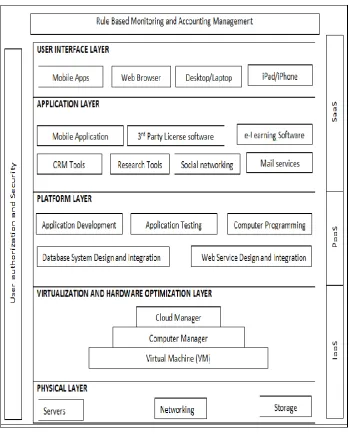
An academic cloud framework is proposed for adapting e-Learning in universities using cloud computing in
order to help the students, faculties, research scholars and administrators of the university to better utilize their
infrastructure. This framework specifies the virtualization technology to be used to build an academic cloud
QoS (Quality of Service) objectives such as high availability, performance, reliability, scalability, load
balancing and security in the service models (IaaS, PaaS, SaaS) of the cloud.
This framework consists of five layers as shown in Fig. Each layer has its own set of components within it. It is
best suited for academic institutions which are ready to use cloud in their institution. These layers incorporate
the three services offered by the cloud within them. This framework also supports various deployment methods
in adapting cloud within their academic infrastructure. Apart from this, it is used to setup the cloud within the
academic institution. Each layer in academic cloud framework consists of various components. Security,
Monitoring and Management are incorporated across all layers to ensure QoS objectives.
Figure 1: Proposed Cloud Framework for e-Learning
Physical Layer: This layer consists of servers, data centers, networking devices and primary / secondary
storage devices.
Virtualization and Hardware Optimization Layer: This layer consists of hypervisor in order to create „n‟
number of virtual machines. Each VM has its own virtual CPU, Memory, Storage and Network. Above VM, the
virtualized university infrastructure by means of the components such as resource scheduler, load balancer, live
migration, templates, snapshot manager and recovery. API is used to communicate with the virtual machines in
order to monitor the virtualized resources more effectively.
Platform Layer: This layer provides PaaS to end user. It serve as a platform to the end-users of the university
to develop, test and deploy an application using the SDK, IDE‟s in the cloud. The users can also maintain database in the cloud. Various web services and libraries can be used by the end-users of the cloud.
Application Layer: This layer provides the “software as a service” to the end-users of the university. The
e-Learning software using web2.0 tools or above and other licensed third-party software are installed in the
University cloud and these are provided to the students as a service.
User Interface Layer: This layer acts as an interface between the end users (students, faulty, research scholars
and administrators) and academic cloud infrastructure. The end-users communicate with the academic cloud
using the browser enabled devices such as (laptop, desktop, mobile phone, iphone, ipad) by means of the
protocols such as RDP (Remote Desktop Protocol), SSH (Secure Shell),Http/Https (Hypertext Transfer
Protocol) and LDAP (Lightweight Directory access Protocol)
Rule Based Monitoring and Accounting: This layer provides rule based monitoring and management of the
resources and it is used to verify whether the QoS objectives are met across all the layers of the academic cloud
framework.
User authorization and Security: This layer provides sign in authentication to the end-users of the university
across all the layers of the framework to access the cloud.
IV. CONCLUSION
Cloud computing based e-Learning provides continuous (anytime, anywhere and any device learning) and
collaborative learning. Cloud computing in an academic environment such as university will be benefitted by
every students, faculties, administrators and research scholars. Most of the universities infrastructures are
underutilized and in some cases over utilization of resources occurs in order to balance the usage of the
resources we need an elastic technology. In order to develop an e-Learning platform for postgraduate students of
computer science and research scholars new methodologies should be taken into consideration for project,
problem based learning and virtual computerization. This type of cloud based e-Learning provides new blended
learning methodologies for education.
Cloud computing provides virtual universities with a fundamentally different model of operation among
e-Learning processes. This new model takes advantage of the maturity of web applications and networks and the
rising interoperability of computing systems to provide IT services. Cloud providers specialize in particular
applications and services, and this expertise allows them to efficiently manage upgrades and maintenance,
backups, disaster recovery, and failover functions. As a result, e-university consumers of cloud services may see
increased reliability, even as costs decline due to economies of scale and other production factors. With cloud
computing, e-universities can monitor current needs and make on-the-fly adjustments to increase or decrease
REFERENCES
[1] Ajadi, T. O, Salawu, I. O., & Adeoye, F. A. (2008), e-Learning and distance education in Nigeria.
[2] Arkorful, V.,& Abaidoo, N. (2015), The role of e-learning, advantages and disadvantages of its adoption in
higher education.
[3] Benta, D., Bologaa, G.,& Dzitaca, I. (2014), E-Learning platforms in higher education: Case study.
Procedia Computer Science, 31, 1170 –1176.
[4] Dickey, M. D. (2003), Teaching in 3D: pedagogical affordances and constraints of 3D virtual worlds for
synchronous distance learning, Distance Education, 24(1), 105–121.
[5] Dong, B., Zheng, Q., Qiao, M., Shu, J., Yang, J. (2009), BlueSky Cloud Framework:An E-Learning
Framework Embracing Cloud Computing. In: Jaatun, M.G., Zhao, G., Rong, C. (eds.) Cloud Computing.
LNCS, vol. 5931, pp. 577–582. Springer, Heidelberg.
[6] Duer, W. (2003), CRM, Customer Relationship Management. MP editions
[7] Hurwitz, J., Bloor, R., Kaufman, M., Halper, F. (2010), Cloud Computing for Dummies. Wiley Jones, C.
(2004) Networks and learning: communities, practices and the metaphor of networks, ALT-J, 12(1), 81–
93.
[8] Karim, F.,& Goodwin, R. (2013), Using cloud computing in e-learning systems. International Journal of
Advanced Research in Computer Science & Technology (IJARCST), 1(1), 65-69.
[9] Kwan, R., Fox, R., Chan, F., Tsang, P. (2008), Enhancing Learning Through Technology: Research on
Emerging Technologies and Pedagogies. World Scientific
[10] Madhumathi, C.,& Ganapathy, G. (2013), An academic cloud framework for adapting e-learning in
universities. International Journal of Advanced Research in Computer and Communication.
[11] Salmon, G. (2002), E-tivities: the key to active online learning (London, Taylor & Francis).
[12] Sullivan, K. & Czigler, P. (2002), Maximising the educational affordances of a technology supported
learning environment for introductory undergraduate phonetics, British Journal of Educational
Technology, 33(3), 333–343.
[13] Talebian, S., Mohammadi, H. M.,& Rezvanfar, A. (2014), Information and communication technology
(ICT) in higher education: Advantages, disadvantages, conveniences and limitations of applying e-learning
to agricultural students in Iran. Procedia -Social and Behavioral Sciences, 152, 300 –305.
[14] Venkataraman, S.,& Sivakumar, S. (2015), Engaging students in group based learning through e-learning
techniques in higher education system. International Journal of Emerging Trends in Science and
Technology, 2(1), 1741-1746.
[15] Tham, C. M., & Werner, J. M. (2005), Designing and evaluating e-learning in higher education: A review
and recommendations. Journal of leadership & organizational studies, 11(2), 15-25.
[16] Whitworth, A. (2005), The politics of virtual learning environments: environment change, conflict and
e-learning, British Journal of Educational Technology, 36(4), 685–691
[17] Witten, I., Frank, E., Hall, M. (2011), Data Mining. Practical Machine Learning Tools and Techniques, 3rd
[18] Yang, S. (2009), Using Blogs to Enhance Critical Reflection and Community of Practice, Educational
Technology & Society, 12 (2) 11–21.
[19] Zemsky, R. & Massy, W. F. (2004), Thwarted innovation: what happened to e-learning and why. Final
report for the weather station project of the Learning Alliance, University of Pennsylvania.
[20] Al-Zoube, M., El-Seoud, S.A., Wyne, M.F. (2010), Cloud computing based e-learning system. Intl. Arab