1 |
P a g e
A BRIEF OUTLINE ON CLOUD COMPUTING
Sneha Sabnani
1, Shraddha Nagar
2Department of Computer Science and Engineering,
Acropolis Institute Of Technology And Research Indore ,(India)
ABSTRACT
Cloud Computing is a virtualized computer power and storage delivered through platform infrastructure of abstract hardware and software used over internet. This share on demand services as per users. Cloud computing is a general term which basically deals with storage.A cloud refers to distinct IT environment that is designed for the purpose of remotely measured IT resources. The term originated as a metaphor for the internet which is a network for providing remote access to decentralized IT resources. In this paper we are introducing cloud, its services, its models, platforms and technologies and its security issues.
Keywords:
Services,Models,Platforms,Security.
I.
INTRODUCTION
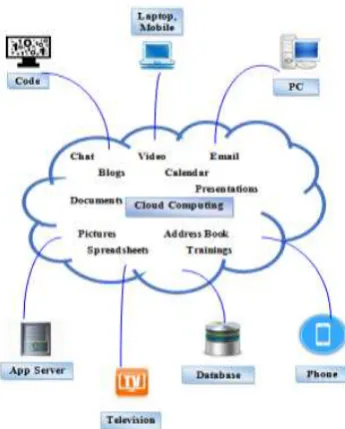
Cloud computing is the most recent emerging ideal promising to turn the vision of “computing utilities” into a reality. As a new and evolving technology cloud computing means internet based computing where it provides both the applications delivered as a service to the users over the internet the hardware and the system software in the data center that provides those services. It offers different services to which users can manage their own data. The word “cloud” basically deals with network, a network that provides connectivity in its own way. It is the source that allows us to save their data and then access to those data through cloud. It allows us to store resources such as computer files on remote computers called servers.[5] A common example of cloud is Gmail – it is an email where we are storing our data or saving our data on cloud and then using as per own choice.
Figure 1. CLOUD
II.
CHARACTERISTIC OF CLOUD COMPUTING
2 |
P a g e
2. Ubiquitous network access: Anywhere, Any device, Any time. 3. Simplified application acceleration and scalability.
4. Nice pricing.
5. Efficient resource allocation.
Figure 2. CLOUD COMPUTING
III.
FUNDAMENTAL CLOUD SERVICES
3.1 Infrastructure as a services (IaaS)
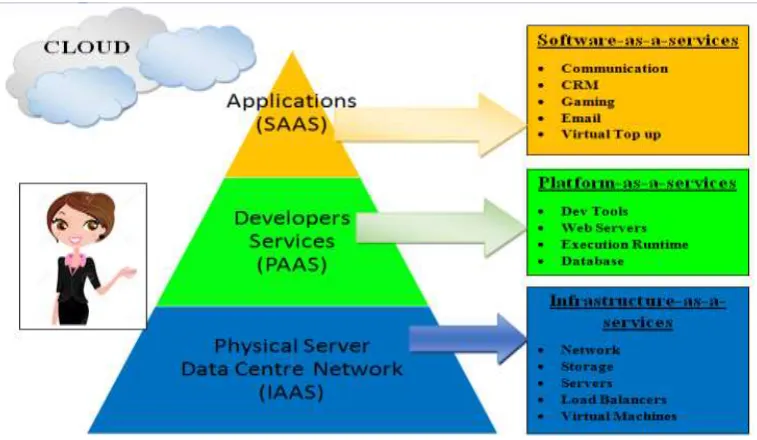
IaaS is the basic layer to provide physical infrastructure including computing, storage and networking as a service. IaaS is the basic layer that can accommodate a complete IT infrastructure. This layer of cloud computing mainly deals with computational services that is, operating systems storage, network connectivity, computer power, processing and other fundamental computing resources , available to end users over the internet for running their software and application.[6] It provides the basic computing infrastructure to the end user so that on which a platform is to create and executed can be established.IaaS is the delivery of huge computing resources so the servers, storage systems, networking equipments such as switches and routers, data center space etc., are pooled and made available virtually to the end user to handle workloads.Examples: Amazon web services, VMware, IBM BlueHouse.
3.2 Platform as a service (PaaS)
3 |
P a g e
infrastructure on which they are running. It reduces the cost and complexity of purchasing, deploying and managing the basic hardware and software components of the platform.Example: Google app engine.
3.3 Software as a service (SaaS)
SaaS is the upper layer where the end- user application is delivered as a service. These are common, ready-to-use applications .SaaS is a model of service delivered by a complete application, that is, application and their computational resources to run them, are provided on demand hosted on the cloud and they offer services to multiple end user or client organizations.The cloud infrastructure consists of operating system, hardware, or network infrastructure, so end users need not purchase hardware, software, servers, etc. at the client side. SaaS lies at the topmost layer of the layered pyramid structure of cloud services that builds upon the underlying the bottom layer IaaS and the m idle layer PaaS to provide integrated access to software application to the clients on demand. SaaS is very valuable tool that has various applications among the business organization for significant interplay of information between the organization or significant need for web or mobile access.Example:-Google apps, Oracle.
Figure 3. CLOUD SERVICES
IV.
CLOUD CONSUMPTION MODELS
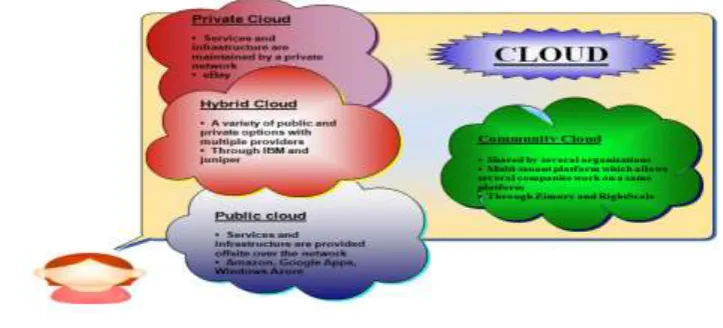
Cloud computing models can be classified on the basics of “who can control the assets”, like private, public, community and hybrid models.
4.1 Private cloud
Private cloud is built exclusively for a single organization. The cloud infrastructure is operated for that specific organization. The private cloud infrastructure is handled either by the institute itself or by third
4 |
P a g e
externally with a cloud service provider is known as externally hosted cloud.The computational resources are deployed surrounded by a firewall and managed by the user organization. This is a private data center not easily available for purchase or reuse to the general public. These are called internal clouds.[7] Example: - eBay.
4.2 Public cloud
Public cloud is the one in which the cloud infrastructure and computational resources are available to the public on the commercial basic for purchase, resale, or some other pay-as-you-go manner by a cloud service provider over the internet. It may be own, access and operated by a government organization or some combination of them delivering cloud services to the end users[3]. Public clouds are cloud services are provided by other third parties but hosted and managed by the service providers. It exists on the premises of the cloud provider. In public clouds, users can scale their use on demand and do not need to purchase the hardware to use the service.Example: - Microsoft Azure, SalesForce.
4.3 Community cloud
Community cloud is the one in which the cloud infrastructure and computational resources are shared among a number of organization with similar interests and requirements. A community cloud may be owned, managed and operated by any of the organization, some combination of them, or some third-party service provider delivering cloud services to the end users. Costs of the cloud infrastructure and computational resources are spread among the multiple organizations. A community cloud is formed by utilizing resources of user machines and providing an infrastructure in which each user can be, at the same time, a user or a coordinator of the services offered by the cloud.Example: - Media Industry.
4.4 Hybrid Cloud
It is a combination of public and private clouds that have the ability through their interface to allow some functions or applications from one cloud to another. It may consist of any combination of providers and end users and may also contain multiple service layers. So a hybrid cloud background consists of some part of computing resources on-site (private cloud) and off-site (public cloud). The hybrid clouds have the advantages of both private and public clouds.
5 |
P a g e
The idea of hiring computing services through distributed computing facilities has been around for a long time. It deals back to the old days of the mainframes in the early fifties. In tracking the evolution, we briefly review core technologies that played an important role in realization of cloud computing. These are distributed systems including mainframe computing, cluster computing and grid computing, another one is web 2.0, service-oriented computing and utility computing, virtualization.
Virtualization: - Virtualization is a major core and advanced technology for cloud computing, but its uses have been made limited by technologies that did not allow virtualization solutions.Today these drawbacks have been easily overcome and virtualization has been a fundamental element of cloud computing.[8]
Web 2.0: - The web is the primary interface through which cloud computing deliver its services. At present time, it encompasses a set of technologies and services that facilities interactive and application composition. This has transformed the web into a rich platform for application development. Such things lead to the advent of “Web 2.0”.
Service- Oriented Computing: - It is the reference model to cloud computing systems.[9]This process deals with the concept of services as main building blocks application and system deployment.
Utility- Oriented Computing: - It is an illusion of computing, the service architecture for computing services in which possessions such as storage, compute power and infrastructure are packaged and offered on a pay-per-use basis.
V.
CLOUD COMPUTING PLATFORMS AND TECHNOLOGIES
Advance of a cloud computing applications happens by leveraging platform and frameworks that provide different types of services, from the infrastructure to customizable applications serving specific purpose.
5.1 Amazon Web Services (AWS)
AWS offers inclusive cloud Infrastructure as services, ranging from effective compute, storage and networking to complete compute loads. AWS is mostly known for its computing and storage on demand services, such as Elastic Compute Cloud (EC2) and Simple Storage Service (S3). EC2 provides users to thesaurus virtual hardware that can be used as the basic infrastructure for developing the computing systems on the cloud. EC2 also provides the capability of saving a specific running instance as image, thus allows users to develop their separate templates for deploying systems.[4]These things are stored into S3 that delivers persistent storage on demand. S3 is launched into buckets; these are container of stuff that are stored in binary form and can be augmenting with attributes.
5.2 Google AppEngine
6 |
P a g e
5.3 Microsoft Azure
It is a cloud operating system and a platform for developing applications in the cloud. It serves a measurable runtime environment for Web applications and distributed applications in general. Applications in Azure are planned around the theory of roles, which classify a distribution module for applications and represent the application’s sense. At this time there are three types of role like Web task, worker task, and virtual machine task. The web part is considered to swarm a Web application, the worker role is a more generic container of application and can be used to achieve workload meting out, and the virtual machine role provides a virtual environment where the computing load can be fully personalized including the operating system.
5.4 Hadoop
Apache Hadoop is an open source construction that is appropriate for processing large data sets on service hardware. Hadoop is an accomplishment of MapReduce, an application programming model residential by Google, which provides two elementary operations for data processing: map and reduce.[10] The former changes and made the input data provided by the user, while the latter aggregates the output obtained by the map operations. Yahoo! Is the sponsor of the Apache Hadoop project, and has put considerable effort in transforming the project to an enterprise-ready Cloud computing podium for data processing..
5.5 Manjrasoft Aneka
Manjrasoft Aneka is a cloud application podium for rapid design of scalable application, and their deployment on various types of clouds in a flawless and elastic manner. It supports an anthology of programming abstractions for developing applications and a circulated runtime environment that can be deployed on heterogeneous hardware. Developers can choose different abstractions to mean their application: tasks, distributed threads, and map-reduce. Then result is executed on the scattered service-oriented runtime environment, which can dynamically integrate additional resources on demand.
VI.
SECURITY ISSUES IN CLOUD
7 |
P a g e
REFERENCE
Journal Papers:
[1].Mircea, M. (2012). Addressing Data Security in the Cloud. World Academy of Science, Engineering andTechnology, 66, 539-546.
[2].R. Maggiani, Communication Consultant, SolariCommunication, “Cloud Computing is Changing Howwe Communicate”, 2009 IEEE InternationalProfessional Conference, IPCC, pp. 1-4, Waikiki, HI,USA, July 19- 22, 2009. ISBN: 978-1-4244-4357-4.
Books:
[3]. Information Storage And Management by Ashish Kumar Mishra
[4]. Mastering Cloud Computing by Rajkumar Buyya,Christian Vecchiola,S.Thamarai Selvi
Sites:
[5]. http://en.wikipedia.org/wiki/Cloud_computing [6]. http://thecloudtutorial.com/related.html
[7]. http://www.wikinvest.com/concept/Cloud_Computing [8].http://en.wikipedia.org/wiki/Virtualization
[9]. Cloud Confusion Amongst IT Professionals. VersionOne (June 6,2011) [10].Hadoop Distributed File System, hadoop.apache.org/hdfs