International Ayurvedic Medical Journal, (ISSN:2320 5091) (February, 2107) 5 (2)
EFFICACY OF AGNIKARMA IN THE MANAGEMENT OF GRIDHRASI
(SCIATICA): A CLINICAL STUDY
Abineet Raina1, Vishal Khanna2, Priya Puesh Pargotra3, Anjali Sharma4
1Assistant Professor, Department of Shalya Tantra, Saint Sahara Ayurved Medical College &
Hospital, Kotshamir, Bathinda, Punjab, India
2 Associate Professor, Department of Shalya Tantra, Jammu Institute of Ayurveda and Research,
Nardani, Bantalab, Jammu, J&K, India
3Assistant Professor, Department of Roga Vijnana, Saint Sahara Ayurved Medical College &
Hospital, Kotshamir, Bathinda, Punjab, India
4 Assistant Professor, Department of Kriya sharir, Sri Ganganagar College of Ayurvedic Science &
Hospital, Rajasthan, India
Email:[email protected]
ABSTRACT
Due to alteration in people’s life style, the disease Gridhrasi (Sciatica) is frequently seen in
the society as a prominent problem. In this disease, patient becomes incapable to do their daily rou-tine work because of severe pain radiating from Kati-pradesh (lumbar region) to Gulfa-sandhi (an-kle-joint). Gridhrasi is such a disease, which carry little threat to life and interfere greatly with living also. The person who suffers from this disease is particularly handicapped, as he can’t walk, stand or sit properly and the painful limb continuously draws his attention. Gridhrasi (Sciatica) is one of the
Vatavyadhi caused by aggravated Vatadoshas. The disease is characterized by cardinal symptom i.e.
Radiating pain (Ruja), which makes the patient difficult to walk; hampering the daily routine of the individual. No specific remedy is given in modern medical science, patients depends on painkillers which has temporary action. Agnikarma (treatment done with cauterization) is the procedure indicat-ed by Aacharya in Vatavyadhi. Acharya Sushruta mentionindicat-ed Agnikarma is more efficacious than other therapeutic procedures as it gives instant relief in pain. The study was undertaken to evaluate the clinical efficacy of Agnikarma in the management of Sciatica and the results were very fruitful.
Keywords: Agnikarma, Gridhrasi, Sciatica INTRODUCTION
Chronic Low Back Pain (CLBP) is the most common cause contributing to a large
number of disabilities claims. Backache is a global problem with 80% of the world
tion suffering from it. Out of 10, 6 people got affected with backache at some stage of their life. Functional disabilities, fatigue, sleep dis-turbances and medication abuse are seen in people suffering from CLBP. Backache is the most common reason for people all over the world to seek a doctor. This is the most com-mon disorder which affects the movement of legs, particularly in most productive period of life. Patients having Pain radiating along the sciatic nerve, which runs down one or both legs from the lower back is known as Sciatica. In Ayurvedic science, various modalities of treatment are explained for the management of
Gridhrasi, Agnikarma chikitsa is said to have
magical results. In Chakradatta &
Yogratnakara, we find direct reference of Ag-nikarma indicated for Gridhrasi which is said
to be done over the Paadakanistakam (little toe). Acharya Charaka has described Basti,
Siravyadha (Venepuncture) and Agnikarma in
the management of Gridhrasi. According to
Sushrut Samhita, relapse of the disease is not
seen if the patient is treated with Agni karma procedure. Several researches have shown that
Agnikarma Chikitsa is more effective as
com-pared to the other treatment modalities such as oral drugs, Kshar karma, Siravyadha or even surgeries etc. The process of Agnikarma is normally done by using gold, silver, Pancha
Dhatu, Iron shalaka or even with metal coins,
ring or with seeds of bhallatak, pippali etc. There is no recorded side effect of Agnikarma if done properly and above it Aganikarma prohibits the wound infections and pus for-mation.
AIMS AND OBJECTIVES:
To evaluate the therapeutic efficacy of
Ag-nikarma in patients of Gridhrasi w.s.r.
to Sciatica.
To explore the literature of Aganikarma.
To explore the literature of Gridhrasi and sciatica in both Ayurvedic and modern texts.
To evaluate the therapeutic efficacy of
Ag-nikarma in patients of Gridhrasi w.s.r.
to Sciatica.
To provide cost effective, safe and effective Ayurvedic method of treatment in the pa-tients suffering from Gridhrasi.
MATERIALS AND METHODS
The study was performed in the Shalya tantra department of Saint Shara Ayurvedic Medical College, Kotshamir, Bathinda (PB). 30 pa-tients were selected who were clinically diag-nosed with Gridhrasi on the basis of signs & symptoms as given in Ayurvedic text.
Criteria for Selection of patient
Patients with classical features of Gridhrasi , mainly pain over the Sphik (waist), Kati (back), Prisht (thigh) , Uru ( hip ) , Janu (knee) , Jangha (calf region ), extending upto Pada ( foot) , Stambh (stiffness ) ,
Toda ( pricking pain ), tigling & numbness
of limbs, difficulty in walking etc. were in-cluded.
Patients with SLR test +ve, patients with chronicity of disease over at least 6month.
Sakthanakshepananigrahaniyat, S.L.R. test, Laseuge sign, sitting test in affected leg for diagnosis as well as prognosis of the treatment.
Local tenderness in lumber region and af-fected lower limb.
Knee and ankle jerk.
Planter flexion test.
Criteria for Exclusion of patient
Cases of Spondylolisthesis, Sacroiliac ar-thritis, Herpes simplex infection causing radiating pain.
Tuberculoma, or any cyst compressing the nerve root, diabetic neuropathies are ex-cluded.
People of Paittik constitution, where
Ag-nikarma is contraindicated.
Debilitated patients, children below 16 yrs of age, patients affected with multiple wounds, cases with destructed vertebral bodies & fractures of the vertebra were ex-cluded.
Criteria for Assessment
The improvement in the patient was assessed mainly on the basis of relief in the cardinal symptoms of the disease. To assess the effect of therapy objectively, following scoring pat-tern was used.
Table1: Ruka (Pain)
Symptom Grading
No pain reported 0
Occasional Pain 1
Mild pain but no difficulty in walking
2
Moderate pain but slight difficulty in walking
3
Severe pain but severe difficulty in walking
4
Table 2: Toda (Pricking Sensation)
Symptom Grading
No pricking sensation 0
Occasional pricking sensation 1
Mild pricking sensation 2
Moderate pricking sensation 3
Severe pricking sensation 4
Table 3: Stambha (Stiffness)
Symptom Grading
No Stiffness 0
Sometimes for 5-10 mins 1
Daily for 10-30 mins 2
Daily for 30- 60 mins 3
Daily more than 1hr 4
Table4: Spandana (Twitching)
Symptom Grading
No Twiching 0
Sometimes for 5-10 mins 1
Daily for 10-30 mins 2
Daily for 30- 60 mins 3
Daily more than 1hr 4
Table 5: Tingling sensation
Symptom Grading
No Tingling sensation 0
Occasionally Tingling sensation 1
Mild Tingling sensation 2
Moderate Tingling sensation 3
Severe Tingling sensation 4
Table 6: Numbness
Symptom Grading
No Numbness 0
Occasionally Numbness 1
Mild Numbness 2
Moderate Numbness 3
Severe Numbness 4
Table7: Walking distance
Symptom Grading
Patient can walk upto 1 km without pain
0
Patient can walk upto 500m without pain
1
Patient can walk upto 250m without pain
2
Patient feels pain on standing 3
Table 8: SLR Test
Symptom Grading
Above 90 degree -0 0
Above 75 & Below 90 -1 1 Above 60 & Below 75 -2 2
Above 45 & Below 60 -3 3
Below 45 -4 4
AGNIKARMA PROCEDURE:
Poorva karma: Procedure was explained to patient in advance and written consent was taken. The patient was made to lie in prone position over the minor OT table. The affected limb was exposed fromlower half of the back to toe, 5 points fixed at low back, mid buttock, mid-thigh, mid-calf and plantar aspect of little toe were marked with the marker.
Pradhanakarma: The Panchaloha Shalaka was heated to red hot over the flame of the gas stove. The Staff Nurse was advised to hold the affected limb in suitable position. Later
Ag-nikarma was performed with Red Hot Shalaka
in Binduakriti at marked points in such a way that Samyakdagdhalakshanas were observed. Paschat karma: After dagdhas, pulp of Al-oevera was applied over treated part & then powder of Yashtimadhu & Haridra was sprin-kled over there. The patient was advised to
keep away the part from water for 24 hrs& not to take curd, peas, grams, rice, & cold water.
OBSERVATIONS: Demographic data Table 9: Age of Patients Age of Patients
31-40 8
41-50 12
51-60 4
61-70 6
Table 10: Sex of Patients Sex of Patients
Male 11
Female 19
Table no. 11: Effected limb of Patients Effected Limb
Right limb 14
Left limb 16
According to demographic data of this study, it is observed that, maximum patient belongs to age group of 41-50 yrs of age, there were 11 male patients & 19 female patients found in the study. Maximum patients show left sided affected limb but there may not be a specific reason behind it.
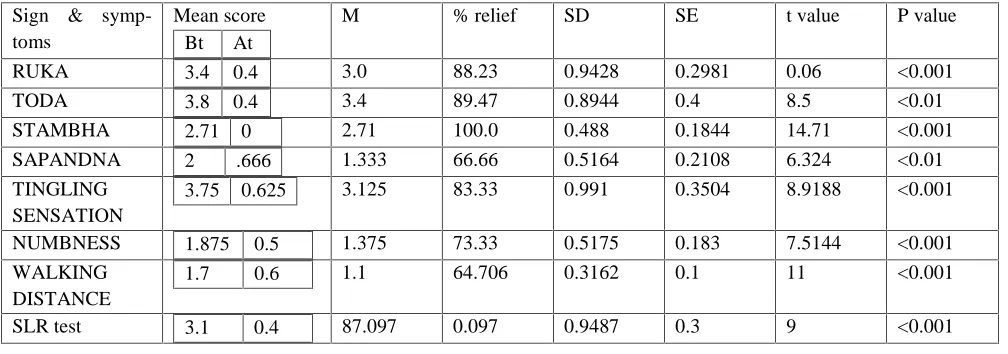
Table12: Effect of therapy on Signs & Symptoms Sign &
symp-toms
Mean score Bt At
M % relief SD SE t value P value
RUKA 3.4 0.4 3.0 88.23 0.9428 0.2981 0.06 <0.001
TODA 3.8 0.4 3.4 89.47 0.8944 0.4 8.5 <0.01
STAMBHA 2.71 0 2.71 100.0 0.488 0.1844 14.71 <0.001
SAPANDNA 2 .666 1.333 66.66 0.5164 0.2108 6.324 <0.01
TINGLING SENSATION
3.75 0.625 3.125 83.33 0.991 0.3504 8.9188 <0.001
NUMBNESS 1.875 0.5 1.375 73.33 0.5175 0.183 7.5144 <0.001
WALKING DISTANCE
1.7 0.6 1.1 64.706 0.3162 0.1 11 <0.001
DISCUSSION
In this study effect of therapy shows highly significant with p value <0.001 results in Ruka, Stambha, Tingling sensation of lower limb, numbness. There was improvement in SLR test which also gives highly significant with p value < 0.001. Moderately significant results with p value <0.01seen in case of Toda & Spandan. It is found that patients were clin-ically improved with the treatment of
Ag-nikarma with no side effect of the therapy.
About 88.23% relief found in case of pain immediately after the treatment which is one of cardinal symptom due to which patient be-came very comfortable & mentally satisfied by the treatment .89.47% relief in Toda, about 100% relief was seen in case of stiffness after the therapy. Gridhrasi is one of painful condi-tion which hampers the daily routine of the patient. This disease having predominancy of
Vatadoshas as it comes under eighty vataj nanatmaj vyadhi & may have kaphaanubandh
with it. Thus, radiating pain from lumber re-gion to the lower extremities may show stiff-ness in the lower limb & difficulty in walking, or continuous standing even for short period. Ayurveda believes that being ushna treatment,
Agnikarma acts against the qualities of vata
and kaphadoshas and hence Agni karma cures all the vataja and kaphaj disorders. Pain oc-curring anywhere in the body is due to vata,
Agnikarma being ushna chikitsa pacifies vata,
and thus the pain is relieved immediately after
Agnikarma. Similarly, kaphaj disorders also
get cured by the ushna i.e hot qualities of
Ag-nikarma. According to Ayurveda, every dhatu
(tissue) has its own dhatvagni (tissue Agni) which is responsible for the nourishment, In-crease & deIn-crease of dhatu. When this
dhatvagni becomes manda diseases begin to
manifest. Thus, in this condition Agnikarma works by giving external heat there by increas-ing the dhatvagni which helps to digest the aggravated doshas and hence cures the dis-ease. While describing the Gridhrasi, Aachar-ya Sushrut has given more emphasis on in-volvement of ligament of heel & toe afflicted with vatadosha which obstruct the movement of leg. In the chapter of Vaatvyadhi chikitsa
Adhyaay, Acharya Charaka has mentioned
process of Agnikarmain case of Gridhrasi. So as to discontinue the recurrence & for
sam-prapti vighatan hetu, patient should be given
oral vatshamak medication.
MODE OF ACTION:
Gridhrasi, a pain and disability
domi-nant disease needs an energetic treatment. The line of management depends on dosha and
dhatu involved in the pathogenesis which in
turn depends on the nidana. Dhatukshaya,
vataprakopa are the inevitableconditions and
involvement of asti, sandhi, upadhatus are evident in any pathogenesis of Gridhrasi.
Ayurvedic principles state that being Ushna
treatment it acts against the qualities of vata and kapha doshas and hence cures all the
Vataja and Kaphaj disorders. Even it helps to
remove Srothosangha and avarana by Ushna
guna. According to scientist Dr Ven Hanff, the
reduction in intensity of pain. There may be generalizing dilatation of the heated blood vessels on the centers concerned with regener-ation of the body temperature. Heating affect the vasomotor centers causing general rise in temperature. Due to increased local metabo-lism, the waste products (metabolites) which are produced gets excreted, which normalize the blood circulation thus resulting in reduc-tion in intensity of pain.
CONCLUSION
Gridhrasi (Sciatica) is commonly seen in
society as a prominent problem.
Number of sittings of Agnikarma depends upon the chronicity and severity of the dis-ease.
Overall, Agnikarma is simple modality of treatment, having no complication.
Gridhrasi can be absolutely cured by Ag-nikarma chikitsa.
REFRENCES
1. Hari Shastri Paradkar – Ashtanghruday, Chaukhamba Surbharati Prakashan, Vara-nasi, 2010 Page no. 535
2. Yadavji Trikamji Acharya– Charaka sam-hita with Chakrapani commentary Pub-lished by
3. Choukhamba Surbharati Prakashan, Vara-nasi, 2011 page no. 619
4. Yadavji Trikamji Acharya & Narayan Ram Acharya, Chaukhamba Sanskrit Sansthan,
5. 2009 Page no. 268
6. B.A. Lohith, Girish K.J. Clinical study to assess the effect of Yogabasti in Gridhrasi. Int. J. Res. Ayur. Pharm. 2013; 4(1):50-53 7. Padmakiran et. al. Role of Katibasti in
Gridhrasi IAMJ. 2013; 1(4):1-5
8. S.DAS, Concise Textbook of Surgery. 1st Ed. Published by Dr. S. Das 13, Old Mayors Court, Calcutta, India. 1994: page no.516.
9. Sushrut Samhita, by Dr. Anantaram Shar-ma, Sutrasthana Chapter 12/10, published by Chaukhambha Surbharati Prakashana, Varanasi
10. Vatavyadhi Chikitsaprakaran , Shloka no. 54, Chakrapanidutta – Chakradutta, com-mentary by Dr. Indradevatripathy, edited by Prof. Ramanath Dwivedy published by chaukhambha Sanskrit sansthan , Varanasi
Source of Support: Nil
Conflict Of Interest: None Declared