577 |
P a g e
OPTIMIZE THE POWER CONTROL AND NETWORK
LIFETIME USING ZERO - SUM GAME THEORY FOR
WIRELESS SENSOR NETWORKS
Vinoba.V
1, Chithra.S.M
21
Department of Mathematics, K.N. Government Arts college, Tamil Nadu,( India.
)
2
Department of Mathematics, R.M.K College of Engineering and Technology, Research
Scholar, Bharathidasan University, Tamil Nadu, (India.)
ABSTRACT
A wireless sensor network is one of the most attractive research fields in the communication networks. This will
creates a great popularity regarding their potential use in a wide variety of applications like monitoring
environmental attributes, intrusion detection, and various military and civilian applications. The main
performance of these sensor networks is maintaining network life time while satisfying coverage and
connectivity in the deployment region. In this paper, we look at the problem of maintaining energy level of the
sensor node , reliable routing and multi-hop in WSN within a finite two-person zero-sum game theoretic
approach. The game theoretic scheme is based on models that express the interaction among players, in this
case, nodes, by modeling them as elements of a social networks in such a way that they act as to maintaining the
maximum utility. Simulation results are shows the effectiveness of the proposed game with various path loss
exponents and also the proposed games is able to maintain the energy level of the network life time.
Keywords:
Wireless Sensor Networks, Two-person zero-sum Game Theory, Routing, Life time.
I. INTRODUCTION
Wireless Sensor networks is one of the most promising and interesting areas in the past years. This network
consists of a large number of sense nodes. These nodes are able to gather the information and process it and
send it to the relevant destinations. Also, these nodes form a network by communicating with each other either
directly or through other nodes. One or more nodes among them will serve as sink(s) that are capable of
communicating with the user either directly or through the existing wired networks. The primary component of
the network is the sensor, essential for monitoring real world physical conditions such as sound, temperature,
humidity, intensity, vibration, pressure, motion, pollutants etc. at different locations. The nodes are deployed in
hostile environment it is not feasible to replace the batteries. Therefore energy conservation is very crucial for
WSN’s both for each sensor node and the entire network level operations to prolong the network lifetime.
Energy –constrained networks, such as Wireless sensor networks are composed of nodes typically powered by
batteries, for which replacement or recharging is very difficult, if not impossible. With finite energy, we can
only transmit a finite amount of information. Therefore, minimizing the energy consumption for data
transmission becomes one of the most important design considerations for such networks [1]. One of the desired
578 |
P a g e
inaccessible terrains in which up to data monitoring schemes are unsafe, heavy-handed, and sometimesinfeasible.
Now days, some research efforts have focused on establishing efficient routing paths for transmitting packets
from a sensor node to a sink in WSN’s. Routing means finding the best possible way for data transmission from
source node to the destination node in the network by considering networks parameters. The other important
factor that must be considered in the network is Load Traffic Distribution. Usually the traffic load in wireless
sensor networks is unbalance. For example, sensors which are nearer to the source have more data load.
Therefore, optimization of load distribution, called Load Balancing, is one of the important factors for
improving the efficiency of the networks. Optimization of load traffic distribution in WSN could increase the
lifetime of the network. Since, there is more power consumption in nodes with more traffic load then the data
transaction in the network could be optimized.
Game Theory is based on models that express the interaction among players, in this case nodes, by modeling
them as an element of a social networks in such a way that they act to maximize their own utility. This allows
the analysis of existing algorithms and protocols for WSN’s as well as the design of equilibrium-inducing
mechanisms that provide incentives for individual nodes to behave in socially constructive ways. In this paper,
by using Zero-Sum Game Theory approach for WSN, optimal route in WSN is found. In this approach, routing
and sensor nodes are assumed to be the game and players respectively. All players want to increase their benefit.
So we use a mixed strategy model as well as profit and loss calculation for each player.
II. RELATED WORKS
The main goal of routing in WSNs is to guarantee successful packet delivery from source to sink node under
constraint requirements like energy consumption, end to end delay, packet delivery ratio and QoS etc. In
addition to energy consumption, more challenges and design issues are pointed out [1].
Lifetime is the one of main design issue in WSN and the lifetime of the sensor node is mainly depends on the
battery energy level. Since WSN is composed of very small nodes, their energy resources are very limited this
imposes tight constraints on the operation of sensor nodes. The transceiver is the element which drains most
power from the node (Fedora and Collier 2007), thus the routing protocols will significantly influence the
lifetime of the overall network.
Energy-aware Routing protocol (Shah and Rabaey 2002) is similar to directed diffusion with the difference is,
it maintains a set of paths instead of or enforcing one optimal path. These paths are maintained and chosen by
means of a certain probability, which will depend the energy consumption of each path. By selecting different
routes at different times, the energy of any single route will not deplete so quickly, the network lifetime
increases.
Data centric, hierarchical and location based routing protocols gives the importance on energy efficiency and
increased network lifetime, with little concern on quality measures. This group of routing protocols in addition
to the energy efficiency focuses on QoS metrics such as latency, bandwidth and efficiency. QoS based protocols
579 |
P a g e
reliable routing algorithms. These protocols are concerned on the network fault tolerance and resilience of thenetwork on node failures or node malfunctioning.
III. MATHEMATICAL MODEL
Game Theory is a theory of decision making under conditions of uncertainly and interdependence. In the
distributed sensor network the game equation has to be found, with application of a game strategy. It is assumed
that all the nodes in the sensor networks are the same and that all nodes are in the interference range. The
activity of all the nodes is at the same level and it increases with the increase of power level transmission.
A game has three components:
(i) a set of players (ii) a set of possible of actions for each player and (iii) a set ofstrategies.
A player’s strategy is a complete plan of actions to be taken when the game is actually played. Players can act
selfishly to maximize their gains and hence a distributed strategy for players can provide an optimized solution
to the game. In any game, utility represents the motivation of players. A utility function, describing player’s
preferences for a given player assigns a number for every possible outcome of the game with the property that a
higher number implies that the outcome is more preferred.
A Zero-sum game is a mathematical representation of situation in which a participant’s gain or loss of utility is
exactly balanced by the losses or gain of the utility of the other participants. The present survey covers research
on infinite zero-sum two-person games in normal form [3] .( i.e., zero-sum two-person games with infinite sets
of player strategies in which the player strategies are elements of certain abstract sets. In this article we do not
consider dynamic and differential games.
Definition: 3.1. The zero-sum two-person game in normal form is formally defined as a triple X,Y,P
in which X and Y are arbitrary infinite sets representing the sets of strategies of Players I and II
respectively and P is a real function defined on the set X Y of all situations and is called the payoff
function or kernel of the game. (If P : X Y R is the payoff function of Player I. Player II’s payoff in the
situation
x,y
is
P
x,y
, where x X , yY the game being zero-sum)Definition: 3.2 The existence of optimal ( optimal) strategies for the opponents in a zero-sum two-person
game is equivalent to satisfaction of the following equations:
X x
max
Y y
inf P
x,y
=Y y min
X x
sup P
x, y
= υ --- (3.1)
X x
sup
Y y
inf P
x, y
=Y y
inf
X x
sup P
x,y
= υ --- (3.2)The quantity υ is called the value of the game. Even in the simplest cases, however, equations (1) and (2) fall
short of being satisfied. Their proof requires the imposition of rather stringent algebraic constraints on the
strategy sets X , Y and the function P (such as concavity in xand convexity in y ) as well as topological
constraints ( the sets X and Y are topological spaces, and the function P has properties of the continuity
580 |
P a g e
It is reasonable, therefore, to extend the strategy sets of the players in such a way that the payoff function,now defined on a new extended set of situations, will satisfy the required constraints .The extended strategy sets
must be convex and include the usual strategies.
Let algebra of subsets of X containing all one-element subsets, let be a
algebra of subsets of Y , and let the function P be bounded and measurable under the algebra x
. A probabilistic measure defined on
is called a mixed strategy of Player I (II). If is a mixedstrategy of Player I and is a mixed strategy of Player II, then the payoff function P
,
under theconditions of the mixed situation
,
is defined by the integral
,
P = P
x y
d x d yX Y
, .If the set of pure strategies of a player is infinite (and especially if it is denumerable ), then in the choice of
his set of mixed strategies there is a certain arbitrariness, which rests on the particular choice of algebra of
subsets of the pure strategy set on which the probabilistic measure is defined[2] .Various randomizations of pure
strategy sets have been investigated by Wald and Bieriein .Clearly, the sets of mixed strategies are convex and,
if the ordinary, or so-called pure, strategies are regarded as corresponding degenerate measures, include all the
pure strategies of the players. Under the conditions of mixed strategies the payoff function turns out be linear in
each of the variables.
Theorems establishing the validity of equations (1) and (2) for an infinite game or its mixed extension are
called existence theorems (or minimax theorems). The proof of existence theorem, (i.e.) the identification of
classes of games for which a value of the game exists (or does not exist), is one the fundamental problems of the
theory of infinite zero-sum two-person games [4].
A pair of optimal strategies of each player in a zero-sum two-person game ( or the set of optimal
strategies for each player) in conjunction with the process of finding those strategies is known as a solution of
the game.
In the infinite game, as in any zero-sum two-person game X,Y,P the principle of player’s optimal
behavior is the saddle point (equilibrium) principle.
Definition: 3.3. Saddle point
The point
x,y
for which the inequality
x y
P
x y
P
x y
P , , , --- (3.3)
holds for allx X , yY is called saddle point.
This principle may be realized in the game if and only if =
=
= P
x, y
where
=
X x
max
Y y
inf P
x, y
--- (3.4)
= Y y min
X x
581 |
P a g e
(i.e) the external extreme of maximin and minimax are achieved and the lower value of the game is equal to
upper value of the game
. The game for which the (4) holds is called strictly determined and the number
is the value of the game.
Definition: 3.4. Saddle points, optimal strategies
The point
x,y
in the zero-sum two-person game X,Y,P is called the equilibrium point if thefollowing inequality holds for any strategies x X and yY of the Players I and II, respectively:
P
x, y
P
x,y
P
x, y
--- (3.5).The point
x,y
for which equation (5) holds, is called the Saddle point and the strategies x & yare called optimal strategies for the players I and II, respectively.
NOTE:
Compare the definitions of the saddle point equation (3) and the Saddle point equation (5), A deviation
from the optimal strategy reduce the player’s payoff where as a deviation from the optimal strategies may
increase the payoff by no more than.
In conclusion we will point out a special class of zero-sum two-person game in which
X = Y = [0, 1]. In these games, situations are the pairs of numbers
x, y
, where x, y
0,1 such games arecalled the games on the unit square. The class of the games on the unit square is basic in examination of
infinite games.
Example 1:
Suppose each of the players I and II chooses a number from the open interval (0,1). Then Player I receives a
payoff equal to the sum of the chosen numbers. In the manner we obtain the game on the open unit square with
the payoff function P
x, y
for Player I.
x y
P ,=x y, x
0,1 , y
0,1 ---(3.6).Here the situation (1,0) would be equilibrium if 1 and 0 were among the players’ strategies, with the game
value being 1Actually the external extreme in (4) are not achieved but in the same time the upper value
is equal to the lower value of the game. Therefore =1 and Player I can always receive the payoff sufficiently
close to the game value by choosing a number 1-,
>0 as a sufficiently small number (close to 0), Player II can guarantee that his loss will be arbitrarily close to
the value of the game.
The following theorem yields the main property of optimal strategies.
Theorem1: For the finite value of the zero-sum two-person game X,Y,P to exist, it is necessary
and sufficient that, for any >0, there be optimal strategies x,yfor the players I and II, respectively,
in which case
P x , y
lim
0
582 |
P a g e
Proof
Case (i) first to prove the Necessary condition:
Suppose the game has the finite value . For any >0 we choose strategy xfrom the condition
2 ,y x P Sup X x --- (3.8)And strategy x from the condition
2 , y x P Inf Yy --- (3.9)
We know that
= X x max Y y
inf P
x,y
, = Y y min X x
sup P
x,y
From equation (8) & (9) we obtain the inequality
2 , 2
, y P x y x
P --- (3.10) for all strategiesx,y.
Consequently,
,
2
y
x P
--- (3.11)
The relations P
x,y
P
x,y
P
x, y
,
P x ,y
lim
0
= follows from
2 ,y x P Sup X xand
2 , y x P Inf Y
y .
2 ,y x P Sup X x
2 , y x P Inf Y yCase (ii) Next to prove the sufficient condition:
If the inequalities P
x,y
P
x,y
P
x, y
hold for any number 0, then
2 2 , 2 , , , , _ _ Inf Sup P x y Sup P x y P x y Inf P x y Sup Inf P x y
y y X x Y y X x X x Y y --- (3.12)
Hence it follows that _ _
, the inverse inequality holds true. Thus, it remains to prove that the value of the
game is finite.
Let us take such sequence
n that lim 0
n
n .
Let k
n km
n , where m any fixed natural number is. We have
x k m y k
k m P
x k m y k m
P
x k y k m
k mP
, , , ,
x k y k m
k P
x k y k
P
x k m y k
kP , , , .
Thus
k k
k m k m
k k m kmy x P y x
P
,
,
583 |
P a g e
Since lim km 0k
for any fixed value of m
, then there exists a finite limit
P x , y
lim
0 . From the
relationship equation (10) we obtain the inequality
x y
P , ; Hence =
P x ,y
lim
0 .
This completes the proof of the theorem.
IV. LIFETIME EXTENSION ALGORITHM
In this section, we propose a infinite zero-sum game theory life time extension algorithm. In order to implement
the algorithm, the node i receives the sum of interference power from sink node to the destination node [6]. The
lifetime sensor node maintained according to the equation maxxX yY
inf P
x,y
=Y y min
X x
sup P
x,y
= υand
P x ,y
lim
0
=
The latency at the source node LS is given by,
data sleep
S T T T
T
L 1 2
2
--- (4.1)
The latency at the intermediate node is same as that of source node, which is given in equation (13).
The end-to-end latency for multi-hop Lm transmission is given by,
N
i i
m L
L
1
--- (4.2).
V. SIMULATION RESULTS AND DISCUSSION
The proposed algorithm has been simulated and validated through simulation. The sensor nodes are deployed
randomly in a 100x100 meters square and sink node deploy at the point of (50, 50), the maximum transmitting
radius of each node is 80 m; other simulation parameters are displayed in Table1. In this section, we first discuss
utility factor and pricing factor’s influences on transmitting power, and then evaluate the algorithm with other
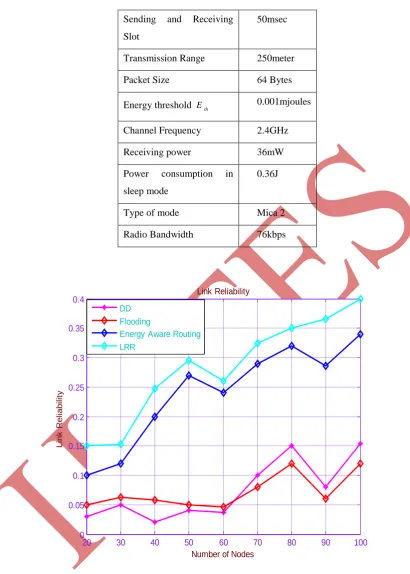
existing algorithm. Figure1. Shows that the average delivery delay with increasing transmission rate.
Table 1. Simulation Parameters
Parameters Value
Number of Nodes 50-100
Network Area 100 X 100
Sensing Range 16m
Initial Energy of sensor
node
584 |
P a g e
Sending and ReceivingSlot
50msec
Transmission Range 250meter
Packet Size 64 Bytes
Energy threshold Eth 0.001mjoules
Channel Frequency 2.4GHz
Receiving power 36mW
Power consumption in
sleep mode
0.36J
Type of mode Mica 2
Radio Bandwidth 76kbps
20 30 40 50 60 70 80 90 100
0 0.05 0.1 0.15 0.2 0.25 0.3 0.35
0.4 Link Reliability
Number of Nodes
L
in
k
R
e
li
a
b
il
it
y
DD Flooding
Energy Aware Routing LRR
Figure 1: Average Delivery Rate with various Transmission Rate
The average delay means the average delay between the instant the source sends a packet and moment the
destination receives this packet. When the transmission rate is 1 packet per second, we can see that the average
585 |
P a g e
In the proposed protocol, when the packets reach at destination, the relay or intermediate nodes have a lowermultiple strategies. In the forwarding node selection game, the probability that a great amount of packets are
forwarded by the same node is relatively low. Thus, the average delivery delay of our protocol does not
significantly increase with an increase in transmission rate. The following table 2 shows the network life time of
nodes in the respective routing protocols.
Routing
Protocols
Nodes Alive
Number of Nodes
100
Rounds
700
Rounds
20 Nodes 100 Nodes
LRR
(Proposed)
100
45
0.15
0.4
Flooding
59
18
0.05
0.07
DD
42
5
0.035
0.15
Energy
Aware
68
20
0.1
0.34
VI. CONCLUSION
In this paper, we introduce a zero-sum game theory for maintaining a sensor network lifetime. In this network
connectivity of nodes forward to any packets to its neighbor nodes. Zero-sum game theory improves the
network lifetime. Direct diffusion (DD) protocol, after 400 rounds, about 25% of nodes alive. In proposed link
reliability routing (LRR) protocol, after 550 rounds Network lifetime is increasing about 70%. Path reliability
for direct diffusion (DD) protocol is random. Path reliability for proposed link reliability routing (LRR)
protocol, increases Number of nodes increases to above 70 nodes, the path reliability is more than 0.3. This
shows that our proposed model and algorithm increases the network lifetime. Also, we will be optimizing the
algorithm to find the maximum usefulness function of all nodes that cooperate in path.
REFERENCES
[1] F.Akyldiz, W.Su, Y. Subramanian, Sankaras and E. Cayirci, “Wireless sensor networks: a survey”
Computer Networks,
[2] Vol.38, Pp. 393-422, 2002.
[3] “Theory of Games and Economic Behavior”-Von Neumann and Morgenstern-1953.
[4] “Game theory in Wireless sensor networks” – Pedro O.S.Vazdemelo, Cesar Fernandes, Raquel A.F, Mini
586 |
P a g e
[5] A.F.Loureiro.[6] A. Agah, S. K. Das, and K. B.Basu, “Preventing DoS attack in sensor and actor networks: A game theoretic
approach”,
[7] IEEE Int’l. Conf. On Communications (ICC), Seoul, Korea, May 2005, pp. 3218-3222.
[8] S. Buchegger and J. Le Boudec, “Performance Analysis of the CONFIDANT Protocol,” Proc. Third
ACM Int’l
[9] Symp. Mobile AdHoc Networking & Computing, pp. 226-236, 2002.
[10]L. Buttyan and J.P. Hubaux, “Nuggets: A Virtual Currency to Stimulate Cooperation in Self
organized Mobile
[11]Ad- Hoc Networks, “Technical Report DSC/2001/001, Swiss Fed. Inst. Of Technology, Jan. 2001.
[12]7.W. Wang, M. Chatterjee, and K. Kwiat, “Enforcing Cooperation in Ad Hoc Networks with
Unreliable Channel,”
[13]Proc. Fifth IEEE Int’ Conf. Mobile Ad-Hoc and Sensor Systems (MASS), pp. 456-462, 2008.
[14]V. Srinivasan, P. Nuggehalli, C. Chiasserini, and R. Rao,“Cooperation in Wireless Ad Hoc Networks,”
Proc.
[15]IEEEINFOCOM, vol. 2, pp. 808-817, Apr. 2003.
[16]Chang, C.Y.; Shih, K.P.; Lee, S.C.; Chang, S.W. RGP: Active route guiding protocol for wireless sensor
networks with
[17]Obstacles. In Proceedings of IEEE MASS, Vancouver, Canada, October 2006; pp. 367-376.
[18]K. Sanzgiri, B. Dahill, B.N. L E.M. Royer, “A Secure Rohoc Networks”, In Proc. of on Network Protocols
(IC2002,