Ubiquitous Computing at its best: Serious exercise
games for older adults in ambient assisted living
environments – a technology acceptance perspective
Philipp Brauner
1,2,∗, Andreas Holzinger
3,4, Martina Ziefle
1,21Human-Computer Interaction Center (HCIC), RWTH Aachen University, Germany 2Chair for Communication Science, RWTH Aachen University, Germany
3Institute for Information Systems and Computer Media, Graz University of Technology, Austria
4Research Unit Human-Computer Interaction, Institute for Medical Informatics, Medical University Graz, Austria
Abstract
Received on 05 November 2014; accepted on 01 December 2014; published on 03 July 2015
Keywords: Serious Games, Serious Games for Health, Health care, Exercise Game, Exergame, Ubiquitous Computing, Ambient Assisted Living, eHealth, Technology Acceptance, User Diversity, Older Adults, Demographic Change
Copyright © 2015 P. Brauner et al., licensed to ICST. This is an open access article distributed under the terms of the Creative Commons Attribution license (http://creativecommons.org/licenses/by/3.0/), which permits unlimited use, distribution and reproduction in any medium so long as the original work is properly cited.
doi:10.4108/sg.1.4.e3
1. Introduction
Western societies are facing an enormous demographic change [41]. The life expectancy is increasing through progress in medicine, nutrition, hygiene, and a time of peace and prosperity [59], however threatened by e.g. obesity [51], and unhealthy nutrition in western countries [3]. By contrast, the birthrate is declining since the 1960s. Current projections estimate that the rate of people 65 years and older will rise from 17% in 2008 to 30% in 2060 [27]. Also, the rate of people 80+ will rise from 5% to 14% in the same period.
This affects the social and welfare systems of western societies, as a shrinking workforce needs to support a growing number of beneficiaries. Today, one dependent elderly person is covered by 3.2 jobholders. This ∗Corresponding author. Email: [email protected]
old-age dependency ratio is expected to dramatically
decrease to 1:1.85 within the next 40 years [27]. The likelihood of chronic illnesses increases with age [31] and many people 80+ need special medical attention and support by others. This aggravates the development and increases the stress on health and welfare systems. To maintain viable social systems that support elderly life with self-determination and dignity, new and innovative solutions must be developed. This work focuses on the idea of “prevention instead of treatment”. Specifically, we want to understand how elderly people can be motivated to maintain or increase their physical fitness through regular exercises, as exercising has positive effects on health [43, 72, 67, 1] and also on mental well-being [53, 17, 35].
To address this question, this work combines three major research lines in the area of ubiquitous computing: Ambient Assisted Living (AAL), Serious
Games for Health (specifically Exercise Games or
Exergames), and technology acceptance research, that
are presented in the following section.
2. Background
The following sections describes the three research domains combined in this work: Ubiquitous computing and ambient assisted living, serious games and serious games for health care and outlines technology acceptance research.
2.1.
Ubiquitous computing, ambient assisted living
Already in 1991, Marc Weiser’s vision of Ubiquitous Computing introduced the concept of “smart envi- ronments” in which information and communication technology is seamlessly integrated into the physical surrounding [69]. This early vision is closely related to the current discussion of “Internet of Things” (IOT) and Europe’s concept of “Ambient Assisted living” (AAL). Smart health is the next big thing in the western coun- tries and a necessity of the future [32].
Ambient Assisted Living strives to enhance the life quality, independence, and dignity of elderly, disabled, or chronically ill people through innovative, ubiquitous, and unobtrusive technology at home [42, 61, 76, 57, 62,
74]. Although such pervasive health care systems have large potential to provide patients with a new quality of (medical) home care [16, 15], fundamental questions regarding the behavior, communication and technology acceptance are not satisfactorily answered [49] and have enormous research potential [36]. Foremost, the social consequences of technology at home and the complexity to tailor the technology to the individual demands of the users is a crucial issue [44, 71] and the specific requirements of elderly are a critical factor for the success of ambient assistive living technologies [58, 54], e.g. usability engineering is a crucial factor [34, 37, 33].
Some visions of ubiquitous computing and ambient assisted living are slowly becoming reality: Smart homes that connect and orchestrate various devices inside a home and personal drones in the form of robot vacuum cleaners facilitate the day-to-day life of their users. Still, many ideas remain visions that cannot yet be realized in domestic environments. To understand the reception of these by potential users and to derive recommendations for researchers and practitioners, prototypic living labs are constructed that simulate the envisioned ideas.
One of these labs is RWTH Aachen University’s Ambient Assisted Living Lab [75]. This prototypic living environment resembles a comfortable 25m2 living room with two couches and a coffee table. Various sensors are seamlessly integrated into this living room.
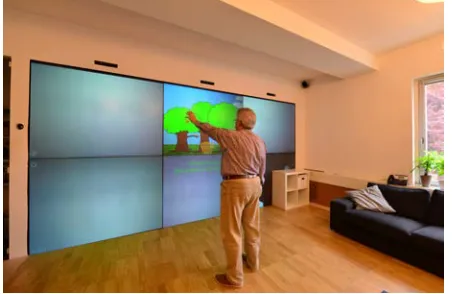
person’s weight on his or her behalf, and an invisible infrared camera can detect a person’s body temperature to signal possible illnesses [40]. A large multi-touch wall supports novel interaction techniques [30] and offers patients tele-medical consultation services, e.g., medical encounters with (tele-)doctors [8]. Figure 1a shows the living room and a video presenting the lab is available online1.
2.2.
Serious games and exercise games
According to a definition by Michael and Chen a “serious game is a game in which education (in its various forms) is the primary goal, rather than entertainment” [55]. Such games can have powerful effects, e.g. to stimulate motivation [20, 46, 56, 45].
From a psychological perspective, serious games build - amongst others - on the Premack principle [60]: The likelihood of an unlikely event (e.g., exercising) increases if it is coupled with a likely event (e.g., playing games [39]). First applications of computer- based serious games for health care, specifically for frail elderly people, have been presented as early as 1983 [70]. One prominent branch of serious games for health care are “exercise games” (a combination of the words “exercise” and “games”) that are controlled by full body motions of the players [66]. They have recently gained new attention through the introduction of the Microsoft Kinect™ sensor as an inexpensive and easy to use gesture detection system, which produces 3D point cloud data and allows a lot of interesting research and worthwhile applications [38]. Rehabilitation of stroke patients [22, 48, 23], increasing maneuverability and strengthening the balance of the body of elderly [29,
25] and raising the motivation for exercising [11, 50] are just some examples of successful applications of serious games for health care.
2.3.
Technology acceptance research
Technology acceptance research is based on Ajzen’s and Fishbein’s Theory of Reasoned Action (TRA) [21] and Theory of Planned Behavior (TPB) [2], both of which state that an individual’s behavior is related to the intention to perform the behavior. This behavioral intention is governed by attitudes, subjective beliefs, and self-efficacy (in TPB) the individual has towards the behavior. Davis used this theory in the Technology Acceptance Model (TAM) to predict the later use of a business software (behavior) based on the intention to use the software (behavioral intention) [18]. In TAM, the usage intention is determined by perceived usefulness, perceived ease of use, and the attitude towards using the software. Intention to use and the later use of For example, sensors in the floor detect movements
the software were highly correlated, meaning that the model describes the factors influencing the adoption of a software as well as predicts future use of a software.
Davis’ Technology Acceptance Model continually evolved to reflect different types of technology and software and to provide a finer grained set of explaining factors. In particular, the Unified Theory of Acceptance
and Use of Technology 2 (UTAUT2) [68] predicts the
adoption of consumer technology. Here, the use is voluntary (in contrast, it is unusual that an employee decides on his own which office applications he or she uses) and besides the perceived usefulness, hedonic value and the price of the product play major roles in the adoption process. Specifically, UTAUT2 uses seven factors that influence the behavioral intention to use the software and the later adaption of a technology. These factors are presented in the following, as they are used in the subsequent user study: Performance
expectancy refers to the perceived benefit of the
given technology, e.g., if the user beliefs that she or he is able to achieve something desirable with the technology. Effort expectancy models the perceived effort for learning and using the technology. Social influence
describes the influence of friends and family and the users’ beliefs about their appraisement of using the technology. Facilitating conditions cover the help users may receive if they experience difficulties using the technology. Hedonic motivation relates to the fun the users experience while using the given technology. Price
value describes the price-value tradeoff and models
the users’ beliefs if the perceived benefit is worth the monetary costs. Habit refers to the users’ beliefs whether she or he would use the technology frequently and make using it a habit. In addition, these factors are moderated by the user factors age, gender, and experience. Despite its complexity, the UTAUT2 model is able to predict a fair amount of variance in behavioral intention (≈ 74%) and later use (≈ 54%) of a technology [68].
To understand if serious exergames would be accepted by elderly inhabitants of ambient assisted living environments and which factors are crucial for the adoption, we developed and evaluated a prototypic game. The following section describes the game, afterwards the experimental setup is described.
3. A serious exergame for ambient assisted living
To understand the personality factors contributing to acceptance of exergames in ambient assisted living environments, we developed the prototypic exergame“Fitness Farm”. The game takes place in a virtual garden
and the player’s task is to collect different fruits within a specific time frame. The gardening scenario is based on one of DeShutter’s and Vandenabeele’s suggestions for meaningful play in elderly life [19]. The garden is
presented on the large multi-touch wall in the living lab (4.8 × 2.4m2) and the players control the game using motion gestures that are detected by one of three Microsoft Kinect™ sensors. The game is conceptually similar to a game developed by Gao and Mandryk for promoting movement exercises at the workplace [24].
To address different exercises for strengthening different muscles, a set of movement gestures was developed. For example, apples need only to be touched briefly by the in-game avatar, which requires quick movements and strengthens the outer muscles. In contrast, pears require to be held for a few seconds, which strengthens the inner muscles of the body. Bananas require a body twist, as bananas appearing left on the screen need to be picked with the right hand and vice versa. This requires more coordination and activates more muscles. In later levels (not evaluated), carrots require a squat gesture that focuses on the leg and back muscles. To ensure medical soundness, we cooperated with a medical professional and a physiotherapist during the development.
In a user-centered and participatory design process, we developed the exercise game “FitnessFarm” with 1) early focus on users and their tasks, 2) empirical measurement of product usage, and 3) an iterative design process as suggested by Gould and Lewis [28]. The design started with paper prototypes and the first functional prototype was evaluated outside the living lab in a doctor’s office [11]. This study showed a high usability for younger and older users and attested that the scenario, the visual presentation, as well as the gestures were accepted by elderly people.
(a)A view of the ambient assisted living lab (image Kai Kasugai). (b) Participant interacting with a game prototype (image Kai Kasugai).
Figure 1. Ambient assisted living lab.
4. Method
The study addresses three central research questions: First, which user factors contribute to the performance within exergames. Second, which factors contribute to acceptance of these games. Third, do exergames influence the player’s perceived health.
4.1.
Procedure
The user study was carried out in RWTH Aachen Uni- versity’s Ambient Assisted Living Lab (see Section 2.1). After a brief introduction to the room, the participants answered the first questionnaire (capturing the inde- pendent and explanatory variables), then they played three levels of the game. Finally, they answered a second questionnaire (which captured the user’s evaluation of the game). The study took ≈ 45 min. per participant.
The next three sections describe the independent (explicitly controlled), explanatory (independent but not specifically controlled), and dependent variables (capturing the interaction with the game).
4.2.
Independent variables
Age and gender2 of the participants was assessed.
The sample was constructed to have 50% male and 50% female subjects (for understanding gender effects), as well as 50% older and 50% younger users (for understanding age-related effects).
4.3.
Explanatory variables
The explanatory variables, which cover user factors such as personality, technical expertise, and attitude
2Gender is dummy coded with 1=male and 2=female.
towards health and games, are described in the following.
Gaming frequency across 11 different games and
related activities was surveyed. These games and activities contain both computer-related activities (e.g., playing video games) and classic games (e.g., playing card games), as well as indoor and outdoor activities.
Technology experience was captured on three different
dimensions: Usage frequency (TUF) and perceived ease of use (TPEU) across several electronic devices and self-efficacy in interacting with technology (SET) were measured on a scale by Beier [7]. Self-efficacy pro- foundly influences perceived ease of use, effectiveness, efficiency, satisfaction, and learnability when interact- ing with electronic devices [13, 12] and is influenced by age and gender [4].
Need for Achievement was surveyed on a shortend
scale (4 items) based on the Leistungsmotivations- Inventar [65]. The need for achievement determines a person’s desire to achieve a difficult and distant goal, to perform very well, and the determination win.
Attitude towards health. Due to the lack of a
widely accepted scale for assessing an individual’s risk behavior towards his or her own health [14], the health sub-scale of the Domain-Specific Risk-Taking (DOSPERT) scale [9] was used as a foundation and extended by new aspects. The applied scale covers nutrition, smoking and drinking, sleeping, physical inactivity and hectic lifestyle with 6 items.
Furthermore, the Five Factor Inventory [52] was measured using the questionnaire by Satow [63] to ensure the sample’s ecological validity and to understand if these personality dimensions relate to performance and evaluation of the game.
smaller players difficult, which may bias performance and the evaluation of the game.
Note that a basically the same experimental setting was used to evaluate technology acceptance patterns for a serious game targeted at training and retaining the cognitive abilities of residents of AAL environ- ments[73]. The game Cook it Right is situated in a kitchen environments and the stimulation of planning abilities is mediated through the preparation of meals through point-and-click interactions on a multitouch display.
4.4.
Dependent variables
The study’s dependent variables were the following:
Perceived pain of the players is surveyed for 8 body parts (hands, arms, feed, legs, hip, neck, shoulders and head) before and after playing.
Perceived exertion of the player is measured before and
after playing on the Borg scale [10]. Although this scale uses subjective ratings, it correlates very strongly with the actual heart of the users.
Performance within the game is captured by interac-
tion log files and measured as fruit/s.
The eight dimensions from the UTAUT2 model (i.e., performance expectancy, effort expectancy, social influence, facilitating conditions, hedonic motivation, price value, habit, and behavioral intention) were covered with 3 item each (see section 2.3 for details).
4.5.
Statistical methods
All subjective measures were assessed on 6-point Likert scales. The data was then analyzed using bivariate correlations, Pearson’s χ2, uni- and multivariate analyses of variance (ANOVA/MANOVA), and multiple linear regression. The type I error rate (significance level) is set to α = .05. Missing values are deleted list- wise on a per test basis. Spearman’s ρ is used for bivariate correlations. Pillai’s V is used and reported for the omnibus test of the MANOVAs. The effect size is reported as partial η2. The enter method was used in the multiple linear regression and models with low std. beta were removed between the runs. Models with high variance inflation (V IF ≫ 1) were excluded. The whiskers in the diagrams indicate the standard error.
4.6.
Description of the sample
64 people have participated in the study (50% male, 50% female). Their age ranged from 17 to 85 years with an average of 43.2 years (SD=19.6). To understand age-related effects with factorial methods, we divided the sample into two groups: young (n = 32, M = 25.7,
SD = 4.5) and old (n = 32, M = 60.6, SD = 11.4). There was no connection between gender and age group (χ2(1, N = 64) = .250, p = .617 > .05, ns.). A quarter
(26%) of the subjects reported chronic illnesses, mainly asthma, diabetes mellitus, and cardiovascular diseases, and the likelihood of chronic illnesses increases with age (ρ(62 − 2) = .338, p = .002 < .05, sig.).
Regarding the Five Factor Model, the sample is comparable with the reference data, attesting that we gathered a valid subset of the basic population.
Age influences perceived pain (before the game) (ρ(64 − 2) = .319, p = .010 < .05, sig.) with older people perceiving higher levels of pain. However, pain is not affected by gender (ρ(64 − 2) = .031, p = .810 > .05, ns.). As expected, age influences usage frequency (ρ(64 −
2) = −.565, p < .01, sig.), perceived ease of use (ρ(64 −
2) = −.770, p < .01, sig.), and self-efficacy in interacting with technology (ρ(64 − 2) = −.367, p < .01, sig.) with elderly being less inclined to technology. Gender influences perceived ease of use (ρ(64 − 2) = −.273, p =
.029 < .05, sig.) and self-efficacy (ρ(64 − 2) = −.331, p < .01, sig.) but not the usage frequency (ρ(64 − 2) = −.122,
p = .336 > .05, ns.), and men are more inclined to
technology than women.
Moreover, gender is unrelated to attitude towards health risks (ρ(64 − 2) = −.127, p = .316 > .05, ns.), gaming frequency (ρ(64 − 2) = −.165, p = .192 > .05, ns.), or need for achievement (ρ(64 − 2) = −.144, p =
.264 > .05, ns.). However, age is related to gaming
frequency (ρ(64 − 2) = −.486, p < .01, sig.) but not with health risks (ρ(64 − 2) = −.142, p = .263 > .05, ns.) or need for achievement (ρ(62 − 2) = .040, p = .758 > .05, ns.).
5. Results
The results section is structured as follows: First, the factors that determine performance are presented. Second, the influences on technology acceptance are examined. Finally, the game’s effect on the participants’ perceived pain and exertion levels is investigated.
5.1.
Determinants for performance
The average performance decreases significantly between the 1st, 2nd, and 3rd level of the game (V = .779, F(2, 59) = 103.922, p < .01, η2 = .779, sig.). Gender does not influence performance (V = .055,
F(2, 59) = 1, 729, p = .186 > .05, ns.), but younger players are significantly faster than older players (V = .125, F(2, 59) = 4.205, p = .020 < .05, η2 = .125, sig.). On average, the performance of younger players is 43% (1st), 39% (2nd), and 43% (3rd level) higher than the performance of older players (see Figure 2).
30
25
20
15
10
5
0
1st level 2nd level 3rd level
young old
Table 2. Linear regression table for behavioral intention based on independent and explanatory variables.
Model B SE B β T
(constant) 2.747 .257 – 10.695
Gaming frequency .588 .146 .462 4.033
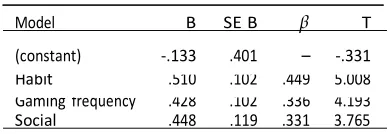
Table 3. Linear regression table for behavioral intention based on independent, explanatory, and UTAUT2 model variables.
Model B SE B β T
Table 1. Linear regression table for average performance.
Model B SE B β T
Need f. Achievement 1.131 .375 .245 3.012
Gender -2.229 .817 -.227 -2.788
factors age and need for achievement explains additional
δr2 = .076 (+8%) variance. Individuals with a higher need for achievement were faster in the game. The third model incorporating gender (female players being slower) explains a total of r2 = .602 (60%, δr2 = .050, +5%) of the variance in game performance and is
presented in Table 1.
For validation of our technical setup, we calculated the influence of body height on performance (ρ(64 −
2) = .286, p = .022 < .05, sig.). Obviously, gender and body height are related, and if controlled for gender, the influence between height and performance fades (r(64 − 3) = −.094, p = .464 > .05, ns.).
5.2.
Determinants for technology acceptance
To reveal the determining factors for technology acceptance, we first investigated the influence of only the independent and explanatory variables on behavioral intention and then considered with a holistic model with independent and explanatory variables and model variables from UTAUT2.
A multiple linear regression with the independent and explanatory variables, as well as performance as independent variables and behavioral intention as dependent variable, revealed a single significant model with gaming frequency as the only predictor for behavioral intention (see Table 2 for the model’s parameters). People with higher gaming frequency are also more inclined towards using the game. The model explains adj. r2 = .200 (20%) of the variance and
Social .448 .119 .331 3.765
leaves 80% of the variance of the behavioral intention unexplained.
The second multiple linear regression incorporates UTAUT2’s model variables and three significant models were revealed. The first predicts 44% (adj. r2 = .443) more variance of behavioral intention than the scale mean and is based on UTAUT2’s habit dimension, i.e., when players can envision using this game on a regular basis, they have a higher behavioral intention. In addition, the second model adds gaming frequency and explains additional 11% of the variance in behavioral intention (δr2 = .106). The final model is based on habit, gaming frequency and UTAUT2’s social influence dimension and adds another 9% (δr2 = .087, adj. r2 =
.604) explained variance, with social influence having a positive effect on behavioral intention. The model’s parameters are presented in Table 3.
Table 4 presents the correlations between the user factors and the factors from the UTAUT2 model. We speculate that a larger sample size would reveal additional influencing factors as many of UTAUT2’s model variables are related to behavioral intention. Still, it should be noted that behavioral intention is not related to age (r(64 − 2) = −.097, p = .446 > .05, ns.), gender (r(64 − 2) = .014, p = .915 > .05, ns.), need for achievement (r(62 − 2) = .102, p = .432 > .05, ns.), attitude towards health (r(64 − 3) = .053, p = .680 > .05, ns.), or in-game performance (r(64 − 3) = .198, p =
.116 > .05, ns.)3. Also, body height is not related to the
behavioral intention (ρ(64 − 2) = −.031, p = .810 > .05, ns.).
3Assuming a test power of 1 − β = .8, we can safely find correlation
coefficients ρ > .3, meaning that accepting the null-hypothesis still leaves a margin of error of 20% for all correlation coefficients ρ < .3.
Fr
ui
ts
c
ol
lec
te
d
(constant) -.133 .401 – -.331
Figure 2. Performance over three levels by age. Habit .510 .102 .449 5.008
Gaming frequency .428 .102 .336 4.193
(constant) 26.463 2.127 – 12.443
).
Pe
rc
ei
ve
d
pa
in
(0
..5
, 5
m
ax
.)
Table 4. Relationships between independent and explanatory variables and the UTAUT2 dimensions (n = 64
In-game Performance (PERF)
PERF –
PE EE
.432** FC .446**
HA SO PV HE BI
Performance Expectancy (PE)
Effort Expectancy (EE) .436** – – .456** .538** .374**.254* .422**.254* .367**.281** Facilitating Conditions (FC)
Habit (HA) .451** – – .443** .280* .507** .285**.627**
Social Influence (SO) Price Value (PV) Hedonic (HE)
– .378**
– .386**
–
.537** .368** .393** Age
Gender Gaming Frequency
-.680** -.343** .549**
.271* -.258*
.311*
.258*
.472**
Technical self-efficacy .585** .268* .476** .300**
Need for Achievement .262* Attitude Towards Health
Note: * p <.05, ** p < .01. Gender is dummy coded with 1=male, 2=female.
5.3.
Effects on perceived exertion and perceived pain
Playing the game has a significant effect on the player’s perceived pain (V = .243, F(1, 60) = 19.308, p < .01,
1,00 0,75
3,00 2,50 2,00
η2 = .243, sig.). On average, the pain more than halved
0,50 1,50
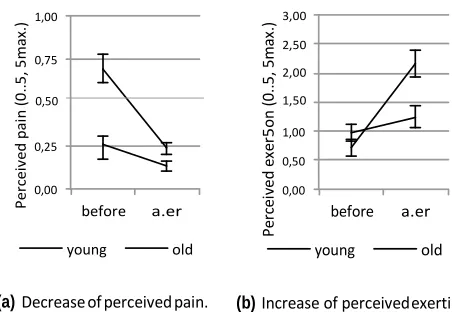
from P = .47 (SD = .65) to P = .18 (SD = .28). The decrease in pain is independent of the participants’ gender (V = .005, F(1, 60) = 19.308, p = .595 > .05, ns.), but related to age (V = .098, F(1, 60) = 6.492, p = .014 < .05, η2 = .098, sig.), as the perceived pain of older players decreases from .70 to .23 (−2.97×) and reaches the initial levels of younger players. Younger players’ perceived pain also decrease from .25 to .13 (−1.91×).
0,25 0,00
before a.er
young old
1,00 0,50 0,00
before a.er
young old
This decrease is illustrated in Figure 3a.
The perceived exertion increases significantly during the game (V = .190, F(1, 60) = 14.033, p < .01, η2 =
(a)Decrease of perceived pain. (b) Increase of perceived exertion.
.190, sig.). Again, this increase is not affected by gender (V = .011, F(1, 60) = .666, p = .418 > .05, ns.) but by age (V = .102, F(1, 60) = 6.789, p = .12 < .05, η2 = .102, sig.). On average, the perceived exertion increases from
.84 to 1.69 (2.01×). Older players’ exertion increases slightly from .97 to 1.22 (1.26×), while younger players’ exertion triples from .72 to 2.16 (3.00×). This is illustrated in Figure 3b.
6. Discussion
The study evaluated the influence of user factors on performance and acceptance of exergames in ambient assisted living environments and revealed expected findings but also some astonishing results.
It is no surprise that age decreases performance in exergames. Age is related with a decline in psycho- motoric abilities, which obviously negatively influences performance in (exercise) games, be they technology mediated or not. Gender also plays a minor role for performance, which is also consistent with research
Figure 3. Change of perceived exertion and perceived pain for older and younger users before and after the game.
that investigates gender differences in psycho-motoric performance. The influence of need for achievement on performance relates well with its theoretical background: Need for achievement influences the choice of and power within tasks; hence, it should also influence the performance in exercise games. No other considered factor plays a major and independent role for performance. Although high technical self-efficacy and high gaming-frequency are associated with higher performance, these factors are mediated by age.
That the performance decreases over the course of the levels is an expected finding as new fruits were introduced in the second and third level. Pears require a short rest and bananas demand additional cognitive and physical effort for the crosswise movement (see section 3); hence, the overall performance decreases with these newly introduced fruits.
Pe
rc
ei
ve
d
ex
er
5on
(0
..5,
5
ma
x.
A technical trifle is the finding that body height (if controlled by gender) does neither influence performance nor behavioral intention. Hence, the Kinect’s unusual mounting well above the player does not introduce any difficulties.
A person’s intention to use exergames is driven by three central aspects: The beliefe that playing the game can become a habit, the current gaming habits, and the perceived social influence.
The most important leverage for the successful adoption of serious exercise games in AAL is the individuals’ belief that they can make playing the game a habit. Hence, the introduction of serious exergames must be accompanied by measures that strengthen the belief in successful habituation, for example, by providing role models that successfully integrated regular exercises with these games into their life. Following Bandura’s self-efficacy theory [6], these role models will increase the individuals’ perceived control and, therefore, also their performance and endurance. Also, the smart living environment may use its intelligence to sense suitable moments for exercising and nudge its resident into playing the game.
The second strongest predictor for later use is gaming frequency. The revealed connection seems natural, yet this still contradicts a finding from an earlier iteration of the game: An earlier, but comparable, prototype was evaluated in a doctor’s office with a similar sample and absolutely no relationship between usage intention and gaming frequency was found [12]4. To resolve
this mystery, a followup study must be carried out that focuses on the modified factors. Specifically, we changed the context (doctor’s office vs. lab) and how and which potential subjects were addressed (a doctor asked patients to test the game5 vs. recruiting subjects
through personal networks and posters).
The third observed control for increasing the intention to use exergames is the perceived social influence by others and whether friends and family are perceived as being positively inclined towards these games. We believe that this factor can be successfully harnessed if games for multiple players are considered. In fact, collaborative and cooperative games have already been found to increase the likelihood of performing rather boring activities [64], and the opportunity to connect with friends, children, or grandchildren is considered an important aspect in meaningful play for elderly [19]. Based on the acceptance theories, we can expect that a sensible social embedding will increase the acceptance and later
4Here, the relationship between gaming frequency and intention to
use is (ρ(64 − 2) = .472, p < .01, sig.), whereas no relationship was found in the preceding study (ρ(70 − 2) = −.006, p = .959 > .05, ns.).
5Of course, without mentioning a medical indication.
use of these games. Actually, the current development branch of the game also supports colocated and distributed play and an early evaluation suggests that this has a positive effect on the players’ motivation and acceptance of serious exergames for elderly.
Surprisingly, even the performance expectation – i.e., the participant’s perception of the efficacy of the game – plays only a subordinate role for the usage intention and projected adoption. Also, the analysis indicates that the intention to use an exergame in ambient assisted living environments is independent from other user factors, such as age and gender, technical expertise, technical self-efficacy (if controlled for age), health consciousness, and the facets of the Five Factor Model (this finding is in line with our previous study). Most importantly, neither the need for achievement nor the attained performance within the game influences the usage intention. Hence, this and similar games will be accepted by people, at least if they have an inclination towards playing games. With “Cook it Right” we developed a second serious game that addresses the cognitive functioning of elderly [73] and it was also evaluate with the same research
framework as presented here. Although both games are utterly different in training domain (i.e., exercises vs. cognitive functioning), interaction paradigm (i.e., motion control vs. point-and-click interaction on multitouch displays), and game scenario (i.e., gardening vs. kitchen) the results were in general comparable, indicating their generalizability.
In conclusion, serious exercise games for health care in ambient assisted living environments are a viable solution for promoting physical fitness among elderly. This will positively influence their life quality through less or less severe chronic illnesses and the health- care systems will be strengthened to successfully meet the demographic change through reduced costs for caregiving.
7. Limitations and outlook
The study gives an insight into exergames for health care in ambient assisted living environments. It is limited insofar as the living lab is a current vision and prototypic implementation of how future ambient assisted living environments might be. Yet, the fast pace in research and development might lead to different scenarios. Also, the study captures the short term evaluation of the game and the gain in perceived health might fade after longer or more frequent interactions with the game. Hence, the findings must be re-validated in a long-term study.
players, which may lead to different and currently unexplored acceptance patterns.
The current study investigated a serious exergame in which a single player competed against the clock and therefore against his or her own ego. A different picture might emerge when multiplayer exergames are considered: The interaction between two or more players – either colocated or over a distance, synchronous or asynchronous – will certainly influence the acceptance of these games.
Acknowledgements. The authors thank all participants
for their willingness and enthusiasm to take part in the study and especially Barbara Brauner for recruiting several participants. We furthermore express our gratitude to Andreas Schäfer, who sedulously implemented the evaluated version of game; Anne Kathrin Schaar, André Calero Valdez and Hannah Marston for valuable research input; and Shirley Beul-Leusmann, Felix Heidrich, Kai Kasugai, Lars Klack, Christian Möllering, and Wiktoria Wilkowska for indispensable support in the eHealth lab. Furthermore, we thank Tatjana Hamann, Ralf Philipsen, Janina Schellartz, Chen Tao, Christopher Rausch, Martin Moss, Julian Hildebrandt, Michael Bertenburg, and Stephan Handschuh, who supported the development or evaluation of earlier iterations of the game. We are also grateful to Chantal “Sean” Lidynia for proof-reading and wrecktifying this article.
References
[1] Ahlskog, J. Eric et al. “Physical exercise as a preventive or disease-modifying treatment of dementia and brain aging.” In: Mayo Clinic proceedings. Mayo Clinic 86 (2011), pp. 876–884. issn: 00256196. doi: 10.4065/mcp. 2011.0252.
[2] Ajzen, Icek. “The Theory of Planned Behavior”. In:
Organizational behavior and human decision processes 50.2 (1991), pp. 179–211.
[3] Alagöz, F. et al. “From cloud computing to mobile
Internet, from user focus to culture and hedonism: The crucible of mobile health care and Wellness applications”. In: Pervasive Computing and Applications (ICPCA), 2010 5th International Conference on. Dec. 2010, pp. 38–45. doi: 10.1109/ICPCA.2010.5704072.
[4] Arning, Katrin and Ziefle, Martina. “Effects of age,
cognitive, and personal factors on PDA menu navigation performance”. In: Behaviour Information Technology 28.3 (2009), pp. 251–268. issn: 0144929X. doi: 10 . 1080 / 01449290701679395.
[5] Azevedo, Roger and Hadwin, Allyson F. “Scaffolding
self-regulated learning and metacognition - Implica- tions for the design of computer-based scaffolds”. In: Instructional Science 33.5-6 (2005), pp. 367–379. issn: 00204277. doi: 10.1007/s11251-005-1272-9.
[6] Bandura, Albert. “Self-efficacy: Toward a unifying
theory of behavioral change”. In: Psychological Review 84 (Mar. 1977), pp. 191–215.
[7] Beier, Guido. “Kontrollüberzeugungen im Umgang
mit Technik [Locus of control when interacting with technology]”. In: Report Psychologie 24.9 (1999), pp. 684–693.
[8]Beul, Shirley, Ziefle, Martina, and Jakobs, Eva Maria.
“It’s all about the medium: Identifying patients’ medial preferences for telemedical consultations”. In: Lecture Notes in Computer Science (including subseries Lecture Notes in Artificial Intelligence and Lecture Notes in Bioinformatics). Vol. 7058 LNCS. 2011, pp. 321–336.
isbn: 9783642253638. doi: 10.1007/978-3-642-25364-5\_23.
[9] Blais, Ann-Renée and Weber, Elke U. “A
Domain-Specific Risk-Taking (DOSPERT) scale for adult popu- lations”. In: Judgment and Decision Making Journal 1.1 (2006), pp. 33–47. issn: 19302975.
[10] Borg, Gunnar A. V. “Psychophysical Bases of Perceived
Exertion”. In: Medicine And Science in Sports and Exercise 14.5 (1982), pp. 377–381.
[11]Brauner, Philipp et al. “Increase Physical Fitness and
Create Health Awareness through Exergames and Gam- ification. The Role of Individual Factors, Motivation and Acceptance”. In: Proceedings of the SouthCHI 2013, LNCS 7946. Ed. by Holzinger, Andreas, Ziefle, Martina,
and Glavini, Vlado. Maribor, Slovenia: Springer-Verlag
Berlin Heidelberg, 2013, pp. 349–362.
[12]Brauner, Philipp et al. “The effect of tangible artifacts,
gender and subjective technical competence on teaching programming to seventh graders”. In: Proceedings of the 4th International Conference on Informatics in Secondary Schools (ISSEP 2010), LNCS 5941. Ed. by
Hromkovic, Juraj, Královiè, R., and Vahrenhold, J.
Zurich, Switzerland: Springer-Verlag Berlin Heidelberg, 2010, pp. 61–71. doi: 10 . 1007 / 978 3 642 11376 -5\_7.
[13] Busch, Tor. “Gender differences in self-efficacy and
attitudes toward computers”. In: Journal of Educational Computing Research 12 (1995), pp. 147–158.
[14] Butler, Shoshana et al. “A medical risk attitude
subscale for DOSPERT”. In: Judgment and Decision Making 7.2 (2012), pp. 189–195.
[15] Cook, Diane J., Augusto, Juan C., and Jakkula,
Vikramaditya R. “Ambient intelligence: Technologies,
applications, and opportunities”. In: Pervasive and Mobile Computing 5.4 (2009), pp. 277–298. issn: 15741192. doi: 10.1016/j.pmcj.2009.04.001.
[16] Cook, Diane J. and Das, Sajal K. “How Smart are our Environments? An Updated Look at the State of the Art”. In: Pervasive and Mobile Computing 3.2 (2007), pp. 53–73. issn: 15741192. doi: 10.1016/j.pmcj.2006. 12.001.
[17] Cooney, Gary M. et al. “Exercise for Depression.” In:
The Cochrane database of systematic reviews 9.9 (Jan. 2013). issn: 1469-493X. doi: 10 . 1002 / 14651858 . CD004366.pub6.
[18] Davis, Fred D. “Perceived Usefulness, Perceived Ease of
Use, and User Acceptance of Information Technology”. In: MIS Quarterly 13.3 (Sept. 1989), p. 319. issn: 02767783. doi: 10.2307/249008.
[19] De Schutter, Bob and Vandenabeele, Vero. “Meaning-
the International Communication Association "Communi- cating for Social Impact". 2008.
[20] Ebner, Martin and Holzinger, Andreas. “Successful
implementation of user-centered game based learning in higher education: An example from civil engineer- ing”. In: Computers & Education 49.3 (2007), pp. 873– 890.
[21] Fishbein, Martin and Ajzen, Icek. Belief, Attitude,
Intention and Behavior: An Introduction to Theory and Research. Reading, MA, USA: Addison-Wesley Publishing Company, Inc., 1975.
[22] Flores, Eletha et al. “Improving Patient Motivation in
Game Development for Motor Deficit Rehabilitation”. In: Proceedings of the 2008 International Conference in Advances on Computer Entertainment Technology - ACE ’08. Vol. 7. 2008, pp. 381–384. isbn: 9781605583938. doi: 10.1145/1501750.1501839.
[23] Gabrielli, Silvia et al. “Designing a Game-based
Solution for In-home Rehabilitation”. In: Proceedings of the 2nd International Congress on Neurotechnology, Electronics and Informatics (NEUROTECHNIX 2014). 2014, (in press).
[24] Gao, Yue and Mandryk, Regan L. “GrabApple: The
Design of a Casual Exergame”. In: The International Conference on Entertainment Computing (ICEC ’11). 2011, pp. 35–46.
[25]Gerling, Kathrin Maria, Schild, Jonas, and Masuch,
Maic. “Exergame design for elderly users: the case study of SilverBalance”. In: Proceedings of the 7th International Conference on Advances in Computer Entertainment Technology - ACE ’10. 2010, pp. 66–69.
isbn: 9781605588636. doi: 10.1145/1971630.1971650.
[26]Gerling, Kathrin et al. “Full-body motion-based game
interaction for older adults”. In: Proceedings of the 2012 ACM annual conference on Human Factors in Computing Systems - CHI ’12 (2012), pp. 1873–1882. doi: 10.1145/ 2207676.2208324.
[27] Giannakouris, Konstantinos. Ageing characterises the
demographic perspectives of the European societies. Tech. rep. EUROSTAT, 2008.
[28] Gould, John D. and Lewis, Clayton. “Designing for
Usability: Key Principles and what Designers Think”. In: Communications of the ACM 28 (1985), pp. 300–311. issn: 00010782. doi: 10.1145/3166.3170.
[29]Gschwind, Yves J. et al. “ICT-based system to predict
and prevent falls (iStoppFalls): study protocol for an international multicenter randomized controlled trial.” In: BMC Geriatrics 14.91 (Jan. 2014), pp. 1–13. issn: 1471-2318. doi: 10.1186/1471-2318-14-91.
[30] Heidrich, Felix et al. “Interacting with Smart Walls:
A Multi-Dimensional Analysis of Input Technologies for Augmented Environments”. In: Proceedings of the 2nd Augmented Human International Conference. AH ’11. New York, NY, USA: ACM, 2011, pp. 1–8. isbn: 978-1-4503-0426-9. doi: 10.1145/1959826.1959827.
[31] Ho, Kalon K. L. et al. “The Epidemiology of Heart
Failure: The Framingham Study”. In: Journal of the American College of Cardiology 22.4 (1993), A6–A13.
[32] Holzinger, Andreas, Röcker, Carsten, and Ziefle,
Martina. Smart Health - state-of-the-art and beyond.
Springer Lecture Notes in Computer Science 8700. Berlin Heidelberg: Springer, 2014. isbn: 978-1-4471-6412-8.
[33]Holzinger, Andreas, Searle, Gig, and Nischelwitzer,
Alexander. “On some Aspects of Improving Mobile
Applications for the Elderly”. In: Coping with Diversity in Universal Access, Research and Development Meth- ods in Universal Access, Lecture Notes in Computer Sci- ence (LNCS 4554). Ed. by Stephanidis, Constantine. Springer Berlin Heidelberg, 2007, pp. 923–932.
[34] Holzinger, Andreas, Searle, Gig, and Wernbacher,
Michaela. “The effect of Previous Exposure to Technol-
ogy (PET) on Acceptance and its importance in Usability Engineering”. In: Universal Access in the Information Society International Journal 10.3 (2011), pp. 245–260.
[35] Holzinger, Andreas et al. “Chances of Increasing
Youth Health Awareness through Mobile Wellness Applications”. In: HCI in Work and Learning, Life and Leisure, Lecture Notes in Computer Science, LNCS 6389. Ed. by Leitner, Gerhard, Hitz, Martin, and
Holzinger, Andreas. Springer Berlin Heidelberg, 2010,
pp. 71–81.
[36] Holzinger, Andreas et al. “Informatics as Semiotics
Engineering: Lessons Learned from Design, Develop- ment and Evaluation of Ambient Assisted Living Appli- cations for Elderly People”. In: Universal Access in Human-Computer Interaction. Context Diversity, Lecture Notes in Computer Science, LNCS 6767. Ed. by Stephani-
dis, Constantine. Lecture Notes in Computer Science.
Springer Berlin Heidelberg, 2011, pp. 183–192.
[37]Holzinger, Andreas et al. “Investigating Usability Met-
rics for the Design and Development of Applications for the Elderly”. In: 11th International Conference on Computers Helping People with Special Needs, Lecture Notes in Computer Science LNCS 5105. Springer Berlin Heidelberg, 2008, pp. 98–105.
[38] Holzinger, Andreas et al. “On the Generation of Point
Cloud Data Sets: the first step in the Knowledge Dis- covery Process”. In: Interactive Knowledge Discovery and Data Mining: State-of-the-Art and Future Challenges in Biomedical Informatics, Springer Lecture Notes in Com- puter Science LNCS 8401. Ed. by Holzinger, Andreas
and Jurisica, Igor. Berlin, Heidelberg: Springer, 2014,
pp. 57–80.
[39] Huizinga, Johan. Homo Ludens: A Study of the
Play-Element in Culture. Pantheon, 1939.
[40] Klack, Lars et al. “Integrated home monitoring and
compliance optimization for patients with mechani- cal circulatory support devices”. In: Annals of Biomed- ical Engineering 39.12 (2011), pp. 2911–2921. issn: 15216047.
[41] Kleinberger, Thomas et al. “Ambient Intelligence in
Assisted Living: Enable Elderly People to Handle Future Interfaces”. In: Universal Access to Ambient Interaction, Lecture Notes in Computer Science, LNCS 4555. Berlin, Heidelberg, New York: Springer Berlin Heidelberg, 2007, pp. 103–112.
[42] Kleinberger, Thomas et al. “Ambient Intelligence in
[43] Knight, Joseph A. “Physical Inactivity: Associated Diseases and Disorders”. In: Annals of Clinical & Laboratory Science 42.3 (2012), pp. 320–337.
[44]Lahlou, Saadi. “Identity, social status, privacy and face-
keeping in digital society”. In: Social Science Information 47.3 (2008), pp. 299–330. issn: 05390184. doi: 10.1177/ 0539018408092575.
[45]Law, E. L.-C. et al. “A Mixed-Method Approach on
Digital Educational Games for K12: Gender, Attitudes and Performance”. In: Human-Computer Interaction and Usability for e-Inclusion. 5th Symposium of the Austrian Computer Society, USAB 2009, Lecture Notes in Computer Science (LNCS 5889). Springer Berlin Heidelberg, 2009, pp. 42–54.
[46] Law, Effie Lai-Chong et al. “Challenges in the
Development and Evaluation of Immersive Digital Educational Games”. In: HCI and Usability for Education and Work, 4th Symposium of the Workgroup Human-Computer Interaction and Usability Engineering of the Austrian Computer Society, USAB 2008, Lecture Notes in Computer Science (LNCS 5298). Ed. by Holzinger, A.
Springer Berlin Heidelberg, 2008, pp. 19–30.
[47]Leusmann, Philipp et al. “Your Floor Knows Where you
are: Sensing and Acquisition of Movement Data”. In: Proceedings - IEEE International Conference on Mobile Data Management. Vol. 2. 2011, pp. 61–66. isbn: 9780769544366. doi: 10.1109/MDM.2011.29.
[48]Lewis, Gwyn N and Rosie, Juliet A. “Virtual Reality
Games for Movement Rehabilitation in Neurological Conditions: How do we Meet the Needs and Expec- tations of the Users?” In: Disability and Rehabilitation 34.22 (Jan. 2012), pp. 1880–1886. issn: 1464-5165. doi: 10.3109/09638288.2012.670036.
[49] Lindley, Siân E., Harper, Richard, and Sellen, Abigail.
“Designing for elders: exploring the complexity of relationships in later life”. In: Proceedings of the 22nd annual conference of the British HCI Group (HCI 2008). 2008, pp. 77–86. isbn: 978-1-906124-04-5. doi: 10 .
1080/13607860902774485.
[50]Macvean, Andrew and Robertson, Judy. “Understand-
ing exergame users’ physical activity, motivation and behavior over time”. In: CHI ’13 Proceedings of the SIGCHI Conference on Human Factors in Computing Sys- tems. 2013, pp. 1251–1260. isbn: 9781450318990.
[51]Mann, Charles C. “Public health – Provocative study
says obesity may reduce US life expectancy”. In: Science 307.5716 (2005), pp. 1716–1717.
[52]McCrae, Robert R. and John, Oliver P. “An Introduc-
tion to the Five-Factor Model and its Applications”. In: Journal of Personality 60.2 (1992), pp. 175–215. issn: 0022-3506. doi: 10.1111/j.1467-6494.1992.tb00970. x.
[53] McMorris, Terry et al. “Acute, intermediate intensity
exercise, and speed and accuracy in working memory tasks: a meta-analytical comparison of effects.” In: Physiology & behavior 102 (2011), pp. 421–428. issn: 00319384. doi: 10.1016/j.physbeh.2010.12.007.
[54] Meyer, Sibylle and Mollenkopf, Heidrun. “Home
Technology, Smart Homes, and the Aging User”. In: Aging Independently: Living Arrangements and Mobility (2003). Ed. by Schaie, K.W. et al., pp. 148–161.
[55] Michael, David and Chen, Sande. Serious Games:
Games That Educate, Train and Inform. Thomson Course Technology, 2006. isbn: 9781592006229.
[56] Miesenberger, K. et al. “More Than Just a Game:
Accessibility in Computer Games”. In: Hci and Usability for Education and Work, Proceedings. Vol. 5298. Lecture Notes in Computer Science. Springer Berlin Heidelberg, 2008, pp. 247–260.
[57] Mukasa, Kizito Ssamula, Holzinger, Andreas, and
Karshmer, Arthur. Intelligent User Interfaces for
Ambient Assisted Living. Stuttgart: Fraunhofer IRB Verlag, 2008.
[58]Mynatt, Elizabeth D. and Rogers, Wendy A. “Devel-
oping Technology to Support the Functional Indepen- dence of Older Adults”. In: Ageing International 27.1 (2001), pp. 24–41. issn: 01635158. doi: 10 . 1007 / s12126-001-1014-5.
[59]Oeppen, Jim and Vaupel, James W. “Demography –
Broken Limits to Life Expectancy”. In: Science 296.5570 (2002), pp. 1029–+.
[60] Premack, David. “Toward empirical behavior laws: I.
Positive reinforcement”. In: Psychological Review 66.4 (1959), pp. 219–233.
[61] Raisinghani, Mahesh S. et al. “Ambient intelligence:
Changing forms of human-computer interaction and their social implications”. In: Journal of Digital Informa- tion 5.4 (2006). issn: 13687506.
[62] Röcker, Carsten, Ziefle, Martina, and Holzinger,
Andreas. “Social Inclusion in AAL Environments:
Home Automation and Convenience Services for Elderly Users”. In: CSERA Press, 2011, pp. 55–59.
[63] Satow, Lars. “B5T. Psychomeda
Big-Five-Persönlichkeitstest. Skalendokumentation und Normen sowie Fragebogen mit Instruktion”. In: Leibniz-Zentrum für Psychologische Information und Dokumentation (ZPID)(Hrsg.), Elektronisches Testarchiv. Available at: http://www.zpid.de/index. php (2011).
[64] Schäfer, Andreas et al. “From boring to scoring a
collaborative serious game for learning and practicing mathematical logic for computer science education”. In: Computer Science Education 23.2 (Apr. 2013), pp. 87– 111. issn: 0899-3408. doi: 10 . 1080 / 08993408 . 2013 . 778040.
[65] Schuler, Heinz and Prochaska, Michael. LMI: Leis-
tungsmotivationsinventar [Need for Achievement Inven- tory]. Hogrefe, 2001.
[66] Sinclair, Jeff, Hingston, Philip, and Masek, Martin. “Considerations for the design of exergames”. In: Proceedings of the 5th International Conference on Computer Graphics and Interactive Techniques in Australia and Southeast Asia - GRAPHITE ’07. 2007, pp. 289–295.
isbn: 9781595939128. doi: 10.1145/1321261.1321313.
[67]Varkey, Emma et al. “Exercise as migraine prophylaxis:
A randomized study using relaxation and topiramate as controls”. In: Cephalalgia. An International Jounral of Headache 31.14 (2011), pp. 1428–1438. issn: 0333-1024.
doi: 10.1177/0333102411419681.
[68] Venkatesh, Viswanath, Thong, James Y. L., and Xu, Xin.
and Use of Technology”. In: MIS Quarterly 36.1 (2012), pp. 157–178.
[69] Weiser, Mark. “The Computer for the 21st Century”.
In: Scientific American 265 (1991), pp. 94–104. issn: 15591662. doi: 10.1145/329124.329126.
[70]Weisman, Shulamith. “Computer games for the frail
elderly.” In: The Gerontologist 23.4 (1983), pp. 361–363.
issn: 0016-9013. doi: 10.1093/geront/23.4.361.
[71] Wilkowska, Wiktoria and Ziefle, Martina. “Privacy
and Data Security in E-health: Requirements from the User’s Perspective”. In: Health Informatics Journal 18.3 (2012), pp. 191–201. issn: 1460-4582. doi: 10 . 1177 / 1460458212442933.
[72] Willey, Joshua Z. et al. “Lower prevalence of silent
brain infarcts in the physically active: the Northern Manhattan Study.” In: Neurology 76.24 (June 2011), pp. 2112–2118. issn: 1526-632X. doi: 10 . 1212 / WNL . 0b013e31821f4472.
[73] Wittland, Jan, Brauner, Philipp, and Ziefle, Mar-
tina. “Serious Games for Cognitive Training in Ambient
Assisted Living Environments - A Technology Accep- tance Perspective”. In: Proceedings of the 15th INTER- ACT 2015 Conference. 2015, (in press).
[74] Ziefle, Martina, Roecker, Carsten, and Holzinger,
Andreas. “Perceived usefulness of assistive technolo-
gies and electronic services for ambient assisted living”. In: IEEE, May 2011, pp. 585–592. isbn: 978-1-61284-767-2.
[75] Ziefle, Martina et al. “A Multi-Disciplinary Approach
to Ambient Assisted Living”. In: E-Health, Assistive Technologies and Applications for Assisted Living: Chal- lenges and Solutions (2011). Ed. by Röcker, Carsten and
Ziefle, Martina, pp. 76–93. doi: 10 . 4018 / 978 1
-60960-469-1.ch004.
[76] Zimmer, Zachary and Chappell, Neena L. “Receptivity