NETWORK ANALYSIS IN SMALL-SIDED AND
CONDITIONED SOCCER GAMES: THE INFLUENCE
OF ADDITIONAL PLAYERS AND PLAYING POSITION
Gibson Moreira Praça¹, Filipe Manuel Clemente
2,3, André Gustavo Pereira de Andrade¹,
Juan Carlos Perez Morales¹, and Pablo Juan Greco¹
1
Universidade Federal de Minas Gerais, Belo Horizonte, Minas Gerais, Brazil
2Instituto Politécnico de Viana do Castelo, Escola Superior de Desporto e Lazer,
Melgaço, Portugal
3
Instituto de Telecomunicações, Delegação da Covilhã, Portugal
Original scientific paper UDC: 796.332:796.08
Abstract:
The purpose of this article was to investigate the influence of additional players and playing position on the network properties during 2x4 minutes small-sided and conditioned games (SSCG) in soccer. Eighteen young soccer players (age 16.4±0.7 years), six defenders, six midfielders, and six forwards, voluntarily participated in SSCGs with different task conditions (4vs.3, with an additional player inside the pitch, 3vs.3+2, with two support players at the side of the pitch, and 3vs.3, numerical equality). General (density, total links and clustering coefficient) and individual (degree centrality, degree prestige, and page rank) network properties were analyzed using the SocNetV® software. Results showed higher values of density (F=59.354, p=.001), total links (F=40.951, p=.001), and clustering coefficient (F=21.851, p=.001) during the 4vs.3 SSCG. Besides, midfielders showed higher values of degree centrality than defenders and forwards (F=10.669, p=.001). Midfielders and forwards also showed higher values of degree prestige than defenders (F=5.527, p=.005). These results indicate that both task condition and playing position influence general and individual network properties during SSCGs. For this reason, it is suggested that both task condition and team composition need to be adjusted to the coaches’ purpose for each training session in order to maximize the possibilities of cooperation among the teammates.
Key words: graph theory, network analysis, task constraints, small-sided games, soccer
Introduction
Soccer players’ performance is not solely deter-mined by their individual characteristics, but it is also conditioned by the opposition-cooperation rela-tionship between teammates and opponents during the game (Gréhaigne & Bouthier, 1997). Research suggests that optimal levels of cooperation among teammates increase the chances of winning soccer games (David & Wilson, 2015). In this way, the understanding of interactions among players and the proposition of training means to stimulate their cooperative behavior are relevant to soccer training.
Small-sided and conditioned games (SSCG) allow the integration of technical, tactical, physical, physiological, and psychological demands (Aguiar, Botelho, Lago, Maças, & Sampaio, 2012). In addi-tion, they reproduce unpredictability, randomness, and complexity of the formal match (Travassos,
Vilar, Araújo, & McGarry, 2014). These character-istics require adjustments of decision-making in a context where players are searching for cooperation (teammates) and opposition (opponents) in a way similar to the formal match (Gréhaigne & Bouthier, 1997). Whereas players’ individual performance reflect the level of cooperation among teammates (David & Wilson, 2015), it is expected that the use of SSGC will improve cooperation patterns between players during the formal match.
macro level (structure of the network) and also the identification of the prominence levels of specific players during the cooperation process (micro level of analysis) (Clemente, Martins, Kalamaras, Wong, & Mendes, 2015a; Gama, Vaz, Davids, Santos, Figueiredo, & Dias, 2014; Peña & Touchette, 2012). Previous studies with official matches suggested that greater values of network density and homoge-neity in cooperation were associated with the best performances (Clemente, Couceiro, Martins, & Mendes, 2014; Duch, Waitzman, & Amaral, 2010; Grund, 2012). Moreover, it has also been found that midfielders and external defenders are prominent players during the attack building and during the attack ball circulation, although greater values of degree centrality have been found for forwards in specific teams that act in counter-attack (Clemente, et al., 2015a). All of these studies were conducted on formal matches and no network analysis was carried out in small-sided and conditioned games, as far as we know. Few studies that have considered collec-tive organization in SSCGs are based on obser-vational analysis and tactical behaviour (Teoldo, Garganta, Greco, Mesquita, & Seabra, 2010; Praça, Folgado, Andrade, & Greco, 2016). Nevertheless, the conditions used in SSCGs may constrain inter-actions among teammates and the social network analysis fit for the main goal to determinate the cooperation level (Grund, 2012).
Some studies have investigated the influence of varying number of players on players’ behavior during SSCG with numerical equality (Aguiar, Gonçalves, Botelho, Lemmink, & Sampaio, 2015). Notwithstanding, during the formal match, a momentary imbalance in the number of players in each team might occur, creating a situation of numerical superiority for one of the teams. Each team strives to create this imbalance near the ball (Hill-Haas, Coutts, Dawson, & Rowsell, 2010), which is a key principle to achieve the goal of the game. Numerical superiority situations can be partially reproduced during SSCG with additional players inside the playing area (Hill-Haas, et al., 2010) or at the sides of the playing area (Dellal, et al., 2008), task settings that might induce the appearance of different behaviors (Praça, et al., 2016).
Moreover, studies on soccer report specific behaviors according to players’ playing posi-tion (i.e. defender, midfielder, forward) (Bush, Barnes, Archer, Hogg, & Bradley, 2015; Di Salvo, et al., 2007). Although previous investigations on SSCG consider the playing position as a vari-able of team composition (Casamichana, Román-Quintana, Calleja-González, & Castellano, 2013; Dellal, et al., 2012), there is a scarce knowledge on the possible influence this variable might have on players’ behaviors. It is suggested that the specific knowledge acquired by a player during the training
process in a certain playing position (Kannekens, Elferink-Gemser, & Visscher, 2011) results in different behaviors during the SSCG, including the cooperation patterns established among players to achieve the game’s goals. In addition, given the specificity of the playing position of the floaters (Clemente, Martins, Mendes, & Campos, 2015b; Praça, Custódio, & Greco, 2015), it is suggested that these players might present behaviors different from others and/or alter the cooperation patterns of the teams.
Although previous research has presented broad knowledge on the use of floaters during SSCG, a lack of investigation on the possible alterations in the interactions and cooperation patterns among teammates, being a consequence of the use of these floaters, limits the use of this SSCG to develop behavior patterns transferable to the formal match. Besides, scarce information about the behavioral specificities of players according to their playing position during SSCG limits the knowledge of its potential to develop skills related to each position. In this sense, this study aims to compare network properties of SSCG in task conditions with numer-ical equality and with additional floater players, and to compare prominence levels of players from different playing positions – defenders, midfielders, and forwards – and their functions – regular players and floater players – during these SSCG.
Methods
Participants
Non-probabilistic sampling was used for the selection of the sample. Eighteen U-17young male soccer players (age: 16.4±0.7 years), members of the team participating in the national and feder-ated competitions, with a mean experience of 4.2 years in the youth academy, were selected. Players were selected considering their positional roles, excluding those who usually play in more than one position (e.g., midfielders that usually play as forwards). Athletes with recent injuries (last two months) were also excluded. The standard training schedule consisted of 6-8 sessions per week (with an approximate duration of 90 min), in addition to one competitive game per week. The Ethics Committee of the Federal University of Minas Gerais (Protocol No. 29215814.8.0000.5149) approved this study. All participants and their legal guardians provided free informed consent. The players, their parents and coaches agreed with the protocol description and were notified that they could withdraw from the study at any moment. This study followed the guidelines of the Declaration of Helsinki.
Procedures
Morales, 2014) was carried out to stratify players into levels according to their procedural tactical knowledge and to create balanced teams. The test encompassed a four-minute game between two teams with 3-a-side. The aim of the game, for the team in ball possession, is to make as many passes as possible, while the defending team tries to recover the ball. To perform the PTKT, athletes were divided into three groups of six athletes in the same playing position (e.g. six midfielders). Each of these groups was randomly divided into two teams (e.g. three midfielders each). These two teams played two games against each other. All games were filmed using a digital camera positioned five meters above the ground from a diagonal perspec-tive. Two observers, experts in the PTKT, classified the athletes into levels of procedural tactical know-ledge, based on the count of the following tactical actions: (1) “Player moves around the playing area to receive the ball” (attacker without the ball); (2) “Player passes the ball to a free teammate and prepares to receive the ball again” (attacker with the ball); (3) “Player supports his teammates in defense (defensive coverage) when they are overcome by the opponent” (defender marking an opponent without the ball); (4) “Player supports a teammate in defense when the opponent has difficulty to control the ball” (player marking an opponent without the ball); and (5) “Player induces the opponent to the corners of the playing area” (player marking the opponent with the ball). The Cohen’s kappa coefficient presented satisfactory values of 0.844 and 0.806 for intra- and inter-observer reliability, respectively. To calcu-late Cohen’s kappa coefficient, 22.2% (n=4) of the athletes (Tabachnick & Fidell, 2007) were reevalu-ated by the observers 21 days after the end of anal-ysis (Robinson & O’Donoghue, 2007).
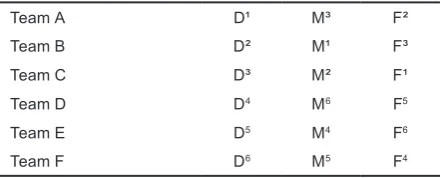
Finally, players were divided into six teams (Table 1). Each team was composed of a defender, a midfielder, and a forward. The three best players of each playing position, according to the Proce-dural Tactical Knowledge test, were assigned to teams A, B, and C, while the three players with the worst performance on the PTKT were assigned to teams D, E, and F. Teams composed of athletes with higher tactical knowledge did not play against teams composed of athletes with lower tactical
knowledge in order to avoid the influence of the opponent’s level on game performance (Folgado, Duarte, Fernandes, & Sampaio, 2014).
After these procedures, players were famil-iarized with the SSCGs with additional “floater” players (on the field and as supporting players at the sides of the field) during the first week. In weeks 2-4, players performed the SSCGs with numerical equality (3vs.3), with support players at the sides of the playing field (3vs.3+ 2), and with an additional “floater” player inside the playing field (4vs.3) three times a week, with an interval of at least 48 hours between them. All SSCG were played in the same pitch, on a natural grass turf, at the same time of the day to standardize the circadian rhythm effects (Drust, Watherhouse, Atkinson, Edwards, & Reilly, 2005). All rules of the formal match, including the offside, were adopted. In all conditions, the team purpose was to score as many goals as possible in a reduced soccer goal (5m x 2m) defended by a goal-keeper. The order of the task conditions was rand-omized and balanced throughout the research, in order to ensure that all the teams play against each other the same number of times in all protocols and to distribute different task conditions along the data collection period. No tactical orientation was established neither at the beginning nor during the SSCG.
Each session started with a fifteen-minute standard warm-up, composed of typical soccer movements, such as accelerations with/without the ball, changes of direction, and jumps. After the warm-up, two four-minute bouts of one of the task conditions were carried out, separated by four minutes of passive recovery (1:1 work/rest ratio). Network analysis
This study followed an observational protocol of a network analysis based on weighted digraphs. In any team sport, the direction of the pass matters and the volume of the passes is also determinant information of the team’s dynamics (Clemente, Martins, & Mendes, 2016; Peña & Touchette, 2012). For that reason, the adjacency matrix used for each observational process followed the recommenda-tions for weighted digraphs analysis (Clemente, et al., 2016). An adjacency matrix was built per unit of attack analyzed (a passing sequence without loss of the ball) (Passos, et al., 2011). A value of 0 (zero) was codified for the case of no passes between the teammates. Complementary, the volume of passes made in the same direction (e.g. two passes from player A to player B and three passes from player B to player A) in a unit of attack was used to codify the relationship between dyads. In the end of each game, a total adjacency matrix was computed (sum of all units of attack that occurred in the game).
An adjacency matrix per each game was obtained and then was processed in Social Network Table 1. Team composition
Team A D¹ M³ F²
Team B D² M¹ F³
Team C D³ M² F¹
Team D D4 M6 F5
Team E D5 M4 F6
Team F D6 M5 F4
Visualizer (SocNetV 1.9), which is a software to visualize and analyze graphs and digraphs in the social network analysis. Two analyses were conducted in our study: i) analysis of the digraph’s structure (general properties of the group); and ii) analysis of the centrality characteristics of players (prominence level of each player in the group). Total links, network density, and clustering coefficient of the group were used as general measures of the network. Degree centrality, degree prestige, and page rank were used as centrality measures of the players’ prominence during the units of attack. General properties of the network
Total links
The total links measure can be defined as the absolute and non-repeated number of the total inter-actions conducted between teammates during a match (Clemente, et al., 2016). Greater values repre-sent a stronger cooperation among the teammates.
Network density
Network density measures overall affection between teammates and represents proportion of the maximum possible links between nodes (Clemente, et al., 2016). Values vary between 0 (no density) and 1 (maximal density and affection).
Clustering coefficient
This measure quantifies how close a player and teammates in a graph are to become a clique, thus in team sports it is possible to observe a higher average clustering coefficient compared to random networks, which proves their clustering nature (Peña & Touchette, 2012).
Centrality measures Degree centrality
This measure quantifies frequency of passes made by a player to teammates. It can be defined as a measure of overall activity during attacking units. Values vary between 0 (no activity) and 1 (maximal and exclusive activity in the network). Players with higher centrality are connected to more teammates than those with lower centrality (Clem-ente, et al., 2016).
Degree prestige
This measure quantifies volume of passes received by a player. Values vary between 0 (no activity) and 1 (maximal and exclusive prestige in the network). A higher centrality score of a player indicates that this player is more prestigious or important among the teammates (Clemente, et al., 2016).
Page rank
In this metric, probability p can be replaced by player-dependent probabilities pi, which would
make more sense if certain players are more likely to keep the ball than the others (Clemente, et al., 2016). Values vary between 0 (no centrality) and 1 (maximal and exclusive popularity in the network). Data analysis
Assumptions of normality (Shapiro-Wilk’s test), homocedasticity (Levene’s test) and sphe-ricity (Mauchly’s test) were verified and no devia-tions of normality and homocedasticity were found. Greenhouse-Geisser corrections were used for the repeated measures situations when deviations from sphericity were identified.
The influence of the factors ‘task condition’ and ‘playing position’ on the degree centrality, degree prestige and page rank were analyzed using a two-way ANOVA (with repeated measures contrast in the factor task condition). Tukey’s post-hoc was used to identify significant differences. The effect size h²p and the confidence interval (95%) were
also calculated. The effect size was classified as no effect (h²p<0.04), minimum effect (0.04 <h²p<0.25),
moderate effect (0.25 <h²p<0.64) and, strong effect
(h²p>0.64) (Ferguson, 2009).
A one-way ANOVA with repeated measures and Tukey’s post-hoc was used to identify the influ-ence of the task condition on the density, total links, and clustering coefficient and to compare the degree centrality, degree prestige, and page rank between floaters and the other players. The effect size h²p
partial and the confidence interval (95%) were also calculated. The effect size was stratified in the same way as presented earlier.
In the task condition 4vs.3, the independent t-test was used to verify the influence of the anal-ysis of density, total links, and clustering coefficient with and without the floaters. The Cohen’s d effect size and the confidence interval (95%) were also calculated. The effect size was considered trivial (d<0.2), small (0.2<d<0.6), moderate (0.6<d<1.2), large (1.2<d<2.0), very large (2.0<d<4.0), or nearly perfect (4.0<d) (Cohen, 1988).
All analyses were performed using the software SPSS 20.0. Only the effect size was calculated using the software GPower 3.17 (Beck, 2013). The level of significance was set at 0.05.
Reliability
Results
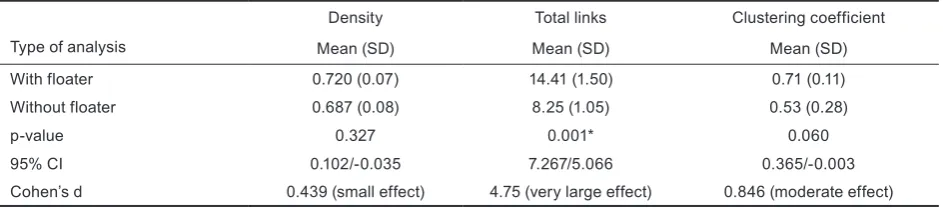
The following tables present the results of this study. Firstly, general network properties are described and compared inthe different task conditions (Table 2). The general network properties were also analyzed including and excluding the additional floater player during the 4vs.3 SSCG (Table 3).
Higher values were observed for density (F=59.354, p=.001, strong effect) and total links (F=40.951, p=.001, strong effect) in the 4vs.3 game compared to the 3vs.3 and 3vs.3+2 task conditions. Lower values were observed of clustering coeffi-cient during the 3vs.3+2 game compared to the other task conditions (F=21.851, p=.001, moderate effect). Besides, the network properties in the anal-ysis with and without the additional floater player revealed higher values of total links in the condi-tion with the floater (T=11.621, p=.001, very large
effect), indicating that presence of this player influ-enced the cooperation during SSCGs.
Tables 4 and 5 show the centrality measures considering the factors task condition (3vs.3, 4vs.3, and 3vs.3+2 – Table 4) and playing position (defender, midfielder and forward – Table 5). No factor interaction was reported for degree centrality (F=0.767, p=.548), degree prestige (F=1.835, p=.128), or page rank (F=1.340, p=.260).
The 4vs.3 game presented lower values of degree centrality (F=6.419, p=.002, minimum effect), degree prestige (F=18.934, p=.001, moderate effect), and page rank (F=40.722, p=.001, moderate effect). This indicates that in this task condition the players were more homogeneous and cooperative, as opposed to the more individual behavior showed in the 3vs.3 and 3vs.3+2 conditions, which were char-acterized by higher values in the centrality meas-ures. Besides, midfielders showed higher values
Table 2. General network analysis of different SSCG
SSCG
Density Total links Clustering coefficient Mean (SD) 95% CI Mean (SD) 95% CI Mean (SD) 95% CI 3vs.3 0.7 ³ (0.06) 0.744-0.657 8.41 ²,³ (0.79) 9.405-7.428 0.722 ³ (0.05) 0.776-0.669 4vs.3 0.72 ³ (0.07) 0.764-0.678 14.41 ¹ (1.50) 15.405-13.428 0.719 ³ (0.11) 0.772-0.666 3vs.3+2 0.427 ¹,² (0.07) 0.471-0.385 12.83 ¹ (2.36) 13.822-11.845 0.509 ¹.² (0.09) 0.562-0.456
p-value 0.001 0.001 0.001
ES 0.782 (strong effect) 0.713 (strong effect) 0.57 (moderate effect) Note. SSCG – small-sided and conditioned game; ES – effect size; SD – standard deviation; ¹ – different from 3vs.3; ² – different from 4vs.3; ³ – different from 3vs.3+2.
Table 3. General network analysis with and without floaters in the 4vs.3 SSCG
Type of analysis
Density Total links Clustering coefficient
Mean (SD) Mean (SD) Mean (SD)
With floater 0.720 (0.07) 14.41 (1.50) 0.71 (0.11)
Without floater 0.687 (0.08) 8.25 (1.05) 0.53 (0.28)
p-value 0.327 0.001* 0.060
95% CI 0.102/-0.035 7.267/5.066 0.365/-0.003
Cohen’s d 0.439 (small effect) 4.75 (very large effect) 0.846 (moderate effect) Note. SD – standard deviation; * – significant differences.
Table 4. Individual network analysis of different SSCG
SSCG
Degree centrality Degree prestige Page rank Mean (SD) 95% CI Mean (SD) 95% CI Mean (SD) 95% CI 3vs.3 29.14 ² (8.02) 31,584-26.967 33.02 ²,³ (7.21) 35.218-30.829 31.11 ²,³ (2,92) 32309-29.926 4vs.3 22.91 ¹,³ (8.21) 25,362-20.475 23.57 ¹,³ (7.03) 25.774-21.384 23.93 ¹ (3,83) 25.121-22.738 3vs.3+2 26.49 ² (5.66) 28,934-24.047 29.93 ¹,² (5.54) 32.134-27.745 25.21 ¹ (4,35) 26.404-24.022
p-value 0.002 0.001 0.001
of centrality degree than defenders and forwards (F=10.669, p=.001, minimum effect). Midfielders and forwards also showed higher values of degree prestige than defenders (F=5.527, p=.005, minimum effect). These results indicate the prominent level of midfielders when playing SSCGs.
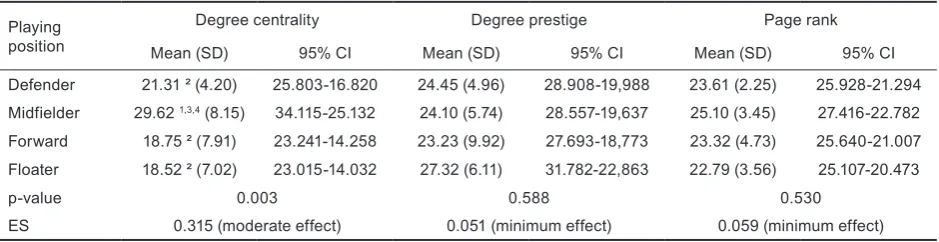
Lastly, Table 6 shows the comparison of centrality measures between players from different playing positions and floater players during the 4vs.3 game. Results indicate higher values of degree centrality for the midfielders than for the other posi-tions (F=5.521, p=.003, moderate effect).
Discussion and conclusions
This study aimed to analyze general network properties of small-sided and conditioned soccer games with additional floater players and the centrality properties of players from different playing positions. The results showed that both (task condition and playing position) had influence on the network properties. Specifically, cooperation was increased during 4vs.3 SSCG, and midfielders showed greater prominence levels.
Previous studies have showed that successful teams present the highest levels of network density, total links, and clustering coefficient (Clemente, et al., 2015a; Cotta, et al., 2013; Peña & Touchette, 2012). Since the ability to increase connections among all teammates results in excellent overall team performance in a tournament (Clemente, et al., 2014; 2015a), it is an important goal of the
training process to provide players with conditions in which they can increase their cooperation in order to achieve team targets (such as goal scoring and keeping ball possession). Our results revealed that 3vs.3 SSCG with no floaters had statistically greater values of network density and clustering coefficient than similar format with floaters. On the other hand, the opposite evidences were found in the 4vs.3 formats. It should be considered that the 3vs.3 SSCG represent a balanced format and the use of floaters increase the number of choices for the on ball player, thus reducing the macro levels. On the other hand, in the case of the 4vs.3 SSCG, the floater may help to increase balance in ball circula-tion for the team in numerical disadvantage; such increase in ball circulation may promote a raise in the individual participation in the attack building. We may hypothesize that for balanced games the use of floaters may increase heterogeneity and can be interesting for the development of specific phases of the game (such as transitions), but it is not appropriate for the improvement of ball circulation and overall participation of teammates during the attack building. Previous studies have shown that in situations with additional players, the context of action demands different decision-making from the defending team (Travassos, et al., 2014). In these games, players must coordinate their defen-sive actions in order to protect the most vulner-able areas of the pitch, namely those near to their own goal (Praça, et al., 2016). In response, during Table 5. Individual network analysis of different playing positions
Playing position
Degree Centrality Degree prestige Page rank Mean (SD) 95% CI Mean (SD) 95% CI Mean (SD) 95% CI Defender 23.25 ² (6.30) 25.641-20.894 26.05 ³ (6.40) 28.493-23.623 26.06 (4.84) 27.637-24.480 Midfielder 30.59 ¹,³ (7.31) 32.953-28.233 28.66 ³ (6.07) 31.096-26.226 27.00 (4.81) 28.586-25.429 Forward 24.70 ² (7.72) 27.062-22.342 31.82 ¹,² (9.21) 34.258-29.388 27.19 (4.98) 28.772-25.615
p-value 0.001 0.005 0.356
ES 0.194 (minimum effect) 0.138 (minimum effect) 0.021 (no effect)
Note. ES – effect size; SD – standard deviation; ¹ – different from defenders; ² – different from midfielders; ³ – different from forwards.
Table 6. Individual network analysis of floaters and regular players in 4vs.3 SSG
Playing position
Degree centrality Degree prestige Page rank Mean (SD) 95% CI Mean (SD) 95% CI Mean (SD) 95% CI Defender 21.31 ² (4.20) 25.803-16.820 24.45 (4.96) 28.908-19,988 23.61 (2.25) 25.928-21.294 Midfielder 29.62 1,3,4 (8.15) 34.115-25.132 24.10 (5.74) 28.557-19,637 25.10 (3.45) 27.416-22.782 Forward 18.75 ² (7.91) 23.241-14.258 23.23 (9.92) 27.693-18,773 23.32 (4.73) 25.640-21.007 Floater 18.52 ² (7.02) 23.015-14.032 27.32 (6.11) 31.782-22,863 22.79 (3.56) 25.107-20.473
p-value 0.003 0.588 0.530
the attack, players must improve ball circulation in order to create opportunities to score goals, thus increasing formal interaction between teammates. In this context, the cooperation levels are increased in a response to the behavior of the defending team that acts in a block closer to their goal, allowing more space for the team with the ball to pass in along the 2nd third of the field. This rationale
reveals potential benefits of task conditions with additional players, used to increase the coopera-tion levels between teammates. Nevertheless, the non-existence of comparative studies makes it diffi-cult to confirm such evidence and, for that, future studies should compare the network macro levels and complementary tactical metrics between match and SSCG in both phases of the match, transition and ball circulation.
Moreover, the influence of playing position on the game demands has been previously reported in literature (Bush, et al., 2015; Di Salvo, et al., 2007). Although the training process must consider the technical, tactical, physical, and physiological specific demands of the playing position (Bush, et al., 2015; Gonçalves, Figueira, Maças, & Sampaio, 2014; Mallo, Mena, Nevado, & Paredes, 2015), few studies have considered specific behaviors that players in different playing positions can adopt during different training activities, SSCGs. In this sense, results showed higher prominence levels for midfielders in relation to the other positional roles and floater players, indicating that midfielders are commonly targeted during the offensive phase, regardless of the task condition. During the formal match, the main role of these players is to control the pitch’s center by effective inter-player spacing (Kannekens, et al., 2011), by advancing and keeping the ball and creating passing possibilities to all directions (Gonçalves, et al., 2014). Our results revealed that midfielders were the most prominent players during the attack building (greater value of degree centrality), however greater values of prestige were observed in forwards. These interesting find-ings can be compared to previous results on formal matches. In the case of the attack building with ball circulation, values of formal matches revealed that midfielders are the most prominent in receiving and passing the ball (prestige and degree centrality, respectively) (Clemente, et al., 2015a). Nevertheless, in attack transitions (counter-attack) forwards are the most prominent in receiving (prestige) (Malta & Travassos, 2014). Thus, it can be suggested that some of the formats applied in our study lead to an increase of participation in forwards, thus possibly promoting specific situations similar to quick tran-sitions or counter-attacks. Results are also in line with literature and for that reason it is possible to indicate that the task conditions used in the present study represent tactical demands similar to formal match in relation to the playing position specificities.
This study has some limitations, mainly related to the team composition criteria adopted during the task conditions. As previously shown in literature, the team composition criteria can potentially change the demands during small-sided games (Köklü, Ersöz, Alemdaroglu, Asxcxi, & Özkan, 2012). In the current study, players were assigned to a team based on their tactical skills and playing position. Considering that players with different positional roles in the formal match may have specific behav-iors during both the game (Bush, et al., 2015) and small-sided and conditioned games (as shown in this article), it is possible to speculate that changing the team composition criteria (e.g. assigning three defenders to the same team) can modify athletes’ behavior, including the cooperative patterns. For that reason, future studies must consider different team composition criteria in order to allow a better understanding of athletes’ cooperative behavior during soccer SSCGs. Besides, since the current results were obtained in SSCG, future studies can also take place in formal game situations.
As regards practical applications, it is suggested that the task condition must be adjusted to the coaches’ purpose for each training session. If the main purpose is to allow players to experience cooperative behaviors in order to achieve the game objectives (e.g. scoring a goal, keeping ball posses-sion or recovering the ball), the 4vs.3 condition appears to be more suitable. On the other hand, tasks with a condition of numerical equality between the teams (e.g. 3vs.3) and with support players on the sides of the field (3vs.3+2) can be more suitable if the coaches’ main purpose is to develop individual behaviors, namely those related to the attacker-defender dyad, for example the management of the interpersonal distance (Headrick, et al., 2012).
References
Aguiar, M., Botelho, G., Lago, C., Maças, V., & Sampaio, J. (2012). A review on the effects of soccer small-sided games. Journal of Human Kinetics, 33(1), 103-113.
Aguiar, M., Gonçalves, B., Botelho, G., Lemmink, K., & Sampaio, J. (2015). Footballers’ movement behaviour during 2-, 3-, 4- and 5-a-side small-sided games. Journal of Sports Sciences, 33(12), 1259-1266.
Beck, T.W. (2013). The importance of a priori sample size estimation in strength and conditioning research. Journal
of Strength and Conditioning Research, 27(8), 2323-2337.
Bush, M., Barnes, C., Archer, D.T., Hogg, B., & Bradley, P. (2015). Evolution of match performance parameters for various playing positions in the English Premier League. Human Movement Science, 39, 1-11.
Casamichana, D., Román-Quintana, J.S., Calleja-González, J., & Castellano, J. (2013). Use of limiting the number of touches of the ball in soccer training: Does it affect the physical and physiological demands? Revista Internacional
de Ciencias del Deporte, 9(33), 208-221.
Clemente, F.M., Couceiro, M.S., Martins, F.M., & Mendes, R.S. (2014). Using network metrics to investigate football team players’ connections: A pilot study. Motriz, 20(3), 262-271.
Clemente, F.M., Martins, F.M., Kalamaras, D., Wong, D.P., & Mendes, R.S. (2015a). General network analysis of national soccer teams in FIFA World Cup 2014. International Journal of Performance Analysis in Sport, 15(1), 80-96. Clemente, F.M., Martins, F.M., & Mendes, R.S. (2016). Social network analysis applied to team sports analysis.
London: Springer.
Clemente, F.M., Martins, F.M., Mendes, R.S., & Campos, F. (2015b). Inspecting the performance of neutral players in different small-sided games. Motriz, 21(1), 45-53.
Cohen, J. (1988). Statistical power analysis for the behavioral sciences (2nd ed.). Hillsdale, NJ: Lawrence Erlbaum
Associates Publishers.
Cotta, C., Mora, A., Merelo, J., & Merelo, C. (2013). A network analysis of the 2010 FIFA World Cup champion team play. Journal of Systems Science and Complexity, 26(1), 21-42.
David, G.K., & Wilson, R.S. (2015). Cooperation improves success during intergroup competition: An analysis using data from professional soccer tournaments. PlosOne, 10(8), e0136503.
Dellal, A., Chamari, K., Pintus, A., Girard, O., Cotte, T., & Keller, D. (2008). Heart rate responses during small-sided games and short intermittent running training in elite soccer players: A comparative study. Journal of Strength
and Conditioning Research, 22(5), 1449-1457.
Dellal, A., Owen, A.L., Wong, D.P., Krustrup, P., van Exsel, M., & Mallo, J. (2012). Technical and physical demands of small vs. large sided games in relation to playing position in elite soccer. Human Movement Science, 31(4), 957-969.
Di Salvo, V., Baron, R., Tschan, H., Calderon Montero, F.J., Bachl, N., & Pigozzi, F. (2007). Performance characteristics according to playing position in elite soccer. International Journal of Sports Medicine, 28(3), 222-227. Drust, B., Watherhouse, J., Atkinson, G., Edwards, B., & Reilly, T. (2005). Circadian rhythms in sports performance:
An update. Chronobiology International, 22(1), 21-44.
Duch, J., Waitzman, J.S., & Amaral, L.A. (2010). Quantifying the performance of individual players in a team activity.
PLoS ONE, 5(6), e10937.
Ferguson, C.J. (2009). An effect size primer: A guide for clinicians and researchers. Professional Psychology: Research
and Practice, 40, 532-538.
Folgado, H., Duarte, R., Fernandes, O., & Sampaio, J. (2014). Competing with lower level opponents decreases intra-team movement synchronization and time-motion demands during pre-season soccer matches. PLoS ONE, 9(5), e97145.
Gama, J., Couceiro, M., Dias, G., & Vaz, V. (2015). Small-world networks in professional football: Conceptual model and data. European Journal of Human Movement, 35, 85-113.
Gama, J., Vaz, V., Davids, K., Santos, J., Figueiredo, A., & Dias, G. (2014). Network analysis and intra-team activity in attacking phases of professional football. International Journal of Performance Analysis in Sport, 14(3), 692-708. Gonçalves, B.V., Figueira, B.E., Maças, V., & Sampaio, J. (2014). Effect of player position on movement behaviour,
physical and physiological performances during an 11-a-side football game. Journal of Sports Sciences, 32(2), 191-199.
Greco, P.J., Aburachid, L.M.C., Silva, S.R., & Pérez Morales, J.C. (2014). Validação de conteúdo de ações tático-técnicas do Teste de Conhecimento Tático Processual – Orientação Esportiva. [Content validity of techinical-tactical actions of the Procedural Tactical Knowledge Test – Sports Orientation. In Portuguese.] Motricidade, 10(1), 38-48.
Gréhaigne, J.F., & Bouthier, D. (1997). Dynamic-system analysis of opponent relationships in collective actions in soccer. Journal of Sports Sciences, 15(2), 137-149.
Grund, T.U. (2012). Network structure and team performance: The case of English Premier League soccer teams.
Social Networks, 34(4), 682-690.
Hill-Haas, S., Coutts, A.J., Dawson, B.T., & Rowsell, G.J. (2010). Time-motion characteristics and physiological responses of small-sided games in elite youth players: The influence of player number and rule changes. Journal
of Strength and Conditioning Research, 24(8), 2149-2156.
Kannekens, R., Elferink-Gemser, M.T., & Visscher, C. (2011). Positioning and deciding: Key factors for talent development in soccer. Scandinavian Journal of Medicine and Science in Sports, 21(6), 846-852.
Köklü, Y., Ersöz, G., Alemdaroglu, U., Asxcxi, A., & Özkan, A. (2012). Physiological responses and time-motion characteristics of 4-a-side small-sided game in young soccer players: The influence of different team formation methods. Journal of Strength and Conditioning Research, 26(11), 3118-3123.
Mallo, J., Mena, E., Nevado, F., & Paredes, V. (2015). Physical demands of top-class soccer friendly matches in relation to a playing position using Global Positioning System technology. Journal of Human Kinetics, 47, 179-188. Malta, P., & Travassos, B. (2014). Caraterização da transicao defesa-ataque de uma equipa de futebol. [Characterization
of the defense-attack transition of a soccer team. In Portuguese.] Motricidade, 10(1), 27-38.
Marcelino, R., & Sampaio, J. (2015). Investigação em Ciências do Desporto: Dos testes de hipótese nula à necessidade de interpretações com significância prática e/ou clínica.[Investigation in sport science: From the null hypothesis tests to the need for interpretations with practical and/or clinical significance. In Portuguese.] Boletim da
Sociedade Portuguesa de Estatística, 10(1), 28-35.
Passos, P., Davids, K., Araujo, D., Paz, N., Minguens, J., & Mendes, J. (2011). Networks as a novel tool for studying team ball sports as complex social systems. Journal of Science and Medicine in Sport, 14(2), 170-176.
Peña, J., & Touchette, H. (2012). A network theory analysis of football strategies. Euromech Physics of Sports
Conference, 517-528.
Praça, G.M., Custódio, I.J.O., & Greco, P.J. (2015). Numerical superiority changes the physical demands of soccer players during small-sided games. Brazilian Journal of Kinanthropometry and Human Performance, 17(3), 269-279. Praça, G.M., Folgado, H., Andrade, A.G.P., & Greco, P.J. (2016). Influence of additional players on collective tactical
behavior in small-sided soccer games. Brazilian Journal of Kinanthropometry and Human Performance, 18(1), 62-71.
Robinson, G., & O’Donoghue, P.G. (2007). A weghted kappa statistic for reliability testing in performance analysis of sport. International Journal of Performance Analysis in Sport, 7(11), 12-19.
Tabachnick, B.G., & Fidell, L.S. (2007). Using multivariate statistics (5th ed.). Boston, MA: Pearson Education.
Teoldo, I., Garganta, J., Greco, P. J., Mesquita, I., & Seabra, A. (2010). Influence of relative age effects and quality of tactical behaviour in the performance of youth football players. International Journal of Performance Analysis in Sport, 10(2), 82-97.
Travassos, B., Vilar, L., Araújo, D., & McGarry, T. (2014). Tactical performance changes with equal vs unequal numbers of players in small-sided football games. International Journal of Performance Analysis in Sport, 14(2), 594-605.
Submitted: April 18, 2016 Accepted: December 15, 2016
Correspondence to: Gibson Moreira Praça Sports Department
Escola de Educação Física, Fisioterapia e Terapia Ocupacional
Universidade Federal de Minas Gerais Av. Antônio Carlos, 6627.
Belo Horizonte, Minas Gerais, Brazil Postal Code 31270-901
E-mail: [email protected]
Acknowledgments