Vol. 9, No.1| June 2017| ISSN 2229-8932 Journal of Technical Education and Training (JTET) |45
PREPARING FIRST YEAR ENGINEERING STUDENTS TO BECOME
ENGINEERS: THE IMPACT OF AN “INTRODUCTION TO
ENGINEERING” COURSE
Samsuri, N.S., Mohd-Yusof, K. & Abdul Aziz, A.
Center for Engineering Education
Universiti Teknologi Malaysia, Johor, Malaysia.
Correspondence author email: [email protected]
Received November 24th, 2016; Accepted March 23rd, 2017
ABSTRACT
The purpose of this research is to investigate the effectiveness of the “Introduction to Engineering” (ITE) course in supporting first year engineering students to transition from school to university in preparing them to be good engineers for the 21st century. To ensure an effective learning environment in the ITE course, the How People Learn (HPL) framework was utilised as a basis for the design of the course. To determine the suitability and the impact of the course on the first year students, an exploratory qualitative research design was used where the interview data were gathered via interviews on 20 first year Chemical Engineering students at a university in Malaysia at the beginning, the middle and the end of the semester. Thematic analysis technique was carried out to identify what students had gained throughout the course. From the analysis, three important themes emerged; (i) engineering knowledge; (ii) professional skills; and (iii) attitude. From the analysis of the data, it can be concluded taht the “Introduction to Engineering” course has a positive impact on students’ understanding of engineering, professional skills and attitude, that are essential for higher order thinking skills in preparation for them to be future engineers.
Vol. 9, No.1| June 2017| ISSN 2229-8932 Journal of Technical Education and Training (JTET) |46
1. INTRODUCTION
The world is facing new and complex challenges that require collective efforts of professionals. Engineers must prepare themselves with a broader and deeper vision that embraces the challenges and possess professional skills to tackle the novel, complex problems of today (Russell, 2012). To become a successful engineer in the 21st Century, engineering graduates must be able to apply engineering knowledge (RAE, 2007; Mohd-Yusof, 2015), possess strong analytical skills (Johnston et. al., 2004), work-related practical skills (World Economic Forum, 2016), analytical skills, practical ingenuity, creativity, good communication skills, leadership, ethical and life- long learner (RAE, 2007, Clough, 2004). To ensure that the quality of graduate engineers is up to standard, all engineering programs in Malaysia must be accredited by the Engineering Accreditation Council (EAC) (Engineering Accreditation Council, 2012). Every engineering programme must have programme outcomes in knowledge, professional skills and attitude. This is in accordance with the requirement of the Washington Accord, which Malaysia is a signatory.
However, there are complaints reported by industry due to students’ inability to perform at the workplace (Venkatesh, 2013, RAE 2007) and their difficulties to find skilled workers (World Economic Forum, 2014). Engineering graduates are found to be weak in professional skills (Saad et. al., 2013, May and David, 2011, Nguyen, 1998). Dinu (2015) stated that the lack qualified lecturers who is skilful in teaching, discouraging environment, teacher-centered learning or traditional teaching approaches are major factors that could lead to an ineffective learning. Issues like one-way communication have been known to reduce students’ motivation to learn. Students must be able to work by themselves or in teamwork and the lecturers must assist them during their work. This will help them to obtain the desired professional skills, engineering knowledge and attitude as proposed by EAC Manual which is (i) Engineering Knowledge; (ii) Problem Analysis; (iii) Design/Development of Solutions; (iv) Investigation; (v) Modern Tool Usage; (vi) The Engineer and Society; (vii) Environment and Sustainability; (viii) Ethics; (ix) Communication; (x) Individual and Team Work; (xi) Life-long Learning; and (xii) Project Management and Finance.
To prepare engineering students with the required attributes, Hillman (2005) stated that the first year is a crucial transition point from a school environment that may affect the students’ development to learn at tertiary level and beyond (Hillman, 2005; Jerie, 2011). The first year has also been known as the most critical year where the greatest amount of failure and drop out usually happen (Hillman, 2005). Tinto (1998) and Hillman (2005) also mention that the completion of the first year is very important because it involves more than half the battle in retention to degree completion. Thus, many universities invest a lot of efforts into supporting first year engineering students, among them through an introductory engineering course.
Vol. 9, No.1| June 2017| ISSN 2229-8932 Journal of Technical Education and Training (JTET) |47
approach in an introductory engineering course to integrate students’ knowledge in engineering practices, strengthen their motivation, as well as the essential personal and interpersonal skills (Siong et. al., 2014). In Purdue University, a 2-hour credit “Introduction to Global Engineering” course using a project-based approach was designed to improve students understanding on global engineering, improving their awareness of industry demand for globally competent engineers and increasing students' appreciation and understanding of the history, culture and people of various regions (Purdue University, 2017). In Arizona State University, “Freshman Introductory Engineering Seminar” was conducted using collaborative learning to assist and prepare students in their academic pursuit in engineering, improving retention from high school to the university (Reyes et. al., 1998). Meanwhile in Universidad de las Américas Puebla, Mexico, a 3-credit “Introduction to Engineering” Design using students-centered learning was conducted to introduce students to the engineering field (Gazca, 2009). Each introductory engineering course have different aims and does not apply the same design and learning approach, leading to different outcomes of students’ development. While there are various models in implementing the introductory course in first year program, there has so far been no discussion on the principles that can be used as a basis to guide the design of the course, and the impact of the course on first year students.
In a public university in Malaysia, the Introduction to Engineering (ITE) course was added in the chemical engineering curriculum in 2005. Considering the demanding overall curriculum requirement as well as the students’ background, the aim of the course is to have a supportive learning environment that allows students to understand engineering and its importance and prepare them for the rigors of learning engineering to finally become a good engineer when they graduate. This requires them to develop important skills to learn, understand and develop abilities required to be a good engineer.
To ensure an effective learning environment, the course learning environment are designed to fulfill the four criteria or lenses of Bransford’s “How People Learn” (HPL) framework, i.e. knowledge-, assessment-, learner- and community-centered (Bransford et. al., 1999). The HPL framework is derived from a meta-analysis of strong research and learning theories, which can be used as a guide to design an effective learning environment, or to evaluate an existing one for its effectiveness. However, this requirement dictates a student centred environment, which may make the first-year students uncomfortable since many have been in a highly teacher centred, spoon-feeding environment during their school years. There was also a worry that this type of learning environment may not be suitable for engineering students who came from this type of background. Therefore, there is a need to study the impact of the course, as well as how the students underwent the transition into a student-centred learning environment.
Vol. 9, No.1| June 2017| ISSN 2229-8932 Journal of Technical Education and Training (JTET) |48 1.2 The How People Learn (HPL) framework
The How People Learn (HPL) framework, introduced by Bransford, Brown and Cocking (1999), consists of four main criteria that define an effective learning environment: (i) learner-centered; (ii) knowledge-centered; (iii) assessment-centered; and (iv) community-centered. The four criteria of learning environments need to be aligned in ways that mutually support one another to maximize students’ learning and help to enhance students’ development and motivation towards learning (Clough, 2004; Svinicki, 2010).
The learner-centered criterion refers to an environment that focuses on students’ prior skills, knowledge, attitude and belief that they bring into an institution. Lecturers must identify students’ ability, achievement, understanding, prior experience, previous educational background, interest and passions. It is very important to know their prior knowledge and ability to help them construct their new knowledge as it can affect their ability to interpret and avoid misconception during the learning process (Bransford et al., 1999; Svinicki, 2010). In this environment, lecturers would give related scaffolding and modeling exercises during their learning, and remove the supports once students become familiar and able to construct their own understanding.
The knowledge-centered criterion helps students to become knowledgeable. This environment considers the interconnection between one discipline to another, so that students are able to understand and link the application of knowledge they have learnt in class with the workplace later on (Bransford et al., 1999; Svinicki, 2010).
The assessment-centered criterion formative assessments, which includes lecturer and peer feedback, peer rating, portfolios, report cards, and draft papers that teacher or peers would comment during the learning process. This assessment is very important since students are able to revise and improve their thinking and learning process. In this aspect, students would have a cooperative learning environment to gain opportunity on getting feedback from peers (Bransford et al., 1999; Svinicki, 2010).
The community-centered criterion where students and lectures in the class form a supportive learning community. Learning in group can influence learners’ skills, knowledge and attitude, as the learners can teach, motivate, and assist among themselves. Students and teachers share norms, and it helps to increase people opportunities to interact, communicate, receive feedback and learn (Bransford et al., 1999; Svinicki, 2010). During the learning process, students are expected to work in a group or community to construct and share ideas and knowledge with others.
1.3 “Introduction to engineering” course
Vol. 9, No.1| June 2017| ISSN 2229-8932 Journal of Technical Education and Training (JTET) |49
themselves as future engineers and to cultivate the attributes of future engineer amongst them (Mohd-Yusof et. al., 2014). The content of this course includes an overview of engineering, the profession and its requirements in the current context, basic calculations of common process variables and unit conversions, a three-part problem related to sustainability and an introduction to engineering ethics. At the end of the course, students should be able to understand the field of engineering and develop important skills to learn so that they are ready to face the learning process to become good future engineers.
Keeping in mind the aim and outcomes of the course, the HPL framework was used as a guiding principle in designing the course learning environment. This means that all four criteria of the framework should be present in all the teaching and learning activities to ensure the effectiveness of the learning environment. Using the principle of Constructive Alignment, the course was designed to become student-centred, with students learning together in small cooperative learning teams to fulfil the community-centred and learner centred aspects. To ensure this, during the first class, the instructor distributed a personal information form to gather students’ demographic background, prior institution, results and achievements and their understanding on engineering. The information was necessary to enable the instructor to identify the level of students’ prior knowledge and background in helping them to construct new knowledge, and to divide the class into small groups of three to five students.
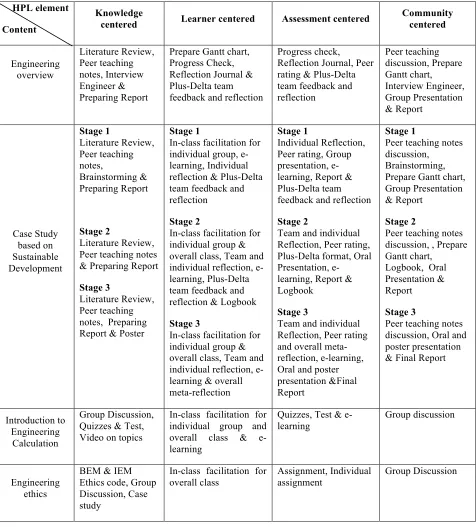
Table 1 shows the mapping of HPL framework in each activity in the “Introduction to Engineering” course. To determine the activities according to the content, various active learning activities have been injected in ITE course to promote the effectiveness of “Introduction to Engineering” course using the application of learning environment using HPL framework. The first topic in the course, engineering overview, is a cooperative learning activity where students have to find information on engineering from conducting literature review in the library as well as using the internet, and to also interview at least two practicing engineers. These learning activities were designed to fulfill the knowledge-centred criterion. To ensure the assessment centered criterion, progress check was conducted by the instructors of the course mid-way through the assignment for providing feedback on the work done by the students in their teams up to that point. At the end of the team assignment, students write learning and reflection journals which were graded and given feedback from instructors, and wrote as well as receive peer rating and feedback from each other using the plus delta format, where a plus is for good efforts to be continued and delta are improvements to be made. These assessment centred activities will help the students to revised and improve their thinking during the learning process after getting feedback from the lecturer and peers.
Vol. 9, No.1| June 2017| ISSN 2229-8932 Journal of Technical Education and Training (JTET) |50
given to the students in the course. More detail on the CPBL cycle can be seen in Mohd-Yusof et. al. (2016). As shown in Table 1, the CPBL learning environment was purposely designed to fulfil the four criteria of the HPL framework.
Table 1: The application of HPL framework in “Introduction to Engineering” course content
HPL element
Content
Knowledge
centered Learner centered Assessment centered
Community centered Engineering overview Literature Review, Peer teaching notes, Interview Engineer & Preparing Report
Prepare Gantt chart, Progress Check, Reflection Journal & Plus-Delta team feedback and reflection
Progress check, Reflection Journal, Peer rating & Plus-Delta team feedback and reflection Peer teaching discussion, Prepare Gantt chart, Interview Engineer, Group Presentation & Report Case Study based on Sustainable Development Stage 1 Literature Review, Peer teaching notes, Brainstorming & Preparing Report Stage 2 Literature Review, Peer teaching notes & Preparing Report Stage 3 Literature Review, Peer teaching notes, Preparing Report & Poster
Stage 1 In-class facilitation for individual group, e-learning, Individual reflection & Plus-Delta team feedback and reflection
Stage 2 In-class facilitation for individual group & overall class, Team and individual reflection, e-learning, Plus-Delta team feedback and reflection & Logbook Stage 3 In-class facilitation for individual group & overall class, Team and individual reflection, e-learning & overall meta-reflection
Stage 1 Individual Reflection, Peer rating, Group presentation, e-learning, Report & Plus-Delta team feedback and reflection Stage 2 Team and individual Reflection, Peer rating, Plus-Delta format, Oral Presentation,
e-learning, Report & Logbook
Stage 3 Team and individual Reflection, Peer rating and overall meta-reflection, e-learning, Oral and poster presentation &Final Report
Stage 1 Peer teaching notes discussion, Brainstorming, Prepare Gantt chart, Group Presentation & Report
Stage 2 Peer teaching notes discussion, , Prepare Gantt chart,
Logbook, Oral Presentation & Report
Stage 3 Peer teaching notes discussion, Oral and poster presentation & Final Report
Introduction to Engineering
Calculation
Group Discussion, Quizzes & Test, Video on topics
In-class facilitation for individual group and overall class & e-learning
Quizzes, Test & e-learning
Group discussion
Engineering ethics
BEM & IEM Ethics code, Group Discussion, Case study
In-class facilitation for overall class
Assignment, Individual assignment
Vol. 9, No.1| June 2017| ISSN 2229-8932 Journal of Technical Education and Training (JTET) |51
2. RESEARCH OBJECTIVE
The objective of this research is to investigate the effectiveness of the “Introduction to Engineering” course in supporting students’ learning and providing learning experiences that promotes first year engineering students’ readiness to become future engineer.
3. METHODOLOGY
An exploratory qualitative study research design was used to gather data via interviews and observation. An in-class observation using observation field notes was conducted throughout the overall semester in “Introduction to Engineering (ITE)”course. To investigate the design of ITE course, the researcher has explore the course content to study the application of HPL framework into the course. To conduct the interview session, the research design comprises of four stages; (i) determination of the axes of investigation; (ii) design of the interview questions; (iii) data collection; (iv) coding; and finally (v) interpretation of results. The research instrument was an interview protocol consisting of three sections that were designed to gather data on (i) demographic factor and previous education background, (ii) students’ understanding on basic knowledge about engineering, and (iii) students’ preparation and readiness to develop professional skills in order to meet the needs of industry. Qualitative data were gathered via interviews on 20 respondents (45% male and 55% female) throughout the semester from September 2015 to January 2016.
The respondents were selected through purposive sampling to an open ended question and they were grouped based on their answers on the statement “I want to be an engineer when I graduate from university”, i.e. based on how true the statement is for them. A set of qualitative data were generated from the focus group interview. The interviews were conducted three times; i.e. at the beginning of the “Introduction to Engineering” course; in the middle of the course and upon completion of the course to see the impact of the course as the students go through the highly student centred learning environment from the beginning to the end of the semester. Respondents’ responses were coded using alphabet and numbers such as A1, B1 and C1, where ‘A’ is the first, ‘B’ the second, ‘C’ the third interview while 1, 2, 3 refers to serial number of respondents. Hence, the code ‘B1’ represents the responses of respondent number 1 on his/her second interview session.
Vol. 9, No.1| June 2017| ISSN 2229-8932 Journal of Technical Education and Training (JTET) |52
4. RESULTS
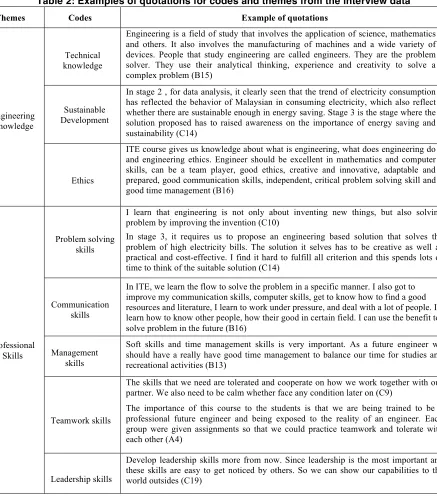
Table 2 shows the examples of quotations and codes for themes of engineering knowledge, professional skills and attitude. The codes under engineering knowledge are technical knowledge, ethics and sustainable development. The respondents mentioned that this course helps them to apply the knowledge to solve a problem (B15 and B16). They also stated that they have learned new things e.g.; codes of ethics and sustainable development which are important to enhance their awareness in future (C14 and B16).
Referring to Table 2, respondent C14 stated that “Introduction to Engineering” course requires them to come out with ideas to propose an engineering based solutions to solve current issues in Malaysia. To solve the following issues, they need to have essential professional skills, such as, problem solving, communication, management, team work and leadership skills. The result shows that the course activities helped students to develop their professional skills. However, the respondents also expressed their concern on the increased work load and made it more time consuming than traditional teaching approaches at the beginning of the semester. They mentioned some difficulties while managing their time to get full cooperation from their team members due to diversity (B13 and C14), but the work-load had led them develop better time-management and teamwork skills.
Listen to the audio recording several times while jotting down the initial codes.
Sorts out the possible codes from the transcription and aligns it with the objectives of the research.
All codes were gathered to identify the themes.
Reviewed the themes with transcript and codes again, whether it is necessary or not.
Define the concise theme’s name that would fit into the overall story of the data; namely, engineering knowledge; professional skills; and attitudes (expectations and motivation).
Produce the report.
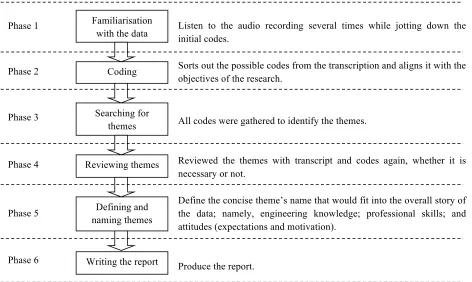
Figure 1: Six phases of thematic analysis by Clarke and Braun (2013) Familiarisation
with the data
Coding
Searching for themes
Reviewing themes
Defining and naming themes
Writing the report Phase 1
Phase 2
Phase 3
Phase 4
Phase 5
Vol. 9, No.1| June 2017| ISSN 2229-8932 Journal of Technical Education and Training (JTET) |53
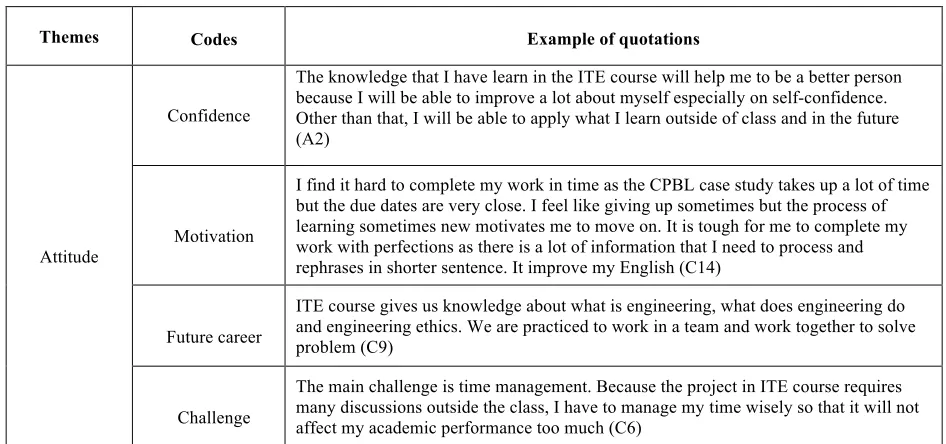
After entering this course, the respondents have become more confident to express ideas and suggestions in front of audience (A2, C6, C9, C14). In this course, they have faced some difficulties due to tight deadlines to focus on presentations and report submissions. Respondent C14 stated that there were times when he wanted to give up, but the new process of learning had improved their motivation especially after they had completed their assignments and received positive feedback from the lecturer. This course had also given them exposure to future career since all of them had to interview at least two practising engineers at the beginning of semester.
Table 2: Examples of quotations for codes and themes from the interview data
Themes Codes Example of quotations
Engineering Knowledge
Technical knowledge
Engineering is a field of study that involves the application of science, mathematics and others. It also involves the manufacturing of machines and a wide variety of devices. People that study engineering are called engineers. They are the problem solver. They use their analytical thinking, experience and creativity to solve a complex problem (B15)
Sustainable Development
In stage 2 , for data analysis, it clearly seen that the trend of electricity consumption has reflected the behavior of Malaysian in consuming electricity, which also reflect whether there are sustainable enough in energy saving. Stage 3 is the stage where the solution proposed has to raised awareness on the importance of energy saving and sustainability (C14)
Ethics
ITE course gives us knowledge about what is engineering, what does engineering do and engineering ethics. Engineer should be excellent in mathematics and computer skills, can be a team player, good ethics, creative and innovative, adaptable and prepared, good communication skills, independent, critical problem solving skill and good time management (B16)
Professional Skills
Problem solving skills
I learn that engineering is not only about inventing new things, but also solving problem by improving the invention (C10)
In stage 3, it requires us to propose an engineering based solution that solves the problem of high electricity bills. The solution it selves has to be creative as well as practical and cost-effective. I find it hard to fulfill all criterion and this spends lots of time to think of the suitable solution (C14)
Communication skills
In ITE, we learn the flow to solve the problem in a specific manner. I also got to improve my communication skills, computer skills, get to know how to find a good resources and literature, I learn to work under pressure, and deal with a lot of people. I learn how to know other people, how their good in certain field. I can use the benefit to solve problem in the future (B16)
Management skills
Soft skills and time management skills is very important. As a future engineer we should have a really have good time management to balance our time for studies and recreational activities (B13)
Teamwork skills
The skills that we need are tolerated and cooperate on how we work together with our partner. We also need to be calm whether face any condition later on (C9)
The importance of this course to the students is that we are being trained to be a professional future engineer and being exposed to the reality of an engineer. Each group were given assignments so that we could practice teamwork and tolerate with each other (A4)
Leadership skills
Vol. 9, No.1| June 2017| ISSN 2229-8932 Journal of Technical Education and Training (JTET) |54
Themes Codes Example of quotations
Attitude
Confidence
The knowledge that I have learn in the ITE course will help me to be a better person because I will be able to improve a lot about myself especially on self-confidence. Other than that, I will be able to apply what I learn outside of class and in the future (A2)
Motivation
I find it hard to complete my work in time as the CPBL case study takes up a lot of time but the due dates are very close. I feel like giving up sometimes but the process of learning sometimes new motivates me to move on. It is tough for me to complete my work with perfections as there is a lot of information that I need to process and rephrases in shorter sentence. It improve my English (C14)
Future career
ITE course gives us knowledge about what is engineering, what does engineering do and engineering ethics. We are practiced to work in a team and work together to solve problem (C9)
Challenge
The main challenge is time management. Because the project in ITE course requires many discussions outside the class, I have to manage my time wisely so that it will not affect my academic performance too much (C6)
The codes for all three themes found during the analysis, which are; (i) engineering knowledge; (ii) professional skills; and (iii) attitude are described in Table 3. It can be seen that the use of learning environment in the course enhanced deep understanding and motivation towards learning through “Introduction to Engineering” course.
Table 4 shows a trend of self-improvement is observed among students as they go through the three stages of the problems, each with a complete cycle of CPBL. Referring to Table 4, the vignette from student 5 indicated that his understanding of engineering became more holistic as the semester progressed. This is the same with the professional skills and attitude aspects.
Table 3: Themes and Codes
Themes Codes
Engineering knowledge Technical knowledge, ethics, sustainable development
Professional kills Problem solving skills, communication skills, management skills, teamwork skills, leadership skills
Vol. 9, No.1| June 2017| ISSN 2229-8932 Journal of Technical Education and Training (JTET) |55 Table 4: Example of quotations at the end of CPBL cycle of Stages 1, 2 and 3 of problem
Themes Example of quotation
Engineering Knowledge
Engineering ease our daily life. It’s like a technology and deal with machinery (A5)
Engineering is a challenging profession and they need to apply scientific and practical knowledge to design, repairing and preserving manufacturing system. Engineer also need to improve life quality with their knowledge and technology (B5)
Engineering is a technical, mathematical, science and physic application during problem solving. Engineering is also the manufacturing process from the raw material into a product. Engineer not only plays with the machine but they work at laboratory to do something related with chemical engineer. Engineers innovate something new for the humankind (C5)
Professional Skills
In this class, I hope to gain communication skills and do more group work (A9).
Soft skill and cooperation is needed as we work with other people and not just engineer so we need to communicate with other people to come out with a good teamwork (B9)
ITE class give us knowledge about what is engineering, what does engineering do and engineering ethics. We practiced to work in a team and work together to solve problem. I become more confident and less nervous during presentation and I also know how to cooperate and work together with my teammate and I know how to tolerate. In this class, we learned about engineering, then we try to find out some problem and finally we do innovation to solve it. It develops my soft skills and improves teamwork skills with my teammate (C9).
Attitude
Engineering overview learning session helped me to know more about engineering and different fields of engineering. At least, I know that my choice to be a chemical engineer is a right choice. I get to know there are lots of possible careers for all types of engineering (A14)
ITE helps us to improve our time management skills, stress management skills and the skills that have to deal with everyone is esp. in your group is soft skills, and management skills in term of time and stress. It is not complicated, but it has a lot to do with the limited time. We don’t sleep at all at this stage and quite tired. We really like the outcome when the report was printed out (B14)
I find it hard to complete my work in time as the CPBL case study takes up a lot of time but the due dates are very close. I feel like giving up sometimes but the process of learning sometimes new motivates me to move on. In stage 3, we need to propose an engineering based solution that solves the problem of high electricity bills. The solution it selves has to be creative as well as practical and cost-effective. I find it hard to fulfil all criteria and this spends lots of time to think of the suitable solution. I understand the process of completing the case study and I feel motivated and happy when my team works together to complete the assignment. (C14)
5. DISCUSSION
5.1 Students’ perception on development of “engineering knowledge”, “professional skill” and “attitude”
Vol. 9, No.1| June 2017| ISSN 2229-8932 Journal of Technical Education and Training (JTET) |56
The knowledge I learned in ITE helped me to be a better person as I can be more organized and good in my time management. Even though I was always busy with assignments report and presentation, it is my pleasure to get involved in ITE as I have learned a lot from this course. Besides cooperative learning, I realized the importance of working in group effectively, and when all work is done and praised by lecturers, the feeling of satisfaction really fulfil the joy of my team.
From the above statement, the use of HPL framework in guiding the design of the learning environment, which includes the teaching and learning activities, as well as the way the content was presented to the students in this course managed to develop student’s skills and help her to become more confident in adapting to new environment. In “Introduction to Engineering” course, students have to get involved with various activities to attain the knowledge effectively. Students also feel motivated after they complete their work and get positive feedback from the lecturer.
The data gained from interview sessions has produced three major themes, as shown in Tables 2 which are (i) engineering knowledge; (ii) professional skills; and (iii) attitude, respectively. These three themes are the impacts of learning environment practices based on the HPL framework. The codes that emerged from “engineering knowledge” – technical knowledge, ethics and sustainable development - are basically the syllabus in “Introduction to Engineering” course. The second theme is “professional skills” which consists of communication, problem solving, team working, leadership, and management skills. From the students’ point of view, professional skills are very important for them to become successful engineers in the future.
Meanwhile, under the theme of attitude, the attributes concerned are confidence, motivation, future career and challenge. The “Introduction to Engineering” course helped students to understand engineering and it motivates them during the learning process. Therefore, the course has been successful in enhancing students’ attitude, professional skills and engineering knowledge to persist the tasks given.
Vol. 9, No.1| June 2017| ISSN 2229-8932 Journal of Technical Education and Training (JTET) |57 5.2 Students’ perception on the Implementation of “Introduction to Engineering”
course
The “Introduction to Engineering (ITE)” course was designed to have effective learning environment to support first year students to learn about engineering and prepare them for the challenging courses in the university to become good engineers. From the results of this study, the design of the learning environment indeed matched the design of the course in fulfilling the four HPL framework criteria.
For knowledge-centered learning criterion, students C15 and C20 mentioned that;
From all stages, I got to increase my knowledge on energy sustainability, how to benchmark and get other precious information (Student C15).
In stage 3, we need to be knowledgeable in sustainable development and need to know more about sustainable. It helps to create our awareness to development to be more sustainable and we need to act before it gets too late (Student C20).
From the statement above, the students stated that they had learned about sustainability. During this course, the problems given were related to practice in the real-world, which exposed students to how engineers deal with problems. To solve open-ended problems related to sustainability issues, they had to find out the learning issues regarding sustainability, and the current practice in Malaysia and other countries for bench-marking purpose. During this learning process, students were able to understand the learning issues and provide the best solutions through bench-marking. This kind of learning environment helps students to attain deep understanding on knowledge, as well as, to improve their professional skills and attitude.
For the learner-centered criterion, student C19 stressed that:
I’ve improved my understanding before getting the engineering solution. After getting the feedback, support and guidance from the lecturer in Stage 1 and 2, my solutions are worthy and better since I do some research and study on the definition and terms, the causes of the problem and the ways to overcome the learning issues.
The statement above shows that student have increased their understanding about the issues after undergoing the process of learning. In ITE course, instructor also provides scaffolding and support to help students avoid misconceptions and wrong interpretation during the learning process.
For community-centered criterion, student C15 noticed that:
Our learning style in ITE is team discussion. If I don’t understand about my particular topic, I prefer to discuss in group as I can ask other people. Discussion in group is good when we need to find the solution of a problem for a better idea.
Vol. 9, No.1| June 2017| ISSN 2229-8932 Journal of Technical Education and Training (JTET) |58
class that required them to work in teams, such as, peer teaching, teams’ presentation, brainstorming, team discussion, peer rating, tournament and exhibition.
Lastly, in the assessment-centered learning environment, Student C14 stated that;
Peer teaching and slide show played by the lecturer was the learning environment in ITE class and I prefer peer teaching as it is more effective way to learned and we are able to help one another, giving feedback and suggestion to improve our self.
From the statement, student prefers to learn in team to improve and assist one another. Every student is given an opportunity to give feedback to their team members through peer rating at every CPBL stage. Peer rating helps students to develop their performance and improve their team contributions towards achieving their goals. The students also received feedback from the instructor after they have completed their task. This continuous feedback is formative assessment, where students receive feedback throughout the learning process. By implementing all four criteria from HPL framework, students are trained to be a self-directed learner, be cooperative and participative while solving the real world problems. Students in the class are motivated when work is done in their team activities collaboratively and actively. Such approach promotes them to help one another in the learning process and support their team mates in achieving the common goals.
6. CONCLUSION
This paper presented a systematic way to design an introductory engineering course using the HPL framework as a basis for creating an effective learning environment prepare the students to become future engineer. The findings of this study showed that the ITE course has managed to enhance students’ understanding of engineering, professional skills and positive attitude. This study also shows that there is a gradual enhancement of knowledge and professional skills development as they go through the course, which starts off with difficulties in facing the new learning environment before finally accepting and attaining success levels. It is found that the students have attained the desired level of professional skills aligned with the requirements of the Engineering Accreditation Council (2012). Therefore, it is possible to prepare students with the attributes of engineers to enable them to face the challenges in 21st century through ITE course, even among those who were accustomed to the teacher-centered approach. Hence, the design of ITE course using the HPL framework as a basis for design were successful to prepare the first year engineering students with engineering knowledge, attitude and professional skills.
Acknowledgement
Vol. 9, No.1| June 2017| ISSN 2229-8932 Journal of Technical Education and Training (JTET) |59 References
Blueprint, Malaysia Education. (2013). Malaysia Education Blueprint 2013-2025. Ministry of Education, Malaysia. Bransford, J.D., A.L. Brown, and R.R. Cocking (1999). How people learn: Brain, mind, experience, and school,
National Academy Press.
Braun, V. & Clarke, V. (2006). Using Thematic Analysis in Psychology. Qualitative Research in Psychology, 3(2), 77-101.
Clarke, V., & Braun, V. (2013). Teaching thematic analysis: Overcoming challenges and developing strategies for effective learning. The psychologist, 26(2), 120-123
Clough, G.W. (2004). The engineer of 2020: Visions of engineering in the new century. National Academy of Engineering, Washington, DC.
Dinu, B. (2015). Impact of Teacher-Student Communication on “High-Risk Dropout” Students. The International Institute for Science, Technology and Education (IISTE), 18 (5), 88-100.
Engineering Programme Accreditation Manual. (2012). Engineering Accreditation Council (EAC). Board of Engineers, Malaysia.
Gazca, L., Palou, E., López-Malo, A., & Garibay, J. M. (2009, October). Ethnography of a first-year design experience in the introduction to engineering design course. In Frontiers in Education Conference, 2009. FIE'09. 39th IEEE (pp. 1-6). IEEE.
Hillman, K. (2005). The first year experience: The transition from secondary school to university and TAFE in Australia. LSAY Research Reports, 44.
Johnston, S., Gostelow, J., & King, W. (n.d). (2004). The Engineer of 2020: Visions of Engineering in New Century. Retrieved 11 November, 2015, from The National Academies Press: http://www.nap.edu/read/10999/chapter/6
Jerie, S. (2011). The transition from a-level to under-graduate geography: a focus on Midlands State University, Zimbabwe. Midlands State University Institution Repository.
May, E., & David S. S. (2011). Is engineering education delivering what industry requires. Proceedings of the Canadian Engineering EducationAssociation.
Mohd-Yusof, K., Helmi, S. A., Phang, F. A., & Mohammad, S. (2015). Future Directions in Engineering Education: Educating Engineers of the 21st Century. ASEAN Journal of Engineering Education, 2(1), 8-13.
Mohd-Yusof, K., Sadikin, A. N., Phang, F. A. & Abdul Aziz, A. (2016). Instilling Professional Skills and Sustainable Development through Problem-Based Learning (PBL) among First Year Engineering Students.
International Journal of Engineering Education, 32, 1(B), 333–347.
Mohd-Yusof, K., Phang, F. A., Sadikin, A. N., and Helmi, S. A. (2014). Determining the Effect of an Engineering Overview Assignment on Students. Proceedings for the 2014 ASEE Annual Conference and Exposition on Engineering Education, Indianapolis, USA, June 15-18.
Nguyen, D. Q. (1998). The essential skills and attributes of an engineer: A comparative study of academics, industry personnel and engineering students. Global J. of Engng. Educ, 2(1), 65-75.
Purdue University. (2017). Introduction to Global Engineering (Engr 103). Retrieved Jun 18, 2017, from Purdue University - college of engineering: https://engineering.purdue.edu/Engr/Academics/Global/engr103.html Reyes, M. A., Anderson-Rowland, M. R., & McCartney, M. A. (1998, November). Freshman introductory
engineering seminar course: Coupled with bridge program equals academic success and retention. In Frontiers in Education Conference, 1998. FIE'98. 28th Annual (Vol. 1, pp. 505-510). IEEE.
Russell, J. S. (2012). Shaping the future of the civil engineering profession. Journal of Construction Engineering and Managemen, 139(6), 654-664.
Saad, M. et al., (2013). Employers’ perception on engineering, information and communication technology (ICT) students’ employability skills. Global Journal of Engineering Education, 15(1), 42-46.
Siong, G. E., Ghee, L. P., & Kiong, A. C. (2014). Introduction to Engineering–The Nanyang Polytechnic
Experience. Proceedings of the 10th International CDIO Conference
Svinicki, M.D. (2010). A guidebook on conceptual frameworks for research in engineering education. Rigorous Research in Engineering Education NSF DUE-0341127, DUE-0817461,
Vol. 9, No.1| June 2017| ISSN 2229-8932 Journal of Technical Education and Training (JTET) |60 Venkatesh, B. R. (2013). A Study on the Importance of Soft Skills And Positive Attitude as Perceived By Industry
With Specific Reference To Fresh Engineer. International Journal of Research in Commerce & Management, 78-86.
Vygotsky, L.S. (1986). Thought and language. (A. Kozulin, trans.) Cambridge, MA: MIT Press. (Original work published 1934).
World Economic Forum. (2014). Global Agenda Council on Employment - Matching Skills and Labour Market Needs Building Social Partnerships for Better Skills and Better Jobs. Davos-Klosters, Switzerland. World Economic Forum.
World Economic Forum. (2016). Global Challenge Insight Report - The Future of Jobs Employment, Skills and Workforce Strategy for the Fourth Industrial Revolution. World Economic Forum.