ISSN: 2372-5060 (Print), 2372-5079 (Online) Copyright © The Author(s). All Rights Reserved. Published by American Research Institute for Policy Development DOI: 10.15640/ijhs.v4n2a1 URL: https://doi.org/10.15640/ijhs.v4n2a1
A Case Report on the Use of a Decision Matrix to Support the Development of Scholarship for
Early Career Health Sciences Faculty
Bridgett Piernik-Yoder, PhD, OTR
1Abstract
Many health sciences faculty do not begin their academic careers with a history of scholarly productivity that will ensure their success in academia because they often transition to the academic setting from the clinical setting. Because scholarship is an integral aspect to success in an academic career, it is important to consider tools to support this aspect of faculty development in the health sciences. The purpose of this case report is to describe the outcomes of the development and utilization of a decision matrix to support the systematic assessment and planning of potential scholarly activities for early-career health sciences faculty. Outcomes presented in this case report indicate this type of decision matrix may be a useful tool to support faculty develop in the area of research and scholarship.
Keywords: faculty development, junior faculty, decision matrix, decision process tools, multi-criteria decision making
1.0 Introduction
The nearly universal expectation for faculty members to develop in the area of scholarship often poses a unique challenge for health sciences faculty who are new to academia or early in their institution’s promotion and tenure process. Many health professionals transition to faculty roles from a practice setting (Hurst, 2010) which provides limited opportunity for individual practitioners to have the lead role in scholarly activities. Whereas they may be prepared to assume teaching and service requirements associated with their new role as a faculty member, they may be less prepared to initiate and chart a plan to support scholarly productivity (Crepeau, Thibodaux, & Parham, 1999; Crist, 1999). However, institutions often place at least equal if not more value on scholarship than teaching (Peterson, Stuart, Hargis, & Patel, 2009). Previous research in faculty development indicates the process of conceiving a research idea to publication may take more than three years (Gist, 1996). This results in the need to identify early career faculty members’ areas of interests and skills related to scholarship and implement a plan as the begin their new academic role that will produce the level of scholarly productivity necessary to qualify for promotion and perhaps tenure.
Even if a new faculty member has completed a terminal degree when they assume a faculty position, few have had the opportunity to develop a sustained program of scholarly activity. Therefore, new faculty members benefit from a structured faculty development process to assist in the transition to their new role (Peterson & Umphred, 2005). Furthermore, faculty in health sciences who enter academia with a clinical doctorate may not have sufficient preparation in the area of research development and will require mentoring to identify and establish a productive path toward scholarship (Kahanov, Eberman, Yoder, & Mahanoy, 2012).Mentoring is one effective approach to supporting research productivity of health sciences faculty (Paul, Stein, Ottenbacher, & Liu, 2002).
1University of Texas Health Science Center San Antonio, Department of Occupational Therapy, 7703 Floyd Curl MC 6245., San
However, studies from various health sciences indicate the extent of mentoring provided to faculty varies considerably. Peterson, Stuart, Hargis, and Patel (2009) report only 50% of physical therapy education programs surveyed in the United States provide formal mentoring for new faculty regarding the development of a scholarly portfolio. Of greater concern is the risk of new health sciences faculty who do not reach an effective level of productivity. Bedeian (1996) suggests if new assistant professors do not publish within three to four years, there is a risk they never will. Therefore, it is important to consider tools to support the development of scholarly activities for early career health sciences faculty. The purpose of this case study is to present the development and utilization of a decision matrix tool to support the systematic assessment and planning of potential scholarly activities for early-career health science faculty.
2. Methods
A new faculty member assumed a position as an Assistant Professor in a health sciences academic department that is part of a large biomedical teaching and research institution. The faculty member had over 14 years of clinical experience, an earned Doctor of Philosophy degree in Education, and eight years of teaching experience as an adjunct faculty member in the same department. Additionally, the faculty member had successfully completed several independent research projects in fulfillment of graduate degree requirements as well as numerous outcomes studies in the clinical setting. However, the new faculty member had no established projector ongoing lines of research that would meet the scholarship productivity requirements of an academic position. The faculty member met with the department chair several times upon beginning the new position specifically to discuss potential ideas and directions for areas of scholarship. Although the new faculty member had numerous ideas of scholarly activities to pursue, it was not readily evident which area would be the most productive to pursue due to the research project ideas ranging in scope, complexity, and type. As a result, it was difficult to systematically compare the various potential projects to determine how to prioritize them or which could be the most productive. Upon further analysis, it was determined that a structured decision matrix could be utilized to support multiple-attribute decision making in order to determine the relative merit of each potential scholarly topic.
A literature review was conducted to determine if any tool existed to assist in research planning for the purpose of faculty development. However, after a search of relevant databases on CINAHL, Pub Med, ERIC, Professional Development Collection, and Academic Search Complete, no published information for such a tool or structured method existed at that time. Based on the literature search, it was concluded that no such tool was available for the identified need. However, decision matrices are commonly used to assess multiple criteria as part of multi-criteria decision-making in many industries such as business, information technology, service, and engineering (Pokehar & Ramachandran, 2004; Zavadskas & Podvesko, 2016).Decision matrices are typically applied when multiple criteria need to be assessed for several possible options based on their relative merits. Therefore, the general principles utilized in developing a decision matrix were applied to this need.
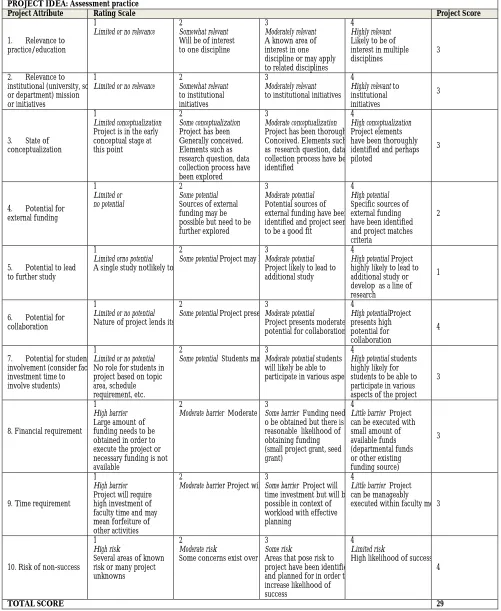
The first step in the development of a decision matrix to assist new faculty with establishing a potential scholarly research path was to establish the criteria required to assess each potential selection. Next, a rating scale was developed to assess potential scholarly research topic selections relative to each criterion (Tzeng & Huang, 2011). In order to create the decision matrix, the new faculty member and chair developed the criteria and rating scale using an iterative review process along with review and input from other senior faculty. A total of ten criteria were established based on attributes related to scholarly activities: seven positive attributes and three high-risk attributes related to scholarly activities. An ordinal rating scale of one to four, was utilized for the matrix rating scale. A value of one was established as the lowest value for the positive ratings, whereas the scale is reverse-ordered for the three high-risk criteria. Content validity was provided through peer review from three tenured faculty members who offered input into the final criteria. In addition, a national group of faculty and deans of schools of health sciences provided input regarding the utility of the matrix and the development of the rating descriptions when the concept was presented at a health sciences conference in the United States (Piernik-Yoder, 2008).
Table 1: Completed decision matrix rating scale for a single project idea
PROJECT IDEA: Assessment practice
Project Attribute Rating Scale Project Score
1. Relevance to practice/education
1
Limited or no relevance
2
Somewhat relevant
Will be of interest to one discipline
3
Moderately relevant
A known area of interest in one discipline or may apply to related disciplines
4
Highly relevant
Likely to be of interest in multiple disciplines
3
2. Relevance to
institutional (university, school, or department) mission or initiatives
1
Limited or no relevance
2 Somewhat relevant to institutional initiatives 3 Moderately relevant
to institutional initiatives 4
Highly relevant to
institutional initiatives
3
3. State of conceptualization
1
Limited conceptualization
Project is in the early conceptual stage at this point
2
Some conceptualization
Project has been Generally conceived. Elements such as research question, data collection process have been explored
3
Moderate conceptualization
Project has been thoroughly Conceived. Elements such as research question, data collection process have been identified
4
High conceptualization
Project elements have been thoroughly identified and perhaps piloted
3
4. Potential for external funding 1 Limited or no potential 2 Some potential
Sources of external funding may be possible but need to be further explored
3
Moderate potential
Potential sources of external funding have been identified and project seems to be a good fit
4
High potential
Specific sources of external funding have been identified and project matches criteria
2
5. Potential to lead to further study
1
Limited orno potential
A single study notlikely to lead to further or related study. 2
Some potential Project may lead to related or additional study
3
Moderate potential
Project likely to lead to additional study
4
High potential Project
highly likely to lead to additional study or develop as a line of research
1
6. Potential for collaboration
1
Limited or no potential
Nature of project lends itself to solo work 2
Some potential Project presents some potential for collaboration
3
Moderate potential
Project presents moderate potential for collaboration
4 High potentialProject presents high potential for collaboration 4
7. Potential for student involvement (consider faculty investment time to involve students)
1
Limited or no potential
No role for students in project based on topic area, schedule requirement, etc.
2
Some potential Students may be able to participate in limited aspects of project
3
Moderate potential students
will likely be able to
participate in various aspects of the project 4
High potential students
highly likely for students to be able to participate in various aspects of the project
3
8. Financial requirement 1
High barrier
Large amount of funding needs to be obtained in order to execute the project or necessary funding is not available
2
Moderate barrier Moderate amount of funding needs to be obtained in order to execute the project or potential funding is not readily available
3
Some barrier Funding needs
o be obtained but there is reasonable likelihood of obtaining funding (small project grant, seed grant)
4
Little barrier Project
can be executed with small amount of available funds (departmental funds or other existing funding source)
3
9. Time requirement 1
High barrier
Project will require high investment of faculty time and may mean forfeiture of other activities
2
Moderate barrier Project will require moderate investment of faculty time and may require consideration of faculty workload
3
Some barrier Project will
time investment but will be possible in context of workload with effective planning
4
Little barrier Project
can be manageably
executed within faculty member’s workload3
10. Risk of non-success 1
High risk
Several areas of known risk or many project unknowns
2
Moderate risk
Some concerns exist over potential success or some project unknowns 3
Some risk
Areas that pose risk to project have been identified and planned for in order to increase likelihood of success
4
Limited risk
High likelihood of success and few unknowns 4
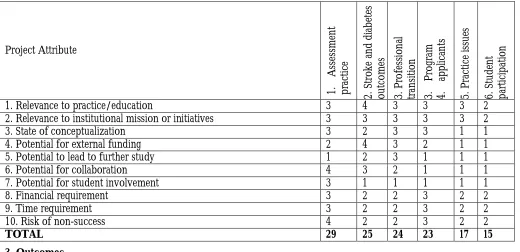
The six project ideas were assessed using the matrix rating scale and placed on the decision matrix for comparison. These are provided on rank order (from left to right) in Table 2.
Table 2: Rank order of project ideas
Project Attribute 1 . A ss es sm en t p ra ct ic e 2 . St ro k e an d di ab et es o u tc o m es 3 . P ro fe ss io n al tr an si ti o n 3 . P ro gr am 4 . ap p lic an ts 5 . P ra ct ic e is su es 6 . St u de n t p ar ti ci p at io n
1. Relevance to practice/education 3 4 3 3 3 2
2. Relevance to institutional mission or initiatives 3 3 3 3 3 2
3. State of conceptualization 3 2 3 3 1 1
4. Potential for external funding 2 4 3 2 1 1
5. Potential to lead to further study 1 2 3 1 1 1
6. Potential for collaboration 4 3 2 1 1 1
7. Potential for student involvement 3 1 1 1 1 1
8. Financial requirement 3 2 2 3 2 2
9. Time requirement 3 2 2 3 2 2
10. Risk of non-success 4 2 2 3 2 2
TOTAL 29 25 24 23 17 15
3. Outcomes
A review of the seven year outcomes of the completed matrix used in the case report indicates the projects deemed as highest potential did yield productive results for the faculty member. Table 3 summarizes the outcome of each project.
Table 3: Project outcomes
Project Idea Matrix Rating Outcome
1. Assessment practice 29
Funded by departmental grant; Project completed in collaboration with senior faculty member; Presented findings at national conference; Resulted in peer-reviewed publication
2. Stroke and diabetes
outcomes 25
Funded by external fellowship grant; Project competed in collaboration with epidemiology; Presented findings at national meeting; Resulted in peer-reviewed publication
3. Professional transition 24
Not pursued initially, but was a good fit for an external funding opportunity that later arose; Externally funded and continuing as an ongoing project: First phase of project presented at national
conference
4. Program applicants 23 Funded by small external grant; Resulted in several conference presentations
5. Practice issues 17 Not pursued
6. Student participation 15 Not pursued
4. Discussion
New health sciences faculty often enter the academic setting with little research or scholarship track record due to high levels of engagement in clinical careers. Although they may have ideas for potential areas of scholarly activities, it can be difficult to weigh the relative advantages in the early phase of an academic career.
Therefore, they may be at risk for not achieving the level of scholarly activity needed to support necessary progress in their academic career (Bedeian, 1996; Crepeau, Thibodaux, & Parham, 1999; Crist, 1999). Furthermore, due to the time it takes to develop a research trajectory, it is important to select areas of endeavor that will have a strong potential to develop into a successful area of scholarly productivity. However, little research exists regarding faculty development tools to aid in this process. As decision matrices are commonly used in other industries to assist in multiple-criteria decision making, this seemed like an appropriate application of such a tool. As there was no evidence of an existing tool for use by new faculty in the research planning process, one was developed based on criteria related to successful outcomes of scholarly activities. The case study demonstrates how the use of a decision matrix can facilitate the planning process and support scholarly productivity for new health sciences faculty.
Based on the outcomes of this case, it appears the decision matrix is a useful tool to use when assessing the multiple-criteria of potential research projects of new faculty members. It is important to note like many decision matrices, the purpose of this tool is not to provide a cut score to determine the value of an individual project but rather a means to assess multiple attributes in order to assess several projects. Furthermore, the use of the decision matrix provided a structured and tangible guide that enhanced the mentoring process of the junior faculty member by the department chair.
There are several limitations in this study. Data regarding the outcomes of the matrix are based on its use in one case of faculty development. Additional data are needed to support conclusions about the effectives of using such a tool. Whereas the criteria included in the matrix is appropriate for health sciences faculty, additional or different criteria may also be beneficial based on the faculty member’s profession. Additionally, some of the attributes are complex to assess such as project’s financial requirement. Included as one of the high risk attributes, it is reverse coded so a high financial requirement is assessed lower on the rating scale. However, one could argue that a project with a higher financial requirement may be supportive of career development and therefore should be positively rated. Because this is a tool intended for new faculty in the health sciences, it was determined the need to develop some ongoing projects was more critical in the first few years of an academic career and these projects are likely to have lower financial requirements. A completed project could provide some track record or pilot data to seek additional external funding which is assessed as a separate attribute.
Finally, whereas the matrix provides a structured tool to assist in the research planning process, the purpose is to assess multiple attributes related to specific project ideas. It is recognized that the development of any successful plan regarding scholarly activities is multifaceted and also depends on the faculty member’s characteristics and skills, resource support, and effective mentoring.
References
Bedeian. A. (1996). Lessons learned along the way: Twelve suggestions for optimizing career success. In P. Frost & M. Taylor (Eds.), Rhythms of academic life: Personal accounts of careers in academia (pp. 3 - 9). Thousand Oaks, CA: SAGE Publications, Inc.
Crepeau, E., Thibodaux, L., & Parham, D. (1999). Academic juggling act: Beginning and sustaining an academic career. The American Journal of Occupational Therapy, 53(1), 25 – 30
Crist, P. (1999). Career transition from clinician to academician: Responsibilities and reflections. The American Journal of
Occupational Therapy, 53(1), 14 - 19.
Gist, M. (1996). Getting tenure. In P. Frost & M. Taylor (Eds.), Rhythms of academic life: Personal accounts of careers in
academia (pp. 185 – 192). Thousand Oaks, CA: SAGE Publications, Inc.
Hurst, K. (2010). Experiences of new physiotherapy lecturers making the shift from clinical practice to academia.
Kahanov, L., Eberman, L., Yoder, A., & Kahanov, M. (2012). Culture shock: Transitioning from clinical practice to educator. The Internet Journal of Allied Health Sciences and Practice, 10(1), ISSN 1540-580X
Paul, S., Stein, F., Ottenbacher, K. & Liu, Y. (2002). The role of mentoring on research productivity among occupational therapy faculty. Occupational Therapy International, 9(1), 24 – 40.
Peterson, C., Stuart, D., Hargis, J., & Patel, R. (2009). Promotion and tenure: Institution, program, and faculty-candidate characteristics. Journal of Physical Therapy Education, 23(1), 64 – 70.
Peterson, C. &Umphred, D. (2005). A structured faculty development process for scholarship in young faculty: A case report. Journal of Physical Therapy Education, 19(3), 86 – 88.
Piernik-Yoder, B. (2008). A decision process tool to support new faculty research productivity. Paper presented at the meeting the Association of Schools of Allied Health, Baltimore, MD.
Pohekar, S. & Ramachandran, M. (2004). Application of a multi-criteria decision making to
sustainable energy planning—A review. Renewable and Sustainable Energy Reviews, 8(4), 365 – 381.doi: 10.1016/j.rser. 2003.12.007
Tzeng, G. & Huang, J. (2011). Multiple attribute decision making: Methods and applications. Boca Raton, FL: Taylor & Francis Group.
Zavadskas, E. &Podvezko, V. (2016) Integrated determination of objective criteria weights in MCDM. International