Original Research Article
Effect of socio demographic profile on knowledge, attitude and
practices of mothers regarding breastfeeding of Lucknow district
Sachi Ojha
1, Shitanshu Srivastava
2*, Pratibha Gupta
3, Divyanshu Agrawal
1INTRODUCTION
Benefits of breastfeeding for both infants and mothers are globally recognized and is an ideal source of nourishment till six months of life.1 The World Health Organization (WHO) recommends continued breastfeeding up to two years of age or beyond and it has been estimated that optimal breastfeeding of children younger than two years, could annually save the lives of over 800,000 children under five years of age.2,3
WHO defines “exclusive breastfeeding" as no other food or drink, not even water, except breast milk (including milk expressed or from a wet nurse) for six months of life, but allows the infant to receive ORS, drops and syrups (vitamins, minerals and medicines).4
As per National family health survey IV (2015-16), only 42 percent of children under 6 months are exclusively breastfed. Continuous vigilance over infant feeding
ABSTRACT
Background: Breastfeeding is the ideal source of nutrition for first six month of life which is globally recognised. There are various advantages of optimal breastfeeding but still breastfeeding rates in Uttar Pradesh is only 56%. This might be attributed to various social, cultural and economical factors. Since there is limited local data on the knowledge, attitudes and practices of women toward breastfeeding. hence, we planned this study to assess knowledge, attitude and practices (KAP) of mothers regarding breastfeeding and influence of sociodemographic profile on them.
Methods: A cross sectional study was conducted on 200 mothers coming to the rural and urban areas of a district with infants between 0-6 months. The data was collected using a predesigned questionnaire based on KAP about breastfeeding. The data was analyzed using (SPSS) version 21.0.
Results: Our study shows that regarding knowledge of breastfeeding, in rural group 42% considered colustrum as first breast milk. In contrast in urban group, 63% were aware that it was first breast milk (p=0.003). Regarding practices, 56% of rural women had started breastfeeding within one hour while only 38% of urban women did the same (p=0.011). Regarding attitude, 77% women of urban area agreed regarding goodness of colostrum for health followed by 48% of rural women (p≤0.001). Most of the women agreed to the belief that a baby should burp after feeding (94% rural and 91% urban).
Conclusions: The Gap between KAP regarding breastfeeding exists in rural and urban setups. So, proper stratgies should be planned depending on socio-demographic profile.
Keywords: Breastfeeding, Colostrum, Infant
1
ELMC&H, Lucknow, Uttar Pradesh, India
2
Department of Pediatrics, Dr Ram Manohar Lohia Institute of Medical Sciences, Lucknow, Uttar Pradesh, India
3
Department of Community Medicine, ELMC&H, Lucknow, Uttar Pradesh, India
Received: 13 November 2018
Revised: 10 December 2018
Accepted: 09 January 2019
*Correspondence:
Dr. Shitanshu Srivastava,
E-mail: [email protected]
Copyright: © the author(s), publisher and licensee Medip Academy. This is an open-access article distributed under the terms of the Creative Commons Attribution Non-Commercial License, which permits unrestricted non-commercial use, distribution, and reproduction in any medium, provided the original work is properly cited.
practices in the community is necessary for timely interventions, to ensure optimal growth and development.
Pre lacteal feeds should not be given but still the majority of woman give sugar water or honey. Discarding the colostrum is still practiced widely. The colostrum is rich in vitamins, minerals, and immunoglobulin that protect the child from infections.5 Practice of breastfeeding among Indian mothers is almost universal, but initiation of breastfeeding is quite late and the colostrum is usually discarded.6 Breastfeeding practices in rural communities are shaped by their beliefs, which are influenced by social, cultural, and economic factors.7
Moreover, to bring a significant change in breastfeeding practices, local data regarding knowledge, attitude and practices needs to be collected and addressed. Therefore, we aimed to identify the influence of socio-demographic factors on knowledge and attitudes and practices (KAP) of women regarding breastfeeding.
METHODS
A cross sectional study was done over a period of eight months after taking institutional ethical clearance and informed consent from mothers. The study population comprised of Mothers with infant between 0-6 months of age coming to the rural and urban health centre of a teaching hospital.
Mothers who were not willing to participate were excluded. The data was collected using a predesigned questionnaire based on knowledge, attitude and practices about breastfeeding.
The sample size was calculated on the basis of prevalence (p) of exclusive breast-feeding NFHS-2005-2006 using the formula,
d = allowable error 7.5% absolute for 90% power of study.
Data loss= 10%, then sample size came out to be 200. We included 100 mother infant pair each from rural and urban centre.
The data was analyzed using (SPSS) version 21.0. Chi-square test and Independent samples ‘t’-test was used to compare the data. A ‘p’ value less than 0.05 is suggestive of a statistically significant difference.
RESULTS
A total 200 women falling in sampling frame were included out of which 100 were from rural and 100 from urban areas. They were assessed for knowledge, attitudes
Table one compares the knowledge level of rural and urban women with respect to breastfeeding. On assessing knowledge regarding breastfeeding, 60% mothers in rural and 91% (2=26.0, p<0.001) urban mothers knew that breast milk was best food for baby. Regarding time to start breastfeeding 28% of rural and only 40% of urban mothers (2=3.21, p=0.073) knew that breastfeeding should be started within one hour of baby’s birth. Regarding colostrum 42% rural 63% urban mothers were aware that it was first breast milk, the difference was statistically significant (p=0.003).
Knowledge regarding benefits of colostrum was also lacking in both rural and urban setup. Only 37% of rural and 56% of urban women was aware that colostrum is needed to boost immunity.
56% rural and 62% urban women knew that exclusive breast-feeding should continue up to first six months of life. There were also gaps in knowledge regarding timing of breastfeeds in both the groups. Majority of rural women (64%) considered appropriate time for feeding to be done whenever child cries while only 46% of urban women considered it so. With respect to position of mother during breastfeeding, 56% rural mothers considered side lying as the ideal position followed by sitting position (44%) whereas in urban group 56% considered sitting position to be ideal position followed by side lying 43% and 1% standing respectively
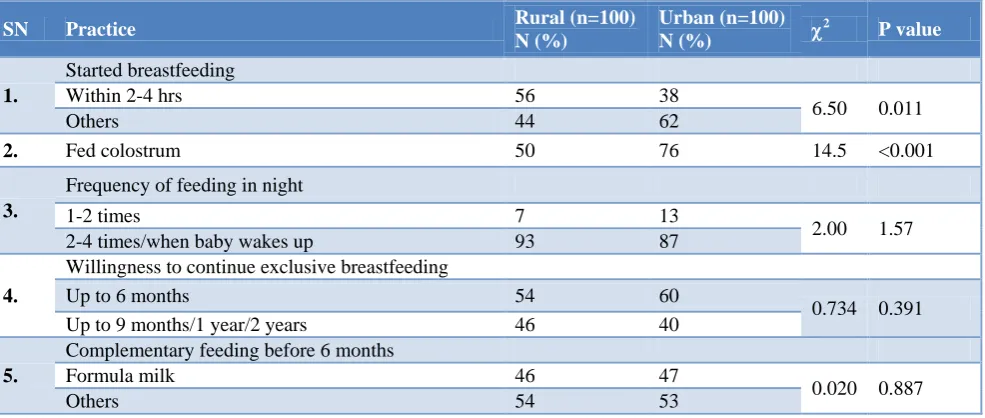
Table 2 shows the comparison of practices of urban and rural women regarding breastfeeding. 56% of rural women had started breastfeeding within one hour, on the other hand only 38% of urban women did the same. This may be attributed to the high incidence of caesarian deliveries in urban areas that causes a delay in the onset of breastfeeding.
The proportion of those who fed colostrum was higher in urban 76%as compared to rural area 50%. 93%of rural and 87% of urban women fed their babies 2-4 times at night or when the baby woke up.
54% of rural and 60% women of urban areas were willing to continue exclusive breastfeeding up to six months followed by 46% of rural and 40% of urban women who were willing to continue the same up to nine months or longer. Statistically, there was no significant difference between two groups with respect to duration to continue exclusive breastfeeding (p=0.391).
With respect to attitudes on the belief that breastfeeding protects from diseases of breast, 49% rural and 43% urban of women agreed. 64% of women of rural area agreed that breastfeeding should be stopped when starting complementary feeding while 36% were uncertain or
disagreed with this. On the contrary in urban area, women those disagreeing were higher (58%). Most of the women agreed to the belief that a baby should burp after feeding (94% rural and 91% urban).
Table 1: Comparison of knowledge of urban and rural women regarding breastfeeding.
SN Factor Rural (n=100)
N (%)
Urban (n=100)
N (%)
2
P value
1.
Best food for baby
Breast milk 60 91
26.0 <0.001
Cow’s milk/others 40 9
2.
Time to start breastfeeding
Within 1 hour 28 40
3.21 0.073
Later than an hour 72 60
3.
Colostrum
First breast milk 42 63
8.84 0.003 Don’t know Breast milk/Secreted after 5 days/
2weeks/ others 58 37
4.
Need for colostrum
For immunity 37 56
1.02 0.313 Promoting growth/food/others 63 44
5.
Period of exclusive breastfeeding
First 6 months 56 62
0.744 0.388 First 2 months/more than a year 44 38
6.
Time for feeding
Child cries 64 46
6.55 0.011 On schedule/as per convenience 36 54
7.
Position of mother during breastfeeding
Side lying 56 43
4.15 0.126
Sitting 44 56
Standing 0 1
Table 2: Comparison of practices of urban and rural women regarding breastfeeding.
SN Practice Rural (n=100)
N (%)
Urban (n=100)
N (%)
2
P value
1.
Started breastfeeding
Within 2-4 hrs 56 38
6.50 0.011
Others 44 62
2. Fed colostrum 50 76 14.5 <0.001
3.
Frequency of feeding in night
1-2 times 7 13
2.00 1.57 2-4 times/when baby wakes up 93 87
4.
Willingness to continue exclusive breastfeeding
Up to 6 months 54 60
0.734 0.391 Up to 9 months/1 year/2 years 46 40
5.
Complementary feeding before 6 months
Formula milk 46 47
0.020 0.887
Table 3: Comparison of attitude of urban and rural women regarding breastfeeding
SN Attitude Rural (n=100)
N (%)
Urban (n=100)
N (%)
2 P value
1.
Colostrum is good for health
Agree 48 77
17.9 <0.001
Uncertain/disagree 52 23
2.
Stop feeding when child has cough/fever
Agree 58 48
2.01 0.157
Uncertain/disagree 42 52
3.
Breastfeeding protects from diseases of breast
Agree 49 43
0.725 0.395
Uncertain/disagree 51 57
4.
Stop breastfeeding when starting complementary feed
Agree 64 42
9.71 0.002
Uncertain/disagree 36 58
5.
Baby should burp after feeding
Agree 94 91
0.649 0.421
Uncertain/disagree 6 9
DISCUSSION
Purpose and benefits of breastfeeding has been stressed all over the world by various health organizations and community-based programs and approaches.
The current study has observed that the knowledge of the urban women regarding what was the best food for the baby and what is the appropriate time to start the breastfeeding was superior to the women residing in rural areas. 91% urban women believed that breast milk was the best food for their infants as opposed to 60% rural women who shared the same opinion. 28% women of rural areas believed that breastfeeding must be initiated within one hour vis-à-vis 63% women of urban areas felt it must be initiated within one hour.
The practice of initiating breastfeeding within one hour was only 38% in urban women whereas 56% of women in rural areas fed their infants within 1-2 hours of their birth. Gaps in knowledge regarding breastfeeding was present in both rural and urban setups. A south Indian based study Chinnasami et al has shown that although 80% women in general had the knowledge to initiate breastfeeding within one hour only 35.5% did so.8 A Ghana based study by Sriram et al has shown that breastfeeding within one hour of delivery reduces the mortality by 22%.9 This shows that health programmes imparting knowledge are not enough neither have women received appropriate antenatal counseling.
Similarly when the knowledge about what colostrum is and why is it essential was evaluated, 42% of rural women and 63% of urban women were aware that it was the first breast milk. 50% of women of rural area gave colostrum to their infants. In urban areas 76% women gave colostrum. While the others discarded it as they were not aware of its importance. On evaluation of
colostrum is good for health as opposed to 77% women of rural areas
The main reason for this in rural areas is on the advice of elders and their belief that colostrum is not good for the health of the baby. Similarly a study in Bihar has shown that about two third of mothers discarded colostrum.10 The study has shown the trend of breast feeding in rural and urban areas to be almost the same. According to Kumar et al, 15.9% respondents threw away their colostrum while in study of Slama et al, 43% of mothers had no knowledge about colostrum.10-12
Regarding the knowledge of period of exclusive breast feeding should be continued for six months it was almost the same in both areas. (56% rural and 62% in urban) and so was the willingness to continue exclusive breast feeding in both areas. (54% in rural and 60% in urban). Chinnasami et al has shown that 11% women did not exclusively breast feed their child and 17% of them gave exclusive breast milk for three months only.8 Mothers should be educated about the benefits of exclusive breastfeeding till six months. In a Delhi based study Taneja et al reported that although 90.6% of mothers breastfed their infants till six months, exclusive breastfeeding was not practiced in majority.13 Medhi & Mahouta et al reported 100% breastfeeding rates with 69.35% of it being exclusive for six months.14 Exclusive breast feeding rates by other studies were 36.8% (Ben Slamaetal) in Riyadh and 22.4% (Yesildal et al) in Turkey.13,15 According to Karnawat et al demand feeding was preferred by 77% of lower class workers while 62% of doctors preferred timed feeding.16
their infant burp after feeding was the same in both areas. In a study done by Mushaphi et al in Vhembe district of Limpopo Province it was observed that about 77.30% mothers had started complementary foods to their infants before six months of age; most commonly they had done so as per elder’s advice (45.00%).17
Contradictory observation was found in the urban and rural areas of Bihar in a study carried out by Yadav et al that 17.70% urban and 13.10% rural mothers started complementary foods before six months of age and 53.70% urban and 54.20% rural mothers started complementary foods between 6–12 months of age.10 However, reason behind early weaning was found to be the apprehension that breast milk was not sufficient (30.00% in urban and 28.90% in rural area). Cereal preparations and milk formed are the major substitutes for children on breast milk. The main reasons for starting supplements were insufficient milk production by mother, child’s demand and supplements are required for proper growth. There was no major difference in the knowledge regarding frequency of feeding in the night and the position to be adopted while feeding. As far as the knowledge of when to feed the child 64% women of rural area were aware of demand feeding as opposed to 46% women of urban areas
There was no major difference in the attitude of women of both areas regarding whether they should stop feeding the child when they are sick and whether breastfeeding protects women from diseases of the breast.
CONCLUSION
Gaps in knowledge, attitude and practices regarding breastfeeding exists in both rural and urban setups and proper steps should be implemented to narrow this. Imparting knowledge and change in attitude through proper counselling may effect breastfeeding practices.
ACKNOWLEDGEMENTS
We thank to the participants of the study for their active participation and co-operation for the study.
Funding: No funding sources Conflict of interest: None declared
Ethical approval: The study was approved by the Institutional Ethics Committee
REFERENCES
1. Ku CM, Chow SKY. Factor influencing the practice of exclusive breastfeeding among Hong Kong Chinese women: a questionnaire survey. J Clin Nurs. 2010;19:2434-45.
2. World Health Organisation. Promoting proper feeding for infants and young chidren. Available at: http://www.who.int/nutrition/topics/infantfeeding/en /ndex.html. Accessed on 10 December 2018.
3. World Health Organisation. Infant and young child feeding: Fact sheet N°342. Geneva: WHO; 2014. Available at: http://www.who.int/mediacentre/ factsheets/fs342/en/. Accessed on 10 December 2018.
4. World Health Organisation. 55th World Health Assembly. Infant and young child nutrition. World Health Organisation (WHA55.25). Available at: http://apps.who.int/gb/archive/pdf_files/WHA55/ew ha5525.pdf;2002. Accessed on 10 December 2018. 5. Davies MC, Arinolan G, Sanusin R, Osotimehin B.
Immunoglobulin classes and nutritional factors in plasma and breast milk of lactating mothers in Nigeria. Iran J Immunol. 2006;3:181–6.
6. Cacodkar J, Joglekar S, Dubhashi A. Breast feeding and infant feeding practices among rural mothers in Goa. Int J Community Med Public Health. 2016;3(1):184-9.
7. Iskandar MB, Costello C, Nasution Y. Initiation and Duration of Breast feeding in Indonesia. Asia Pac Popul J 1990;5:89-112.
8. Chinnasami B, Sundar S, Kumar J, Sadasivam K, Pasupathy S. Knowledge, Attitude and Practices of Mothers Regarding Breastfeeding in a South Indian Hospital. Biomed Pharmacol J. 2016;9(1):195-9. 9. Sriram S, Soni P, Thanvi R, Prajapati N, Mehariya
KM. Knowledge, attitude and practices of mothers regarding infant feeding practices. National J Community Med. 2013;3(2).
10. Yadav RJ and Singh P. Knowledge attitude and practices of mothers about breast feeding in Bihar. Indian J Community Med. 2004;29(3):130-1. 11. Kumar D, Agarwal N, Swami HM.
Socio-demographic correlates of breastfeeding in urban slums of Chandigarh. Indian J Med. Sci 2006;60:461-6.
12. Ben Slama F, Ayari I, Buzini F, Belhadj O, Achour N. Exclusive breastfeeding and mixed feeding- knowledge, attitudes and practices of premiparous mothers. East Mediterr Health J. 2010;16(6):630-5. 13. Taneja DK, Saha R, Dabas P, Gautam VP, Tripathy
Y, Mehra M. Study of infant feeding practices and the underlying factors in a rural areas of Delhi. Indian J Community Med. 2003;28:107-11.
14. Medhi GK and Mahauta J. Breastfeeding weaning practices and nutritional status of infants of tea gardens of Assam. Indian Pediatr. 2004;41:1277-8. 15. Yesildal N, Aytar G, Kocabay K, Mayda AS, Dagil
SC and Bahcebasi T. Breastfeeding practices in Duzce Turkey. J Hum Lact Nov. 2012:24:393-400. 16. Karnawat BS, Singh RN, Gupta BD, Chaudhary SP.
Knowledge and attitudes of hospital employees regarding infant feeding practices. Indian Pediatr. 1987;24:939-48.
17. Mushaphi LF, Mbhenyane XG, Khoza LB. Infant-feeding practices of mothers and the nutritional status of infants in the Vhembe District of Limpopo Province. S Afr J ClinNutr. 2008;21(2):36-41.