* To whom all correspondence should be addressed. Tel/Fax: 09122689608/+98-1135302450;
E-mail: [email protected]
Analysis of Important
H.pylori
Outer Membrane Proteins by
Detection of Common Sequences in Exposed Areas; in Silico Study
Fatemeh Tohidi1, Omid Teymournejad 2*, Ali Taravati 3, Khadijeh Jami al Ahmadi4 and Ramazan Rajabnia2
1Department of Medical Biotechnology, School of Medicine,
MashhadUniversity of Medical Sciences, Mashhad, Iran.
2Department of Microbiology, School of Medicine, Babol University of Medical Sciences, Babol, Iran. 3Department of Molecular and Cell Biology, Faculty of Basic Sciences,
University of Mazandaran, Babolsar, Iran.
4Biotechnology Research Centre, Mashad University of Medical Sciences, Mashad, Iran.
doi: http://dx.doi.org/10.13005/bbra/2184 (Received: 12 May 2015; accepted: 09 July 2015)
H. pylori Outer membrane proteins (OMPs) play a main role in the pathogenesis.Our study aimed to study on computational investigation for determination of H. pylori OMPsstructures, accessible surface area and common amino acid sequences in exposed regions. BabA/BabB,AlpA/AlpB andSabA/SabB were analyzed. NCBI and PDB were used as databases. PHD, GOR4, SignalP3.0, CPH Models, PHYRE and VADAR servers and two software including Swiss PDB viewer and Discovery studio were used for all analysis. Seven, six, five, five, four and two sequences of exposed amino acid were identified for SabB, SabA, Alpa, AlpB, BabA and BabB, respectively. Sequence similarities between BabA,BabB,AlpA,AlpB,SabA and SabB were 7.6%. Similarity between BabA / BabB and AlpA/AlpB were approximately 41%. Similarity betweenSabA and SabB were 71.19%. The common areas in expose amino acid region were 86-89/56-58 in SabA/ SabB and 170-171, 34-37/186-187, 54-57 in AlpA /AlpB, respectively. Detection of exposed amino acid sequences of OMPs is very helpful for characterization of their corresponding receptor. A number of common regions, between SabA/ SabB and AlpA /AlpB, located on the exposed amino acid areas but none of the similar areas in BabA/B is located on the exposed amino acid regions. Exposed amino acid of OMPs isthe main sequences which are related to interaction with stomach epithelial cells.
Key words:AlpA, AlpB, BabA, SabA, Exposed amino acid sequences.
After discovery of Helicobacter pylori pathogenesis approximately 30 years ago many scientists have shown that H. pylori strains cause various diseases including chronic gastritis, peptic ulcer, gastric adenocarcinoma and primary gastric B-cell lymphoma(J. V. Solnick and D. B. Schauer, 2001).
It has been proposed that H. pylori adhesins play important role for binding to the gastric mucosa and outcome of infection (D. Ilver et al., 1998, J. Mahdavi et al., 2002, N. Murata-Kamiya, 2011). Adherence of Helicobacter pylori and colonization to the gastric mucosa induces host immune and inflammatory responses. However, H. pylori escape from host immune response with different mechanisms (E. P. Reeves et al., 2008).
surface of the bacteria, which act as adhesions. (BabA/B, SabA, AlpA/B, OipA and HopZ)(J. Mahdavi, B. Sonden, M. Hurtig, F. O. Olfat, L. Forsberg, N. Roche, J. Angstrom, T. Larsson, S. Teneberg, K. A. Karlsson, S. Altraja, T. Wadstrom, D. Kersulyte, D. E. Berg, A. Dubois, C. Petersson, K. E. Magnusson, T. Norberg, F. Lindh, B. B. Lundskog, A. Arnqvist, L. Hammarstrom and T. Boren, 2002) . Most of these outer membrane proteins adhere to corresponding receptors on the host gastric epithelium and increase the outcome of infection.
Currently, candidate receptors have been identified on the host gastric epithelium including oligosaccharides, glycolipids, glycoproteins and mucins. For instance , fucosylated oligosaccharide structure presented both in the H-1 and Lewis b blood group antigens and BabAbinds the Lew b antigen(M. Aspholm-Hurtig et al., 2004, D. G. Evans et al., 1988, S. Hirmo et al., 1999, D. Ilver, A. Arnqvist, J. Ogren, I. M. Frick, D. Kersulyte, E. T. Incecik, D. E. Berg, A. Covacci, L. Engstrand and T. Boren, 1998, J. Lelwala-Guruge et al., 1992).
Indeed, Lewis b available on the surface of MUC5AC in gastric mucus (C. De Bolos et al., 1995).Pervious study had shown that the presence of babAgenewith cagA(cytotoxin-associated gene A) and vacA(vacuolatingcytotoxin gene A), togetherincreasethe risk of gastritis, ulcer disease, gastric cancer and MALT lymphoma (M. Gerhard et al., 1999, F. O. Olfat et al., 2005, C. F. Zambon et al., 2003).
SabA is one of the major H. pyloriadhesins and the sialyl-Lewis x antigen is a binding site for SabA. The interaction of H. pylori with MUC1 in gastric mucus mediates by both SabA and BabA(S. K. Linden et al., 2009). Induction of interleukin-8(IL-8) secretion by two highly homologous OMPs, AlpA and AlpB, facilitate gastric injury and inflammation (H. Lu et al., 2007).
These two genes are capable of binding to the host cell laminin probably as adhesins. Additionally, other host related receptors have not been recognized yet (O. A. Senkovich et al., 2011). AlpA and AlpB mutants in C57BL/6 mice showed low colonization in gastric epithelial cells (H. Lu, J. Y. Wu, E. J. Beswick, T. Ohno, S. Odenbreit, R. Haas, V. E. Reyes, M. Kita, D. Y. Graham and Y. Yamaoka, 2007).
Some of OMPs are associated with multiple intracellular signaling pathways and consecutive production of pro-inflammatory cytokines, such as interleukin-8 (IL-8), in epithelial cells and increased peptic ulcer disease (S. Censini et al., 1996, Y. Yamaoka et al., 2002).
In the present study we have focused on OMPs that play important role in the gastric disease.
The aim of this research is an extensive computational analysis for investigate OMPs in view of Secondary structures,tertiary structure, signal sequence,internal and external loops. Finding of homology modeling, prediction of accessible surface area amino acids among sequences of external loops and similarity of exposed amino acid area in these groups of proteins. The result of this study will be useful for detection adhesion motifs, reorganization of cell surface receptors and to get a better understanding of OMPs interaction with gastric epithelial cells and host inflammatory response.
MATERIALS AND METHODS
Databases
Amino acids sequences of, BabA,BabB,AlpA ,AlpB,SabA and SabB were analyzed via recovering the genes from National Center for Biotechnology Institute and Uni-prot KB/Swiss-Prot.
Accession number of BabA,BabB,AlpA ,AlpB,SabA and SabB in NCBI were 7010027, 12356019, 12355264, 12355263, 9349659 and 7009867, respectively. Accession number of these genes in Uni-prot KB/Swiss-Prot were B6JMB5, E6NLN7, E6NNU8,E6NNU7,D7FE80and B6JLV4, respectively. Proteins tertiary structure were taken in Protein Data Bank(H. M. Berman et al., 2000). Servers
There are many freely accessible Web servers for protein structures prediction on the Internet. Our model can be built by Phyre servers, namely, structure prediction systems using such algorithm to provide models in PDB format and homology modeling(L. A. Kelley and M. J. Sternberg, 2009).
It is well known that a tertiary structure is mainly responsible for protein’s function. Role of loops and turns in protein structure, folding, stability, and function is determined (J. S. Fetrow, 1995, P. T. Jones et al., 1986). Every OMP has a
particular pattern of exposed amino acid sequences in external loops, which can be predicted by GETAREA and VADAR servers. Swiss PDB viewer and Discovery studio server were used for processing of data.Uniprot alignment was performed for sequence similarity OMPs detection.
RESULT
Sequences of the outer membrane proteins were retrieved from the data bases and analysis for detection of surface amino acids were
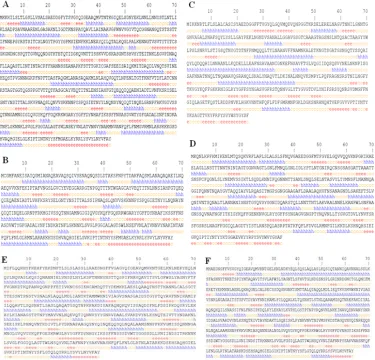
Fig. 2. Secondary structure prediction of OMPs by GOR4 server;A(BabA),B(BabB), C(AlpA), D(AlpB),E(SabA), F (SabB).
performed via above-mentioned servers. Our findings showed that BabAhad four exposed sequences of amino acid;30-55,140-155,245-260,309-320, BabBwith twoexposed sequences of amino acid;36-41,100-115, Alpa with five exposed sequences of amino acid;12-37,80-90,130-135,170-175,183-190, AlpB with fiveexposed sequences of amino acid;50-55,75-82,100-105,172-180,180-187, SabA with sixexposed sequences of amino acid;78-80,86-112,140-160,195-200,240-260,300-310, SabB with seven exposed sequences of amino acid;52-58,82-115,135-155,230-240,270-285,270-275,290-298. SignalP 4.1 Server allowed us to recognize signal sequences of the outer membrane proteins and incision sites which are shown in fig.1. Moreover, secondary structures (beta sheet, alpha
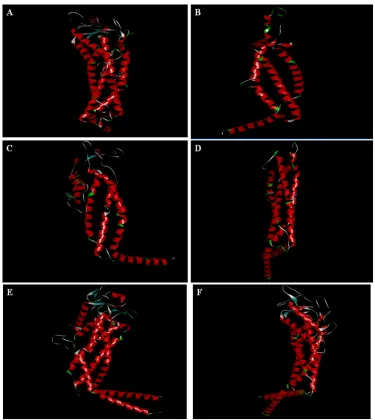
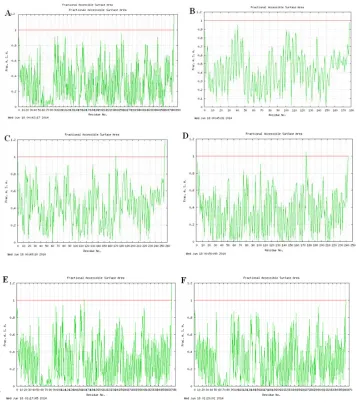
helices, random coil) for the OMPs are shown throughPHD and GOR 4 servers (figure2).The tertiary structures were predicted by Phyre servers(figure3) following via GETAREA and VADAR servers for detecting accessible surface area amino acids(figure4).
Uniprot alignment for measuring similarity between the OMPs showed that although there is a low similarity (7.6%) between BabA, BabB, AlpA, AlpB, SabA and SabB, the sever has found high similarities among BabA/ BabB (41.16%), AlpA/ AlpB (41.95%) and SabA/SabB (71.19%).
Fig. 3. Tertiary structure prediction of OMPs by CPH model server. Data are shown with Discovery StudioVisualizer;A(BabA), B(BabB), C(AlpA), D(AlpB),E(SabA), F(SabB).
86-89/56-58 in SabA/SabB, 170-171, 34-37/186-187, 54-57 in AlpA/AlpB.
Despite high sequence similarity between BabA and BabB, none of the similar areas were located on the exposed regions. The similarity between BabA, BabB, AlpA, AlpB, SabA and SabB were not in exposed amino acid sequences.
DISCUSSION
The gastric pathogen,H. pylori, is one of the bacteria that lead to development of chronic
Fig. 4. Prediction of accessible surface area by vadar server;A(BabA),B(BabB), C(AlpA), D(AlpB),E(SabA), F (SabB).
The remarkable progress in recent years has resulted from taking advantage of bioinformatics tools with the structure and function of proteins and application of this information for protein engineering, modeling and manufacturing of vaccines .Outermembrane proteinscouldpossiblybeone ofthemost important proteins in H. pylori.Furthermore,OMPs act as adhesins and involve in gastric colonization(B. Kalali et al., 2014). It was found thatOMPs of bacteriaare appropriatecandidates for vaccine production(Ravinder Singh et al., 2014). In the current study, we have systematically analyzed
finding a common amino acid sequence of the proteins which share a high similarity in their exposed amino acid sequences will likely provide us a possible target site for new drugs or vaccines.Moreover, detection of these sequences is very useful for finding complementary receptors on surface of gastric epithelial cell and specific targeting of cell surface receptors.
BabA play a role in CagAtranslocation by theH. pylori TFSSand lead to inflammationand intestinal metaplasia(N. Ishijima et al., 2011, S. M. Sheu et al., 2012).Although, BabA interacts with a Lewis b on the human gastric MUC5AC, the biding role of the other proteins in HOP (helicobacter outer membrane proteins) group (BabB, BabC, and HP0227) has not been identified so far(D. Ilver, A. Arnqvist, J. Ogren, I. M. Frick, D. Kersulyte, E. T. Incecik, D. E. Berg, A. Covacci, L. Engstrand and T. Boren, 1998).Sequence similarity between BabA/ B genes was 41.16% and the proteins are highly similar in their N- and C-terminal regions but none of thesimilar areas has located on the exposed amino acid region.
Two greatly homologous OMPs, AlpA and AlpB located in the alpAB operon. AlpA/B causes interleukin-8(IL-8) secretion and expansion of the inflammatory responses (S. Odenbreit et al., 2002, S. Odenbreit et al., 1996, S. Odenbreit et al., 1999). Even though, the pair proteins will bind to host laminins, their corresponding receptors for these proteins remains unknown up to now (O. A. Senkovich, J. Yin, V. Ekshyyan, C. Conant, J. Traylor, P. Adegboyega, D. J. McGee, R. E. Rhoads, S. Slepenkov and T. L. Testerman, 2011) .Various types of bioinformatic tools were used to analyses sequence similarity and detection of exposed amino acid sequences. As a result, afew regions of exposed amino acid sequences were detected as common regions which were 170-171, 34-37 in AlpA and 186-187,54-57 in AlpB, respectively.The biological importance of AlpA and AlpB in adherence to host cells and tissues was reported in several studies and Exposed amino acid sequences of OMPs family play important role in binding to gastric tissue(S. Odenbreit, G. Faller and R. Haas, 2002, S. Odenbreit, M. Till and R. Haas, 1996, S. Odenbreit, M. Till, D. Hofreuter, G. Faller and R. Haas, 1999). Moreover, these two proteins are expressed in all H.pylori strains at steady rates whereas other H.pylori OMPs produce at variable rates which emphasis a
critical function of AlpA and AlpB in the bacteria (S. C. Baik et al., 2004).
SabAof H. pylori can bind to various receptors such as sialyl-dimeric-Lex, sialylated structures on the surface of erythrocytes ,salivary mucin MUC7, MUC5B and sialylated moieties on the extracellular matrix protein laminin(J. Mahdavi, B. Sonden, M. Hurtig, F. O. Olfat, L. Forsberg, N. Roche, J. Angstrom, T. Larsson, S. Teneberg, K. A. Karlsson, S. Altraja, T. Wadstrom, D. Kersulyte, D. E. Berg, A. Dubois, C. Petersson, K. E. Magnusson, T. Norberg, F. Lindh, B. B. Lundskog, A. Arnqvist, L. Hammarstrom and T. Boren, 2002, M. Oleastro and A. Menard, 2013). Both proteins, SabAand BabA, adhere to the salivary mucin MUC5B in human gastric butSabAbinds to mucinweaker than BabA(A. Walz et al., 2005, A. Walz et al., 2009).
Our finding has shown that thesimilarity rate between two proteins SabA/ SabBwas 71.19% but there was a short amino acid sequence in the exposed area which was common between two proteins (86-89/56-58).
Detection of Exposed amino acid sequences in OMPs is very helpful for characterization of the receptors. Adherenceto the gastric epithelium with specific receptors is a crucial step in beginning of infection. In addition, it can be considered for better understanding of the pathways of H. pylori colonization. In this way, we can recognize possible receptor on gastric epithelial cells. In fact, detection of these receptors probably helps us for control of H. pylori infection and to understand fundamental mechanisms of H. pylori colonization in chronic infection. Additionally,Adhesion motifs of the OMPsare a stimulator for host cell immune responseand induce pro-inflammatory intracellular signaling. Therefore, these proteins can be used as a purpose for vaccine expansion and protein docking study. Indeed,further studies shouldbe performedinvaccine design and potential targets in future.
CONCLUSION
A number of common regions,between SabA/SabB and AlpA/AlpB, located on the exposed aminoacid areas.In spite of high similarity in BabA/B Homologous, none of the similar areas is located on the exposed amino acid regions.
This study has provided accessible surface areaamino acid sequences, which will be helpful for detection of possible receptors on gastricepithelial cells andto design novel targets to prohibit progress of disease that leads to severe pathologic outcomes.
REFERENCE
1. Aspholm-Hurtig, M.; G. Dailide; M. Lahmann; A. Kalia; D. Ilver; N. Roche; S. Vikstrom; R. Sjostrom; S. Linden; A. Backstrom, et al. “Functional Adaptation of Baba, the H. Pylori Abo Blood Group Antigen Binding Adhesin.”
Science, 2004; 305(5683), 519-22.
2. Baik, S. C.; K. M. Kim; S. M. Song; D. S. Kim; J. S. Jun; S. G. Lee; J. Y. Song; J. U. Park; H. L. Kang; W. K. Lee, et al. “Proteomic Analysis of the Sarcosine-Insoluble Outer Membrane Fraction of Helicobacter Pylori Strain 26695.” J Bacteriol, 2004; 186(4), 949-55.
3. Berman, H. M.; J. Westbrook; Z. Feng; G. Gilliland; T. N. Bhat; H. Weissig; I. N. Shindyalov and P. E. Bourne. “The Protein Data Bank.”
Nucleic Acids Res, 2000; 28(1), 235-42. 4. Blaser, M. J. “Ecology of Helicobacter Pylori
in the Human Stomach.” J Clin Invest, 1997;
100(4), 759-62.
5. Censini, S.; C. Lange; Z. Xiang; J. E. Crabtree; P. Ghiara; M. Borodovsky; R. Rappuoli and A. Covacci. “Cag, a Pathogenicity Island of Helicobacter Pylori, Encodes Type I-Specific and Disease-Associated Virulence Factors.” Proc Natl Acad Sci U S A, 1996; 93(25), 14648-53. 6. De Bolos, C.; M. Garrido and F. X. Real. “Muc6
Apomucin Shows a Distinct Normal Tissue Distribution That Correlates with Lewis Antigen Expression in the Human Stomach.”
Gastroenterology, 1995; 109(3), 723-34. 7. Evans, D. G.; D. J. Evans, Jr.; J. J. Moulds and
D. Y. Graham. “N-Acetylneuraminyllactose-Binding Fibrillar Hemagglutinin of Campylobacter Pylori: A Putative Colonization Factor Antigen.” Infect Immun, 1988; 56(11), 2896-906.
8. Fetrow, J. S. “Omega Loops: Nonregular Secondary Structures Significant in Protein Function and Stability.” Faseb j, 1995; 9(9), 708-17.
9. Gerhard, M.; N. Lehn; N. Neumayer; T. Boren; R. Rad; W. Schepp; S. Miehlke; M. Classen and C. Prinz. “Clinical Relevance of the Helicobacter Pylori Gene for Blood-Group Antigen-Binding Adhesin.” Proc Natl Acad Sci U S A, 1999;
96(22), 12778-83.
10. Hirmo, S.; E. Artursson; G. Puu; T. Wadstrom and B. Nilsson. “Helicobacter Pylori Interactions with Human Gastric Mucin Studied with a Resonant Mirror Biosensor.” J Microbiol Methods, 1999; 37(2), 177-82.
11. Ilver, D.; A. Arnqvist; J. Ogren; I. M. Frick; D. Kersulyte; E. T. Incecik; D. E. Berg; A. Covacci; L. Engstrand and T. Boren. “Helicobacter Pylori Adhesin Binding Fucosylated Histo-Blood Group Antigens Revealed by Retagging.”
Science, 1998; 279(5349), 373-7.
12. Ishijima, N.; M. Suzuki; H. Ashida; Y. Ichikawa; Y. Kanegae; I. Saito; T. Boren; R. Haas; C. Sasakawa and H. Mimuro. 2011. “Baba-Mediated Adherence Is a Potentiator of the Helicobacter Pylori Type Iv Secretion System Activity.” J Biol Chem, 286(28), 25256-64. 13. Jones, P. T.; P. H. Dear; J. Foote; M. S.
Neuberger and G. Winter. “Replacing the Complementarity-Determining Regions in a Human Antibody with Those from a Mouse.”
Nature, 1986; 321(6069), 522-5.
14. Kalali, B.; R. Mejias-Luque; A. Javaheri and M. Gerhard. “H. Pylori Virulence Factors: Influence on Immune System and Pathology.” Mediators Inflamm, 2014, 426309.
15. Kelley, L. A. and M. J. Sternberg. “Protein Structure Prediction on the Web: A Case Study Using the Phyre Server.” Nat Protoc, 2009; 4(3), 363-71.
16. Lelwala-Guruge, J.; A. Ljungh and T. Wadstrom. “Haemagglutination Patterns of Helicobacter Pylori. Frequency of Sialic Acid-Specific and Non-Sialic Acid-Specific Haemagglutinins.”
Apmis, 1992; 100(10), 908-13.
17. Linden, S. K.; Y. H. Sheng; A. L. Every; K. M. Miles; E. C. Skoog; T. H. Florin; P. Sutton and M. A. McGuckin. “Muc1 Limits Helicobacter Pylori Infection Both by Steric Hindrance and by Acting as a Releasable Decoy.” PLoS Pathog, 2009; 5(10), e1000617.
18. Lu, H.; J. Y. Wu; E. J. Beswick; T. Ohno; S. Odenbreit; R. Haas; V. E. Reyes; M. Kita; D. Y. Graham and Y. Yamaoka. “Functional and Intracellular Signaling Differences Associated with the Helicobacter Pylori Alpab Adhesin from Western and East Asian Strains.” J Biol Chem, 2007; 282(9), 6242-54.
S. Teneberg; K. A. Karlsson, et al. “Helicobacter Pylori Saba Adhesin in Persistent Infection and Chronic Inflammation.” Science, 2002;
297(5581), 573-8.
20. Murata-Kamiya, N. “Pathophysiological Functions of the Caga Oncoprotein During Infection by Helicobacter Pylori.” Microbes Infect, 2011; 13(10), 799-807.
21. Nielsen, H.; J. Engelbrecht; S. Brunak and G. von Heijne. “A Neural Network Method for Identification of Prokaryotic and Eukaryotic Signal Peptides and Prediction of Their Cleavage Sites.” Int J Neural Syst, 1997; 8(5-6), 581-99. 22. Odenbreit, S.; G. Faller and R. Haas. “Role of the Alpab Proteins and Lipopolysaccharide in Adhesion of Helicobacter Pylori to Human Gastric Tissue.” Int J Med Microbiol, 2002;
292(3-4), 247-56.
23. Odenbreit, S.; M. Till and R. Haas. “Optimized Blam-Transposon Shuttle Mutagenesis of Helicobacter Pylori Allows the Identification of Novel Genetic Loci Involved in Bacterial Virulence.” Mol Microbiol, 1996; 20(2), 361-73. 24. Odenbreit, S.; M. Till; D. Hofreuter; G. Faller and R. Haas. “Genetic and Functional Characterization of the Alpab Gene Locus Essential for the Adhesion of Helicobacter Pylori to Human Gastric Tissue.” Mol Microbiol, 1999;
31(5), 1537-48.
25. Oleastro, M. and A. Menard. “The Role of Helicobacter Pylori Outer Membrane Proteins in Adherence and Pathogenesis.” Biology (Basel), 2013; 2(3), 1110-34.
26. Olfat, F. O.; Q. Zheng; M. Oleastro; P. Voland; T. Boren; R. Karttunen; L. Engstrand; R. Rad; C. Prinz and M. Gerhard. “Correlation of the Helicobacter Pylori Adherence Factor Baba with Duodenal Ulcer Disease in Four European Countries.” FEMS Immunol Med Microbiol, 2005; 44(2), 151-6.
27. Porollo, Aleksey A; Rafal Adamczak and Jaroslaw Meller. “Polyview: A Flexible Visualization Tool for Structural and Functional Annotations of Proteins.” Bioinformatics, 2004;
20(15), 2460-62.
28. Reeves, E. P.; T. Ali; P. Leonard; S. Hearty; R. O’Kennedy; F. E. May; B. R. Westley; C. Josenhans; M. Rust; S. Suerbaum, et al. “Helicobacter Pylori Lipopolysaccharide Interacts with Tff1 in a Ph-Dependent Manner.”
Gastroenterology, 2008; 135(6), 2043-54, 54.e1-2.
29. Rost, B.; C. Sander and R. Schneider. “Phd—an Automatic Mail Server for Protein Secondary Structure Prediction.” Comput Appl Biosci, 1994; 10(1), 53-60.
30. Senkovich, O. A.; J. Yin; V. Ekshyyan; C. Conant; J. Traylor; P. Adegboyega; D. J. McGee; R. E. Rhoads; S. Slepenkov and T. L. Testerman. “Helicobacter Pylori Alpa and Alpb Bind Host Laminin and Influence Gastric Inflammation in Gerbils.” Infect Immun, 2011; 79(8), 3106-16. 31. Sheu, S. M.; B. S. Sheu; W. C. Chiang; C. Y.
Kao; H. M. Wu; H. B. Yang and J. J. Wu. . “H. Pylori Clinical Isolates Have Diverse Babab Genotype Distributions over Different Topographic Sites of Stomach with Correlation to Clinical Disease Outcomes.” BMC Microbiol, 2012; 12, 89.
32. Singh, Ravinder; Nisha Garg; Neena Capalash; Rajnish Kumar; Manoj Kumar and Prince Sharma. “In Silico Analysis of Acinetobacter Baumannii Outer Membrane Protein Bama as a Potential Immunogen.” Int. J. Pure Appl. Sci. Technol, 2014; 21(2), 32-39.
33. Solnick, J. V. and D. B. Schauer. “Emergence of Diverse Helicobacter Species in the Pathogenesis of Gastric and Enterohepatic Diseases.” Clin Microbiol Rev, 2001; 14(1), 59-97.
34. Walz, A.; S. Odenbreit; J. Mahdavi; T. Boren and S. Ruhl. “Identification and Characterization of Binding Properties of Helicobacter Pylori by Glycoconjugate Arrays.” Glycobiology, 2005;
15(7), 700-8.
35. Walz, A.; S. Odenbreit; K. Stuhler; A. Wattenberg; H. E. Meyer; J. Mahdavi; T. Boren and S. Ruhl. “Identification of Glycoprotein Receptors within the Human Salivary Proteome for the Lectin-Like Baba and Saba Adhesins of Helicobacter Pylori by Fluorescence-Based 2-D Bacterial Overlay.” Proteomics, 2009; 9(6), 1582-92.
36. Yamaoka, Y.; S. Kikuchi; H. M. el-Zimaity; O. Gutierrez; M. S. Osato and D. Y. Graham. “Importance of Helicobacter Pylori Oipa in Clinical Presentation, Gastric Inflammation, and Mucosal Interleukin 8 Production.”
Gastroenterology, 2002; 123(2), 414-24. 37. Zambon, C. F.; F. Navaglia; D. Basso; M. Rugge