Original Research Article
Active detection of tuberculosis: tackling the problem head on in the
remote area of Andaman and Nicobar Islands
Samarendra Prasanna Burma
1, Gunda Jahnavi
2*, Pappachen Lal
3, Pandurang V. Thatkar
2INTRODUCTION
Andaman and Nicobar islands, one of the seven union territories of India is archipelago of 572 islands in the Bay of Bengal; comprises two island groups, the Andaman Islands and the Nicobar Islands. These islands are a home for six primitive tribes which constitute about 10 of the population and also the immigrants from mainland India. Car Nicobar is the administrative
headquarters for the Nicobar District and has a population of 36,842 according to 2011 census. Nicobarese families are patriarchal and as a rule live in large joint families called Tuhet. They live in circular shaped huts with a high thatched pent roof. The hut is raised on piles 5-7 feet from the ground consisting of one large boarded floor, without divisions. The houses have no windows and there is only one single sleeping space for all the occupants of the hut.
ABSTRACT
Background: Community based active case finding for tuberculosis (TB) is an essential step in the fight forward for eliminating TB. One of the steps in targeting TB intervention is early diagnosis and treatment of patients by reducing the reservoir of infection in the community. Active case finding (ACF) targeting the entire population by house to house survey was done in Nicobar district of these islands.
Methods: A community-based, cross-sectional, descriptive study was conducted with the trained mobile teams from 17.07.2017 to 31.07.2017 in the Nicobar District. The algorithm of the case detection included screening patients by symptoms, then by sputum microscopy for confirmation. X-ray was done in patients who were symptomatic but sputum negative. If both smear and chest X-ray results were negative but still symptomatic, then cartridge-based nucleic acid amplification test (CBNAAT) was done.
Results: A total population of 18526 was mapped of which 14784 (79.8) could be screened. A total of 209 people were identified by the mobile teams with symptoms who were examined by sputum microscopy. Among them 7 cases were identified to be sputum smear positive, 2 X-ray positive and 2 were diagnosed by CBNAAT.
Conclusions: This study shows that the active case finding method is feasible and acceptable by the community. The results obtained are encouraging for the implementation of ACF through mobile team activity in all these islands in order to meet the target of WHO’s End TB Strategy.
Keywords: Active case finding, Tuberculosis, Nicobar district
1
Department of TB and Chest, GB Pant Hospital, 2Department of Community Medicine, Andaman and Nicobar Islands Institute of Medical Sciences, Port Blair, Union Territory, India
3
District TB Officer, South Andaman, Port Blair, Union Territory, India
Received: 30 May 2019
Revised: 16 July 2019
Accepted: 17 July 2019
*Correspondence:
Dr. G. Jahnavi,
E-mail: [email protected]
Copyright: © the author(s), publisher and licensee Medip Academy. This is an open-access article distributed under the terms of the Creative Commons Attribution Non-Commercial License, which permits unrestricted non-commercial use, distribution, and reproduction in any medium, provided the original work is properly cited.
The National Tuberculosis Control Programme started in these islands from 1962, and then in 1997 Revised National Tuberculosis Control Programme was implemented. The targets set by World Health Organization of detecting 70 of estimated cases and successfully treating 85 of the detected cases have been achieved by the islands in 2005. Despite the success achieved over the past decade the notification rates have stagnated. Though there is a lack of definitive evidence that systematic screening for TB leads to epidemiological impact, screening persons at high risk for TB has increasingly become a major global health priority, as it ensures that those with TB receive prompt treatment and may reduce ongoing transmission.1-4 A variety of active case-finding strategies for tuberculosis (TB) were tested and proved to be effective over the past century.5
Early diagnosis and treatment of TB remains the essential step in reducing the reservoir of infection in the community. While the routine TB services are essential particularly for case management, it has proven inadequate to control TB because available services are not always accessible to poor and vulnerable populations where TB often concentrates.6,7 In light of this challenge, a renewed interest in active case finding (ACF) as a complementary strategy to improve case detection has emerged.8,9,10 In a large study carried out in India using ACF resulted in the detection of a large number of presumptive pulmonary TB cases who were not accessed by the regular National TB programme with variation across different states.11
TB is the 9th leading cause of death worldwide and the leading infectious cause, ranking above HIV/AIDS.11 The World Health Organization’s End TB Strategy and also Sustainable Development Goals envisage achieving 90 reduction in TB deaths and an 90 decrease in TB incidence by 2035 compared to 2015.12 Active case finding was proposed under RNTCP to enhance the case finding of the remaining 25 of the missed cases.13,14 Systematic screening of those at high risk for TB is a key component of the end TB strategy. Active case finding (ACF) can help in early and efficient case detection among vulnerable population.
The incidence of Tuberculosis in the Nicobar district is 3.1 per 1000 polulation which is very high as compared to the rest of the country 2.1 per 1000 population. (167 cases in 2017 and 115 cases in 2018 total population 37000). As it is a hard to reach area and the incidence of Tuberculosis is very high and the living conditions which favour the spread of Tb like sharing the same hall for sleeping, overcrowding and ill ventilated houses, the ACF strategy has been undertaken in this district to start with.
The objective of this study was to detect the missed out cases from the vulnerable population of the Nicobar district through mobile teams, contribution of patients
through active case finding, characteristics of the patients detected and their treatment outcomes.
METHODS
A community-based, cross-sectional, descriptive study was conducted was conducted from 17.07.2017 to 31.07.2017 in the Nicobar District. A total of 10 teams had performed house-to-house survey using the structured proforma. Before conducting the survey, detailed area map was prepared by individual team. The team consisted of Ashas, Anganwadi workers, multi-purpose health workers of that area. They were trained before the survey. Village selection for active case finding was based on Hard to Reach and Vulnerable population. 7 villages were selected from Car Nicobar island, 4 from Campbell Bay, 6 from Nancowrie, 3 from Katchal, 5 from Teressa. Thus a total of 25 villages were chosen from 5 islands of the Nicobar district. A house to house screening was done to cover the entire population of these villages. The algorithm followed was to screen for presence of Presumptive TB with any of the four symptoms suggestive of Pulmonary Tuberculosis – cough or fever ≥ 2 weeks, history of hemoptysis anytime in last 6 months, significant weight loss, chest pain ≥ 1 month as per RNTCP criteria.10 If any of these presumptive symptoms were present, they were motivated to undergo sputum examination. They were educated to bring out mucopurulent sputum and spot samples were collected by the survey team, the second container was given to collect early morning sputum and the same was collected by the survey team on the next day. Sputum examinations were done of which even one positive is considered as confirmation of Tuberculosis and put on treatment. Chest X-ray was advised for sputum negatives or if the individual cannot expectorate and reviewed by the chest physician. If both smear and chest X-ray results were negative but still symptomatic, then cartridge-based nucleic acid amplification test (CBNAAT) was done. Those who were diagnosed were started on treatment. Socio demographic data like age, sex, address also was collected.
Health Care pertaining to Tuberculosis in Andaman and Nicobar islands are that there are 9 TB units, 13 Designated Microscopy Centers, 233 Dots Centers of which 3 TB units, 4 Designated Microscopy Centers and 35 Dots Centers are in Nicobar District.
The data collected was entered in MS excel and analysed using SPSS statistical software IBM SPSS 20.0 (Chicago), after which it was tabulated, analysed and interpreted using frequencies and percentages.
RESULTS
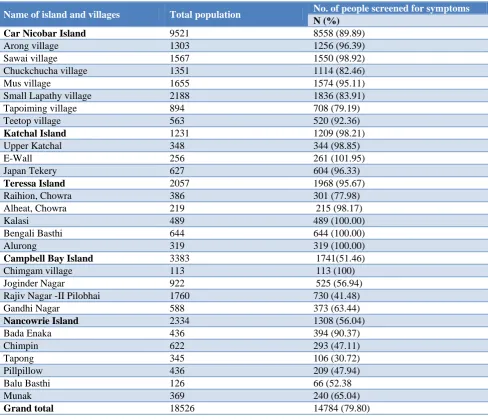
Bengali Basthi and Alurong of Teressa island all the people could be screened as shown in Table 1.
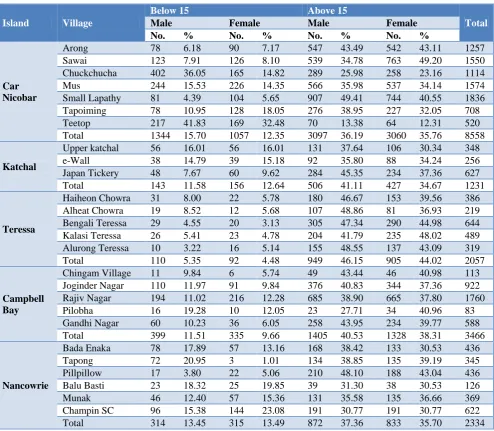
The age and sex distribution of the total number of people screened for symptoms of Tuberculosis is depicted in Table 2. Males and females were almost equally represented with slight preponderance of males.
A total of 209 people were detected with one or more symptoms of Tuberculosis of which151 people were detected with cough for more than 2 weeks, 33 with fever and night sweats, 43 with weight loss, 31 with hemoptysis and 72 with chest pain. The highest number of people with one or more symptoms was found in the Car Nicobar island (Table 3).
A total of 209 people with symptoms of Tuberculosis were examined for sputum microscopy, X-ray, CBNAAT and 11 were found positive from various villages as depicted in Table 4.
Tuberculosis cases detected by routine case finding and active case finding through mobile teams is depicted in Table 5.
There is a wide range of variation in the contribution in these islands with highest in Car Nicobar island and zero contribution in Teressa island. Overall the average contribution in the Nicobar district by active case finding is 6.59.
A total of 11 patients were diagnosed with Tuberculosis of which 7 were females. Most of the patients belonged to 15-45 year age group. Most of the patients diagnosed were sputum positive. All the patients were cured or treatment completed at the end of treatment as depicted in Table 6.
Table 1: Total population and the number of people screened for TB.
Name of island and villages Total population No. of people screened for symptoms
N (%) Car Nicobar Island 9521 8558 (89.89)
Arong village 1303 1256 (96.39)
Sawai village 1567 1550 (98.92)
Chuckchucha village 1351 1114 (82.46)
Mus village 1655 1574 (95.11)
Small Lapathy village 2188 1836 (83.91)
Tapoiming village 894 708 (79.19)
Teetop village 563 520 (92.36)
Katchal Island 1231 1209 (98.21)
Upper Katchal 348 344 (98.85)
E-Wall 256 261 (101.95)
Japan Tekery 627 604 (96.33)
Teressa Island 2057 1968 (95.67)
Raihion, Chowra 386 301 (77.98)
Alheat, Chowra 219 215 (98.17)
Kalasi 489 489 (100.00)
Bengali Basthi 644 644 (100.00)
Alurong 319 319 (100.00)
Campbell Bay Island 3383 1741(51.46)
Chimgam village 113 113 (100)
Joginder Nagar 922 525 (56.94)
Rajiv Nagar -II Pilobhai 1760 730 (41.48)
Gandhi Nagar 588 373 (63.44)
Nancowrie Island 2334 1308 (56.04)
Bada Enaka 436 394 (90.37)
Chimpin 622 293 (47.11)
Tapong 345 106 (30.72)
Pillpillow 436 209 (47.94)
Balu Basthi 126 66 (52.38
Munak 369 240 (65.04)
Table 2: Age and sex distribution of total number of people screened for symptoms.
Island Village
Below 15 Above 15
Total
Male Female Male Female No. % No. % No. % No. %
Car Nicobar
Arong 78 6.18 90 7.17 547 43.49 542 43.11 1257 Sawai 123 7.91 126 8.10 539 34.78 763 49.20 1550 Chuckchucha 402 36.05 165 14.82 289 25.98 258 23.16 1114 Mus 244 15.53 226 14.35 566 35.98 537 34.14 1574 Small Lapathy 81 4.39 104 5.65 907 49.41 744 40.55 1836 Tapoiming 78 10.95 128 18.05 276 38.95 227 32.05 708 Teetop 217 41.83 169 32.48 70 13.38 64 12.31 520 Total 1344 15.70 1057 12.35 3097 36.19 3060 35.76 8558
Katchal
Upper katchal 56 16.01 56 16.01 131 37.64 106 30.34 348 e-Wall 38 14.79 39 15.18 92 35.80 88 34.24 256 Japan Tickery 48 7.67 60 9.62 284 45.35 234 37.36 627 Total 143 11.58 156 12.64 506 41.11 427 34.67 1231
Teressa
Haiheon Chowra 31 8.00 22 5.78 180 46.67 153 39.56 386 Alheat Chowra 19 8.52 12 5.68 107 48.86 81 36.93 219 Bengali Teressa 29 4.55 20 3.13 305 47.34 290 44.98 644 Kalasi Teressa 26 5.41 23 4.78 204 41.79 235 48.02 489 Alurong Teressa 10 3.22 16 5.14 155 48.55 137 43.09 319 Total 110 5.35 92 4.48 949 46.15 905 44.02 2057
Campbell Bay
Chingam Village 11 9.84 6 5.74 49 43.44 46 40.98 113 Joginder Nagar 110 11.97 91 9.84 376 40.83 344 37.36 922 Rajiv Nagar 194 11.02 216 12.28 685 38.90 665 37.80 1760 Pilobha 16 19.28 10 12.05 23 27.71 34 40.96 83 Gandhi Nagar 60 10.23 36 6.05 258 43.95 234 39.77 588 Total 399 11.51 335 9.66 1405 40.53 1328 38.31 3466
Nancowrie
Bada Enaka 78 17.89 57 13.16 168 38.42 133 30.53 436 Tapong 72 20.95 3 1.01 134 38.85 135 39.19 345 Pillpillow 17 3.80 22 5.06 210 48.10 188 43.04 436 Balu Basti 23 18.32 25 19.85 39 31.30 38 30.53 126 Munak 46 12.40 57 15.36 131 35.58 135 36.66 369 Champin SC 96 15.38 144 23.08 191 30.77 191 30.77 622 Total 314 13.45 315 13.49 872 37.36 833 35.70 2334
Table 3: Total number of people detected with symptoms of TB.
Name of the island
People with cough >2 weeks
Fever with night
sweats Weight loss Hemoptysis Chest pain
Car Nicobar 99 19 31 25 48
Katchal 2 1 1 0 1
Teressa 13 5 3 3 7
Campbell Bay 15 5 7 2 13
Nancowrie 22 3 1 1 3
Total 151 33 43 31 72
Table 4: Total number of people examined for sputum and the number diagnosed among them.
Name of the islands and villages No. of people examined for sputum No. of TB patients diagnosed
Car Nicobar island 141 7
Arong village 24 1
Sawai village 36 2
Chuckchucha 18 0
Mus 24 3
Name of the islands and villages No. of people examined for sputum No. of TB patients diagnosed
Small Lapathy 9 0
Tapoiming 15 1
Teetop 15 0
Katchal Island 2 1
Upper Katchal 0 0
E-Wall 0 0
Japan Tekery 2 1
Teressa Island 17 0
Raihion, Chowra 3 0
Alheat, Chowra 6 0
Kalasi 6 0
Bengali Basthi 2 0
Alurong 0 0
Campbell Bay Island 26 1
Chimgam village 1 1
Joginder Nagar 10 0
Rajiv Nagar -II Pilobhai 10 0
Gandhi Nagar 5 0
Nancowrie Island 23 2
Bada Enaka 1 1
Chimpin 14 1
Tapong 4 0
Pillpillow 0 0
Balu Basthi 4 0
Munak 0 0
Grand Total 209 11
Table 5: Contribution of TB cases by ACF in the year 2017.
Name of the Island Total cases detected by PCF and ACF TB cases detected by ACF Contribution (%)
Car Nicobar 108 7 6.48
Katchal 2 2 100
Teressa 2 0 0
Campbell Bay 12 1 8.33
Nancowrie 43 1 2.33
Total 167 11 6.59
Table 6: Characteristics of TB patients diagnosed by ACF in 25 villages of 5 islands of Nicobar district.
Variable Number (%)
Total number of patients diagnosed with TB 11
Sex
Male 4 (36.36)
Female 7 (63.64)
Age group in years
<15 0 (0.00)
15–54 10 (90.91)
>55 1 (9.09)
Type of TB disease
Sputum positive 7 (63.64)
Extra pulmonary 2 (18.18)
CBNAAT 2 (18.18)
TB treatment outcome
Cured 7 (63.64)
DISCUSSION
It was seen from our study that nearly 80 of the people could be screened for symptoms of tuberculosis from the 25 villages of the 5 islands varying from more than 90 in Carnicobar, Katchal and Teressa island to less than 60 in Campbell bay and Nancowrie islands.
The current study involved all the people regardless of their age. In a similar study conducted by Riyazet al they had included all the members of the community in Puducherry for active case finding. Of the 2252 houses, they covered 1746 resulting in a response rate of 77.5 and included 6606 residents.15
In our study it was observed that out of 14784 people who could be surveyed, 209 (1.4) were symptomatic of whom 11 (5.3) were diagnosed with Tubercuclosis. In a house to house symptom survey study at addis ababa, ethiopia done by Demissie et al it was observed that out of 12 000 residents in four kebeles, or urban neighborhoods, surveyed, it was revealed 173 (1.4) symptomatic cases, of whom 23 (189/100 000) were sputum smear-positive for acid-fast bacilli (AFB).15,16 During the rapid village survey done by Schuurman et al Khon Kaen Province, Thailand 1117 people were contacted and 7 (627/100 000) smear-positive cases were detected. An additional 19613 were seen in the total village survey, and only one additional TB case was detected.17 In a study conducted at Myanmar by Ohnmar et al it was observed that out of 9349 people with symptoms suggestive of TB, 504 were diagnosed with Tuberculosis.18
In our study it was revealed that the overall contribution to total TB case detection by active case finding was 6.59. In the above mentioned study conducted at Myanmar, it was observed that the contribution to total TB case detection in the respective townships was 25.3.18
The treatment success rate of all the cases diagnosed by active case finding in our study were 63.64 cured and the rest 36.36 had completed the treatment. In the above mentioned study conducted in Myanmar the overall treatment success rate for all new TB cases was 93 (401/431) whereas the rates for death, loss-to-follow-up and failure were 2.3, 2.3, and 0.9, respectively.18
Active case finding could be further strengthened in the islands by equipping the mobile team with a mobile Chest X-ray machine along with the technicians. This strategy should be extended in call the other islands of Andaman and Nicobar islands as the people here live in a close knit society with a greater risk of transmission.
CONCLUSION
There is a large pool of undetected cases in the community at any given point of time and Active Case Finding can detect cases early. This study, employing
mobile teams, for screening of the entire population of the selected villages for one or more symptoms of Tuberculosis had shown a good yield of the cases and treatment outcomes. These results are encouraging for the implementation of ACF through mobile team activity in all these islands in order to meet the target of WHO’s End TB Strategy.
ACKNOWLEDGEMENTS
Authors sincerely thank Zacharia Data entry operator RNTCP and Arup Kumar Roy: Senior Treatment Supervisor RNTCP for their valuable co-operation.
Funding: No funding sources Conflict of interest: None declared
Ethical approval: The study was approved by the Institutional Ethics Committee
REFERENCES
1. Corbett EL, Marston B, Churchyard GJ, De Cock KM. Tuberculosis in sub-Saharan Africa: opportunities, challenges, and change in the era of antiretroviral treatment. Lancet. 2006;367(9514):926–37.
2. Herbert N, George A, Baroness Masham of Ilton, Sharma V, Oliver M, Oxley A, et al. World TB Day 2014: finding the missing 3 million. Lancet. 2014;383(9922):1016–8.
3. World Health Organization. Recommendations for investigating contacts of persons with infectious tuberculosis in low- and middle-income countries. Geneva: WHO; 2012.
4. Kranzer K, Afnan-Holmes H, Tomlin K, Golub JE, Shapiro AE, Schaap A, et al. The benefits to communities and individuals of screening for active tuberculosis disease: a systematic review. Int J Tuberc Lung Dis. 2013;17(4):432–46.
5. Getahun H, Raviglione M. Active case finding for TB in the community: time to act. Lancet. 2010. 6. Lonnroth K, Corbett E, Golub JE, Godfrey-Faussett
P, Uplekar M, Weil D, et al. Systematic screening for active tuberculosis: rationale, definitions and key considerations. Int J Tuberc lung Dis. 2013;17: 289– 98.
7. Obermeyer Z, Abbott-Klafter J, Murray CJL. Has the DOTS strategy improved case finding or treatment success? An empirical assessment. PLoS One. 2008;3:e1721.
8. Lönnroth K, Castro KG, Chakaya JM, Chauhan LS, Floyd K, Glaziou P, et al. Tuberculosis control and elimination 2010–50: cure, care, and social development. Lancet. Elsevier Ltd. 2010;375:1814– 29.
10. Systematic screening for active tuberculosis: Principles and recommendations. World Health Organization, Geneva 2013.
11. Prasad BM, Satyanarayana S, Chadha SS, Das A, Thapa B, Mohanty S, et al. Experience of active tuberculosis case finding in nearly 5 million households in India. Public Health Action. 2016;6(1):15–8.
12. World Health Organization. Tuberculosis Fact sheet; 2016.
13. World Health Organization (WHO). End TB Strategy. Global Strategy and Targets for Tuberculosis Prevention, Care and Control After 2015; 2014O/HTM/TB/2015.19. Geneva (Switzerland); 2015.
14. Central Tuberculosis Division. Technical and Operational Guidelines on Treatment of Tuberculosis. New Delhi: Central Tuberculosis Division; 2016.
15. Mani M, Riyaz M, Shaheena M, Vaithiyalingam S, Anand V, Selvaraj K, et al. Is it feasible to carry out
active case finding for tuberculosis in community-based settings? Lung India. 2019:36(1):28-31 16. Demissie M, Zenebere B, Berhane Y, Lindtjorn B.
A rapid survey to determine the prevalence of smear-positive tuberculosis in Addis Ababa. Int J Tuberc Lung Dis. 2002;6:580–4.
17. Schuurman EMW, Srisaenpang S, Pinitsoontorn S, Bijleveld I, Vaeteewoothacharn K, Methapat C. The rapid village survey in tuberculosis control. Tuberc Lung Dis. 1996;77:549–54.
18. Myint O, Saw S, Isaakidis P, Khogali M, Reid A, Hoa NB, et al Active case-finding for tuberculosis by mobile teams in Myanmar: yield and treatment outcomes. Infectious Diseases of Poverty. 2017;6:77.