Android Controlled Fire Fighting Robot
S. Sakthi Priyanka R. Sangeetha
UG Student UG Student
Department of Instrumentation & Control Engineering Department of Instrumentation & Control Engineering Saranathan College of Engineering Trichy, India Saranathan College of Engineering Trichy, India
S. Suvedha Ms. G. Vijayalakshmi
UG Student Assistant Professor
Department of Instrumentation & Control Engineering Department of Instrumentation & Control Engineering Saranathan College of Engineering Trichy, India Saranathan College of Engineering Trichy, India
Abstract
The project is to develop a robotic vehicle capable of detecting the presence of fire and extinguishing it automatically. It is a movable robot that consists of gas sensor for detecting the fire, gear motor and motor driver for the movement of the robot, relay driver for pump control and a Bluetooth module which are used for the detecting and extinguishing the fire. Usually, the robot moves at a steady speed. When the gas sensor detects the fire in the environment, the signal indicating the presence of fire will be sent to the Arduino through which the extinguishing is done. In the extinguishing process, whenever the detection of fire is positive the robot will stop at the place of fire occurred and starts the pump and sprinkle water through a sprinkler until the smoke is put off. The entire control is achieved using Arduino which is interfaced with the android mobile via Bluetooth module, so that the control of the robot can be made from an android mobile as well.
Keywords: Arduino UNO R3, Gas Sensor, PC with Arduino Software, DC Motor and Driver Circuit, Single Channel Relay Driver Circuit, Pump and Sprinkler
________________________________________________________________________________________________________
I. INTRODUCTION
As the robotic field is developed a lot, human interaction is made less and the robots are widely used for the purpose of safety. Fire accidents have become common in our day-to-day life and sometimes it may lead to dangerous problems which will be harder for the firemen for protecting the human life. In order to avoid these cases, this robot is used to guard human lives, surroundings and wealth from the fire accidents. For engineering students, who are interested in robotics, this firefighting robot project is an advanced project. The Bluetooth technology for remote operation and Arduino UNO R3 are incorporated in this project.
II. FIREFIGHTING ROBOT
The need for a robot or a device that detects and extinguishes fire on its own is long past due. Fire accidents originate when someone is either sleeping or not at home or due to some carelessness in laboratories, stores etc. By inventing such a device, humans as well as property can be saved at higher rate with minimum damage caused by the fire. As instrumentation engineers, our task was to design and build a prototype system that could autonomously detect and extinguish a fire and also aims at minimizing the air pollution. The possibilities of fire are at any remote area or in an industry such as in garments go down, cotton mills, and fuel storage tanks, electric leakages may result in terrible fire & harm. To the worst case of accidents, fire causes heavy loss both financially and by taking lives. These robots are the best possible way, in orders to guard life of humans, surroundings and wealth. It can navigate alone actively and scan the presence of fire and extinguish t. In cases this robot can be used as an emergency device. It is designed in such a manner that could identify the fire as soon as the fire catches and extinguish before the fire spread out and cause heavy damage. The firefighting robot will have future scope that it can work with firefighters, which greatly reduce the danger of injury to victims. It is a innovative work in the field of robotics that operates towards a sensible and obtainable access to save the lives and prevents the danger to property.
III. HARDWARE ARCHITECTURE
Arduino UNOR3
board that can be functioned via Arduino IDE by sending a set of instructions to the microcontroller on it. Arduino does not need an extra piece of hardware (called a programmer) unlike most previous programmable circuit boards, in order to load a new code to the board. By simply using a USB cable the interfacing can be done. A simplified version of C++ is used in the Arduino IDE that makes it easier to learn the program. However, it provides a standard form that breaks the functions of the micro-controller into accessible package.
Fig. 1: Arduino UNO R3
GAS SENSOR
The MQ-135 gas sensor is capable of sensing the gases like ammonia nitrogen, aromatic compounds, sulfide, smoke, oxygen, alcohols. It consists of a boost converter within it called PT1301. The operating voltage of this gas sensor is from 2.5V to 5.0V.This gas sensor has a lower conductivity to clean the air as a gas sensing material. The principle of this sensor is that ,as the concentration of polluting gas in the atmosphere increases ,the conductivity of gas sensor increases. This gas sensor can be used to detect the smoke, benzene, steam and other different harmful gases. The 135 gas sensor cost is low to purchase. The image of the MQ-135 gas sensor is given below.
Fig. 2: MQ-135 Gas Sensor
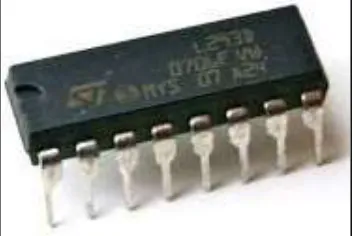
Motor Driver
Gear Motor
The 12V DC gear motors are simply an extension of the DC motors. It consists of a gear assembly attached to the motor. The gear assembly is used for reducing the speed and increasing the torque of the motor. The speed can be reduced to any desirable figure by using the correct combination of gears in a gear motor. Gear reduction is the concept where gears reduce the speed of the vehicle but increase its torque. The speed of motor is counted in terms of RPM (rotations of the shaft per minute).This 12V DC gear motor has a RPM of 500.This speed is capable of changing its value, according to the input voltage given to drive the motor. The structure of 12V DC gear motor is described in the following.
Fig. 4: 12V DC Gear Motor
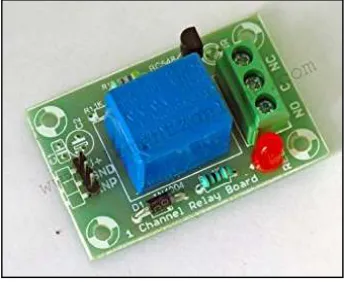
Relay Driver
Single channel relay driver is an electrically operated device which has a control system and controlled system. A control system is also called as input circuit or input contactor and the controlled system is also called as output circuit or output contactor that are frequently used in automatic control of a circuit. It is an automatic switch that controls a high-current circuit with a low-current signal. Some advantages of a relay are its lower moving inertia, stability, high reliability and small volume. It has wider application in power protection device, automation technology, sports, remote control, reconnaissance and communication and in electro mechanics and power electronics devices. A relay consist of an induction part that is capable of reflecting the input variable like current, voltage, temperature, pressure, speed, light, power, resistance and frequency etc. To energize or de-energize the connection of controlled circuit an actuator module (output) is present inside it. For coupling and to isolate input current as well as to actuate the output there is an intermediary part between input part and output part is used for the operation to be dones. The controlled output circuit of relay will be energized or de-energized when the rated value of input (voltage, current and temperature etc.) is above the critical value.
Fig. 5: Single Channel Relay Driver
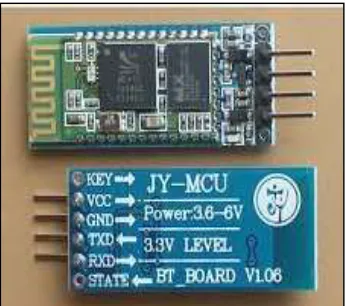
Bluetooth Module
Fig. 6: HC-05 Bluetooth Module
Robot Body
The robot body consists of wheels which are to drive the robot and extinguishing components like water tank, pump, and sprinkler. A water tank with pump is placed on the robot body and its operation is carried out from the Arduino o/p through the proper signal from the transmitting end. The entire operation is controlled by a Arduino. A motor driver IC is interfaced to the Arduino through which the controller drives the gear motors for the movement of the robotic vehicle.
IV. BLOCK DIAGRAM
As discussed earlier, the Block Diagram consists of several components which are used for the control and interfacing of the android controlled fire-fighting robot. The Main components that are used in this firefighting robot are given below.
Fig. 7: Android Controlled Fire Fighting Robot
V. SOFTWARE ARCHITECTURE ARDUINO UNO R3 PROGRAMMING
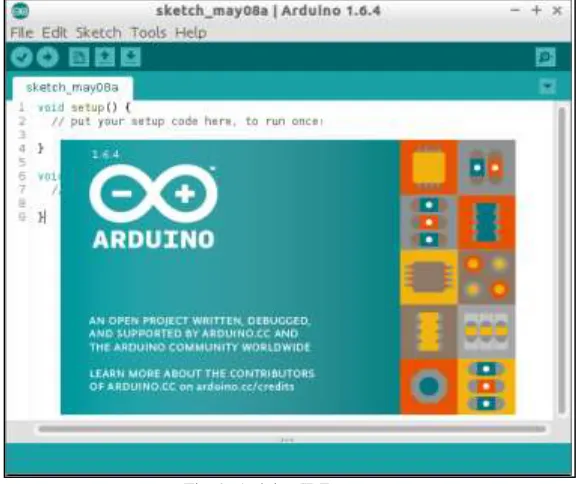
To program Arduino UNO R3, there is a need for the open source Arduino IDE software that the card manufacturer company written. This is a software programming that is written by Java language which is used to program the Arduino cards and for downloading the Arduino cards to Arduino cards. It contains a text editor used for writing code, a text console, as message area, a toolbar with buttons for the common functions and for a series of menus. It consists of an editor which uses the Wiring/ processing language, commands that supports the utilities for the projects and resemble the C language in some cases. The programming work can easily be performed by making the necessary settings and definitions in the IDE program. It connects to the Arduino hardware to upload programs and communicate with them.
Fig. 9: Arduino IDE program
VI. CONCLUSION
This project describes about the real time firefighting robot which moves in a constant speed, identify the fire and then extinguish it with the help of pumping mechanism. The detection and extinguishing was done with the help of Arduino in which the gas sensor, gear motor and its driver, relay driver etc. are interfaced. The robot is connected with mobile phone through the Bluetooth module and processes the analog and digital data received from the sensors in the Arduino control determine the fire in the environment. Both hardware and software has been realized successfully in this project. The "Android controlled firefighting robot" can be used easily in everyday life such as in homes, laboratories, parking lots, supermarkets, stores, shops etc. The fire extinguishing was done with the help of water through the pumping mechanism. Some alternatives in these aspects are blowing wind by fans, fire extinguisher gel tightening with the help of servo motors etc. However, in this project, extinguishing of fire is done with the water which is most suitable for both time and material work.
REFERENCES
[1] Intelligent sprinkler handbook of robotics mini system-International journal of computers-Bruno Sicilianos, vol.1, issue21, 2013.
[2] Development &Applications of Automatic Fire fighting robot-International Journal of Advanced Research in Computer Engineering & Technology- Paul E
Sandin,vol.2,issue14,2013.
[3] International Journal of Recent Research in Mathematics Computer science and Technology-Abilash, Dhumathar, Sumit, Bhiogade, vol.2, Issue., April 2015.
[4] International Journal of advanced Research in Computer and communication Engineering, IJARCCE DOI.1017148\2015.494612,VOL.4,Issue9,September