IJSTE - International Journal of Science Technology & Engineering | Volume 4 | Issue 5 | November 2017 ISSN (online): 2349-784X
Design Optimization of Dynamic Vibration
Absorber for Boring Process
R. Shankar V. Brahadeeshwaran
Assistant Professor Assistant Professor
Department of Mechanical Engineering Department of Mechanical Engineering Kings College of Engineering, Punalkulam Kings College of Engineering, Punalkulam
Abstract
Mechanical systems with flexible dynamics often suffer from vibration induced by changes in the reference command or from external disturbances. The technique of adding a vibration absorber has proven useful at eliminating vibrations from external disturbances and rotational imbalances. In this paper, the application of a Dynamic Vibration Absorber for suppression of chatter vibrations in the boring manufacturing process is presented. The boring bar is modelled as a cantilever Euler–Bernoulli beam and the DVA is composed of a mass and a spring and elements. After formulation of the problem, the optimum specifications of the absorber such as spring stiffness, absorber mass and its position are determined. The analog-simulated block diagram of the system is developed and the effects of various excitations such as step, ramp, etc. on the absorbed system are simulated. In addition, chatter stability is analysed in dominant modes of boring bar.
Keywords: Vibration Absorber, Boring, Simulink, Dynamic Analysis, Optimum
________________________________________________________________________________________________________
I. INTRODUCTION
Vibrations are present in many machines and structures. In general, vibrations adversely affect the performance of a machine. Vibrations may also cause fatigue failure or even damage the machine or structure by causing excessive levels of stress. The prevention or control of the vibration of machines and structures is therefore an important design consideration. There are numerous ways of reducing and preventing vibrations, for example, by changing the stiffness of a structure, increasing damping by using materials that have high damping properties, or by using control. Three types of control can be distinguished: active, semi-active and passive control. A dynamic vibration absorber (DVA) is a typical example of a passive controller. It consists of an auxiliary mass-spring system which tends to neutralize the vibration of a structure to which it is attached. The basic principle of operation is vibration out of phase with the vibration of such structure, thereby applying a counteracting force. An important advantage of a DVA in comparison with other methods that reduce vibrations is that it can also be applied to structures which are already in operation and appear to have unsatisfactory dynamic properties. DVA's are also advantageous because they are able to reduce the vibration level of a structure at a comparatively low cost of a few additional materials. Dynamic Vibration Absorber for suppression of chatter vibrations in the boring manufacturing process is presented. The boring bar is modelled as a cantilever Euler–Bernoulli beam and the DVA is composed of a mass and a spring and elements. After formulation of the problem, the optimum specifications of the absorber such as spring stiffness, absorber mass and its position are determined.
II. SIMULATION
Fig. 1: Simulation without absorber
Simulation of Mass Ratio on Natural Frequency:
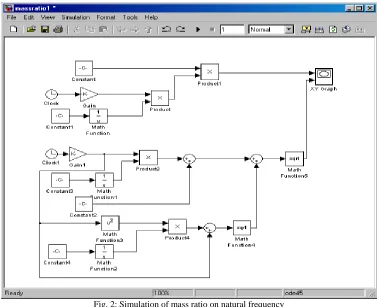
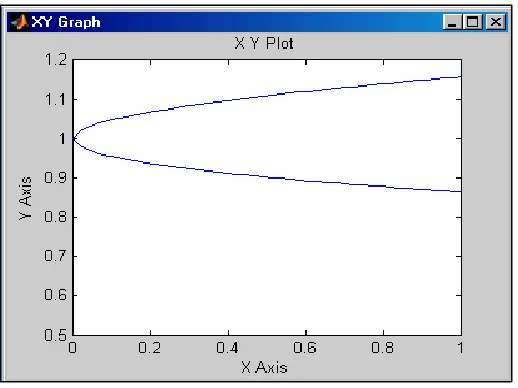
Mass ratio on natural frequency is simulated in this chapter. Figure 2 shows the Simulink of mass ratio on natural frequency. By varying the absorber mass and stiffness, the boring bar is simulated. This simulation is also used to find the absorber mass and the stiffness.
Fig. 2: Simulation of mass ratio on natural frequency
Design Optimization of Dynamic Vibration Absorber for Boring Process (IJSTE/ Volume 4 / Issue 5 / 022)
Fig. 3: Simulation of amplitude response Simulation of Boring Bar with Absorber
III. RESULTS & DISCUSSION
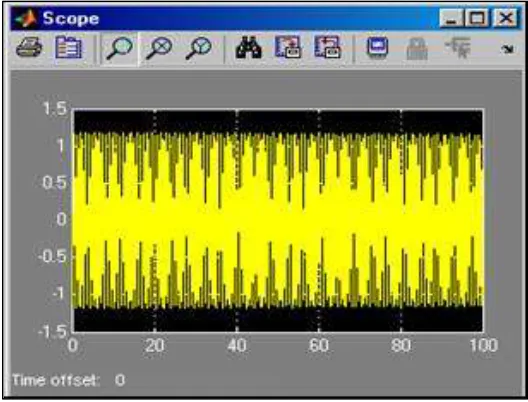
The boring simulated without absorber. From the results obtained from graph is shown in Figure 5 the maximum value of amplitude reach 1.1667mm in this simulation. The value of forced frequency mass m1 = 2.48 kg and its stiffness k1 = 5000KN/m.
Fig. 5: Simulation of amplitude response
Result of Mass Ratio on Natural Frequency:
Fig. 6: natural frequencies of the system with absorber
Result of Amplitude response of Tool and Absorber Mass:
The boring bar is simulated and result is discussed from the graph shown in Fig., the amplitude of tool and absorber is observed from this result. It is observed that, when the amplitude of tool reaches the value of maximum positive value, the absorber reaches the maximum opposite i.e., negative sign value of amplitude
Fig. 7: Simulation of amplitude response
IV. CONCLUSION
In this paper, the optimum design of a Dynamic Vibration Absorber (DVA) is presented and applied to suppress chatter in boring manufacturing process. The formulation is done for an absorber composed of mass and spring elements. The boring bar is modeled as a Cantilever Euler Beam. The optimum specification of absorber such as spring stiffness and absorber mass are determined by using the software MATLAB. Result shows that the optimum absorber work effectively, especially in resonance condition. Results of computed graphs predict vibration characteristics, but it requires extensive collection of data for different machine tools and their interpretation so as to make a judicious choice of effective cutting stiffness in order to tune the stiffness of tool to an optimal value. This proposed SIMULINK predicts effective absorber stiffness (k2 = 2000kN/m) for optimized absorber tool mass (m2 = 16.5 kg) corresponding to the less amplitude value.
From the simulation following results are computed. From the result, the optimized values are identified.
Tool Used Stiffness of the Absorber k2 (kN/m) Mass of the Tool m1 (kg) Mass of the Absorber m2 (kg) Amplitude (mm)
1300 2.48 1.554 0.066
Design Optimization of Dynamic Vibration Absorber for Boring Process (IJSTE/ Volume 4 / Issue 5 / 022)
Mass of the tool m1 = 2.48 (kg) Mass of the absorber m2 = 16.54 (kg) Amplitude = 0.054 mm
REFERENCES
[1] M.F. Ashby, D.R.H. Jones, Engineering Materials 1. An Introduction to their properties and Applications, Pergamon Press, Oxford, 1980. [2] S.A. Tobias, Machine–Tool Vibration, Blackie & Son, London, 1965
[3] S. Kato, E. Marui, on the cause of regenerative chatter due to workpiece deflection, Journal of Engineering for Industry 96 (1974) 179–186.
[4] M.K. Khraisheh, C. Pezeshki, A.E. Bayoumi, Time series based analysis for primary chatter in metal cutting, Journal of Sound and Vibration 180 (1) (1995) 67–87.
[5] M.N. Hamdan, A.E. Bayoumi, An approach to study the effects of tool geometry on the primary chatter vibration in orthogonal cutting, Journal of Sound and Vibration 128 (3) (1989) 451–469.