E-Waste Management And Awareness
,
Srimathi H, Krishnamoorthy A, Dharshini S
Abstract : The evolution of electrical and electronic equipments (EEE) in 20th century made our life easy brought enormous changes in household, industry and economy. It is very difficult for us to function without electrical and electronic products. However, one serious problem is a massive amount of waste and hazardous generation from the products when they become obsolescence. India is one of the highest producers of e-waste. In addition, few of the Asian and African countries become dumping sites of e-waste to the first world countries including India. Most of the e-waste management in India is taking place in in-formal sector with limited infrastructure, technology and lack of awareness. The paper identifies the existing sector gap and public awareness on e-waste with specific study carried out in Chennai region and recommends suggestions to way forward.
Index Terms: E-Waste, Health Hazard, Environment Pollution, EPR, Recycling,
—————————— ——————————
1 INTRODUCTION
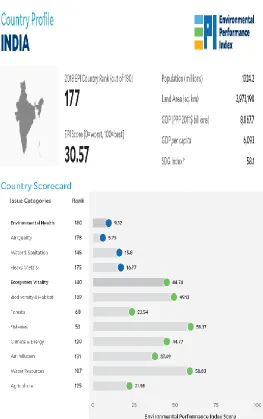
ndia is one of the emerging e-waste generators, which increase grave concerns on health and environment pollution. According to the joint study made by Assocham and NEC technologies, the e-waste production of India at the end of 2018 is 3.3 million metric ton (MT) and the expected information technology (IT) and electronic sector growth is $400 billion by 2020. There is a need of serious call on e-waste management as the e-e-waste growth is influenced by multiple factors such as growth of Information technology, socio-economic growth, rapid technological advancements and shorter replacements. As per the study of Environmental Performance Index (EPI), India has secured lowest rank (177) in the year 2018 as given in Fig. 1 (Wendling et al, 2018). The government has launched E-Waste management rule on 2016. The act further provides the penalty and punishment of non-compliance. The central pollution control board (CPCB) authorized 726 producers with the concept of extended producer responsibility (EPR) to collect back the waste goods, but there is a huge struggle to formalize. This has necessitated the wide awareness on e-waste followed by stringent punishment to non-compliance. The paper is organized as follows: section 2 lists the e-waste generation section 3 describes the effect of e-waste on environment and health, section 4 lists the methodologies used in e-waste disposal; section 5 surveys the awareness & practices of e-waste in Chennai region followed by way forward suggestions.
Fig. 1. The EPI score of India for the year 2018 (Source: Wendling 2018)
2
E-WASTE
GENERATION
The expected global e-waste generation is 52.2 million MT by 2021 and India is one of the top 5 countries in the list. Fig. 2 shows the list of Indian states who contribute more e-waste and the states which have good recycling capacity (Assocham & NEC, 2018). The production of e-waste is 4.56 times higher I
————————————————
Srimathi H, Professor & Assistant Director, Directorate of Admissions, SRM Institute of Science and Technology, Chennai, India. E-mail: [email protected]
Krishnamoorthy A, Professor & Associate Dean, Department of Electronics and Instrumentation Engineering, SASTRA Deemed University, Thanjavur, E-mail: [email protected]
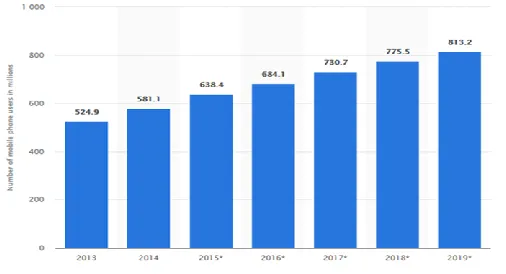
than the e-waste processing capacity. There is a lack of public awareness about safe disposal of e-waste. These factors influence 80 % of e-waste management through un-organized sectors. Fig. 3 describes the segmentation of e-waste in India as on year 2016 (Assocham & cKinetics, 2016). The number of mobile phone users in India has tremendous growth as shown in Fig. 4 (Statistica, 2019). Computers, laptop and mobile devices contributed 70 % e-waste due to industrial innovation and increased buying capacity. More than half a population uses mobile devices. The free laptops distributed to student community by some of the state governments added additional usage volumes in rural sectors. In addition to country’ own e-waste, United States, China and European Union exports their e-waste to India. The 85 % of Delhi NCR region is imported from developed countries through shipment and unauthorized sources.
(a) E-waste production – Top states
(b) E-Waste recycle provisions – Top states
Fig. 2. Top states of E-Waste contributor and recycle provision (Assocham & NEC, 2018)
Fig.3. E-Waste contributors (Source : Assocham& cKinetics, 2016)
Fig. 4. Projected number of cell phone users in India (Source : Statistica, 2019)
3
EFFECT
ON
ENVIRONMENT
AND
HEALTH
HAZARD
E-waste causes both environment and health hazards in the absence of formal recycle and disposals (Needhidasan et al, 2014). The toxic elements present in e-waste pollute air, water and soil and in turn affect human health as shown in Fig. 5. The chemical pollutants present in mixtures complicate the pollution situation and transferred to human either through direct or indirect exposure (Park et al, 2017). The persons who are handling e-waste have chance of direct exposure to inhaling toxic chemicals, skin contact and ingestion (Sushant et al 2010). The disposal activities like land-filling, burning, and leach into water degrade the environment and impact the food-chain (Ramachndra et al, 2004). The concentration of toxic elements affect the food-chain cycle. Both labors and surrounding neighbours are affected, where the case is more vulnerable to pregnant women and children (Sthiannopkao et al, 2013). Thus e-waste has close link to affect world’s sustainable development goals such as good health & well-being, clean water & sanitation, sustainable cities & communities, responsible consumption & production, life below water and decent work & economic growth (Balde et al, 2017). There is a need of well-defined, full-fledged and comprehensive recycle and dispose of e-waste (Gupta, 2011).
5
E-W
ASTEM
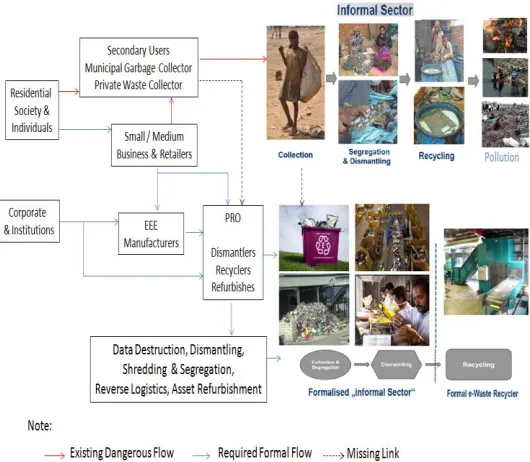
ANAGEMENTIn India, the Ministry of environment, forest and climate change is the nodal administrative agency to enact e-waste rules, CPCB is empowered to prepare guidelines on EPR and state boards are allowed to authorize dealers within state (UK India Business Council, 2018). The formal e-waste recycling sector is emerging in India. However, the existence of unorganized sector is for a long time, which employs 1 million poor people (Balde et al 2017). The informal e-waste management affects both environment and economy due to the potential wastage of raw materials. In many cases, the collection of e-waste by authorized manufacturers, retailers and offices goes to scrap dealers and transferred to informal sector (Skinner et al 2010). The scrap dealers are limited interest on safe disposal, possess large capacity of warehouse and run with a business motive (Sinha et al 2011). The methodology used in informal / unorganized sector increases the end-life of e-waste. They process 90-95 % of e-waste in rudimentary methods like breaking, incineration, open burning, dismantling, and dumping (Kumar et al, 2017). They employ children, women, and unskilled labors for low cost. The informal sector is well connected but not bound by any laws (Garlapati, 2016). The recovery of metals such as copper, silver / gold traces is extracted in an unsafe manner through open burning and dismantling. The valuable parts which can be reused and serve as secondary raw materials are also dismantled in pieces due to lack of knowledge and training. For example, the metal recovery in 40 gm of circuit board in washing machine is minuscule proportion, but poses a challenge in entire recycling stream (Ahluwalia et al 2018). The non-commercial parts of e-waste are either burnt / disposed off in lands. The various industrial methods of recycling circuit boards and e-waste are studied in details with list of methods: Pyrolysis, Hydrometallurgical, Mechanical milling, Air classification, Electrostatic, Bio-metallurgical and Magnetic separation (Gupta et al 2014). The present gap existing between formal and informal sectors in e-waste management is shown in Fig. 6. The recognized producer responsibility organization (PRO) is largely dealing with imports. The CPCB must insist PROs to process country’s own wastage with attractive incentives. The PROs can also be recommended to establish website with recycling procedures, capacity, level of treatment, availability of skilled trainers, processed volume and collection points to reach end users. The educational institutions can be engaged to awareness campaign. The representatives from local civic body, residential associations, non-government organizations and government authorities must be involved to review of e-waste recycle. The challenges and opportunities of formal recycling industry with respect to environment and health issues are listed in (Ceallos et al, 2016). Some of the obstacles to impose formal e-waste management are (Lundgren, 2012):
Lack of reliable data
In-efficient collection scheme and incentives
Limited government intervention to authorized dealers
Limited infrastructure in formal sector
Involved high cost of setting advanced technology
Fig. 6. The E-waste management flow with sector gap
6
E-WASTE
AWARENESS
IN
CHENNAI
The Chennai city generates more than 0.03 million tons of e-waste per year (Christin, 2014). The prominent dump sites of e-waste are Kodungaiyur, Oragadam, Ambattur and Perungudi. There are few studies conducted in water bodies of Chennai with the correlation of phyisco-chemical parameters (Banuraman et al, 2016). There was 100 tons of e-waste mixed along with rest of garbage in streets in 2015 flood, which were mostly handled by unauthorized recyclers. The state pollution control board displays the list of recognized dismantlers, recyclers and refurbishers and many of them engaged with dealing imports. The survey is conducted to understand the awareness among Chennai residents, as the e-waste produced by households are the major threats. The survey consists of questionnaire related to usage of EEE products, present practice of e-waste clearance and awareness on e-waste management. There are totally 80 participants approached, in which 65 % of them are women as they used to care house cleanliness in large scale. The balanced distribution of employment profile (Software Professionals, Government sector, Students, Home makers and others) is ensured in data collection. The usage statistics of EEE items is given in Fig. 7. The waste disposal practice in house-hold appliances are shown in Fig. 8 (Vats et al, 2014).
Fig. 8. Waste disposal practice in Residence
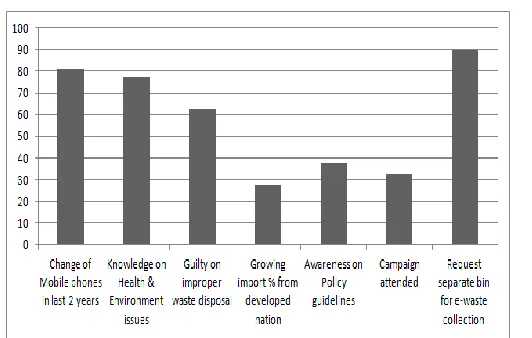
The awareness on health hazards, number of persons attended campaign and other details are listed in Fig. 9. The tiny items like bulbs, batteries are thrown to municipal garbage collection without segregation. Residents recommend separate bin to collect such items in a daily basis.
Fig. 9. Awareness on E-waste guidelines, health issues
7
CONCLUSION
The study attempted to record the growing concern of e-waste disposal with respect to environment and health issues. The existing sector gap and large percentage of management through informal sector is also studied. Chennai is one of the metropolitan cities with large number of IT, Automobile and other small scale industries. The study witnessed that the civic society has ignorant on e-waste. The government bodies must integrate all the stakeholders, conduct frequent awareness, collection campaign, ensure EPR capabilities of manufactures & retailers, provide training to unskilled labour. The recent ban on plastic is well received in entire Tamil Nadu. The government also tightens the non-reusable plastic production. The same can be extended to unsafe throw of e-waste by levying heavy penalty and mobilize multiple collection points. The prevention of e-waste must be ensured through ―Reuse – Reduce – Recycle‖ strategy.
REFERENCES
[1] Assocham & cKinetics, 2016, E-Waste generation, https://economictimes.indiatimes.com/tech/hardware/indi a-likely-to-generate-52-lakh-mt-of-e-waste-by-2020-study/articleshow /52569725.cms
[2] Assocham & NEC (2018), Electrical and Electronics Manufacturing in India, https://in.nec.com/ en_IN/pdf /ElectricalsandElectronics ManufacturinginIndia2018.pdf [3] Balde, C.P, Forti V, Gray V, Kuher R, and Stegmann P,
(2017), The Global E-Waste Monitor 2017, Quantities, Flows, and Resources, United Nations University (UNU), International Telecommunication Union (ITU) & International Solid Waste Association (ISWA), Bonn/Geneva/Vienna.
[4] Banuraman, S. and Madavan, V. (2016), Study of Ground water in Perungudi area of Chennai: Correlation with Physico-Chemical Parameters
[5] Ceballos, D.M. and Dong, Z. (2016), The formal electronic recycling industry: Challenges and opportunities in occupational and environmental health research, Environmental International, 95, 157-166 [6] Garlapati VK (2016) E-waste in India and developed
countries: Management, recycling, business and biotechnological initiatives. Renew and Sustain Ener Rev 54: 874-881
[7] Gupta, S. (2011), E-waste management: Teaching how to reduce, reuse and recycle for sustainable development – Need of some educational strategies, Journal of Education and Practice
[8] Gupta, S. Modi, G. Saini, R. and Agarwala, V. (2014), A review on various electronic waste recycling techniques and hazards due to its improper handling, International Journal of Engineering and Science
[9] Isher Judge Ahluwalia, Almitra Patel, (2018), The afterlife of e-goods, A rapidly growing e-waste crisis needs rapid official decision-making, time-bound responses, https://indianexpress.com /article/opinion/columns/e-waste-management-delhi-pollution-5509258/
[10] Kumar A, Holuszko M, Espinosa DCR (2017) E-waste: An overview on generation, collection, legislation and recycling practices. Res Conser and Recyc 122: 32-42. [11] Lundgren, K. (2012), The global impact of e-waste:
Addressing the Challenge, International Labour Organization, Geneva
[12] Needhidasan S, Samuel M, Chidambaram R (2014) Electronic waste-an emerging threat to the environment of urban India. J of Environ Health Sci and Eng 12: 36 [13] Park, JK. Hoerning, L.Watry, S. Burgett, T. and
Matthias, S. (2017) Effects of Electronic Waste on Developing Countries. Adv Recycling Waste Manag 2:128. doi:10.4172/2475-7675.1000128
[14] Philip, C.M. (2014), Chennai sits on a growing e-waste pile,
https://timesofindia.indiatimes.com/city/chennai/Chennai-sits-on-a-growing -e-waste-pile/articleshow/11668823.cms
[15] Ramachandra, T.V and Varghese, S. K (2004), Environmentally sound options for e-waste management, Envis Journal of Human Settlements
http://eeas.europa.eu/delegations/india/documents /eu_india /final_e_waste_book_en .pdf
[17] Skinner, A., Dinter, Y., and Strothmann, P. (2010). The Challenges of E-Waste Management in India:Can India draw lessons from the EU and the USA? ASIEN , 7-26. [18] Song Q, and Li J, (2014), A systematic review of the
human body burden of e-waste exposure in China, Environment International, Vol 68, Pg 82-93
[19] Statistica, 2019, https://www.statista.com/statistics/274658/forecast-of- mobile-phone-users-in-india
[20] Sthiannopkao S, and Wong MH (2013) Handling e-waste in developed and developing countries: Initiatives, practices, and consequences. Sci of the Tot Environ 463: 1147-1153.
[21] Sushant B. Wath, P.S. Dutt, T. and Chakrabrti, (2010), E-waste scenario in India, its management and its implications, Environ Monit Assess
[22] UK India Business Council, (2018), Framework of India’s E-Waste, Urban Gateway of India,
https://www.ukibc.com/urban-gateway-india/ [23] Vats, M. C. and Singh. S. K. (2014) E-Waste
Characteristic and Its Disposal. International Journal of Ecological Science and Environmental Engineering. Vol. 1, No. 2, pp. 49-61.