Themed Section: Scienceand Technology
Improving Usability of Password Management with Storage
Optimized Honeyword Generation
N. Sivaji1, Dr.K.S.Yuvaraj2
1PG Student, Department of MCA, St. Ann’s College of Engineering & Technology, Chirala, Andhra Pradesh,
India
2Assistant Professor, Department of MCA, St. Ann’s College of Engineering & Technology, Chirala,Andhra
Pradesh, India
ABSTRACT
Among the cutting edge security dangers on password based validation procedures, the brute forcealgorithm is the one that plays out the reversal of hash esteems. A few advances have been produced for the algorithm of brute force in the reversal attack. This risk can be moderated by identifying the password splitting with the Honeyword based confirmation protocol. Despite the fact that different existing procedures have a few restrictions, for example, stockpiling overhead, weak DoS resistivity and various framework weaknesses. To defeat these current disadvantages, a novel honeyword age approach with the imitation information system is proposed in this work. The Paired Distance Protocol is utilized as a part of this work and executed for assessing the proposed procedure. The execution of the proposed methods is contrasted and the current procedures and furnishes better outcomes in the security with lessened capacity overhead and capacity cost.
Keywords : Authentication, Password, Inversion Attack, Honeyword, Paired Distance.
I.
INTRODUCTION
The most ordinarily utilized confirmation strategy is the password based validation technique due to its guidelines in use and security adjust. However, the password based methodologies likewise have a few difficulties because of the different attacks as in some other security approaches. Reversal attack is one of the normal attacks developed as of late which are portrayed as takes after. The client must present the username and password for enrolling in the site amid the production of web-account. The username is recorded by the framework as plain content and the password as hash by changing over them utilizing hashing algorithm H. Amid the reversal of hashes, at first the attacker decides a password string with the assistance of some current strategies. At that point subsequent to changing over it onto a hash an incentive by H, the coordinating procedure is done for
some security strategies were produced. A few traps are utilized to make the change of password into hash esteem harder that expands the login time. Likewise few fake login accounts were made for this by the chairman. The framework recognizes the security soften at whatever point an attacker prevails up the reversal of hash esteems for any record. The genuine and framework made usernames are recognized by attackers utilizing some watchful examination. The likelihood of giving security in logical inconsistency of reversal attack utilizes honeyword based strategies.
II.
RELATED WORK
The modern password cracking algorithm uses the concept of probabilistic context free language structures. Kelley et al. describes the powerlessness of the passwords under a similar risk show by thinking about various passwordcompositions arrangements. One of such feeble secret key arrangement is "basic8" in which clients are told "Secret word must have atleast 8 characters". One billion figuresareadequate to figure 40.3% of such passwords. Authors demonstrate that by utilizing a solitary graphical handling unit, three billion conjectures every second can be achievable to break the hash capacities like - MD5. Among the 70 million hurray clients it has been watched that greater part of the passwords are having minimal more than 20 bits of successful entropy against an ideal aggressor. The honeyword plot gives huge help to the traditional secret key plan as far as giving security and can be fused with the regular secret word framework. To the best of our insight, in 2006 Fred Cohen has made the primary commitment in this area. There after numerous strategies have been proposed toward this path. The thought has been sent to numerous secret words related areas. Herley what’s more, Florencio utilize this idea to secure web based keeping money accounts from animal power attack. Bojinov et al. propose the idea of "Kamouflage" where genuine secret key of the client is put away alongside the phony passwords however this does exclude the
idea of "honey checker" server. Laterauthors present the idea of "honey checker" server to recognize the watchword splitting system. As of late Chakraborty and Mondal indicate how honeywords can be utilized to recognize bear surfingattack.
III.
OUTLINE OF HONEYWORD BASED
AUTHENTICATION APPROACH AND ITS
LIMITATIONS
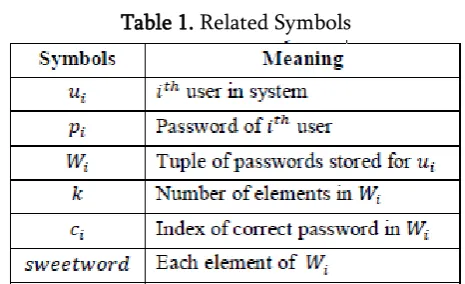
At first, the working essential of the honeyword based verification approach is portrayed in this area. At that point the confinements of a few existing methodologies are examined in this segment. Prior to that a portion of the images that are identified with the honeyword approach are communicated in Table 1.
Table 1. Related Symbols
password list. Else the honeychecker gives a negative criticism to the framework chairman. At that point concurring they got criticism; the framework executive takes vital activities utilizing the security approach. Subsequently the honeyword based framework offers dispersed security that is harder to trade off. Despite the fact that the current methodologies in view of the honeyword strategy gives better security, a few confinements are likewise introduced which are as per the following:
Storage overhead
Co-social danger
Distinct password designs
Resistivity of DoS
Multiple framework helplessness
Problems because of grammatical mistake wellbeing
IV.
PROPOSED METHODOLOGY
The Paired Distance Protocol (PDP) is proposed in this work which offers three noteworthy data, for example, (a) Username (b) Password and (c) a Random String RS with the length of ℓ that contains letter sets and numbers. For the most part the length of RS is set to 3 as default length. The client needs to recollect the mystery data as RS alongside the password. Despite the fact that it prompts an overhead, the RS has various preferences. The vital attributes of RS are as per the following. (i) a similar RS can be utilized for different frameworks. (ii) The RS that are picked by the client are difficult to figure and do not has a specific example. (iii) Does not requires connection between's the username and password. Utilizing PDP the enrollment interface can be communicated in the Figure 1.
Figure 1. Registration interface of PDP
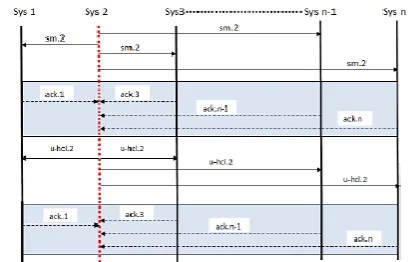
Figure 2. PDP protocol utilized by n distinctive clients
As indicated by the ease of use guidelines, the essential contrasts between the proposed approach and the current adopt a-tail strategy is spoken to in Table 2
Table 2. Difference between a take-a-tail and PDP from the ease of use point of view.
Honey Circular List A roundabout list is made which is referred to a honey roundabout list or hcl with the length of |hcl|. This honeyround list contains letter sets and digits arbitrarily. Here the default |hcl| esteem is considered as 36 and for that default esteem the |hcl| is appeared in Figure 3.
At that point this hcl is disseminated safely to m unmistakable frameworks by PDP protocol for the making of honeywords and kept up in the password record F.
Maintenance of user database For keeping up the login data of the client in database the framework takes after a few traps. At first the framework records the username and password of the client. At that point the separation between the progressive components of RS with respect to the components recorded in hcl are estimated by the framework. The separation between any two components are called as matched separation. It is characterized as takes after. Give e1 and e2 a chance to be the two components of hcl and the combined separation between these components is the quantity of cells in the hcl to be consulted in clock astute heading from component e1 to component e2. This matched separation between the two components are spoken to as Pr(e1, e2). The framework keeps up the separation chain in a password record F alongside the username and password and that separation chain is acquired from RS. This separation chain can be characterized as the arrangement of n-1 combined separations between each two progressive components of RS with length n. An exceptional property of separation chain is found while dissecting it and this uncommon property is recognized as uniqueness property. The uniqueness property of a separation chain can be controlled by a given hcl and a particular separation chain. On the off chance that the principal component of RS is known, at that point it can be exceptionally inferred. By utilizing the RS string and the hcl, the honeywords are made. From the separation chain that is recorded in the framework, the aggressor can ready to determine the different conceivable strings that likewise contain the RS which is picked by client. For making the separation chain, the utilized password can be utilized as a part of the place of Rs which make the attacker to recognize the first password of the client. This is on the grounds that arbitrary course of
action of the characters in hcl and prompts a less likelihood of acquiring the string.
DoS resiliencyPerforming DoS assault (talked about in Section II-B) is exceedingly unimaginable on a PDP secure framework. DoS assault is just conceivable if foe can create a separation chain that is kept up by the framework for any unique RS not picked by client. As RS not permits reiteration of characters along these lines, enemy requires the learning of introduction of characters in the hcl to play out the assault. For instance, if RS permits redundancy of characters then foe may make a separation chain produced using characters RRR and keeping in mind that login, foe may submit RS as SSS to perform DoS assault. This is on the grounds that both the RS infer same separation chain as 0 − 0 yet first character put away in "honeychecker" (here R) jumbles with first character of submitted RS (here S). Consequently foe ends up fruitful to achieve the DoS assault. As every one of the components in RS get vary from each different accordingly, without knowing the introduction of characters in the hcl, the likelihood of creating a given separation chain by presenting a RS (which isn't picked by client) can be calculated by
Working Guideline of the Proposed System The usage of the proposed fake information to the framework is portrayed as takes after and the algorithm for this proposed strategy is likewise examined here.
Password MeterThe password meter demonstrates the irregularity of RS. The password meter demonstrates solid flag when the arbitrariness of RS is high. Else, it demonstrates powerless flag. A few cases of decisions of RS for low haphazardness are portrayed as takes after:
If RS makes some lexicon word, it is linked with client password. For e.g. password – rab, RS – bit.
If RS the previously mentioned is a lexicon word. For e.g. fox.
RS has a specific example like successive keystroke that is separated by attacker.
On the off chance that the password demonstrates low irregularity, at that point the clients are prescribed to change their RS. Additionally the irregularity of RS moves toward becoming when there is a co-connection between the username and password. Be that as it may, it isn't tended to by the password meter.
V.
USABILITY STANDARDS
The ease of use standard, set by a honeyword age approach can be estimated regarding three parameters − (a) Typo security (b) System obstruction and (c) Stress on memorability. Each of these is talked about straightaway. A honeyword age calculation is called grammatical error safe if composing mix-up of clients doesn't prompt produce a negative input motion by nectar checker. Utilizing PDP, nectar checker produces a negative input flag just if the string other than RS determines a separation chain that gets coordinated with the put away separation chain. While composing the RS, client can enter either (a) sub part of RS as wrong or, (b) every one of the components of RS as off-base. In the event that client enters sub some portion of RS as wrong (e.g. rather than tp7, on the off chance that he enters tp8) at that point it will never assess a separation chain which gets coordinated with the put away one. In the event that client enters every one of the components of RS wrong (which may once in a while happen) by
writing botch, the likelihood that a same separation chain (enjoyed put away one) will be created, can be inferred by
VI.
COMPARATIVE ANALYSIS
The proposed PDP is contrasted and some current honeyword age approaches like take-a-tail, teasing by-tweaking-digits and displaying language structure approach as far as guidelines of use and security. There are three very much characterized parameters like levelness, DoS flexibility and security against MSV are utilized for the assessment of power in honeyword age approaches. Utilizing these security models the quality of the proposed PDP is evaluated. So also, for the assessment of convenience, three parameters, for example, framework obstruction, memorability stress and error security are utilized for in the honeyword age approaches. The client can pick up the security as same as that of the take-tail for giving security concerning MSV and levelness. Take-a-tail has constrained quality for giving security and this can be overwhelmed by the proposed PDP demonstrate. The most astounding security level is guaranteed by this PDP approach in light of the RS arbitrariness. At the point when contrasted with the adopt a-tail strategy, the PDP builds the bar by the terms of memorability stress and framework impedance and furthermore makes this proposed PDP as a to a great degree viable approach for the utilization of normal clients. Additionally it has the advantage of putting away a solitary data that decreases the capacity overhead essentially contrasted with that of the current methodologies.
VII.
CONCLUSION
customary systems. However, in the honeyword based methods, the significant disadvantage is the capacity cost and overhead. To conquer these current downsides, this paper presents a novel honeyword age approach with the new distraction instrument. This proposed work is executed and contrasted and the current approach. From the outcomes, it is presumed that the proposed honeyword based approach gives change in security diminished capacity cost and capacity overhead.
VIII.
REFERENCES
[1]. J. Galbally, I. Coisel, and I. Sanchez, "A New Multimodal Approach for Password Strength Estimation—Part I: Theory and Algorithms,"IEEE Transactions on Information Forensics and Security, vol. 12, pp. 2829-2844, 2017.
[2]. H. Kumar, S. Kumar, R. Joseph, D. Kumar, S. K. S. Singh, and P. Kumar, "Rainbow table to crack password using MD5 hashing algorithm," in Information & Communication Technologies (ICT), 2013 IEEE Conference on, 2013, pp. 433-439. [3]. J. Ma, W. Yang, M. Luo, and N. Li, "A study of
probabilistic password models," in Security and Privacy (SP), 2014 IEEE Symposium on, 2014, pp. 689-704.
[4]. S. Ji, S. Yang, T. Wang, C. Liu, W.-H. Lee, and R. Beyah, "Pars: A uniform and open-source password analysis and research system," in Proceedings of the 31st Annual Computer Security Applications Conference, 2015, pp. 321-330.
[5]. S. M. Segreti, B. Ur, L. Bauer, and N. Christin, "Designing Password Policies for Strength and Usability," ed: TISSEC, 2016.
[6]. H.-C. Chou, H.-C. Lee, H.-J. Yu, F.-P. Lai, K.-H. Huang, and C.-W. Hsueh, "Password cracking based on learned patterns from disclosed passwords,"IJICIC, 2013.
[7]. I. Erguler, "Some Remarks on Honeyword Based Password-Cracking Detection,"IACR Cryptology ePrint Archive, vol. 2014, p. 323, 2014.
[8]. S. Yang, S. Ji, and R. Beyah, "DPPG: A Dynamic Password Policy Generation System,"IEEE
Transactions on Information Forensics and Security, 2017.
[9]. A. Juels and R. L. Rivest, "Honeywords: Making password-cracking detectable," in Proceedings of the 2013 ACM SIGSAC conference on Computer & communications security, 2013, pp. 145-160.
[10]. S. Ji, S. Yang, X. Hu, W. Han, Z. Li, and R. Beyah, "Zero-sum password cracking game: A large-scale empirical study on the crackability, correlation, and security of passwords,"IEEE Transactions on Dependable and Secure Computing, vol. 14, pp. 550- 564, 2017.
[11]. B. Ur, S. M. Segreti, L. Bauer, N. Christin, L. F. Cranor, S. Komanduri, et al., "Measuring Real-World Accuracies and Biases in Modeling Password Guessability," in USENIX Security Symposium, 2015, pp. 463-481.
[12]. M. H. Almeshekah, C. N. Gutierrez, M. J. Atallah, and E. H. Spafford "Ersatzpasswords: Ending password cracking and detecting password leakage," in Proceedings of the 31st Annual Computer Security Applications Conference, 2015, pp. 311-320.
[13]. A. L.-F. Han, D. F. Wong, and L. S. Chao, "Password cracking and countermeasures in computer security: A survey,"arXiv preprint arXiv:1411.7803, 2014. [14]. S. Houshmand, S. Aggarwal, and R. Flood, "Next gen
PCFG password cracking,"IEEE Transactions on Information Forensics and Security, vol. 10, pp. 1776-1791, 2015.
About Authors:
Narra Sivaji is currently pursuing his MCA in
MCA Department, St. Ann's College
Engineering and Technology, Chirala A.P.
He received his Bachelor of Science from
ANU