R E S E A R C H A R T I C L E
Open Access
Effectiveness of Cognitive Orientation to
daily Occupational Performance over and
above functional hand splints for children
with cerebral palsy or brain injury: a
randomized controlled trial
Michelle Jackman
1,2*, Iona Novak
1,3, Natasha Lannin
4, Elspeth Froude
5, Laura Miller
6and Claire Galea
3Abstract
Background:Functional hand splinting is a common therapeutic intervention for children with neurological conditions. The aim of this study was to investigate the effectiveness of the Cognitive Orientation to daily Occupational Performance (CO-OP) approach over and above conventional functional hand splinting, and in combination with splinting, for children with cerebral palsy or brain injury.
Methods:A multisite, assessor-blinded, parallel, randomized controlled trial was conducted in Australia. Participants (n= 45) were randomly allocated to one of three groups; (1) splint only (n= 15); (2) CO-OP only (n= 15); (3) CO-OP + splint (n= 15). Inclusion: age 4–15 years; diagnosis of cerebral palsy or brain injury; Manual Ability Classification System I–IV; hand function goals; sufficient language, cognitive and behavioral ability. Primary outcome measures were the Canadian Occupational Performance Measure (COPM) and Goal Attainment Scale (GAS). Treatment duration for all groups was 2 weeks. CO-OP was provided in a group format, 1 h per day for 10 consecutive weekdays, with parents actively involved in the group. Hand splints were wrist cock-up splints that were worn during task practice. Three individual goals were set and all participants were encouraged to complete a daily home program of practicing goals for 1 h. Analyses were conducted on an intention to treat basis.
Results:The COPM showed that all three groups improved from baseline to immediately post-treatment. GAS showed a statistically significant difference immediately post-intervention between the splint only and CO-OP only groupsp= 0.034), and the splint only and CO-OP + splint group (p= 0.047) favoring CO-OP after controlling for baseline.
Conclusions:The CO-OP Approach™appeared to enhance goal achievement over and above a functional hand splint alone. There was no added benefit of using hand splints in conjunction with CO-OP, compared to CO-OP alone. Hand splints were not well tolerated in this population. Practice of functional goals, through CO-OP or practice at home, leads to goal achievement for children with cerebral palsy or brain injury.
Trial registration:Registered with the Australian New Zealand Clinical Trials Registry (ACTRN12613000690752) on 24/06/2013.
Keywords: Upper limb, Task-specific training, Motor training, Cognition, Orthoses, Goal-directed, Occupational
therapy
* Correspondence:[email protected] 1
School of Child and Adolescent Medicine, The University of Sydney, Sydney, Australia
2Occupational Therapy Department, John Hunter Children’s Hospital, Newcastle, Australia
Full list of author information is available at the end of the article
Background
Cerebral palsy (CP) and brain injury (BI) can significantly impair a child’s ability to use their hands [1]. Therapeutic modalities to improve hand function have progressed sig-nificantly over the past 20 years, and there is now a sub-stantial body of evidence to support task-specific upper limb (UL) training interventions in this population [2,3]. In clinical practice, usual care includes functional hand splint-ing to promote functional hand use. We wanted to know, whether or not, “Cognitive Orientation to Occupational Performance (CO-OP)”, a new task-specific intervention for the cerebral palsy and brain injury populations, had any clinical benefits over and above functional hand splinting. There also remains limited empirical evidence regarding whether combining UL therapies has any additive effect [2, 3]. We therefore sought to measure the combined effect.
Functional splints are worn when performing an activ-ity, with the aim of supporting one or more joints to maximize the function of the UL during a task. Within the International Classification of Functioning, Disability and Health (ICF) [4], functional splints are a‘body func-tion and structure’ and ‘environmental’ intervention which aims to support changes in activities by changing the position of the hand. Functional splints are made from various materials, including, but not limited to, neoprene, Lycra™, thermoplastic or tape. Common ex-amples of functional hand splints are a wrist cock-up splint to assist with cutlery use during meal times, a su-pination splint to assist with catching a ball or a thumb abduction splint to assist with pencil grasp during hand-writing [5]. There are a small number of randomized tri-als investigating functional hand splints [6–10], although there are wide variations in the type of splints investi-gated, quality of evidence and reliability of outcome measures used in these studies [11]. Functional splints, like many interventions used with children with CP and BI, are often used in combination with other interven-tions including task-specific training.
Task-specific training is a term used to describe a group of interventions that involve active use of the UL [3]. In the pediatric neurological population, there is high level evidence to support the use of task-specific training, in-cluding approaches such as constraint-induced movement therapy (CIMT) and bimanual training [2, 3, 12]. The Cognitive Orientation to daily Occupational Performance (CO-OP) [13] is another task-specific training option. The CO-OP Approach™combines both motor learning theor-ies with cognitive approaches [14], and shares many of the key ingredients of task-specific training [15] with the im-portant and unique feature of individual child-led problem-solving and strategy choice. In CO-OP, children set their own therapy goals and are guided to discover and develop their own cognitive strategies for successfully carrying out the goal, through the use of the global
problem-solving strategy “goal-plan-do-check” [14]. Chil-dren are guided to discover their own successful strategies for carrying out a task, instead of the therapist selecting a successful strategy from task analysis and training task performance, which is the convention in other forms of task-specific training. Once a successful strategy has been discovered by the child, children are encouraged to prac-tice the task consistently, as is done in other task-specific UL approaches, in order to bring about the neuroplastic changes in function that underpin motor learning [16]. CO-OP is conventionally carried out over 12 weekly indi-vidual therapy sessions, as per the inventor’s recommen-dations. The CO-OP Approach™ has been piloted in children with CP and BI [13,17,18] although there exists limited high level evidence in this population.
The theoretical underpinnings of splinting and CO-OP are very different. When considered in light of the ICF, CO-OP is directly focused on addressing ‘activities’, through cognitive and training strategies, whilst splinting is focused on addressing the ‘impairment’ with the aim of improving function. It is therefore important to ex-plore which of these interventions is most effective, and whether or not there is benefit to combining such inter-ventions. There are currently three different theories that seek to explain the relationship between functional splints and task-specific training. One theory is that a functional splint will allow the user to carry out a task more effectively immediately, with a carry-over effect once the skill is learnt and the splint removed. An-other theory is that a functional splint will in fact in-advertently hinder active movement of the limb during task practice, which is vital in the motor learn-ing process. Finally, the “orthotic effect” theory, where the splint is considered to have a neutral effect on motor learning and improved function. The splint im-proves function when donned, but does not facilitate learning, nor does it inhibit learning. All three theories are currently untested.
The aim of this randomized controlled trial (RCT) was to investigate whether the CO-OP Approach™ led to greater achievement of goals for children with CP or BI over and above conventional splinting alone or when used in combination. The hypotheses for this trial were (1) Children with CP or BI who received CO-OP combined with a splint will achieve comparable improvements in goal achievement and hand function when compared to children who receive CO-OP alone, (2) Children with CP or BI who participate in CO-OP alone will achieve clinic-ally significant changes in goal achievement when com-pared to children who receive a splint alone.
task-specific training). Our hypotheses sought to examine the relative effectiveness of these two different paradigms within the same study.
Method
Design and sample size
We conducted a single-blinded RCT that was registered with the Australian New Zealand Clinical Trials Register (ACTRN12613000690752). Detailed study procedures have been previously published [19]. Sample size power calculations were estimated from a previously published 3-group RCT using the same population and outcome measures [20]. We sought an effect size of 0.9, which re-quired 15 participants per each of the three groups, to pro-duce an 80% probability of detecting a 2-point clinically significant change on the 10 point Canadian Occupational Performance Measure [21] (COPM) scale. Statistical signifi-cance was set atp< 0.05.
Participants
Children were eligible to participate if they met the following inclusion criteria: (a) Age 4 to 15 years, (b) Diag-nosis of CP or BI (minimum 12 months post-injury), (c) Manual Ability Classification System (MACS) I–IV, (d) Impaired hand function as a result of the neurological condition, (e) Child-set goals focused on improving hand function, (f) Sufficient language, cognitive and behavioral skills to set goal topics using the COPM, interact with therapist and participate within a group context (accord-ing to CO-OP guidelines), (g) Parents able to commit to a 2 week block of therapy. Exclusion criteria: (a) Impaired hand function resulting from secondary condition (e.g. fracture), (b) Significant intellectual or language impair-ment (CO-OP guidelines), or (c) Known allergy to splint-ing materials.
Procedures
Ethical approval was granted from participating organiza-tions and the University of Notre Dame, Australia. Partici-pants were recruited to this multicenter study through tertiary children’s hospitals and community agencies across three states of Australia from 2013 to 2016. Potential par-ticipants were initially screened via email and phone con-tact. Those deemed likely to be eligible were invited to attend an eligibility assessment. Prior to full baseline assess-ment, study procedures were fully explained and written consent obtained from the carers of all participants. Participants were randomized immediately following base-line assessment. The randomization sequence was gener-ated using a computer random number generator, with concealment of group undertaken using sequentially num-bered and sealed opaque envelopes, stored and opened by an independent offsite officer. To assign group allocation, the principal researcher telephoned the independent
officer, who opened the envelope and advised on the assigned group. Blinding of subjects and therapists was not possible due to the nature of the treatment. Masked assessment was carried out at baseline, immediately following the 2 weeks of treatment (primary endpoint) and 8 weeks following completion of treatment by a quali-fied occupational therapist masked to group allocation. Participants were not provided with previous COPM scores at re-assessment. Data entry was conducted by an independent person masked to group allocation.
Intervention
Participants were randomly allocated to one of three treatment groups: (1) functional hand splint only, (2) CO-OP only, or (3) CO-OP + a functional hand splint. The total duration of the treatment for all groups was 2 weeks. Each participant’s individual goals, identified on the COPM, were the focus of therapy. All participants were encouraged to complete 1 h of daily home practice of goals, recorded in a logbook. Detailed information re-garding the interventions are available in the study protocol [19].
Functional hand splinting
All the functional hand splints were a wrist cock-up splint fabricated in either thermoplastic or neoprene with a static insert on the volar surface to support the wrist and block wrist flexion. The prescriber aimed to position the wrist in approximately 20–30° of wrist ex-tension as per splinting conventions, however if this negatively impacted on the individual’s ability to actively extend their fingers and/or functionally grasp, the splint was fabricated in their maximum possible wrist exten-sion with full finger extenexten-sion. An additional support at the thumb or for supination was included, depending on the child’s hand function and individual goals. To im-prove wearing tolerance, child and family preference of material were considered. Participants allocated to splint groups were instructed to wear the splint during goal practice (1 h each day), although practice with and with-out the splint was recorded. Participants in the splint only group were instructed to practice goals at home and did not undertake any face-to-face intervention with a therapist.
Cognitive Orientation to daily Occupational Performance (CO-OP)
within a small group (3–4 children). Due to recruitment numbers and randomization sequence factors, the groups varied in the number of participants (range 2–5) depending on recruitment rates at that site. This meant some participants needed to receive individual CO-OP intervention (n= 6) because they were a“group of one”. Parents were active participants within the sessions.
Functional hand splinting + CO-OP
Participants randomized to the CO-OP + splint group undertook CO-OP, whilst being prescribed with a hand splint, as described above. Children were expected to wear their splint at all times during practice of goals, both within the CO-OP group and during home prac-tice. Logbooks recorded time spent with the splint on and off during goal practice. In line with ethical consid-erations, if a child did not assent to wearing the splint their wishes were respected. Researcher and parent notes were taken regarding reasons the child chose to discon-tinue wearing the splint.
Outcome measures
All outcome measures collected are reported in this paper. Outcome measures were collected at baseline, im-mediately following the 2 weeks of intervention, and pri-mary outcome measures only were collected at 8 weeks post intervention (follow up).
Primary outcome measures
Primary outcome measures were the COPM [21] and Goal Attainment Scale (GAS) [23], with the study powered to de-tect a change on the COPM. The COPM is the ICF activities level recommended tool of choice when using CO-OP, ac-cording to the developer of CO-OP’s recommendations [14]. COPM is a standardized goal setting and outcome measure-ment tool commonly used in pediatric rehabilitation practice and research [21, 24] and is validated for both child report and parent proxy report. The COPM enables the participant to rate their performance, as well as satisfaction on a scale of 1–10 for each individual goal. As per the COPM administra-tion manual, children who were able to understand the con-cept of rating the COPM scored themselves. Whereas if the child had difficulty understanding the numeracy concepts of scoring, parents completed the COPM proxy-scoring, which is known to be valid, reliable and responsive in young chil-dren with cerebral palsy [25]. For example, chilchil-dren with in-tellectual disability or children younger than 8 years old. Whoever rated the COPM at baseline assessment also rated at follow up assessment. COPM raw scores (range 0–10) were used to determine change.
The GAS is a standardized measure of goal achievement that measures change in an individuals goals [23], accord-ing to a five point scale, in which−2 is the current level of function, 0 is the expected level of function and + 2 far
exceeds the expected level of function following the treat-ment. GAS scores were not weighted. Data analysis uti-lized GAS T-scores (range 22–78).
Secondary outcome measures
Secondary outcome measures included the Box and Block Test [26] (BBT) and wrist range of motion (ROM), which are ICF body structures level measures that reflect the therapeutic intent of splinting. The BBT is an assessment of grasp and release, in which the participant transfers individ-ual blocks from one side of a box, over a partition to the other side, over a 60s period [26]. The score is the total number of blocks moved (range 0–150). A number of studies have utilized the BBT for children with CP [27–29], although reliability and validity in this population is unclear. Strong test-retest and interrater reliability has been shown in typically developing children [26,30].
Wrist ROM comprised of passive wrist ROM (with fingers flexed), Volkmann’s angle [31] (with fingers ex-tended) and active wrist ROM (with fingers flexed). An external wrist ROM device was utilized to standardize ROM measurements in an effort to improve interrater reliability. Joint angle was measured using a digital in-clinometer, with change measured in whole numbers of degrees (range 0–180).
Statistical analysis
Participant characteristics were analyzed using descrip-tive statistics. A one-way ANCOVA controlling for COPM performance at baseline was also conducted to ensure no significant baseline differences between all three groups. All data were assessed for normality using Shapiro-Wilks and visual inspection of boxplots. All analyses were conducted on an intention to treat basis, as per the study protocol. Statistical significance was set at p < 0.05 (two-tailed). Two-way mixed ANOVA with repeated measures were undertaken to account for ex-pected correlation within participant scores over the three time points. ANCOVA controlling for baseline score were conducted when only two time points were used. Where there was contamination between the ment groups, i.e. participants deviated from the treat-ment protocol, post-hoc secondary analyses on primary outcomes were run using the same analysis methodology as intention to treat. All data were analyzed using SPSS (V.24) and STATA (STATA, Version 14, StataCOrp, College Station, TX, USA). Findings are reported accord-ing to the CONSORT statement [32].
Results
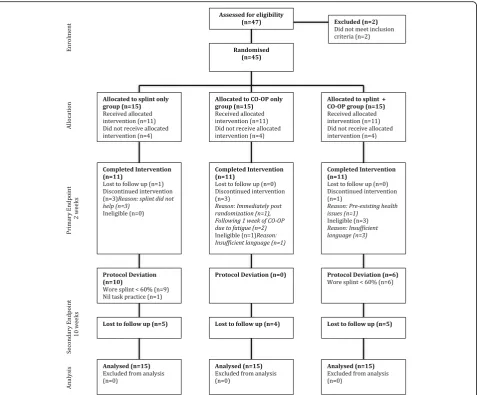
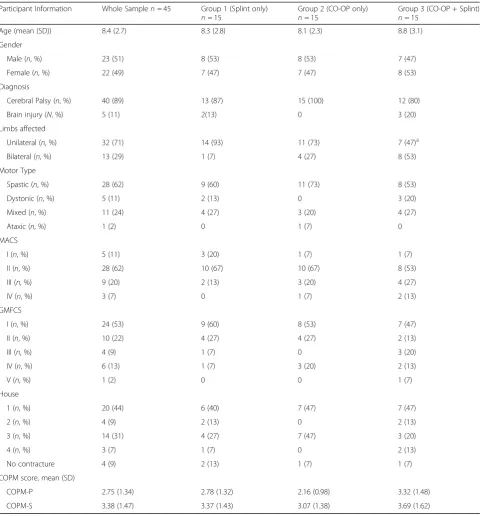
Participants ranged from 4.1 to 15.2 years, MACS I–IV and GMFCS I–V. Participant baseline characteristics are shown in Table1. Overall, 33 of the 45 participants com-pleted the intervention (Splint only group n = 11[73%], CO-OP only group n = 11[73%], CO-OP + splint group n = 11[73%]). The only variable different between the groups at baseline was unilateral impairment topography. Analyses were conducted using the MACS classification, which is known to be more objective and stable.
Primary outcomes
COPM
All groups improved on both COPM performance and COPM satisfaction scores from baseline to immediately post-intervention (Table2). There were no statistically sig-nificant differences between the three groups immediately following the intervention (after controlling for baseline)
or 8 weeks post-intervention (repeated measures) on COPM Performance or COPM Satisfaction, as shown in Table 3. Between-group intervention contamination oc-curred, as children abandoned their splints, preferring to carry out goal practice splint free (refer to dose of practice section).
therapist, in conjunction with the parent, made a de-cision regarding the participant’s ability to rate the COPM independently. Reasons for children over the age of six requiring parental assistance included cognitive delay (n = 5), attention deficit (n = 2) and language delay (n= 2) (Additional file1: Table S1).
GAS
For GAS scores, there was a statistically significant dif-ference between the splint only and the CO-OP only groups (p= 0.034) as well as the splint only and CO-OP + splint (p= 0.047) immediately post-treatment, in favor of the CO-OP group. Analyses indicated a type II error
Table 1Baseline characteristics of participants
Participant Information Whole Samplen= 45 Group 1 (Splint only)
n= 15
Group 2 (CO-OP only)
n= 15
Group 3 (CO-OP + Splint)
n= 15
Age (mean (SD)) 8.4 (2.7) 8.3 (2.8) 8.1 (2.3) 8.8 (3.1)
Gender
Male (n, %) 23 (51) 8 (53) 8 (53) 7 (47)
Female (n, %) 22 (49) 7 (47) 7 (47) 8 (53)
Diagnosis
Cerebral Palsy (n, %) 40 (89) 13 (87) 15 (100) 12 (80)
Brain injury (N, %) 5 (11) 2(13) 0 3 (20)
Limbs affected
Unilateral (n, %) 32 (71) 14 (93) 11 (73) 7 (47)a
Bilateral (n, %) 13 (29) 1 (7) 4 (27) 8 (53)
Motor Type
Spastic (n, %) 28 (62) 9 (60) 11 (73) 8 (53)
Dystonic (n, %) 5 (11) 2 (13) 0 3 (20)
Mixed (n, %) 11 (24) 4 (27) 3 (20) 4 (27)
Ataxic (n, %) 1 (2) 0 1 (7) 0
MACS
I (n, %) 5 (11) 3 (20) 1 (7) 1 (7)
II (n, %) 28 (62) 10 (67) 10 (67) 8 (53)
III (n, %) 9 (20) 2 (13) 3 (20) 4 (27)
IV (n, %) 3 (7) 0 1 (7) 2 (13)
GMFCS
I (n, %) 24 (53) 9 (60) 8 (53) 7 (47)
II (n, %) 10 (22) 4 (27) 4 (27) 2 (13)
III (n, %) 4 (9) 1 (7) 0 3 (20)
IV (n, %) 6 (13) 1 (7) 3 (20) 2 (13)
V (n, %) 1 (2) 0 0 1 (7)
House
1 (n, %) 20 (44) 6 (40) 7 (47) 7 (47)
2 (n, %) 4 (9) 2 (13) 0 2 (13)
3 (n, %) 14 (31) 4 (27) 7 (47) 3 (20)
4 (n, %) 3 (7) 1 (7) 0 2 (13)
No contracture 4 (9) 2 (13) 1 (7) 1 (7)
COPM score, mean (SD)
COPM-P 2.75 (1.34) 2.78 (1.32) 2.16 (0.98) 3.32 (1.48)
COPM-S 3.38 (1.47) 3.37 (1.43) 3.07 (1.38) 3.69 (1.62)
for GAS data, suggesting that the study was underpow-ered. GAS data, as shown in Table 2 suggested a trend towards greater improvements in the CO-OP only and CO-OP + splint groups compared to the splint only group.
Secondary outcomes–BBT and ROM
There was a statistically significant within group differ-ence between splint only and CO-OP only (p = 0.047) immediately post-treatment in favor of CO-OP only. There were no other statistically significant between group differences after controlling for baseline (Table3).
Dose of practice
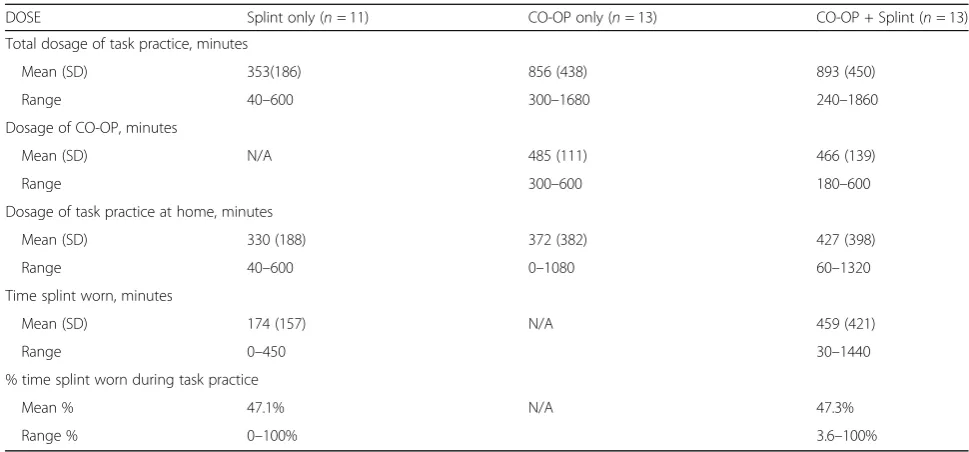
Information regarding dosage of task practice and splint wear is detailed in Table4. At study commencement, all three groups were instructed to practice tasks at home
at the exact same dosage, and the two splint groups (Groups 1 & 3) were instructed to wear the splints dur-ing the home practice for the same dosage. However, not all participants adhered to the prescribed dosage for splint-wearing or task practice at home. For both the CO-OP groups (Groups 2 & 3), CO-OP was provided face-to-face, in addition to the home practice with or without splint wearing depending on group allocation. The mean (SD) dose of the home-based task practice for each group in minutes, self-selected by participants, was: Splint only = 353 (186); CO-OP only = 856 (438); CO-OP + Splint = 893 (450). In the splint only group, partici-pants adhered to the prescribed splint wearing on aver-age 47.1% of the expected prescribed minutes, and in the CO-OP + splint group, participants adhered to the prescribed splint wearing on average 47.3% of the ex-pected prescribed minutes. One participant in the CO-OP + splint group withdrew due to ill health arising from a pre-existing medical condition, which is a known confounder in childhood disability trials.
At completion of the study, children and parents were asked “If given the choice would you have worn the splint during practice of goals?”, to which 64% (16/25) responded no. Reasons given by children and parents in-cluded: the splint restricted movement, making it diffi-cult to grasp and release; the splint made practice of goals more difficult; and the splint was poorly tolerated by the child.
Per protocol post hoc secondary analyses were run and no additional statistically significant between group differences were identified with dropouts removed (Additional file 1: Table S2).
Discussion
In this three group, pragmatic RCT, all groups showed statistically significant within-group improvements fol-lowing 2 weeks of treatment. Between-groups, goal at-tainment was greater for those who received CO-OP, compared to a functional hand splint and practicing goals at home. Combined use of CO-OP and splinting had no additive effect over CO-OP alone. Splints were not well tolerated by our participants, and participants deviated from the protocol by practicing goals without the splint on. The dose of task practice required to achieve significant improvements in this study was much lower than suggested minimum UL task-specific training dosage [3]. CO-OP, as well as task-specific practice of goals at home, may be effective interventions that lead to goal achievement when collaborative client-centered goals are set, a short, intense block of therapy is pre-scribed and the treatment is focused on active practice of the child’s chosen goals.
We investigated whether CO-OP added any benefits over and above a functional hand splint alone and when
Table 2Results at baseline, immediately following treatment (2 weeks), and at follow up (10 weeks)
Outcome measure
Outcome Score
Splint only CO-OP only CO-OP + Splint
COPM-Per Mean(SD)
Baseline 2.78 (1.32) 2.16 (0.98) 3.32 (1.48)
Immediate 5.43 (2.12) 5.89 (2.37) 6.11 (2.43)
Follow up 5.41 (2.00) 5.36 (2.21) 6.33 (2.05)
COPM–Sat Mean(SD)
Baseline 3.37 (1.43) 3.06 (1.38) 3.69 (1.62)
Immediate 5.78 (2.20) 6.47 (2.26) 6.34 (2.32)
Follow up 5.88 (2.19) 6.51 (2.21) 6.33 (2.19)
GAS, Mean (SD)
Baseline 22.79 (0.67) 22.61 (0.0) 22.79 (0.67)
Immediate 39.24 (9.95) 50.91 (14.14) 50.41 (18.89)
Follow up 39.24 (15.26) 49.02 (14.53) 49.92 (17.18)
BBT, Mean (SD)
Baseline 12.1 (10.2) 12.4 (10.6) 11.5 (11.0)
Immediate 12.1 (10.7) 14.5 (11.9) 12.6 (11.8)
Wrist Extension PROM, degrees (Mean, SD)
Baseline 53.4 (25.2) 60.8 (21.1) 60 (29.5)
Immediate 59.6 (21.4) 64 (21) 63.5 (24.5)
Wrist Extension AROM, degrees (Mean, SD)
Baseline 19.9 (42.4) 23.4 (35.1) 37.1 (37.4)
Immediate 30.1 (35.1) 28.6 (32.2) 40.5 (31)
Volkmann’s angle, degrees (Mean, SD)
Baseline 36.9 (38.1) 43.2 (34.8) 37.7 (47.3)
Immediate 40.7 (38.2) 37.9 (50.1) 32.7 (54.3)
Legend:COPM-PerCanadian Occupational Performance Measure– Performance,COPM-SatCanadian Occupational Performance Measure–
used in combination. Children provided with CO-OP in addition to splint demonstrated no greater improvement in goal achievement than children who completed CO-OP alone. In contrast to our findings, Elliott and colleagues [7] found that children who received a splint plus goal-directed training improved more on GAS scores than children who completed goal-directed train-ing alone. Further research may be needed, however given the poor tolerance of splints in our study it may
be ethically challenging to justify a larger trial of this nature.
CO-OP was shown to lead to goal achievement, there-fore may be another beneficial task-specific training op-tion for children with CP or BI. Task-specific UL training approaches, that involve active practice of a task, rather than addressing underlying impairments, are now widely recognized as best practice in this popula-tion [33]. CO-OP may be utilized with children who are
Table 3Intention to treat (ITT) Results and between group ANCOVA analyses immediately following treatment (2 weeks), and repeated measures at follow up (10 weeks). Analyses used are specified within table
Outcome Measure Group Estimated Mean Estimated 95% CI Pvalue
Repeated measures analysis (3 Time points)n= 45
COPM PER Splint 4.54 3.72–5.36 p= 0.052
COOP 4.47 3.65–5.29
CO-OP + Splint 5.25 4.43–6.07
COPM SAT Splint 5.02 4.15–5.88 p= 0.756
COOP 5.35 4.48–6.21
CO-OP + Splint 5.45 4.59–6.32
GAS Splint 33.76 28.75–38.76 p= 0.072
COOP 40.85 35.84–45.86
CO-OP + Splint 41.04 36.03–46.05
ANCOVA (Controlling for baseline 2 time points pre and immediately following intervention)
COPM PER Splint 5.41 4.24–6.59 Splint–COOPp= 0.371
COOP 6.17 4.95–7.40 Splint–CO-OP + splintp= 0.618
CO-OP + Splint 5.83 4.62–7.05 COOP–CO-OP + Splintp= 0.702
COPM SAT Splint 5.79 4.70–6.89 Splint–COOPp= 0.268
COOP 6.66 5.55–7.76 Splint–CO-OP + Splintp= 0.647
CO-OP + Splint 6.15 5.04–7.25 COOP–CO-OP + Splintp= 0.518
GAS Splint 39.12 32.23–46.91 Splint–COOPp= 0.034
COOP 51.16 43.32–59.00 Splint–CO-OP + Splintp= 0.047
CO-OP + Splint 50.29 42.50–58.08 COOP–CO-OP + Splintp= 0.875
BBT Splint 11.97 10.55–13.40 Splint–COOPp= 0.047
COOP 14.02 12.60–15.45 Splint–CO-OP + Splintp= 0.250
CO-OP + Splint 13.14 11.71–14.57 COOP–CO-OP + Splintp= 0.382
PROMa Splint 62.00 52.21–71.59 Splint–COOPp= 0.893
COOP 60.94 50.57–71.32 Splint–CO-OP + Splintp= 0.932
CO-OP + Splint 62.48 52.84–72.13 COOP–CO-OP + Splintp= 0.827
WROMa Splint 34.35 22.93–45.76 Splint–COOPp= 0.482
COOP 28.50 16.29–40.70 Splint–CO-OP + Splintp= 0.661
CO-OP + Splint 30.64 18.29–42.99 COOP–CO-OP + Splintp= 0.804
Volkmann’s anglea Splint 42.25 21.90–62.60 Splint–COOPp= 0.461
COOP 31.25 9.36–53.14 Splint–CO-OP + Splintp= 0.550
CO-OP + Splint 33.69 13.32–54.01 COOP–CO-OP + Splintp= 0.871
Legend:COPM-PerCanadian Occupational Performance Measure–Performance,COPM-SatCanadian Occupational Performance Measure–Satisfaction,GASGoal Attainment Scale,BBTBox and blocks test,PROMPassive range of motion,AROMActive range of motion.Pvalue significance set atp< 0.05
a
able to set their own goals, have the communication and cognitive skills to problem-solve and are motivated to persist with practice of goals. CO-OP can be used with children with unilateral or bilateral impairment, with a range of functional abilities. In other populations, CO-OP has been shown to have the additional benefit of transfer of problem-solving skills to future goals and functional skills [34]. We did not investigate transfer of skills, although a study of CO-OP for children with BI suggested transfer may not be achieved [18], warranting further investigation. As CO-OP is a promising interven-tion in this populainterven-tion, there is a need to provide CO-OP training to therapists in an effort to translate this new evidence into clinical practice.
Splints were not well tolerated by children in our study and this in itself is an important finding. Dislike of splint wearing and self-selected abandonment has been observed in other clinical populations [35–37]. Participants in the splint group, who were expected to practice their goals daily with their hand splint on, generally chose not to wear their splint, but instead to practice their goals without the splint on. The majority of children who were provided with a splint chose to wear it less than 50% of the time during goal practice, despite instructions to wear the splint 100% of the time. It appears that if participants did not find the splint useful, it was discarded and they continued to practice goals without the splint. Intervention con-tamination between-groups therefore occurred, and the splint only group were completing goal-directed, task-specific training at home. In doing so, these par-ticipants were able to achieve their goals, suggesting children may have discerned what was working, and
thus were motivated to practice using the effective goal-direct task-specific training strategy. Daily, targeted practice of goals within the home may be another effective task-specific training option, consistent with previously re-ported benefits of home programs [20]. The lack of differ-ence between the groups was therefore not surprising given the number of children in the splint only group that did not adhere to the protocol, and instead carried out task-specific training in a home program format, which has similarities with the CO-OP approach. Previous head-to-head trials of different types of task specific training for children with cere-bral palsy (e.g. Constraint Induced Movement Therapy ver-sus Bimanual Training), have showed no differences in outcomes between types of task-specific training interven-tions [2, 3]. It is interesting that the children performing home programs achieved similar outcomes on the COPM, because home programs provide a low-cost alternative with no travel requirements for parents. Previous splinting studies have reported poor tolerance of external garments by chil-dren [38] and static splints by adults [35–37], however there have also been studies that have reported no issues with splint tolerance [7,8,38].
Dose, or total amount of practice has been identified as an essential consideration in task-specific training [32]. Previous studies have suggested a minimum of 40 h of practice may be required to achieve significant im-provements in UL function [3]. In our study, the dose of practice was much less than this suggested minimum dosage, consistent with previous CO-OP studies in the developmental coordination disorder population [14, 33]. The splint only group improved with an average of approximately 6 h of self-selected goal practice at home
Table 4Dosage of intervention (time in minutes)
DOSE Splint only (n= 11) CO-OP only (n= 13) CO-OP + Splint (n= 13)
Total dosage of task practice, minutes
Mean (SD) 353(186) 856 (438) 893 (450)
Range 40–600 300–1680 240–1860
Dosage of CO-OP, minutes
Mean (SD) N/A 485 (111) 466 (139)
Range 300–600 180–600
Dosage of task practice at home, minutes
Mean (SD) 330 (188) 372 (382) 427 (398)
Range 40–600 0–1080 60–1320
Time splint worn, minutes
Mean (SD) 174 (157) N/A 459 (421)
Range 0–450 30–1440
% time splint worn during task practice
Mean % 47.1% N/A 47.3%
Range % 0–100% 3.6–100%
and the CO-OP groups improved with approximately 14 h of practice over a 2 week period (10 h face-to-face plus 4 h at home) (Table 3). Possible explanations for these positive results from lower dose intervention in-clude: (a) the interventions in this study focused solely on practice of the three goals as chosen by each individ-ual child, whereas in other cerebral palsy and brain in-jury studies [3,12], participants may practice many tasks that target improved upper limb function. It is possible that a smaller dose of practice, such as the 6–14 h achieved in our study, is enough to successfully achieve three individual goals, whereas a larger dose, for ex-ample 40 h, is required in order to not only achieve goals, but also to improve hand function as measured on the Assisting Hand Assessment (AHA) and Quality of Upper Extremity Skills Test (QUEST) [3]; (b) CO-OP is more effective than other task specific approaches at low doses in the cerebral palsy population, because CO-OP teaches a global problem solving strategy that the child can use to solve problems at home when the therapist is not present [13]. The only previous study of CO-OP in the cerebral palsy population found that CO-OP led to greater generalization, supporting this proposition [13]; (c) In regard to outcome measures, the COPM and GAS, which measure changes in‘activities and participa-tion’ were of interest in this study, in keeping with the ICF focus in pediatric rehabilitation and newer theories of motor learning. In our study the primary outcome measures were the COPM and GAS, whereas previous task-specific training studies have utilized assessments such as the AHA or QUEST in combination with goal achievement outcomes. The COPM and GAS are known to be highly responsive to detecting small individualized gains. The differences between the COPM and GAS out-comes are not clear, however one theory is that the COPM is more subjective than the GAS. It has previ-ously been suggested that participants are likely to per-ceive whichever therapy they reper-ceive as effective, and this may be reflected in COPM outcomes. The GAS may be more objective, and therefore may be more likely to reflect actual improvements in goal achievement, rather than perceived improvement. Moreover, although the BBT provided a basic measure of hand function, it is understandable that children did not improve on the BBT as a result of CO-OP as they did not practice grasp-ing and releasgrasp-ing blocks as part of their treatment. Par-ticipants practiced their own goals and therefore we wanted to measure if those goals had been achieved; and (d) Undertaking CO-OP with a therapist face-to-face where motivation and the “just right challenge” for learning is implemented, as opposed to prescribing a splint with self-directed practice at home, perhaps is more likely to lead to a greater dose of training and therefore a better outcome.
Future directions
The results of our study further support the benefits of task-specific training approaches in various forms for children with CP or BI. Further research comparing CO-OP or task-specific home programs to proven task-specific training approaches, such as CIMT or bi-manual training is warranted, particularly as dose re-quirements appear lower enabling cost effective services. Further research is needed regarding the types of chil-dren with CP or BI who may respond best to the CO-OP Approach™. A larger sample would enable sub-group analyses by etiology and type of cerebral palsy and brain injury, which would provide valuable informa-tion to clinicians about responders. Educainforma-tion regarding CO-OP is needed for therapist working with children with cerebral palsy and brain injury in order to translate this new evidence into practice in this population. Fu-ture studies should plan to recruit a much larger sample size, based on a power calculation using this new pilot data.
Limitations
Conclusion
Task-specific training continues to be best practice in sup-porting goal achievement for children with CP or BI, with CO-OP being a new form of task-specific training useful in these populations. CO-OP or task-specific training at home may be intervention options that require a lower dose to achieve individual goals, although CO-OP because of its structured problem-solving approach is likely to be more effective than child-led home practice alone. Com-bined use of CO-OP and functional hand splints did not lead to any additional benefits over CO-OP alone, and splints were not well tolerated by our participants. Ther-apy can be maximized through child-chosen goals, setting short, intensive timeframes and treatment including active practice of goals.
Additional file
Additional file 1:Table S1.COPM Ratings.Table S2.Excluding dropouts results and between group ANCOVA analyses immediately following treatment (2 weeks), and repeated measures at follow up (10 weeks). Analyses used are specified within table. (DOCX 31 kb)
Abbreviations
AHA:Assisting hand assessment; BBT: Box and Blocks Test; BI: Brain injury; CIMT: Constraint-induced movement therapy; CO-OP: Cognitive Orientation to daily Occupational Performance; COPM: Canadian Occupational Performance Measure; CP: Cerebral palsy; GAS: Goal attainment scale; GMFCS: Gross motor function classification system; ICF: International Classification of Functional, Disability and Health; MACS: Manual abilities classification system; QUEST: Quality of Upper Extremity Skills Test; RCT: Randomised controlled trial; ROM: Range of motion; UL: Upper limb
Acknowledgements
Sincere thanks to the children and dedicated families who participated in this research. Thankyou also to Noni Payling, Amanda Orr, Dr. Brian Hoare, Megan Thorley, Amanda Cauchi, Sarah Wilkes-Gillan, Carly Stewart, Kate Morris and Jane Berry.
Funding
This study was supported by a National Health and Medical Research Council postgraduate scholarship (MJ 1074570). The funding body, NHMRC, did not contribute to the design of this trial or the content or preparation of this manuscript in any way.
Availability of data and materials
The datasets used and analyzed during the current study are available from the corresponding author on reasonable request.
Authors’contributions
MJ, IN and NL conceptualized and designed the study. MJ, IN, EF and LM were involved in the acquisition of data. CG, MJ, IN and NL analysed and interpreted the data. MJ drafted the manuscript. IN, NL and CG critically revised the manuscript. All authors reviewed and approved the final manuscript.
Ethics approval and consent to participate
Informed written consent was obtained from the guardians of all participants. This study was approved by the following human research ethics committees (HREC): Hunter New England HREC 11/11/16/4.03; NSW HREC/11/HNE/410; The University of Notre Dame HREC 012042S; The cerebral palsy alliance 2012-02-01; Monash Health HREC 14232B; Children’s health Queensland HREC/15/QRCH/22.
Consent for publication Not applicable.
Competing interests
The authors declare that they have no competing interests.
Publisher’s Note
Springer Nature remains neutral with regard to jurisdictional claims in published maps and institutional affiliations.
Author details 1
School of Child and Adolescent Medicine, The University of Sydney, Sydney, Australia.2Occupational Therapy Department, John Hunter Children’s Hospital, Newcastle, Australia.3Cerebral Palsy Alliance Research Institute, The University of Sydney, Sydney, Australia.4Alfred Health, La Trobe University, Melbourne, Australia.5School of Health Science, Australian Catholic University, Sydney, Australia.6School of Health Science, Australian Catholic University, Brisbane, Australia.
Received: 3 April 2017 Accepted: 6 July 2018
References
1. Arner M, Eliasson AC, Nicklasson S, Sommerstein K, Hägglund G. Hand function in cerebral palsy. Report of 367 children in a population-based longitudinal health care program. J Hand Surg. 2008;33:1337–47. 2. Novak I, McIntyre S, Morgan C, Campbell L, Dark L, Morton N, Stumbles E,
Wilson S-A, Goldsmith S. A systematic review of interventions for children with cerebral palsy: state of the evidence. Dev Med Child Neurol. 2013;55:885–910. 3. Sakzewski L, Ziviani J, Boyd RN. Efficacy of upper limb therapies for
unilateral cerebral palsy: a meta-analysis. Pediatrics. 2014;133:e175–204. 4. Rosenbaum P, Stewart D. The World Health Organization international
classification of functioning, disability, and health: a model to guide clinical thinking, practice and research in the field of cerebral palsy. Semin Pediatr Neurol. 2004;11:5–10.
5. Lannin Natasha A, Novak I. In: Curtin M, Molineaux M, Supyk J, editors. Orthotics for Occupational Outcomes. 6th ed. London: Elsevier; 2010. p. 507–26.
6. Elliott C, Reid S, Hamer P, Alderson J, Elliott B. Lycra(®) arm splints improve movement fluency in children with cerebral palsy. Gait Posture. 2011;33: 214–9.
7. Elliott CM, Reid SL, Alderson JA, Elliott BC. Lycra arm splints in conjunction with goal-directed training can improve movement in children with cerebral palsy. In: NeuroRehabilitation; 2011. p. 47–54.
8. Keklicek H, Uygur F. Effects of hand taping on upper extremity function in children with cerebral palsy. In: Neurorehabilitation and neural repair, vol. 26; 2012. p. Np7–np8.
9. Kara OK, Uysal SA, Turker D, Karayazgan S, Gunel MK, Baltaci G. The effects of Kinesio taping on body functions and activity in unilateral spastic cerebral palsy: a single-blind randomized controlled trial [with consumer summary]. Dev Med Child Neurol. 2015;57:81–8.
10. Azzam AM. Efficacy of enhancement forearm supination on improvement of finger dexterity in hemiplegic cerebral palsy children. Indian J Physiother Occup Ther. 2012;6:5–8.
11. Jackman M, Novak I, Lannin Natasha A. Hand splinting for children with cerebral palsy and brain injury: a systematic review with meta analysis. In: Australian Occupational Therapy Conference, vol. 62. Melbourne: Australian Occupational Therapy Journal; 2015. p. 142.
12. Hoare Brian J, Wasiak J, Imms C, Carey L. Constraint-induced movement therapy in the treatment of the upper limb in children with hemiplegic cerebral palsy. In: Cochrane Database of Systematic Reviews: Wiley; 2007.
www.cochranelibrary.com.
13. Cameron D, Craig T, Edwards B, Missiuna C, Schwellnus H, Polatajko HJ. Cognitive orientation to daily occupational performance (CO-OP): a new approach for children with cerebral palsy. Phys Occup Ther Pediatr. 2016;37 (2): 1–16.
14. Polatajko HJ, Mandich A. Enabling Occupation in Children: The Cognitive Approach to Occupational Performance (CO-OP) Approach. Ottowa: COAT Publications ACE; 2004.
Australasian Academy of Cerebral Palsy and Developmental Medicine. Adelaide; 2016.
16. Gauthier LV, Taub E, Perkins C, Ortmann M, Mark VW, Uswatte G. Remodeling the brain: plastic structural brain changes produced by different motor therapies after stroke. Stroke. 2008;39:1520–5. 17. Mandich AA, Polatajko HJ, Zilberbrant A. A cognitive perspective on
intervention. In: Eliasson AC, Burtner P, editors. Improving Hand Function in Children with Cerebral Palsy. London: Wiley; 2008.
18. Missiuna C, DeMatteo C, Hanna S, Mandich A, Law M, Mahoney W, Scott L. Exploring the use of cognitive intervention for children with acquired brain injury. Phys Occup Ther Pediatr. 2010;30:205–19.
19. Jackman M, Novak I, Lannin N. Effectiveness of functional hand splinting and the cognitive orientation to occupational performance (CO-OP) approach in children with cerebral palsy and brain injury: two randomised controlled trial protocols. BMC Neurol. 2014;14:144.
20. Novak I, Cusick A, Lannin N. Occupational therapy home programs for cerebral palsy: double-blind, randomized, controlled trial. Pediatrics. 2009; 124:e606–14.
21. Law M, Baptiste S, Carswell A, McColl M, Polatajko HJ, Pollock N. COPM Canadian Occupational Performance Measure. 4th ed. Ottowa: CAOT Publications ACE; 2005.
22. McEwan, Polatajko, Wolf, Baum. CO-OP Fidelity Checklist. Revised 2015 edition. CO-OP Academy Executive; 2015. http://co-opacademy.ca/wp-content/uploads/2018/04/CO-OP-Fidelity-Checklist-Apr-4-2018.pdf. Accessed 13 July 2018.
23. Kiresuk TJ, Smith A, Cardillo JE. Goal attainment scaling: Applications, theory, and measurement. Hillsdale, England: Lawrence Erlbaum Associates, Inc; 1994.
24. Cusick A, McIntyre S, Novak I, Lannin N, Lowe K. A comparison of goal attainment scaling and the Canadian occupational performance measure for paediatric rehabilitation research. Pediatr Rehabil. 2006;9(2):149–57. 25. Cusick A, Lannin NA, Lowe K. Adapting the Canadian occupational
performance measure for use in a paediatric clinical trial. Disabil Rehabil. 2007;29:761–6.
26. Mathiowetz V, Federman S, Wiemer D. Box and blocks test for manual dexterity: norms for 6–19 year olds. Can J Occup Ther. 1985;52:241–5. 27. Öhrvall A-M, Krumlinde-Sundholm L, Eliasson A-C. Exploration of the
relationship between the manual ability classification system and hand-function measures of capacity and performance. Disabil Rehabil. 2013;35: 913–8. 916
28. Geerdink Y, Aarts P, Geurts AC. Motor learning curve and long-term effectiveness of modified constraint-induced movement therapy in children with unilateral cerebral palsy: a randomized controlled trial. Res Dev Disabil. 2013;34:923–31.
29. Sakzewski L, Miller L, Ziviani J, Abbott DF, Rose S, Macdonell RAL, Boyd RN. Randomized comparison trial of density and context of upper limb intensive group versus individualized occupational therapy for children with unilateral cerebral palsy. Dev Med Child Neurol. 2015;57(6): 539–547. 30. Jongbloed-Pereboom MG, Nijhuis-van der Sanden MW, Steenbergen B.
Norm scores of the box and block test for children ages 3–10 years. Am J Occup Ther. 2013;67:312–8. 317
31. Bassini L, Patel M. Pediatric Hand Therapy. In: Cooper C, editor. Fundamentals of Hand Therapy: Clinical Reasoning and Treatment Guidelines for Common Diagnoses of the Upper Extremity. St Louis: Mosby Elsevier; 2007.
32. Schulz KF, Altman DG, Moher D. CONSORT 2010 statement: updated guidelines for reporting parallel group randomised trials. BMC Med. 2010;8(1):18.
33. Sakzewski L, Gordon A, Eliasson A-C. The state of the evidence for intensive upper limb therapy approaches for children with unilateral cerebral palsy. J Child Neurol. 2014;29:1077–90.
34. Polatajko HJ, Mandich AD, Miller LT, Macnab JJ. Cognitive orientation to daily occupational performance (CO-OP): part II–the evidence. Phys Occup Ther Pediatr. 2000;20:83–106.
35. Cebesoy O, Kose KC, Kuru I, Altinel L, Gul R, Demirtas M. Use of a splint following open carpal tunnel release: a comparative study. Adv Ther. 2007;24:478–84.
36. Safazİ, TÜRk H, YaŞAr E, Alaca R, Tok F, TuĞCuİ. Use and abandonment rates of assistive devices/orthoses in patients with stroke. Gulhane Med J. 2015;57:142–4.
37. Lannin NA, Horsley SA, Herbert R, McCluskey A, Cusick A. Splinting the hand in the functional position after brain impairment: a randomized, controlled trial. Arch Phys Med Rehabil. 2003;84:297–302.