Chapter 5
Transpersonal Psychology
We do not see things as they are but as we are. Talmud
To seek Mind with the mind is the greatest of all mistakes… The more you talk about it, the further astray you wander from the truth.
Third Zen Patriarch
5.1 Introduction
In his overview of Western psychology, Bankart (1997) categorises the three main forces in the field as the classical-psychodynamic, positivistic -behavioural and humanistic. The transpersonal approach is considered by some to be the fourth force (Cowley, 1993; Rowan 1993; Wilber 1997). Although the formal establishment of transpersonal psychology can be traced back to the humanistic school of Maslow in the 1960’s the roots of the approach reach to the very origins of humankind (Gordon-Brown & Somers, 1988). It was not officially inaugurated as a distinct approach until 1968-1969 when the Journal of Transpersonal Psychology was launched, though the word ‘transpersonal’ seems to have been coined by Jung in 1917. The humanistic school that spawned transpersonal psychology was revolutionary in that it diverted the traditional
pathologising stance of psychology to one that rather had an avid belief in the dimension of human potential. The transpersonal approach embraced this idea, but extended it even further. In 1967 whilst under the influence of Eastern mysticism, Maslow delivered a lecture (entitled ‘The further reaches of human nature’) in which he argued for a fourth force in psychology that encompassed “…transcendent experiences and transcendent values…” (Schwartz, 1995, p. 344). Several other notable individuals like Stanislov Grof, Anthony Sutich, Michael Murphy, Alan Watts and Roberto Assagioli became involved in the new movement and several of them became founder members of the Association for Transpersonal Psychology in 1969. Whereas previously (and still to some extent today) Western psychology had always sat somewhat uncomfortably alongside, but very separate from, Eastern spiritual psychologies, the transpersonal embraced them entirely. The new movement explored and integrated the well established but comparatively esoteric practices from these other cultures, and in so doing pushed passed the conservative limits of the conventional Western paradigm (Rothberg, 1998a). Contemporary transpersonal
clearly demarcated, as it remains in the process of comprehensively defining itself (Cortright,1997).
A main feature of the approach is that it integrates transcendent spiritual experiences into its protocols, though is in no way associated with any particular religious orthodoxies. Cowley (1993, p. 527) , in noting the distinctive spiritual focus of transpersonal psychology, explains that it encompasses “… the transformation of consciousness…” through such devices as mystical experiences which ultimately allow “…access to the unitave self…”. While some other
psychological approaches incorporate the spiritual dimension as an adjunct to their primary focus, for example as a source of psychosocial support (Kasprow & Scotton, 1999) or as a peripheral issue (Haug, 1998), in transpersonal psychology the spiritual dimension is the prime focus area. Rowan (1993) underlines that a key realisation of transpersonal psychology is that the ordinary consciousness which individuals take for granted, by its very nature removes them from a wider reality. Without some effort most people remain oblivious of an expanded reality, and Western culture by and large is uncomfortable with stages of consciousness development that extend beyond adult ego.
Kasprow and Scotton (1999) allude to recent experiments in which hospitalized patients were covertly prayed for, manifesting in faster and more enduring recoveries. Although this might be difficult to explain within current scientific orthodoxy, for transpersonal psychology, the distal effects of consciousness is common currency. The construct of consciousness can be difficult subject matter, particularly expanded consciousness and aspects of spirituality (Walsh & Vaughn, 1993a). Unfortunately the ephemeral nature of consciousness makes its somewhat resistant to scientific scrutiny, especially when consciousness is divorced from its more accessible and traditional home as part of the brain. Walsh and Vaughn (p. 14) note that in its most esoteric sense consciousness is an aspect of “… the Absolute… God, Void… beyond space, time, qualities, concepts, categories, and limits of any kind.”, and hence ridicules any attempts to conscript its intangib le nature, even to written description. Expanded consciousness can only be known through direct experience and through some degree of trial and error. Western trained researchers, who have no direct experience of such altered states, may find accounts of them to be unintelligible, incomprehensible or simply unbelievable. Boorstein (2000) describes how as a skeptical psychiatric practitioner he on a whim attended a meditation weekend pitched
specifically at physicians. He was shocked to find that his traditional scientific paradigms were shaken to the core by his unexpected abilities as a result of the course. He spent the next five
years trying to make sense of his experience through undertaking his own spiritual journey. There are many other examples like this, and several psychologists have documented their own experiences (Armstrong, 1989; Rowan, 1993). For Western psychologists, the intangible aspects of consciousness are only now coming to attention, yet Goleman (1993) notes how the
psychologies of many other cultures had incorporated altered states of consciousness into their daily lives thousands of years ago. An example is the Buddhist tradition which integrated the transcendence of consciousness as the prime mode of escaping from suffering and futile attachments, both emotional and material.
Although transpersonal psychology is received by many orthodox practitioners as an avant-garde or fringe approach, it does not deny the value of mainstream psychology, but sees itself as an extension of it, much the same way the quantum physics extends Newtonian physics (Kasprow & Scotton, 1999). Some facets of the movement are frequent bedfellows in clinical practice (such as Jungian dreamwork) whilst others are either less well known or more skeptically received (such as Grof’s (1988) holotropic breathwork). Wilber (1993) argues that there is a psychological homogeneity (psychologia perennis - perennial psychology) of consciousness that pervades the vast majority of disciplines through the ages and across cultures. This suggests that although practices can be remarkably different on one level, they are intricately tied together on another. What binds them together is the golden thread of transpersonal psychology.
5.2 Cornerstones of transpersonal psychology
A defining principal of transpersonal psychology is its focus on human development that goes beyond adult ego. The result of the release from egoic concerns is that boundaries between the self and other objects become distorted and possibly collapse, allowing for profound
connectedness to other objects. Walsh and Vaughn (1993a) suggest that transpersonal experiences are those in which the individual’s sense of identity extends beyond the self, encompassing humankind, life or indeed, the entire cosmos. They posit the following definintion (p. 3):
“Transpersonal psychology is the psychological study of transpersonal
experiences and their correlates. These correlates include nature, varieties, causes and effects of transpersonal experiences and development, as well as the
psychologies, philosophies, disciplines, arts, cultures, lifestyles, reactions and religions that are inspired by them, or that seek to induce, express, apply or understand them.”
Rowan’s (1993) discussion of transpersonal psychology is noteworthy in that he launches his discourse by describing what it isn’t. Firstly he says it is not extrapersonal, that set of activities suggested by the likes of levitation, spoon-bending, dowsing, telepathy, clairvoyance and firewalking. One distinction is that the transpersonal deals on some level with the divine whilst extrapersonal does not. This Rowan acknowledges is a flawed distinction, though it points in the right direction. Rowan goes on to emphasise that transpersonal psychology is not New Age, by which he means the branch of esoteric experiences devoted to the positive and seemingly
designed for the gullible. Neither, he states, is it anything religious. Transpersonal experiences are about personal discovery, and not linked to religious institutions of any kind.
Perhaps the single most important differentiation to be made regarding transpersonal and
mainstream psychotherapy, is that in the former spiritual experiences are pursued as central tenant of the encounters. Therapeutic interventions are less concerned with psychopathology, than a fostering of higher human development through deepening connectedness to whatever might be considered relevant at the time, including the self, community, nature or the cosmos (Kasprow & Scotton, 1999). In this regard transpersonal psychology is intrinsically linked to healing
approaches the world over, including eastern mysticism, shamanistic healing and South African traditional healing. Cowley (1993) notes that in terms of the transpersonal perspective, spiritual health and well-being are defined by a feeling of wholeness and integration. Where psychology answers the question “Who am I?” with variations of - an ego or a self, - religion answers the same question with - a soul, a spirit. Transpersonal psychology attempts to blend these two worldviews, and answer questions that cannot be answered by studying the likes of genes and neuroscience (Cortright, 1997).
5.2.1 Basic assumptions
A fundamental idea in transpersonal psychology, is that the level of mind that appears to exist to most people is illusionary. There is no duality between self and non-self. Although it appears to exist it does not, and is only a fabrication of mind (Wilber, 1993). In short, the individual identifies with the organism which exists in time and space. The organism perceives itself as finite and thus fears death. At the same time an idealised version of the self is created – the ego – which is a mental representation of the organism. Wilber however describes the ego as akin to the images on a television set. Although they can be seen, they are unreal and existing only as
pictures. In part, transpersonal psychology therefore involves evolved practices for transcending the illusion of being.
Cortright (1997) distinguishes several basic assumptions of transpersonal psychotherapy: 1. The spiritual essence of individuals is primary, and supports the psychological self.
2. Consciousness is multidimensional and accessible via the spiritual self. Within the expanded consciousness, the individual can experience clarity, love, wisdom and experience the connectedness of all beings.
3. Spiritual seeking is a natural urge, and individuals have a tendency towards self-growth and discovery. Where Western psychology accepts human motivation as described by Maslow, transpersonal psychology extends the motivation into the spiritual realm.
4. By turning inward, deep sources of growth and wisdom are available. Although mainstream psychology accepts this to some extent, e.g. in finding the authentic self (client-centered) or nuclear-self (object relations), transpersonal psychology directs individuals to their deepest recesses of wisdom.
5. The spiritual quest aligns people to the healing forces of the psyche. It is not a panacea, but an optimal route towards psychological and spiritual integration.
6. Altered states of consciousness can be a useful way of accessing the spiritual dimension, but is by no means the only way.
7. Mental health is mediated by uncovering meaning in the world. This is in contrast to the existential position in which mental health is achieved by creating meaning. Similar to some existential and phenomenological approaches, the transpersonal therapist is not an authority, but like the client, a fellow seeker on his own journey.
Although transpersonal psychology is often associated with the esoteric, parapsychology, psi factors and mysticism, more recently it has sought the profound in the ordinary, sacredness in daily life (Cortright, 1997). For those who have had transpersonal experiences, both voluntary and involuntary, the effect appears to be profound providing both meaning and direction in life, as Krippner (1998, p. ix) describes that “… one’s identity plunges more deeply, extends more widely, or expands more broadly…. ‘Spirit’ is encountered…”. This espouses the notion of an evolved state of being, something akin to the Buddhist concept of Nirvana, wherein one
experiences a clarity of existence and enlightenment. Cortright (p. 59) describes how during his meditations he becomes “… more centered to the depths of my being …a greater calm,
equinamity, and loving sense of presence…”. For Grof (1988) transpersonal experiences transcend the usual barriers between the individual and the rest of the universe. In this state the
individual is able to merge with other aspects of humanity and in its more extreme form, the consciousness of other organic (e.g. animals and plants) and inorganic objects.
5.3 The Chakra system
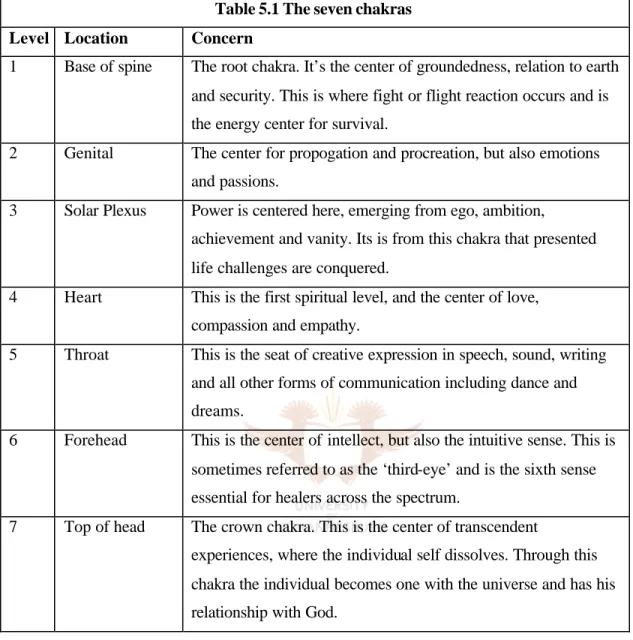
As has been evident so far, Eastern and Western concepts of mind and body differ significantly (Cortright, 1997; Walsh, 1990). One of the key departure points is that the Western model views humans in terms of physiology and various levels of functioning (e.g. emotions, consciousness, behaviours), the Eastern view is derived from the view of human beings as comprising energy levels or chakras (Gallegos, 1983), which comes from the Sanskrit meaning ‘wheel’, referring to the belief that chakras are wheels of energy on the body. The concept of chakras originated from the discipline of yoga at least 3000 years ago, and has been the cornerstone of Eastern medicine ever since, forming the bedrock of such disciplines as acupuncture. To this day the chakra system is taught in many Oriental and Asian medical schools (Nelson, 1990), and can be thought of as a way of integrating body, mind and spirit. The chakras can be conceptualised as funnels for drawing vital energies (prana) inward from a universal source, and in a sense represent evolved levels of consciousness. In essence there are considered to be seven charkas at various levels in the body, from the base of the spine to the top of the head. Each higher chakra encapsulates the capacities of lower chakras, and with evolution through the chakra levels, the essential focus of life changes. So while someone centered at the first level will be primarily concerned with survival needs, these will remain important for someone at the fourth level, but their primary concern may have switched to humanistic concerns. Each chakra level therefore has its own qualities of being, including cognitions, relationships, ethics and values, with the chakra system being a map of consciousness development from embryonic, through ego to transcendent (Nelson, 1996).
In brief the seven chakras are (Cumes, 1998; Gallegos, 1983; Nelson, 1990): Table 5.1 The seven chakras
Level Location Concern
1 Base of spine The root chakra. It’s the center of groundedness, relation to earth and security. This is where fight or flight reaction occurs and is the energy center for survival.
2 Genital The center for propogation and procreation, but also emotions and passions.
3 Solar Plexus Power is centered here, emerging from ego, ambition,
achievement and vanity. Its is from this chakra that presented life challenges are conquered.
4 Heart This is the first spiritual level, and the center of love, compassion and empathy.
5 Throat This is the seat of creative expression in speech, sound, writing and all other forms of communication including dance and dreams.
6 Forehead This is the center of intellect, but also the intuitive sense. This is sometimes referred to as the ‘third-eye’ and is the sixth sense essential for healers across the spectrum.
7 Top of head The crown chakra. This is the center of transcendent
experiences, where the individual self dissolves. Through this chakra the individual becomes one with the universe and has his relationship with God.
Notice that the first three chakras are a part of the physical body and its functions, and are referred to as the lower chakras. The four higher chakras are associated with higher levels of functioning. Cumes (1998) points out that the chakra model is another representation of Maslow’s hierarchy of needs. Chakras 1 – 3 are synonymous with Maslow’s deficiency needs on his lowest two levels (physiological and safety). Similarly Chakras 4-6 correspond with Maslow levels 3 (love) and 4 (esteem), whilst chakra 7 is akin to Maslow level 5 (self-actualisation) though goes beyond it in the Western sense of the word. Interestingly, Wilber (2000) notes how there is a tradition that each of the 7 chakra levels takes seven years of adaptation, thus the first seven years of life are an adaptation to the physical realm (food, survival, security), the second seven years embrace sexual development culminating in puberty, the third seven years involves the
emergence of the logical mind and new perspectives. The forth seven years starting at around age 21 is often where consciousness development becomes stagnant, though with the potential for extensive development if given the intent.
The chakra system can also be used for spiritual diagnosis, similar in a way to Freudian fixation at various stages of development. For example an individual centered at the root chakra is associated with co-dependency and neediness in relationships. It is the natural center for infants before they evoke the second chakra some years later. Nelson (1990) states that it is rare for individuals in industrialised societies to progress passed the third chakra, whose primary modes are power and control. Individuals with their energies centered in the fourth chakra have moved beyond attachments to the material world, and enjoy a union with all sentient life, and the primary mode there is universal love. According to the predominant Western view (following Freud), the fifth level is regarded as the highest possible, and is characterised by wisdom, with the primary modes being grace and creativity. The sixth and seventh chakra would be considered to be pathological according to most Western models, as they include an expanded vision, capable of tapping into universal knowledge, and hence with the capacity for visionary power and prophesy, while the highest level is the complete dissolution of the self-boundaries and a merger with soul and divine essence. It is rare for even highly evolved individuals to remain on this level, with most people only ever being able to achieve a temporary centeredness in this domain.
5.4 Ken Wilber
No one is more closely associated with the theoretical underpinnings of contemporary transpersonal psychology than Ken Wilber (Walsh & Vaughan, 1994). He has almost single handedly cut through the confusing spiritual insights from non-Western paradigms and produced an intricate integrated model from a diversity of disciplines, cultures and epistemologies. In a age of specialisation, Rothberg (1998a) marvels at the breadth of Wilber’s framework. At a time when a synthesis of just Western social knowledge would be almost unimaginably daunting, Wilber has gone further by integrating both Western and Eastern knowledges in his models. His body of work is considered to be arrestingly comprehensive, offering not only a synthesis of polarised thinking but delivering unique insights and models that emerge from the integration. His prolific output began at the age of twenty-three (1975), when Wilber wrote The Spectrum of Consciousness now viewed as a classic in transpersonal literature. Although with no formal training in philosophy or psychology, Wilber had read widely in the many fields, and in the book fused the ideas of many Western and Eastern thinkers from an array of disciplines including
psychology, anthropology, philosophy, sociology and religion (Schwartz, 1995). Despite the usual difficulties in getting the book published, once this was achieved, it was immediately hailed as an important work, and receiving considerable attention and acclaim. Wilber went on to write dozens more books and articles, as well as editing the transpersonal journal ReVision. Walsh (1998, p. 32) states that by 1987 Wilber “… had created an interdisciplinary collection of rare scope and integrative power…”. Personal circumstances including the tragic death of his wife resulted in a long silence from Wilber. Only in 1995 did Wilber produce his next transpersonal book (a monumental 800 page discourse called Sex, Ecology, Spirituality: The Spirit of Evolution), followed by several more books in the ensuing years. Walsh notes that Wilber’s writing can be intimidating, even to seasoned academics and that retaining the gestalt of his vision can be extremely difficult. Not, he stresses, through poor writing, but rather due to the profusion of novel ideas. Rothberg (1998a, p. 6) offers the opinion that despite his prolific output and the complexity of his themes, Wilber’s output is centered around a relatively simple idea, namely that “…there is a profound drive in humans, as well as in all life and even matter, to evolve towards what he usually calls ‘Spirit’”.
Nowadays, although somewhat reclusive, he is considered, despite his young age to be something of a sage in the field. Important to keep in mind however is that Wilber is a theoretician, and conceptualises almost purely from that level. His writings are therefore not of the self-help variety, but rather offer a rather dense philosophical foundation. The discourse is often obscure and rarely easily translatable into daily practices.
5.4.1The Philosophy of Ken Wilber
Wilber (1997) notes that there are two conflicting approaches to knowledge. The first of these focuses on exterior aspects of the world, things that are material and can be touched, and are largely objective. The second approach is the subjective interior world and is referred to, amongst other possibilities, as consciousness, awareness and psyche. The epistemology of the first is largely empirical, while the latter is experiential. In psychology where the former has resulted in psychotherapies like behaviourism and systems theory, the second has spawned the likes of depth psychology and Jungian analysis.
Other transpersonal psychologists, for example Grof (1988) and Assaglioli (1993) have commented on the limitations of the Western conceptualisation of consciousness. Wilber’s original work explored the interior world of consciousness, and by integrating ideas found in both
Eastern and Western literature he developed a new model of consciousness. The model suggested that just as light has a spectrum of colours, so does consciousness have a spectrum of levels and states (Walsh & Vaughan, 1994). Using the metaphor, Wilber discusses how different schools of psychology, for example Freudianism and behaviourism are not contradictory, but rather address different levels of the spectrum. In this way, Wilber’s book provided the argument that
competing schools of psychology complemented each other and all contained at least partial truths and descriptions of levels of consciousness. While Western psychology focused mostly on the lower levels of the spectrum, Eastern spirituality described the higher levels (Cortright, 1997). For Wilber, mystical experiences involving the dissolution of ego boundaries are an indication of an evolved state, and not an indication of pathology. At the same time, Walsh and Vaughan are quick to point out that Wilber does not dismiss all notions of pathology, but rather explains pathology in regard to developmental levels, viz. prepersonal, personal and
transpersonal, with pathology being localised on the lowest level of the spectrum. Wilber also drew attention (through what became known as the ‘pre/trans fallacy’) to the idea that ego-loss associated with transcendent experiences were totally dissimilar to ego-loss of prepersonal (e.g. schizophrenic or infant) states (Cortright). Many Western scientists held the view that the
experiences of Eastern mystics, or even those of people having so-called ‘near-death experiences’ (NDEs) were delusional and indicative of possible pathology (Achterberg & Peters, 1994). For many in the West who utilised Eastern practices, and for the Eastern academics and teachers, this attitude served to confirm the rigidity and to some extent naiveté of their Western counterparts.
Although Wilber’s transpersonal theories might seem to indicate a predilection for the esoteric, he does not eschew science, but rather argues the concept of distinct epistemological modes – the sensory, the intellectual and the contemplative. Each realm of knowledge has its own data and methods of enquiry and category errors ensue when inappropriate assessment strategies are used for a particular domain. For example although science is generally useful for understanding physical phenomena, it is profoundly more limited if not totally inept, within the contemplative domain (e.g. religion). At the same time he is also critical of the postmodern stance (Wilber, 1998b) which holds that science is not in fact knowledge of the world, but rather an interpretation of the world, no more or less valid that for example than an artistic or poetic interpretation. For Wilber, the idea is simply that poetry and physics are not merely different perceptions of one event, but rather that they require different lenses to understand them. He argues that this idea goes back to Plotinus (about 1800 years ago) who mooted the idea of twelve different ways of knowing, which according to Wilber can be boiled down to a core 3, viz.: (p. 18) “… the eye of
the flesh (empiricism), the eye of the mind (rationalism), and the eye of contemplation (mysticism)…”.
Wilber (1998b) goes as far as saying that there is a no more pressing topic than the relationship between science and religion, and that whilst science provides humans with a means to finding truth, religion is the means to finding meaning, and that these two forces are at odds with each other. He states that most scientists consider religion to be a throwback to earlier stages of human evolution, an idea that comes through in the writings of inter alia Freud, Comte and Marx. Similarly, religion, especially when given expression in a fundamentalist form denigrates science, for example by dismissing theories of evolution, paleo-anthropology and cosmology. Wilber’s point, which is made in various sources (Rothberg, 1998a; Walsh, 1998; Wilber 1998b) is that ways of understanding nature are unsuited to modernist empirical inquiry, and Wilber suggests a contemplative science, much the same way that philosophy allows for a more interpretive
science. In a similar vein, Walsh points out that whilst Wilber acknowledges the value of general systems theory in order to understand various aspects of nature and interpersonal functioning, he argues that it only deals with exteriors and that to comprehend interiors something different is required. From his perspective the subjective experience and inner consciousness requires an approach of introspection, interpretation and empathy.
A central recurring idea in Wilber’s works, is the notion of so-called perennial philosophies (term coined by Aldous Huxley), the gist of which is that despite the superficial differences in doctrines and practices of most world religions, the core understandings of reality, nature, knowledge, ethics and spiritual life are all remarkably similar. Cortright (1997) notes for example that in most Western theistic traditions (e.g. Christianity, Judaism and Islam) the individual seeks to form a personal relationship with the divine via the soul. In Eastern traditions (e.g. Buddhism and Taoism) the individual soul seeks to merge into an impersonal divine, stressing the illusionary nature of the self. Interestingly the mystical aspects of the Western traditions (Gnostics, Kabbalah and Sufism respectively) also emphasise the nondual Eastern approach, while aspects of the Eastern doctrines (not Buddhism however) also reflect the personal-divine relationship. In short there are large reconcilable overlaps in these diverse spiritual approaches.
5.4.2 The great chain of being
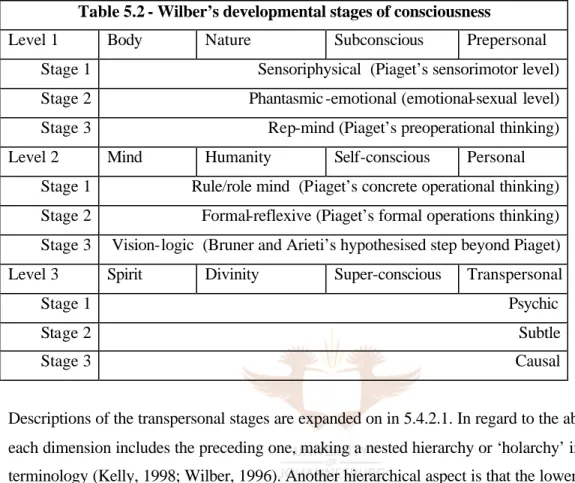
Ontologically, Wilber views reality as multilayered with a hierarchy ascending from matter through body, mind and finally spir it. Paralleled with these three links in Wilber’s “great chain of
being” (Cortright, 1997; Kelly, 1998; Wilber 1998b) are corresponding domains or movements, namely:
Table 5.2 - Wilber’s developmental stages of consciousness
Level 1 Body Nature Subconscious Prepersonal
Stage 1 Sensoriphysical (Piaget’s sensorimotor level) Stage 2 Phantasmic -emotional (emotional-sexual level) Stage 3 Rep-mind (Piaget’s preoperational thinking)
Level 2 Mind Humanity Self-conscious Personal
Stage 1 Rule/role mind (Piaget’s concrete operational thinking) Stage 2 Formal-reflexive (Piaget’s formal operations thinking) Stage 3 Vision-logic (Bruner and Arieti’s hypothesised step beyond Piaget) Level 3 Spirit Divinity Super-conscious Transpersonal
Stage 1 Psychic
Stage 2 Subtle
Stage 3 Causal
Descriptions of the transpersonal stages are expanded on in 5.4.2.1. In regard to the above levels each dimension includes the preceding one, making a nested hierarchy or ‘holarchy’ in Wilber’s terminology (Kelly, 1998; Wilber, 1996). Another hierarchical aspect is that the lower levels need to be fully established before proceeding up the order. The prepersonal aspects must therefore be fully formed before commencing with the personal, and the personal must be fully realized before continuing to the transpersonal – an idea of which Kelly and Rothberg (1998b) are somewhat critical of, arguing that transpersonal development or experiences can run parallel to personal or indeed the prepersonal dimension. In addition what is somewhat simplified in the above is that there is not only a single line of development, but several, and that various independent modes of development including cognitive, emotional, moral and relationship functioning occur
simultaneously at different paces through the different levels (Rothberg, 1998b), and that the self, may be in several different stages at once, although the general movement is towards higher structures. Wilber (2000) emphasises that although he depicts consciousness as a rather
monolithic set of linear stages, that this is just for descriptive synthesis. He suggests that a better image might be of numerous fluid streams of development all flowing at their own pace, though the stages cannot be skipped. Thus various streams, including emotional, spiritual, moral and self-identity develop through general levels in non-linear waves. Someone could thus be high in
the logico-mathematical domain (the central Piagetian cognitive domain), but low in gender identity, altruism and socio-emotional capacity – all equally valid cognitive domains. Piaget, Wilber argues, focused his cognitive developmental model in a far more limited frame. In reality, developmental lines do tend to unfold in a fairly predictable and sequential holarchical fashion.
Wilber (1998b, p. 8) suggests the following diagram to understand the “great chain of being” which he also calls the “great nest of being”.
Spirit Soul Mind Life Matter Physics Biology Psychology Theology Mysticism
Wilber (2000) states that the Great Nest of Being is nothing more than the developmental space in which human consciousness can unfold. Each senior level includes its juniors but also possess the emergent qualities not found on the lower level. Animals for example are made of matter, but include sensations which are not found in matter (like rocks). Another example is ‘Soul’, which refers to that component of self that transcends birth and death, whilst spirit is essentially merging identity with the divine – as in Buddhism where enlightenment dispenses with the subject-object duality creating “oneness” (Cortright, 1997). Similarly humans include sensations but add
emergent properties like reason, while the soul includes reason it adds archetypal vision not found in the rational mind (Wilber, 1998b).
5.4.2.1 Stages of consciousness
According to Rothberg (1998a) Wilber maintains that the relationship between reality and the psyche is similarly hierarchical with higher levels being superior to lower levels, and with higher
levels showin g evolved qualities as compared to previous levels, much like Piaget’s stage of formal operations is both superior and qualitatively different to the stage of concrete operations. So it is with the stages of consciousness in Wilber’s model. Returning to the levels and stages of development (as indicated in Table 5.2), the first few stages of development are clearly informed mostly by Piaget, whilst the additional five stages emerged as a result of Wilber’s Spectrum integration (Rothberg, 1988a; Rowan, 1993; Walsh, 1998):
A) Vision-logic Level – a higher mode of integrative and dialectical reasoning than found in Piaget, and involving the ability to intuit directly complex patterns, as well as an
integration of mind and body. Importantly, the stage involves an ability to (Walsh, p. 41) “…envision multiple relationships among individual concepts simultaneously.”.
B) Psychic Level – first of the transpersonal stages in which the “soul” emerges beyond individual ego, and sometimes associated with shamanism. The unfortunate choice of name has nothing to do with ESP or any other “psi” phenomena, but rather the first largely somatically experience stage of transpersonal encounter. This first stage beyond ego allows for newly acquired levels of empathic understanding.
C) Subtle Level – emergence in consciousness of archetypal forms such as the power of animals, gods and other deities. These experience are at a deeper interior space than the previous levels and the individual can take on some of the powers of the archetypal forms. First experiences of rapture or bliss may occur, while it is common at this stage to experience high levels of compassion. The transpersonal self has been accessed, a self that almost appears outside of ordinary self.
D) Causal Level – emergence of pure formless awareness (akin to the Buddhist ‘nirvana’), so that there is only consciousness. There is a readily obtainable blissful experience, people speak of a formless consciousness, of God and soul becoming one.
E) Nondual (or Ultimate) Level – unmanifest formless awareness, less a stage than the ground of all phenomena, which Walsh describes as a kind of lucid dreaming, but where the individual has full control. There is both everything and nothing – an identity with the entire cosmos.
As might be obvious, the higher stages lend themselves less to description than experience. Wilber (1996) and Rowan (1993) note how vocabularies can do little justice to capturing the essence of transpersonal states. Rowan’s noteworthy comment is that (p. 116) “…I have found
that people have so little experience of them that they go blank and glazed when I talk about them…”. In attempting to encapsulate them on a highly simplified level, however,
Cortright (1997) notes how the above levels draw heavily on perennial philosophy which identifies four planes of existence, namely:
1. The terrestrial plane – normal earthly senses
2. The intermediate plane – clairvoyant sense, also referred to as the psychic level 3. The celestial plane – where the divine is encountered
4. The infin ite plane - the divine is oneself
Wilber similarly argues that in the higher stages, the objectivity of the physical world gives way to (Walsh, 1998, p. 42) “…a subjective, dependent projection of mind…the victim of experience becomes its creator…”. The individual is able to liberate himself from over-identification with personal concerns (Kasprow & Scotton, 1999) and thus in this state all the anxieties on physical world are revealed as illusionary and insignificant. From the nondual perspective the physical world is a limited space, and succumbing to the demands of that space (being immobilised within ego) without evolving to the higher planes of consciousness is seen by transpersonal practitioners as virtual entrapment. Clearly this highly evolved stage of consciousness is a far cry from the Western Piagetian concept of mature cognitive development. Walsh speculates that perhaps one reason for the apparent arrested development of Western culture is that Judaic -Christian ethic encouraged the externalisation of transpersonal development through its institutions in the form of prayer and historical texts, and not as in many Eastern traditions via transrational post-egoic and mystical exploration. Indeed any such experimentation within the domain of meditation or seeking higher consciousness is often seen as blasphemous. Walsh does point out that every now and again religious institutions have borne their own mystics, like St Theresa, Eckhart and St. Augustine, who declared that God could be known through introspection and stated
unequivocally that “He who knows himself knows God.”
5.4.2.2 Structure of consciousness
Wilber (1998a) states that the consciousness system has at least 3 main components. These are: A) Enduring structures that once emerging during development tend to remain, and include
linguistic competence, motor co-ordination, and some of the basic holons of consciousness like perception and sensation. Each developmental stage of these features are incorporated into higher stages.
B) There are also features which are relatively transitional, and which are replaced with development. He sites Kohlberg’s stages of moral development as an example of these features in which higher stages replace lower stages, but also mentions structures like worldview, self-needs and self-identity.
C) The self-system (or just self) mediates between the enduring and transitional features. It assesses and incorporates experiences in several ways, for example through identification, organisation, will, defense, navigation and metabolism. As consciousness develops, the self has access to previous levels, but at each pivotal stage of development, there is filtering process in which previous ways of experiencing which might now be redundant are shed, whilst others structures are incorporated and integrated.
If there is continued development, the self transcends a particular level and identifies with a more evolved structure (Wilber, 1998a). Like Piaget, Wilber believes that the delineated stages, and their progression, are universal and therefore applicable to all cultures, although he stresses (like Kohlberg (Craig, 1996)) that more advanced stages emerge for relatively few people (Rothberg, 1998b). Wilber also argues that the stages are logically coherent, that is structured wholes, with each being distinguishable from the others, although he acknowledges a certain indiscrete vagueness in regard to the transpersonal levels. Further to this Rothberg highlights that there can be regression within the levels, something which would not be considered normal within the Piagetian view, unless subject to organic insult.
5.4.3 Recent Writing
Walsh (1998) offers an overview to Wilber’s (1995) tome. He notes that Wilber considers the world to be highly fractured both environmentally and emotionally. Humans are fractured from nature, mind from body, spirit from everything. Fundamental to Wilber’s understanding, is the concept of the holon, simply the idea that every entity in the universe is both a part of something but a whole in its own right at the same time. Zimmerman’s (1998) example is that of a cell, which is a whole but also part of an organism, while Wilber (1996) explains how a whole atom is a part of a whole molecule, which is a part of a whole cell, continuing both up and down the hierarchy (or holorachy) to infinity, and including the dimension of time, so that even the whole of the cosmos at this moment is only a part of the cosmos in the next moment. The driving force of each holon is to preserve both its wholeness and its ‘partness’. In addition there are emergent properties of entities when they are combined, for example oxygen and hydrogen combine to form water molecules, but this is largely unpredictable from the constituent atoms, the whole
emerges from something greater than the sum of the parts. Another example might be that any single part of a watch on its own cannot produce the time, which is the emergent quality of the whole watch. The wholeness of the watch is not found in any part but in the whole, which for Wilber is a metaphor for the futility and ineffectiveness of the traditional reductionist scientific approach. Senior levels cannot be reduced to their junior levels, they transcend them by their emergent properties. Importantly, for Wilber (1996) the universe is self-transcending, emergent qualities are self-perpetuating, since holons are driven to transcend. This basic drive differs from evolution by natural selection, which is based on chance mutation, by rather a basic spirituous energy in the universe driven to create. Wilber emphasises that this does not comply with the traditional views of God or the creationist ideology, but rather an unqualifiable spirit.
For Wilber life is made up of the biosphere (biological), the physiosphere (matter) and noosphere (sentience). Feelings are not part of biology, but an emergent property, and derive from
combining aspects of the biosphere and physiosphere. Life, similarly, is not simply reducible to pure matter, and life has emergent capacities unexplainable from the mere movement of molecules. Humans, in the Wilberian worldview, are compounds of all three spheres, and not simply “… strands of the biosphere…” (Walsh, 1998, p. 36). In most other cosmologies, biology falls under matter (biosphere fits into the larger physiosphere), however, this is due to spatial reasoning. Walsh argues that the paradigm shift is made when the reasoning is ontological, and the physiosphere is seen as just one component of the “… ontologically richer biosphere...”. Similarly Zimmerman (1998) indicates that Wilber’s provocative view is that the biological realm is included within the realm of consciousness and not the other way around. Although this seems to suggest that humankind subsumes the entire biosphere, Wilber’s point is rather that
humankind, and specifically human consciousness, represents a qualitatively advanced evolutionary step that embraces all other levels in the biological dimension, but it by no means assumes that human beings are more important than other species or should regard then instrumentally.
Walsh (1998) explains Wilber’s Four Quadrant model, which incorporates different epistemologies. The quadrants are made up as follows (simplified from Walsh p. 37):
Left Hand Right Hand (upper)
Interior-Individual Exterior-Individual Intentional Behavioural Domain Domain Cultural Social Domain Domain Interior-Collective Exterior-Collective
Left Hand Right Hand (lower)
Knowledge of Right-hand disciplines use empirical methods, with the upper right quadrant involving the study of individual entities (for example the limbic system), and the lower right the larger social systems (for example tribes). The Left-hand disciplines cannot use empirical
methods directly, but rather subjective and experiential study, with the goal not being truth, but sincerity in the upper left quadrant (perhaps the study of emotions), and appropriateness of fit in the lower left quadrant (the study of cultural myths). Wilber notes that both left and rig ht hand approaches have their place, but when the right hand is used exclusively, the result is either subtle or gross reductionism. According to Wilber (1998b), both right-hand quadrants represent
objective or exterior realities, in contrast to the interior and subjective realities of the left-hand quadrants. While on the right-hand everything has a simple location (e.g. Upper: molecules, brain parts, Lower: planets, nations, galaxies), on the left there are no physical locations (e.g. Upper: irritability, perception Lower: magic, archaic). The other division that can be made is the upper quadrants dealing with the individual and the lower dealing with the collective. Each aspect in any quadrant will have correlates in all the other quadrants, since you cannot have an inside without an outside, a singular without a plural. One of the issues that Wilber has is that scholars mostly specialise in just one quadrant often denying the existence or importance of the correlates in the other quadrants. He refers to studies which encompass all the quadrants as integral, in that
the knowledge claims they make comprehensively utilise empiricism, constructivism, relativism and aestheticism, with a multi-dimensional approach to ‘truth’.
In tying it all together Wilber (1997) gives an example of going to the grocery store. The original thought (upper-left) is experienced as a thought, while it simultaneously manifests as
neurochemical transmission in the neocortex (upper-right). The thought is however set in a cultural environment (lower-left) with its own symbols, the idea of the grocery store is Western and in Wilber’s context American, while finally the context also has a collective counterpart, in that Wilber’s society that allows an individual to go to a grocery store must be comprised of farming communities as well as factories to package the goods and delivery systems to distribute them. These are the social actions systems of the lower-right quadrant. In this holistic manner all the interrelated components are interwoven, each of the domains (intentional, behavioural, cultural and social), mutually causes and in turn determines each of the others.
5.4.4 Criticisms
Radical thinkers rarely have their ideas going unchallenged, and Wilber is no exception. He does appear to be open to extrapolating on his concepts and he regularly addresses differences of opinion.
1. The first challenge is that transpersonal experiences cannot be validated since they are private, interior experiences (Walsh, 1998). Wilber argues that there are many unempirical endeavors, ranging from psychoanalysis through literature and linguistics that are widely accepted. For Wilber these upper Left-hand experiences can only be validated and indeed comprehended by a community of people capable of interpreting and therefore experiencing at the same depth. For Wilber all thorough enquiry involves three steps viz.: injunction, observation and confirmation – the injunction being given by those familiar with creating the right conditions for the
phenomenon, then being able to observe the experience, and finally the actual observations then being followed by the testing of experiences against others adequately trained and at similar or more advanced stages of development.
2. Grof (1998, p. 90) is highly complimentary about Wilber’s work in general, but expresses concern that he dismisses the pre- and perinatal periods of human consciousness development as important, despite what Grof describes as “… important clinical and experimental evidence…” to the contrary. Grof notes that the emotional functioning of individuals can often be traced back to
traumatic birth processes and that with the aid of rebirthing therapies profound healing and psychospiritual transformation can occur. In addition to this criticism, Grof also notes that Wilber tends to be biased in his cosmogenic descriptions of consciousness by relying almost exclusively on the culturally specific Tibetian philosophy (Bardo Thodol- from the Book of the Dead) instead of something more universal. In his more recent work Wilber (1995) addresses these concerns, acknowledging the existence of the perinatal consciousness, although in Grof’s view, not in a manner that does justice to the complexity or importance of the various prenatal stages.
3. Wilber (1998a) comments that a recurring criticism is his argument that the developmental structures are linear, an idea, which he suggests alienates those, who can only identify with holism and for whom the concept of linear is derogatory since it suggests inf lexibility. Both Metzner (1998) and Washburn (1988) offer alternative non-linear models, though both are also suggestive of an implicit hierarchy delineating egoic and trans-egoic states. Wilber maintains that human consciousness development is irreversible and nested, much like an acorn develops into an oak. He does emphasise that the self is not linear at all and can identify with any developed structures within the spectrum of consciousness. The self’s journey is more like a rollercoaster than a ladder, but the overall trend is towards transcendence of evolved structures.
4. Cortright (1997) argues that Wilber’s description of spiritual unfolding is too rigid and that for example the Subtle level need not necessarily precede the Nondual level, or the order may be reversed. Cortright notes that spiritual realisation can begin with any of the transpersonal levels and proceed to any of the other levels in any order, hence contradicting the notion of a ‘stage’.
5. Several commentators (Cortright, 1997; Grof, 1988) argue that Wilber being a theoretician rather than a clinician is apparent. They suggest that while his models are tidy and well organised, they do not reflect practical experience, for example in that the hypothesised pathologies
associated with the personal level (e.g. role and rule pathology) have not met with any clinical validity. Similarly others argue that spirituality can emerge anywhere in the spectrum, and not just at the top of it as Wilber implies in the case of ‘true growth’. Cortright also notes how many sages of spirituality seem to be capable of both total enlightenment, but experience relative depravity at the same time (e.g. alcoholism, depression, sexual anomalies) as in the cases of Trungpa Rinpoche, Ramakrishna and Maharashi). Clearly spiritual evolution in the context of human development is a complex issue if not something of a slippery slope, and Cortright argues that it is erroneous to even suggest that psychological development and spiritual development are
by nature one continuous process as Wilber suggests, but as separate as physical and cognitive development.
5.5 Transpersonal Psychotherapy
There is a wide variety of practices designed to achieve transcendence, which is in effect a nonordinary state of consciousness. According to Taylor (1995), such a state is characterised by four elements viz:
1) The amplification of sensory perception 2) Space and time are transcended
3) Distinctions between matter and energy are blurred 4) Parts and wholes become integrated
The human organism seems biologically adept at inducing nonordinary states, with common methods being exercise (witness San trance dancing
(Clottes and Lewis-Williams (1998
)), fasting, sensory deprivation and meditation. Walsh and Vaughn (1993b), argue that despite their differences at least six common elements can be identified to facilitate the process viz.: ethical training, development of concentration, emotional transformation, refinement of awareness, cultivation of wisdom, and movement from egocentricism to self-transcendence. Each of the different traditions has its own path towards the final goal, however most processes include some form of meditation as it can be catalytic in fostering wisdom through expanding consciousness.Like other more mainstream therapies, the transpersonal approach is also concerned with matters of identity, and recognises two main centers of identity – a primary center, often referred to as the self, and a secondary center which in Western models is called the ego (Gordon-Brown &
Somers, 1988). It is this latter center that occupies individuals most of the time in regard to their ego-centered personal concerns like worries, ambitions and loves. The primary center goes beyond the ego, but includes it also, and might be considered as the soul. Its focus surpasses the personal towards the whole, and is associated with experiences in which the individual transcends primary ego needs. Gordon-Brown and Somers note that while people tend to believe they have a soul, the transpersonal approach believes that the (p. 230) “… souls has us…”. In order to
connect with the primary center, transpersonal therapies tend to access altered states of consciousness, in order to shift to alternative patterns of behaviour. Outside of transpersonal psychology, behaviour changes in this vein are routinely witnessed when people have profound religious experiences (Kasprow & Scotton, 1999).
Cortright (1997) notes how transpersonal psychotherapy is not just for enlightened individuals already set on a spiritual path, but for ordinary people with ordinary problems who are open to spiritual experiences. He also states that transpersonal psychotherapy tends to be identified through technique, but that this is erroneous as the real essence is within the transpersonal framework. Although use can be made of guided imagery, holotropic breathwork and other work in altered states, these are incidental rather than pivotal. Transpersonal psychotherapy can be equally facilitated without any of these tools, and the techniques are merely the developed ways of accessing the deeper and spiritual self.
In more conventional psychotherapeutic encounters, Cortright (1997) notes that change is generally dependent on either the cognitive (e.g. Rational Emotive Therapy) or affective (e.g. Gestalt Therapy), and that considerable energy has been expended on defending which of these modalities is more effective. Cortright says that this is a false dichotomy and that effective therapy (in his view - transpersonal therapy) incorporates both of these aspects of consciousness, and should include the somatic and spiritual as well. Just as in more mainstream approaches, most (some altered state therapies can be self-directed) transpersonal therapeutic encounters occur in the context of a therapeutic relationship, and the therapist clearly has to have experience of opening up to his spiritual dimension to effectively facilitate the process. For Gordon-Brown and Somers (1988) the transpersonal therapist considers life to be a journey in which the ego gathers experience and grows in consciousness, moving towards fulfillment. The authors note how in Jungian terms the ego hits a crisis and turns inward to discover meaning. In so doing the shadow side of the self is explored, and the polarities and contradictions of the self become known. This approach is closely aligned to Buddhist principles in which it is argued that individuals have a fear of experiencing themselves directly and hence people avoid doing just that – an idea not too far removed from Freud’s manifestation of neuroses though building defenses (Epstein, 1995). The process of finding the self through transcendent experiences, ties the individual to a greater consciousness and on some levels joins a collective spirit of all fellow travele rs.
Engler (1984) points out a fundamental distinction between Eastern and Western psychology centered around the construct of ‘Ego’. Most Western psychologists would argue that a strong ego is associated with an individual’s sense of identity and continuity, and that when a person loses their unity of identity, their ego fragments and might be considered psychotic. In the Buddhist universe this model is inverted, and (p.25) “… clinging to a sense of personal continuity and self-identity results in chronic discontent and psychic conflict…’. The ultimate Zen
experience is to realise that there is no-self and there is merely a perceptual illusion of continuity and sameness. Epstein (1986) points out that for a start there are profound semantic difficulties in translating concepts across the hemispheres, confirming Engler’s view that words like ‘ego’ and ‘self’ are often used by scientists as professional jargon and catchwords, dissociated from their original meanings. The Buddhist goal of ‘transcending the ego’ is thus an awkward hybrid of Eastern and Western concepts and makes no sense in either world. To the psychodynamic practitioner the fundamental integrative functions of ego should never be voluntarily transcended, as this could only serve to surrender ones essential humanity along with all the relevant
psychological structures of the individual. By the same token an ego psychologist can almost certainly identify with the Buddhist principles of non-attachment, which in the Western sense is akin to psychological growth through renouncing outmoded infantile ties to objects, and
modifying restrictive or maladaptive self-representations. In the Buddhist tradition the ‘ego’ is referred to simply as ‘I’, which like its label suggests is not a single entity that can readily be abandoned, but rather as Epstein (p. 62) states ‘…a complex and sophisticated matrix of structures, functions and representations…’. Yet the ‘I’ is seen as elusive, particularly when scrutinised during meditation, and this concept does easily reconcile with the psychodynamic notions of personality.
In the transpersonal world Engler (1984) notes that the ‘me’ or the ‘self’ is not a reified object, but rather a representation which is constructed from moment to moment – an idea in many ways congruent with the postmodern constructionist movement (McNamee & Gergen, 1992). The concepts part ways however in that for the Buddhist perspective a presence of self is the source of suffering, and preserving the self is seen as futile – a direct inversion of mainstream psychology, where a lack of self is seen as psychopathological. For the transpersonal Buddhist recognising the transparency of the illusion of self is a crucial step towards enlightenment , however Engler does suggest that one needs to construct a self as a precondition to a no-self.
Although transpersonal therapy does not eschew psychopathology, its dialogue with the medical approach is cautious. Labeling is viewed as destructive, and someone might be considered to have ‘depressive’ symptoms rather than ‘be depressed’. Gordon-Brown and Somers (1988) note how psychological disturbance might be viewed as a product of the individual’s transformation, and is required for growth. Psychological distress in this framework is not a problem to be solved, but (like traditional healing) a message from deep within that must be listened to.
Transpersonal psychotherapy, being on the periphery of academic interest, does not have an adequate experimental foundation. Walsh and Vaughn (1996) believe that if transpersonal psychotherapy is going to gain any credibility, this deficiency will need to be addressed, though they acknowledge that many transpersonal approaches do not lend themselves to conventional scientific scrutiny. Grof (1996), on the other hand, argues for the observation and measurement of altered states of consciousness under laboratory conditions, and further believes that the
transpersonal orientation can be fully scientifically justified.
5.5.1 Meditation
The issue of meditation as a therapeutic tool is complicated by its wide utilitarian value (Rowan, 1993). Meditation can be preparation for therapy, it can constitute the main therapeutic process, or it can serve as an adjunct to therapy. One way or another, in several key transpersonal processes, the path towards enlightenment appears to be through various forms of meditation. In his comprehensive survey of leading American specialists in spiritual growth, Schwartz (1995) discovers that although from widely divergent practices, faiths and disciplines, they almost unanimously advocate some form of meditative practice. Joseph Goldstein, states that “… the meditative process is one of opening to all different levels of our nature. As the mind becomes more still and concentrated, there’s a space that’s created in us for whatever is in us to come up…” (Goldstein & Rothberg, 1998, p.152). In short, Walsh and Vaughn (1993b) state that meditation brings under voluntary control the qualities of awareness, insight, concentration, equinamity and love. It seems bizarre on the surface that so much can be offered merely from becoming self-aware and stilling oneself. In recent years researchers have grappled with the more tangible and observable benefits of therapy. Walsh (1993) gives a useful breakdown of the findings, including enhanced psychological perception, improved physiological functioning including reduced metabolic rate, lower blood pressure and slower pulse. EEG measures indicate deep relaxation (alpha and theta waves) whilst therapeutic spin-offs include reduced anxiety, depression, insomnia and post-traumatic stress disorder. On another level, it testifies to the efficacy of the practice, that at some point in their histories almost all cultures and religions have utilised some form of meditation. Hinduism and Buddhism stand out as contemporary examples, yet Isalm, Judaism and Christianity have all at some time embraced the approach.
Meditation is often catagorised into two main types, the first of restricting attention, the second of expanding attention. In the former the individual concentrates on a single thought, object or event. This is the meditation of reciting mantras, or of focusing on ones breathing, in so doing
moving towards a state of withdrawal and total absorption leading to increasingly refined tranquility (Engler, 1984). Insight meditation, on the other hand, works by acknowledging the train of thoughts that progresses through ones mind and culminates in the knowledge of the insubstantial and impermanent nature of all phenomena.
Engler (1984) notes how novice meditators often become engrossed in the content of their thoughts rather than in the process of psychological awareness – the typical Western response is to analyse thoughts, rather than to let go of them. He notes how the vast and strange world of inner experience can be frightening at first, and requires an adaptation of some effort to become comfortable in the journey. A key step in Buddhist meditation is to transcend the sense of self as a fixed independent observer to the point where there are just separate moments of observation not tied to a continuous self. The self-representation is thus a result of an interaction with an object, and the object-representation is relative to the state of observation. Each moment in the interaction between observer and object conditions the next moment, but there is no Engler (1984, p. 46) “…content end products of representation: There is only a continual process of
representing…”. Both observer and object are not enduring entitie s, but momentary constructions.
Many authors (Engler, 1984; Epstein, 1986; Schwartz, 1995) are quick to point out that meditation is not a panacea but only one part of an inclusive journey that encompasses many other avenues. The Buddhist tradition for example, lays out an eightfold path to enlightenment including interpersonal relationships, behaviour and vocation. Yet this approach is only one of many, and in other traditions the paths to peak spiritual experiences differ markedly (e.g.
Kundalini, Nirvana, Brahman-Atman, bhavi samadhi (Keane & Cope, 1996; Rowan, 1993)). The common denominator would be that they all deal with aspects of consciousness, which not surprisingly is also the domain where Cortright (1997) suggests that psychology and spirituality intersect. He goes on to state that the history of psychology is an (p. 51) “… evolution of our understanding of consciousness”, arguing that behaviorism (external behaviour),
psychodynamism (external behaviour + cognitions and feelings) and humanism (external behaviour + cognitions and feelings + body) demonstrate this evolution with transpersonal psychology adding in the next dimension of consciousness which is spirituality.
5.5.2 Holotropic Psychotherapy
Stanislov Grof (1988) developed holotropic breathwork as an alternative to tradition verbal psychotherapies. The name is derived from the Greek holo -wholeness tropic -moving towards, therefore: moving towards wholeness. Rowan (1993) notes how Grof’s research originally grew out of the experiences which subjects had when under the influence of hallucinogenic drugs, most notably LSD. The drug appeared to expand consciousness so that inner phenomena were
experienced much more vividly and explicitly than under normal conditions. Given the
complications of doing research with illegal substances, Grof and his co-workers experimented with alternative methods of inducing altered states akin to those achieved with LSD. They finally found substantial utility in the effects of rapid breathing techniques, the main idea of which was to activate the unconscious, unblocking obstructed energies through experiential breathwork (pneumocatharsis). The goal of breathwork, like other transpersonal therapies, is to enter a nonordinary state through which mental, spiritual, emotional and physical wholeness can be achieved (Taylor, 1995).
The technique is derived from ancient shamanic healing, which Grof argues, are found in many other cultural healing practices like kundalini yoga, Sufi practice, Buddhist and Taoist meditation. At its simplest level clients increase their rate of breathing whilst concentrating on inner
experiences. During this state defenses are typically loosened and unconscious materials released. Grof argues that although the technique is straightforward and undemanding, the results can be profound and extremely healing. It is highly experiential and results differ with each individual. Important is that there should be a supportive environment as the individual generally enters unfamiliar emotional and psychosomatic manifestations which can be extremely intimidating. Although it is unclear how the process works, Grof suggests that biochemical changes to the blood (increased alkalinity and decreased ionization of calcium) brought about by the hyperventilation, bring deep-seated tensions to the surface where they can be processed and disposed of. Grof indicates that clients undergoing holotropic breathwork react in various ways. Although they ultimately have cathartic and even mystical experiences, along the way they may experience moderate bodily sensations such as tremors, twitching or gagging, but can also endure more dramatic screaming or vomiting. He notes that at times the movements and experiences mimic a rebirthing. Besides the physical manifestations, emotional feelings are also diverse, including anger, aggression, anxiety sadness and depression.
Taylor (1995) describes that in a typical holotropic session, participants work in pairs - a breather and a sitter. The breather is lead through a guided relaxation, and the end of which they are instructed to breathe faster. Sometimes rhythmic music is played to assist the process. In somewhere between 5 and 40 minutes of breathing most people will enter a nonordinary state. From the outside the sitter may witness anything from benign rocking to intense weeping, moaning or shouting. The process continues for anything from 90 to 150 minutes when the breather feels finished, after which it is common to share experiences through art or group discussions. The breathers’ experience tends to be some unresolved biographical part of their lives, that the unconscious chooses to reveal. Taylor gives many anecdotal details of clients experiences, which can be either pleasant and unpleasant. For example (p. 55) one clie nt describes their reliving an early trauma:
I was in between an argument between my step-dad and my natural father. I felt like they were arguing over me, over who was my real father. I was not sure whose side I was on. I just cried right there in the middle of them.
Holotropic experiences facilitate vivid re-experiencing of such events, but with the participants now having the advantage of being able to engage in a more evolved way with the material, and thus resolving deeply buried episodes.
Grof (1996b) gives substantial attention to the perinatal experience of the individual. Whilst modern medicine tends to dismiss neonates’ ability to integrate their birth experience, Grof’s fieldwork has led him to believe just the opposite. For him the birthing experience makes an indelible impression on the young mind, to the extent that decades later the grownup adult can under the right conditions replay the biological birth process. The reliving of perinatal and birth is common during holotropic breathwork, and Taylor (1995) gives several examples of such
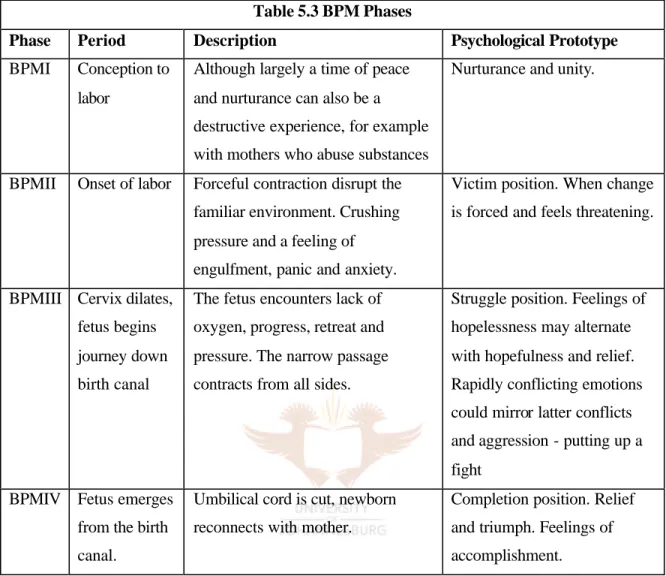
experiences. For many of Grof’s clients, this is an invaluable experience with the events of their birth shedding revelatory insight into their adult issues. Grof’s thesis is that the experience of birth is the psychological prototype of future challenges, setting up the patterns of how individuals deal with such events. He divides the perinatal period into four Basic Perinatal Matrices (BPM I - IV).
A brief description of the phases follow (Grof, 1988; Taylor, 1995): Table 5.3 BPM Phases
Phase Period Description Psychological Prototype
BPMI Conception to labor
Although largely a time of peace and nurturance can also be a destructive experience, for example with mothers who abuse substances
Nurturance and unity.
BPMII Onset of labor Forceful contraction disrupt the familiar environment. Crushing pressure and a feeling of engulfment, panic and anxiety.
Victim position. When change is forced and feels threatening.
BPMIII Cervix dilates, fetus begins journey down birth canal
The fetus encounters lack of oxygen, progress, retreat and pressure. The narrow passage contracts from all sides.
Struggle position. Feelings of hopelessness may alternate with hopefulness and relief. Rapidly conflicting emotions could mirror latter conflicts and aggression - putting up a fight
BPMIV Fetus emerges from the birth canal.
Umbilical cord is cut, newborn reconnects with mother.
Completion position. Relief and triumph. Feelings of accomplishment.
Grof (1988, 1996b) has done extensive research of many holotropic experiences. Accounts of even decidedly skeptical individuals reveal the highly charged and profound experiences they report. Although Western or conventional science appears loathe to engage with his findings, Grof (1996) remains a resolute scientist with demanding standards arguing that transpersonal psychology can stand up for itself under rigorous research conditions. He remarks finally, that given the efficacy of these transpersonal methods, Western science will one day have little choice but to take notice.
5.5.3 Visualisation
A further way of expanding consciousness is to use visualisation exercises (Rowan, 1993). These can take many forms, a common one being the use of guided imagery. Both Buddhist and yogic traditions make extensive use of such imagery in the form of vision quests and shamanic journeys