Universidade de São Paulo
2016-08
One-class to multi-class model update using
the class-incremental optimum-path forest
classifier
European Conference on Artificial Intelligence, XXII, 2016, Hague.
http://www.producao.usp.br/handle/BDPI/51068
Downloaded from: Biblioteca Digital da Produção Intelectual - BDPI, Universidade de São Paulo
Biblioteca Digital da Produção Intelectual - BDPI
Frontiers in Artificial Intelligence and Applications
The book series Frontiers in Artificial Intelligence and Applications (FAIA) covers all aspects of theoretical and applied Artificial Intelligence research in the form of monographs, doctoral dissertations, textbooks, handbooks and proceedings volumes.
The FAIA series contains several sub-series, including ‘Information Modelling and Knowledge Bases’ and ‘Knowledge-Based Intelligent Engineering Systems’. It also includes the biennial European Conference on Artificial Intelligence (ECAI) proceedings volumes, and other EurAI (European Association for Artificial Intelligence, formerly ECCAI) sponsored publications. An editorial panel of internationally well-known scholars is appointed to provide a high quality selection.
Series Editors:
J. Breuker, N. Guarino, J.N. Kok, J. Liu, R. López de Mántaras, R. Mizoguchi, M. Musen, S.K. Pal and N. Zhong
Volume 285
Recently published in this seriesVol. 284. D. Pearce and H.S. Pinto (Eds.), STAIRS 2016 – Proceedings of the Eighth European Starting AI Researcher Symposium Vol. 283. R. Ferrario and W. Kuhn (Eds.), Formal Ontology in Information Systems – Proceedings of the 9th International Conference
(FOIS 2016)
Vol. 282. J. Mizera-Pietraszko, Y.-L. Chung and P. Pichappan (Eds.), Advances in Digital Technologies – Proceedings of the 7th International Conference on Applications of Digital Information and Web Technologies 2016
Vol. 281. G. Chen, F. Liu and M. Shojafar (Eds.), Fuzzy System and Data Mining – Proceedings of FSDM 2015
Vol. 280. T. Welzer, H. Jaakkola, B. Thalheim, Y. Kiyoki and N. Yoshida (Eds.), Information Modelling and Knowledge Bases XXVII Vol. 279. A. Rotolo (Ed.), Legal Knowledge and Information Systems – JURIX 2015: The Twenty-Eighth Annual Conference Vol. 278. S. Nowaczyk (Ed.), Thirteenth Scandinavian Conference on Artificial Intelligence – SCAI 2015
Vol. 277. E. Armengol, D. Boixader and F. Grimaldo (Eds.), Artificial Intelligence Research and Development, Proceedings of the 18th International Conference of the Catalan Association for Artificial Intelligence
Vol. 276. H. Fujita and S.-F. Su (Eds.), New Trends on System Sciences and Engineering – Proceedings of ICSSE 2015
Vol. 275. J. Mizera-Pietraszko and S. Fong (Eds.), Advances in Digital Technologies – Proceedings of the 6th International Conference on Applications of Digital Information and Web Technologies 2015
Vol. 274. W.C.-C. Chu, H.-C. Chao and S.J.-H. Yang (Eds.), Intelligent Systems and Applications – Proceedings of the International Computer Symposium (ICS) held at Taichung, Taiwan, December 12–14, 2014
Vol. 273. J. Seibt, R. Hakli and M. Nørskov (Eds.), Sociable Robots and the Future of Social Relations – Proceedings of Robo-Philosophy 2014
Vol. 272. B. Thalheim, H. Jaakkola, Y. Kiyoki and N. Yoshida (Eds.), Information Modelling and Knowledge Bases XXVI Vol. 271. R. Hoekstra (Ed.), Legal Knowledge and Information Systems – JURIX 2014: The Twenty-Seventh Annual Conference Vol. 270. H.-M. Haav, A. Kalja and T. Robal (Eds.), Databases and Information Systems VIII – Selected Papers from the Eleventh
International Baltic Conference, DB&IS 2014
Vol. 269. L. Museros, O. Pujol and N. Agell (Eds.), Artificial Intelligence Research and Development – Recent Advances and Applications Vol. 268. A. Utka, G. Grigonytė, J. Kapočiūtė-Dzikienė and J. Vaičenonienė (Eds.), Human Language Technologies – The Baltic
Perspective: Proceedings of the Sixth International Conference Baltic HLT 2014
Vol. 267. P. Garbacz and O. Kutz (Eds.), Formal Ontology in Information Systems – Proceedings of the Eighth International Conference (FOIS 2014)
Vol. 266. S. Parsons, N. Oren, C. Reed and F. Cerutti (Eds.), Computational Models of Argument – Proceedings of COMMA 2014 Vol. 265. H. Fujita, A. Selamat and H. Haron (Eds.), New Trends in Software Methodologies, Tools and Techniques – Proceedings of the
Thirteenth SoMeT_14
Vol. 264. U. Endriss and J. Leite (Eds.), STAIRS 2014 – Proceedings of the 7th European Starting AI Researcher Symposium Vol. 263. T. Schaub, G. Friedrich and B. O’Sullivan (Eds.), ECAI 2014 – 21st European Conference on Artificial Intelligence Vol. 262. R. Neves-Silva, G.A. Tshirintzis, V. Uskov, R.J. Howlett and L.C. Jain (Eds.), Smart Digital Futures 2014
Vol. 261. G. Phillips-Wren, S. Carlsson, A. Respício and P. Brézillon (Eds.), DSS 2.0 – Supporting Decision Making with New Technologies
Vol. 260. T. Tokuda, Y. Kiyoki, H. Jaakkola and N. Yoshida (Eds.), Information Modelling and Knowledge Bases XXV Vol. 259. K.D. Ashley (Ed.), Legal Knowledge and Information Systems – JURIX 2013: The Twenty-Sixth Annual Conference Vol. 258. K. Gerdes, E. Hajičová and L. Wanner (Eds.), Computational Dependency Theory
Vol. 257. M. Jaeger, T.D. Nielsen and P. Viappiani (Eds.), Twelfth Scandinavian Conference on Artificial Intelligence – SCAI 2013
ISSN 0922-6389 (print) ISSN 1879-8314 (online)
ECAI 2016
22nd European Conference on Artificial Intelligence
29 August–2 September 2016, The Hague, The Netherlands
Including
Prestigious Applications of Artificial Intelligence (PAIS 2016)
Proceedings
Edited by
Gal A. Kaminka
Bar Ilan University, Israel
Maria Fox
King’s College London, United Kingdom
Paolo Bouquet
University of Trento & OKKAM srl, Italy
Eyke Hüllermeier
Paderborn University, Germany
Virginia Dignum
Delft University of Technology, The Netherlands
Frank Dignum
Utrecht University, The Netherlands
and
Frank van Harmelen
Vrije Universiteit Amsterdam, The Netherlands
Organized by the European Association for Artificial Intelligence (EurAI) and the Benelux Association for Artificial Intelligence (BNVKI).
Part 1/Part 2
© 2016 The Authors and IOS Press.
This book is published online with Open Access and distributed under the terms of the Creative Commons Attribution Non-Commercial License 4.0 (CC BY-NC 4.0).
ISBN 978-1-61499-671-2 (print) ISBN 978-1-61499-672-9 (online)
Library of Congress Control Number: 2016949341
Publisher IOS Press BV Nieuwe Hemweg 6B 1013 BG Amsterdam Netherlands fax: +31 20 687 0019 e-mail: [email protected]
Distributor in the USA and Canada IOS Press, Inc.
4502 Rachael Manor Drive Fairfax, VA 22032 USA
fax: +1 703 323 3668
e-mail: [email protected]
LEGAL NOTICE
The publisher is not responsible for the use which might be made of the following information. PRINTED IN THE NETHERLANDS
Introduction
This volume contains the proceedings of the Twenty-second European Conference on Artificial Intelligence (ECAI 2016), held from August 29th to September 2nd, 2016, in The Hague, The Netherlands. Since 1974, the biennial European Conference on Artificial Intelligence, organized by the European Association for Artificial Intel-ligence (EurAI, formerly named ECCAI), has been the premier venue for presenting AI research in Europe. ECAI is the place for researchers and practitioners of Artificial Intelligence (AI) to gather and to discuss the latest trends and challenges in all subfields of AI as well as to demonstrate innovative applications and uses of advanced AI technology.
ECAI 2016 was co-located with Collective Intentionality X, the interdisciplinary conference on collective in-tentionality, and the IEEE Symposium on Ethics of Autonomous Systems (SEAS Europe). As in the past, ECAI 2016 incorporates the Conference on Prestigious Applications of Intelligent Systems (PAIS 2016) and the Starting AI Researcher Symposium (STAIRS). The papers from PAIS are included in this volume, while the papers from STAIRS are published in a separate volume. ECAI 2016 also featured a special topic on Artificial Intelligence for Human Values, with a dedicated track and a public event in the Peace Palace in The Hague.
The program of ECAI 2016 included five invited plenary talks, including two, by Michael Bratman and Johan-na Seibt, shared with Collective IntentioJohan-nality X, and an extensive workshop and tutorial program.
In total, 656 papers were submitted to ECAI 2016. Of these, 177 (27%) were accepted as long papers and 123 (19%) were accepted as short papers, of which 108 were presented at the conference. This makes ECAI 2016 the largest edition in the 40-year history of ECAI conferences, reflecting the growth and vitality of AI as a research field. This year we pioneered the idea of supporting continuity of the peer reviewing process, by allowing authors to submit resubmissions of papers rejected from IJCAI 2016, alongside their reviews from that conference. We also introduced a Summary Reject process, enabling Senior Program Committee (SPC) members to use their knowledge and experience to help to reduce the load on reviewers. We also tried a new process of allocating papers to Program Committee (PC) members, in which SPCs allocated papers to a team of PC members that they had recruited them-selves, in order to encourage team-working. Thanks to the dedicated support of SPC and PC members, these inno-vations worked well. Out of the short paper acceptances, 12 (9.8%) and out of the accepted long papers, 31 (17.4%) were former IJCAI submissions. Clearly people took advantage of the opportunity, and a large proportion of their revised submissions were rewarded by success. During the paper discussion period, four papers were given the option of transferring to PAIS. The PAIS programme consisted of 10 papers presenting substantial applications of AI research.
We were lucky to be part of a dedicated team. We would like to thank Meir Kalech for putting in place an ex-tensive workshop program of 18 workshops; Sophia Ananiadou and Leon van der Torre for attracting 13 exciting tutorials, including 5 “Spotlight” tutorials; Helena Sofia Pinto and David Pearce for developing an exciting STAIRS 2016 program; Jeroen van den Hoven and Henry Prakken for managing the AI and Human Values Track; Robert-Jan Sips for organising the AIckathon, and last but not least Eyke Hullermeijer and Paolo Bouquet for chairing PAIS 2016.
We would also like to thank the local organizers, Frank Dignum and Virginia Dignum, and the General Chair, Frank van Harmelen. We are indebted to our predecessor, Torsten Schaub, whose materials we found helpful, and Thomas Preuss for help and advice in using the Confmaster system. Finally, heartfelt thanks to all PC and SPC members, reviewers, sponsors, and all authors who submitted to ECAI 2016.
Maria Fox and Gal A. Kaminka Program Chairs ECAI 2016
Conference Organization
Generalchair: Frank van Harmelen, The Netherlands
ECAIprogramchairs: Gal A. Kaminka, Israel and Maria Fox, UK
Localorganizationchairs: Frank Dignum and Virginia Dignum, The Netherlands
Workshopchair: Meir Kalech, Israel
Tutorialschairs: Sophia Ananiadou, UK and Leon van der Torre, Luxembourg
PAISprogramchairs: Eyke Hüllermeier, Germany, and Paolo Bouquet, Italy
STAIRSprogramchairs: H. Sofia Pinto, Portugal, and David Pearce, Spain
AIandHumanValuesTrackchairs: Jeroen van den Hoven and Henry Prakken
LocalOrganizationCommittee
Sponsorship: Martijn Warnier, The Netherlands
Publicity: Suzan Verberne
Website: Huib Aldewereld
Logistics: Amineh Ghorbani and Helle Hvid Hansen, The Netherlands
StudentOffice: Tibor Bosse, The Netherlands
AIckathon: Robert-Jan Sips, The Netherlands
FinanceandAdministration: MCI Netherlands
Sponsors
PricewaterhouseCoopers City of The Hague Taylor & Francis Group Essence ITN Network Vrije Universiteit Amsterdam
SupportingOrganisations
Artificial Intelligence Journal SIKS Graduate School Utrecht University
Delft University of Technology
OrganisingBody
EurAI – European Association for Artificial Intelligence BNVKI – Benelux Association for Artificial Intelligence
InvitedPlenarySpeakers
Michael Bratman (USA) Jeff Rosenschein (Israel)
Marie-Christine Rousset (France) Johanna Seibt (Denmark)
Michael Zillich (Austria)
SeniorProgramCommittee
Noa Agmon, Sven Behnke, Sara Bernardini, Hendrik Blockeel, Ronen Brafman, Frances Brazier, Pompeu Casano-vas, Amedeo Cesta, Amanda Coles, Adnan Darwiche, Amal El Fallah Seghrouchni, Ulle Endriss, Esra Erdem, Alessandro Farinelli, Helene Fargier, Linda van der Gaag, Hector Geffner, Lluis Godo, Malte Helmert, Koen Hindriks, Anthony Hunter, Catholijn Jonker, Meir Kalech, Antonin (Tony) Kucera, Gerhard Lakemeyer, Jérome Lang, Pedro Larrañaga, Alessio Lomuscio, Derek Long, Daniele Magazzeni, Pedro Meseguer, Michela Milano, Daniele Nardi, Ann Nowé, Barry O’Sullivan, Michal Pechoucek, Eric Postma, Luc De Raedt, Francesca Rossi, Marie-Christine Rousset, David Sarne, Torsten Schaub, Michele Sebag, Katia Sycara, Leon van der Torre, Harko Verhagen, Cees Witteveen, Pinar Yolum, Filip Zelezny
ProgramCommittee
Rui Abreu, Carole Adam, Stéphane Airiau, Charilaos Akasiadis, Marco Alberti, Alex Albore, Huib Aldewereld, Alexandre Allauzen, Teresa Alsinet, Claudia d’Amato, Leila Amgoud, Francesco Amigoni, Francisco Andrade, Angelo Angelo Fanelli, Nino Antulov-Fantulin, Yashar Araghi, Alexander Artikis, Kevin Ashley, Manuel Atencia, Katie Atkinson, Reyhan Aydogan, Amos Azaria, Christer Bäckström, Antonio Bahamonde, Josef Bajada, Marcello Balduccini, Stefania Bandini, Jacopo Banfi, Ariel Bar, Elias Bareinboim, Pietro Baroni, Roman Bartak, Roberto Basili, Nicola Basilico, Christian Bauckhage, Kim Bauters, Francesco Belardinelli, Vaishak Belle, Nahla Ben Amor, Trevor Bench-Capon, Philippe Besnard, Floris Bex, Aurélie Beynier, Concha Bielza, Xavier Binefa, Gilles Bisson, Filippo Bistaffa, Stefano Bistarelli, Susanne Biundo, Elizabeth Black, Bernhard Bliem, Domenico Bloisi, Christian Blum, Fernando Bobillo, Blai Bonet, Elise Bonzon, Richard Booth, Rafael Bordini, Daniel Borrajo, Bran-islav Bošanský, Sylvain Bouveret, Ronen Brafman, Tomas Brazdil, Robert Bredereck, Davide Bresolin, Marco Bressan, Thomas Bridi, Joost Broekens, Jan Broersen, Ken Brown, Tim Brys, Joanna Bryson, Katarzyna Budzyn-ska, Nils Bulling, Andreas Bunte, Andreas Bunte, Miroslav Bureš, Pedro Cabalar, Philippe Caillou, Olivier Cailloux, Michal Čáp, Clément Carbonnel, Michael Cashmore, Giovanni Casini, Claudette Cayrol, Tristan Ca-zenave, Jesus Cerquides, Federico Cerutti, Georgios Chalkiadakis, François Charpillet, Tristan Charrier, Jiehua Chen, Yann Chevaleyre, Sylvain Chevallier, Angelos Chliaoutakis, Yoonsuck Choe, Arthur Choi, Amit Chopra, Lukas Chrpa, Davide Ciucci, Jens Claßen, Luca Console, Giorgio Corani, Cristina Cornelio, Juan David Correa Granada, Vincent Corruble, Gabriella Cortellessa, Fabrizio Costa, Stefania Costantini, Giuseppe Cota, Marcos Cramer, Natalia Criado, Danilo Croce, Matthew Crosby, Scott Cunningham, James Cussens, Andreas Darmann, Mehdi Dastani, Jérôme David, Bernard De Baets, Riccardo De Benedictis, Cassio de Campos, Martine De Cock, Giuseppe De Giacomo, Joachim De Greeff, Marina De Vos, Mathijs De Weerdt, Aurelien Decelle, Juan Jose del Coz, Maria J. del Jesus, Dario Della Monica, Guissepe Della Penna, Pilar Dellunde, Louise Dennis, Sebastien Destercke, Sam Devlin, Virginia Dignum, Yannis Dimopoulos, Juergen Dix, Carmine Dodaro, Patrick Doherty, Carmel Domshlak, Klaus Dorer, Sylvie Doutre, Agostino Dovier, Jan Drchal, Nicolas Drougard, Didier Dubois, Stefano Duca, Barbara Dunin Keplicz, Soma Dutta, Saso Dzeroski, Stefan Edelkamp, Kyriakos Efthymiadis, Chris-tian Eichhorn, Edith Elkind, Avshalom Elmalech, Zied Elouedi, Ozan Erdem, Salome Eriksson, Jerome Euzenat, Patricia Everaere, Piotr Faliszewski, Jorge Fandinno, Alexander Feldman, Stefano Ferilli, Alexander Ferrein, Mar-celo Finger, Alberto Finzi, Ferdinando Fioretto, Pierre Flener, Federico Fogolari, Vojtech Forejt, Nicoletta Fornara, Alexander Förster, Guillem Frances, Enrico Francesconi, Simone Fratini, Alfredo Gabaldon, Christian Gagné, Lucie Galand, Joao Gama, Aldo Gangemi, Guglielmo Gemignani, Katie Genter, Alexander Gepperth, Malik Ghallab, Amineh Ghorbani, Massimiliano Giacomin, Maria Gini, Jesús Giráldez-Cru, Enrico Giunchiglia, François Goasdoué, Vibhav Gogate, Vicenç Gómez, Jorge González-Conejero, Laurent Gourvès, Guido Governatori, Um-berto Grandi, Alban Grastien, Gregory Grefenstette, Andreas Griesmayer, Diarmuid Grimes, Dagmar Gromann, Stefano Gualandi, Javier Guerrero, Akin Gunay, Tias Guns, Thomas Guyet, Galit Haim, Barbara Hammer, Chris-tian Hammerschmidt, Christopher Hampson, Blaise Hanczar, Marc Hanheide, Helle Hansen, Amelia Harrison, Anna Harutyunyan, Salima Hassas, Patrick Healy, Fredrik Heintz, Dirk Helbing, Ulrich Hillenbrand, Rinke Hoeks-tra, Jörg Hoffmann, Han Hoogeveen, Enda Howley, Joris Hulstijn, Giovambattista Ianni, Rasmus Ibsen-Jensen, Ayumi Igarashi, Felix Ingrand, Iñaki Inza, Luca Iocchi, Quiliano Isaac Moro, Rezarta Islamaj, Amin Jaber, François Jacquenet, Wojtek Jamroga, Baptiste Jeudy, Ke Jiang, Sergio Jiménez, Anders Jonsson, Fabrice Jouanot, Souhila Kaci, Magdalena Kacprzak, Serdar Kadioglu, Ozgur Kafali, Lars Karlsson, Erez Karpas, George Katsire-los, Hilal Kazan, Thomas Keller, Gabriele Kern-Isberner, Kristian Kersting, Piyush Khandelwal, Angelika
mig, Zeynep Kiziltan, Jiri Klema, Marius Kloft, Tomas Klos, Michal Knapik, Max Knobbout, Jens Kober, Antonín Komenda, Sebastien Konieczny, Pavel Kordik, Frederic Koriche, Lars Kotthoff, Panagiotis Kouvaros, Petr Kre-men, Jan Kretinsky, Martin Kronegger, Daniel Kudenko, Ondrej Kuzelka, Bruno Lacerda, Arnaud Lallouet, Javier Larrosa, Aron Larsson, Paweł Laskoś-Grabowski, Jimmy Lee, Joao Leite, Julien Lesca, Yves Lesperance, Mario Leung, Omer Lev, Jordi Levy, Beishui Liao, Churn-Jung Liau, Martin Liebenberg, Carlos Linares López, Marius Lindauer, Tony Lindgren, Thomas Linsbichler, Nir Lipovetzky, Marco Lippi, Francesca Alessandra Lisi, Weiru Liu, Yongmei Liu, Brian Logan, Katrin Lohan, Ramon Lopez de Mantaras, Andrea Loreggia, Emiliano Lorini, Peter Lucas, Stephan Lukosch, Jianbing Ma, Yue Ma, Brian Mac Namee, Samhar Mahmoud, Alexander Maier, Jean-Guy Mailly, Julien Mairal, Kleanthis Malialis, Yuri Malitsky, Michailis Mamakos, Bernard Manderick, René Mandiau, Lawrence Mandow, Marco Manna, Felip Manya, Marco Maratea, Gaetan Marceau-Caron, Fabio Marfia, Joao Marques-Silva, Pierre Marquis, Mercedes Martínez-gonzález, Joao Martins, Viviana Mascardi, Nicholas Mattei, Robert Mattmüller, Nicolas Maudet, Deepak Mehta, Reshef Meir, Antonella Meneghetti, Jerome Mengin, Jiří Menšík, Fabio Mercorio, Rijk Mercuur, Tekin Mericli, John-Jules Meyer, Roberto Micalizio, Jakub Michal-iszyn, Andrea Micheli, Steffen Michels, Pedro Miraldo, Reuth Mirsky, Sanjay Modgil, Karthika Mohan, Jérôme Monnot, Marco Montali, Angelo Montanari, Michael Morak, Serafin Moral, Paul Morris, Sergio Mover, Marie-Laure Mugnier, Enrique Munoz De Cote, Aniello Murano, Bernhard Nebel, Trung Thanh Nguyen, Alexandre Niveau, Pablo Noriega, Paulo Novais, Peter Novak, Petr Novotny, Philipp Obermeier, Svetlana Obrasztova, Ange-lo Oddi, Dimitri Ognibene, Andrei Olaru, Nir Oren, Emmanouil Orfanoudakis, Petter Orgen, Andrea Orlandini, Nardine Osman, Max Ostrowski, Arzucan Ozgur, Umut Oztok, Erhan Oztop, Ugo Pagallo, Maurice Pagnucco, Hector Palacios, Ravi Palla, Papapetrou Panagiotis, Pere Pardo, Xavier Parent, Fabio Patrizi, MariaTeresa Pazien-za, Justin Pearson, Federico Pecora, Marieke Peeters, Bernhard Peischl, Jose Peña, Rafael Penaloza Nyssen, Wojciech Penczek, Nathalie Pernelle, Patrice Perny, Laurent Perrussel, Ginevra Peruginelli, Dominik Peters, Ron Petrick, Tomas Pevny, Guillermo A. Pérez, Rens Philipsen, Chiara Piacentini, Gauthier Picard, Gabriella Pigozzi, Ingo Pill, Maria Silvia Pini, Matija Piskorec, Jeremy Pitt, Enric Plaza, Sylwia Polberg, Florian Pommerening, Ma-tei Popovici, Daniele Porello, Bary Pradelski, Luca Pretto, Jörg Pührer, Luis Quesada, Rahim Rahmani, Franco Raimondi, David Rajaratnam, Subramanian Ramamoorthy, Sarvapali Ramchurn, Miquel Ramirez, Karinne Ramirez Amaro, Jan Ramon, Riccardo Rasconi, Irma Ravkic, Jesse Read, Shulamit Reches, Ioannis Refanidis, Vojtech Rehak, Alessandro Ricci, Francesco Riccio, Ariela Richadson, Bram Ridder, Fabrizio Riguzzi, Jussi Rintanen, Livio Robaldo, Odinaldo Rodrigues, Juan Rodriguez, Juan Rodriguez-Aguilar, Victor Rodríguez-Doncel, Emma Rollon, Nico Roos, Jörg Rothe, Ovi Rouly, Marco Roveri, Sasha Rubin, Sebastian Rudolph, Michael Ruhn-ke, Jordi Sabater-Mir, Regis Sabbadin, Orkunt Sabuncu, Alessandro Saetti, Brigitte Safar, Abdallah Saffidine, Alessandro Saffiotti, Fatiha Sais, Pietro Sala, Antonio Salmeron, Francesco Santini, Vitor Santos Costa, Ario San-toso, Sebastian Sardina, Giovanni Sartor, Enrico Scala, Enrico Scala, Burkhard Schafer, Leander Schietgat, Stefan Schiffer, Steven Schockaert, Marc Schoenauer, Christoph Schommer, Marco Schorlemmer, Claudia Schulz, Fran-cois Schwarzentruber, Christoph Schwering, Guido Sciavicco, Luciano Serafini, Ivan Serina, Antonio Sgorbissa, Yang Yang Shi, Mohamed Siala, Carles Sierra, Gerardo Simari, Gilles Simonin, Piotr Skowron, Marija Slavkovik, Christine Solnon, Petr Somol, Tran Cao Son, Ulrich Sorger, Matthijs Spaan, Olivier Spanjard, Siddharth Srivasta-va, Michal Sroka, Michele Stawowy, Gerald Steinbauer, Roni Stern, Michiel Stock, Michal Stolba, Umberto Strac-cia, Alina Strachocka, Jörg Stückler, Jose Such, David Sundgren, Vojtech Svatek, Anton Talantsev, Matthew Tay-lor, Cem Tekin, Isabelle Tellier, Annette ten Teije, Michael Thielscher, Matthias Thimm, Michael Thomazo, Jin Tian, Paolo Turrini, Federico Ulliana, Marian van de Akker, Jan Van Haaren, Kristof Van Laerhoven, Pieter van Langen, Martijn van Otterlo, Joaquin Vanschoren, Tiago Veiga, Kristen Brent Venable, Celine Vens, Carmine Ventre, Sebastian Ventura, Bart Verheij, Sicco Verwer, Srdjan Vesic, Paolo Viappiani, Serena Villata, Arnoud Visser, Jonas Vlasselaer, Sven Wachsmuth, Martijn Warnier, Erwin Walraven, Philipp Wanko, Martin Wehrle, Paul Weng, Emil Weydert, Nic Wilson, Stefan Woltran, Guohui Xiao, Liping Xiong, Fangkai Yang, Roi Yehosh-ua, Reyyan Yeniterzi, William Yeoh, Neil Yorke-Smith, Changhe Yuan, Anna Zamansky, Tom Zamir, Benjamin Zarriess, John Zeleznikow, Riccardo Zese, Yingqian Zhang, Yair Zick, Danielle Ziebelin, Michael Zillich, Albrecht Zimmermann, Inon Zuckerman.
Prestigious Applications of Intelligent Systems
PAISProgramCommittee
Bert Bredeweg, Ken Brown, Simon Colton, Alfredo Cuzzocrea, Simon De Givry, Marina De Vos, Agostino Dovier, Martin Dow, Alexander Felfernig, Johannes Fürnkranz, Joao Gama, Matjaz Gams, Fuyuki Ishikawa, Michal Jakob, Dietmar Jannach, Mustafa Jarrar, Ernesto Jimenez-Ruiz, Nicola Leone, Ramon Lopez De Mantaras, Peter Lucas, Michael Madden, Wolfgang Mayer, Andrea Molinari, Barry Smyth, Daniel Sonntag, Erich Teppan, Marc Troemel, Giovanni Tummarello, Pascal Van Hentenryck, Franz Wotawa
AdditionalReviewers
Stefano Bortoli, Stefano Burigat, Giovanni Grasso, Francesco Ricca
Starting Artificial Intelligence Research Symposium
STAIRSProgramCommittee
Harith Alani, Natasha Alechina, José Júlio Alferes, Ronen Brafman, Gerhard Brewka, Pedro Cabalar, Philipp Cim-iano, Stefania Costantini, Ulle Endriss, Joerg Hoffmann, João Leite, Paolo Liberatore, Weiru Liu, Ramon López de Mántaras, Emiliano Lorini, Enrico Motta, Igor Mozetič, Pablo Noriega, Manuel Ojeda Aciego, Julian Padget, Da-vid Pearce, H. Sofia Pinto, Steven Schockaert, Levan Uridia, Agustin Valverde, Harko Verhagen, Stefan Woltran
AdditionalReviewers
Pedro Barahona, Martin Kronegger, Evgeny Kuznetsov, Martin Lackner, Brian Logan, Jumana Nassour, Andreas Pfandler, Jasmina Smailović
Contents
Introduction v
Maria Fox and Gal A. Kaminka
Conference Organization vii
Part 1
ECAI Long Papers
When Do Rule Changes Count-As Legal Rule Changes? 3
Thomas C. King, Virginia Dignum and Catholijn M. Jonker
Constant Time EXPected Similarity Estimation for Large-Scale Anomaly Detection 12
Markus Schneider, Wolfgang Ertel and Günther Palm
AUC Maximization in Bayesian Hierarchical Models 21
Mehmet Gönen
Validating Cross-Perspective Topic Modeling for Extracting Political Parties’ Positions from Parliamentary
Proceedings 28
Janneke M. van der Zwaan, Maarten Marx and Jaap Kamps
Finite Unary Relations and Qualitative Constraint Satisfaction 37
Peter Jonsson
Dynamic Choice of State Abstraction in Q-Learning 46
Marco Tamassia, Fabio Zambetta, William L. Raffe, Florian ‘Floyd’ Mueller and Xiaodong Li
A Dialectical Proof Theory for Universal Acceptance in Coherent Logic-Based Argumentation Frameworks 55
Abdallah Arioua and Madalina Croitoru
Adaptive Binary Quantization for Fast Nearest Neighbor Search 64
Zhujin Li, Xianglong Liu, Junjie Wu and Hao Su
Exploring Parallel Tractability of Ontology Materialization 73
Zhangquan Zhou, Guilin Qi and Birte Glimm
Student-t Process Regression with Dependent Student-t Noise 82
Qingtao Tang, Yisen Wang and Shu-Tao Xia
An Extension of the Owen-Value Interaction Index and Its Application to Inter-Links Prediction 90
Piotr L. Szczepański, Tomasz P. Michalak, Talal Rahwan and Michael Wooldridge
Cluster-Driven Model for Improved Word and Text Embedding 99
Zhe Zhao, Tao Liu, Bofang Li and Xiaoyong Du
Learning Temporal Context for Activity Recognition 107
Claudio Coppola, Tomáš Krajník, Tom Duckett and Nicola Bellotto
Leader-Follower MDP Models with Factored State Space and Many Followers – Followers Abstraction,
Structured Dynamics and State Aggregation 116
Régis Sabbadin and Anne-France Viet
CUBE: A CUDA Approach for Bucket Elimination on GPUs 125
Filippo Bistaffa, Nicola Bombieri and Alessandro Farinelli
Managing Energy Markets in Future Smart Grids Using Bilateral Contracts 133
Caillière Romain, Aknine Samir, Nongaillard Antoine and Sarvapal D. Ramchurn
A Rational Account of Classical Logic Argumentation for Real-World Agents 141
M. D’Agostino and S. Modgil
Two Dimensional Uncertainty in Persuadee Modelling in Argumentation 150
Anthony Hunter
A Data Driven Similarity Measure and Example Mapping Function for General, Unlabelled Data Sets 158
Damien Lejeune and Kurt Driessens
On Stochastic Primal-Dual Hybrid Gradient Approach for Compositely Regularized Minimization 167
Linbo Qiao, Tianyi Lin, Yu-Gang Jiang, Fan Yang, Wei Liu and Xicheng Lu
Decentralized Large-Scale Electricity Consumption Shifting by Prosumer Cooperatives 175
Charilaos Akasiadis and Georgios Chalkiadakis
Analysing Approximability and Heuristics in Planning Using the Exponential-Time Hypothesis 184
Meysam Aghighi, Christer Bäckström, Peter Jonsson and Simon Ståhlberg
A Simple Account of Multi-Agent Epistemic Planning 193
Martin C. Cooper, Andreas Herzig, Faustine Maffre, Frédéric Maris and Pierre Régnier
Lexicographic Refinements in Possibilistic Decision Trees 202
Nahla Ben Amor, Zeineb El Khalfi, Hélène Fargier and Régis Sabbadin
Even Angels Need the Rules: AI, Roboethics, and the Law 209
Ugo Pagallo
One-Class to Multi-Class Model Update Using the Class-Incremental Optimum-Path Forest Classifier 216
Mateus Riva, Moacir Ponti and Teofilo de Campos
More than a Name? On Implications of Preconditions and Effects of Compound HTN Planning Tasks 225
Pascal Bercher, Daniel Höller, Gregor Behnke and Susanne Biundo
A Probabilistic Logic Programming Approach to Automatic Video Montage 234
Bram Aerts, Toon Goedemé and Joost Vennekens
Checking the Conformance of Requirements in Agent Designs Using ATL 243
Nitin Yadav and John Thangarajah
A Uniform Account of Realizability in Abstract Argumentation 252
Thomas Linsbichler, Jörg Pührer and Hannes Strass
A Scalable Clustering-Based Local Multi-Label Classification Method 261
Lu Sun, Mineichi Kudo and Keigo Kimura
Multiscale Triangular Centroid Distance for Shape-Based Plant Leaf Recognition 269
Chengzhuan Yang, Hui Wei and Qian Yu
Complexity of Control by Partitioning Veto and Maximin Elections and of Control by Adding Candidates
to Plurality Elections 277
Cynthia Maushagen and Jörg Rothe
Agent-Based Refinement for Predicate Abstraction of Multi-Agent Systems 286
Francesco Belardinelli, Alessio Lomuscio and Jakub Michaliszyn
Combining Deterministic and Nondeterministic Search for Optimal Journey Planning Under Uncertainty 295
Akihiro Kishimoto, Adi Botea and Elizabeth Daly xii
Robust Real-Time Human Perception with Depth Camera 304
Guyue Zhang, Luchao Tian, Ye Liu, Jun Liu, Xiang An Liu, Yang Liu and Yan Qiu Chen
A New Kernelized Associative Memory and Some of Its Applications 311
Matthew Saltz and Lluís A. Belanche
Strategical Argumentative Agent for Human Persuasion 320
Ariel Rosenfeld and Sarit Kraus
Formalizing Commitment-Based Deals in Boolean Games 329
Sofie De Clercq, Steven Schockaert, Ann Nowé and Martine De Cock
A Joint Model for Sentiment-Aware Topic Detection on Social Media 338
Kang Xu, Guilin Qi, Junheng Huang and Tianxing Wu
A Reinforcement Learning Framework for Trajectory Prediction Under Uncertainty and Budget Constraint 347
Truc Viet Le, Siyuan Liu and Hoong Chuin Lau
Person Re-Identification via Multiple Coarse-to-Fine Deep Metrics 355
Mingfu Xiong, Jun Chen, Zheng Wang, Zhongyuan Wang, Ruimin Hu, Chao Liang and Daming Shi
How Hard Is Bribery with Distance Restrictions? 363
Yongjie Yang, Yash Raj Shrestha and Jiong Guo
Beyond IC Postulates: Classification Criteria for Merging Operators 372
Adrian Haret, Andreas Pfandler and Stefan Woltran
Schema-Based Debugging of Federated Data Sources 381
Andreas Nolle, Christian Meilicke, Melisachew Wudage Chekol, German Nemirovski and Heiner Stuckenschmidt
Belief Contraction Within Fragments of Propositional Logic 390
Nadia Creignou, Raïda Ktari and Odile Papini
A Novel Cross-Modal Topic Correlation Model for Cross-Media Retrieval 399
Yong Cheng, Fei Huang, Cheng Jin, Yuejie Zhang and Tao Zhang
Situation Calculus Game Structures and GDL 408
Giuseppe De Giacomo, Yves Lespérance and Adrian R. Pearce
The Game of Reciprocation Habits 417
Gleb Polevoy, Mathijs de Weerdt and Catholijn Jonker
Randomized Distribution Feature for Image Classification 426
Hongming Shan and Junping Zhang
ShapeLearner: Towards Shape-Based Visual Knowledge Harvesting 435
Huayong Xu, Yafang Wang, Kang Feng, Gerard de Melo, Wei Wu, Andrei Sharf and Baoquan Chen
Observation-Based Multi-Agent Planning with Communication 444
Luca Gasparini, Timothy J. Norman and Martin J. Kollingbaum
A Framework for Actionable Clustering Using Constraint Programming 453
Thi-Bich-Hanh Dao, Christel Vrain, Khanh-Chuong Duong and Ian Davidson
Repetitive Branch-and-Bound Using Constraint Programming for Constrained Minimum Sum-of-Squares
Clustering 462
Tias Guns, Thi-Bich-Hanh Dao, Christel Vrain and Khanh-Chuong Duong
Is Spearman’s Law of Diminishing Returns (SLODR) Meaningful for Artificial Agents? 471
José Hernández-Orallo
Efficient Computation of Exact IRV Margins 480
Michelle Blom, Vanessa Teague, Peter J. Stuckey and Ron Tidhar
On Labelling Statements in Multi-Labelling Argumentation 489
Pietro Baroni, Guido Governatori and Régis Riveret
Annotate-Sample-Average (ASA): A New Distant Supervision Approach for Twitter Sentiment Analysis 498
Felipe Bravo-Marquez, Eibe Frank and Bernhard Pfahringer
Semi-Supervised Group Sparse Representation: Model, Algorithm and Applications 507
Longwen Gao, Yeqing Li, Junzhou Huang and Shuigeng Zhou
Modeling Bounded Rationality for Sponsored Search Auctions 515
Jiang Rong, Tao Qin, Bo An and Tie-Yan Liu
An Improved State Filter Algorithm for SIR Epidemic Forecasting 524
Weipeng Huang and Gregory Provan
Socially-Aware Multiagent Learning: Towards Socially Optimal Outcomes 533
Xiaohong Li, Chengwei Zhang, Jianye Hao, Karl Tuyls, Siqi Chen and Zhiyong Feng
Factors of Collective Intelligence: How Smart Are Agent Collectives? 542
Nader Chmait, David L. Dowe, Yuan-Fang Li, David G. Green and Javier Insa-Cabrera
Synthesizing Argumentation Frameworks from Examples 551
Andreas Niskanen, Johannes P. Wallner and Matti Järvisalo
Budgeted Multi–Armed Bandit in Continuous Action Space 560
Francesco Trovò, Stefano Paladino, Marcello Restelli and Nicola Gatti
A Framework for Automatic Debugging of Functional and Degradation Failures 569
Nuno Cardoso, Rui Abreu, Alexander Feldman and Johan de Kleer
Online Adaptation of Deep Architectures with Reinforcement Learning 577
Thushan Ganegedara, Lionel Ott and Fabio Ramos
Multi-Class Probabilistic Active Learning 586
Daniel Kottke, Georg Krempl, Dominik Lang, Johannes Teschner and Myra Spiliopoulou
Online Prediction of Exponential Decay Time Series with Human-Agent Application 595
Ariel Rosenfeld, Joseph Keshet, Claudia V. Goldman and Sarit Kraus
Set-Valued Conditioning in a Possibility Theory Setting 604
Salem Benferhat, Amélie Levray, Karim Tabia and Vladik Kreinovich
An Improved CNF Encoding Scheme for Probabilistic Inference 613
Anicet Bart, Frédéric Koriche, Jean-Marie Lagniez and Pierre Marquis
A Bayesian Approach to Norm Identification 622
Stephen Cranefield, Felipe Meneguzzi, Nir Oren and Bastin Tony Roy Savarimuthu
Subsumed Label Elimination for Maximum Satisfiability 630
Jeremias Berg, Paul Saikko and Matti Järvisalo
Vertical Optimization of Resource Dependent Flight Paths 639
Anders N. Knudsen, Marco Chiarandini and Kim S. Larsen
Exploiting Bayesian Network Sensitivity Functions for Inference in Credal Networks 646
Janneke H. Bolt, Jasper De Bock and Silja Renooij
Interval-Based Relaxation for General Numeric Planning 655
Enrico Scala, Patrik Haslum, Sylvie Thiebaux and Miquel Ramirez xiv
Randomized Canonical Correlation Discriminant Analysis for Face Recognition 664
Bo Ma, Hui He, Hongwei Hu and Meili Wei
Reconsidering AGM-Style Belief Revision in the Context of Logic Programs 671
Zhiqiang Zhuang, James Delgrande, Abhaya Nayak and Abdul Sattar
Value Based Reasoning and the Actions of Others 680
Katie Atkinson and Trevor Bench-Capon
Analogical Classifiers: A Theoretical Perspective 689
Nicolas Hug, Henri Prade, Gilles Richard and Mathieu Serrurier
Uncertainty-Sensitive Reasoning for Inferring sameAs Facts in Linked Data 698
Mustafa Al-Bakri, Manuel Atencia, Jérôme David, Steffen Lalande and Marie-Christine Rousset
Can a Condorcet Rule Have a Low Coalitional Manipulability? 707
François Durand, Fabien Mathieu and Ludovic Noirie
Upper and Lower Time and Space Bounds for Planning 716
Christer Bäckström and Peter Jonsson
Abstraction-Based Verification of Infinite-State Reactive Modules 725
Francesco Belardinelli and Alessio Lomuscio
Translation-Based Revision and Merging for Minimal Horn Reasoning 734
Gerhard Brewka, Jean-Guy Mailly and Stefan Woltran
Parallel Filter-Based Feature Selection Based on Balanced Incomplete Block Designs 743
Antonio Salmerón, Anders L. Madsen, Frank Jensen, Helge Langseth, Thomas D. Nielsen, Darío Ramos-López, Ana M. Martínez and Andrés R. Masegosa
Distributed Controllers for Norm Enforcement 751
Bas Testerink, Mehdi Dastani and Nils Bulling
Automatic Verification of Golog Programs via Predicate Abstraction 760
Peiming Mo, Naiqi Li and Yongmei Liu
An Assessment Study of Features and Meta-Level Features in Twitter Sentiment Analysis 769
Jonnathan Carvalho and Alexandre Plastino
Crowdfunding Public Projects with Provision Point: A Prediction Market Approach 778
Praphul Chandra, Sujit Gujar and Y. Narahari
Welfare of Sequential Allocation Mechanisms for Indivisible Goods 787
Haris Aziz, Thomas Kalinowski, Toby Walsh and Lirong Xia
A Computational Approach to Consensus-Finding 795
Eric Grégoire and Jean-Marie Lagniez
Complexity and Tractability Islands for Combinatorial Auctions on Discrete Intervals with Gaps 802
Janosch Döcker, Britta Dorn, Ulle Endriss and Dominikus Krüger
Efficient SAT Approach to Multi-Agent Path Finding Under the Sum of Costs Objective 810
Pavel Surynek, Ariel Felner, Roni Stern and Eli Boyarski
Fixed-Domain Reasoning for Description Logics 819
Sarah Gaggl, Sebastian Rudolph and Lukas Schweizer
On Redundancy in Simple Temporal Networks 828
Jae Hee Lee, Sanjiang Li, Zhiguo Long and Michael Sioutis
On Metric Temporal Description Logics 837
Víctor Gutiérrez-Basulto, Jean Christoph Jung and Ana Ozaki
Plan-Based Narrative Generation with Coordinated Subplots 846
Julie Porteous, Fred Charles and Marc Cavazza
Hybrid Gaussian and von Mises Model-Based Clustering 855
Sergio Luengo-Sanchez, Concha Bielza and Pedro Larrañaga
Adaptive Symbiotic Collaboration for Targeted Complex Manipulation Tasks 863
Rui Silva, Francisco S. Melo and Manuela Veloso
Attuning Ontology Alignments to Semantically Heterogeneous Multi-Agent Interactions 871
Paula Chocron and Marco Schorlemmer
On the Construction of High-Dimensional Simple Games 880
Martin Olsen, Sascha Kurz and Xavier Molinero
A Dynamic Logic of Norm Change 886
Max Knobbout, Mehdi Dastani and John-Jules Meyer
h-Index Manipulation by Undoing Merges 895
René van Bevern, Christian Komusiewicz, Hendrik Molter, Rolf Niedermeier, Manuel Sorge and Toby Walsh
Planning Under Uncertainty for Aggregated Electric Vehicle Charging with Renewable Energy Supply 904
Erwin Walraven and Matthijs T.J. Spaan
Part 2
On the Computation of Top-k Extensions in Abstract Argumentation Frameworks 913
Said Jabbour, Badran Raddaoui, Lakhdar Sais and Yakoub Salhi
On Revision of Partially Specified Convex Probabilistic Belief Bases 921
Gavin Rens, Thomas Meyer and Giovanni Casini
Solving Dynamic Controllability Problem of Multi-Agent Plans with Uncertainty Using Mixed Integer
Linear Programming 930
Guillaume Casanova, Cédric Pralet, Charles Lesire and Thierry Vidal
Combining Efficient Preprocessing and Incremental MaxSAT Reasoning for MaxClique in Large Graphs 939
Hua Jiang, Chu-Min Li and Felip Manyà
An Efficient Approach for the Generation of Allen Relations 948
Kleanthi Georgala, Mohamed Ahmed Sherif and Axel-Cyrille Ngonga Ngomo
You Can’t Always Forget What You Want: On the Limits of Forgetting in Answer Set Programming 957
Ricardo Gonçalves, Matthias Knorr and João Leite
Solving Set Optimization Problems by Cardinality Optimization with an Application to Argumentation 966
Wolfgang Faber, Mauro Vallati, Federico Cerutti and Massimiliano Giacomin
The Need for Knowledge Extraction: Understanding Harmful Gambling Behavior with Neural
Networks 974
Chris Percy, Artur S. d’Avila Garcez, Simo Dragičević, Manoel V.M. França, Greg Slabaugh and Tillman Weyde
Strategy Representation and Reasoning in the Situation Calculus 982
Liping Xiong and Yongmei Liu
Exploiting MUS Structure to Measure Inconsistency of Knowledge Bases 991
Said Jabbour and Lakhdar Sais xvi
Gaining Insight by Structural Knowledge Extraction 999
Pietro Cottone, Salvatore Gaglio, Giuseppe Lo Re and Marco Ortolani
Complexity of Threshold Query Answering in Probabilistic Ontological Data Exchange 1008
Thomas Lukasiewicz and Livia Predoiu
Markov Logic Networks with Numerical Constraints 1017
Melisachew Wudage Chekol, Jakob Huber, Christian Meilicke and Heiner Stuckenschmidt
Revisiting the Cross Entropy Method with Applications in Stochastic Global Optimization and
Reinforcement Learning 1026
Ajin George Joseph and Shalabh Bhatnagar
Online Auctions for Dynamic Assignment: Theory and Empirical Evaluation 1035
Sujit Gujar and Boi Faltings
Mathematical Programming Models for Optimizing Partial-Order Plan Flexibility 1044
Buser Say, Andre A. Cire and J. Christopher Beck
On Distances Between KD45n Kripke Models and Their Use for Belief Revision 1053
Thomas Caridroit, Sébastien Konieczny, Tiago de Lima and Pierre Marquis
Unsupervised Activity Recognition Using Latent Semantic Analysis on a Mobile Robot 1062
Paul Duckworth, Muhannad Alomari, Yiannis Gatsoulis, David C. Hogg and Anthony G. Cohn
Dichotomy for Pure Scoring Rules Under Manipulative Electoral Actions 1071
Edith Hemaspaandra and Henning Schnoor
Higher-Order Correlation Coefficient Analysis for EEG-Based Brain-Computer Interface 1080
Ye Liu, Qibin Zhao, Min Chen and Liqing Zhang
Classtering: Joint Classification and Clustering with Mixture of Factor Analysers 1089
Emanuele Sansone, Andrea Passerini and Francesco G.B. De Natale
Extending the Description Logic t(deg) with Acyclic TBoxes 1096 Franz Baader and Oliver Fernández Gil
Clique-Width and Directed Width Measures for Answer-Set Programming 1105
Bernhard Bliem, Sebastian Ordyniak and Stefan Woltran
Emotion Analysis as a Regression Problem – Dimensional Models and Their Implications on Emotion
Representation and Metrical Evaluation 1114
Sven Buechel and Udo Hahn
Aspect-Based Relational Sentiment Analysis Using a Stacked Neural Network Architecture 1123
Soufian Jebbara and Philipp Cimiano
Learning Invariant Representation for Malicious Network Traffic Detection 1132
Karel Bartos, Michal Sofka and Vojtech Franc
Making Sense of Item Response Theory in Machine Learning 1140
Fernando Martínez-Plumed, Ricardo B.C. Prudêncio, Adolfo Martínez-Usó and José Hernández-Orallo
Skeptical, Weakly Skeptical, and Credulous Inference Based on Preferred Ranking Functions 1149
Christoph Beierle, Christian Eichhorn, Gabriele Kern-Isberner and Steven Kutsch
Real-Time Timeline Summarisation for High-Impact Events in Twitter 1158
Yiwei Zhou, Nattiya Kanhabua and Alexandra I. Cristea
Towards Better Models of Externalities in Sponsored Search Auctions 1167
Nicola Gatti, Marco Rocco, Paolo Serafino and Carmine Ventre
A Computational Method for Extracting, Representing, and Predicting Social Closeness 1176
Katherine Metcalf and David Leake
Planning Using Actions with Control Parameters 1185
Emre Savaş, Maria Fox, Derek Long and Daniele Magazzeni
Fixed-Parameter Tractable Optimization Under DNNF Constraints 1194
Frédéric Koriche, Daniel Le Berre, Emmanuel Lonca and Pierre Marquis
Preference Modeling with Possibilistic Networks and Symbolic Weights: A Theoretical Study 1203
Nahla Ben Amor, Didier Dubois, Héla Gouider and Henri Prade
Leveraging Stratification in Twitter Sampling 1212
Vikas Joshi, Deepak P. and L.V. Subramaniam
A Minimization-Based Approach to Iterated Multi-Agent Belief Change 1221
Paul Vicol, James Delgrande and Torsten Schaub
Parameterised Model Checking for Alternating-Time Temporal Logic 1230
Panagiotis Kouvaros and Alessio Lomuscio
Interpretable Encoding of Densities Using Possibilistic Logic 1239
Ondřej Kuželka, Jesse Davis and Steven Schockaert
Unsupervised Ranking of Knowledge Bases for Named Entity Recognition 1248
Yassine Mrabet, Halil Kilicoglu and Dina Demner-Fushman
Skeleton-Based Orienteering for Level Set Estimation 1256
Lorenzo Bottarelli, Manuele Bicego, Jason Blum and Alessandro Farinelli
Interruptible Task Execution with Resumption in Golog 1265
Gesche Gierse, Tim Niemueller, Jens Claßen and Gerhard Lakemeyer
Constructing Hierarchical Task Models Using Invariance Analysis 1274
Damir Lotinac and Anders Jonsson
Learning the Structure of Dynamic Hybrid Relational Models 1283
Davide Nitti, Irma Ravkic, Jesse Davis and Luc De Raedt
A Distributed Asynchronous Solver for Nash Equilibria in Hypergraphical Games 1291
Mohamed Wahbi and Kenneth N. Brown
Summary Information for Reasoning About Hierarchical Plans 1300
Lavindra de Silva, Sebastian Sardina and Lin Padgham
Knowledge-Based Programs with Defaults in a Modal Situation Calculus 1309
Jens Claßen and Malte Neuss
Solving Multi-Agent Knapsack Problems Using Incremental Approval Voting 1318
Nawal Benabbou and Patrice Perny
Propositional Abduction with Implicit Hitting Sets 1327
Alexey Ignatiev, Antonio Morgado and Joao Marques-Silva
Improved Multi-Label Classification Using Inter-Dependence Structure via a Generative Mixture Model 1336
Ramanuja Simha and Hagit Shatkay
Accelerating Norm Emergence Through Hierarchical Heuristic Learning 1344
Tianpei Yang, Zhaopeng Meng, Jianye Hao, Sandip Sen and Chao Yu
Entity Embeddings with Conceptual Subspaces as a Basis for Plausible Reasoning 1353
Shoaib Jameel and Steven Schockaert xviii
Automatic Bridge Bidding Using Deep Reinforcement Learning 1362
Chih-Kuan Yeh and Hsuan-Tien Lin
Hierarchical Strategy Synthesis for Pursuit-Evasion Problems 1370
Rattanachai Ramaithitima, Siddharth Srivastava, Subhrajit Bhattacharya, Alberto Speranzon and Vijay Kumar
Decidable Reasoning in a First-Order Logic of Limited Conditional Belief 1379
Christoph Schwering and Gerhard Lakemeyer
A Temporal-Causal Modelling Approach to Integrated Contagion and Network Change in Social
Networks 1388
Romy Blankendaal, Sarah Parinussa and Jan Treur
Exact Particle Filter Modularization Improves Runtime Performance 1397
Padraic D. Edgington and Anthony S. Maida
Using the Sugeno Integral in Optimal Assignment Problems with Qualitative Utilities 1406
Soufiane Drissi Oudghiri, Patrice Perny, Olivier Spanjaard and Mohamed Hachimi
Complexity Results for Probabilistic Datalog± 1414
İsmail İlkan Ceylan, Thomas Lukasiewicz and Rafael Peñaloza
Strategic Voting in a Social Context: Considerate Equilibria 1423
Laurent Gourvès, Julien Lesca and Anaëlle Wilczynski
The Complexity of Deciding Legality of a Single Step of Magic: The Gathering 1432
Krishnendu Chatterjee and Rasmus Ibsen-Jensen
Description Logics Reasoning w.r.t. General TBoxes Is Decidable for Concrete Domains with
the EHD-Property 1440
Claudia Carapelle and Anni-Yasmin Turhan
Realisability of Production Recipes 1449
Lavindra de Silva, Paolo Felli, Jack C. Chaplin, Brian Logan, David Sanderson and Svetan Ratchev
Towards Lifelong Object Learning by Integrating Situated Robot Perception and Semantic Web Mining 1458
Jay Young, Valerio Basile, Lars Kunze, Elena Cabrio and Nick Hawes
Declaratively Capturing Local Label Correlations with Multi-Label Trees 1467
Reem Al-Otaibi, Meelis Kull and Peter Flach
Get Me to My GATE on Time: Efficiently Solving General-Sum Bayesian Threat Screening Games 1476
Aaron Schlenker, Matthew Brown, Arunesh Sinha, Milind Tambe and Ruta Mehta
False-Name-Proof Mechanisms for Path Auctions in Social Networks 1485
Lei Zhang, Haibin Chen, Jun Wu, Chong-Jun Wang and Junyuan Xie
Multi-Robot Adversarial Coverage 1493
Roi Yehoshua and Noa Agmon
Parameterized Complexity Results for the Kemeny Rule in Judgment Aggregation 1502
Ronald de Haan
AGM-Style Revision of Beliefs and Intentions 1511
Marc van Zee and Dragan Doder
Facility Location Games with Optional Preference 1520
Hongning Yuan, Kai Wang, Ken C.K. Fong, Yong Zhang and Minming Li
Iterative Judgment Aggregation 1528
Marija Slavkovik and Wojciech Jamroga
Partial Order Temporal Plan Merging for Mobile Robot Tasks 1537
Lenka Mudrova, Bruno Lacerda and Nick Hawes ECAI Short Papers
Towards Online Concept Drift Detection with Feature Selection for Data Stream Classification 1549
Mahmood Hammoodi, Frederic Stahl and Mark Tennant
Towards SPARQL-Based Induction for Large-Scale RDF Data Sets 1551
Simon Bin, Lorenz Bühmann, Jens Lehmann and Axel-Cyrille Ngonga Ngomo
Burg Matrix Divergence Based Multi-Metric Learning 1553
Yan Wang and Han-Xiong Li
A Novel Approach of Applying the Differential Evolution to Spatial Discrete Data 1555
Vojtěch Uher, Petr Gajdoš, Michal Radecký and Václav Snášel
A Stochastic Belief Change Framework with a Stream of Expiring Observations (Short Paper) 1557
Gavin Rens
Topic-Level Influencers Identification in the Microblog Sphere 1559
Yakun Wang, Zhongbao Zhang, Sen Su, Cheng Chang and Muhammad Azam Zia
Multilevel Agent-Based Modelling for Assignment or Matching Problems 1561
Antoine Nongaillard and Sébastien Picault
Simple Epistemic Planning: Generalised Gossiping 1563
Martin C. Cooper, Andreas Herzig, Faustine Maffre, Frédéric Maris and Pierre Régnier
A General Characterization of Model-Based Diagnosis 1565
Gregory Provan
On the Impact of Subproblem Orderings on Anytime AND/OR Best-First Search for Lower Bounds 1567
William Lam, Kalev Kask, Rina Dechter and Javier Larrosa
Salient Region Detection Based on the Global Contrast Combining Background Measure for Indoor
Robots 1569
Na Li, Zhenhua Wang, Lining Sun and Guodong Chen
Semi-Supervised Learning on an Augmented Graph with Class Labels 1571
Nan Li and Longin Jan Latecki
Identifying and Rewarding Subcrowds in Crowdsourcing 1573
Siyuan Liu, Xiuyi Fan and Chunyan Miao
Data Set Operations to Hide Decision Tree Rules 1575
Dimitris Kalles, Vassilios S. Verykios, Georgios Feretzakis and Athanasios Papagelis
Evolutionary Agent-Based Modeling of Past Societies’ Organization Structure 1577
Angelos Chliaoutakis and Georgios Chalkiadakis
Strategic Path Planning Allowing On-the-Fly Updates 1579
Ofri Keidar and Noa Agmon
Finding Diverse High-Quality Plans for Hypothesis Generation 1581
Shirin Sohrabi, Anton V. Riabov, Octavian Udrea and Oktie Hassanzadeh
Using a Deep Understanding of Network Activities for Network Vulnerability Assessment 1583
Mona Lange, Felix Kuhr and Ralf Möller
All-Transfer Learning for Deep Neural Networks and Its Application to Sepsis Classification 1586
Yoshihide Sawada, Yoshikuni Sato, Toru Nakada, Kei Ujimoto and Nobuhiro Hayashi xx
Computing Extensions’ Probabilities in Probabilistic Abstract Argumentation: Beyond Independence 1588
Bettina Fazzinga, Sergio Flesca and Filippo Furfaro
Explained Activity Recognition with Computational Assumption-Based Argumentation 1590
Xiuyi Fan, Siyuan Liu, Huiguo Zhang, Cyril Leung and Chunyan Miao
Execution Errors Enable the Evolution of Fairness in the Ultimatum Game 1592
Fernando P. Santos, Francisco C. Santos, Ana Paiva and Jorge M. Pacheco
Encoding Cryptographic Functions to SAT Using TRANSALG System 1594
Ilya Otpuschennikov, Alexander Semenov, Irina Gribanova, Oleg Zaikin and Stepan Kochemazov
Explanatory Diagnosis of an Ontology Stream via Reasoning About Actions 1596
Quan Yu, Hai Wan, Jiangtao Xu, Freddy Lécué and Liang Chang
DARDIS: Distributed And Randomized DIspatching and Scheduling 1598
Thomas Bridi, Michele Lombardi, Andrea Bartolini, Luca Benini and Michela Milano
Reasoning About Belief and Evidence with Extended Justification Logic 1600
Tuan-Fang Fan and Churn-Jung Liau
Scaling Structure Learning of Probabilistic Logic Programs by MapReduce 1602
Fabrizio Riguzzi, Elena Bellodi, Riccardo Zese, Giuseppe Cota and Evelina Lamma
Employing Hypergraphs for Efficient Coalition Formation with Application to the V2G Problem 1604
Filippos Christianos and Georgios Chalkiadakis
Increasing Coalition Stability in Large-Scale Coalition Formation with Self-Interested Agents 1606
Pavel Janovsky and Scott A. DeLoach
Strategies for Privacy Negotiation in Online Social Networks 1608
Dilara Keküllüoğlu, Nadin Kökciyan and Pınar Yolum
DA-BSP: Towards Data Association Aware Belief Space Planning for Robust Active Perception 1610
Shashank Pathak, Antony Thomas, Asaf Feniger and Vadim Indelman
Bagged Boosted Trees for Classification of Ecological Momentary Assessment Data 1612
Gerasimos Spanakis, Gerhard Weiss and Anne Roefs
Reputation in the Academic World 1614
Nardine Osman and Carles Sierra
Collective Future Orientation and Stock Markets 1616
Mohammed Hasanuzzaman, Wai Leung Sze, Mahammad Parvez Salim and Gaël Dias
Learning of Classification Models from Noisy Soft-Labels 1618
Yanbing Xue and Milos Hauskrecht
Distributed Learning in Expert Referral Networks 1620
Ashiqur R. KhudaBukhsh, Peter J. Jansen and Jaime G. Carbonell
Transfer Learning for Automatic Short Answer Grading 1622
Shourya Roy, Himanshu S. Bhatt and Y. Narahari
Long-Time Sensor Data Analysis for Estimation of Physical Capacity 1624
Yoshikuni Sato, Yoshihide Sawada, Toru Nakada, Tadayoshi Nonoyama, Masafumi Kubota, Yusuke Koie, Masaki Yasutake and Osamu Yamamura
Enhancing Sketch-Based Image Retrieval via Deep Discriminative Representation 1626
Fei Huang, Yong Cheng, Cheng Jin, Yuejie Zhang and Tao Zhang
Structure in the Value Function of Two-Player Zero-Sum Games of Incomplete Information 1628
Auke J. Wiggers, Frans A. Oliehoek and Diederik M. Roijers
GDL-III: A Proposal to Extend the Game Description Language to General Epistemic Games 1630
Michael Thielscher
Impact of Automated Action Labeling in Classification of Human Actions in RGB-D Videos 1632
David Jardim, Luís Nunes and Miguel Dias
Transductive Learning for the Identification of Word Sense Temporal Orientation 1634
Mohammed Hasanuzzaman, Gaël Dias and Stéphane Ferrari
Towards a Framework for Detecting Opportunism in Multi-Agent Systems 1636
Jieting Luo, John-Jules Meyer and Max Knobbout
Learning a Bayesian Network Classifier by Jointly Maximizing Accuracy and Information 1638
Dan Halbersberg and Boaz Lerner
Transfer of Reinforcement Learning Negotiation Policies: From Bilateral to Multilateral Scenarios 1640
Ioannis Efstathiou and Oliver Lemon
Substantive Irrationality in Cognitive Systems 1642
Pierre Bisquert, Madalina Croitoru, Florence Dupin de Saint-Cyr and Abdelraouf Hecham
A History Tree Heuristic to Generate Better Initiation Sets for Options in Reinforcement Learning 1644
Alper Demir, Erkin Çilden and Faruk Polat
On Truthful Auction Mechanisms for Electricity Allocation 1646
Heng Song, Junwu Zhu, Bin Li and Yi Jiang
Towards a BDI Player Model for Interactive Narratives 1648
Jessica Rivera-Villicana, Fabio Zambetta, James Harland and Marsha Berry
A Typicality-Based Revision to Handle Exceptions in Description Logics 1650
Roberto Micalizio and Gian Luca Pozzato
A New Stochastic Local Search Approach for Computing Preferred Extensions of Abstract Argumentation 1652
Dangdang Niu, Lei Liu and Shuai Lü
Crowdsourced Referral Auctions 1654
Praphul Chandra, Sujit Gujar and Y. Narahari
Minisum and Minimax Committee Election Rules for General Preference Types 1656
Dorothea Baumeister, Toni Böhnlein, Lisa Rey, Oliver Schaudt and Ann-Kathrin Selker
Space Debris Removal: A Game Theoretic Analysis 1658
Richard Klima, Daan Bloembergen, Rahul Savani, Karl Tuyls, Daniel Hennes and Dario Izzo
Cuilt: A Scalable, Mix-and-Match Framework for Local Iterative Approximate Best-Response Algorithms 1660
Mihaela Verman, Philip Stutz, Robin Hafen and Abraham Bernstein
Not Being at Odds with a Class: A New Way of Exploiting Neighbors for Classification 1662
Myriam Bounhas, Henri Prade and Gilles Richard
Value-Based Reasoning and Norms 1664
Trevor Bench-Capon
Using Recursive Neural Networks to Detect and Classify Drug-Drug Interactions from Biomedical Texts 1666
Víctor Suárez-Paniagua and Isabel Segura-Bedmar
Efficient Computation of Deterministic Extensions for Dynamic Abstract Argumentation Frameworks 1668
Sergio Greco and Francesco Parisi
The Post-Modern Homunculus 1670
Eric Neufeld and Sonje Finnestad xxii
Symmetric Multi-Aspect Evaluation of Comments – Extended Abstract 1672
Theodore Patkos, Giorgos Flouris and Antonis Bikakis
An Efficient and Expressive Similarity Measure for Relational Clustering Using Neighbourhood Trees 1674
Sebastijan Dumančić and Hendrik Blockeel
On Inconsistency Measuring and Resolving 1676
Said Jabbour
A Fuzzy Semantic CEP Model for Situation Identification in Smart Homes 1678
Amina Jarraya, Nathan Ramoly, Amel Bouzeghoub, Khedija Arour, Amel Borgi and Béatrice Finance
Multi-Context Systems in Time 1680
Stefania Costantini and Andrea Formisano
Speech Emotion Recognition Using Voiced Segment Selection Algorithm 1682
Yu Gu, Eric Postma, Hai-Xiang Lin and Jaap van den Herik
Scalable Exact MAP Inference in Graphical Models 1684
Radu Marinescu, Akihiro Kishimoto and Adi Botea
Hiding Actions in Concurrent Games 1686
Vadim Malvone, Aniello Murano and Loredana Sorrentino
Shape Invariant Formulation for Change Point Models in Multiple Dimensions 1688
Jesse Glass and Zoran Obradovic
Shaping Proto-Value Functions Using Rewards 1690
Raj Kumar Maity, Chandrashekar Lakshminarayanan, Sindhu Padakandla and Shalabh Bhatnagar
Heuristic Constraint Answer Set Programming 1692
Erich C. Teppan and Gerhard Friedrich
Non-Deterministic Planning with Numeric Uncertainty 1694
Liana Marinescu and Andrew Coles
How Good Is Predictive Routing in the Online Version of the Braess Paradox? 1696
László Z. Varga
Delete-Free Reachability Analysis for Temporal and Hierarchical Planning 1698
Arthur Bit-Monnot, David E. Smith and Minh Do
Intention Selection with Deadlines 1700
Yuan Yao, Brian Logan and John Thangarajah
Cost-Optimal Algorithms for Planning with Procedural Control Knowledge 1702
Vikas Shivashankar, Ron Alford, Mark Roberts and David W. Aha
Adaptive Condorcet-Based Stopping Rules Can Be Efficient 1704
Omer Reingold and Nina Narodytska
Landmark-Based Plan Recognition 1706
Ramon Fraga Pereira and Felipe Meneguzzi
Multi-Level Semantics with Vertical Integrity Constraints 1708
Alison R. Panisson, Rafael H. Bordini and Antônio Carlos da Rocha Costa
Supervised Graph-Based Term Weighting Scheme for Effective Text Classification 1710
Niloofer Shanavas, Hui Wang, Zhiwei Lin and Glenn Hawe
Temporal Planning with Constants in Context 1712
Josef Bajada, Maria Fox and Derek Long
Secure Multi-Agent Planning Algorithms 1714
Michal Štolba, Jan Tožička and Antonín Komenda
Analysis of Swarm Communication Models 1716
Musad Haque, Christopher Ren, Electa Baker, Douglas Kirkpatrick and Julie A. Adams
Fault Manifestability Verification for Discrete Event Systems 1718
Lina Ye, Philippe Dague, Delphine Longuet, Laura Brandán Briones and Agnes Madalinski
Using Petri Net Plans for Modeling UAV-UGV Cooperative Landing 1720
Andrea Bertolaso, Masoume M. Raeissi, Alessandro Farinelli and Riccardo Muradore
Applications of Argumentation: The SoDA Methodology 1722
Nikolaos I. Spanoudakis, Antonis C. Kakas and Pavlos Moraitis
Decoupling a Resource Constraint Through Fictitious Play in Multi-Agent Sequential Decision Making 1724
Frits de Nijs, Matthijs T.J. Spaan and Mathijs M. de Weerdt
GPU-Accelerated Value Iteration for the Computation of Reachability Probabilities in MDPs 1726
Zhimin Wu, Ernst Moritz Hahn, Akın Günay, Lijun Zhang and Yang Liu
Sets of Contrasting Rules to Identify Trigger Factors 1728
Marharyta Aleksandrova, Armelle Brun, Oleg Chertov and Anne Boyer
Link Prediction by Incidence Matrix Factorization 1730
Sho Yokoi, Hiroshi Kajino and Hisashi Kashima
Dialogues as Social Practices for Serious Games 1732
Agnese Augello, Manuel Gentile, Lucas Weideveld and Frank Dignum
Abducing Workflow Traces: A General Framework to Manage Incompleteness in Business Processes 1734
Federico Chesani, Riccardo De Masellis, Chiara Di Francescomarino, Chiara Ghidini, Paola Mello, Marco Montali and Sergio Tessaris
Optimal Simple Strategies for Persuasion 1736
Elizabeth Black, Amanda Coles and Christopher Hampson
Non-Utilitarian Coalition Structure Generation 1738
Oskar Skibski, Henryk Michalewski, Andrzej Nagórko, Tomasz P. Michalak, Andrew Dowell, Talal Rahwan and Michael Wooldridge
PA*: Optimal Path Planning for Perception Tasks 1740
Tiago Pereira, Manuela Veloso and António Moreira
Cross-Domain Error Correction in Personality Prediction 1742
Işıl Doğa Yakut Kılıç and Shimei Pan
Classical Planning with Communicative Actions 1744
Tânia Marques and Michael Rovatsos
Mixed Strategy Extraction from UCT Tree in Security Games 1746
Jan Karwowski and Jacek Mańdziuk
Boolean Negotiation Games 1748
Nils Bulling and Koen V. Hindriks
Toward Addressing Collusion Among Human Adversaries in Security Games 1750
Shahrzad Gholami, Bryan Wilder, Matthew Brown, Dana Thomas, Nicole Sintov and Milind Tambe
Detecting Communities Using Coordination Games: A Short Paper 1752
Radhika Arava and Pradeep Varakantham xxiv
Pricing Options with Portfolio-Holding Trading Agents in Direct Double Auction 1754
Sarvar Abdullaev, Peter McBurney and Katarzyna Musial
Efficient Semantic Tableau Generation for Abduction in Propositional Logic 1756
Yifan Yang, Ricardo De Aldama, Jamal Atif and Isabelle Bloch
Case-Based Classification on Hierarchical Structure of Formal Concept Analysis 1758
Qi Zhang, Chongyang Shi, Ping Sun and Zhengdong Niu
Stochastic Area Pooling for Generic Convolutional Neural Network 1760
Zhidong Deng, Zhenyang Wang and Shiyao Wang
Hole in One: Using Qualitative Reasoning for Solving Hard Physical Puzzle Problems 1762
Xiaoyu Ge, Jae Hee Lee, Jochen Renz and Peng Zhang
Relational Grounded Language Learning 1764
Leonor Becerra-Bonache, Hendrik Blockeel, María Galván and François Jacquenet PAIS Papers
Learning the Repair Urgency for a Decision Support System for Tunnel Maintenance 1769
Y. Gatsoulis, M.O. Mehmood, V.G. Dimitrova, D.R. Magee, B. Sage-Vallier, P. Thiaudiere, J. Valdes and A.G. Cohn
ONE – A Personalized Wellness System 1775
Ajay Chander and Ramya Srinivasan
Planning Search and Rescue Missions for UAV Teams 1777
Chris A.B. Baker, Sarvapali Ramchurn, W.T. Luke Teacy and Nicholas R. Jennings
Integrating ARIMA and Spatiotemporal Bayesian Networks for High Resolution Malaria Prediction 1783
A.H.M. Imrul Hasan and Peter Haddawy
Rapid Adaptation of Air Combat Behaviour 1791
Armon Toubman, Jan Joris Roessingh, Pieter Spronck, Aske Plaat and Jaap van den Herik
An Intelligent System for Personalized Conference Event Recommendation and Scheduling 1797
Aldy Gunawan, Hoong Chuin Lau, Pradeep Varakantham and Wenjie Wang
Continuous Live Stress Monitoring with a Wristband 1803
Martin Gjoreski, Hristijan Gjoreski, Mitja Luštrek and Matjaž Gams
An Intelligent System for Aggression De-Escalation Training 1805
Tibor Bosse, Charlotte Gerritsen and Jeroen de Man
A Practical Approach to Fuse Shape and Appearance Information in a Gaussian Facial Action Estimation
Framework 1812
Teena Hassan, Dominik Seuss, Johannes Wollenberg, Jens Garbas and Ute Schmid
Planning Tourist Agendas for Different Travel Styles 1818
Jesus Ibañez, Laura Sebastia and Eva Onaindia
Author Index 1825
One-Class to Multi-Class Model Update Using the
Class-Incremental Optimum-Path Forest Classifier
Mateus Riva1 and Moacir Ponti1 and Teofilo de Campos2
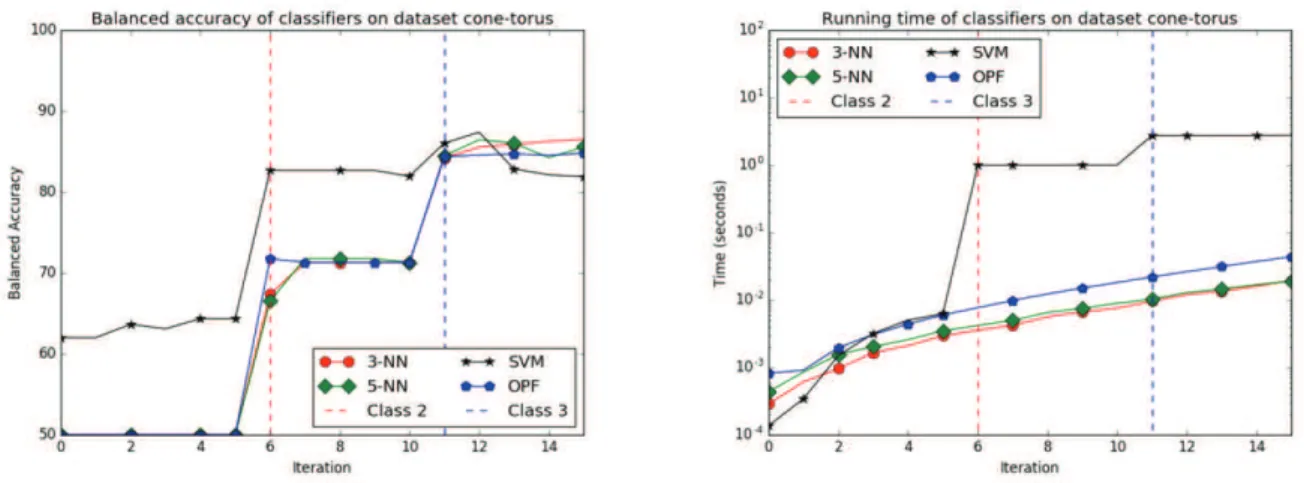
Abstract. Incremental learning capabilities of classifiers is a rele-vant topic, specially when dealing with scenarios such as data stream mining, concept drift and active learning. We investigate the capa-bilities of an incremental version of the Optimum-Path Forest clas-sifier (OPF-CI) in the context of learning new classes and compare its behavior against Support Vector Machines andkNearest Neigh-bours classifiers. The OPF-CI classifier is a parameter-free, graph-based approach to incremental training that runs in linear time with respect to the number of instances. Our results show OPF-CI keeps the running time low while producing an accuracy behavior similar to the other classifiers for increments of instances. Also, it is robust to variations on the order of the learned classes, demonstrating the applicability of the method.
1 INTRODUCTION
In incremental learning we consider a process in which new instances emerge and the model adjusts previous knowledge according to the new data. Thus, it does not assume the availability of a sufficient training set in the beginning of the learning process, but rather that training instances appear over time [8]. The ability to learn not only from a fixed training set, but also considering both new data and an already learned model, is an important feature in pattern recognition systems [24]. Moreover, it is important to update models in an effi-cient way in order to comply with realistic scenarios [9].
One of the issues in this context are the class-incremental prob-lems, in which instances from new classes appear over time [26] [12]. Scenarios where learning new classes is required are not uncommon. A dataset of produce images, for instance, is constantly being up-dated as new types of fruits and other produce are uploaded into the system. In order to make a viable recognition system, a model with the ability to learn new classes is required, and, as the dataset increases in size, this model must be updated as efficiently as possi-ble [2]. It is also important to keep it robust to order effects [6].
Graph-based approaches represent the feature space structure by capturing relationships among instances (vertices in a graph) and the weights of said relationships. In this manner, algorithms can perform supervised [14], unsupervised [21, 22] and semi-supervised learn-ing [11]. In data stream mining or active learning it is possible to update minimum spanning trees [4] and paths [1] in order to main-tain the graph structure and thus the learning model [10].
The Optimum-Path Forest (OPF) classifier [14] is a supervised learning approach that uses graph theory in order to build a model based on Optimum-Path Trees that encode the information of classes
1
Instituto de Ciˆencias Matem´aticas e de Computac¸˜ao, University of S˜ao Paulo, Brazil, email: [email protected], [email protected]
2
CVSSP, University of Surrey, UK, email: [email protected]
in the feature space. It can be used to develop simple, fast, multiclass and parameter independent classifiers, and shown to be reliable in ap-plications such as intrusion detection, image classification [16] and as a base classifier in ensemble learning for different datasets [18]. It has similarities with theknearest neighbors (kNN) classifier, spe-cially with the 1NN, but it is often capable of capturing the intrinsic characteristics of the feature space by creating more or less dense trees in different subspaces [23]. Because of its quadratic training complexity (i.e.O(n2
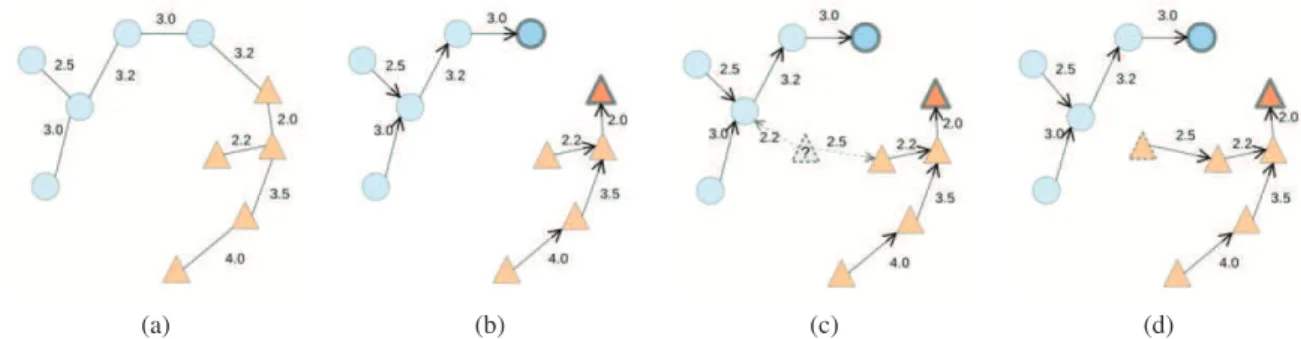
)for ninstances in the training set), strate-gies were developed to speed-up training [13]. Additionally, a linear incremental-learning version of the OPF was proposed in [17], capa-ble of includingpnew instances with aO(n·p)cost, wherenis the sample size in the current model.
As incremental learning is still relevant to the analysis of evolv-ing datasets for the purposes of classification and regression [25], novelty detection and concept-drift [7], we report a new algorithm and a series of experiments that tries to incrementally build a model containing from one to multi-class data. In particular, our paper ex-plores the incremental optimum path forest classifier (OPFI) [17], extending it to class-incremental scenarios (OPF-CI), i.e. capable of learning new classes without retraining the whole model. The nov-elty of the paper relies on building up an OPF model from one-class to multi-class. Besides, we compare our algorithm with other clas-sifiers under different incremental learning conditions, in particular class-incremental, using different class orders. Our method starts by building an initial one-class model upon which the incremental algo-rithm can run [21], and then include new classes as new trees on the optimum-path forest.
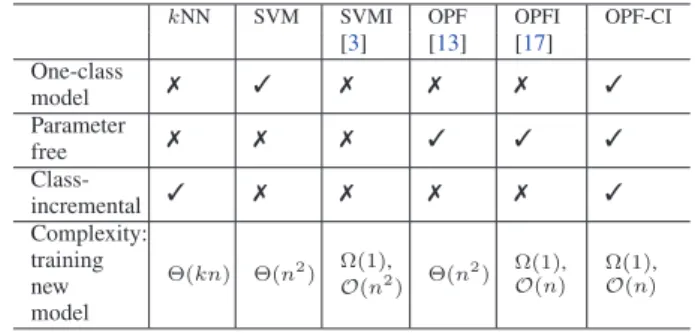
In order to analyse the OPF-CI behavior we compare its results with the classifierskNN and Support-Vector Machine (SVM) [5], which also has an incremental version [3]. While SVM has a stronger theoretical framework, it is expensive to train and needs parameter tuning. kNN does not need training but it is slow — specially in its original version — for large datasets. OPF is a parameter-free algorithm that works well even with small training sets, which suits several applications, making it relevant to be compared with SVM andkNN. Some characteristic of each method and their complexities are compared in Table1, in whichnis the total of instances available to train a model in a given time.
In this paper, we set out to develop a fast and accurate method based on the Incremental OPF classifier to learn new classes with supervision, from a model with just one class (based on an initial clustering) to a multi-class model, which is our main contribution. This method must be capable of updating itself with the new classes in linear time while maintaining the accuracy of the original OPF, al-lowing this method to be used in data stream mining, active learning and other related scenarios.
ECAI 2016 G.A. Kaminka et al. (Eds.) © 2016 The Authors and IOS Press. This article is published online with Open Access by IOS Press and distributed under the terms of the Creative Commons Attribution Non-Commercial License 4.0 (CC BY-NC 4.0). doi:10.3233/978-1-61499-672-9-216 216