2 0 0 5 2 0 0 5 2 0 0 5 2 0 0 5 2 0 0 5 2 0 0 5 2
0 0 2 2 0 0 5 2 0 0 5 2 0 0 5 2 0 0 5 2 0 0 5 2 0 0
2 0 0 5 2 0 0 5 2 0 0 5 2 0 0 5 2 0 0 5 2 0 0 5 2 0
0 0 5 2 0 0 5 2 0 0 5 2 0 0 5 2 0 0 5 2 0 0 5 2 0 0
5 2 0 0 5
2 0 0 5 2 0 0 5 2 0 0 5 2 0 0 5 2 0 0 5
0 0 5 2 0
0 5 2 0 0 5 2 0 0 5 2 0 0 5 2 0 0 5 2 0
0
0 5 2 0 0
5 2 0 0 5 2 0 0 5 2 0 0 5 2 0 0 5 2 0 0 5
2 0 0 5 2 0 0 5 2 0 0 5 2 0 0 5 2 0 0 5 2 0 0 5 2 0
0 5 2 0 0 5 2 0 0 5 2 0 0 5 2 0 0 5 2 0 0 5 2 0 0
2 0 0 5 2 0 0 5 2 0 0 5 2 0 0 5 2 0 0 5 2 0 0 5 2 0
0 0 5 2 0 0 5 2 0 0 5 2 0 0 5 2 0 0 5 2 0 0 5 2 0 0
2 0 0 5 2 0 0 5 2 0 0 5 2 0 0 5 2 0 0 5 2 0 0 5 2 0
0 5 2 0 0 5 2 0 0 5 2 0 0 5 2 0 0 5 2 0 0 5 2 0 0 5
5 2 0 0 5 2 0 0 5 2 0 0 5 2 0 0 5 2 0 0 5 2 0 0 5
0 0 5 2 0 0 5 2 0 0 5 2 0 0 5 2 0 0 5 2 0 0 5 2 0 0
2 0 0 5 2 0 0 5 2 0 0 5 2 0 0 5 2 0 0 5 2 0 0 5 2 0
5 2 0 0 5 2 0 0 5 2 0 0 5 2 0 0 5 2 0 0 5 2 0 0 5
0 5 2 0 0 5 2 0 0 5 2 0 0 5 2 0 0 5 2 0 0 5 2 0 0 5
0 0 5 2 0 0 5 2 0 0 5 2 0 0 5 2 0 0 5 2 0 0 5 2 0 0
2 2 0 0 5 2 0 0 5 2 0 0 5 2 0 0 5 2 0 0 5 2 0 0 5
2 0 0 5 2 0 0 5 2 0 0 5 2 0 0 5 2 0 0 5 2 0 0 5 2 0
2 0 0 5 2 0 0 5 2 0 0 5 2 0 0 5 2 0 0 5 2 0 0 5
Key Data on Teaching Languages
at School in Europe
2005 Edition
K
ey Data on on T
eaching Languages at School in Eur
ope – 2005 Edition
EN
EURYDICE
EURYDICE, the information network
on education in Europe
Eurydiceis an institutional network for gathering, monitoring, processing and circulating reliable and readily comparable information on education systems and policies throughout Europe. The Network focuses primarily on the way education in Europe is structured and organised at all levels. Its publications output may be broadly divided into descriptions of national education systems, comparative studies devoted to specific topics, and indicators and statistics.
Eurydice works mainly for those involved in educational policy-making nationally and in the European Union institutions, as well as at regional and local levels. However, its publications may be consulted by anyone and are available both in print and over the Internet.
First launched by the European Community in 1980, the EurydiceNetwork consists of a European Unit set up by the European Commission in Brussels and National Units established by education ministries in all countries taking part in Socrates, the EU education action programme. Eurydicehas been an integral part of Socrates since 1995. The Network boosts European cooperation in education by developing exchanges of information about systems and policies and producing studies on issues common to education systems.
Eurydiceis a dynamic interdependent Network to whose work all Units contribute. The European Unit coordinates the activity of the Network, drafts and distributes most of its publications, and designs and administers Eurydicedatabases and the central website. National Units provide and are involved in processing the data on which this activity relies and ensure that the output of the Network reaches target groups within their countries. In most countries, Units are situated within the education ministry. In a few, however, they are located in library resource centres, or bodies for administration and research.
EURYDICE on the Internet – http://www.eurydice.org
Education and Culture
EN
59,2 30,8
24,7
55,3
16
54
29,8
45,4
34,6
24,7
45,3
8,4
81,6 47,9
43,7
26,3
58,4
29,2
50,8
12,5
57,5
49,6 40,4
33,3
46,7
17,1
52,9
56,1 33,9
61,5 25,4
44,6
59,9 30,1
30,8
49,2
9,3
60,7
51,1
30,6
49,4
18,2
51,8
38
52
26,9 53,1
35
Bălgarski Dansk Deutsch Ellinika English Español Eesti Suomi Français Magyarí
slenzk Italiano Svenska Česky Lietuviu Latviešu Malti Nederlands Norsk Polski Português Română Slovensky Slovensci European Commission ISSN 1830-2076EURYDICE
Key Data on Teaching Languages
at School in Europe
2005 Edition
Eurydice
European Commission (Directorate-General for Education and Culture).
Available in English (Key Data on Teaching Languages at School in Europe), French (Chiffres clés de l’enseignement des langues à l’école en Europe) and German (Schlüsselzahlen zum Sprachenlernen an den Schulen in Europa).
ISBN 92-894-8681-3
This document is also available on the Internet (http://www.eurydice.org). Text completed in November 2004.
© Eurydice, 2005.
The contents of this publication may be reproduced in part, except for commercial purposes, provided that the extract is preceded by a complete reference to ‘Eurydice, the information network on education in Europe’, followed by the date of publication of the document.
Requests for permission to reproduce the entire document must be made to the European Unit.
Cover photograph: © Zefa visual media, Brussels, Belgium.
Eurydice European Unit Avenue Louise 240 B-1050 Brussels Tel. +32 2 600 53 53 Fax +32 2 600 53 63 E-mail: [email protected] Internet: http://www.eurydice.org Printed in Belgium
Multilingualism is specifically mentioned as part of my portfolio as Commissioner. This has not happened by chance, because languages are not a mere means of communication. They contribute to a better knowledge of other European cultures and have a real potential for a deeper understanding between European citizens. Multilingualism policy aims at ensuring multiculturalism, tolerance and European citizenship. Widespread general competence in foreign languages also plays its part in keeping xenophobia and intolerance at bay. We have to understand each other if we want to reap the full benefits of the cultural, social and economic richness of our continent.
In an enlarged and multilingual Europe, proficiency in languages generates rewarding fresh prospects for individuals personally, as well as for business and professional activity and all dialogue between people from different cultures and backgrounds. In this framework, I will actively support language teaching and linguistic diversity. This Eurydice publication I am presenting for the first time to you will show every two years the evolution and the results of our efforts.
The publication of this first separate report in the Key Data series devoted specifically to the teaching of languages fully reflects the increasing importance attached to this area of learning in the European context. At the March 2002 Barcelona European Council, the Heads of State or Government called for a sustained effort ‘to improve the mastery of basic skills, in particular by teaching at least two foreign languages from a very early age’. At the same time, they called for a ‘linguistic competence indicator’ to be established in this field. The present report also contributes to the European Commission 2004-06 Action Plan for language learning and linguistic diversity.
The wide variety of foreign languages taught, the fact that very young children now learn them, and the training of foreign language teachers are all issues central to much current debate on education in Europe. The Eurydice data set out here show that, in certain areas, the recommendations of the Heads of State or Government are being followed. Pupils in Europe are learning foreign languages at an increasingly early age and, in most countries, all children have a chance to learn at least two during their compulsory education.
Eurydice European Unit and the Eurydice National Units, to which Eurostat has also contributed with its harmonised statistical data. The working method developed as a result of this unique partnership has ensured that the data contained in the report are highly authoritative. The use of different data sources and the inclusion of many diagrammatic illustrations with their explanatory notes add a further interesting dimension to the present report.
The Key Data on Teaching Languages at School in Europe series is an outstanding quality resource. It will be of considerable help to anyone involved in thought and discussion on the subject of foreign language teaching and in developing arrangements for improving and diversifying the language competence of everyone in Europe.
Ján Figel’
Commissioner responsible for Education, Training, Culture and Multilingualism
Preface 3
Contents 5
Introduction 7
Main issues
9
Codes, abbreviations and acronyms
13
A – CONTEXT
15
B – ORGANISATION
23
C – PARTICIPATION
39
D – TEACHERS
57
E – TEACHING PROCESSES
67
Glossary 83
Statistical tools
85
Annexes 89
Thematic index of figures
99
The 37 indicators contained in this book comprise a subject-based collection consisting of five chapters, namely Context, Organisation, Participation, Teachers and Teaching processes. Given the importance attached to foreign language teaching in European cooperation, indicators published by the Eurydice Network on this subject are no longer contained in a chapter of the Key Data general report but occupy a separate volume devoted exclusively to the topic. Eurydice will publish regular updates of these indicators and make every effort to include new ones, depending on the availability of relevant data and the interest shown in further ramifications of the subject.
Eurydice information from official sources covers many aspects of the provision of foreign language teaching and teacher training for it. Its reference year is 2002/03. The Eurostat statistical material taken from the New Cronos database relates to 2001/02 and provides information on pupil participation rates for foreign language learning in primary and secondary education. It is possible therefore to compare the level of language learning with foreign language teaching requirements in the curriculum of each country.
In general, this publication is concerned solely with languages regarded as foreign languages in the curriculum laid down by the central education authorities. However, regional or minority languages are also discussed when the curriculum considers them to be alternatives to foreign languages. The same applies to ancient languages in information for which Eurydice is the source. Furthermore, all Eurydice and Eurostat indicators relate exclusively to general education and public-sector and grant-aided private schools.
The inclusion of several time series is a further novel feature of the publication. They are taken from Eurydice and Eurostat sources and are especially useful for identifying certain trends in the qualitative and quantitative development of language teaching in recent decades. They indicate the extent to which foreign languages are being taught as a compulsory subject at an increasingly early stage of primary education, and show how the percentage of pupils learning English in primary and secondary education is increasing. New indicators have been prepared using the PIRLS 2001 and PISA 2000 international databases. They relate to the situation of pupils in the fourth year of primary education who are aged 9 or 10 depending on the particular country (PIRLS) and pupils aged 15 (PISA). They also provide an insight into the multilingual environment of schools in Europe. They contain details about the proportion of pupils who at home speak a language other than the language of instruction, and the populated areas in which schools with the most pupils in this category are situated.
An indicator taken from the European Socrates (Comenius) programme database administered by the European Commission Directorate-General for Education and Culture rounds off the study. It shows the percentage of grants earmarked for in-service teacher training, with respect to the language of training and country of origin of the participant. The reference year is 2002/03.
A glossary and details regarding statistical tools are given at the end of the book. Codes, abbreviations and acronyms used are listed at the beginning of the report.
required. Thus in so far as initial teacher education institutions possess a significant degree of autonomy, little can really be learnt from analysing the content of official teacher training recommendations. Furthermore, schools or even teachers themselves may to some extent be free to act as they wish as regards teaching methods and practice. In this respect, only empirical surveys could give a satisfactory account of their approach to these matters. Finally, while language competence evaluation grids certainly exist, there is as yet no entirely consistent data collection instrument at European level for measuring such competence among pupils, so no study in this area can be undertaken. However, the Heads of State or Government at the Barcelona European Council (2002) called for a ‘linguistic competence indicator’ to be established, which should make it possible to measure the progress achieved by different Member States in enabling all citizens to acquire the skills needed to speak at least two languages in addition to their mother tongue.
The indicators contained in this report are examined here in relation to four major topics: Language diversity within schools,
The position of foreign languages in the curriculum, The range of different languages taught,
The initial education of teachers and their qualifications.
Language diversity within schools
8 % of pupils aged15 say that at home they speak a
language other than the language of instruction
There are wide variations between countries in the percentage of pupils aged 15 who say that at home they speak a language other than the language of instruction. The proportion ranges from 0.7 % in the United Kingdom (Northern Ireland) to 34 % in Belgium (the Flemish Community) (Figure A2b). These contrasting figures cannot be explained solely in terms of the presence or otherwise of pupils from immigrant backgrounds. Indeed, in some countries pupils speak a regional language at home or use a dialect of the state language. The tendency to do this is especially marked in Belgium (the Flemish Community).
Language support measures have been introduced for immigrant pupils of foreign mother tongue
Language support measures for immigrant pupils of foreign mother tongue have been introduced in almost all countries (Figure E7). Where they exist, support is mostly provided in accordance with two main kinds of procedure: either pupils are directly integrated within classes corresponding to their age (or lower classes in some cases) and receive special language support, or they are kept separate for a limited period and receive tuition adapted to their needs. The most widespread situation is one in which both kinds of provision exist alongside each other.
The position of foreign languages in the curriculum
Compulsoryteach-ing of a foreign language is begin-ning at an increas-ingly early stage
Pupils have to learn a foreign language from primary education onwards in almost all countries (Figure B1). In several of them, they are obliged to do so even in their first year. Indeed, the tendency to offer this provision at an earlier stage than previously is apparent in most education systems (Figure B3). The percentage of pupils in primary education learning at least one foreign language has risen almost everywhere in recent years (Figure C3). At present in the majority of countries, half of all pupils at this level (or even more in certain countries) learn at least one foreign language (Figure C1).
majority of pupils to learn at least two foreign languages
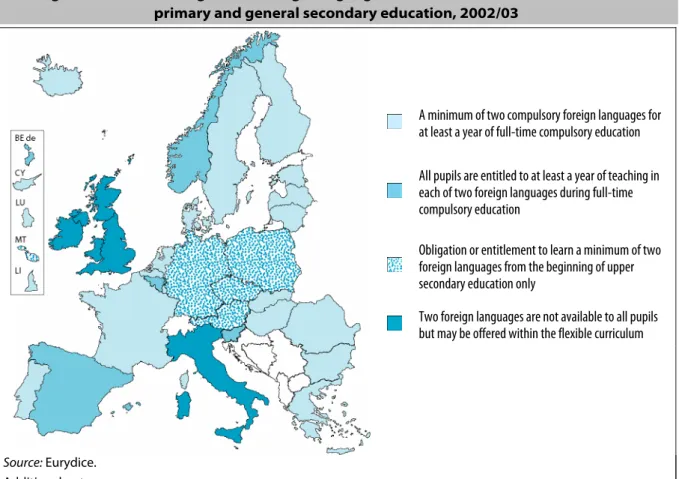
learning a minimum of two foreign languages during compulsory education (Figure B4). In around 20 countries, they are even obliged to do so for at least one school year. Inclusion of this provision in the curriculum thus complies with the recommendations of European Union Heads of State and Government regarding the importance of a sustained effort ‘to improve the mastery of basic skills, in particular by teaching at least two foreign languages from a very early age’ (Barcelona European Council, 2002).
In lower secondary education, less than half of all pupils learn two or more languages
In spite of the foregoing possibility, the proportion of pupils learning at least two foreign languages in general lower secondary education is less than 50 % in the majority of countries for which data are available (Figure C2). Variations between countries may be very considerable. In Luxembourg all pupils learn two foreign languages (around half of them learn at least three) while, according to the statistics available, in Slovenia this applies to 1.6 % of pupils. It should be noted however that the corresponding percentage is far higher in general upper secondary education.
The proportion of teaching time allocated to foreign languages as a compulsory subject varies from 9 % to 34 %
In most countries with official recommendations on teaching time, the share of time to be devoted to foreign languages as a compulsory subject relative to total teaching time varies between 10 % and 15 % in compulsory general secondary education (Figure E5). This proportion is highest in Luxembourg (34 %) and lowest in Poland (9 %).
Language teaching is not provided over a short period. The more the total amount of teaching time grows, the greater the number of years over which this provision is spread
Generally speaking, during compulsory education, the greater the total amount of time (in hours) earmarked for teaching the first foreign language as a compulsory subject, the longer the period (in years) during which this language is a compulsory subject (Figure E3). However, Austria and Norway represent significant departures from this trend. The total number of hours allocated is relatively low compared to the total number of years provision lasts, which is among the highest in Europe.
Schools may also make foreign language learning compulsory
In some countries, schools themselves determine part of the minimum curriculum. They are thus able to include a compulsory foreign language in the curriculum for all pupils, in addition to languages that the central education authorities oblige them to learn (Figure B2).
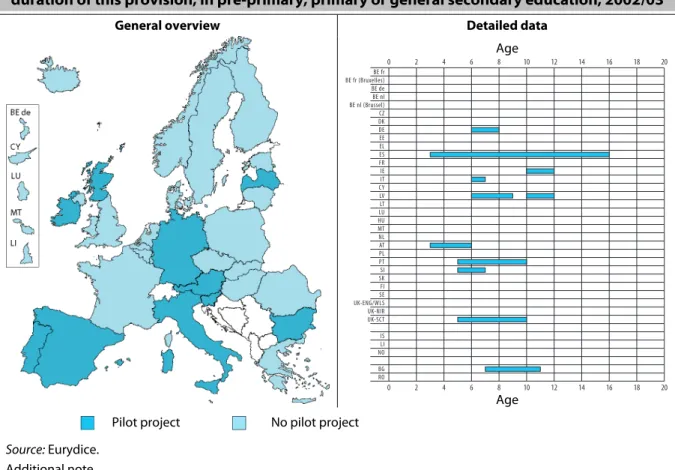
In several countries also, pilot projects have been introduced enabling pupils to begin learning a foreign language before it becomes compulsory for everyone (Figure B5).
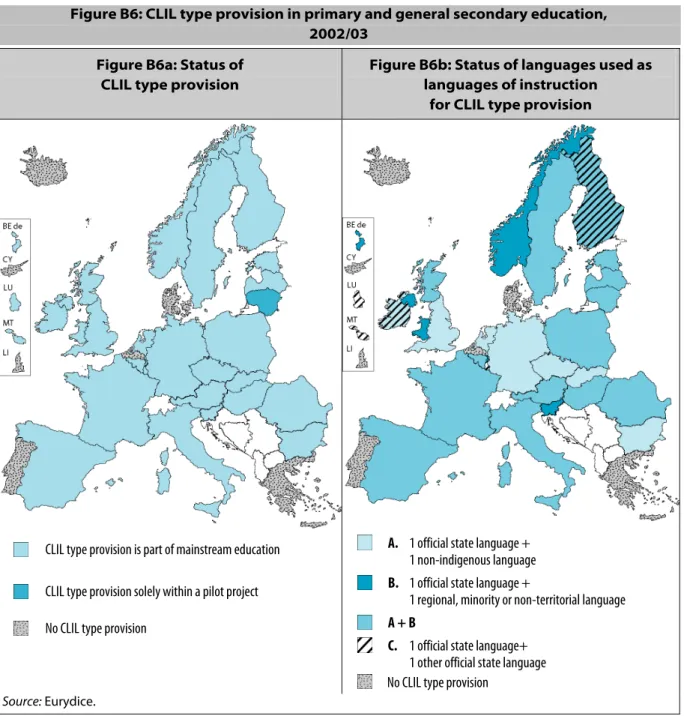
language integrated learning is included in normal provision in most education systems
than a minority of pupils are currently catered for. The status and position of this type of provision varies depending on the country, but it is very often an integral part of the education system.
The range of different languages taught
English, French,German, Spanish and Russian
represent 95 % of all languages learnt
The sometimes very broad range of possible foreign languages included in the curricula of many countries such as Germany and France (Figure B7) reflects the determination of educational policy-makers to diversify school provision for foreign language learning. However, statistical data on this provision indicate that just a few out of the many languages on offer account for by far the greatest share of foreign language learning at school. Thus in secondary education, English, French, German, Spanish and Russian represent over 95 % of all languages learnt in the majority of countries (Figure C9). The percentages of pupils learning Russian are highest in the Baltic countries. This language is also learnt to a lesser extent in Finland, Poland and Bulgaria. Pupils thus appear to opt for learning more widely used languages. This may be attributable either to pressure from families or a lack of qualified teachers in other languages.
The teaching of English is constantly expanding and predominates almost everywhere
English is the most taught language in virtually all countries (Figures C4 and C7). Furthermore, in both primary and secondary education its dominant position is becoming even stronger, especially in the countries of central and eastern Europe (Figures C5 and C10).
Around 90 % of pupils in upper secondary education learn English, regardless of whether or not this is compulsory
In 13 European countries, pupils are obliged to learn English during compulsory education, or in some countries for an even longer period extending into upper secondary education (Figure B7). In all these countries, therefore, the proportion of pupils learning English in secondary education is logically higher than 90 %. However, in the remaining countries, pupils opt for this language in similarly huge numbers given that the proportion of those learning it is also close to 90 % nearly everywhere (Figure C8).
German or French is the second most taught language
German and French generally share the position of second most taught language. German occupies this position in the Nordic countries and the countries of central and eastern Europe, while French is more popular in the countries of southern Europe and, more particularly, the Latin countries (Figure C7).
Language teachers are often generalists in primary
education and specialists in secon-dary education
In primary education, foreign languages are very often taught by generalists (non-specialists) who teach all or most subjects in the curriculum, including foreign languages (Figure D1). In secondary education, teaching is primarily the responsibility of specialists (Figure D2) who, depending on the particular country, are qualified to teach either just foreign languages, or two subjects one of which is a foreign language (Figure D3).
In general, the initial education of specialist or semi-specialist teachers lasts four or five years
In all countries, the initial teacher education of specialist or semi-specialist teachers of foreign languages is provided in tertiary education and leads, in most of them, to a university qualification (ISCED level 5A). In general, this education lasts four or five years (Figure D4). This form of training is similar to that for teachers of other subjects (1).
Recommendations that prospective teachers should spend some time in a country speaking the language to be taught are most uncommon in Europe
In Europe, virtually all institutions for initial teacher education are either totally or partially free to determine the content of their provision (2). However, in
many countries the central education authorities recommend that institutions should provide courses in the theory of language teaching, one or several language courses and in-school placements. Only Luxembourg and the United Kingdom (Scotland) recommend that prospective teachers should spend one or more periods of time in a country that speaks the language they will have to teach (Figure D5). Over 60 % of in-service training courses funded by the European Socrates (Comenius) programme are given in English
Over 60 % of in-service training funded by the Comenius action of the European Socrates programme is provided in English. According to European Commission recommendations, 70 % of this training should consist of language courses and, more particularly, provision intended to improve foreign language teaching skills. The other most widely used languages of instruction are French (17 %), and German and Spanish (both 5 %) (Figure D7).
In most countries, the order in which the different languages used in Socrates (Comenius) are represented corresponds in the main to the percentages of pupils learning English, French, German and Spanish in secondary education (Figure C8).
(1) Eurydice (2002). The teaching profession in Europe: profile, trends and concerns. Report I: Initial training and
transition to working life. Key Topics in Education in Europe, Volume 3.
Country codes
EU European Union PL Poland
BE Belgium PT Portugal
BE fr Belgium – French Community SI Slovenia
BE de Belgium – German-speaking Community SK Slovakia
BE nl Belgium – Flemish Community FI Finland
CZ Czech Republic SE Sweden
DK Denmark UK United Kingdom
DE Germany UK-ENG England
EE Estonia UK-WLS Wales
EL Greece UK-NIR Northern Ireland
ES Spain UK-SCT Scotland
FR France
IE Ireland EFTA/EEA The three countries of the European Free
IT Italy countries Trade Association which are members of
CY Cyprus the European Economic Area
LV Latvia IS Iceland
LT Lithuania LI Liechtenstein
LU Luxembourg NO Norway
HU Hungary
MT Malta Candidate countries
NL Netherlands BG Bulgaria
AT Austria RO Romania
Statistics
(:) Data not available
ar Arabic et Estonian ja Japanese sc Sardinian
be Belorussian eu Basque lb Letzeburgesch sk Slovak
bg Bulgarian fi Finnish lt Lithuanian sl Slovene
br Breton fr French lv Latvian smi Sami (Lapp)
ca Catalan fur Friulian mt Maltese sq Albanian
cat Valencian fy Frisian nl Dutch sr Serbian
co Corsican ga Irish no Norwegian sv Swedish
cs Czech gd Scottish Gaelic oc Occitan tr Turkish
csb Kashubian ger Regional languages of Alsace oci Provençal uk Ukranian
cpf Creole ger L. Moselle reg. pl Polish ukr Ruthenian
cy Welsh gl Galician pt Portuguese ur Urdu
da Danish he Modern Hebrew ro Romanian wen Sorbian
de German hr Croatian roa Mirandês zh Chinese
el Greek hu Hungarian roa Ladin
en English is Icelandic rom Romany
es Castillan it Italian ru Russian
The codes used are derived from the ISO 639 standard which gives an official list of language names. The standard contains two code systems, the first consisting of two letters and the second of three letters, which covers more languages. Preference has been given to the two-letter system in this report in that its codes have already been used in other Eurydice publications. However, the report also uses the three-letter system when the languages identified have no two-letter codes. Languages have been classified in the alphabetical order of the codes in the Figures. For further information on the status of these languages, see Figure A1 (Chapter A) and annexe 2.
Abbreviations and acronyms
International conventionsCLIL Content and Language Integrated Learning
EU-15 The 15 Member States of the European Union before 1 May 2004
EU-25 The 25 Member States of the European Union after 1 May 2004
Eurostat Statistical Office of the European Communities
ISCED International Standard Classification of Education
PIRLS Progress in International Reading Literacy Study (IEA)
PISA Programme for International Student Assessment(OECD)
National abbreviations in their language of origin
AHS Allgemeinbildende höhere Schule AT
GCSE General Certificate of Secondary Education UK (ENG/WLS/NIR)
HAVO Hoger algemeen voortgezet onderwijs NL
MAVO Middelbaar algemeen voortgezet onderwijs NL
VBO Voorbereidend beroepsonderwijs NL
VMBO Voorbereidend middelbaar beroepsonderwijs NL
C O N T E X T
SEVERAL LANGUAGES ARE OFFICIALLY RECOGNISED
IN HALF OF ALL EUROPEAN COUNTRIES
Europe is home to many different languages – a result of both its past and recent history. The linguistic patterns of most European countries are complex and formed from a variety of languages existing within the borders of each. Certain countries also share the same languages, especially around their border areas. This multilingualism characteristic of Europe may be considered from different angles one of which is unquestionably the official recognition of languages by the European, national or regional authorities. Since 1 May 2004, the European Union has recognised 20 official languages (1) with the status of state
language in its different member countries. However, certain countries extend the status of official state language to other languages that exist within their borders (Irish in Ireland, Turkish in Cyprus or Letzeburgesch in Luxembourg). Often, these official state languages are spoken by the majority of inhabitants of the country concerned. Elsewhere, they are used by a minority as in the case of Swedish in Finland.
Few European countries officially recognise (for legal or administrative purposes) the existence of regional or minority languages within their borders. In such countries, languages are granted official state recognition but solely within the geographical area – often a region or autonomous unit – in which they are normally spoken. In Spain for example, Basque, Catalan, Galician and Valencian are official languages alongside Spanish in their corresponding Autonomous Communities. This official recognition granted both to a state language and other languages spoken within national borders also exists in Italy in which several languages are spoken alongside Italian. In these countries, the presence of people who speak different languages results in situations in which the use of two languages is more or less marked, depending on the language policies adopted. Teaching a regional or minority language or using it as a language of instruction is unquestionably instrumental in keeping it alive for future generations (Figure B7 and annexes 1 and 2).
A further characteristic of the linguistic scene in Europe is the existence of all those languages which are not granted official recognition by the public authorities, but which are used by various groups of people in different countries. They correspond to geographically based linguistic minorities formed, in some cases, by groups living away from their native territory, whether a State or a region, as well as to non-territorial minorities whose language is not associated with any one particular territory (such as the Romanies).
All such languages have been formally identified by the Council of Europe under the single heading of ‘regional or minority languages’ (European Charter for Regional or Minority Languages, Article 1, 1992) (2).
Finally, attention should be drawn to the existence in Europe of languages spoken by immigrant populations consisting of significantly large numbers of people in some countries (Figure A3) (3).
(1) Czech, Danish, Dutch, English, Estonian, German, Finnish, French, Greek, Hungarian, Italian, Latvian, Lithuanian, Maltese, Polish,
Portuguese, Slovak, Slovene, Spanish and Swedish.
(2) Further information on regional or minority languages in Europe is provided on the website of the European Bureau for Lesser Used
Languages (ww2.eblul.org:8080/eblul).
(3) For further information on immigrant populations in Europe, see: Integrating Immigrant Children into Schools in Europe. Survey.
Figure A1: Official state languages and regional or minority languages with official status in Europe, 2004
Source: Eurydice.
1 official state language
2 official state languages 3 official state languages
One or more regional or minority languages with official status, in addition to the official state language
Official state language Regional or minority language with official status
Official state language
Regional or minority language with official status
BE French, German, Dutch MT English, Maltese
CZ Czech NL Dutch Frisian
DK Danish AT German Czech, Croatian, Hungarian, Slovak, Slovene
DE German Danish, Sorbian PL Polish
EE Estonian PT Portuguese
EL Greek SI Slovene Hungarian, Italian
ES Castillan Catalan, Valencian, Basque, Galician SK Slovak
FR French FI Finnish, Swedish Sami (Lapp)
IE English, Irish SE Swedish
IT Italian Catalan, German, Greek, French, UK-ENG/NIR English
Friulian, Croatian, Occitan, Provençal, UK-WLS English Welsh Ladin, Slovene, Sardinian, Albanian UK-SCT English Scottish Gaelic
CY Greek, Turkish IS Icelandic
LV Latvian LI German
LT Lithuanian NO Norwegian Sami (Lapp)
LU German, French, Letzeburgesch BG Bulgarian
HU Hungarian RO Romanian
Additional note
Italy: Since the May 2001 decree took effect, regional languages have been officially recognised.
Explanatory note
FEW PUPILS IN EUROPE SPEAK A LANGUAGE AT HOME
THAT IS NOT THEIR LANGUAGE OF INSTRUCTION
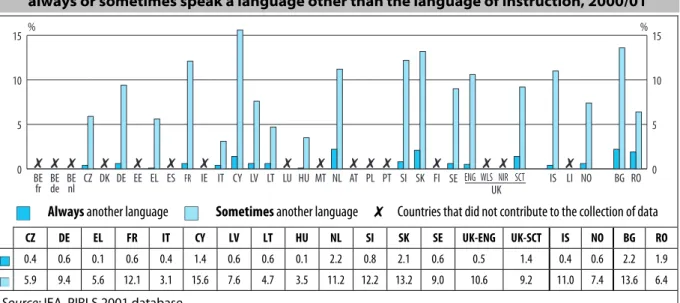
In all European countries that took part in the PIRLS 2001 and PISA 2000 international surveys, the proportion of pupils who at home speak a language other than their language of instruction is much lower than the proportion of pupils who speak the language used at school. The phenomenon is apparent to the same extent among pupils in the fourth year of primary school (Figure A2a) as among those aged 15 (Figure A2b). According to the PIRLS data, the proportion of pupils aged 9 or 10 who at home ‘always’ speak a language other than the language of instruction is negligible (Figure A2a). The highest percentages (2 %) are observed solely in the Netherlands, Slovakia, Bulgaria and Romania. Nevertheless, the proportion of pupils who ‘sometimes’ speak a language other than the one spoken at school is a little greater. In half the countries concerned, 10 % or more of pupils sometimes use at home a language distinct from the one used at school. Cyprus has the highest proportion of bilingual pupils (15 %). This is partly attributable to the fact that the country has two official languages, Greek and Turkish.
Figure A2a: Proportion of pupils in the fourth year of primary school who say that at home they always or sometimes speak a language other than the language of instruction, 2000/01
0 5 10 15 0 5 10 15 RO BG NO LI IS SCT NIR WLS ENG SE FI SK SI PT PL AT NL MT HU LU LT LV CY IT IE FR ES EL EE DE DK CZ BE nl BE de BE fr UK % %
Always another language Sometimes another language Countries that did not contribute to the collection of data
CZ DE EL FR IT CY LV LT HU NL SI SK SE UK-ENG UK-SCT IS NO BG RO
0.4 0.6 0.1 0.6 0.4 1.4 0.6 0.6 0.1 2.2 0.8 2.1 0.6 0.5 1.4 0.4 0.6 2.2 1.9
5.9 9.4 5.6 12.1 3.1 15.6 7.6 4.7 3.5 11.2 12.2 13.2 9.0 10.6 9.2 11.0 7.4 13.6 6.4
Source: IEA, PIRLS 2001 database. Explanatory note
The questionnaire put two questions to pupils: ‘How often do you speak the language of instruction at home?’ and ‘How often do you speak the language of instruction with adults living in your home?’ The replies of pupils who said they never spoke the language of instruction at home to anyone (including adult members of the household) were placed in a first category labelled ‘always another language’. The replies of pupils who said they sometimes spoke the language of instruction at home were placed in a second category ‘sometimes another language’. The inconsistent replies of pupils who said that at home they never spoke the language of instruction and, at the same time, that they almost or nearly always spoke it with adult members of the household were discarded.
For further information, see the Statistical Tools and Annexes.
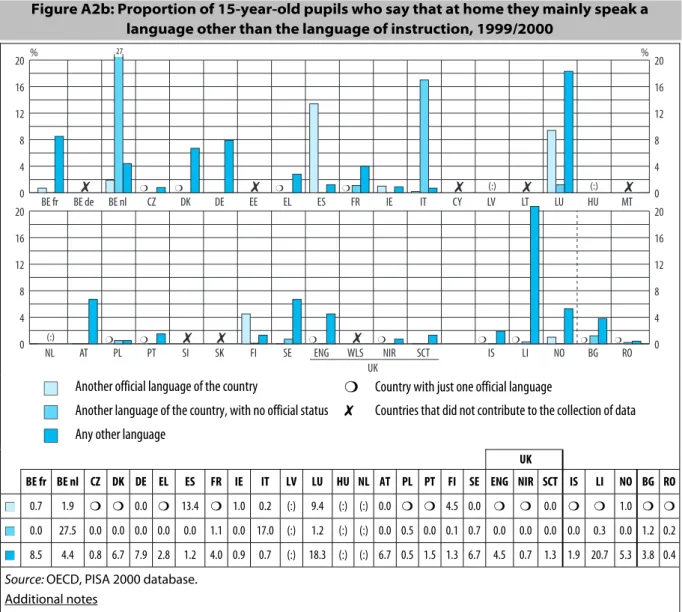
In the PISA 2000 study, 15-year-old adolescents were also asked to state which language or languages they used with their families (Figure A2b). Their replies revealed that the majority of pupils almost everywhere spoke the language of instruction at home. However, there were contrasting situations in some countries, no doubt attributable to unusual features of their linguistic context (Figure A1). For example, in the Flemish Community of Belgium, a high proportion of pupils aged 15 said that at home they spoke another indigenous language which corresponds to the Flemish dialect. In Spain, Luxembourg and Finland, 13 %, 9 %
and 4 % of pupils respectively identified themselves as speakers of other official languages of their country. These are countries with several official languages.
It is also interesting to note that in all countries a fairly significant proportion of pupils at home use ‘any other language’, which is different from the one or more national languages. This category, for which the highest proportions are recorded in Luxembourg and Liechtenstein, is undoubtedly associated in most cases with languages spoken by groups of immigrants that have settled in the countries concerned. The proportion of these pupils stands at around 7-8 % in Belgium (the French Community), Denmark, Germany, Austria and Sweden.
Figure A2b: Proportion of 15-year-old pupils who say that at home they mainly speak a language other than the language of instruction, 1999/2000
0 4 8 12 16 20 0 4 8 12 16 20 (:) (:) MT HU LU LT LV CY IT IE FR ES EL EE DE DK CZ BE nl BE de BE fr 0 4 8 12 16 20 0 4 8 12 16 20 (:) RO BG NO LI IS SCT NIR WLS ENG SE FI SK SI PT PL AT NL UK H H H H H H H H H H H H % 27 %
Another official language of the country Country with just one official language
Another language of the country, with no official status Countries that did not contribute to the collection of data Any other language
UK
BE fr BE nl CZ DK DE EL ES FR IE IT LV LU HU NL AT PL PT FI SE ENG NIR SCT IS LI NO BG RO
0.7 1.9 0.0 13.4 1.0 0.2 (:) 9.4 (:) (:) 0.0 4.5 0.0 0.0 1.0
0.0 27.5 0.0 0.0 0.0 0.0 0.0 1.1 0.0 17.0 (:) 1.2 (:) (:) 0.0 0.5 0.0 0.1 0.7 0.0 0.0 0.0 0.0 0.3 0.0 1.2 0.2 8.5 4.4 0.8 6.7 7.9 2.8 1.2 4.0 0.9 0.7 (:) 18.3 (:) (:) 6.7 0.5 1.5 1.3 6.7 4.5 0.7 1.3 1.9 20.7 5.3 3.8 0.4
Source: OECD, PISA 2000 database. Additional notes
Belgium (BE fr): The questionnaire contained no proposals concerning the category ‘another language of the country,
with no official status’.
Belgium (BE nl): The category ‘another language of the country, with no official status’ refers to the Flemish dialect.
Italy: The PISA 2000 survey was conducted before many existing indigenous languages were officially recognised in
2001 (Figure A1). The category ‘another language of the country, with no official status’ may thus include languages of the country that were granted official status in 2001 as well as dialects.
Latvia: As two questionnaires (in Russian and Latvian) were used, the data have not been indicated in order to avoid
any mistaken interpretation of the language categories indicated.
Netherlands: The response rate to the PISA 2000 survey was considered to be too low for purposes of meaningful
comparison. This explains why the data (another official language of the country = 0; another language of the country with no official status = 12.7; any other language = 5.4) are not shown in the Figure.
Explanatory note (Figure A2b)
Interpretation of the data concerning this question about the language pupils spoke at home, which was asked in the PISA survey, should take two factors into account. First, in some countries pupils from regional or ethnic minorities who received instruction in their mother tongue were not included in the sample. The proportion of pupils who at home speak a language other than the language of instruction has in such instances been slightly overestimated. Secondly, the basis for replying to the question was a list of languages from which pupils had to choose the language spoken at home most of the time. The categories were drawn up subsequently using indicators provided by those responsible at national level.
Language of instruction: Official language of the country used to teach pupils.
Another official language of the country: Another official language in a country in which several such languages coexist.
Another language of the country with no official status: A regional language or dialect without official language status.
Any other language: Any language other than an official language of the country, or a regional or minority language without
official language status. In general, this means a language spoken by immigrant pupils. For further information, see the Statistical Tools and Annexes.
THE PROPORTION OF PUPILS AGED 15 WHO DO NOT SPEAK THE LANGUAGE
OF INSTRUCTION IS LOWER THAN THAT OF IMMIGRANT PUPILS
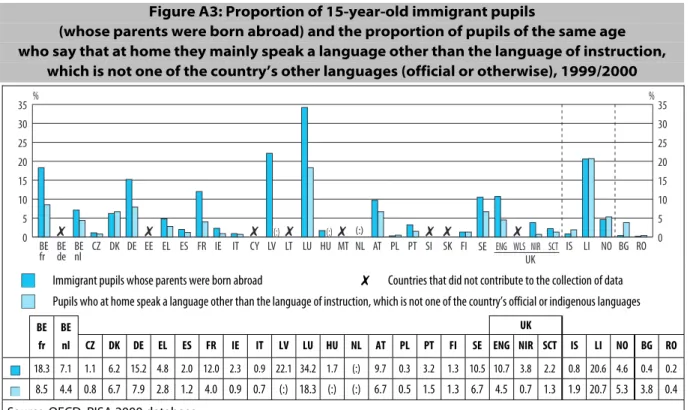
In countries that took part in the PISA 2000 international survey, it is possible to compare the proportions of 15-year-old immigrant pupils whose parents were born abroad with the proportions of pupils of the same age who at home speak a language other than the language of instruction, which is not one of the country’s other official or indigenous languages. In almost half of the countries that took part in the international survey, the two percentages are close. It is thus not unreasonable to suppose that the majority of immigrant pupils in these countries are accustomed to speaking their mother tongue at home, and that this language is different from the one used at their school. Nevertheless, in some countries such as Belgium (the French Community), France, Luxembourg or the United Kingdom (England), a significant proportion of foreign residents speak the same (one or more) languages as those used in the education system, no doubt because of the large number of immigrants who originally come from French-speaking or English-speaking countries, respectively.
Figure A3: Proportion of 15-year-old immigrant pupils
(whose parents were born abroad) and the proportion of pupils of the same age who say that at home they mainly speak a language other than the language of instruction,
which is not one of the country’s other languages (official or otherwise), 1999/2000
0 5 10 15 20 25 30 35 0 5 10 15 20 25 30 35 (:) (:) (:) RO BG NO LI IS SCT NIR WLS ENG SE FI SK SI PT PL AT NL MT HU LU LT LV CY IT IE FR ES EL EE DE DK CZ BE nl BE de BE fr UK % %
Immigrant pupils whose parents were born abroad Countries that did not contribute to the collection of data Pupils who at home speak a language other than the language of instruction, which is not one of the country’s official or indigenous languages
…
BE BE UK
fr nl CZ DK DE EL ES FR IE IT LV LU HU NL AT PL PT FI SE ENG NIR SCT IS LI NO BG RO
18.3 7.1 1.1 6.2 15.2 4.8 2.0 12.0 2.3 0.9 22.1 34.2 1.7 (:) 9.7 0.3 3.2 1.3 10.5 10.7 3.8 2.2 0.8 20.6 4.6 0.4 0.2 8.5 4.4 0.8 6.7 7.9 2.8 1.2 4.0 0.9 0.7 (:) 18.3 (:) (:) 6.7 0.5 1.5 1.3 6.7 4.5 0.7 1.3 1.9 20.7 5.3 3.8 0.4
Additional note (Figure A3)
Netherlands: The response rate to the PISA 2000 survey was considered to be too low for purposes of meaningful
comparison. This explains why the data (immigrant pupils = 11.9; pupils who at home speak a language other than the language of instruction, which is not one of the country’s official or indigenous languages = 18.3) are not shown in the Figure.
Explanatory note
The indicator is calculated by dividing the number of 15-year-old pupils who at home speak a language other than the language of instruction (which is not one of the country’s other languages, official or otherwise) by the total number of pupils aged 15.
The group referred to as immigrants corresponds to replies of the type ‘both parents and the 15-year-old pupil born
abroad’ or ‘both parents born abroad and the 15-year-old pupil born in the country concerned’. For further information, see the Statistical Tools and Annexes.
SMALL AND MEDIUM-SIZED TOWNS, OR CITIES, HAVE THE HIGHEST
PROPORTIONS OF 15-YEAR-OLDS WHOSE MOTHER TONGUE
IS NOT THE LANGUAGE OF INSTRUCTION
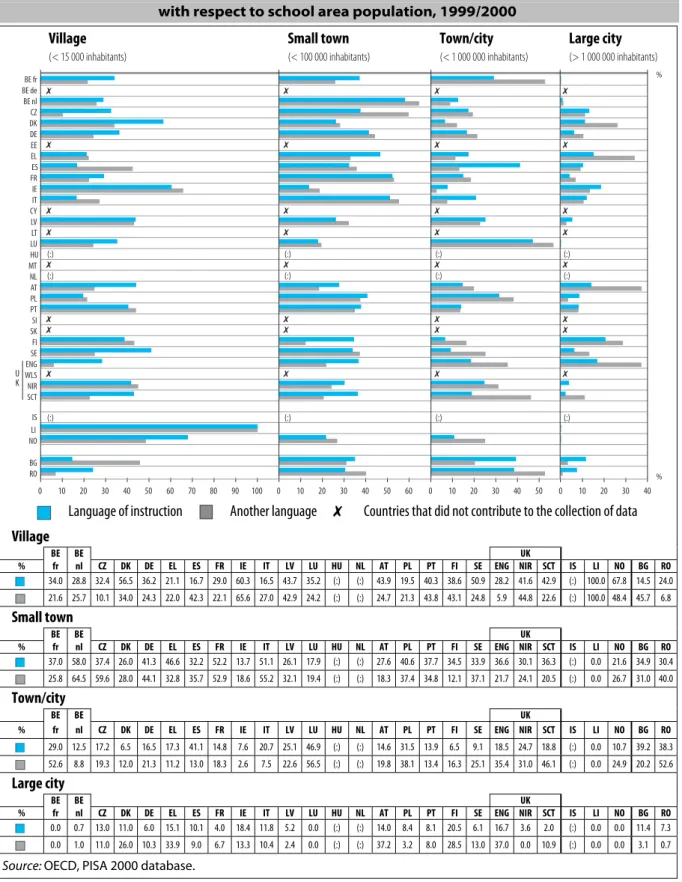
From the PISA 2000 data one can compare the breakdown, by school area population, of 15-year-old pupils who at home speak a language other than the language of instruction, with the corresponding breakdown for pupils aged 15 who speak the language of instruction.
This comparison reveals clearly that, as a general rule, pupils aged 15 who at home use a language other than the language of instruction are proportionally more numerous in schools in locations of under 100,000 inhabitants (‘small towns’) or urban areas (‘towns/cities’). The same trend is also apparent in the capitals or largest cities of some countries. In Copenhagen, Athens, Vienna or London, pupils speaking languages other than those of their teachers in the classroom are proportionally more numerous than elsewhere in the country.
Conversely, in nearly all countries the proportion of pupils who speak solely the language of instruction is relatively higher in ‘villages’ with under 15 000 inhabitants. The exceptions are Spain, Italy and above all Bulgaria in which the proportions of pupils in rural areas who speak a language other than the language of instruction are much higher. The fact that more than one language is native to each of these three countries may account for this.
Additional note (Figure A4)
Netherlands: The response rate to the PISA 2000 survey was considered to be too low for purposes of meaningful
comparison. This explains why the data (village: language of instruction (11.5)/another language (13.8); small town: language of instruction (59.4)/another language (60.3); town/city: language of instruction (29.1)/another language (25.9); large cities: language of instruction (0)/another language (0)) are not shown in the Figure.
Explanatory note
For each of the four main area categories (‘village’, ‘small town’, ‘town/city’ and ‘large city’), the Figure shows the breakdown of 15-year-old pupils who at home speak the language of instruction and then, underneath, the corresponding breakdown for pupils of the same age who at home speak another language.
Language of instruction: Official language of the country used to teach pupils.
A language other than the language of instruction: This category covers the other languages of the country (with or
without official status) and all further languages.
Figure A4: Proportions of 15-year-old pupils who say that at home they mainly speak the language of instruction or a language other than the language of instruction,
with respect to school area population, 1999/2000
Village Small town Town/city Large city
(< 15 000 inhabitants) (< 100 000 inhabitants) (< 1 000 000 inhabitants) (> 1 000 000 inhabitants)
0 10 % % 20 30 40 50 60 70 80 90 100 0 10 20 30 40 50 60 0 10 20 30 40 50 0 10 20 30 40 (:) (:) (:) (:) (:) (:) (:) (:) (:) (:) (:) (:) U K RO BG NO LI IS SCT NIR WLS ENG SE SK FI SI PT PL AT NL MT HU LU LT LV CY IT IE FR ES EL EE DE DK CZ BE nl BE de BE fr
Language of instruction Another language Countries that did not contribute to the collection of data
Village BE BE UK % fr nl CZ DK DE EL ES FR IE IT LV LU HU NL AT PL PT FI SE ENG NIR SCT IS LI NO BG RO 34.0 28.8 32.4 56.5 36.2 21.1 16.7 29.0 60.3 16.5 43.7 35.2 (:) (:) 43.9 19.5 40.3 38.6 50.9 28.2 41.6 42.9 (:) 100.0 67.8 14.5 24.0 21.6 25.7 10.1 34.0 24.3 22.0 42.3 22.1 65.6 27.0 42.9 24.2 (:) (:) 24.7 21.3 43.8 43.1 24.8 5.9 44.8 22.6 (:) 100.0 48.4 45.7 6.8 Small town BE BE UK % fr nl CZ DK DE EL ES FR IE IT LV LU HU NL AT PL PT FI SE ENG NIR SCT IS LI NO BG RO 37.0 58.0 37.4 26.0 41.3 46.6 32.2 52.2 13.7 51.1 26.1 17.9 (:) (:) 27.6 40.6 37.7 34.5 33.9 36.6 30.1 36.3 (:) 0.0 21.6 34.9 30.4 25.8 64.5 59.6 28.0 44.1 32.8 35.7 52.9 18.6 55.2 32.1 19.4 (:) (:) 18.3 37.4 34.8 12.1 37.1 21.7 24.1 20.5 (:) 0.0 26.7 31.0 40.0 Town/city BE BE UK % fr nl CZ DK DE EL ES FR IE IT LV LU HU NL AT PL PT FI SE ENG NIR SCT IS LI NO BG RO 29.0 12.5 17.2 6.5 16.5 17.3 41.1 14.8 7.6 20.7 25.1 46.9 (:) (:) 14.6 31.5 13.9 6.5 9.1 18.5 24.7 18.8 (:) 0.0 10.7 39.2 38.3 52.6 8.8 19.3 12.0 21.3 11.2 13.0 18.3 2.6 7.5 22.6 56.5 (:) (:) 19.8 38.1 13.4 16.3 25.1 35.4 31.0 46.1 (:) 0.0 24.9 20.2 52.6 Large city BE BE UK % fr nl CZ DK DE EL ES FR IE IT LV LU HU NL AT PL PT FI SE ENG NIR SCT IS LI NO BG RO 0.0 0.7 13.0 11.0 6.0 15.1 10.1 4.0 18.4 11.8 5.2 0.0 (:) (:) 14.0 8.4 8.1 20.5 6.1 16.7 3.6 2.0 (:) 0.0 0.0 11.4 7.3 0.0 1.0 11.0 26.0 10.3 33.9 9.0 6.7 13.3 10.4 2.4 0.0 (:) (:) 37.2 3.2 8.0 28.5 13.0 37.0 0.0 10.9 (:) 0.0 0.0 3.1 0.7
CERTAIN SCHOOLS ENROL LARGE NUMBERS OF PUPILS
WHOSE MOTHER TONGUE IS NOT THE LANGUAGE OF INSTRUCTION
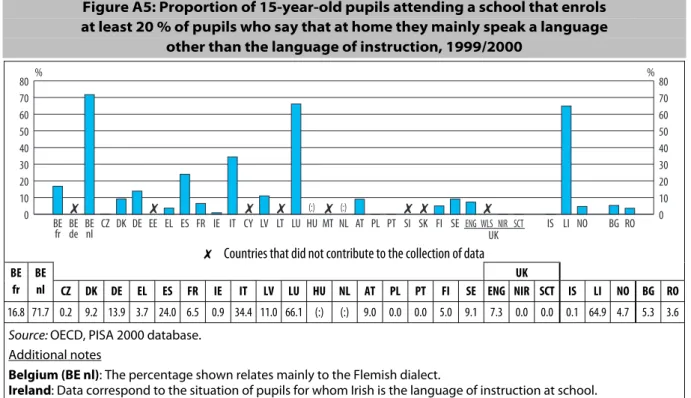
In Europe, some schools have to cater significantly more than others for language diversity in their pupil intake. A large proportion of their pupils speak a language at home other than the language of instruction. Data on this taken from the PISA 2000 database show that countries such as Belgium (Flemish Community), Luxembourg and Liechtenstein face a very complex situation in their schools as far as the languages spoken by their pupils are concerned. The intake at almost all schools in these countries reflects a distinctive pattern of language diversity. In their classrooms and playgrounds, pupils speaking only the language of instruction are in constant contact with those who at home speak another language. The same phenomenon is also apparent to a lesser extent in Belgium (French Community), Spain and Italy.
Figure A5: Proportion of 15-year-old pupils attending a school that enrols at least 20 % of pupils who say that at home they mainly speak a language
other than the language of instruction, 1999/2000
0 10 20 30 40 50 60 70 80 0 10 20 30 40 50 60 70 80 (:) (:) RO BG NO LI IS SCT NIR WLS ENG SE FI SK SI PT PL AT NL MT HU LU LT LV CY IT IE FR ES EL EE DE DK CZ BE nl BE de BE fr UK % %
Countries that did not contribute to the collection of data
BE BE UK
fr nl CZ DK DE EL ES FR IE IT LV LU HU NL AT PL PT FI SE ENG NIR SCT IS LI NO BG RO 16.8 71.7 0.2 9.2 13.9 3.7 24.0 6.5 0.9 34.4 11.0 66.1 (:) (:) 9.0 0.0 0.0 5.0 9.1 7.3 0.0 0.0 0.1 64.9 4.7 5.3 3.6
Source: OECD, PISA 2000 database. Additional notes
Belgium (BE nl): The percentage shown relates mainly to the Flemish dialect.
Ireland: Data correspond to the situation of pupils for whom Irish is the language of instruction at school.
Netherlands: The response rate to the PISA 2000 survey was considered to be too low for purposes of meaningful
comparison. This explains why the data (28.5) are not shown in the Figure. Explanatory note
Language of instruction: Official language of the country used to teach pupils.
A language other than the language of instruction: This category covers the other languages of the country (with or
without official status) and all further languages.
O R G A N I S AT I O N
COMPULSORY LEARNING OF A FOREIGN LANGUAGE STARTS
AT PRIMARY SCHOOL IN MOST EUROPEAN COUNTRIES
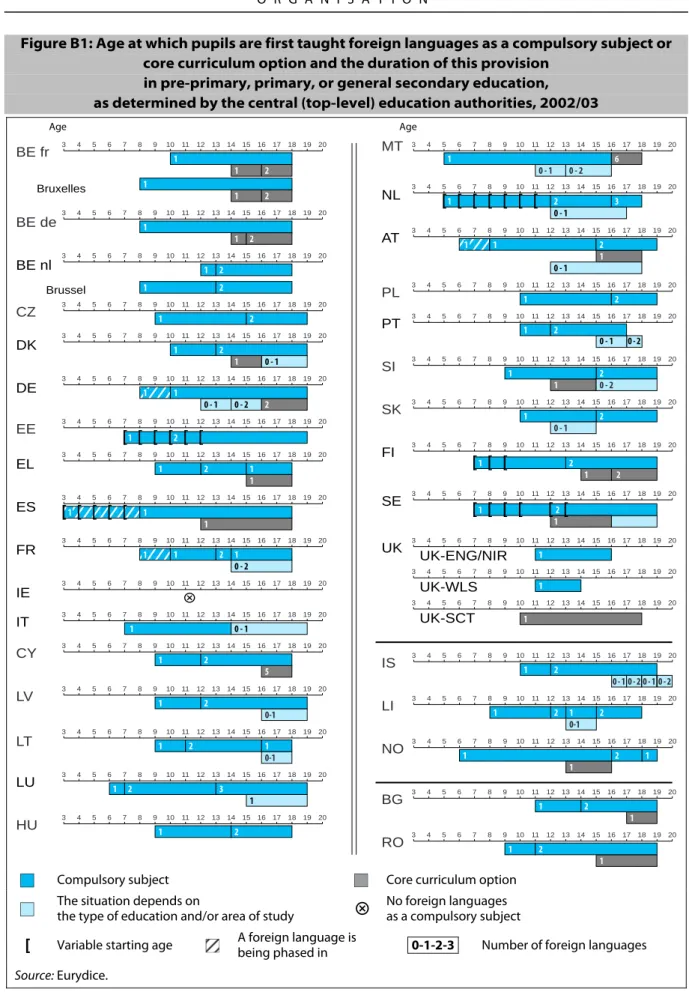
Figures B1 and B2 read in conjunction with each other give an overall view of how the teaching of foreign languages is organised within the minimum level of educational provision. Relating these Figures to the real proportions of pupils engaged in learning foreign languages (Figures C1 to C10) clarifies the picture still further. The investigation is supplemented with information on the percentage of overall taught time devoted to them in the curriculum (Chapter E).
In 2002/03 in all countries except Ireland and the United Kingdom (Scotland), all pupils learnt at least one foreign language as a compulsory subject while at school. In Ireland, all pupils learn Irish and English which are not foreign languages. Depending on requirements, this language learning has to begin in primary education, except in Belgium (the Flemish Community outside the region of Brussels), Slovakia, the United Kingdom and Bulgaria. In these countries, however, language learning does occur in practice at primary level (Figure C4).
In several countries, a foreign language is taught as a compulsory subject from the first year of primary education onwards, or even earlier in some Autonomous Communities in Spain. The Autonomous Communities, along with schools in Estonia, the Netherlands, Finland and Sweden, are to some extent free to determine the year in which the first language is introduced as a compulsory subject. Not all pupils therefore begin language learning as soon as they attend primary school. This has however been the case in Luxembourg, Malta and Norway.
Following reforms in some countries, the situation is rapidly changing. It has become compulsory to learn a foreign language in primary education since 2003/04 in Bulgaria and since 2004/05 in Belgium (the Flemish Community). The point at which this occurs has been brought forward to the age of 9 in Denmark and 8 in Greece. In Belgium (the German-speaking Community), Baden-Wurtemberg in Germany, as well as in Italy and Austria, a foreign language now has to be taught from the first year of primary education onwards. All pupils are obliged to learn a minimum of one foreign language at least up to the end of compulsory education, except in Italy and the United Kingdom (Wales).
Learning two foreign languages is a curricular requirement in general secondary education in all countries of central and eastern Europe, all EFTA/EEA countries, and around 10 countries in the EU-15. These languages are learnt from primary education onwards in just four countries (Estonia, Luxembourg, Sweden and Iceland). In Luxembourg, all pupils learn both French and German from the second year of primary school. Although both have official language status, they are nonetheless regarded as foreign languages in the curriculum. In secondary education in several countries, the central (or top-level) education authorities require that schools include at least one foreign language among their core curriculum options. This arrangement enables each pupil, whatever his or her school, to opt for learning an additional language. It exists for example in Belgium (the French and German-speaking Communities) and Spain, in which secondary education curricula only include one foreign language as a compulsory subject.
Finally, in certain branches of secondary education, the number of compulsory foreign languages or foreign languages as core curriculum options (or both) may be greater than what is required or offered to all pupils at the same time.
Figure B1: Age at which pupils are first taught foreign languages as a compulsory subject or core curriculum option and the duration of this provision
in pre-primary, primary, or general secondary education, as determined by the central (top-level) education authorities, 2002/03
Age Age [ [ [ 0 - 2 [ [ [ [ [ [ [ [ [ [ [ [ [ [ [ [ [ [ [ [ [ [ [ [ 1 1 1 1 2 2 2 1 1 2 1 2 0 - 1 1 2 1 0 - 1 0 - 2 1 2 2 1 1 1 1 5 1 1 1 1 2 1 0 - 2 0 - 1 2 0 - 2 0 - 2 0 - 1 0 - 1 1 2 2 0-1 1 1 1 2 1 1 1 2 1 2 1 2 1 2 1 0-1 2 1 2 1 0-1 1 1 2 0 - 1 0 - 2 6 1 2 1 2 1 1 2 1 2 0 - 2 1 0 - 1 2 1 1 1 1 2 3 1 0 - 1 2 3 1 1 1 1 0 - 1 2 1 1 2 0 - 1 0 - 2 1 2 1 2 1 1 1 1 1 Bruxelles Brussel UK UK-ENG/NIR UK-SCT UK-WLS IT LU NL AT PT FI SE DE EL ES FR IE BE fr BE de BE nl DK IS LI NO BG CZ EE CY LV HU MT PL RO SI SK LT 20 19 18 17 16 15 14 13 12 11 10 9 8 7 6 5 4 3 20 19 18 17 16 15 14 13 12 11 10 9 8 7 6 5 4 3 20 19 18 17 16 15 14 13 12 11 10 9 8 7 6 5 4 3 20 19 18 17 16 15 14 13 12 11 10 9 8 7 6 5 4 3 20 19 18 17 16 15 14 13 12 11 10 9 8 7 6 5 4 3 20 19 18 17 16 15 14 13 12 11 10 9 8 7 6 5 4 3 20 19 18 17 16 15 14 13 12 11 10 9 8 7 6 5 4 3 20 19 18 17 16 15 14 13 12 11 10 9 8 7 6 5 4 3 20 19 18 17 16 15 14 13 12 11 10 9 8 7 6 5 4 3 20 19 18 17 16 15 14 13 12 11 10 9 8 7 6 5 4 3 20 19 18 17 16 15 14 13 12 11 10 9 8 7 6 5 4 3 20 19 18 17 16 15 14 13 12 11 10 9 8 7 6 5 4 3 20 19 18 17 16 15 14 13 12 11 10 9 8 7 6 5 4 3 20 19 18 17 16 15 14 13 12 11 10 9 8 7 6 5 4 3 20 19 18 17 16 15 14 13 12 11 10 9 8 7 6 5 4 3 20 19 18 17 16 15 14 13 12 11 10 9 8 7 6 5 4 3 20 19 18 17 16 15 14 13 12 11 10 9 8 7 6 5 4 3 20 19 18 17 16 15 14 13 12 11 10 9 8 7 6 5 4 3 20 19 18 17 16 15 14 13 12 11 10 9 8 7 6 5 4 3 20 19 18 17 16 15 14 13 12 11 10 9 8 7 6 5 4 3 20 19 18 17 16 15 14 13 12 11 10 9 8 7 6 5 4 3 20 19 18 17 16 15 14 13 12 11 10 9 8 7 6 5 4 3 20 19 18 17 16 15 14 13 12 11 10 9 8 7 6 5 4 3 20 19 18 17 16 15 14 13 12 11 10 9 8 7 6 5 4 3 20 19 18 17 16 15 14 13 12 11 10 9 8 7 6 5 4 3 20 19 18 17 16 15 14 13 12 11 10 9 8 7 6 5 4 3 20 19 18 17 16 15 14 13 12 11 10 9 8 7 6 5 4 3 20 19 18 17 16 15 14 13 12 11 10 9 8 7 6 5 4 3 20 19 18 17 16 15 14 13 12 11 10 9 8 7 6 5 4 3 20 19 18 17 16 15 14 13 12 11 10 9 8 7 6 5 4 3 20 19 18 17 16 15 14 13 12 11 10 9 8 7 6 5 4 3 20 19 18 17 16 15 14 13 12 11 10 9 8 7 6 5 4 3 20 19 18 17 16 15 14 13 12 11 10 9 8 7 6 5 4 3 20 19 18 17 16 15 14 13 12 11 10 9 8 7 6 5 4 3
Compulsory subject Core curriculum option
The situation depends on
the type of education and/or area of study
No foreign languages as a compulsory subject
[
Variable starting age A foreign language isbeing phased in .0-1-2-3. Number of foreign languages
Additional notes
Belgium (BE de): Learning a foreign language has been compulsory from the first year of primary education since September
2004. A recent decree does no more than officially confirm a situation that has existed de facto in virtually all schools for several decades. It also prescribed activities in foreign languages from the age of 3 onwards.
Belgium (BE nl): A decree approved in 2004 makes learning a foreign language compulsory from the age of 10 onwards with
effect from September 2004. Special regulations applicable to Brussels remain unchanged.
Denmark: Since August 2004, it has been compulsory to learn a foreign language from the age of 9.
Germany: In Baden-Wurtemberg, a foreign language from the age of 6 onwards has been compulsory since August 2003.
Greece and Bulgaria: Since 2003/04, a foreign language has been compulsory from the age of 8 onwards.
Spain: According to curricular requirements applicable to the whole country, all pupils have to learn a foreign language from
the age of 8 onwards. Since 2002 in certain Autonomous Communities, they have been able to begin doing so from the age of 3 onwards.
France: New primary education curricula drawn up in 2002 state that a foreign or regional language must be taught from the
final year of nursery school onwards (five-year-olds) with effect from September 2005.
Ireland: The teaching of foreign languages is not compulsory. The official languages of English and Irish are taught to all
pupils.
Italy: Since 2003/04, a foreign language has been included as a compulsory subject from the first year of primary education
onwards. Pupils at a liceo artistico do not learn a foreign language as a compulsory subject unless they enrol in an experimental class, for which the school may make the teaching of a foreign language compulsory.
Cyprus: During the final two years of upper secondary education, pupils may also opt for extra lessons to extend their
knowledge of one of the two languages learnt as a compulsory subject.
Luxembourg: In the classical section, English is started at the age of 14 instead of 13.
Netherlands: Learning a foreign language is compulsory in primary education. In practice, it is taught to pupils between the
ages of 10 and 12.
Austria: Since 2003/04, learning a foreign language has been compulsory from the age of 6 onwards.
Finland: In practice most pupils are first taught a foreign language as a compulsory subject in the third year. The curriculum
for the (upper secondary) lukio/gymnasium does not specify the number of foreign languages schools have to offer, but encourages them to enable pupils to study four.
Sweden: Pupils can deepen their study in English and Swedish instead of learning a second foreign language as a compulsory
subject. Most pupils who chose this option are of foreign mother tongue. In upper secondary education, the number of foreign languages depends on what pupils choose. Syllabuses do not specify the number of languages but simply the credits allocated to them. Pupils may therefore choose to extend their knowledge of a foreign language they have already studied, or to learn one or several other foreign languages.
United Kingdom (ENG): Since September 2004, foreign languages are no longer a compulsory subject for pupils aged from
14 to 16, but schools are still obliged to offer all pupils at least one language.
United Kingdom (SCT): The curriculum is non-statutory. Schools and local authorities are free to interpret and adapt the
guidelines according to the specific context of the school and the community. According to the recommendations of the ministerial action group on languages (2000), foreign language learning should begin by the age of 10 at the latest and last a minimum of six years, or its equivalent in hours (corresponding to around 500 hours).
Iceland: In the case of upper secondary education, schools must teach the minimum number of course units in accordance
with national guidelines, but they may decide how to organise the teaching during any semester or school year.
Norway: Only pupils who have selected a foreign language as one of their core curriculum options between the ages of 13
and 16 do not have to study a foreign language as a compulsory subject when they are aged 18 and 19. Explanatory note
These diagrams deal only with languages described as ‘foreign’ (or ‘modern’) in the curriculum. Regional and/or ancient languages are included solely when the curriculum regards them as alternatives to foreign languages.
Minimum level of educational provision; foreign languages as a compulsory subject; foreign languages as a core
curriculum option; foreign language being phased in: See glossary.
The situation varies with the type of education and/or area of study:Whether the minimum curriculum contains foreign
languages offered as either compulsory subjects or core curriculum options (in addition to those languages that are compulsory or core curriculum options for everyone), depends on the area of study or type of general education concerned.
Number of foreign languages at any one time: The significance of this number varies depending on whether foreign
languages are compulsory subjects or core curriculum options. Where they are compulsory subjects, the number corresponds to the number of languages that pupils must study. Where they are core curriculum options, the number corresponds to the minimum number of languages that schools must include within the entire set of subjects on offer. The scale shown in the bands which indicates that the situation depends on the type of education and/or area of study, corresponds to the minimum and maximum number of foreign languages pupils may study (as compulsory subjects or core curriculum options) in all areas of study or types of education considered as a whole, in addition to those that are studied by everyone. The total number of foreign languages learnt is obtained by adding the one or more languages indicated in the other bands.
Variable starting age: The central education authorities do not stipulate the age at which subjects have to be taught for the
first time, but confine themselves to setting objectives for a given level of education. Schools are thus free to decide when they start to teach a foreign language.
DIFFERENT FORMS OF DECISION-MAKING DELEGATED
TO SCHOOLS MAY INCREASE LANGUAGE TEACHING
In the majority of countries, schools are freely entitled to introduce teaching of an extra foreign language as part of the minimum level of educational provision if they so wish. Where schools decide to do this, all pupils thus either have to learn this further language, or may select it as a core curriculum option. These languages are additional to those covered by centrally specified requirements (see Figure B1).
Figure B2: Scope for schools to provide foreign language teaching within the minimum level of educational provision, in pre-primary, primary and general secondary education, 2002/03
General overview Detailed data
Age 0 2 4 6 8 10 12 14 16 18 20 0 2 4 6 8 10 12 14 16 18 20 RO BG NO LI IS UK-SCT UK-NIR UK-ENG/WLS SE FI SK SI PT PL AT NL MT HU LU LT LV CY IT IE FR ES EL EE DE DK CZ BE nl (Brussel) BE nl BE de BE fr (Bruxelles) BE fr [ [ Age
Foreign language as an alternative No scope for schools to offer provision within the minimum level of educational provision Flexible curriculum
[
Variable starting ageSource: Eurydice. Additional notes
Denmark: The Act on the Folkeskole encourages schools to offer a foreign language as an optional subject for pupils
aged between 14 and 16.
Austria: The Hauptschulen and Allgemeinbildende höhere Schulen may decide to follow the curriculum drawn up by the
Ministry, or their own curriculum in accordance with a framework determined by the Ministry. In the latter case, schools may provide teaching that is more focused on languages.
Poland: The 1999/2000 reform has introduced a certain degree of flexibility into the curriculum for primary and
secondary education in that school heads or management bodies are entitled to increase the minimum amount of teaching time.
Finland: The curriculum for the perusopetus/grundläggande utbildning (compulsory education) encourages schools to
offer a foreign language as an optional subject to pupils aged 10 or 11.
United Kingdom (ENG/WLS/NIR): Schools are expected to develop their whole curriculum beyond the requirements
of the National Curriculum and the Northern Ireland Curriculum (see Figure B1) in accordance with their particular needs
and circumstances. This can mean teaching a foreign language beyond the statutory minimum. There is no compulsory common core curriculum for pupils aged 16-18.