Institute of Architecture of Application Systems University of Stuttgart
Universitätsstraße 38 D–70569 Stuttgart
Master’s Thesis
Securing Cloud Service Archives
for Function and Data Shipping
in Industrial Environments
Muhammad Ali Haider
Course of Study: M.Sc. Computer Science
Examiner: Prof. Dr. Dr. h. c. Frank Leymann Supervisor: Michael Zimmermann, M.Sc.
Commenced: February 1, 2017 Completed: August 1, 2017
Abstract
Cloud Computing paradigm needs a standard for portability, and automated deployment and management of cloud services, to eliminate vendor lock-in and minimization of management efforts respectively. Topology and Orchestration Specification for Cloud Applications (TOSCA) language provides such standard by employing semantics for rep-resentation of components and business processes of a cloud application. Advancements in the fields of Cloud Computing and Internet of Things (IoT) has opened new research areas to support 4th industrial revolution (Industry 4.0), which in turn has resulted in the emergence of smart services. One application of smart services is predictive maintenance, which enables the anticipation of future devices’ states by implementing functions, for example, analytics algorithms, and collecting huge amounts of data from sensors. Considering performance demands and runtime constraints, either the data can be shipped to the function site, called data shipping or the functionality is provi-sioned closely to the data site, called function shipping. However, since this data can contain confidential information, it has to be assured that access to the data is strictly controlled. Although TOSCA already enables defining policies in general, a concrete data security policy approach is missing. Moreover, constituents of TOSCA are packaged in a self-contained and portable archive, called Cloud Service Archive (CSAR), which is also required to be secured and restricted to authorized personals only.
Taking the above facts into account, the goal of this thesis is to refine and enhance the TOSCA standard to the field of smart services in production environments through the usage of policies, for example, being effectively able to define the security aspects. In this thesis, various available policy languages with frameworks supporting them are researched, and their applicability for the field of Industry 4.0 is analyzed. An approach is formulated with one language selected, to define policies for TOSCA compliant cloud applications. Furthermore, a prototype is developed to secure the content of CSAR using the proposed approach.
Contents
1 Introduction 15
2 Fundamentals 19
2.1 Cloud Computing . . . 19
2.2 Topology and Orchestration Specification for Cloud Applications (TOSCA) 20 2.3 Smart Services . . . 25
2.4 Function Shipping versus Data Shipping . . . 26
3 Policy Language Characteristics and Frameworks 27 3.1 Policy Frameworks . . . 27
3.2 Characteristics of Policy Languages . . . 31
4 Shortlisted Policy Languages 37 4.1 TPL/ DTPL . . . 37
4.2 EPAL . . . 40
4.3 XACML . . . 42
4.4 Ponder . . . 45
4.5 WS-Policy . . . 48
5 Policy Based Approach to Secure TOSCA-based Cloud Services 53 5.1 Evaluation of Discussed Policy Languages . . . 53
5.2 Approach to Address Security Requirements of Smart Services . . . 59
6 Prototype to Secure Cloud Service Archives 67 6.1 Technologies . . . 67
6.2 Secure CSAR Use cases and Algorithms . . . 68
7 Conclusion and Future Work 81
List of Figures
2.1 Constructs of TOSCA . . . 21
2.2 Sample CSAR Directory Structure . . . 25
3.1 Trust negotiation through bilateral exchange of digital certificates . . . . 28
3.2 Policy Core Information Model . . . 29
3.3 Overview of Sticky Policy Approach . . . 31
4.1 EPAL Policy Enforcement Model . . . 41
4.2 XACML Context . . . 43
4.3 Policy Implementation in Ponder . . . 46
4.4 WS-Policy assertions intersection example . . . 50
5.1 Correspondence between the decision requests of XACML and EPAL . . . 56
5.2 Correspondence between the elements of XACML and WS-Policy framework 58 5.3 An approach to secure cloud service archives . . . 62
6.1 Encrypt CSAR Service - Algorithm Flowchart . . . 70
6.2 Sign CSAR Service - Algorithm Flowchart . . . 72
6.3 Verify CSAR Service - Algorithm Flowchart . . . 75
List of Tables
4.1 EPAL Rule Example - Protecting a chemical formula . . . 41 5.1 Comparison of Policy Languages with respect to the Defined Characteristics 54 5.2 Possible solutions of smart services security requirements . . . 60
List of Listings
2.1 TOSCA syntax to define an application . . . 23
2.2 Structure of first block of TOSCA meta file . . . 24
2.3 Structure of non-first blocks of TOSCA meta file . . . 24
4.1 TPL simple constraints example - Webservice accessibility to member devices of a trusted manufacturing industry with name "Smart Industry" 38 4.2 TPL external function call example - Challenge-response to prove that the mobile device possesses the corresponding private key . . . 39
4.3 EPAL Syntax Example - Protecting a chemical formula . . . 42
4.4 XACML example - Login to servers in Germany is only allowed between 9AM and 5PM . . . 44
4.5 Ponder example - authorization policy definition [DDLS01] . . . 46
4.6 Ponder example - policy type and instantiation [Slo] . . . 47
4.7 Ponder example - obligation policy definition [Slo] . . . 47
4.8 WS-Policy example - Using compact form expression . . . 49
4.9 WS-Policy example - Using normal form expression . . . 49
4.10 WS-Policy example - Reffering policies using WS-Policy Attachment . . . 49
4.11 WS-Policy schema - Including one policy in another . . . 50
4.12 WS-Policy example - Attaching a policy to a webservice using WS-Policy Attachment . . . 51
5.1 Secure smart service example - X509 Authentication using WS-Policy . . 63
5.2 Secure smart service example - Policy Type definition database encryption for storage (Adopted from [OAS13b]) . . . 63
5.3 Secure smart service example - Policy Template definition database en-cryption for storage (Adopted from [OAS13b]) . . . 64
6.1 CSAR TOSCA.meta file - Encrypted entry . . . 69
6.2 CSAR TOSCA.meta file - Signed entry . . . 73
6.3 CSAR TOSCA.meta file - Signing a CSAR multiple times with different digest algorithms . . . 74
6.4 Signature file (with .SF extension) of a signed CSAR . . . 74
6.5 Secure CSAR Policy Template for Signing and Encryption . . . 78
List of Abbreviations
API Application Program Interface. 19
BPMN Business Process Model and Notation. 20 CA Certificate Authority. 30
CSAR Cloud Service Archive. 3
DMTF Distributed Management Task Force. 28 DTPL Definite Trust Policy Language. 37 EAR Enterprise Application aRchive. 21
EPAL Enterprise Privacy Authorization Language. 39 GUI Graphical User Interface. 65
IaaS Infrastructure as as Service. 19 IETF Internet Engineering Task Force. 28 IoT Internet of Things. 3
JSON JavaScript Object Notation. 67
LDAP Lightweight Directory Access Protocol. 45 MVC Model View Controller. 67
OASIS Organization for the Advancement of Structured Information Standards. 15
PaaS Platform as a Serivce. 19 PAP Policy Authorization Point. 28 PCIM Policy Core Information Model. 28 PDP Policy Decision Point. 28
PEP Policy Enforcement Point. 28
PIP Policy Information Point. 28 PR Policy Repository. 28
QoS Quality-of-Service. 61
REST REpresentational State Transfer. 60 SaaS Software as a Service. 19
SAML Security Assertion Markup Language. 50 SLA Service Level Agreement. 26
SOAP Simple Object Access Protocol. 50 TA Trusted Authority. 29
TOSCA Topology and Orchestration Specification for Cloud Applications. 3
TPL Trust Policy Language. 37
W3C World Wide Web Consortium. 39
WAR Web application ARchive. 67
WSBPEL Web Services Business Process Execution Language. 20
WSDL Web Services Description Language. 51
1 Introduction
Cloud Computing is a paradigm that enables to access computing resources (e.g., net-works, servers, storage, applications, and services) over a network ubiquitously [MG11]. Cloud Computing has revolutionized Information Technology (IT), assisting the idea of IT services being used in the same way we use utility services like electricity, natural gas, water, etc., with supporting different pricing models like pay-per-use [BBKL14]. Cloud-based services can be easily scale-up and scale-down by adjusting services’ de-ployment instances with changing bandwidth requirements. In addition to that, a lot of other benefits of Cloud Computing as well have convinced many businesses to move to the cloud. When enterprises now prefer to use cloud services to create and deploy their application, they find it hard to move from one cloud provider to another cloud provider. Generally, pieces of an application need to be adjusted when migrating to a new cloud provider [SAL15]. This problem is known as vendor lock-in. TOSCA is a standard for Cloud Computing which solves this problem.
TOSCA is a Cloud Computing standard from Organization for the Advancement of Structured Information Standards (OASIS) which enables to create a cloud application, seamlessly manageable across any TOSCA compliant cloud provider. Besides support-ing portability of application between different cloud providers, TOSCA also enables automatic deployment and management of application, and interoperability through the usage of TOSCA service templates. TOSCA achieves this by providing a metamodel to describe the structure and management lifecycle of cloud applications as topologies. The topologies define the components, and relationships between the components of a cloud application. The management plans can also be optionally defined to describe each step of how to achieve what is being defined in the topologies. The plans orchestrate management operations exposed by the components to define management tasks. The files of a TOSCA compliant application are packaged in a self-contained and portable archive, called Cloud Service Archive (CSAR) [OAS13b].
Internet of things (IoT) is a concept that has changed the way we interact with the physical world. IoT has no universally agreed definition but it is safe to say that it is a collaboration of devices (things) embedded with sensors, actuators, and software, over a network (or Internet) with active data exchange [AKN17; WIK17]. The availability of cheap sensors, growing access to high-speed internet, and advancements in the field of
Cloud Computing have promoted IoT to get the attention of many enterprises and have triggered 4thIndustrial Revolution (also called Industry 4.0).
Industry 4.0 is an attempt to augment conventional pieces of machinery to become smart cyber-physical systems [WIKa]. An important use case of the Industry 4.0 is the predictive maintenance of the machinery [FBC+16]. The goal of this idea is to improve production flow of industrial set-up by detecting any potential risk of failure of machines (devices) and adjusting configurations of any machine in the industrial set-up which is not functioning to its fullest. This can be made possible by using smart services which implement functions (e.g, analytics algorithms) and process the data from sensors in the industrial environment. The data could be static as part of smart service, or a reference to live data could be given to the service. The huge amount of metered data has to be analyzed and processed in a timely manner by these functions, to optimize system functioning at runtime. Moreover, this data contains confidential and proprietary information of the industry, employing the smart services. Considering security and runtime issues, for instance, latencies and limited bandwidth, it does not suffice to transfer this data to a central processing system and give a response to trigger actuation. Therefore, two approaches,function shippinganddata shippingare used in this context. In function shipping, functionality is shipped to the data source; and in data shipping, data is transferred to the central execution environment, hosted in-house or in a public cloud environment [FBC+16].
The whole business process goes as follows. Service developer designs and implements a smart service based on TOSCA specifications, and optionally publishes it to public repository or marketplace. Depending on permissions and licenses, another developer can customize the service algorithm according to its specific industry needs. Customers can search and purchase the service from the marketplace or directly from service developer, and use it by deploying it to a TOSCA compliant cloud provider. This raises many points of concerns, particularly regarding integrity and security [FBC+16]. The implementation of the smart services is packaged in CSAR. It is very critical to secure the contents of CSAR from unauthorized access as the logic of algorithm and static data in CSAR can be analyzed and re-engineered to exploit trade secrets of an industry. Moreover, the algorithm is an intellectual property of the developer, and unless granted rights, cannot be reused, manipulated or adopted; hence integrity and security of the contents of CSAR must be maintained. Further, metered data from a production process contains trade secrets and confidential information of an industry, hence transport and persistency of the data must be done in an encrypted way. And there must be a way to define data policies, for example, "the metering data must not leave the IT infrastructure of the customer that will run the smart service" [FBC+16]. Although TOSCA already enables defining policies in general, a concrete data security policy approach is missing [FBC+16].
The agenda of this master’s thesis is to research on available policy languages and their applicability to Industry 4.0, and formulate an approach to fulfill above-mentioned security requirements of smart services. To accomplish this, non-functional requirements of any system based on concepts of Cloud Computing and Industry 4.0 are gathered. A conclusion is drawn that which policy language best suits to define the gathered requirements. If the selected policy language does not satisfy any security requirement, then the possibility to extend the selected policy language or development of new policy language out of it is researched. Concrete use-cases specific to common security requirements are formulated. An approach is outlined to define the security requirements of smart service ecosystem. This thesis also contains a prototype, built to encrypt, sign, verify, and decrypt the CSAR with finalized approach.
This thesis is structured in the following way:
Chapter 2 – Fundamentalsexplains the concepts this thesis is based upon. This includes
a brief outline of concepts of Cloud Computing, detailed explanation of TOSCA standard and its constructs, and overview of smart services. Finally, the approaches of function shipping and data shipping in industrial environments are discussed.
Chapter 3 – Policy Language Characteristics and Frameworksdiscusses the
charac-teristics, defining criteria for policy language selection. Further, some of the popular policy frameworks are explained in this chapter. The research on policy language characteristics and available policy framework are beneficial to shortlist a set of policy languages to base the research of this master’ thesis.
Chapter 4 – Shortlisted Policy Languages analyses various policy languages, their
pros, and shortcomings. The policy languages are shortlisted based on criteria inferred from research work already done and relevance of the policy language to the security domain.
Chapter 5 – Policy Based Approach to Secure TOSCA-based Cloud Servicesdiscusses
the comparisons of researched policy languages. One language is selected which best suits the characteristics defined in Chapter 3 and which is able to cater the security requirements of Industry 4.0 in the best way. In the end, an approach is defined to secure Cloud Service Archives for Function and Data Shipping in Industrial Environment.
Chapter 6 – Prototype explains the details of the prototype, built to secure cloud
service archives for function and data shipping. This chapter starts off with the details on technologies used in the prototype. Then it discusses the use cases of the prototype and the algorithms used to implement the use cases. Finally, a brief guideline of using this prototype is also a part of this chapter.
Chapter 7 – Conclusion and Future Worksummarizes the work done in this thesis and
2 Fundamentals
This chapter explains the fundamentals and concepts, which this thesis is based upon. This includes a brief outline of Cloud Computing and detailed explanation of TOSCA constructs. A basic idea of Internet of Things (IoT), Industry 4.0, and smart services is also included. Finally, this chapter discusses the approaches of function shipping and data shipping in industrial environments.
2.1 Cloud Computing
Cloud Computing is a paradigm shift in Information Technology. For the sake of com-pleteness, the definition of Cloud Computing from National Institute of Standards and Technology (NIST) is stated as it is, as follows:
"Cloud computing is a model for enabling ubiquitous, convenient, on-demand network access to a shared pool of configurable computing resources (e.g., networks, servers, storage, applications, and services) that can be rapidly provisioned and released with minimal management effort or service provider interaction." [MG11]
NIST categorizes Cloud Computing in three service models, including Software as a Service (SaaS), Platform as a Serivce (PaaS), and Infrastructure as as Service (IaaS). Some of the important actors involved in the use of cloud applications are cloud provider (cloud vendors), service provider (cloud consumer), and service consumer. In one line, the service providers create cloud services/ applications, which are hosted on the infrastructure provided by the cloud providers, and consumed by the service consumers. The cloud providers provide different services to service providers (developers) based on the service model of cloud providers. For example, a PaaS cloud provider may provide different database Application Program Interfaces (APIs) to developers to build their applications, facilitating developers to set-up their database online, without having to set up the required infrastructure in-house, thus saving cost and time. A SaaS cloud provider may provide end users with services to manage their documents online so that service consumers do not have to install any software on their personal computers. Similarly,
IaaS cloud providers provide virtual infrastructure like virtual storage, operating systems, etc. which can minimize costly IT maintenance of setting up own infrastructure.
Cloud services are usually comprised of a comprehensive software stack and complex deployment procedures. Businesses keep evolving, and so their needs change. There may be times when current cloud provider cannot fulfill the needs of a business (service provider). In such cases, the service provider may have to migrate to another cloud provider. This requires the service provider to patch, configure, and change parts of their service, costing them time and money. This problem is called as vendor lock-in. TOSCA is a Cloud Computing standard which has solved this problem [Lip13].
2.2 Topology and Orchestration Specification for Cloud
Applications (TOSCA)
When the problem of vendor lock-in was realized, a consortium of cloud vendors created the Cloud Computing standard TOSCA and proposed a new technical committee in OASIS [Lip13]. OASIS is "[...] a global nonprofit consortium that works on the devel-opment, convergence, and adoption of standards for security, Internet of Things, [...]" [WIKb]. TOSCA enables service providers to create cloud provider agnostic applications by defining application topologyandmanagement plans(Orchestration Specification for Cloud Applications).
2.2.1 Constructs of TOSCA Language
The application topology defines the structure of an application using TOSCA language, and the management plans use business process modeling languages like Business Process Model and Notation (BPMN) [MN] and Web Services Business Process Execution Language (WSBPEL) [TC] to define management of the application lifecycle. Figure 2.1 is the bird-view of constructs of TOSCA language.
Application topology defines the structure of a cloud application in terms ofNode Type, Node Template,Relationship Type,Relationship Template,Deployment Artifact, Implemen-tation Artifact,Policy Type, and Policy Template, with the usage of service template. A Node Type defines the structure of a node in terms of properties a node can have, for example, username, password, etc, and management operations, for instance, install, start, stop, etc. The corresponding Node Templates set the value of these properties, hence initializing the topology template. There can be many Node Templates based on a Node Type. The concept of types and templates enable reusability as the same Node
2.2 Topology and Orchestration Specification for Cloud Applications (TOSCA)
Figure 2.1:Constructs of TOSCA [OAS13b]
Type can be used for many templates, even across different cloud applications. The same concept is used forRelationship TypesandRelationship Templates. A Relationship Type with corresponding Relationship Template defines the relationship between two nodes. Relationship Templates are directional, meaning they have a source Node Template and a target Node Template, and they set properties defined by corresponding Relationship Type.
The example Service Template (Listing 2.1), depicting the structure and management lifecycle of a hypothetical payroll application, can be taken to understand the con-stituents of the application topology. The application can be packaged as an En-terprise Application aRchive (EAR), and deployed to an application server, for ex-ample, IBM WebSphere Application Server (a well-known application server). The application server must be installed on an operating system, for example, Ubuntu (a flavor of Linux operating system). In this scenario, the required Node Types may be EAR Application,Application Server, andOperating System, wherePayroll Application, IBM WebSphere Application Server, and Ubuntu Operating System be
the corresponding Node Templates [OAS13b]. The example shows deployed on
Application Server, where the Relationship Template can set any property required for deployment. The corresponding Relationship Type (not shown in the example) declare those properties. This is how TOSCA language defines the structure of an application. The business logic, for example, code, scripts, etc. are defined byDeployment Artifacts. On other handImplementation Artifactssupport the business plan (service orchestration for deployment and management) by implementing management operations exposed by the Node Types.
A Deployment Artifact is associated with a Node Template, and defines the concrete instance of a node. For example, in the above example, Payroll.ear file could be Deployment Artifact associated with the Payroll ApplicationNode Template. Imple-mentation artifacts support management of a node. For example, in the above example, the EAR Application Node Type have an operation start that is implemented by an Implementation Artifactpayrolladm.jar [OAS13b]. Further, Node Templates can have capabilities and requirements which can be defined using TOSCACapability Types and Requirement Types constructs. They are used to find a suitable Node Template fulfilling the requirements of another Node Template, for example, memory, bandwidth, version, etc. In the discussed example,IBM WebSphere Application ServerNode Template can define requirements in its definition that the node can only be installed on the Linux operating system.
TOSCA language also enables defining policies for a Node Type usingPolicy Typeand Policy Template. Policy Type defines the place holders for policy properties using XML schema. Policy Templates define the actual values of the properties. For example, in the above example, theApplication Server Node type may have "high availability" policy with heartbeat frequency" count defined by a Policy Type, whose actual value is set by the corresponding Policy Template, keeping the Application Server up and running with high availability [OAS13b].
Service Template file can refer to constructs of TOSCA from other TOSCA definition files as well. For example in the Listing 2.1, the corresponding Node Types and Relationship Types are being referred from another TOSCA definition document,PayrollTypes.tosca. Artifacts can be referred even from other CSARs, for example, Deployment artifact Payroll.earis being referenced from another CSAR in Listing 2.1.
2.2.2 Cloud Service Archive (CSAR)
All the files related to application topology, for example, schemas, templates, types, definitions, binary files, and business process related files, are packaged in a ZIP file (with extension ".csar") known as Cloud Service Archive (CSAR). The CSAR follow a standard format which enables it to get deployed in any TOSCA compliant cloud provider, hence
2.2 Topology and Orchestration Specification for Cloud Applications (TOSCA)
Listing 2.1 TOSCA syntax to define an application (adopted from [OAS13b, p.77-78])
1 <?xml version="1.0" encoding="UTF-8"?>
2 <Definitions xmlns:pay="http://www.example.com/tosca/Types" id="PayrollDefinitions" targetNamespace="http://www.example.com/tosca">
3 <Import namespace="http://www.example.com/tosca/Types"
location="http://www.example.com/tosca/Types/PayrollTypes.tosca" importType=" http://docs.oasis-open.org/tosca/ns/2011/12" />
4 <Types>...</Types>
5 <ServiceTemplate id="Payroll" name="Payroll Service Template"> 6 <TopologyTemplate ID="PayrollTemplate">
7 <NodeTemplate id="Payroll Application" type="pay:EAR Application"> 8 ...
9 <DeploymentArtifacts>
10 <DeploymentArtifact name="PayrollEAR" type="http://www.example.com/ ns/tosca/2011/12/ DeploymentArtifactTypes/CSARref">EARs/Payroll.ear</DeploymentArtifact> 11 </DeploymentArtifacts> 12 ... 13 <!-- ImplementationArtifacts --> 14 ... 15 </NodeTemplate>
16 <NodeTemplate id="IBM WebSphere Application Server" type="pay:Application Server"> 17 <DeploymentArtifacts>
18 <DeploymentArtifact name="IBMWebSphereAS" type="http://www.example.com/ ns/tosca/2011/12/ DeploymentArtifactTypes/WebSphereASref">ibm-websphere-edf2cf99</DeploymentArtifact> 19 </DeploymentArtifacts>
20 </NodeTemplate> 21 ...
22 <!-- Linux Operating System node template --> 23 ...
24 <RelationshipTemplate id="deployed_on" type="pay:deployed_on"> 25 <SourceElement ref="Payroll Application" />
26 <TargetElement ref="IBM WebSphere Application Server" /> 27 </RelationshipTemplate>
28 </TopologyTemplate> 29 </ServiceTemplate> 30 </Definitions>
enabling portability. The CSAR contains at least two directories, theTOSCA-Metadata directory and the Definitions directory. Apart from these two directories, the creator of CSAR can have any structure in CSAR; what suits best for the cloud application modularity.
The TOSCA-Metadata directory essentially has a TOSCA meta file,TOSCA.metawhich is consisted of name/value pairs. A name/value pair is separated by a colon and followed by a space. The name must not have any colons in it. Each name/value pair is on a new line. Related name/value pairs are separated by an empty line. The consecutive
Listing 2.2 Structure of first block of TOSCA meta file [OAS13b, p.75] 1 TOSCA-Meta-File-Version: digit.digit
2 CSAR-Version: digit.digit 3 Created-By: string
4 Entry-Definitions: string ?
Listing 2.3 Structure of non-first blocks of TOSCA meta file [OAS13b, p.76]
1 Name: <path-name_1> 2 Content-Type: type_1/subtype_1 3 <name_11>: <value_11> 4 <name_12>: <value_12> 5 ... 6 <name_1n>: <value_1n> 7 8 ... 9 10 Name: <path-name_k> 11 Content-Type: type_k/subtype_k 12 <name_k1>: <value_k1> 13 <name_k2>: <value_k2> 14 ... 15 <name_km>: <value_km>
name/value pairs are called as block. Each block describes an artifact in CSAR. The first block represents the CSAR itself [OAS13b]. The content of the first block in the TOSCA meta file is shown in Listing 2.2.
Each block except the first block has the first name/value pair, with key name "Name", referring to the path of the artifact within CSAR (relative to CSAR). Each non-first block of TOSCA meta file also have a key Content-Typewhich tells about the MIME type of the referred artifact. The structure of non-first blocks of TOSCA meta file is shown in Listing 2.3.
Figure 2.2 illustrates the content of CSAR for the example payroll application that we discussed in the previous section.
Having discussed all the constructs of TOSCA standard, it is important to realize that TOSCA only presents a grammar for describing cloud applications by means of topology templates and business plans [OAS13b]. TOSCA needs a runtime to deploy and manage instances of cloud application as defined in the Service Template of CSAR. "Without such a container, TOSCA could be used as pure exchange format and manually operated according to the definitions in the Service Template" [BBKL14].
2.3 Smart Services Payroll-Application.csar /TOSCA-Metadata TOSCA.meta /Definitions Payroll.tosca PayrollTypes.tosca /Plans AddUser.bpmn /EARs Payroll.ear /JARs Payrolladm.jar /Python wsadmin.py
Figure 2.2: Sample CSAR Directory Structure [OAS13b, p.78]
2.3 Smart Services
Devices (Things) embedded with electronics, for example, sensors and actuators, etc. are interconnected with the usage of a shared platform, such as cloud services, to perform functions adaptively, on their own, or with the input from the physical world [AKN17]. Industry 4.0 is inspired from the concepts of IoT. Four design principals of Industry 4.0 as mentioned on [WIKa] are Interoperability, Information transparency, Technical assistance, and Decentralized decisions. Interoperability means the ability of devices, sensors, machines, actuators, and humans to connect with each other via Internet of Things (IoT). Information transparency is the ability of the system to create a virtual copy of the physical model by aggregating data from all the devices and sensors in the industrial environment. Technical assistance design principals mean that the system should update the users about the status of the industrial environment so that the users can take decisions effectively. The last design principal of Industry 4.0, Decentralized decisions enables the system to take decisions on its own. Only if there is a conflict in decisions, request for decision is delegated to humans.[WIKa]
In general, a smart service is just a smart (web) service with provided awareness of context, makes it "reactiveor even proactive" [AL05]. In the context of Industry 4.0, one application of the smart services is predictive maintenance of the devices in an industrial environment. The idea is that all the mounted sensors send data to the smart service. The smart service based on the metered data, categorize a device as good or bad. Good means that the device is functioning correctly and bad means that the device is not functioning correctly and needs to be replaced or re-configured.
Considering the advantages of Cloud Computing and TOSCA standard, as discussed in the previous sections, the smart services are deployed in a TOSCA compliant cloud provider. Hence they are packaged as CSAR. The business process is that a data scientist (service developer) develops an analytics algorithm and put it in CSAR. Apart from the algorithm, CSAR may have static data, for example, if the analytics algorithm needs some data that does not change over time, and reference to the data source of sensors. Further, policies to manage the smart service, for example, a security policy stating that metering data must not leave the industrial environment, is also part of the CSAR. The two approaches to incorporate a smart service in an industrial environment arefunction shippingand data shipping[FBC+16].
2.4 Function Shipping versus Data Shipping
Function Shipping and Data Shipping are two approaches that are used for incorporating Smart Services in industrial environments. In general, function shipping means that the function, for example, analytics algorithm is provisioned close to a data source. On other hand, in data shipping, data from the data source is provisioned to the function. In the function shipping approach, data ownership is more in control as the data never leaves the environment where it is created. Further, function shipping enables to perform parallel processing in a timely manner. This is because, in real-time systems, the existence of high latency hinders transport of data (request), and command to actuators (response) in a parallel manner [FBC+16].
But sometimes, processing of metered data from sensors require a powerful processing environment. Thus, insufficient IT infrastructure close to the data source requires shipping and aggregation of data from sensors to a centralized location. This is also the case when the purpose of use-case is only to analyze the data and not real time processing. But this approach is only suitable if the industry does not have security constraints on their data, and the industry can afford to have their data leave their premises. In such cases, the smart service is deployed in self-hosted or public TOSCA compliant cloud infrastructure. It totally depends on the use-case requirements, and Service Level Agreements (SLAs), that which approach is used [FBC+16].
3 Policy Language Characteristics and
Frameworks
This chapter discusses some of the existing frameworks for policy negotiation between different parties. It also reviews the characteristics of policy languages, some of which may count for the goodness of a policy language. The research in this chapter is beneficial to shortlist a set of policy languages to base the research of this master thesis.
3.1 Policy Frameworks
Although the purpose of this thesis is to research on available policy languages, the reason of discussing policy frameworks is that the policy languages need a policy framework to work with.
3.1.1 Trust Negotiation Model
The first framework worth considering is proposed by Seamons et al. [SWY+]; even though the work was done in 2002, but their research is still considered valuable and forms the basis of a lot of researches in policy languages. Their work was mainly about the requirements for the policy languages, but they also introduced a model based on which a trust negotiation between two parties can be made. Figure 3.1 illustrates main components of Trust Negotiation Model. It is a very basic model to exchange policies, with the consideration that policies themselves are confidential as well. The model is peer-to-peer, which means that both parties hold sensitive resources, policies, and credentials.
Trust negotiation is initiated when a client wants to access a secret resource on a server. The server demands credentials from the client to access that resource, by using policies. The client cannot give the credentials straight away to the server. Thus, before establishing trust, the client may also require the server to provide, for example, a digital
Client Nego�a�on Manager Compliance Checker Server Nego�a�on Manager Compliance Checker Secret resources
Secret creden�als Secret policies
Secret resources Secret creden�als
Secret policies Request for a secret resource
Disclose star�ng creden�al (possibly digital cer�ficate) Disclose subset of policies (requiring creden�als) Disclose subset of creden�als (applicable to current nego�a�on) Grant access to requested resource
only if valid creden�als
Figure 3.1: Trust negotiation through bilateral exchange of digital certificates [SWY+]
certificate, certifying the server to be a part of a trusted organization. So besides the initial policy, the server must also give a starting credential to the client [SWY+]. The policies themselves are confidential as well because by viewing requirements speci-fied in a policy, sensitive information about a party could be inferred. Considering this, the exchange of such policies happen in round-trips comprising a set of negotiations. Each negotiation only exposes a subset of policies. If both parties satisfy each other policy requirements, access to the secret resource is granted to the client [SWY+]. Negotiations are managed by a negotiation manager. The manager is responsible for regulating a strategy which determines "which credentials and policies to disclose, and when to disclosed them" [SWY+]. The manager is assisted by acompliane checkerwhich analyze whether the credentials against the policies under the current negotiation are satisfied or not. Based on the decision from compliance checker about an assertion of access control policies, negotiation manager could grant or reject access to the secret resource, or proceed with further negotiations [SWY+].
3.1 Policy Frameworks PDP PEP PR PAP Restore Retrieve Response PIP Fetch Event Request Ac�on
Figure 3.2:Policy Core Information Model (adopted from [HL12])
3.1.2 Policy Core Information Model
Policy Core Information Model (PCIM) was developed jointly by Internet Engineering Task Force (IETF) and Distributed Management Task Force (DMTF). It consists of three pivotal components: Policy Repository (PR), Policy Decision Point (PDP), and Policy Enforcement Point (PEP) [HL12]. There are two other components which have been repeatedly proposed and incorporated by policy language standards: Policy Authoriza-tion Point (PAP) and Policy InformaAuthoriza-tion Point (PIP). This should be noted that these two components are not part of actual IETF standard. But, their use makes a lot of purpose in the PCIM. Figure 3.2 illustrates how the components of PCIM fit in a policy-driven management system.
The PAP provides an interface to define, update, or delete policies. The policies are stored in the PR. The PEP keeps polling for any request or event to the system, and forward all the requests to the PDP. The PDP looks into PR for all the applicable policies and makes decisions likepermit,deny, andNotApplicable, and give a response back to PEP. While making the decision, PDP may interact with PIP (systems like LDAP, database, web service, etc.), to fetch request detailed attributes. Finally, PEP takes the concrete action based on the decision made by the PDP [HL12].
3.1.3 Sticky Policies
Sticky policies is an approach as part of EnCoRe project [HP] to manage the privacy of data across multiple parties. By party, it means the organizations or service providers which need confidential data from the users for processing. The data is made available to parties with the consent of the users. The consents are defined in terms of machine-readable policies. The data is encrypted and attached to the policies, as the data travels across multiple parties [PM11]. The data could comprise anything but the
approach sticky policies was designed with motivation to protect Personally Identifiable Information (PII), for example, name, date of birth, address, phone number, credit card number, password, etc. The attached policies define how the data needs to be treated, including constraints, conditions, or compliance with standards. The policies also contain a list of Trusted Authorities (TAs) which provide keys to decrypt the data on the satisfaction of the policies [PM11].
Figure 3.3 illustrates the basic idea behind the management of sticky policies. Organi-zations which incorporate sticky policy framework publishes lists of supported policies and TAs. The data subject (data owner) encrypts the subset of the data which needs to be protected. Policies are created by the data subject and TAs are added to the policies. Finally, the created policies are defined on that data subset. The policy could include preferences like data should be deleted after 2 years of use, or data should not be made accessible to particular parties, etc. The data subject then includes a list of TAs which can be requested for the key to decrypt the data. The data subject may also encrypt different subsets of data with different keys. The system then sends the encrypted data with the sticky policies to the service provider. After receiving the encrypted data and sticky policies, the service provider sends the sticky policies to one of the listed TAs, with the assertion that it complies with the sticky policies. The TA can confirm this assurance from the service provider with methods, for example, verifying digital certificates from trusted Certificate Authorities (CAs) that the service provider may hold, or by verifying the absence of the service provider from a known blacklist, or verifying from an external reputation management system. The verification actions are logged by the TA, which creates an audit trail made available to the data owner and the TA in cases, for example, policy violation. Once the TA verifies all the policy requirements, the key to decrypt the data is released to the service provider [PM11].
Sticky policy approach does not have any fixed underlying encryption mechanism to protect data, though [PM11] suggests a public-key encryption technique to secure propagation of data along the service provision chain. This technique assumes that all stakeholders (data subject, service provider, and TA) possess certified public or private key pairs from trusted CAs. In this technique, data owner generates the policy, together with a symmetric key K. Data owner sends two items to service provider: (1) Data encrypted with K, (2) Sticky policy, having K appended to the policy’s hash, with K and hash encrypted with TA’s public key and signed with the data owner’s private key. The signing makes it possible to verify the policy’s authenticity and integrity. When the service provider receives the sticky policy with the encrypted data, it sends the sticky policy which contains encrypted K and policy hash, to one of the TAs. The TA decrypts K and policy hash, verifies the policy’s signature with data owner’s public key, and challenges the service provider for fulfillment of the policy. If all the verification steps get passed, TA sends K to the service provider by encrypting it with the service
3.2 Characteristics of Policy Languages
Organiza�on 1
Organiza�on 2 Organiza�on 3
Organiza�on 4
Trusted Authority (TA) Data subject Data Storage S�cky Policy Decrypted Data Business Applica�ons Data Storage Data Storage Data Storage Data Storage
Policy analysis, key release, and audi�ng Encrypted data + S�cky
policy
Encrypted data + S�cky policy
Disclosure of keys to decrypt data
�Request for keys to decrypt data
�S�cky Policy
Business Applica�ons Business ApplicaBusiness �ons
Applica�ons Business Applica�ons Business Applica�ons Business Applica�ons
Figure 3.3:Overview of Sticky Policy Approach [PM11]
provider’s public key. The service provider can then decrypt K with its private key and in turn decrypt the data using K [PM11].
3.2 Characteristics of Policy Languages
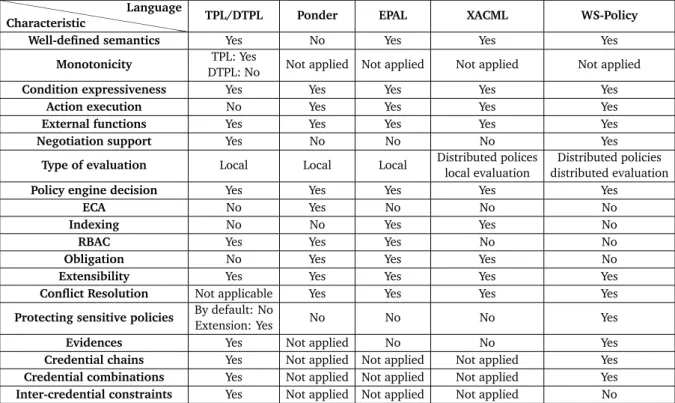
Seamons et al., 2002 [SWY+] presented requirements for a policy language in their work on the trust negotiation model. To date, a lot of advancements have been done in the field of policy languages, and dynamics of information technology have changed. But the work of Seamons et al. is still considered valuable. Duma et al., 2007 [DHS07] and Coi et al., 2008 [CO08] referred to [SWY+] for their work on the scenario based comparison of policy languages, and review of security policy languages respectively. Policy properties included in this section have been taken from [SWY+], [CO08], [DHS07], and [HL12]. The properties should only be considered as general characteristics of policy languages, and are not necessarily the criteria for a policy language to qualify for goodness. First fifteen characteristics are general language features and last four are related to credential support.
Well-defined semantics. A policy language semantics are well defined if its constructs are not implementation specific, for example, relational algebra is not implementation specific but SQL is. A language having this quality allows to confidently infer something from it, irrespective of how and when the language is used [CO08; SWY+].
Monotonicity. A policy language should be monotonic, which means the disclosure
of more policies or more credentials should only give more privileges or access rights to the requester. For example, an insurance company ABC issues ABC credentialsto its clients certifying them to be part of the insurance company. If a health care club web-service should not be accessible to the clients of ABC, imagine a policy language that grants access to the health care club web-service as long as theABC credentialsare not disclosed. From this case, it does not mean that negation of credentials should not be allowed, it only means that a policy language should allow policy writers to define the absence of credentials. Further, the monotonicity requirement does not prevent the use of inequality constraints or temporal predicates, for example, access to the health care club web-service should only be made between 06:00 and 21:00 [CO08; SWY+].
Condition expressivenessmeans expressiveness of a policy language in defining
condi-tions under which a request should be fulfilled. Policy languages differ in expressiveness: Many policy languages allow to add constraints on attributes of requesters, values of credentials, or properties of the requested action. Some policy languages enable to define pre-conditions for a request to be considered. Further, some policy languages even allow to add constraints on environmental factors (for example, time), and a few also support the notion ofpurposein the requests [CO08; SWY+].
Action executionis the ability of a policy language to execute an action during
evalua-tion of a policy. For example, being able to get system current time and send it with the response of the evaluation. Some policies also enable executing an action depending on the outcome of an evaluation, for example, sending an email to a customer if his discount gets approved [CO08].
External functions. Some policy languages come with a library of functions, for
exam-ple, date comparisons, time formatting, currency conversions, etc. The well-defined semantics of these functions enable the involved parties to agree on the same outcome of an evaluation of the policy [SWY+].
Negotiation support. Negotiation takes place when a request is initiated with the
consideration of multiple policies individually defined by the parties involved in the negotiation, and evaluation of the request is done in a distributed way. The important point here is that not only the party offering a service has a policy, but also the party requesting for a service also have a policy. Policy evaluation is successful if both of the parties satisfy each other’s policy requirements. For example, in the case of the sticky
3.2 Characteristics of Policy Languages
policy approach that we discussed in the previous section, policy language ought to have this characteristic [CO08].
Type of evaluation.Those policy languages which support negotiation between multiple
parties, perform the evaluation of policies in a distributed way. Each involved party evaluates a policy step by step, and advance the negotiation. This type is named as distributed evaluation. Some languages enable their runtime to break a policy on several nodes. Each node can further split the policy or return the evaluation result to the peer who sent the policy for evaluation. Finally, the root node could accumulate the results from each node, evaluate all the responses, and return the final result. This type of evaluation is called as distributed policies. The policy languages which do not offer negotiations, perform all their evaluations locally, hence the name local evaluation [CO08].
Policy engine decision. Policy language semantics should enable the policy engine to
notify requester about the policy evaluation. This could be made possible by, for example, having a detailed policy response structure. The result sent back to the requester may consists of simple boolean value true/false, or values likeallow,deny, anddon’t care, or detailed reasons, for instance, why the evaluation of the policy got failed [CO08]. ECA. This refers toEvent,Condition,Action paradigm. It is recommended that a policy language is based on ECA paradigm because this paradigm enables a policy language to handle more complex events, for example, asynchronous event calls, or composite policies. If a policy language is not based on ECA paradigm, then it follows Condition-Actionway of evaluating policies [HL12].
Indexing. This characteristic allows a policy language to create indexes on entities
of policy languages, for example, subject, resources, etc. Normally, there are a lot of policies in a system, and at runtime, there is the need for a policy engine to quickly access the required policy for evaluation. Indexes enable a policy engine to retrieve the required policy more efficiently [HL12].
RBAC stands for Role-Based Access Control. The policy languages which have this characteristic, perform policy evaluation by mapping subjects (for example, users, machines, etc.) to roles. Then, the roles are given permissions, and access control is calculated. It is good for a policy language to have this characteristic as it is easier to manage access control policies based on roles, rather than individual subjects. Also, the access permissions of a subject automatically change with role changes [HL12].
Obligationmeans that apart from performing an action based on a condition, perform
another task. This task can be, for example, log the request, email the requester, start a scheduler, etc. The policy languages having this characteristic are able to produce a side effect based on a policy evaluation [HL12].
Extensibilityis the ability of a policy language to facilitate extensions. A policy language should be extensible with new features, and customizable for a specific system needs [CO08].
Conflict Resolution is the ability of a policy language to resolve the conflicts if two
policies are satisfied but both are contradictory, for example, one policy grants access to a web service call and the other denies the access. The policy engine cannot take both of the actions. In such cases, there must be some way in the language itself to resolve the conflicts and choose one action.
Protecting sensitive policies. A policy itself may also be confidential. For instance, if
the policy protecting a person’s medical record requires that the requester of the medical record must submit a certificate issued by a mental health organization, it could be inferred that the person may have some mental health problem. So during evaluation of policies, it should be able to protect such sensitive information either at policy syntax level or using the policy engine. For example, the policy engine could disclose sensitive policies only when required, or the policy content is encrypted, which can be decrypted with external function calls [SWY+].
Evidences. It should be able to specify signed statements (credentials) in a policy
language and should be able to specify authentication requirements by means of external function calls or as part of policy language itself. For example, a student discount system must be able to authenticate that a customer indeed is the student mentioned in the student digital ID credential. There should be a mechanism to confirm a credential ownership by, for example, being able to refer to the private key associated with a public key referred to in a credential [CO08; SWY+].
Credential chains. A policy language should allow to construct and constrain a chain
of credentials. This means that a policy language should be expressive enough to verify that the issuer name in one of the credential is the subject name of the next credential in a credential chain [SWY+].
Credential combinations. Many times, in order to establish trust, it is required to
prove authenticity using multiple credentials from different trusted authorities. For example, a health care service may require student certificate and insurance certificate to offer a particular discount. This also ensures greater credibility because an attacker would have to fabricate several private/public key pairs before being able to get illegal access. So, policy language having this characteristic enable the policy writers to specify combinations of credentials using a conjunction, disjunction or other semantics [SWY+].
Inter-credential constraints. If two certificates are issued to the same subject, it is very
likely that subject name is same in both of the certificates. For example, if a health care service may require student certificate and insurance certificate from a customer, then
3.2 Characteristics of Policy Languages
the policy language should allow adding a constraint that subject name on both of the certificates is same or at least close enough [SWY+].
Based on the discussion included in this chapter, different policy languages are short-listed and will be discussed in the next chapter. In the later chapters, the discussed policy languages and their compliant frameworks will be compared, based on which an approach will be defined to secure applications of Industry 4.0, particularly smart services deployed in TOSCA runtime.
4 Shortlisted Policy Languages
The languages considered for this thesis are TPL/ DTPL, XACML, EPAL, X-Sec, Rei, PSPL, KeyNote, P3P/ APPEL, ASL, VALID, PDL, PFDL, WS-Policy, and Ponder. The languages are considered based on their popularity. Only the prominent features and the domain in which the considered policy languages deal in, are briefly researched. Out of these 14 policy languages, 5 policy languages are shortlisted for the detailed research due to their closeness with the security domain and applicability for the field of Industry 4.0. Further, the general characteristics defined in the previous section are also considered while selecting the policy languages.
4.1 TPL/ DTPL
Trust Policy Language (TPL) [IBM] created by IBM Research centre is an XML based policy language which maps requesters togroups/rolesbased on the certificates they possess. The terms roles and groups are used in the language interchangeably. Definite Trust Policy Language (DTPL) is the subset of TPL which does not contain negative rules and hence is monotonic. The constructs of TPL are as follow.
The root of TPL is POLICY tag. The POLICY tag may contain one or more GROUP tags. Membership of the group is determined by multiple RULE tags. The RULE tag expresses constraints on a certificate using a sequence of INCLUSION and EXCLUSION tags and an optional FUNCTION tag. The INCLUSION tag adds basic constraints on existence of a certificate, for example,typeandissuer. Similarly, the EXCLUSION tag adds basic constraints on the nonexistence of a certificate. Both INCLUSION and EXCLUSION tags have an attribute ID, which is used to refer the certificate associated with the RULE tag. The scope of ID attribute is only limited to the RULE tag. The FUNCTION tag is used to express complex constraints on a certificate by using TPL logical constructs like AND, OR, NOT, EQ, GE, etc. TPL expresses the reference to a field in a certificate using FIELD tag. The FIELD tag consists of two attributes: (1) ID attribute, which refers to INCLUSION or EXCLUSION ID (a unique id of the certificate where the field appears), (2) NAME attribute which refers to the name of a field in the certificate. TPL enables external function calls using EXTERN tag. The FIELD and EXTERN tags could come inside TPL
Listing 4.1TPL simple constraints example - Webservice accessibility to member devices of a trusted manufacturing industry with name "Smart Industry"
1 <?xml version="1.0"?> 2 <POLICY>
3 <GROUP NAME="self"></GROUP> 4 <GROUP NAME="industries">
5 <RULE>
6 <INCLUSION ID="indCrt" TYPE="memberIndustry" FROM="self"></INCLUSION>
7 </RULE>
8 </GROUP>
9 <GROUP NAME="mobileDevices">
10 <!-- device identification from an industry -->
11 <RULE>
12 <INCLUSION ID="deviceCrt" TYPE="DeviceID" FROM="industries"></INCLUSION>
13 <FUNCTION>
14 <EQ>
15 <FIELD ID="deviceCrt" NAME="Industry Name"></FIELD> 16 <CONST>"Smart Industry"</CONST> 17 </EQ> 18 </FUNCTION> 19 </RULE> 20 </GROUP> 21 </POLICY>
logical construct tags. Listing 4.1 is the TPL snippet, defining policy requirements for accessibility of a web service only for mobile devices possessing a certificate issued by a particular trusted manufacturing industry with name "Smart Industry" [SWY+].
As can be seen in Listing 4.1, TPL has well-defined semantics. A special group, ’self’ group refers to the self public key. The FROM attribute in INCLUSION and EXCLUSION tags refers to the name of a group. Only certificates signed by a member in that group should be eligible to evaluate the function in INCLUSION or EXCLUSION; this enables TPL to verifycredential chains. The CONST tag allows TPL to express a comparison for the value of a field in a certificate with a constant value. The ability of TPL to express external function calls enable it to specify complex constraints, evaluate Inter-credential constraints, and allows requester to specify evidences. The ability of TPL to execute external functions can be used to develop a library of standard functions. One function could becheckStrongAuthentication, which at the time of role mapping evaluation decrypt some data. The function should be provided with certificate public key in the input, and the data to decrypt could be provided from within function call itself. For example, Listing 4.1 can be extended to decrypt some data as shown in Listing 4.2. Invoking this function would trigger a challenge-response to prove that the mobile device possesses the corresponding private key [SWY+].
4.1 TPL/ DTPL
Listing 4.2 TPL external function call example - Challenge-response to prove that the
mobile device possesses the corresponding private key 1 <?xml version="1.0"?>
2 <POLICY>
3 <GROUP NAME="self"></GROUP> 4 <GROUP NAME="industries">
5 <RULE>
6 <INCLUSION ID="indCrt" TYPE="memberIndustry" FROM="self"></INCLUSION>
7 </RULE>
8 </GROUP>
9 <GROUP NAME="mobileDevices">
10 <RULE>
11 <INCLUSION ID="deviceCrt" TYPE="DeviceID" FROM="industries"></INCLUSION>
12 <FUNCTION>
13 <AND>
14 <EQ>
15 <FIELD ID="deviceCrt" NAME="Industry Name"></FIELD>
16 <CONST>"Smart Industry"</CONST>
17 </EQ>
18 <EXTERN CLASS="checkStrongAuthentication">
19 <PARAM NAME="publicKey">
20 <FIELD ID="deviceCrt" NAME="publicKey"/>
21 </PARAM> 22 </EXTERN> 23 </AND> 24 </FUNCTION> 25 </RULE> 26 </GROUP> 27 </POLICY>
In Listing 4.2, to make the external call possible, a class must be created that implements thecheckStrongAuthenticationinterface. The name of the class should match the value of the CLASS attribute in the EXTERN tag.
TPL does not support sensitive policies but Seamons et al. [SY01] have proposed a way to protect sensitive policies by using the policy graphs. Formally, the policy graph is a directed acyclic graph with exactly one node and sink. Every node except the sink represents a policy. The sink represents the resource to be protected. A policy node n should only be disclosed if the outcome of all the policy nodes in the path to n (except policy node n itself) have been satisfied by the credential [SWY+].
4.2 EPAL
Enterprise Privacy Authorization Language (EPAL) is an XML-based language proposed by IBM, and was submitted to World Wide Web Consortium (W3C) in 2003 for consider-ation as a standard [HKPS03], but has not been approved yet. EPAL addresses security issues of enterprise applications in a structured and interoperable manner. It is based on Policy Core Information Model that we discussed in the previous chapter. An EPAL policy expresses applications privacy by defining the following constructs: data-categories, user-categories,conditions,purposes, sets of (privacy)actions, and obligations.
Data-categories define the data to be protected, for example, medical record, chemical formula, etc. User-categories (users/ groups) are the entities which collect the data, for example, health researcher, chemical composition analyst, etc. Conditions consist of boolean expressions to expresses constraints on the Data-categories. The purposes define the intended use of the data, for instance, marketing, auditing, processing, analysis, etc. Actions tell how the data is used, for example, disclose, store, read, etc. Obligations model actions that should be taken by EPAL engine when interacting with the data, for instance, delete the data 1 week after using, or ask for consent from the data holder, etc.
The elements defined above are used to formulaterulesto establish access control. The outcome of policy could be one ofallow,deny,Not-applicable. Not-applicable means that the formulated policy does not care if the user-category should be allowed or disallowed to perform the specified action on the data-category for certain purpose while enforcing particular conditions. Figure 4.1 illustrates EPAL policy enforcement model.
EPAL has a strict but very generic XML schema. Hence, EPAL has well-defined semantics. The root element of EPAL isepal-vocabularytag which hasuser-category,date-category, action, purpose, container, and obligation. It is possible that the rules conflict with each other. EPAL vocabulary allows to resolve such conflicts by for example, assigning precedence to a particular rule over others, etc. Table 4.1 shows an example of how a policy can be mapped to the elements of EPAL Rule.
The corrosponding EPAL syntax for EPAL Rule shown in Table 4.1 is presented in Listing 4.3. It must be noted that the individual elements, for example data-category, data-user, etc. need to be defined in epal-vocabulary. Separating rule def-inition from epal-vocabulary provides modularity. There can be a sequence of one or more <user-category>, <data-category>, <purpose>, and <action> elements in <epal-query>.
Constructs and vocabulary of EPAL are very abstract. It does not enforce how different elements need to be implemented, for example, how an action is triggered when the policy rule is evaluated, or how to call an application which is implementing a
4.2 EPAL
Policy Administrators Applica�ons
Policies Obliga�ons NoAudit�fy Permit ... Access Control Deny Data/Resources �Files �Equipment �Databases
�Other applica�ons
�...
Figure 4.1:EPAL Policy Enforcement Model [And04]
Policy Rule Allow a chemical researcher or chemical engineer to collect a
product formula’s for analysis if the formula inventor has not patented the formula, and the formula inventor has been notified of the privacy policy. Delete the data 5 years from now.
ruling allow
user category chemical department
action store
data category product-formula
purpose analysis
condition the product formula is not patented
obligation delete the data 5 years from now
Listing 4.3 EPAL Syntax Example - Protecting a chemical formula 1 <epal-query>
2 <rule id="rule1" ruling="allow"/> 3 <data-user id="chemical department"/> 4 <data-category id="product-formula"/> 5 <purpose id="analysis"/> 6 <action id="store"/> 7 <condition id="not-patented"/> 8 <obligation id="retention"> 9 <parameter id="years">5</parameter> 10 </obligation> 11 </epal-query>
particularobligation logic. Neither it has any concrete scheme to exchange key-pairs for authorization and security. Furthermore, it does not enforce how the data which needs to be protected is stored, and mapped to EPALdata-category vocabulary. It is the responsibility of the policy engine to enforce what has been defined in policies.
4.3 XACML
The eXtensible Access Control Markup Language (XACML) is an XML based policy language defined in 2001, the third version of it was approved as an OASIS standard in 2013 [Ris13]. XACML can be broken down into three parts: policy language, request/ response scheme, and underlying model. The policy language defines how to express access control constraints. The request/ response scheme defines the structure of request and response in XACML context. The request enables to form the query that whether an access to a resource is permitted or not. Similarly, the response enables to interpret a policy evaluation result. The policy engine must convert application context attributes, for example, JAVA, LDAP, etc. to create XACML context request, and convert XACML policy decision to an application context response. How to perform this conversion, does not come under the scope of XACML. The underlying model is PCIM (Figure 3.2) that we discussed in the previous chapter. Figure 4.2 illustrates how XACML fit in an application context. [OAS13a; Ris13]
When someone wants to access a resource (database, web service, filesystem, etc.), the request first goes to PEP. PEP creates XACML context request based on the requester’s attribute, action, the resource to access, and any relevant information for access control. The request is forwarded to PDP. PDP fetches request’s other details it may require from PIP, and looks into PR for all applicable policies. The PDP then evaluates the policies and takes a decision. The decision could be one of the following: Permit, Deny, Indeterminate (a decision cannot be made because some error occurred while evaluating policies, or
4.3 XACML Domain-specific inputs XACML Cotext/ Request.xml XACML Policy.xml XACML Context/ Response.xml Domain-specific outputs PDP Applica�on context XACML context
Figure 4.2: XACML Context [Ris13]
some required value was missing) or Not Applicable (the request is not applicable to any policies in PR). The decision is then returned to the PEP, based on which the requester is either allowed or denied the access to the resource.
The root of XACML policy document is either Policy element or PolicySet element. PolicySet can contain Policy elements, references to policies on remote locations, or furtherPolicySetelements. ThePolicyelement defines the rule for access control. It is consisted of one Targetelement and multiple Rule elements. The Target specifies for whichSubject,Resources, andActions the policy holds. Beside enabling XACML to find applicability of a policy for a request, theTargetalso help XACML to create indexes on the policies to quickly shift from one policy to another. For instance, if a policy applies to resource country name, and thusTargetmust apply constraint onResource, in this case an index can be made on Resource country name; when request arrives, PDP will know where to look for the policies.
Once the applicable policies have been found, they are evaluated usingRuleelements. Ruleis applicable to a certainTargetand contains policy evaluation logic inCondition element. The Condition can calculate complex logics using XACML built-in functions or custom-made functions. If the condition results in true, then the effect of the Rule (Permit or Deny) is applied. The condition can also result in Intermediate (some error occurred) or NotApplicable (rule does not apply). As one Policy element can have many Rule elements, the result of rules need to be combined. XACML achieves that by providing Combining Algorithms. The XACML standard contains thirteen built-in Combining Algorithms but custom Combining Algorithms can also be defined.
XACML entire logic runs on XACML context attributes. So when PEP receives an event, PEP maps application context attributes to XACML context request attributes
![Figure 2.1: Constructs of TOSCA [OAS13b]](https://thumb-us.123doks.com/thumbv2/123dok_us/9449047.2819238/21.892.162.679.168.627/figure-constructs-of-tosca-oas-b.webp)
![Figure 2.2: Sample CSAR Directory Structure [OAS13b, p.78]](https://thumb-us.123doks.com/thumbv2/123dok_us/9449047.2819238/25.892.308.506.156.627/figure-sample-csar-directory-structure-oas-b-p.webp)
![Figure 3.1: Trust negotiation through bilateral exchange of digital certificates [SWY+]](https://thumb-us.123doks.com/thumbv2/123dok_us/9449047.2819238/28.892.136.812.128.592/figure-trust-negotiation-bilateral-exchange-digital-certificates-swy.webp)
![Figure 3.2: Policy Core Information Model (adopted from [HL12])](https://thumb-us.123doks.com/thumbv2/123dok_us/9449047.2819238/29.892.160.696.150.373/figure-policy-core-information-model-adopted-hl.webp)
![Figure 3.3: Overview of Sticky Policy Approach [PM11]](https://thumb-us.123doks.com/thumbv2/123dok_us/9449047.2819238/31.892.83.762.154.569/figure-overview-of-sticky-policy-approach-pm.webp)
![Figure 4.1: EPAL Policy Enforcement Model [And04]](https://thumb-us.123doks.com/thumbv2/123dok_us/9449047.2819238/41.892.98.698.152.441/figure-epal-policy-enforcement-model-and.webp)
![Figure 4.2: XACML Context [Ris13]](https://thumb-us.123doks.com/thumbv2/123dok_us/9449047.2819238/43.892.78.763.147.429/figure-xacml-context-ris.webp)
![Figure 4.3: Policy Implementation in Ponder [Slo]](https://thumb-us.123doks.com/thumbv2/123dok_us/9449047.2819238/46.892.127.810.146.519/figure-policy-implementation-in-ponder-slo.webp)
![Figure 4.4: WS-Policy assertions intersection example [BBC06]](https://thumb-us.123doks.com/thumbv2/123dok_us/9449047.2819238/50.892.118.812.146.890/figure-ws-policy-assertions-intersection-example-bbc.webp)