© 2018. Sm Shamim, Shahadat Shisir, Ahosanul Hasan, Mehedi Hasan & Arafat Hossain. This is a research/review paper, distributed under the terms of the Creative Commons Attribution-Noncommercial 3.0 Unported License http://creativecommons.org/licenses/by-nc/3.0/), permitting all non-commercial use, distribution, and reproduction inany medium, provided the original work is properly cited.
Performance Analysis of Different Openflow based Controller
Over Software Defined Networking
By Sm Shamim, Shahadat Shisir, Ahosanul Hasan, Mehedi Hasan
& Arafat Hossain
Abstract-
Software Defined Networking (SDN) is a new networking paradigm where control plane is
separated from data plane. Over the past several years, SDN has emerged as a compelling
paradigm for developing and deploying new network capabilities and services. OpenFlow is the most
commonly deployed Software Defined Networking architecture. Multiple networking switches can be
controlled by a single centralized controlled OpenFlow controller. Different Python and Java based
OpenFlow controller are available for Software Defined Networking. This paper implements Ryu, POX
and Pyretic OpenFlow based Python controller in tree networking topology over Software Defined
Networking. The result of this paper shows that these Python based OpenFlow controller performs
well over SDN. All the implementation of different controller has been done using Mininet Emulator.
Keywords:
software-defined networking; openflow; mininet emulator; openflow controller; network
topology.
GJCST-C Classification:
C.2.6
PerformanceAnalysisofDifferentOpenflowbasedControllerOverSoftwareDefinedNetworking
Strictly as per the compliance and regulations of:
Online ISSN: 0975-4172& Print ISSN: 0975-4350
Type: Double Blind Peer Reviewed International Research Journal
Software & Data Engineering
Global Journal of Computer Science and Technology
: C Volume 18 Issue 1 Version 1.0 Year 2018Publisher: Global Journals
Performance Analysis of Different Openflow
based Controller Over Software Defined
Networking
Sm Shamimα, Shahadat Shisirσ, Ahosanul Hasanρ, Mehedi HasanѠ & Arafat Hossain¥
Abstract- Software Defined Networking (SDN) is a new
networking paradigm where control plane is separated from data plane. Over the past several years, SDN has emerged as a compelling paradigm for developing and deploying new network capabilities and services. OpenFlow is the most commonly deployed Software Defined Networking architecture. Multiple networking switches can be controlled by a single centralized controlled OpenFlow controller. Different Python and Java based OpenFlow controller are available for Software Defined Networking. This paper implements Ryu, POX and Pyretic OpenFlow based Python controller in tree networking topology over Software Defined Networking. The result of this paper shows that these Python based OpenFlow controller performs well over SDN. All the implementation of different controller has been done using Mininet Emulator. The result of this paper also shows Pyretic controller has an excellent performance over Software Defined Networking compare to POX and Ryu Controller.
Keywords: software-defined networking; openflow;
mininet emulator; openflow controller; network topology.
I.
I
ntroductionoftware-defined Networking [1, 2, 3] (SDN) has emerged as a new paradigm of networking that enables network operators, vendors, and even third parties to innovate and create new capabilities at a faster pace. This SDN paradigm shows potential for all domains of users. SDN played an important role in increasing the capabilities of traditional networking system [4]. Software-Defined Networking (SDN) has recently gained an unprecedented attention from industry and research communities. SDN provides us a simplified network management by enabling network automation, fostering innovation through programmability. Different types of controller in SDN technology are being used for observing the performance of networking system.
SDN provides some great features that allow the network providers and administrators to act as fast as possible to access, interchange and update any system easily [5]. It consists of decoupling the control
and data planes of a network. It relies on the fact that
the simplest function of a switch is to forward packets according to a set of rules. However, the rules followed
by the switch to forward packets are managed by a software-based controller. One motivation of SDN is to
perform network tasks that could not be done without additional software for each of the switching elements
[6]. It allows abstracting the underlying infrastructure
and program and open flow of data into the network by separating the control plane and the data plane. It has
been gaining a great popularity both in the research communication & industry. Most network operators and
owners are actively exploring SDN. For example, Google
has switched over to Open Flow and SDN for its inter
-datacenter network [7]. Different types of controller in
SDN technology are being used for observing the performance of networking system. This paper analyzes
performance of different OpenFlow based controllers in Software Defined Networking.
The structure of this paper is as follows. Section II, the research methodology is described. In Section III, proposed model Test Bed Setup is illustrated. Section IV, evaluates the results after the experiment. Section V; conclude the paper with future work.
II.
R
esearchM
ethodologyA literature review is performed to find out details about the routing algorithm over Software Defined Networking. After studying required software tools and hardware equipment are selected for implementing the different controller. Then software tools have been selected for the experiment. After then a preliminary experiment setup is designed which include the hardware setup and software configurations. Various software tools have been performed among OFNet [8], Maxinet [9], EstiNet [10], NS-3 [11], OMNET++ [12] and Mininet [13, 14]. Above discussion appears that for simulating Software Defined Networking open source networking Simulator Mininet has good potential.
Mininet is the most widely used open source networking Simulator. It can construct a vast network with the collection of networking elements such as switches, end-hosts, routers based on Linux kernel. Complicated network topology can be designed to virtualizes using Mininet. Most popular examples for
S
Global Journal of Computer Science and Technology Volume XVIII Issue I Version I
11 Year 2 018 ( ) C
Authorα:Department of Information and Communication Technology,
Mawlana Bhashani Science and Technology University. e-mail: [email protected]
Author σ: Department of Computer Science and Engineering,
Bangladesh Army University of Engineering & Technology.
Author ρ Ѡ ¥: Department of Information and Communication
developing SDN controller are Open Daylight, NOX, POX, Floodlight, and Beacon, Ryu and Pyretic. Ryu Controller is an open, software-defined networking (SDN) Controller designed to increase the agility of the network by making it easy to manage and adapt how traffic is handled. Pyretic controller is Python based controller that works on the control layer of SDN. Controllers are distinct from the switches in SDN. This separation of the control from the forwarding allows more sophisticated traffic management. OpenFlow communication protocol gives access to the forwarding plane of a network switch or router over the network.
III.
T
estB
edS
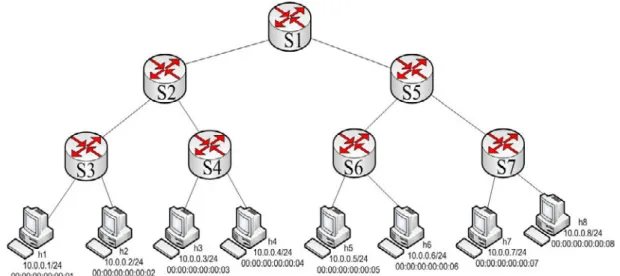
etupAll the simulation has been done over Software Defined Networking using Mininet Emulator. In order to simulate tree networking topology has been used which shows on Figure-1. Mininet creates virtual hosts by using a process-based virtualization method and the network namespace mechanism, which is a feature supported since Linux version 2.2.26, to separate network interfaces, routing tables, and ARP tables of different virtual hosts.
Fig. 1: Designed Network Topology
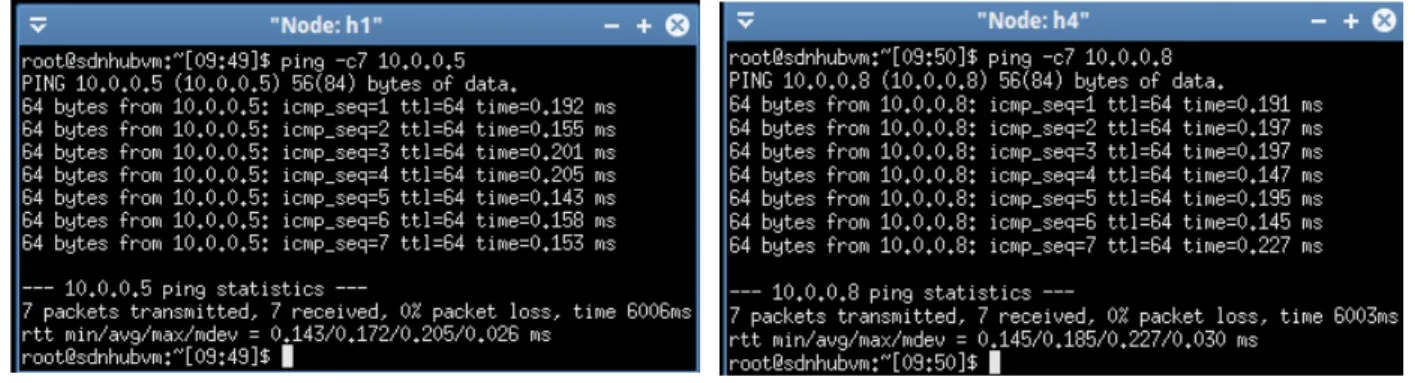
(a) Ping Message from h1 to h15 (b) Ping Message from h4 to h8
Fig. 2:Ping Test Result for OpenFlow Controller
Global Journal of Computer Science and Technology Volume XVIII Issue I Version I
12 Year 2 018 ( ) C
Performance Analysis of Different Openflow based Controller Over Software Defined Networking
Designed tree networking topology consists of seven OpenFlow switch and eight hosts where two hosts is connected each of the switch. Host h1, h2 is connected to switch S1 and host h3, h4 is connected to switch S2. In addition, host h4, h5 is connected to switch S3 and host h5, h6 connected with switch S4.
IV.
R
esult andA
nalysisDifferent Python based OpenFlow controller has been implemented separately over Software Defined
Networking. Firstly, Ryu controller has been implemented in designed tree network topology. In the designed network topology Ping executed from host h1 to host h5 and host h4 to host h8. Figure 2 shows the corresponding Ping result with statistics.
Secondly, OpenFlow POX controller performance has been implemented. For the designed network topology two Ping have been performed from
host h1 to host h5 and host h4 to host h8. The obtained result has been shown in Figure 3 with Ping statistics.
(a) Ping Message from h1 to h5 (b) Ping Message from h4 to h8
Fig. 3: Ping Test Result for OpenFlow POX Controller
Finally, OpenFlow based controller Pyretic have been implemented over Software Defined Networking using Mininet Emulator. Similarly in previous two Ping message has been executed from host h1 to host h5
and host h5 to host h8. The result obtained for Pyretic controller has been shown in Figure 4 with Ping statistics.
(a) Ping Message from h1 to h5 (b) Ping Message from h4 to h8
Fig. 4: Ping Test Result for OpenFlow Pyretic Controller
Each of the OpenFlow based controller perform
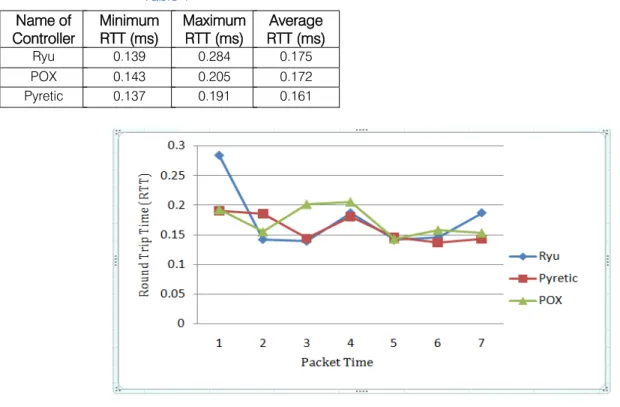
well over Software Defined Networking. The performance analysis graph has been drawn for Ping message from host h1 to host h5 in Figure 5.
Fig. 5: Performance Analysis Graph while Ping from host h1 to host 5
Global Journal of Computer Science and Technology Volume XVIII Issue I Version I
13 Year 2 018 ( ) C
Round Trip Time (RTT) is the length of time it takes for a signal to be sent plus the length of time it takes for an acknowledgment of that signal to be received. This time delay therefore consists of the propagation times between the two points of a signal. Smallest Round Trip Time is always expected for analyzing networks performance. While Ping from host h1 to host h5 corresponding minimum, maximum and average Round Trip Time for each controller has been shown in table-1.
Table 1
Name of
Controller Minimum RTT (ms) Maximum RTT (ms) RTT (ms) Average
Ryu 0.139 0.284 0.175
POX 0.143 0.205 0.172
Pyretic 0.137 0.191 0.161
From table-1, Pyretic controller has smallest minimum RTT 0.137ms, maximum RTT 0.191ms and average RTT 0.161ms. Ryu controller has largest maximum RTT 0.284ms and largest average RTT 0.175ms. Since average RTT larger for Ryu controller compare to other controller, it has the lower performance. Performance analysis graph for Ping Message from host h4 to host h8 is shown in Figure 6.
Fig. 6: Performance Analysis Graph while Ping from host h4 to host 8
Table-2 shows the corresponding minimum, maximum and average Round Trip Time for Ping message from host h4 to host h8.
Table 2
Name of
Controller Minimum RTT (ms) Maximum RTT (ms) RTT (ms) Average
Ryu 0.144 0.230 0.177
POX 0.145 0.227 0.185
Pyretic 0.108 0.179 0.140
From the table-2, OpenFlow POX controller has largest average RTT 0.185ms and largest minimum RTT 0.145ms while Ping from host h4 to host h8. Among the three OpenFlow based controller, Pyretic controller has smallest minimum RTT 0.108ms, maximum RTT 0.179ms and average RTT 0.140ms. From the network performance analysis graph Figure 4 and Figure 5, Pyretic controller has better performance over Software Defined Networking compare Ryu and POX controller.
V.
C
onclusionsFor the Next Generation Networks (NGN) and future internet technologies, Software Defined Networking using OpenFlow protocol will be the most deployed networking architecture. OpenFlow protocols provide standards for routing and delivery of packets on a switch. OpenFlow Controller uses the OpenFlow protocol to connect and configure the network devices in order to determine the best path for application traffic. In this paper, several OpenFlow based controller has been implemented separately over Software Defined Networking. All the evaluation has been done using Mininet Emulator. The result of this paper shows Pyretic controller shows better performance over Software Defined Networking compare to Ryu and POX controller. Future works involves performance analysis of different OpenFlow based controller over Software Defined Wireless Networks (SDWN).
Global Journal of Computer Science and Technology Volume XVIII Issue I Version I
14 Year 2 018 ( ) C
R
eferencesR
éférencesR
eferencias1. Jarraya, Y., Madi, T., & Debbabi, M. (2014). “A
survey and a layered taxonomy of software-defined
networking”. IEEE Communications Surveys &
Tutorials, 16(4), 1955-1980.
2. Kreutz, D., Ramos, F. M., Verissimo, P. E.,
Rothenberg, C. E., Azodolmolky, S., & Uhlig, S. (2015). “Software-defined networking: A
comprehensive survey”. Proceedings of the
IEEE, 103(1), 14-76.
3. Bholebawa, I. Z., Jha, R. K., & Dalal, U. D. (2016). “Performance analysis of proposed openflow-based
network architecture using Mininet”. Wireless
Personal Communications, 86(2), 943-958.
4. Sonkoly, B., Gulyás, A., Németh, F., Czentye, J.,
Kurucz, K., Novák, B., & Vaszkun, G. (2012, October). “OpenFlow virtualization framework with
advanced capabilities”. In European Workshop
onSoftware Defined Networking (EWSDN)(pp.
18-23). IEEE.
5. Casado, M., Freedman, M. J., Pettit, J., Luo, J.,
Gude, N., McKeown, N., & Shenker, S. (2009).
“Rethinking enterprise network control”. IEEE/ACM
Transactions on Networking (ToN), 17(4),
1270-1283.
6. McKeown, N., Anderson, T., Balakrishnan, H.,
Parulkar, G., Peterson, L., Rexford, J., & Turner, J. (2008). “OpenFlow: enabling innovation in campus
networks”. ACM SIGCOMIM Computer
Communication Review, 38(2), 69-74.
7. “Going With the Flow: Google’s Secret Switch to the
Next Wave of Networking”, Online Available:
http://www.wired.com/wiredenterprise/2012/04/goin
g-with-the-flow-googledesseccA ,: 2017-04-24
8. “OFNet- Quick User Guide ”Online Available: http://sdninsights.org/, Accessed: 2016-10-19
9. “MaxiNet: Distributed Network Emulation”, Online Available: https://maxinet.github.io/, Accessed: 2016-11-08
10. “EstiNet 9.0 | Simulator”, Online Available: http://www.estinet.com/ns/?page_id=21140,
Accessed: 2016-09-30
11. “NS-3”, Online Available: https://www.nsnam.org/, Accessed: 2016-11-08
12. OMNeT++ Discrete Event Simulator” Online
Available: 25.
13. “Mininet: An Instant Virtual Network on your Laptop (or other PC) - Mininet” Online Available: http://mininet.org/. Accessed: 2016-06-15.
14. F. Keti and S. Askar, “Emulation of Software Defined Networks Using Mininet in Different Simulation Environments,” 6th International Conference on in
Intelligent Systems,Modeling and Simulation (ISMS),
2015, pp. 205–210, IEEE, 2015.
Global Journal of Computer Science and Technology Volume XVIII Issue I Version I
15 Year 2 018 ( ) C
This page is intentionally left blank
Global Journal of Computer Science and Technology Volume XVIII Issue I Version I
16 Year 2 018 ( ) C © 2018 Global Journals 1