K-12 Education Center for Research and Evaluation
10-2013
Effects of Implementing School Wide Positive
Behavioral Intervention and Supports in an
Alternative School Setting
Erica Evans
Johnson & Wales University - Providence, [email protected]
Robert K. Gable
Johnson & Wales University - Providence, [email protected]
Follow this and additional works at:https://scholarsarchive.jwu.edu/k12_ed
Part of theEducation Commons
This Conference Proceeding is brought to you for free and open access by the Center for Research and Evaluation at ScholarsArchive@JWU. It has been accepted for inclusion in K-12 Education by an authorized administrator of ScholarsArchive@JWU. For more information, please contact
Repository Citation
Evans, Erica and Gable, Robert K., "Effects of Implementing School Wide Positive Behavioral Intervention and Supports in an Alternative School Setting" (2013).K-12 Education. 23.
Effects of Implementing School Wide Positive Behavioral Intervention and Supports in an Alternative School Setting1
Erica Evans
Rhode Island Training School Johnson & Wales University
Robert Gable
Center for Research & Evaluation Educational Leadership Doctoral Program
College of Arts & Sciences Johnson & Wales University
1
Paper presented at the 44th annual meeting of the Northeastern
In spite of research documenting the negative effects of punishment, most high schools and correctional facilities rely on punishment to establish order and compliance with rules and routines (Nelson, Sprague, Jolivette, Smith, & Tobin, 2009). One alternative to punitive consequences is School Wide Positive
Behavioral Intervention and Supports (SWPBIS). Since research on the
implementation of SWPBIS in correctional facilities is limited, this mixed method study evaluated the effects of the implementation of SWPBIS on problem
behavior, academic achievement, and social behavior of students in a juvenile corrections facility. Stufflebeam’s evaluation model was used as a framework for the study (Stufflebeam & Shinkfield, 2007).
Research Questions:
1. Are there differences with respect to (a) problem behaviors and (b) academic achievement between students exposed pre-, and post-implementation of SWPBIS?
2. Is there a relationship between specific categories of behaviors and the implementation of SWPBIS during pre-, post, and follow-up?
3. What are the perceptions of school personnel regarding students’ social skills post-implementation of SWPBIS?
A t-test analysis of the number of problem behavioral referrals of
adjudicated youth pre- (n = 130, M = 4.28) and post-implementation (n =160, M = 3.99), found no statistically significant difference. However, there was a
statistically significant difference in the number of problem behavioral referrals between the pre-implementation (n = 130, M = 4.28) and follow-up time periods (n = 98, M = 3.23, p =.05, d=.27, small effect size. A paired t-test on means of report card grades pre- and post-implementation (N=8) analysis found no
statistically significant difference between academic performance in core subjects. Descriptive data on the SWPBIS survey taken by school personnel (N=14)
indicated that respondents tended to be split in their decision of whether social skills improved in their classroom. Finally, three major themes emerged from a focus group of school personnel (N=6): an improvement of classroom
management skills by teachers, inconsistent application of positive behavioral supports, and a lack of administration support for the program.
Findings from this study add to the literature on SWPBIS and will be useful to administrators in juvenile correctional settings.
Statement of Problem
Problem behaviors (e.g., aggression and antisocial behavior) have been linked to academic underachievement in a circular relationship (Christle, Nelson, & Jolivette, 2004; Green, 2009). When comparing students with and without identified disabilities, Christle et al. (2004) reported that students with an
identified disability were twice as likely to be suspended then their non-disabled counterparts and students identified as having emotional or behavioral problems were 11 times more likely to be suspended from school. This finding has led educators such as Wald and Losen (2003) to develop the term “school-to-prison pipeline”. This term refers to high school students who have been removed from school for disciplinary reasons and therefore, have a higher probability of
entering the prison system and a lower probability of returning to school. Research demonstrates that school discipline, which focuses on punitive measures or consequences, is ineffective and produces negative side effects including a decrease in student academic achievement and positive social behaviors(Christle et al., 2005; Sugai & Horner, 2008). According to Scott et al. (2002), most correctional facilities rely on negative, punitive forms of discipline such as punishment (Crisis Prevention Institute, 2010). These facilities give little or no attention to teaching expected appropriate behaviors, developing skills necessary for task completion, or reinforcing positive behaviors (Nelson et al., 2009).
Mendel (2012) found that among the world’s developed nations, America has the highest youth custody rate (i.e., 336 of every 100,000 youth in 2002). He
stated that this number is nearly five times the rate (i.e., 69 per 100,000) of the next highest nation, South Africa. Since juvenile justice systems vary so much across states, there is no national recidivism rate for juveniles (Snyder &
Sickmund, 2006). However, data collected in a small juvenile correctional facility in a Northeastern state in the United States demonstrated that for the 669 youth in the facility for all or part of the year 2011, “21% or 138 were readmitted at least twice in 2011, and 3% were readmitted three or more times in 2011” (Rhode Island Kids Count, 2011, p. 94).
An approach of school discipline supported by evidence-based research is School Wide Positive Behavioral Interventions and Supports (SWPBIS). SWPBIS focuses on behavior and interpersonal skills. In 2003, The National Council on Disability recognized SWPBIS as an effective approach in meeting the needs of adjudicated youth in the juvenile justice system (Nelson, Scott, Gagnon, Jolivette & Sprague, 2008). Houchins, Jolivette, Wessesdorf, McGlynn, and Nelson (2005) agree, and argue that positive behavioral supports should be adopted by correctional facilities for adjudicated youth.
Due to the paucity of research on the implementation of SWPBIS in juvenile correctional facilities, Nelson et al. (2009) and Scott et al. (2002), recommend future research.
Purpose of this Study
The purpose of this mixed methods study was to examine the relationship of a program intervention (i.e., School Wide Positive Behavioral Interventions and Supports) to an outcome (i.e., frequency of problem behavior referrals, academic
achievement, and specific behaviors); and to provide an analysis of teachers’ opinions regarding the level of social skills in the population of adjudicated youth (Creswell, 2009). This mixed-methods study investigated the following research questions:
Research Questions:
1. Are there differences with respect to (a) problem behaviors and (b) academic achievement between students exposed pre- and post- implementation of School Wide Positive Behavioral Interventions and Supports (SWPBIS)?
2. Is there a relationship between specific categories of behaviors (i.e., respect, integrity, tolerance, safety, other) and the implementation of School Wide Positive Behavioral Interventions and Supports (SWPBIS) during pre-, post-, and follow-up?
3. What are the perceptions of school personnel regarding students’ social skills post implementation of School Wide Positive Behavioral
Interventions and Supports (SWPBIS)?
Framework of the Study
Originating during the 1960’s as a way to improve and achieve accountability for school programs, Stufflebeams’ CIPP program evaluation model “is a comprehensive framework for conducting formative, and summative evaluations of programs, projects, personnel, products, organizations, and evaluation systems” (Stufflebeam & Shriklfield, 2007, p. 325). This study used components of Stufflebeam’s process evaluation and product evaluation in order to identify strengths as well as barriers to the implementation of SWPBIS in a small correctional alternative school setting in the Northeastern United States.
Process Evaluation
Interventions and Supports survey (Appendix A) and key focus questions 4 and 6 on the Focus Group Questions (Appendix B) allowed subjects ample opportunity to comment, explain and share experiences and attitudes about the strengths and barriers to implementation of SWPBIS (Krueger & Casey, 2009). In addition, question 5 of the Focus Group Questions (Appendix B) requested information about habitually reinforcing positive behaviors, in order to “assess the extent to which participants carry out their roles” (Stufflebeam & Shinkfield, 2007, p. 341).
Product Evaluation
Quantitative data included the following: the frequency of problem behavior referrals, grades on students’ report cards, and teachers’ perceptions regarding students’ general and specific social skills. Qualitative data from a focus group regarding the effectiveness of SWPBIS were analyzed in
order to “assess the intended and unintended outcomes as well as positive and negative outcomes” (Stufflebeam & Shinkfield, 2007, p. 345). In addition, the product evaluation assessed the judgments of school personnel regarding the implementation of SWPBIS. The results obtained through the survey and focus group contributed to the decision making process regarding whether or not to continue the SWPBIS program (Stufflebeam & Shinkfield, 2007).
Methodology Research Design
This mixed methods study utilized quantitative descriptive research as well as qualitative data from a focus group. A quantitative design was chosen to address Research Question 1, Research Question 2, and Research Question 3
in order to examine the relationship of a program intervention (i.e., SWPBIS) to an outcome (i.e., problem behavior referrals and academic achievement); and to provide ananalysis of teachers’ opinions regarding the level of social skills in the population (i.e., adjudicated youth) (Creswell, 2009). Quantitative data were collected in four forms:
(1) ex-post facto data on the frequencies of problem behaviors of adjudicated youth at the facility as measured by office referrals: pre-implementation (i.e., five months before implementation of SIPBIS); post-implementation (i.e., five months after implementation); as well as follow-up (i.e., five months after
post-implementation of SWPBIS);
(2) ex-post facto data (pre-implementation of SWPBIS, post-implementation, and at follow-up) on the frequencies of problem behavior referrals for specified social skills (e.g., respect, integrity, tolerance, safety, and other);
(3) data on academic achievement as documented on students’ report cards (pre- and post-implementation of SWPBIS); and
(4) data obtained through a survey of teachers’ perceptions regarding the effectiveness of SWPBIS on students’ general social skills, as well as on specified social skills (i.e., respect & integrity).
In addition to the quantitative approach, a qualitative research approach was chosen for Research Question 3, in order to give depth and understanding to this specific situation (Krueger & Casey, 2009). Qualitative data were collected by means of a focus group composed of teachers, support staff and one
of inferences regarding the implementation of School Wide Positive Behavioral Interventions and Supports (SWPBIS) (Krippendorff, 2004).
Sample Quantitative
Due to the small population of adjudicated youth remanded to the facility, as well as their special status (i.e., incarcerated), the participants in this study consisted of the aggregated data of the entire population of adjudicated youth who were present at the facility and received one or more disciplinary referrals for problem behavior from the educational staff at the various stages of the research study (i.e., pre-implementation of SWPBIS, n = 130;
post-implementation of SWPBIS, n = 160; and at follow-up, n = 98). Also, grades on the report cards of students who were present both before and after
implementation were analyzed: (i.e., term 2 and term 3 of the 2011-2012 school year, N = 8). In addition, school personnel (i.e., teachers, administrators,
teachers aids, and support staff) were surveyed (N = 40 surveys were distributed and 14 (35%) were completed) regarding their perceptions of students’ social skills after SWPBIS implementation.
Qualitative
According to Krueger & Casey (2009), the “ideal size of a focus group for non-commercial topics is five to eight participants” (p. 67). Participants in the focus group (N = 6) included: three High School teachers, one GED teacher, one special education teacher, and one school social worker. All members of the focus group had been working at the facility for five or more years.
Instrumentation
Archival behavioral and educational data were accessed using two web- based school-wide informational systems (i.e., SWIS and Aspen). Ex-post facto data collected from these web-based systems were used to address Research Question 1: Are there differences with respect to (a) problem behaviors and (b) academic achievement between students exposed pre- and post-implementation of School Wide Positive Behavioral Interventions and Supports (SWPBIS)? Question 2: Is there a relationship between specific categories of behaviors (i.e., respect, integrity, tolerance, safety, other) and the implementation of School Wide Positive Behavioral Interventions and Supports (SWPBIS) during pre-, post-, and follow-up? The School-Wide Information System (SWIS) tracked the frequencies of problem behaviors from office referrals written by teachers. In addition, SWIS tracked the category of problem behaviors (e.g., respect, integrity, tolerance, safety, other), pre-implementation (five months prior to February 2012), post-implementation (five months after February 2012), and at follow-up, an
additional five months after implementation of SWPBIS. The Aspen Student Information System (SIS) software was utilized to collect data on academic achievement (i.e., grades on report cards for students who were present at the facility pre- and post- implementation of SWPBIS).
In order to address Research Question 3: What are the perceptions of school personnel regarding students’ social skills post-implementation of School Wide Positive Behavioral Interventions and Supports (SWPBIS), a survey was developed using Surveymonkey (Appendix C). This survey included an 8
question, 5-point Likert-type agreement rating scale with two open-ended
questions. The questions on the survey pertained to general and specific social skills of students. The survey was piloted on a group of teachers (N = 5) in order to ensure clarity and content validity. The survey was distributed to all school personnel (N = 40) via email, and a hard copy of the survey was placed in their mailboxes. A reminder to complete the survey form was sent via email to school personnel ten days after the survey was sent. The researcher received N = 14 (35%) completed surveys.
Due to the small population (i.e., N = 40), the survey contained no
demographic information and was anonymous to protect confidentiality. A survey was chosen in order to provide a numeric description of the opinions of school personnel about students’ social behavior post-implementation of SWPBIS (Creswell, 2009). Open-ended questions about SWPBIS were added to the survey in order to gather information about the strengths and obstacles of
SWPBIS implementation and to assist in the creation of follow-up questions for a focus group.
Finally, a convenience sample focus group (N = 6) was developed which included five teachers and one school support staff member. A focus group was chosen in order to provide a better understanding of the opinions of school personnel regarding the implementation of SWPBIS (Krueger & Casey, 2009, p. 4). Focus group questions (Appendix B) were piloted with positive behavioral supports facilitators (N = 2), for clarity and content validity. The Krueger & Casey (2009) Good Question Route was used to in order to “foster consistency in
questioning” to “improve analysis” (p. 38). This route included, an opening, introductory, transition, three key and one ending question. The focus group was run by a non-employee of the facility who was familiar with the implementation of SWPBIS in this setting. A transcription of this focus group allowed for content analysis and the development of inferences regarding the implementation of School Wide Positive Behavioral Interventions and Supports (SWPBIS) in an alternative juvenile justice setting (Krippendorff, 2004).
Data Analysis
To address Research Question 1 and 2, archival data from the School-Wide Information System (SWIS) and Aspen Student Information System (SIS) were analyzed utilizing the Statistical Package for the Social Sciences (SPSS, 2011) software. Prior to conducting a t-test on means, descriptive statistics (i.e., frequencies, percentages, means and standard deviations) were collected and analyzed on problem behaviors, and students’ grades both before and after implementation of (SWPBIS). A t-test was utilized to determine whether the differences between student behavior, before and after implementation of SWPBIS, was statistically significant at the .05 level. In addition, a t-test using the paired samples procedure was utilized in order to determine whether academic achievement was statistically significant. Finally, a chi-square using the crosstab procedure on specific types of behavior and time period, was utilized.
In order to address Research Question 3, descriptive statistics (i.e., frequencies, percentages, means and standard deviations) for the survey data
were analyzed using SPSS. The purpose of this analysis was to assist in the development of meaningful focus group questions. Finally, content analysis of the transcript of the focus group was utilized to make valid inferences about teachers’ perceptions of the implementation of SWPBIS regarding students’ specific social skills (Krippendoff, 2004).
Major Results Research Question 1a
Descriptive statistics
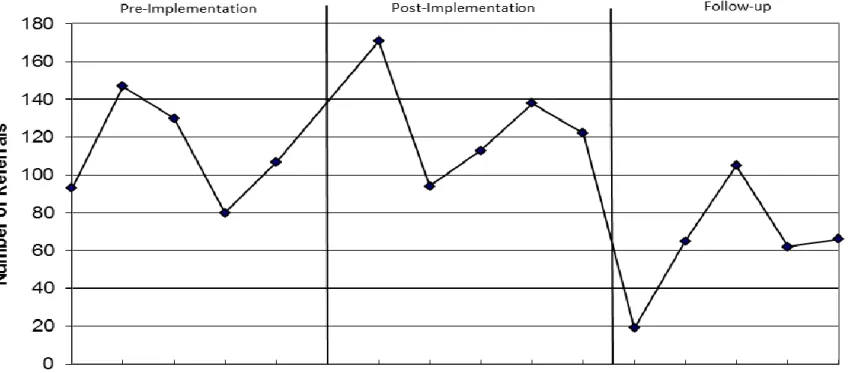
In order to address Research Question 1a, descriptive statistics were utilized (i.e., frequencies, percents, means and standard deviations). Data was collected on the number of office referrals written by teachers on students per month: pre-implementation (September 2011-January 2012),
post-implementation (March 2012-July 2012) and follow-up (August 2012-December 2012). Implementation of SWPBIS took place in February 2012, so office referrals for that month were removed from the data to be analyzed. Figure 1, displays the number of office referrals written per month; pre-implementation, post-implementation and follow-up.
Pre-Post Implementation Differences
Table1, presents the results of two t-tests. A t-test, first was conducted on the mean number of office referrals pre-implementation and post-implementation of SWPBIS. Based on the analysis, there was not a statistically significant
difference (t = .567, p = .571) between the frequency of office referrals pre-
implementation (N = 130, M = 4.28, SD = 4.34) and post implementation (n =160, M = 3.99, SD = 3.99). Next, a test was conducted on the mean number of office referrals pre-implementation and during follow-up. Based on analysis, there was a statistically significant difference (t= 1.950, p = .052, d = .27) in the frequency of office referrals between the pre-implementation of SWPBIS and at follow-up. The effect size (d=.27) was small between the frequency pre-implementation (M = 4.28, SD = 4.34) and at follow-up (M = 3.23, SD = 3.56).
Figure 1. Frequency of Office Referrals per Implementation Time Period
Table 1
t-test on Group Category Time Periods of Office Referralsa
Time period N Ratiob M SD t p dc
Group 1 130 1.07 4.28 4.34 .567 .571 .02
Group 2 160 1.36 3.99 4.51
Group 1 130 1.07 4.28 4.34 1.950 .052 .27
Group 3 98 .96 3.23 3.56
a
Group category time period are as follows: Group 1 = Pre-implementation, Group 2 = Post-implementation, Group 3 = Follow-up
b
Ratio is the number of referrals divided by average enrollment per time period
c
Effect size guidelines were as follows: .20 = small, .50 = medium, .80 = large
Research Question 1b
In order to address Research Question 1b, Table 2, displays a paired t-test of grades on report cards in core subjects (i.e., English, Math, Science, History) of 8 students who were present at the facility pre- and
post-implementation of the School Wide Positive Behavioral Intervention and Supports (SWPBIS). Based on the analysis, there were no statistically significant
differences in their grades. Table 2
Paired t-test on Academic Achievementa in Core Subjects Pre and Post Implementation of School Wide Positive Behavioral Intervention and Supports (SWPBIS) N=8
Core Subject Pre Post Change t P
English 5.25 5.13 .13 .284 .785
Math 7.25 7.63 -.38 -.258 .803
Science 6.25 7.38 -1.13 -.814 .442
History 5.50 4.75 .75 1.271 .244
Research Question 2
In order to see if there was a relationship between SWPBIS
implementation and specific categories of behaviors, the behaviors were grouped into five categories: respect, integrity, tolerance, safety, and other. Table 3
displays, descriptive statistics on the categories, behaviors, frequencies and percents of students who received office referrals for problem behaviors pre-, post- Implementation of (SWPBIS), and at follow-up. In addition, Table 4 shows a crosstabulation chi square that was run between behavior categoryand time period (i.e., pre-post implementation). The category tolerance was removed from the analysis due to the small number of violations N=4. Chi-square analysis of the behavior categoriesand program implementation time period revealed there was no relationship between referral behavioral category and program
implementation (X2 = 2.058, df = 3, p = .561).
Research Question 3 Survey:
In order to find out the perceptions of school personnel regarding students’ social skills post-implementation of SWPBIS, a survey was distributed to 40 school personnel via Surveymonkey, and a hardcopy version was placed in their mailboxes. There were 14 completed responses. Table 5 shows the results of the survey that contained 8 questions with a 5-point Likert-type agreement rating scale and two open-ended questions. An inspection of the descriptive data on the SWPBIS survey indicated that for the majority of items defining each category (i.e., overall behavior, respect, and integrity), respondents tended to be split in their decision of agreement or disagreement whether the social skills of students improved in the classroom. In addition to the quantitative portion of the survey, the qualitative portion included two open-ended questions.
(1) What do you believe are the obstacles associated with the SWPBIS approach in your school? The majority of respondents (8/13) stated that there was lack of administrative support.
(2) What do you believe are the strengths associated with the SWPBIS approach in your school? Out of the 12 people who responded to this question, 33% (4/12) remarked that having clear expectations was a strength of the
program; 33% (4/12) remarked that providing positive feedback and/or incentives to the students was a strength; 25% (3/12) stated the approach improved
Table 3
Note. Category “Other” refers to all other problem behavior that does not fall under the four
categories listed (e.g., students kissing).
Categories , Behavior, Frequency, and Percent of Students who Received Office Referrals for Problem Behaviors Pre-, Post- Implementation of (SWPBIS), and at Follow-up
Category Behavior Frequency Percent
1. Respect Defiance 193 14 (N=1,336) Major Defiance 2 <1 Disrespect 309 23 Major Disrespect 2 <1 Non-Compliance 382 29 Disruption 317 24 Major Disruption 1 <1
Dress Code Violation 2 <1
Property Misuse 14 1
Inappropriate Language, Topics, Gestures 98 7
Major Inappropriate Language, Topics, Gestures
8 1
Technology Violation 7 1
Property Damage/Vandalism 1 <1
Total 1336 83
2. Integrity Skipping Class 41 37 (N=111) Refusing to Work Without Good Cause 53 48
Lying/Cheating 14 12 Tardy 3 3 Total 111 7 3. Tolerance Harassment 4 100 (N=4) Total 4 <1
4. Safety Physical Contact or Aggression 66 55 (N=121) Major Physical Aggression 20 16
Fighting 29 24
Contraband 4 3
Major Contraband 1 1
Inappropriate Location/Out of Bounds Area 1 1
Total 121 7
5. Other Other 42 98
(N=43) Major Other 1 2
Total 43 3
Table 4
Crosstabulation between Behavior Categoryand Time Period
Behavior Category Implementation Status Total Pre-Implementation Post-Implementation Respect Count 102 134 236 Expected Count 105.8 130.2 236.0 % within respect 43.2% 56.8% 100.0% Adjusted Residual -1.2 1.2 Integrity Count 7 5 12 Expected Count 5.4 6.6 12.0 % within integrity 58.3% 41.7% 100.0% Adjusted Residual 1.0 -1.0 Safety Count 14 16 30 Expected Count 13.4 16.6 30.0 % within safety 46.7% 53.3% 100.0% Adjusted Residual .2 -.2 Other Count 7 5 12 Expected Count 5.4 6.6 12.0 % within other 58.3% 41.7% 100.0% Adjusted Residual 1.0 -1.0 Total Count 130 160 290 Expected Count 130.0 160.0 290.0 % within categories 44.8% 55.2% 100.0%
Table 5
Descriptive Statistics for School Wide Positive Behavioral Intervention and Supports (SWPBIS) Implementation Survey (N = 14)
Category/Item Rating Strongly Disagree Disagree Not Sure Agree Strongly Agree M SD Overall Behavior
Social behavior of your
students has improved f 0 5 4 5 0 3.00 .88 % 0 36 28 36 0
Respect
Students speak politely
to adults more often f 0 5 1 8 0 3.21 .98 % 0 36 7 57 0 Students ask permission to use material more frequently f 0 7 4 3 0 2.71 .83 % 0 50 29 21 0 Student raise their hand
to ask question in class more often f 1 7 6 0 0 2.36 .63 % 7 50 43 0 0 Students follow direction of teacher more frequently f 0 5 2 7 0 3.14 .95 % 0 36 14 50 0 Integrity
Students work to the best of their ability more often
f 0 5 4 5 0 3.00 .88 % 0 36 29 36 0
Students do their own
work more frequently f 0 5 5 4 0 2.93 .88 % 0 36 36 29 0
Students take pride in their work more frequently
f 0 4 3 7 0 3.21 .89 % 0 29 21 50 0
Note. Item responses were: 1 = Strongly Disagree, 2 = Disagree, 3 = Not Sure, 4 = Agree, 5 = Strongly Agree
Focus Group:
Finally, a convenience sample focus group (N = 6) was developed composed of five teachers and one school support staff member. The digital recording of the focus group was transcribed and analyzed. Three major themes were identified during analysis of the focus group transcription. They included: An improvement of classroom management skills by teachers, inconsistent application of positive behavioral supports, and a lack of administrative support for the program.
Limitations
There were several limitations in this study. The first limitation was characteristics of the subjects (i.e., students and school personnel). The composition of both groups included the entire population at the facility (i.e., adjudicated youth, and school personnel). Due to lack of control over the
composition of the subjects, many other factors could account for the differences reported (e.g., learning disabilities, emotional disturbances, etc., of the students; and discipline philosophy, job satisfaction, etc., of the school personnel). Any of these factors could have impacted students’ behavior, and the opinions of school personnel regarding the implementation of SWPBIS. In addition, “mortality” or loss of subjects is a possible threat to internal validity. Students are remanded to this facility for one month to one year or more, the average sentence is three months. Also, students may be released early, for good behavior, or transferred to the adult prison if they “age out” by turning 19 while at the facility. This should not have affected the frequency of problem behavior referrals, since this study was assessing the entire student body as aggregate data. However, due to short stays, this researcher could only identify a small sample of students (N = 8) who had been present both before and after the implementation of SWPBIS. The third limitation is the location of the school in a prison setting where safety issues
are the number one priority. There were unanticipated changes in such areas as school hours, change in personnel, administration decisions regarding the
routines and schedules of teachers and students that may have impacted the subjects and the results of this study.
Summary
The process and product components of Stufflebeam’s (CIPP) evaluation model, was used as an approach to evaluate the effectiveness of the
implementation School Wide Positive Behavioral Interventions and Supports (SWPBIS) in a juvenile correctional setting (Stufflebeam & Shinkfield, 2007). The goal of this study was to determine the effectiveness of the implementation of School Wide Positive Behavioral Interventions and Supports (SWPBIS) approach on the problem behaviors, academics and social behaviors of students in a small correctional alternative school. A mixed-methods approach was chosen in order to examine the depth and understanding of the implementation process (Krueger & Casey, 2009; Stufflebeam & Shinkfield, 2007), and to examine the program outcomes (Creswell, 2009). The findings from examining and analyzing the data can be transferable to small juvenile correctional facilities with similar populations and characteristics in order to identify successes and failures in the
implementation of SWPBIS (Stufflebeam, 1987).
Comments
It would seem that findings from this study are similar to the research and literature on SWPBIS. Due to the traditional correctional model of the facility and obvious differences from public school environments, implementing SWPBIS is more difficult and complex (Nelson et. al., 2009). Barriers identified were: getting a “buy in” to SWPBIS from all system staff (e.g., education, social workers, clinic
staff, and unit managers) as well as security (Nelson et al., 2009). While there was a “buy-in” from most of the education professionals, other facility staff (e.g., security, treatment, administration) seemed to adhere to an emphasis on strict discipline and punitive punishment. This difference was noted in the continuous theme of “lack of administrative support” for the program and “inconsistency of implementation” by teachers. Benefits of the implementation of SWPBIS included: a significant decrease in office referrals from pre-implementation to follow up, as well as better classroom management of problem behavior. This reduction in allocating resources and time to problem behavior may have increased instruction time, however, results from this study did not show a significant increase in student academic outcomes for the small group of n = 8 students.
Education Implications
As seen in this research, it is a challenge for education leadership to implement more effective, less exclusionary methods for maintaining safe, productive schools (Skiba and Sprague, 2008). Effective leadership skills that involve a more structural, human resource and symbolic approach may be warranted. School Wide Positive Behavioral Support and Interventions
represents a proactive approach to identifying and organizing effective school practices for students who have significant problem behaviors. School
leadership needs to take on a structural approach and adopt guidelines for efficient and sustainable practices. According to Sugai, Horner, Sprague, and Walker (2000), attention must be focused on the policies, environments, structures, and practices of positive behavioral supports. These include: addressing the needs of students who present significant problem behavior,
personnel who have highly specialized skills, access to resources, and administrative supports.
In addition, since school personnel stated there was a lack of administrative support for the program and in some cases for the staff
themselves, leadership that involves honesty, and the ability to build relationships and inspire trust might be helpful (Bolman & Deals, 2008 p. 340). Also, since SWPBIS in correctional models is more “difficult and complex” (Nelson et. al., 2009), educational leadership may need to take on a more symbolic approach, in order to “persuade” and “inspire” people (Bolman & Deals, 2008 p. 336).
In creating learning environments that prepare students to be successful citizens in the 21st century, Dunlap et al. (2010) state that the educational community must provide a system that will support students’ efforts to manage their own behavior and assure academic achievement. In addition, they state that due to SWPBIS being a proactive, positive, skill-building approach, it ensures effective strategies that promote pro-social behavior and respectful learning environments.
Finally, according to Harris, Lockwood, Mengers, and Stoodley (2011), in juvenile corrections, recidivism is the most commonly used indicator of program and system effectiveness. They state that “developing knowledge of best practices and effective programs, and obtaining support for the replication of evidence-based programs, depends heavily on an agency’s ability to present performance data clearly and consistently to policy makers” (p.8). Since SWPBIS uses best practices and evidence-based data, future research on the implementation of SWPBIS and recidivism rates in juvenile correctional facilities may be warranted.
Recommendations
The following recommendations are based on the literature on School Wide Positive Behavioral Supports in alternative settings and from the outcomes and results of this research study. Recommendations are for both administrators and practitioners in alternative educational settings and juvenile correctional facilities.
1. Education leaders should take on a more structural, human resource and symbolic approach to leadership that involves: an organized strategy, implementation, and adaptation; emphasize support, empowerment, staff development, and be responsive to employee’s needs; and inspire a vision for safety and a better school climate. (Bolman & Deals, 2008) 2. Identify all key personnel in all departments (e.g., education, clinical,
treatment, security) and achieve consensus (i.e., “buy-in”) that SWPBIS is a desirable system change approach in the facility. If necessary,
emphasize and supply documentation in the form of data about the positive impact of the program on safety and security at other sites (Nelson et al., 2005).
3. Educate higher-level administration on SWPBIS benefits, needed
resources, etc.; and obtain reassurance that the program will be treated as a priority. If necessary, link SWPBIS to related state initiatives:
The State continues to promote School Wide Positive Behavioral Interventions and Supports (SWPBIS) and encourages districts to adopt these practices. The State is working on developing a Multi-Tiered System of Support, incorporating SWPBIS into the Response to Intervention problem-solving process and strengthening the connections between these two initiatives (State Annual Performance Report (APR) for FFY 2011).
4. Adopt a data collection and decision model. Collect data routinely, distribute findings and use data to facilitate on-going decision-making (Leone & Weinberg, 2010).
5. Incorporate SWPBIS into the already existing discipline model (Nelson et al., 2009). In order to continue facility “buy-in”, incorporate the system into strategies that staff are doing already.
6. Support and acknowledge the staff members who are consistently
7. Incorporate students, parents and community members on the SWPBIS teams. Osher and Huff (2008) suggest that programming aimed at involving families, and special efforts to engage them in activities, do make a difference, even though there may be barriers (e.g., parents’ feeling that they are being judged by correctional staff, lack of, or inefficient communication between the school and the parents, lack of transportation, language barriers, and rigid time constraints, etc.). In addition, Brock, Burrell and Tulipano (2006), state that “families have the potential to be the greatest source of positive change and support for youth in the juvenile justice system” (p.1). According to Osher and Huff (2008), “the educational leader or administrator has overall responsibility for all aspects of the educational services provided for youth in
correctional education programs” (p.5). This includes, setting the tone for the rest of the staff, and modeling effective, appropriate communication, and interaction with families.
References
Bolman, L. & Deal, T. (2008). Reframing organizations: Artistry, choice, and leadership. San Francisco, CA: Jossey Bass.
Brock, L., Burrell, J., & Tulipano, T. (2006). NDTAC issue brief: Family
involvement. Retrieved from National Evaluation and Technical Assistance Center for the Education of Children and Youth Who Are Neglected,
Delinquent, or At Risk web site:
http://www.neglected-delinquent.org/nddocs NDTAC_issuebrief_family.pdf. Christle, C. A., Jolivette, K., & Nelson, C. M. (2005). Breaking the school to
prison pipeline: Identifying school risk and protective factors for youth delinquency, exceptionality: Special Education Journal, 13(2), 69-88 doi.10.1207/s15327035ex1302_2
Christle, C., Nelson. C. M., & Jolivette, K. (2004). School characteristics related to the use of suspension. Educational and Treatment of Children, 27(4), 510-526.
Creswell. J. W. (2009). Research design: Qualitative, quantitative, and mixed methods. (3rd ed.) Thousand Oaks, CA: Sage.
Crisis Prevention Institute (2010). Positive connections: CPI and positive behavior support. (Presentation notes) Retrieved from
http://www.crisisprevention.com/home.aspx
Dunlap, K., Goodman, S., McEvoy, C., & Paris, F. (2010). School-wide positive behavioral interventions and supports: Implementation guide. Lansing, MI: Michigan Department of Education.
Green, J. (2009). Changing past student discipline practices to create a district- wide disciple plan. Education and Urban Society, 41(4), 457-468.
Retrieved from SAGE database
Harris, P. W., Lockwood, B., Mengers, L., & Stoodley, B. H. (2011) Measuring recidivism in juvenile corrections. Journal of Juvenile Justice 1(1), 1–16. Houchins, D. E., Jolivette, K., Wessesdorf, S., McGlynn, M & Nelson, C. M.
(2005). Stakeholders’ view of implementing positive behavioral support in a juvenile justice setting. Education and Treatment of Children, 28(4), 380-399.
Krippendorff, K. (2004). Content analysis: An introduction to its methodology. (2nd ed.). Thousand Oaks, CA: Sage Publications.
Krueger, R. A. & Casey, M. A. (2009). Focus groups: A practical guide for applied research. (2nd ed.). Thousand Oaks, CA: Sage Publications
Leone, P. & Weinberg, L (2010, May). Addressing the unmet educational needs of children and youth in the juvenile justice and child welfare systems. (epaper) Center of Juvenile Justice Reform CJJR. Georgetown
University. Retrieved from cjjr.georgetown.edu/pdfs/ed/edpaper.pdf
Mendel, R. (2012). Juvenile confinement in context. American Educator, 36(2), 6-11.
Nelson, C.M., Scott, T.M., Gagnon, J.C., Jolivette, K., & Sprague, J.R. (May 2008). Positive behavior support in the juvenile justice system. PBIS Newsletter. 5(4), 3. Retrieved from http://www.pbis.org/pbis_
newsletter/volume_4/issue3.aspx
Nelson, C. M., Sprague, J. R., Jolivette, K., Smith, C. R., & Tobin, T. J.,
(2009). Positive behavioral support in alternative education, community-based mental heath, and juvenile justice settings. In Sailor, W., Dunlap, G., Sugai, G., & Horner, R. (Eds.), Handbook of Positive Behavioral Support (pp. 465-496). New York, NY: Springer.
Osher, T., & Huff, B. (2008). A Family Guide to Getting Involved with Correctional Education. Washington, DC: National Evaluation Technical Assistance Center for the Education of Children Who Are Neglected, Delinquent or At Risk. On-line at/www.neglected-delinquent.org.
Rhode Island KIDS COUNT. (2011). In Rhode Island Kids Count fact book. Retrieved from http://www.rikidscount.org/matriarch/documents/2011 %20Data%20Book%20release_FINAL%281%29.pdf.
Scott, T. M., Nelson. C. M., Liasusin, C. J., Jolivette, K., Christle. C. A., & Riney, M., (2002). Addressing the needs of at-risk and adjudicated youth through positive behavioral support: Effective prevention practices. Educational and Treatment of Children, 25(4), 532-551.
Simonsen, B., Sugai, G., & Negron, M. (2008). School-wide positive behavior supports: Primary systems and practices. Teaching Exceptional Children, 40(6). 32-40.
Skiba, R. & Sprague, R. (2008). Safety without suspensions. Educational Leadership 66(1), 38-43.
Snyder, N. H., & Sickmund, M., (2006). Juvenile offenders and victims: 2006 national report. Washington, DC: U.S. Department of Justice. Retrieved from http://www.ojjdp.gov/ojstatbb/nr2006/downloads/NR2006.pdf Stufflebeam, D. L., & Shinkfield, A. J. (2007). Evaluation, theory, models, and
Sugai, G., & Horner, R. H. (2008). What we know and need to know about preventing problem behavior in schools. Exceptionality, 16, 67-77. doi:10.1080/09362830801981139
Sugai, G., Sprague, J. R., Horner, R. H., & Walker, H. M. (2000). Preventing school violence: The use of office discipline referrals to assess and monitor school-wide discipline interventions. Journal of Emotional and Behavioral Disorders, 8, 94-101.
Wald, J. & Losen, D. J. (2003), Defining and redirecting a school-to-prison pipeline. New Directions for Youth Development, 9–15.
doi: 10.1002/yd.51
Appendix B
School-Wide Positive Behavioral Interventions and Supports Implementation Focus Group Questions
Opening: 1. Please tell us your name and how
(5 minutes) long you have been working here.
Introductory: 2. What is the first thing that comes to mind
(5 minutes) when you hear School-Wide Positive
Behavioral Interventions and Supports.
Transition: 3. What has been your experience during the
(10 minutes) implementation of School-Wide Positive
Behavioral Interventions and Supports.
Key Questions: 4. What do you believe are the positive
(30 minutes) outcomes of the implementation of School-
Wide Positive Behavioral Interventions and Supports.
5. Do you believe this approach to behavioral
management is being implemented with fidelity? Why or why not?
6. What do you believe are the barriers to the
implementation of School-Wide Positive Behavioral Interventions and Supports?
Ending Question: 7. If you had the chance to give advice to
(10 minutes) other juvenile correctional facilities about
implementation of School- Wide Positive Behavioral Interventions and Supports, what advice would you give?