A Case Study On The
Implementation Of A Working
Memory Programme In A Primary
School
A
LEXANDRAS
MITHResearch Thesis Submitted In Part Requirement For The
Doctor Of Educational And Child Psychology
Department Of Educational Studies
November 2016
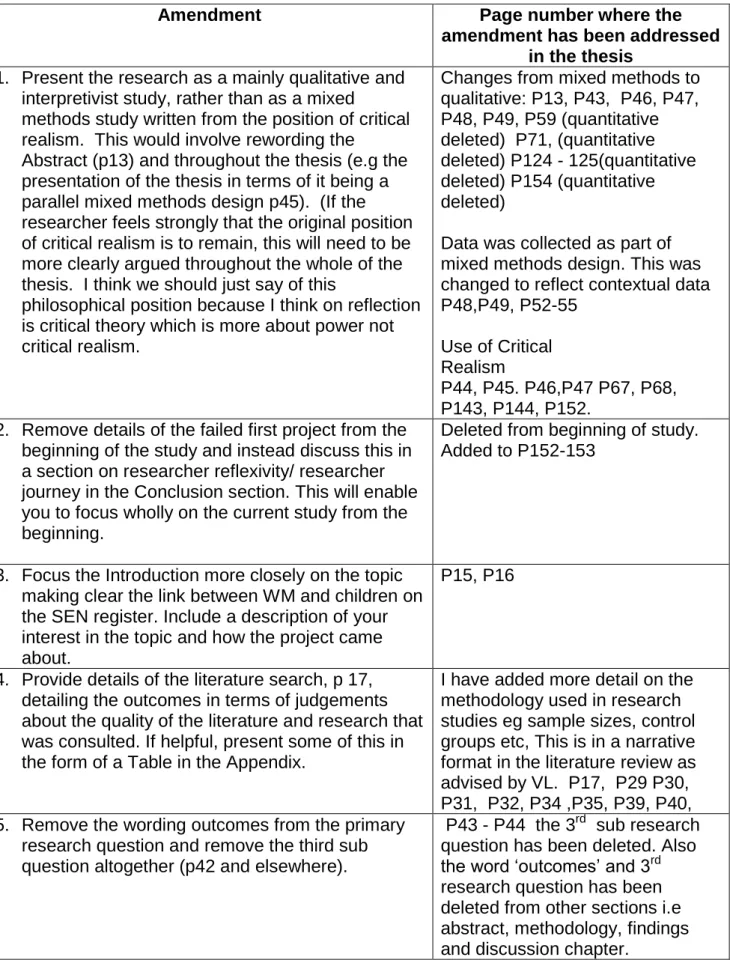
Table of Amendments.
Amendment Page number where the
amendment has been addressed in the thesis
1. Present the research as a mainly qualitative and interpretivist study, rather than as a mixed
methods study written from the position of critical realism. This would involve rewording the
Abstract (p13) and throughout the thesis (e.g the presentation of the thesis in terms of it being a parallel mixed methods design p45). (If the researcher feels strongly that the original position of critical realism is to remain, this will need to be more clearly argued throughout the whole of the thesis. I think we should just say of this
philosophical position because I think on reflection is critical theory which is more about power not critical realism.
Changes from mixed methods to qualitative: P13, P43, P46, P47, P48, P49, P59 (quantitative deleted) P71, (quantitative deleted) P124 - 125(quantitative deleted) P154 (quantitative deleted)
Data was collected as part of mixed methods design. This was changed to reflect contextual data P48,P49, P52-55
Use of Critical Realism
P44, P45. P46,P47 P67, P68, P143, P144, P152.
2. Remove details of the failed first project from the beginning of the study and instead discuss this in a section on researcher reflexivity/ researcher journey in the Conclusion section. This will enable you to focus wholly on the current study from the beginning.
Deleted from beginning of study. Added to P152-153
3. Focus the Introduction more closely on the topic making clear the link between WM and children on the SEN register. Include a description of your interest in the topic and how the project came about.
P15, P16
4. Provide details of the literature search, p 17, detailing the outcomes in terms of judgements about the quality of the literature and research that was consulted. If helpful, present some of this in the form of a Table in the Appendix.
I have added more detail on the methodology used in research studies eg sample sizes, control groups etc, This is in a narrative format in the literature review as advised by VL. P17, P29 P30, P31, P32, P34 ,P35, P39, P40, 5. Remove the wording outcomes from the primary
research question and remove the third sub question altogether (p42 and elsewhere).
P43 - P44 the 3rd sub research question has been deleted. Also the word ‘outcomes’ and 3rd research question has been deleted from other sections i.e abstract, methodology, findings and discussion chapter.
6. Include a clear description of the COGMED programme (p46) including where, when and by whom it was developed. Some details of
COGMED being used in UK schools would provide the reader with contextual detail.
The word ‘dosage’ is currently used – how relevant is this as a word for a school based programme?
You could take a critical stance towards the medicalisation of WM problems which
P50, P51.
VL suggested that I explain that the use of dosage. Implementation science – Dosage this is a term used in implementation science see P53, P146
P146 medicalisation of WM problems.
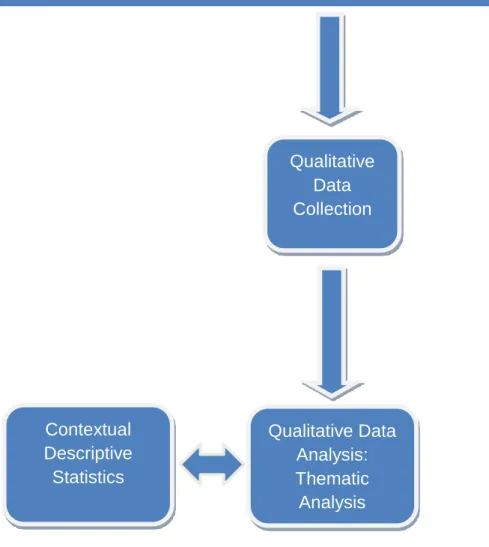
7. Alter the table on p48 to reflect the heavier focus on qualitative data (within the left hand column omit the first box and alter the second to reflect ‘contextual descriptive statistics of COGMED’, with an interlinking arrow connected to the right hand side box Qual data analysis; thematic analysis. Omit the box at the bottom of the diagram).
P49
8. Move the quantitative data resulting from the Y5 pupils completing tests of MALS and WM into the Appendix to provide details of contextual
background.
Moved to Appendices xxi, xxii, xxiii, xxiv
9. Provide a section discussing the link between working memory and MALS and Metamemory or write a section justifying your use of these
assessments as contextual data.
Remove references to age dependent development of metacognition or provide evidence to justify your point.
I have explained these
assessments provide contextual data: P48, P52, P53, P54,P55, P56
P55- I have deleted reference to this in section 3.8.3 pupils. . 10. Present clearer details on the school as a case
study, including levels of SEN/ free school meals etc (see p 49). Include details of pupil language skill if available
P52, P56-57
11. Provide more specific contextual details on the pupils such as any SEN or language difficulties and reflect on how these might have affected the qualitative data collection
P56-57 and P147
12. Separate the table on p50 into year five and year six data - displaying the additional information gathered for the year five pupils.
13. Provide detailed tables showing the process of data analysis from quotations (giving interview and line number) to code, show how codes have been clustered into categories and how these became themes (or sub themes and themes). You may need to review your current data analysis.
Appendix xxv, xxvi, xxvii, xxviii VL suggested to select one overarching theme and use it as an example to illustrate how the data analysis was conducted. I have used the overarching theme “Recommendations”. I have included a table and a diagram to illustrate quotes - codes –
categories – subthemes – theme. P65,P86
14. Provide details of the debriefing process referred to on page 67
P70.
15. Rename the sub theme pupil characteristics (p69) in order to reflect more that this was about
comments about the programme rather than any ‘within child characteristic’.
P72, P76 changed to pupil perceptions
16. Re-structure the Findings chapter to focus on themes rather than RQs thus making a link between this chapter and the data analysis table. Avoid quantifying the qualitative data, so removing words such as ‘many’ or ‘the majority’ and instead focus on the themes providing illustrative quotes from the data where necessary.
P71, 72 , P86
P73,P74, P75,P77, P79, I have removed words such as many. I have deleted the research questions in Chapter 4 as suggested by VL.
The Discussion section needs to be more in depth in terms of interpreting the findings and linking these to the literature.
17. Include a more in depth critical Discussion chapter, linking the findings to the existing literature and removing any quotations from the data . Currently section 3 is very descriptive and requires a more critical approach to the literature. This section is problematic because you are drawing conclusions and making
recommendations based on a very small number of pupils eg. the link between MALS and progress on COGMED cannot be made with this sample size; similarly the link with metacognition is not robust because this is not part of COGMED training.
P125, P126, P127, P128, P129, P130, P131, P132,
P133,P134,P135,P136,P137,P138 ,P139, P140, P141,P142.
I have included more literature. I have also included more detail on Durlak and Dupre’s (2008)
framework for effective
implementation and how it can be related to my research.
The quotations have been removed from Chapter 5.
(The changes in thesis have been highlighted in blue)
P58 WRMS is appendix 2;Done – now on P54
P85 Characteristics : Done – now on P88
P116 Positive. Done – now P118
pg 122 “indication” Done now on P214
P143 Should this read ‘ children with processing difficulties’?I have changed it to "children who do not have processing difficulties" p138.
pg 154 use of word “inclusively”) Deleted the word inclusively, P150
p194 Letter to pupils should have suggested the type of researcher (TEP etc)
Added – now P193
P191, 198, 199 Remove telephone number Deleted: 190, 191, 192,
Data is a plural word and should be used so throughout Done : P13, P53, P65, P70, P218
Appendices: It is not necessary or desirable to include a full interview transcript, however it would be useful to have more detail about how data were coded.
Transcript has been reduced and example of how data was coded has been placed in Appendices xxv, xxvi
Appendix 4 provides a framework for interventions which looks very useful, a short explanation of how this was used in the study would be helpful: This has been added in Chapter 5, P125, P140- 142. Appendix iv : P176. Also P40 provides a description of the framework.
There are some issues with titles of some tables which are overly descriptive and not always consistent with the titles given in the Contents page. These have been checked
Tighten the academic tone of the writing especially in the Introduction section removing direct questions to the reader and colloquialisms. Questions have been removed.
Check the in text citation/reference to Baddeley – WM theory is much older than 2010 – Changed on P18, P19
checks (p62) and comment further on this in the discussion section (p61)
19. Include a fuller section in chapter 5, of the limitations of the research, including detail on ethics, judgements around rigour, implications for EPs, as well as learning points/ reflexivity.
P68, P70,P143, P144,P145,P146, P147,P148,P149,
P150,P151,P152, P153, P154, P155
2
Contents Page
List of Appendices 8 List of Tables 10 List of Figures 11 List of Abbreviations 12 Abstract 13 Chapter 1: Introduction 15Chapter 2: Literature Review 17
2.0: Chapter Overview 17
2.1: Literature Review Search Strategy 17
2.2: Working Memory 17
2.3: Assessment of Working Memory 20
2.4: Working Memory in the Classroom 23
2.5: Interventions and Approaches to Promoting Working
Memory 24
2.5.1: Modifying the environment 24
2.5.2: Strategy use 24
2.5.3: Computerized programmes 27
2.5.3.1: COGMED monitoring provision 28
2.5.3.2: COGMED coaches 28
2.5.3.3: Types of programme 28
2.6: The Outcomes and Research on COGMED 29
2.6.1: Use in schools 30 2.6.2: Transfer 31 2.6.3: Individual factors 36 2.6.4: Training factors 37 2.6.5: Schools as a system 38 2.7: Implementation 39
2.8: Pupils and Teachers’ Perceptions of working
memory and COGMED 41
3
2.8.2: Perceptions of working memory. 41
2.9: Rationale 42 Chapter 3: Methodology 43 3.0: Chapter Overview 43 3.1: Research Objective 43 3.2: Research Questions 43 3.3: Philosophical Considerations 44
3.4: Case Study Methodology 46
3.5: Rationale for use of the Data Collection Methods 47
3.6: Research Methodological Procedure 49
3.7: Description of COGMED 50
3.8 Sampling Method 51
3.8.1: School 51
3.8.2: Contextual Data 52
3.8.2.1 Contextual data COGMED monitoring
Provision 54
3.8.2.2 Contextual data WMRS 54
3.8.2.3 Contextual data MALS 55
3.8.3 Pupils 55
3.8.4: Staff 57
3.9: Data Collection Methods 58
3.9.1: Equipment needed for the study 59
3.9.2: Semi-structured interview 60
3.9.3: Semi-structured interview schedule 62
3.10: Data Analysis Methods 64
3.10.1 Qualitative data analysis 64
3.11: Validity and Reliability 66
3.12: Reflexivity 68
3.13: Ethical Considerations 69
3.13.1 Informed consent and right to withdraw 69
3.13.2 Confidentiality 70
4
Chapter 4: Findings 71
4.0: Chapter Overview 71
4.1: Pupils View of COGMED? 72
4.1.1: Facilitators and barriers 73
4.1.1.1: Sub Theme: Positives / Advantages 73
4.1.1.1.1: Programme structure 73
4.1.1.1.2: Engages and helps pupils 74
4.1.1.2: Sub Theme: Negatives / Barriers 75
4.1.1.2.1: Programme structure 75
4.1.1.2.2: Computerised 75
4.1.1.2.3: Absent from lessons 75
4.1.2: Pupil Perceptions 76
4.1.2.1: Sub Theme: Pupils perception of ability 76 4.1.2.1.1: Pupils perception of their ability
on COGMED 76
4.1.2.1.2: Ability to remember 76
4.1.2.2: Sub Theme: Strategy use 77
4.1.2.2.1: General Strategy use 77
4.1.2.2.2: Strategy Use on COGMED 78
4.1.2.2.3: Strategy use in class 79
4.1.3: Implementation Of COGMED 80
4.1.3.1: Sub Theme: Delivery of COGMED 80
4.1.3.1.1: Programme Fidelity 80
4.1.3.1.2: What is COGMED and its
purpose? 81
4.1.3.2: Sub Theme: Outcomes of delivery 82
4.1.3.2.1: What the pupils learnt 82
4.1.3.2.2: Staff engagement 84
4.1.3.3: Sub Theme: Alterations / recommendations
for future use 85
4.1.3.3.1: ICT 85
5
4.1.3.3.3: Content 85
4.1.3.3.4: Future use 85
4.2 Teachers Views on COGMED 86
4.2.1 Facilitators 88
4.2.1.1: Sub Theme: Pupil attributes 89
4.2.1.1.1: Pupil characteristics 89
4.2.1.1.2: Pupil engagement 89
4.2.1.2: Sub Theme: Programme factors 90
4.2.1.2.1: Logistical factors 90
4.2.1.2.2: Design and content 90
4.2.2: Barriers 93
4.2.2.1: Sub Theme: Pupil attributes 94
4.2.2.1.1: Pupil characteristics 94
4.2.2.1.2: Pupil engagement 96
4.2.2.2 Sub Theme: Programme factors 97
4.2.2.2.1: Knowing which pupils to select 97
4.2.2.2.2: Design / content 98
4.2.3: Implementation 101
4.2.3.1: Sub Theme: Reason for implementing
COGMED 102
4.2.3.1.1: Rationale for use of COGMED 102 4.2.3.1.2: Understanding working memory
and COGMED 104
4.2.3.1.3: Expected outcomes from
implementing COGMED 106
4.2.3.2: Sub Theme: Delivery 108
4.2.3.2.1: Who the staff selected to
participate in COGMED 108
4.2.3.2.2: Pupil and staff engagement 108
4.2.4: Recommendations 112
6 4.2.4.1.1: Future school practice of
Interventions 112
4.2.4.1.2: Future use of COGMED 113
4.2.4.1.3: Modifications 115
4.2.4.2: Sub Theme: Guidelines 116
4.2.4.2.1: Guidelines on the selection of
participants 116 4.2.4.2.2: Training to increase understanding 117
4.2.5: Outcomes 118
4.2.5.1: Sub Theme: Impact 119
4.2.5.1.1: Positive outcomes 119
4.2.5.1.2 Negative outcomes 119
4.2.5.1.3: Judging impact 120
4.2.5.1.4: Judging impact and transfer 122
4.2.5.1.5: Transfer 123
4.2.5.2: Sub Theme: Reflections 123
4.2.5.2.1: What the teachers learnt 123
4.2.5.2.2: What the teachers would
do differently 123
4.3: Summary 124
Chapter 5: Discussion 125
5.1: Chapter Overview 125
5.2: Research Question One - How do the pupils view participating in COGMED and what are the barriers
and facilitators for implementation? 125
5.2.1: Positive experience / facilitators 125
5.2.1.1: Impact on working memory 126
5.2.2: Negative experience / barriers 127
5.2.2.1: Fidelity of the programme 127
5.2.2.2: Understanding the purpose of
7 5.3 Research Question Two - How do teachers view
implementing COGMED in school and what are
the barriers and facilitators for implementation? 128
5.3.1: Facilitators 129
5.3.1.1: Easy to implement 129
5.3.1.2: Contextual appropriateness 129
5.3.1.3: Funding and policy 131
5.3.1.4: Engages pupils 132
5.3.2: Barriers 132
5.3.2.1: Innovation characteristics 132
5.3.2.2: Pupil attributes 134
5.3.2.3: Selection 135
5.3.2.4: Staff skill and effective communication 136
5.3.2.4.1: Staff skills 136
5.3.2.4.2: Effective communication 137
5.3.3: Teachers Views on Factors relating to
Implementation 138
5.4: Conclusion and Integrated Findings 139
5.4.1: Researcher Reflexivity and Critique of the
Methodology and Limitations of the Research 143
5.5: Implications of the Research Findings 149
5.5.1: Implications of COGMED structure 149 5.5.2: Implications of the teachers in the school 150 5.5.3: Implications for educational psychologist 151
5.5.4: Summary of Implications 152
5.6: Research Journey 152
5.7: Concluding Points and Considerations for
Future Research 154
References 156
8
List of Appendices
Appendix i. Description of measures of the visuo spatial sketch pad 172
Appendix ii. Working memory rating scale 173
Appendix iii. Dehn’s (2008) items for classroom observations of
working memory 174
Appendix iv. Durlak and DuPre (2008) framework for effective
implementation 176
Appendix v. Interview schedule for pupils 179
Appendix vi. Interview schedule for Teachers 181
Appendix vii. Working memory rating scale scores 185
Appendix viii. Myself as learner rating scale 186
Appendix ix. Discussion tasks with pupils 187
Appendix x. School recruitment poster 190
Appendix xi. Parent information sheet 191
Appendix xii. Pupil information sheet 192
Appendix xiii. Teacher information sheet 195
Appendix xiv. Teacher consent form 198
Appendix xv. Pupil consent form 199
Appendix xvi. Parental consent form 200
Appendix xvii. Sample segment of an interview transcript 202 Appendix xviii. MALS table of scoring / information on scoring 206 Appendix xix. Sample of different segments from a number of coded
transcript segment 207
Appendix xx. Timeline of present study 208
Appendix xxi Information given to Teacher B on working memory 211
9 Appendix xxiii A pie chart to show the scores on MALS 216
Appendix xxiv COGMED data 217
Appendix xxv The data analysis process 224
Appendix xxvi An example of the data analysis process 226
Appendix xxvii Teacher Interviews: Qualitative Results of Sub Themes
and Categories. 237
Appendix xxviiiPupil Interviews: Qualitative Results of Sub Themes and
10
List of tables
Table 2.1 Functions of each component according to the
multi component model of working memory 19
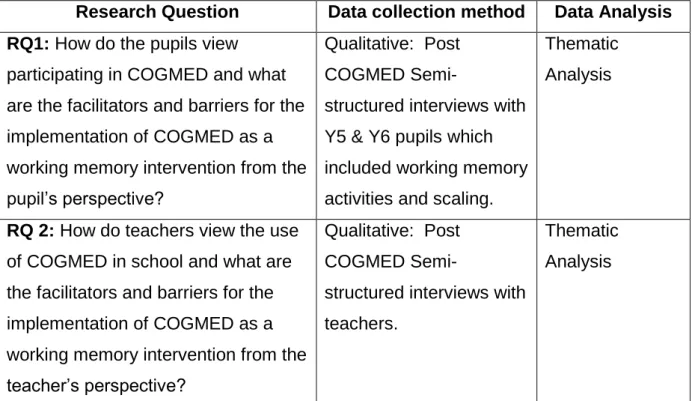
Table 3.1 Data collection methods and analysis 48
Table 3.2 Categories of the contextual data collected 53
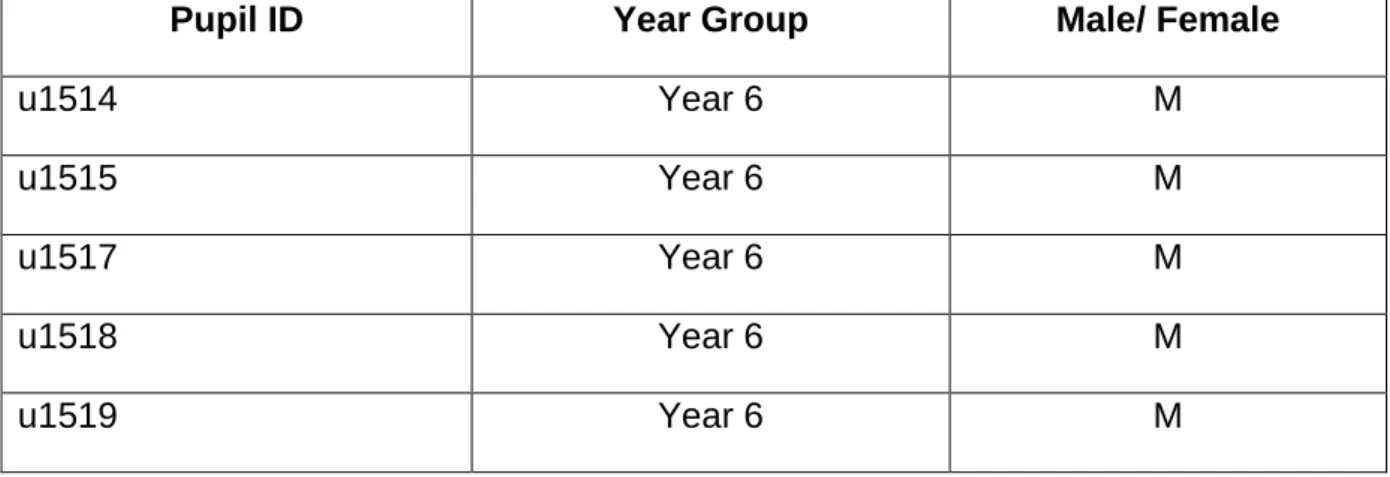
Table 3.3 Year 6 Pupil ID and Gender 55
Table 3.4 Year 5 Pupil ID, Gender, MALS and WMRS Score 56
Table 3.5 Teacher ID 58
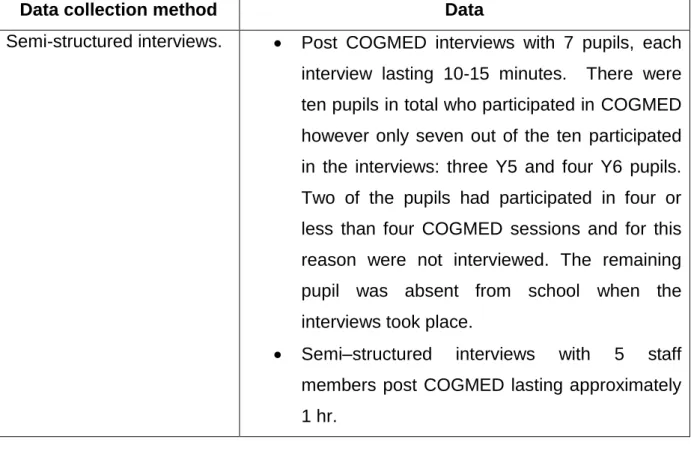
Table 3.6 Data collection methods 59
Table 3.7 Criteria for judging the quality of research design 66
Table 5.1 A summary of the study's findings on the facilitators and
barriers of implementing COGMED 139
Table 5.2 Summary of the key implementation factors for
COGMED in relation to the framework for effective 141 Implementation
11
List of figures
Figure A The multi component model of working memory 19
Figure B Research methodological process 49
Figure C Thematic map: Pupils views of COGMED 72
Figure D Thematic map: Pupils views on the facilitators and barriers 73 of COGMED
Figure E Thematic map: Pupil perceptions 77
Figure F Thematic map: Implementation of COGMED 81
Figure G Thematic map: Teachers views of COGMED 88
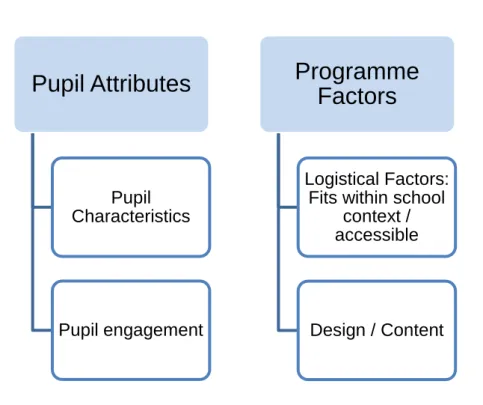
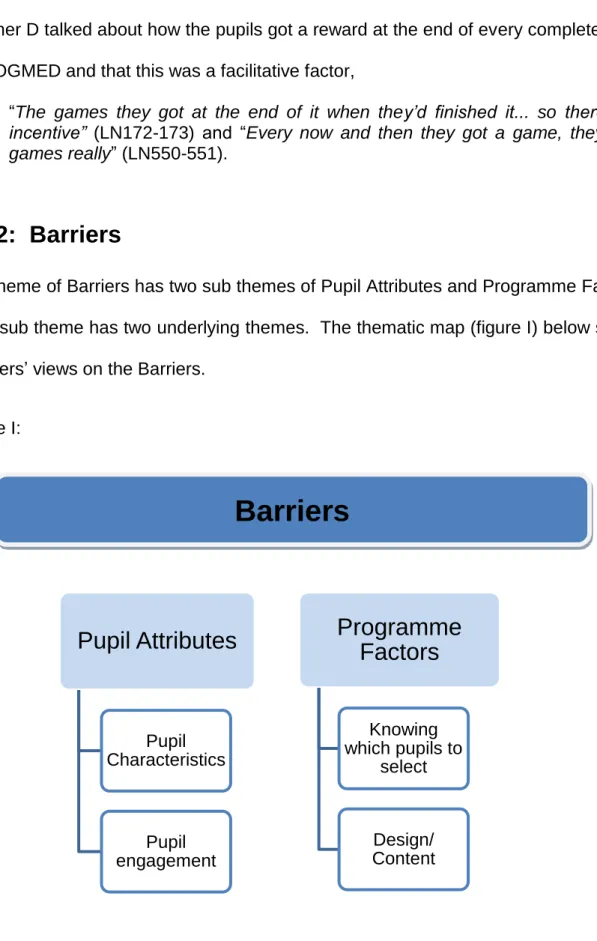
Figure H Thematic map: Teachers views on the facilitators 89 Figure I Thematic map: Teachers views on the barriers 94 Figure J Thematic map: Teachers views on the implementation of COGMED 102 Figure K Thematic map: Teacher views on recommendations 113 Figure L Thematic map: Teacher views on the outcomes of using COGMED 120
12
List of abbreviations
2sd 2 standard deviations
ADHD Attention Deficit Hyperactivity Disorder BPS British Psychological Society
EP Educational Psychologist.
EHCP Education and Health Care Plan
ICT Information Communication Technology ID Identifiers
IEP Individual Educational Plan IQ Intelligence Quotient
LN Line Number
RCT Random Control Test RQ Research Question
SEN Special Educational Needs
SENCO Special Educational Needs Co-ordinator TA Teaching Assistant
TEP Trainee Educational Psychologist WM Working Memory
Yr6 Year 6 Yr5 Year 5
13
Abstract
Background: Working memory refers to a system that temporarily holds and manipulates information (Alloway et al 2016). There is substantial literature on the descriptions of memory but a lack of research on the practical application of memory interventions in schools. COGMED is marketed to schools as an evidence-based intervention which could help individuals who have memory deficits. There have been a number of research studies on COGMED, however there is a lack of research on the implementation of COGMED in schools and also a lack of qualitative research on COGMED. The current research study focused on the ‘real life’ use and implementation of COGMED in a school from the perspectives of teachers, management and pupils. This research set out to find out about the barriers and facilitators which affect the implementation of COGMED in a primary school.
Participants: Five Year 5 pupils and Five Year 6 pupils from one primary school undertook a Working Memory intervention, COGMED, which was implemented by the teachers. Seven of the pupils and five members of staff participated in semi- structured interviews.
Methods: Ten pupils received COGMED which was implemented by the teachers in their school. The Year 5 pupils received the intervention in the Summer Term 2015 and the Year 6 pupils in the Spring Term 2015. Qualitative data were collected through semi– structured interviews with teachers and pupils.
14 Analysis/Results: Semi-structured interviews were transcribed and analysed using thematic analysis. The results were presented as thematic maps which included the facilitators and barriers of implementing COGMED.
Conclusion/Implications: This study identified a number of facilitators and barriers in relation to the use and implementation of COGMED in a primary school. The findings suggest learning opportunities for the school and support agencies and also implications for future implementation and research.
15
Chapter 1: Introduction
“The bridge between a promising idea and its impact on students is implementation, but innovations are seldom implemented as planned”
(Berman and McLaughlin 1976, p349).
Working as a Trainee Educational Psychologist I have experienced a number of schools in search of and under increasing pressure to find a solution to develop children’s working memory. The current government’s educational agenda focuses on increasing pupils’ attainment in schools. Pupils’ memory skills can be suggested as a crucial component for a child’s ability to learn and achieve in school. Working memory is linked to a child's capability in academic skills including reading (Alloway, 2007), acquisition of language and vocabulary (Morra and Camba, 2009), mathematics, (Alloway, 2007), spelling (Service and Turpeinen, 2001) and behavioural inhibition (Mcauley and White, 2011). Children who are placed on a school's Special Educational Needs' Register may have a developmental disorder which can be associated with working memory difficulties; e.g. ADHD, Down syndrome, reading and mathematical difficulties and specific language impairment (Holmes, Gathercole and Dunning, 2010). Jarvis and Gathercole, (2003) found that pupils with low scores on working memory assessments performed poorly on national curriculum assessments. It is estimated that approximately 10-15% of pupils experience some form of working memory difficulty (Holmes, Gathercole and Dunning 2009). Ultimately if working memory training was successful in schools this could lead to a major advance in the education of children. However there is substantial literature on descriptions of working memory but a lack of research on the practical application of working memory interventions in schools. In a previous post I worked as an Assistant Educational Psychologist, where I became aware that some Educational Psychologists in the service
16 were recommending, in their reports, that schools implement COGMED working memory intervention with pupils who had been identified as having working memory difficulties. When I became a Trainee Educational Psychologist I was on placement in a different local authority and the Principal Educational Psychologist, who was also training to be a Neuropsychologist, discussed that she had previously facilitated the use of COGMED with a group of pupils. This led me to explore the use of COGMED in schools in further detail and identify the gaps in the literature. This thesis has been written as part of the qualification for the Doctorate in Child and Educational Psychology and the research explores the implementation of a working memory intervention in a school. In this thesis I utilize a case study design and the literature on effective frameworks for implementation (Durklak and DuPre, 2008).
The school who participated in the research had been advised by their Educational Psychologist to implement a working memory intervention; however after initially piloting the intervention with their Year 6 pupils they were concerned that the intervention had not made an impact on all of the pupils. There has been limited exploration of the implementation of computerised programmes, such as COGMED, in classrooms and the aims of this research were developed to explore the implementation of COGMED in a school in order to reveal the facilitators and barriers of using the programme in a primary school. This thesis is divided into four chapters; Literature Review Chapter, Methodology Chapter, Results Chapter and Discussion Chapter.
17
Chapter 2: Literature Review
2.0: Chapter Overview
This chapter provides a review of the literature and research on working memory, its place in classroom learning and the interventions to improve working memory. It will discuss the current gaps in the research and literature to identify a number of relevant research questions. A search for the most current research was undertaken and a critical stance on the research literature was adopted.
2.1: Literature Review Search Strategy
A number of methods were utilized to access the literature, these included a search of electronic databases including Scopus, Web of Science, PubMed, ProQuest Education Journals, ERIC, Taylor and Francis Online, Wiley Online, Elisevier, National Library of Sweden, Informa, Springer Link Open Access and Sage Full Text Collection. The British Library Electronic Theses Online Service (EThOS), the COGMED website, Google and Google Scholar were also used. The following search terms were used in a number of different combinations; “COGMED”, “teachers”, “school”, “pupils”, “children”, “intervention”, “views”, “implementation”, “strategies” and “working memory”. Literature was also identified from journal articles which had cited and referenced other sources and journal articles.
2.2: Working Memory
There are a number of theoretical models of Working Memory and they have different conceptualisations of the structure, and function of the Working Memory system, but essentially agree that there is a temporary storage only function in Short Term Memory and the manipulation of information in Working Memory (Baddeley, 2010; Barrett, Tugade,
18 and Engle, 2004; Cowan, 2005, 2008; Ericsson and Kintsch, 1995). Verbal and visuo– spatial “short term memory components form part but not the whole of the larger working memory system” (Gathercole and Alloway, 2008, p12). For example short term memory stores information for a few seconds without mentally manipulating the information. Gathercole and Alloway (2008) utilize a memory game (‘kim’s game’) to explore children’s visuo-spatial short- term memory. This game involves a child viewing a set of objects for a minute and then attempting to recall the objects when they have been concealed.
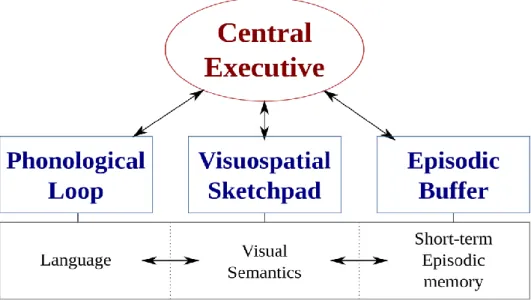
According to Gathercole and Alloway (2004, p2) working memory “refers to the ability to hold and manipulate information in the mind for a short period of time”. Awh and Jonides (2001) argue that attention is required for maintaining and manipulating information in working memory and argue that it is not possible to separate working memory and attention control. It is important to be clear that the structure and function of working memory within the literature continues to be deliberated and debated. Nevertheless the multi-component model of working memory (Baddeley, 2000) presented below is considered the most influential model. It proposes that there are four components of working memory which are; the episodic buffer, the visuo-spatial scratchpad, a central executive and a phonological loop. Figure A below illustrates the multi component model of working memory.
19 Figure A shows the multi component model of working memory (Baddeley, 2000).
The table below, Table 2.1 illustrates in more detail the proposed functions of each component according to the multi- component model of working memory (Baddeley, 2000).
Table 2.1: The proposed functions of each component according to the multi- component model of working memory (Baddeley, 2000).
Component Role / Features
Central executive This has overall attention control of the working memory system. It is employed when a person needs to process and simultaneously store information.
The central executive has five main roles in distributing
attention within the working memory system: selective attention and inhibition, switching attention, divided attention, updating, and manipulating and storing information to and from long term memory (Baddeley, 1999). It can be
20 simulated to a management system that controls attention, selects strategies and amalgamates information from the different sources.
Visuospatial sketchpad.
This does not have the ability to control decision making or
attention (Henry, 2011). It functions by remembering spatial information and visual features.
Phonological loop
This is proposed to be a system for storing auditory
information. The phonological loop interacts with the phonological short term store and a sub vocal rehearsal process (Baddeley, 1986). It is suggested that approximately a couple of seconds’ worth of auditory material can be held in this component. The rehearsal process which is the reciting of information, i.e. verbal rehearsal in the phonological store, increases the time information can be held. However in children under the age of seven years spontaneous rehearsal does not reliably occur and therefore in the phonological loop only the phonological store exists (Gathercole and Hitch, 1993).
Episodic buffer The episodic buffer integrates information from the other components and long-term memory
2.3: Assessment of Working Memory
The measurement of working memory is an ongoing debate. Oberauer (2005) questions what is a valid and reliable indicator of the construct and what defines a working memory task. It is discussed that complex span tasks (Daneman and Carpenter, 1980) and simple
21 span tasks are a measure of working memory. “Complex span tasks, like simple span tasks require participants to recall a set of items in their correct serial order. However, complex span tasks differ from simple span tasks in that some form of processing activity is interleaved between the to be remembered items” (Unsworth and Engle, 2006, p69). Baddeley and Logie (1999) state there are demands on both the phonological loop and the central executive during complex span tasks.
“An example of a complex span task is listening recall. In this task the child has to listen to a series of sentences to decide whether each sentence is true or false (e.g., rabbits have ears – “true”, bananas can fly – “false”), and then at the end of the block of sentences to recall the last word of each sentence in the correct sequence (“ears, fly””)” (Gathercole and Alloway, 2004, p3).
According to Unsworth and Engle (2006, p69) complex span tasks emerged to subsequently assess “a more dynamic memory system based on the Baddeley and Hitch (1974) model”.
Other complex span tasks include backwards digit recall tests (see, e.g., Morra, 1994) and counting recall tests (see e.g. Case et al., 1982). Gathercole, Pickering, Ambridge and Wearing (2004) also refer to Digit Recall, Word Recall, and Nonword Recall as measures of the phonological loop and Block Recall, Mazes and Visual Patterns Test as measures of the visuo-spatial sketch pad (see Appendix i for a description of these tests). It is suggested that there is enough research literature to indicate that all of these tests mentioned above provide a valid test of one particular component of either verbal or visuo-spatial working memory (see Appendix i) (Gathercole and Pickering, 2000). Additionally Dehn (2008 p145) notes “contemporary measures of working memory capacity do reliably predict real-world performance in academic learning and daily functioning”.
22 The critical point is when researchers, often due to time constraints, only use a single task to measure working memory function and from which they then draw conclusions. Furthermore one criticism of the use of a single task, e.g. a complex span task is that it may also measure other abilities such as reading ability (Loehlin, 2004; Wittman, 1988) in addition to working memory. Hence one single task cannot be given a monopoly as a measurement of working memory (Foster and Shipstead and Harrison, Hicks, Redick and Engle, 2014) and therefore the use of triangulation with alternative assessments is preferential. Dehn (2008, p145) suggests that “generally, the validity of assessment results improves as the number of data-collection methods increases”.
Formal methods as discussed above and also informal assessment methods such as observations, rating scales and interviews can be used to collect information on working memory. A relatively recent development in assessing working memory deficits is a teacher behavioural rating scale. For example the Working Memory Rating Scale (Alloway, Gathercole, Kirkwood and Elliott, 2008) consists of twenty descriptions that could be observed in children with low working memory abilities e.g. does not follow classroom instructions accurately. Teachers complete the scale by rating the child’s behaviour on a scale of 0 (not typical at all) to 3 (very typical) (See appendix ii). The scores from each scale are totalled and the total score gives an indication of how likely the pupil may have a working memory impairment. Alloway et al (2008) found that the Working Memory Rating Scale is negatively correlated with the scores in the Automated Working Memory Assessment (AWMA) (see Alloway et al., 2008) i.e. high teacher ratings on the Working Memory Scale (higher scores equal more problematic behaviour) correlated with low scores on the AWMA indicating that the WMRS and the AWMA support one another.
23
2.4: Working memory in the Classroom
Working memory is suggested to be an important part of children’s learning and is required for many aspects of learning (Gathercole, Lamont and Alloway, 2006). However there have been few research studies that investigate pupils’ poor working memory function in the classroom and the difficulties that they experience. Gathercole, Lamont and Alloway (2006 p222) assert that this lack of research “limits the practical applications of the substantial evidence that working memory plays a crucial role in supporting the acquisition of knowledge and complex skills during the school years”. Gathercole, Lamont and Alloway (2006) endeavoured to observe and analyse the working memory constraints of routine classroom activities. They aimed to identify situations where working memory demands have a consequence on a pupil’s ability to undertake a task. Gathercole, Lamont and Alloway (2006) observed memory failure in pupils when they struggled to engage in a challenging processing activity, whilst simultaneously storing information e.g. counting. It was reported that “the most commonly observed memory-related failure was an inability to follow instructions from the teacher” (Gathercole, Lamont and Alloway 2006 p226). They suggested that writing sentences from memory which have been generated by the teacher also places a demand on working memory. Additionally to identify how working memory difficulties impact on classroom performance Alloway, Gathercole and Kirkwood (2008) observed pupils with IQ scores in the average range but low working memory skills within numeracy and literacy lessons. They suggested that the following may be characteristics of children with poor working memory:
they rarely volunteer answers during group discussions
forget instructions or messages
have high levels of distractibility
show poor academic progress
24 It can be suggested that many classroom tasks involve a range of skills, for example a processing ability or the ability to spell a word and that failure on some tasks may not just be a reflection of the pupil’s working memory skills. Hence determining working memory function is complex. Dehn (2008) offers a comprehensive list of suggested items for classroom observations of Working Memory (see appendix iii).
2.5: Interventions and approaches to promoting working
memory.
This next section focuses on the approaches and interventions that aim to promote working memory. There is a requirement for more research on the practical application of memory interventions in the classroom. Currently there are a number of distinct approaches which can attempt to help children who have difficulties with attention and working memory skills.
2.5.1: Modifying the environment
The first approach is modifying the environment; teachers can “scaffold” and support children with poor working memory; for example breaking big tasks into smaller chunks, providing cues, visual aids and establishing routines.
2.5.2: Strategy use
The second approach is for teachers to explicitly teach children strategies. As an example strategies support working memory by helping an individual hold information for longer in short term memory so that they can manipulate it in their working memory. These strategies include using mnemonic and memorization strategies such as rehearsing and repeating information. Melterz, Pollica and Barziilai (2007) state that strategy instruction is one of the most effective ways of addressing working memory difficulties. On the basis of Baddeley and Hitch’s (1974) model, rote rehearsal and elaborative rehearsal are two types
25 of strategies proposed to improve memory performance. Elaborative rehearsal involves connecting the information to something meaningful which is already in the individual’s long term memory. Rote rehearsal involves repeating the information verbally to aid retaining the information (Gardiner, Gawlick, and Richardson-Klavehn, 1994; Broadley, MacDonald and Buckley, 1994; Baddeley, 1999; Turley-Ames and Whitfield, 2003). Other strategies identified in the literature are:
Chunking which involves sub-segmentation of individual memory items into fewer
groups (Miller, 1956; Carr and Schneider, 1991; Bor, Cumming, Scott, Owen, 2004),
Visual/imagery based strategies (Atkinson, 1975; De La Iglesia, Buceta, and
Campos, 2005);
Strategies that propose categorising information and developing schemas (Brewer
and Treyens, 1981; Shelble, Therriault and Miller, 2012);
Mnemonics, which is using semantics such as creating meaningful links between items (Turley–Ames and Whitfield 2003) and visualization strategies (De La Iglesia, Buceta and Campos, 2005; Baleghizadeh and Ashoori, 2010; Levin, Levin, Glasman and Nordwall, 1992).
Several researchers argue that individuals who use strategies have higher memory spans than individuals who do not use strategies (Turley-Ames and Whitfield, 2003; Dunlosky and Kane, 2007; Engle Cantor and Carullo, 1992). Both Bjorklans and Douglas (1997) and Gathercole (1998) report that children only appear to use these strategies unprompted from seven years old and onwards. Additionally it is suggested that some children under the age of ten are unlikely to be able to select a suitable strategy to undertake a task and are only able to utilize simple strategies such as chunking and rehearsal. A study by Mata, Von Helverson and Rieskamp (2011) supports these assertions as they found that
26 children, particularly those under ten years of age, struggled to identify when a strategy would be useful and which strategy to utilize. However Wellman, Ritter and Flavell’s (1979) research found that three year old children could spontaneously use a range of strategies to help them remember which cup a toy was placed under. The children placed their hand on the cup or moved the cups around to help them remember and think about where the toy was placed. Bjorklund, Miller, Coyle, and Slawinski (1997) proposed that young children and children who have cognitive difficulties may not be able to apply the strategy in an appropriate situation. Dehn (2008, p259) argues “students with learning disabilities are less adept at generating and utilizing effective memory strategies”. Flavell (1979) emphasises that it is important for an individual to know how to use strategies and to know that they can use strategies to accomplish a task. Flavell (1979) distinguished procedural knowledge as knowing about a strategy and routine and dynamic knowledge, knowing when and how to use that strategy.
Knowing about strategies and when to use them in a particular situation draws on meta cognition skills which are important for optimising working memory. In simplistic terms according to Livingston (1997) meta cognition is “thinking about one’s own thinking”. Piaget’s (1976) research with nine to eleven-year old children demonstrated that children were able to articulate the processes they had utilised in accomplishing an activity and the ways in which they were aware of their thinking. Piaget labelled this as “consciousness of cognizance,” which is similar to the term meta cognition. Pupils with working memory difficulties are often aware that they cannot remember information. For example children with poor working memory have reported “I forget everything, me!”, or “The teacher told me a lot and I forgot” (Gathercole et al, 2006, p234). Similarly meta memory can be seen as a type of meta cognition, which is both the introspective knowledge of processes involved in memory self monitoring and the strategies that can aid memory (Pannu and
27 Kaszniak, 2005). To learn about a child’s meta memory, O’ Sullivan (1996, p8) asked, “What did you do to try to remember the words?” and “What helped you most to remember, something you did, something about the words or something else?”
2.5.3: Computerised programmes
The third proposed approach to improving working memory is through computerised working memory training programmes which have gained momentum and use in a number of schools in the UK. There are various computerised programmes available to schools such as COGMED, Lumosity and Jungle Memory and the literature indicates that COGMED has received the most research interest and is also the most utilized commercial working memory training programme and for the purpose of this research I am going to focus on COGMED. Shipstead et al (2012) notes that a lot of research studies involving COGMED have been undertaken by researchers who appear to have no links to the intervention and therefore do not appear to have an incentive to arrive at a particular conclusion. COGMED argue that professionals should be aware that they do not claim that training results in improved school achievement, improved long term memory, or work successfully for all users. Accordingly they suggest that approximately twenty percent of users will not experience any improvement as a result of the training (COGMED, 2013).
The COGMED Memory Training can be used by children, adolescents and adults and “is marketed as a computer-based solution for attention problems caused by poor memory that combines cognitive neuroscience with innovative computer game design and close professional support to deliver substantial and lasting benefits” (Roche and Johnson, 2014, p379). COGMED is based upon the multi-compartmental theory of memory (Baddeley and Hitch, 1974). Roche and Johnson (2014 p383) state that “while it is unclear if the program facilitates actual changes in neural pathways that can then promote
28 generalization of gains, or if it trains specific memory and attention focusing strategies that are much narrower in their application, it appears to be one of the better WM training programs currently available”.
2.5.3.1: COGMED monitoring provision
The programme offers the COGMED Progress Indicator (CPI) report which is detailed as an index of improvement in non–trained tasks. The programme has a monitoring system that schools can access via a computer to track pupil engagement and progress.
2.5.3.2: COGMED Coaches
In the COGMED manual there is reference that COGMED coaches are also incorporated in the programme’s implementation Following the teachers receiving initial training on COGMED they would receive regular contact with the COGMED coaches to support the implementation and offer feedback.
2.5.3.3: Types of programme
There are three types of COGMED training: JM for preschool children, RM for school aged children and QM for adults. The standard administration protocol is for twenty–five, thirty-five or fifty minute sessions a day, 5 days a week, for 5 weeks. The tasks on COGMED target short term memory and working memory. The computerised tasks are inherently visual in nature and the programme aims to develop an individual’s working memory. The fundamental basis of COGMED is that it adapts to a user’s performance. If the individual is able to complete the task, one item will be added to the to-be-remembered list. If the individual is unable to complete the task, one item will be removed from the to-be-remembered list. This method means that the individual is having to perform at the limit of their abilities. The programme manual indicates that COGMED is not suitable for users
29 with severe anxiety, severe conduct disorder or severe depression. It is unclear of the appropriateness of COGMED with individuals with an IQ score below 70 as the research evidence is still pending (Soderqvist, Nutley, Otterson, Grill, and Klingberg, 2012).
Interestingly I have noted that several Educational Psychologists from different Educational Psychology Services have made reference to COGMED in the recommendations on children’s reports. COGMED thus provides a relevant and interesting case study for exploring the use of marketable working memory training in schools. The next section will therefore explore the research literature available on COGMED.
2.6: The outcomes and research on COGMED
In recent years there has been an ongoing debate on the outcomes of COGMED. The founder of COGMED emphasises the underlying assumption of COGMED being that improvements in working memory will transfer to other activities that require working memory and will impact on ADHD symptoms (Klingberg, 2010). In 2014 Chacko et al. undertook a research study with 85 children aged seven to 11 with ADHD who were assigned to either a COGMED intervention group or a placebo group. The results indicated that in comparison to the placebo group the COGMED intervention group of children showed an improvement in verbal and also visuo spatial short term memory. The main limitation of this study is that the COGMED intervention group received a lot more supportive adult interactions than the placebo group. Additionally the findings of the randomised control test indicated that COGMED showed no benefit for academic measures, ADHD measures or measures of working memory. In Klingberg et al's (2005) study 44 children with ADHD, aged between seven to 12 years, were assigned to a
30 computerised working memory intervention group or a placebo group. The results indicated that following the participation in the computerised working memory intervention the children obtained higher working memory scores in comparison to the control group. However the authors treated the results with caution as the results were not seen as having a robust statistical significance.
Overall the research on COGMED is mixed as some studies indicate positive outcomes with regard to working memory performance and transfer to academic performance whilst in other studies this is not apparent and this will be discussed further in the next section, section 2.6.1. The main contention is the methodological shortcomings and limitations of the research studies which can complicate the debate on what can be claimed as outcomes of COGMED.
2.6.1: Use in schools
There are some studies which report improvement following COGMED in maths and reading performance in children, but methodological problems can obscure interpretations. In exemplar Holmes et al (2009) found improvement in numeracy scores six months after COGMED, but there was no comparable assessment undertaken with the control group, therefore questioning whether the gains were influenced by repeat testing. To date there has been a lack of research studies on the use of COGMED Memory Training (CWMT) in schools. Holmes and Gathercole (2013) undertook one of the first research studies on COGMED in a school and published a paper entitled, ‘Taking memory training from the laboratory into schools’. The programme was administered by teachers who supported each pupil during the training through providing encouragement and feedback and also rewards for every five sessions the pupils undertook. In this study there were two Trials, Trial 1 and Trial 2. In Trial 1, 22 mixed ability eight to nine year olds were assigned to the COGMED programme and were given pre-intervention and post intervention working
31 memory tests. Trial 1 showed significant gains in working memory for all the children. However within this study they did not use a control group and this makes it difficult to conclude whether the gains were as a result of COGMED training. In Trial 2 50 Year 5 and Year 6 pupils were assigned to a COGMED intervention group. Trial 2 used a control group which consisted of pupils in the same school from the previous years cohort, these pupils were matched with the COGMED intervention group based on gender and age. Trial 2 showed that the Year 5's in the COGMED intervention group made significant larger improvements than the control group in numeracy, but not in literacy, whilst the Year 6 pupils in the COGMED intervention group made improvements in both literacy and numeracy. The findings from the research indicated that “teacher-administered training leads to generalised and robust gains in working memory and educationally significant gains in academic performance” (Holmes and Gathercole, 2013 p440). However a limitation of Trial 2 is that the control group did not receive any intervention at all, hence the gains made by the COGMED intervention group could have been influenced by the additional adult attention the COGMED group received.
2.6.2: Transfer
Several studies have established that following COGMED training the scores improved on working memory tasks, when they were similar to the tasks on the programme (e.g. Gropper, Gotlieb, Kronitz and Tannock, 2014; Dahlin, 2013). However there is a debate regarding whether the effects of the programme can be generalised and transfer onto other working memory tasks. Transfer is an important concept in educational learning; over the last 100 years it has been questioned whether transfer exists or not (Detterman, 1993). Nevertheless it has been suggested that all learning involves transfer “at least in a trivial sense: there is no such thing as learning if there is no demonstration of learning
32 outcome in a different context, even if the context is very similar” (Jaeggi and Buschkuehl 2014, p21).
Transfer can be conceptually divided into two categories of ‘near and far’. An effect of the trained task on a similar non trained task can be classed as ‘near transfer’ while an effect of the trained task on a quite different non trained task is called ‘far transfer’. A number of COGMED studies have found near transfer effects, but far transfer effects have proven to be more elusive. Shinaver, Entwistle and Söderqvist (2014) suggest that COGMED has an effect on verbal and visual working memory and these effects generalize to improved sustained attention up to six months. Nevertheless Roche and Johnson (2014, p381) conclude that although COGMED is “one of the better working memory training programmes currently available….how enduring and generalisable the treatment effects from COGMED training are remains to be demonstrated. This is partly due to inconsistent findings and methodological flaws within a number of studies”.
A meta-analysis conducted by Melby-Lervåg and Hulme (2012) claimed that training effects from memory training programmes are not long term, they are specific to training and do not generalize. They argue the “absence of transfer to tasks that are unlike the training tasks shows that there is no evidence these programs are suitable as methods of treatment for children with developmental cognitive disorders or as ways of effecting general improvements in adults’ or children’s cognitive skills or scholastic attainments” (Lervåg and Hulme, 2013, p.283). However, there are also limitations of Melby-Lervag and Hulme’s meta-analysis including age differences in the samples. Programmes other than COGMED are included, such as researchers implementing their own bespoke working memory training programmes rather than using replicable working memory programmes and also within the studies there are a variety of different clinical conditions.
33 Indeed COGMED (2013) responded to Melby-Lervag and Hulme (2013) by commenting:
“Unfortunately, a discerning review of the current literature is a difficult undertaking and can lead to questionable analysis and flawed conclusions as found in the Melby-Lervåg and Hulme article. The authors used this review to tell us what we already know to be true: Current training programs yield reliable, short-term improvement on both verbal and non-verbal working memory tasks. However, they failed to recognize the key differences between training programs and the serious limitations inherent in comparing these programs.”
A number of researchers (e.g., Gibson, Kronenberger, Gondoli, Johnson, Steeger, and Morrissey, 2012 and Shipstead et al., 2012) highlight concerns regarding the methodology used in some COGMED studies. For example Shipstead, Redick, et al. (2012), critique the studies by arguing that they are lacking sufficient measures of working memory by measuring it with only one task, confusing short-term with working memory, participants are not randomly allocated to groups, there is often a lack of a suitable control group and the sample sizes are inadequate. Shipstead, Redick and Engle (2012, p190) states, "The only unequivocal statement that can be made is that COGMED will improve performance on tasks that resemble COGMED training”. In defence Gathercole, Dunning and Holmes (2012, p201) argue that
“Shipstead, Hicks and Engle’s article does a valuable job in laying out the full range of published research on the COGMED training programme in particular. We do however have concerns about how realistic are the criteria by which they evaluate (and in most cases, reject) individual studies, and argue here for a broader analysis that weighs up the evidence across the full range of relevant data”.
Additionally they add that it can initially be a challenge to undertake a design such as a large scale randomized controlled study, as this needs to be preceded by prior research e.g. “studies employing these designs are time consuming and expensive and, until the existing evidence indicates that the intervention passes less stringent empirical tests the investment is risky” (Gathercole, Dunning and Holmes, 2012, p201).
34 More recent efforts have occurred to attempt to overcome the criticisms made by Shipstead et al (2012). In particular a study in 2013 by Dunning,Holmes, and Gathercole undertook the first randomised control trial with 94 children aged seven to nine with low working memory to investigate whether COGMED leads to generalized improvements in complex activities involving working memory typical of the classroom and also in developing academic abilities. The children who participated in the research were screened using the Automated Working Memory Assessment (Alloway, 2007) and were identified as having working memory ability at or below the 15th percentile. The children were randomly assigned into three groups, adaptive COGMED working memory training group, COGMED non-adaptive working memory training group and a control group. The research found that “first, training in low WM children leads to generalized enhancements to a wide range of untrained WM tasks. Second, these gains do not translate into capacity improvements on ecologically valid measures of WM or to gains in academic progress” (Dunning,Holmes, and Gathercole, 2013, p923).
A proposed premise of COGMED is that repeated practice of memory tasks lead to changes in neural activity and structure. However Dunning and Holmes (2014, p885) argue the advantages of training only extend to working memory tasks that are identical to the trained activities, whereas broader transfer “would be expected if training were inducing fundamental changes in brain function”.
Gathercole (2014, p256) states “The lack of transfer to structurally different working memory tasks runs counter to this concept of neural plasticity and, at a cognitive level, to the idea that training enhances the broad working memory construct. It suggests instead that intensive practice promotes neural processes (Dahlin, Neely, Larsson, Backman and Nyberg, 2008) cognitive skills and/or metacognitive practised activities”.
It is suggested that although COGMED does not explicitly teach strategies, research indicates that it may promote pupils to spontaneously employ strategies to accomplish
35 working memory tasks. In a study by Holmes et al (2009, p11) twenty-five children aged eight to eleven years old receiving COGMED Working Memory Training, and following the training were asked “what they thought had helped them improve”. Fifteen children answered the question of which ten children reported using visualization and rehearsal strategies. Dunning et al. (2013) recommends that individuals could be supported to apply the skills they develop through COGMED. Further children have reported that they improve their performance on working memory tasks by paying attention, rehearsing information and shutting their eyes to concentrate (Holmes et al., 2009). St Clair-Thompson, Stevens, Hunt, and Bolder (2010) included 254 children aged between five to eight years old. The children were placed in either a computerised working memory training group or a control group. The computerised working memory training group used Memory Booster which is a computerised working memory programme that explicitly teaches strategy use. The results found that training the children to use strategies enhanced their performance on classroom tasks. The limitation of this study is that the researchers compromised the studies' reliability by using an opportunity sampling group design through the use of existing primary school classes, as either the control or intervention group.
A number of authors have taken a standpoint of rejecting the possibility of transfer. For example, a number of psychologists agree with Detterman's (1993, p21) view that; “the lesson learned from studies of transfer is that, if you want people to learn something, teach it to them. Don't teach them something else and expect them to figure out what you really want them to do”. This suggests that “the transfer of learning is not spontaneous, but requires specific learning. In this case, it is called informed transfer” (Gick and Holyoak, 1987 cited in Bossard, Kermarrec, Buche and Tisseau 2008, p152). I wonder whether this concern was considered by the COGMED designers. Therefore Dunning and Holmes
36 (2014, p860) argue “to bridge the gap between the specific cognitive gains induced by training and their flexible application to other working memory demanding situations, existing programmes may need to be modified to provide adaptive training that encourages the recruitment of strategies across a variety of tasks that map more directly onto the challenging cognitive situations in which working memory is used in everyday life”. In another paper it is asserted
“One possibility is that the benefits of training are simply restricted to computer-based WM tasks that share many of the surface features of the training tasks (Dahlin, Neeley, Larsson, Backman and Nyberg, 2008). Alternatively it may be that the training regime employed here only does half of the job required. One of the cardinal principles of neuro rehabilitation is that scaffolding and support is required for training to generalize and be effective in new situations (Wilson, 2008). WM trainees may therefore need guidance, practice and reinforcement to apply their newly developed skills or strategies to everyday activities with structures that deviate substantially from the trained tasks but which nonetheless depend in part on WM” (Dunning, Holmes and Gathercole, 2013, p9).
Therefore to encourage transfer a plausible suggestion as a next step for researchers would be to explore and expand COGMED; adding advice for teachers on how to support children using strategies in a variety of situations. However, prior to this, it would be logical for research to consider implementation and feasibility of COGMED in a context such as a school. The next sections therefore will explore the literature on the implementation and the potential variables that impact on COGMED training.
2
.6.3: Individual factors
There is a lack of literature on the individual differences in children and how this may affect their engagement with COGMED. Chein and Morrison (2010) speculate that individual differences and motivational factors may affect improvements in memory. Research by Klauer and Phye (2008) suggest that transfer of learning may be influenced by self- efficacy beliefs, motivation and external locus of control. Bloom (1985) argues that when undertaking any task, grit can often be as important as talent for high achievement.
37 Interestingly Bloom (1985) found that individuals who were not narrow-minded about intelligence are more likely to persevere on tasks that are challenging. Von Bastain and Oberauer(2013, p48) argue that further investigation is required on
“features such as the training regime and conditions, and on the other hand individual differences potentially impacting WM training outcomes such as initial cognitive ability, genetic predispositions, and motivation and personality. By doing so, we found that there is still a lot of work to do to fill the existing wide gaps with empirical evidence before we can conclude whether and under which circumstances WM training can improve cognitive performance beyond task-specific practice effects”.
2.6.4: Training factors
The meta-analysis results of Schwaighofer, Fischer, and Buhner (2015) indicated small immediate far-transfer effects to verbal ability and non verbal, as a result of working memory training, but they were not sustainable. They argued that
“the claim that WM training has practical benefits for learning or, more generally, education is not supported by the findings of this meta-analysis. If this is a valid interpretation of the findings obtained in the field, there is a straightforward conclusion: We should bury all hopes that learning and education can be improved by boosting some general-purpose basic cognitive functions and redirect our resources for educational research and practice to more promising fields. We believe, however, that this would be premature. The findings could instead be interpreted as implicating that we have not even started to seriously design and vary the training conditions or, put more generally, the learning environment” (Schwaighofer, Fischer, and Buhner, 2015, p157).
In general there has been a lack of focus on training variables (Von Bastian and Oberauer, 2014). Klingberg (2010) acknowledged that variables such as duration and frequency of training sessions are not yet understood in terms of their impact on transfer. In exemplar Bloom and Sheull (1981) found that massed learning was less effective than distributed learning. In addition Penner et al (2012) suggested that it is advantageous to use COGMED in a distributed approach of twice a week for eight weeks compared to massed training of four sessions a week for four weeks. It is argued that dosage affects the magnitude of the training effect (Alloway, Bibile, and Lau, 2013). Schwaighofer, Fischer, and Buhner’s (2015) meta analysis also identified supervision as a variable on outcomes.