What Happens Next? Event Prediction
Using a Compositional Neural Network Model
Mark Granroth-Wilding
and
Stephen Clark
{mark.granroth-wilding, stephen.clark}@cl.cam.ac.uk Computer Laboratory, University of Cambridge, UK
Abstract
We address the problem of automatically acquiring knowl-edge of event sequences from text, with the aim of providing a predictive model for use in narrative generation systems. We present a neural network model that simultaneously learns embeddings for words describing events, a function to com-pose the embeddings into a representation of the event, and a coherence function to predict the strength of association be-tween two events.
We introduce a new development of the narrative cloze eval-uation task, better suited to a setting where rich informa-tion about events is available. We compare models that learn vector-space representations of the events denoted by verbs in chains centering on a single protagonist. We find that recent work on learning vector-space embeddings to capture word meaning can be effectively applied to this task, including simple incorporation of a verb’s arguments in the representa-tion by vector addirepresenta-tion. These representarepresenta-tions provide a good initialization for learning the richer, compositional model of events with a neural network, vastly outperforming a number of baselines and competitive alternatives.
Introduction
This paper follows a line of work begun by Chambers and Jurafsky (2008), who introduced a technique for auto-matically extracting knowledge about typical sequences of events from text. They observed that coreference resolu-tion, which identifies passages that make repeated mentions of the same entity, provides a source of information about where an entity participates in multiple events within a doc-ument. They make an assumption that places where an en-tity is mentioned as the argument to a verb denote events that the entity is involved in. In this way, they extract chains of events, each centered on a single entity. They use this data to infer prototypical narrative chains that are similar to the classical notion of ascript(Schank and Abelson 1977).
A narrative generation system builds the structure of a story at some level of abstraction, involving sequences of events, actions and states, and the characters and entities that participate in them. Planning-based approaches (Turner 1994; P´erez y P´erez and Sharples 2001; Gerv´as et al. 2005) require knowledge of actions and events that are possible at Copyright c2016, Association for the Advancement of Artificial Intelligence (www.aaai.org). All rights reserved.
particular points in the narrative and their effects on the state. Ensuring coherence in generated sequences of events is cru-cial (P´erez y P´erez and Sharples 2004). Knowledge repre-sentations are typically built by hand for small domains, but acquiring them automatically from text is a difficult task. Unsupervised induction in the style of Chambers and Juraf-sky (2008) can provide a useful approximation to one part of this knowledge (McIntyre and Lapata 2009).
Ultimately, we aim to provide tools for broad-domain nar-rative generation. We consider a component that takes a context of events/actions concerning a character (the story so far) and measures the plausibility of possible continua-tions. This is related to thenarrative clozetask (Chambers and Jurafsky 2008). In particular, we are interested in the first half of the schema extraction pipeline, which addresses the narrative cloze prediction task, but less in the subsequent step, which infers generalized script-like schemas.
This paper makes two key contributions. Firstly, we pro-pose a new task, multiple choice narrative cloze(MCNC), closely related to the narrative cloze task, but better suited to comparing systems’ usefulness as a component in narra-tive generation. In MCNC, a system is able to make use of richer information about events (in both the context and pre-dictions). Secondly, we present a neural network model for predicting whether or not two events are expected to appear in the same chain by learning vector representations of event predicates and argument nouns and a composition function that builds a dense vector representation of the event.
We evaluate a range of systems that induce vector-space representations of events and use them to make predictions, comparing the results to the positive pointwise mutual infor-mation (PPMI) measure of Chambers and Jurafsky (2008, henceforth C&J08). We find that the vector-learning sys-tem of Mikolov et al. (2013a), word2vec, learns useful representations of events for the MCNC task. We show that a naive use of the same system to learn representations of verb arguments yields an improvement in prediction accu-racy. We then treat these representations as a starting point for the more sophisticated neural network model that com-poses information about an event from a verb and its argu-ments into a single vector. The composed representation can be used for measuring the plausibility of possible next events, vastly outperforming the other models.
Text:Robbers made a big score, fleeing after stealing more than $300,000 from Wells Fargo armored-truck guards who were servicing the track’s ATMs, the Police Department said. The two Wells Fargo guards reported they were starting to put money in the clubhouse ATM when a man with a gun approached and ordered them to lie down. . .
Entity mentions:{Wells Fargo armored-truck guards,The two Wells Fargo guards,they,. . .}
Predicate events:service(x0, ATMs), report(x0), put(x0, money, in clubhouse), lie+down(x0),. . .
C&J08 events:(service, subj),(report, subj),(put, subj),(lie+down, subj)
Figure 1: Example event chain extraction. Mentions of an entityx0(dashed underline) are identified by coreference resolution. Events are extracted from verbs to which the entity is an argument (solid underline). The chain is shown first as predicates with arguments, then as predicate-GRs as used by C&J08.
Related Work
Recent work on unsupervised inference of prototypical event sequence information from text began with Chambers and Jurafsky (2008). They introduced a technique for induc-ing models of event sequences, orchains, using coreference resolution, and an evaluation task they callnarrative cloze. Chambers and Jurafsky (2009) built on this to bring the in-duced representations closer to the idea of semantic frames, inferringevent schemas. We focus on the original work of Chambers and Jurafsky (2008), as we are interested in com-paring or predicting possible upcoming events in a specific narrative context, rather than building the abstract represen-tation of an event schema. Chambers (2013) and Cheung, Poon, and Vanderwende (2013) also focus on schema induc-tion, rather than next event predicinduc-tion, but we have explored related models in the present context.
A variety of developments of C&J08 have been proposed. Jans et al. (2012) compare ways of collecting and using the model’s statistics to measure association between events. They achieve better results with a bigram conditional proba-bility model than C&J08’s PPMI statistic, and we adopt this as one of our baselines.
Balasubramanian et al. (2013) use open-domain relations extracted by the information extraction system Ollie in-stead of verbs, capturing more information about events. They too focus on event schema extraction. Pichotta and Mooney (2014) propose a solution to limitations of C&J08’s representations closer to the original model, es-timating the joint probability of a pair of events, taking into account all the entities that they share as arguments (rather than just one, as in C&J08).
Another line of work approaches event knowledge acqui-sition usingevent schema descriptions(ESDs), natural lan-guage descriptions of typical sequences of events, written by hand (Regneri, Koller, and Pinkal 2010; Regneri et al. 2011; Modi and Titov 2013; Frermann, Titov, and Pinkal 2014). We consider the approach of using large text corpora better suited to our goals of learning broad-domain event knowl-edge, since the events learned are not restricted to those in a hand-constructed corpus. However, some models proposed for ESDs could carry over to our setting. The embeddings of Modi and Titov (2013) in particular are closely related to our best performing system. Their event representation net-work is similar to the argument composition component of our model, differing in how the representations are trained
and treatment of the word representations at the inputs. McIntyre and Lapata (2009) and McIntyre and Lap-ata (2010) present, to our knowledge, the only previous work to apply these models to narrative generation. We expect im-provements in event prediction accuracy demonstrated here to translate into better results in this downstream task.
Narrative Generation
We adopt the same approach as Chambers and Juraf-sky (2008) to extraction of events. They assume that an event is described each time an entity is an argument to a verb. The event is represented by a pair of the verb lemma and the grammatical dependency relation between the verb and the entity (subj, obj or iobj), which we re-fer to as a predicate-GR. An example is shown in fig-ure 1. C&J08 can be applied directly as a component in a narrative generation system (McIntyre and Lapata 2009; 2010). However, the model has some limitations in this con-text, which we set out to address.
Firstly, in predicting the next event, C&J08 looks only at the co-occurrences of predicate-GRs. Sometimes this con-tains the most important information about the event – e.g.
(arrest, obj)– but often the meaning of the event is drasti-cally changed by its arguments – e.g. (perform play, subj)
vs. (perform surgery, subj). In other cases, almost no in-formation is conveyed by the predicate alone – e.g. (go on holiday, subj)vs.(go to church, subj). We address this by incorporating arguments into our representations of events.
Secondly, the model uses only co-occurrence statistics of specific pairs of predicate-GRs: it does not generalize from the observations to assign scores to unobserved pairs. It makes remarkably good judgements about frequent predi-cates, but is less successful with rare events. For example, a model trained on the Gigaword NYT corpus has little infor-mation concerningunderestimateoutside very specific con-texts. A model that exploits contextual similarities between, say,underestimateandcalculatemay be able to make more informed predictions by making better use of the limited in-formation it has about infrequent predicates. We address this by using continuous vector embeddings of words and events. One aspect of an event prediction model for narrative gen-eration not considered here is the temporal order of events. For example, we will produce improbable narratives if, pre-sented with(die, subj), our model suggests(live, subj)as the next event, simply because the two often co-occur.
Build-ing such information into a model is a non-trivial task, since the order of events in a document rarely corresponds to their temporal order. Chambers and Jurafsky first build an unordered model of event associations and then apply a model of partial temporal ordering while building narra-tive schemas. There is a large body of work on inferring temporal relations (UzZaman et al. 2013), including recent work specifically on ordering of events (Frermann, Titov, and Pinkal 2014; Abend, Cohen, and Steedman 2015). Such models could be used to constrain suggestions made by the models discussed here, an extension we leave to future work.
Evaluating Representations for Prediction
We consider methods for representing information about not just predicate-GRs, but verb arguments in inferring event models. We therefore require an evaluation task capable of comparing models in a context where this richer informa-tion is available. The narrative cloze task (Chambers and Ju-rafsky 2008) evaluates a predictive model by measuring the rank assigned to the observed next event given its context in a chain and a full vocabulary of possible events. When including predicate arguments, the task is problematic: the vocabulary becomes unmanageably large, once, e.g. put(x, money, in clubhouse)andput(x, robber, in jail)are distin-guished, and ranking metrics less meaningful. Recent work has called into question the value of narrative cloze, even for comparing models that represent events only by their predicate-GRs (Rudinger et al. 2015).
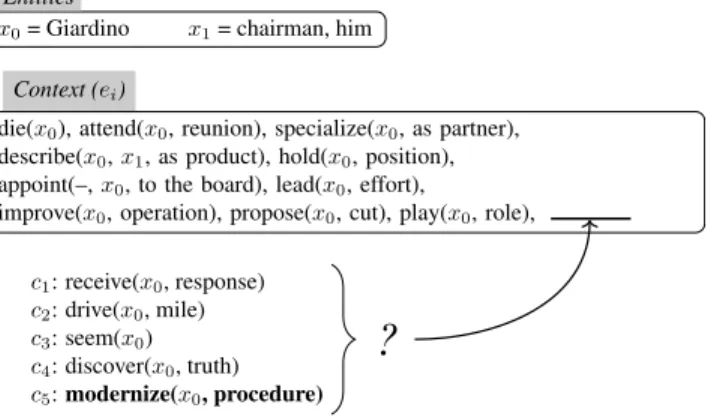
We propose a multiple choice version of the narrative cloze task, MCNC, inspired by multiple choice variants of the cloze task for language assessment (Sadeghi 2014). As before, the system is presented with a series of contextual events,e0, . . . , en−1. It is given five randomly ordered
can-didates, c0, . . . , c4, to choose the next event from, one of which is the observed event, the others sampled at random from elsewhere in the corpus. The randomly sampled events have their protagonist replaced by the protagonist of the cur-rent chain and any other entities replaced by randomly cho-sen other entities from the same document as the current chain. An example is shown in figure 2. MCNC allows us to compare models that take account of richer information from the text about both context and candidate events.
An additional advantage of this form of evaluation is that the task can in principle be completed by humans. A human study would be a valuable comparison to the models’ results. The test data is imperfect, due to noise in the automatic ex-traction process and the random sampling of confounders. Our informal initial human studies suggest these are indeed problems, but not so common as to invalidate conclusions drawn here. We have not yet carried out large-scale human annotation, but plan to do so in the future.
Dataset
Following Chambers and Jurafsky (2008; 2009), we extract events from the NYT portion of the Gigaword corpus (Graff et al. 2003). The event extraction pipeline follows an al-most identical procedure to Chambers and Jurafsky (2009), using the C&C tools (Curran, Clark, and Bos 2007) for PoS
x0= Giardino x1= chairman, him Entities
die(x0), attend(x0, reunion), specialize(x0, as partner), describe(x0,x1, as product), hold(x0, position), appoint(–,x0, to the board), lead(x0, effort),
improve(x0, operation), propose(x0, cut), play(x0, role), Context (ei) c1: receive(x0, response) c2: drive(x0, mile) c3: seem(x0) c4: discover(x0, truth) c5:modernize(x0, procedure)
?
Figure 2: Multiple choice narrative cloze prediction task. The observed event is marked in bold.
tagging and dependency parsing and OpenNLP1for
phrase-structure parsing and coreference resolution. In addition to the events inferred from verbs, we also extract predicative adjectives where an entity is an argument to the verbbeor
become– e.g. Giardino was upset⇒be(x0, upset)– with the intention of approximating narrative state information, just as verbs approximate events. Such information is a po-tentially helpful addition to a model’s output for downstream narrative generation. As in C&J08, other occurrences ofbe
are dropped.
As well as the lemmatized verb and its dependency rela-tion to the chain entity, the dataset also includes any subject, object or indirect object arguments to the verb identified by the parser. This may be another coreference entity (as for
describein figure 2), or the text of a noun phrase (though our models use just the headword of the noun phrase).
We randomly select 10% of the documents in the corpus to use as a test set and 10% to use as a development set, the latter being used to compare architectures and optimize hyperparameters prior to evaluation. For repeatability, we make the lists of documents selected for each set available online2.
Using the full set of extracted chains for evaluation suffers from an over-emphasis on frequent predicate types: e.g., the predicate-GR(have, subj)accounts for 3.5% of the training set. To mitigate this, we build astopeventlist (analogous to
stopwords– frequent words that carry little meaning), con-sisting of the 10 most frequent predicate-GRs in the training set and filter events using these out of the chains used for evaluation. The full training set consists of 830,643 docu-ments, with 11,538,312 event chains.
Models
Chambers & Jurafsky 08
We take C&J08 as our starting point. Each eventeis repre-sented by its predicatep(e)and dependency relation to the
1https://opennlp.apache.org/ 2
http://mark.granroth-wilding.co.uk/\\papers/what\happens\ next/
Predicate events:service(x0, machine), report(x0), put(x0, money, in clubhouse), lie+down(x0),. . . a.word2vec‘sentence’:service:subj report:subj put:subj lie+down:subj
b. word2vec‘sentence’ with arguments:service:subj arg:guards arg:machine report:subj arg:guards put:subj arg:guards arg:money arg:clubhouse lie+down:subj arg:guards
Figure 3: Example chain from figure 1, in the form in which it is presented toword2vec. In a, we learn embeddings for predicate-GRs only, in terms of surrounding predicate-GRs. Inb, we also learn embeddings for argument headwords.
chain’s entityd(e)(together a predicate-GR, see figure 1). As a shorthand, we usepg(e) = (p(e), d(e)).
For any given pair of event types represented in this way, their PPMI is used as a relatedness score, computed from their co-occurrence in the same chains in the training set. Given the event context in MCNC, we compute a scores(c)
for a candidate next eventcby summing its PPMI with each of thencontext events.
s(c) =
n−1 j=0
ppmi(pg(c), pg(ej)) (1)
Bigram
Jans et al. (2012) find that a bigram conditional probability model performs better on the narrative cloze ranking task than C&J08. We evaluate a simple conditional model, BI
-GRAM, that uses maximum likelihood estimates of the prob-ability of each predicate-GR, conditioned on individual pre-vious events. We apply Laplace smoothing to the estimates and backoff to unigram probabilities for unobserved con-texts. The score assigned to a candidate is its average prob-ability given each of the context events.
s(c) = 1 n
n−1 j=0
P(pg(c)|pg(ej)) (2)
Distributional Vector Model
A shortcoming of C&J08 is that it only assigns a score to pairs of events seen together in the training corpus. Models that represent events in a continuous vector space may give more reliable judgements of how likely two infrequent event types are to co-occur. We uselatent semantic indexing(LSI, Deerwester et al. 1990) to represent events in terms of the contexts in which they have been seen, as a baseline for other vector-space models.
A matrix is built of co-occurrence counts of predicate-GRs. Each row represents a predicate-GR and each cell the number of times it appears in the same chain as another par-ticular predicate-GR. Singular value decomposition (SVD) on the matrix produces a lower-dimensional, dense repre-sentation of each predicate-GR,S. We reduce the dimen-sionality to 200.
To get a score for each candidate next event, we compute a representation of the context as the sum of the vectors for each predicate-GR. We score each candidate by the cosine similarity of its predicate-GR’s vector to the context vector3.
3
Levy, Goldberg, and Ramat-Gan (2014) observe that this is equivalent to maximizing the sum of the similarity to each context event.
We refer to this model as DIST-VECS.
s(c) =cosine(
n−1
j=0
Spg(ej), Spg(c)) (3)
We also experimented with a variety of other methods of deriving vectors for events, among them LDA and an LDA-inspired generative model of predicates and arguments closely related to that of Chambers (2013). Since none of them significantly outperformed DIST-VECS on the devel-opment set, we do not discuss them further here.
Word2vec Word Representations
Mikolov et al. (2013a) introduce a method for efficiently learning embeddings (dense vector representations) of words from large text corpora that have proved to be effec-tive at capturing a variety of relations between words and useful for a range of tasks (Mikolov et al. 2013b). They are learned by training askip-grammodel, in which surrounding words are predicted based on vector similarity to the current word. The authors’ implementation is available in the form of theword2vectool.
Embeddings of verbs learned byword2veccould pro-vide a suitable measure to judge the relatedness of two events. E.g., given a context eventcriticize(politician, x0)
and a candidaterepeal(parliament,x0), a close relation be-tween criticizeand repealin the word vector space could provide evidence that this is a good candidate. This method has the advantage that vectors can be learned for a huge vo-cabulary by runningword2vecover a large corpus. It can score almost any pair of events encountered at test time, re-gardless of whether they appeared together, or even at all, in the event chain training set. It also provides a trivial way to compose predicates with their arguments, since their vec-tor representations live in the same, generic word-meaning space. Mikolov et al. (2013a) found that the vectors com-pose well for similarity-based tasks under vector addition.
We try a verb-only model and a verb-argument model. In the verb-only model, MIKOLOV-VERB, we represent an event using the vector for its verb, summing context events as before and computing cosine similarity. We use the 300-dimensional vectorsW trained by Mikolov et al. (2013b) on the Google News corpus and made available by the authors4.
s(c) =cosine( n−1 j=0 Wp(ej), Wp(c)) (4) 4 https://code.google.com/p/word2vec/
MIKOLOV-VERB+ARGrepresents each event as the sum
of the vectors fromWfor its verb and each of its arguments.
s(c) =cosine(
n−1 j=0
Wp(ej)+Wa0(ej)+Wa1(ej)+Wa2(ej), Wp(c)+Wa0(c)+Wa1(c)+Wa2(c)) (5)
Word2vec Event Representations
Another way to useword2vecto derive representations of events is to learn embeddings from the event chains. Like the distributional vector model above, the vectors should have the property that events that occur in similar chain contexts are close together.
Vectors are learned by treating each event’s predicate-GR as a word and each training chain as a sentence presented toword2vec5(see figure 3a). We train a skipgram model
with hierarchical sampling, using a window size of 5 and vector size of 300. We call this WORD2VEC-PRED.
As a first step to including argument words in the vector representations, WORD2VEC-PRED+ARG, we learn a rep-resentation of predicates and arguments together by simply placing all of the words in the ‘sentence’. Thus, each predi-cate and argument functions both as context for surrounding predicates and arguments and as a target word itself (see fig-ure 3b). We increase the window size to 15 to ensfig-ure that as many surrounding events are included in the context as before. The representation of an event is now the sum of the vectors for the predicate-GR and each of the arguments.
s(c) =cosine(
n−1 j=0
Wp(ej):d(ej)+Warg:a0(ej)+
Warg:a1(ej)+Warg:a2(ej),
Wp(c):d(c)+Warg:a0(c)+Warg:a1(c)+Warg:a2(c)) (6)
Neural Compositional Representations
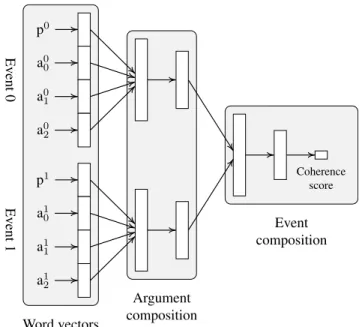
We train a neural network, EVENT-COMP, to learn a non-linear composition of predicates and arguments into an event representation, shown in figure 4. As with WORD2VEC
-PRED+ARG, it has a large vocabulary of vectors correspond-ing to predicate-GR and argument words. The vectors cor-responding to an event’s predicate and each of its argument positions are concatenated to form the first layer represent-ing the event. Zero vectors are used for empty arguments and unseen words. A series of layers (theargument com-position), each with a tanh activation function, produces a lower-dimensional representation of the event. For a pair of events, a further series of layers (theevent composition), again with tanh activation functions and a sigmoid activation function on the final layer, produces a single output value, the coherence score(coh), representing how confident the model is that the two events are from the same chain.
The word vectors are initialized using the vectors learned by WORD2VEC-PRED+ARG. The argument composition
5
We use the Gensim implementation: http://radimrehurek.com/gensim/ Word vectors Argument composition Event composition p0 a00 a01 a02 p1 a10 a11 a12 Coherence score Ev ent 0 Ev ent 1
Figure 4: Neural event composition model, which com-poses each event’s predicates and arguments, then scores how strongly they are expected to appear in the same chain.
layers are initialized by training a stack of denoising autoen-coders, so that the initial representation of an event is an efficient compression of theword2vec-trained representa-tions of its predicate and arguments. The event composition layers are randomly initialized6. Some training iterations are performed updating only the weights of the event com-position. Further iterations then update all the weights, in-cluding the input word vectors7. Although word vectors and
argument composition function weights are updated at this stage for both events in a pair, the parameters are tied, so that only a single event representation network is learned, used for events in both positions.
Both stages minimize the objective function:
1 m m i=1 −log(pi×coh(e0i, e1i)+ (1−pi)×(1−coh(e0i, e1i)) +λL(θ) (7)
where pi = 1 for positive examples and 0 for negative,
coh(e0i, e1i)is the score output by the network for theith
training pair and L(θ) is an l2 regularization term on all weights.
Training the event composition function requires positive and negative samples of pairs of events. For every evente0i
in a chain containing more than one event, another event in the chain is chosen at random to produce a positive sample
(e0i, e1i). An event is also chosen at random from outside 6
Autoencoder pretraining of these layers did not improve the results.
7
We find updating the word vectors at this stage to be benefi-cial (c.f. Modi and Titov 2013). Unlike Modi and Titov, we learn distinct representations for predicates and each argument slot.
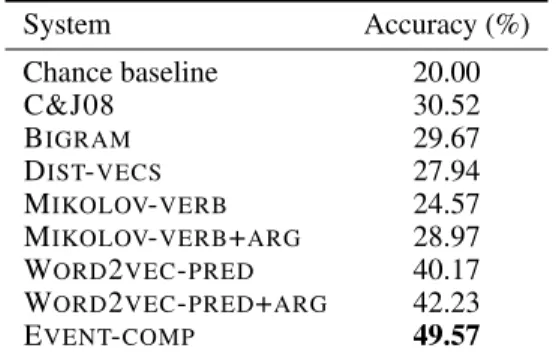
System Accuracy (%) Chance baseline 20.00 C&J08 30.52 BIGRAM 29.67 DIST-VECS 27.94 MIKOLOV-VERB 24.57 MIKOLOV-VERB+ARG 28.97 WORD2VEC-PRED 40.17 WORD2VEC-PRED+ARG 42.23
EVENT-COMP 49.57
Table 1: Model accuracy on the MCNC task.
the current chain to serve ase1ifor a negative sample, which
it is assumed should receive a low score.
The input vector for each word is 300-dimensional. We use two hidden layers in the argument composition, with sizes 600 and 300, and two in the event composition, with sizes 400 and 200. Autoencoders were all trained with 30% dropout corruption for 2 iterations over the full training set, with a learning rate of0.1andλ= 0.001. Both subsequent training stages used a learning rate of0.01andλ= 0.018.
The first (event composition only) was run for 3 iterations, the second (full network) for 8. All stages of training used SGD with 1,000-sized minibatches.
At test time, the model is used to score candidate next events by averaging pairwise scores with the context events, just as in C&J08: s(c) = 1 n n−1 j=0 coh(c, ej) (8)
Results
The test set prediction accuracy of each of the models is shown in table 1. C&J08 performs comfortably above the chance baseline of 20%. BIGRAMachieves the same level of accuracy as C&J08: the difference is not significant9.
DIST-VECS, our baseline vector similarity method, does not
quite match the performance of C&J08.
Using embeddings for just the verb of each event, MIKOLOV-VERB, performs worse than C&J08, but substan-tially above chance. Including the embeddings of argument headwords improves the result, almost matching C&J08. Note that neither of these models is trained on event chain data.
The best results of the predicate-GR-only models were produced by using word2vec to learn vector represen-tations of predicate-GRs from event chains (WORD2VEC
-PRED). A further gain is produced by also learning a representation of argument headwords, WORD2VEC
-PRED+ARG, a considerable improvement over C&J08.
8Learning rates, regularization coefficients and network
archi-tectures were tuned on the development set.
9
Significance under Pearson’sχ2test,p <0.05. All other dif-ferences are significant, except MIKOLOV-VERB+ARG/DIST-VECS
and MIKOLOV-VERB+ARG/BIGRAM.
EVENT-COMP, which learns a complex composition of
arguments and predicates, achieves a further substantial im-provement, giving the best result by far of all the models. We attribute this to a combination of the non-linear argu-ment composition function and the learned non-linear com-bination of the vectors’ dimensions to score event pairs.
Implementations of all the models and the evalua-tion, as well as the evaluation dataset split, are avail-able at http://mark.granroth-wilding.co.uk/\\papers/what\
happens\next/.
Conclusion
We consider the problem of automatic acquisition of event knowledge from text as introduced by Chambers and Ju-rafsky (2008), but with a focus on next event prediction. We introduce a new development of the narrative cloze task (Chambers and Jurafsky 2008): multiple choice narrative cloze. We use this task to compare several approaches to event prediction that involve deriving a vector representation of events. We find that the word2veclearning technique of Mikolov et al. (2013a) can be used to induce event repre-sentations that, like C&J08, use only the predicate-GRs and achieve considerably better predication accuracy. A simple technique for using argument words to influence the vector representation of an event yields further improvement.
We then use the representations of predicates and their arguments learned in this way as initialization to a neural network model that predicts how likely two events are to appear in the same chain by performing a non-linear com-position of their predicates and arguments. At training time, it simultaneously adjusts the word embeddings and learns the predicate-argument composition function and the chain coherence function. This model achieves impressive MCNC prediction accuracy. One possible reason for its success is its ability to capture non-linear interactions between predicates and arguments – e.g. allowingplay golf andplay deadto lie in different regions of the vector space. Examination of the best model’s performance on infrequent events shows that it is better able than C&J08 to generalize what it has learned about co-occurrence of frequent events to rarer items.
In future work, we plan to experiment with methods to combine whole event chains into a single vector, so the model is not limited to learning associations between pairs of events. We also hope to explore ways in which the model can be used in practice by a narrative generation system for suggesting probable events in a given context.
Acknowledgments
This research was funded by European Commission FP7 framework, through the project WHIM 611560.
References
Abend, O.; Cohen, S. B.; and Steedman, M. 2015. In Pro-ceedings of NAACL, 1161–1171. Association for Computa-tional Linguistics.
Balasubramanian, N.; Soderland, S.; Mausam; and Etzioni, O. 2013. Generating coherent event schemas at scale. In
EMNLP, 1721–1731. Association for Computational Lin-guistics.
Chambers, N., and Jurafsky, D. 2008. Unsupervised learn-ing of narrative event chains. InProceedings of ACL, 789– 797. Association for Computational Linguistics.
Chambers, N., and Jurafsky, D. 2009. Unsupervised learn-ing of narrative schemas and their participants. In Proceed-ings of the Joint Conference of the 47th Annual Meeting of the ACL and the 4th International Joint Conference on Nat-ural Language Processing of the AFNLP, 602–610. Associ-ation for ComputAssoci-ational Linguistics.
Chambers, N. 2013. Event schema induction with a prob-abilistic entity-driven model. In Proceedings of EMNLP, 1797–1807. Association for Computational Linguistics. Cheung, J. C. K.; Poon, H.; and Vanderwende, L. 2013. Probabilistic frame induction.CoRRabs/1302.4813. Curran, J.; Clark, S.; and Bos, J. 2007. Linguistically moti-vated large-scale NLP with C&C and Boxer. InProceedings of ACL, Companion Volume Proceedings of the Demo and Poster Sessions, 33–36. Association for Computational Lin-guistics.
Deerwester, S. C.; Dumais, S. T.; Landauer, T. K.; Furnas, G. W.; and Harshman, R. A. 1990. Indexing by latent se-mantic analysis. Journal of the American Society of Infor-mation Science41(6):391–407.
Frermann, L.; Titov, I.; and Pinkal, M. 2014. A hierar-chical bayesian model for unsupervised induction of script knowledge. InProceedings of EACL, 49–57. Association for Computational Linguistics.
Gerv´as, P.; D´ıaz-Agudo, B.; Peinado, F.; and Herv´as, R. 2005. Story plot generation based on CBR. Knowledge-Based Systems18(4):235–242.
Graff, D.; Kong, J.; Chen, K.; and Maeda, K. 2003. En-glish Gigaword, LDC2003T05. Linguistic Data Consor-tium, Philadelphia.
Jans, B.; Bethard, S.; Vuli´c, I.; and Moens, M. F. 2012. Skip n-grams and ranking functions for predicting script events. InProceedings of EACL, 336–344. Association for Compu-tational Linguistics.
Levy, O.; Goldberg, Y.; and Ramat-Gan, I. 2014. Linguistic regularities in sparse and explicit word representations. In
Proceedings of CoNLL, 171. Association for Computational Linguistics.
McIntyre, N., and Lapata, M. 2009. Learning to tell tales: A data-driven approach to story generation. InProceedings of the Joint Conference of the 47th Annual Meeting of the ACL and the 4th International Joint Conference on Natural Language Processing of the AFNLP, 217–225. Singapore: Association for Computational Linguistics.
McIntyre, N., and Lapata, M. 2010. Plot induction and evolutionary search for story generation. InProceedings of ACL, 1562–1572. Association for Computational Linguis-tics.
Mikolov, T.; Chen, K.; Corrado, G.; and Dean, J. 2013a. Efficient estimation of word representations in vector space. InProceedings of Workshop at ICLR.
Mikolov, T.; Sutskever, I.; Chen, K.; Corrado, G. S.; and Dean, J. 2013b. Distributed representations of words and phrases and their compositionality. In Advances in Neu-ral Information Processing Systems, 3111–3119. The MIT Press.
Modi, A., and Titov, I. 2013. Learning semantic script knowledge with event embeddings.CoRRabs/1312.5198. P´erez y P´erez, R., and Sharples, M. 2001. Mexica: A computer model of a cognitive account of creative writ-ing. Journal of Experimental & Theoretical Artificial In-telligence13(2):119–139.
P´erez y P´erez, R., and Sharples, M. 2004. Three computer-based models of storytelling: BRUTUS, MINSTREL and MEXICA.Knowledge-based systems17(1):15–29.
Pichotta, K., and Mooney, R. J. 2014. Statistical script learn-ing with multi-argument events. InProceedings of EACL, 220–229. Association for Computational Linguistics. Regneri, M.; Koller, A.; Ruppenhofer, J.; and Pinkal, M. 2011. Learning script participants from unlabeled data. In
Proceedings of RANLP, 463–470. Association for Compu-tational Linguistics.
Regneri, M.; Koller, A.; and Pinkal, M. 2010. Learning script knowledge with web experiments. InProceedings of ACL 2010, 979–988. Association for Computational Lin-guistics.
Rudinger, R.; Rastogi, P.; Ferraro, F.; and Durme, B. V. 2015. Script induction as language modeling. In Proceed-ings of EMNLP, 1681–1686. Association for Computational Linguistics.
Sadeghi, K. 2014. Phrase cloze: A better measure of read-ing? The Reading Matrix14(1).
Schank, R. C., and Abelson, R. P. 1977.Scripts, plans, goals and understanding. Lawrence Erlbaum.
Turner, S. R. 1994.The creative process: A computer model of storytelling and creativity. Psychology Press.
UzZaman, N.; Llorens, H.; Derczynski, L.; Allen, J.; Ver-hagen, M.; and Pustejovsky, J. 2013. Semeval-2013 task 1: Tempeval-3: Evaluating time expressions, events, and tem-poral relations. InSecond Joint Conference on Lexical and Computational Semantics (*SEM), Volume 2: Proceedings of the Seventh International Workshop on Semantic Evalu-ation (SemEval 2013), 1–9. Association for Computational Linguistics.