POUR L'OBTENTION DU GRADE DE DOCTEUR ÈS SCIENCES
acceptée sur proposition du jury: Prof. G. Ferrari Trecate, président du jury
Prof. C. N. Jones, directeur de thèse Prof. P. Patrinos, rapporteur Prof. J. Lygeros, rapporteur Prof. M. Jaggi, rapporteur
Distributed Optimization and Control using Operator
Splitting Methods
THÈSE N
O8623 (2018)
ÉCOLE POLYTECHNIQUE FÉDÉRALE DE LAUSANNE
PRÉSENTÉE LE 22 JUIN 2018À LA FACULTÉ DES SCIENCES ET TECHNIQUES DE L'INGÉNIEUR LABORATOIRE D'AUTOMATIQUE 3
PROGRAMME DOCTORAL EN GÉNIE ÉLECTRIQUE
Suisse 2018 PAR
Acknowledgements
My greatest thanks goes to my advisor, Colin Jones, for mainly three reasons. First, for the freedom he has given to me in terms of choosing my research directions. Second, for being available for long discussions in front of a whiteboard and for actually engaging in the problem-solving process. Colin has the ability to not only propose an answer to a given question, but also to put together a start-to-end approach involving the questions that will be raised in the process and their potential answers. I was usually left with filling in the missing pieces, which were in most cases, and surprisingly, ‘fillable’. Third, for all the provisions that I enjoyed during my PhD, be it traveling to any conference I would feel like attending, or pursuing side-projects that would interest me. His research style has, unarguably, been a decisive influence on mine, and I have, hopefully, adopted a tiny bit of his practical ‘let’s do something useful with it’ attitude.
I would like to thank my committee members, Prof. Panos Patrinos, Prof. John Lygeros, Prof. Martin Jaggi and Prof. Giancarlo Ferrari Trecate for undertaking the laborious task of reading the dissertation, and for providing me with useful feedback as well as insightful suggestions for continuation of my work. I would also like to thank them for making the exam a pleasant and interesting experience.
I am indebted to Dr. Claus Danielson and Dr. Daniel Burns for hosting me at MERL during the summer of 2016. I really enjoyed the experience of working in such a lax and, at the same time, intriguing environment, which contributed to making my stay in Boston memorable and fun.
Luck plays a significant role in every life experience, and I consider myself really lucky to be in such a great working environment, the LA. The lab is a colorful mosaic of characters, all very different and exceptionally interesting. Everybody contributed in creating a warm and friendly atmosphere, fostering both fruitful collaborations and a great deal of extracurricular activities. More specifically, many thanks go to the first generation that warmly welcomed me to LA, Milan, Jean-Hubert, Andrea, and Ye, as well as the rest of the gang that joined roughly at the same time as I did, namely Tomasz, Faran, Altug; it was great having you all around. In addition, a big thanks goes to the whole LA; thanks Sanket, Francisco, Martand, Tafarel, Predrag, René, Luca, Kristoph, Harsh, Ehsan, Yanni, Truong, Ivan, Diogo, Michele, Peter, Zlatko, Sean, Niketh, Basile, Mahdieh, Melanie, Timm and the newcomers Pulkit and Mustafa. I am happy that I had the chance to share with each and every one of you views on both academic and non-academic topics. I am also thankful to the professors and the non-perishable members of LA for creating and maintaining such a family-like atmosphere through several initiatives; Dominique, Roland, Ali, Christophe, Philippe, and Sandra. A special thanks to the people who made my life easier on several occasions; Francis, Norbert, Christophe, Francine, Ruth, Eva, Margot, and Nicole.
Emre, Iris, Lorenzo, Vasili (a.k.a. Skylos) and the whole greek gang that’s still lingering in Switzer-land. Thanks to the EPFL migrants with whom we coincided in Boston and had the chance to revive the Swiss wine-tasting atmosphere in several occasions: Elda, Guillaume, and Xiaowen. A huge thanks goes to my lifelong friends Dimitris, Kostas, Yannis, and Giorgos for patiently listening to my uninteresting academic-life stories, for sharing a room during the summer vacations, and for regulating me whenever it was getting too much or too little.
It would be no exaggeration to say that my decision to come to Lausanne and pursue a PhD here was thanks to Dorina and Vicky, the closest thing to a ‘family’ that I have in Switzerland. Thank you for hosting me during the first period and for constantly being there providing both material and immaterial help. Special thanks to Vaggelis, whose arrival extended the family by two more members, and who reminded me of my adolescence on numerous occasions. My deepest thanks go to Dorina, for always caring to understand me, to find out what it is that I really want and make it a common goal, and for being supportive beyond what is expected, many times at a personal cost. She has also developed the ability to listen to my ongoing monologues on topics that she could not care less about, sometimes giving me the impression that what I say is interesting.
Last but not least, I owe my most profound gratitude to my parents and brother for their unconditional love and support. They have always made it possible for me to pursue my academic goals, at, literally, any cost. More importantly, the values and principles they have taught me have shaped who I am; and I am thankful for that.
Abstract
The significant progress that has been made in recent years both in hardware im-plementations and in numerical computing has rendered real-time optimization-based control a viable option when it comes to advanced industrial applications. At the same time, the field of big data has emerged, seeking solutions to problems that classical optimization algorithms are incapable of providing. Though for different reasons, both application areas triggered interest in revisiting the family of optimization algorithms commonly known as decomposition schemes or operator splitting methods. This lately revived interest in these methods can be mainly attributed to two characteristics: Com-putationally low per-iteration cost along with small memory footprint when it comes to embedded applications, and their capacity to deal with problems of vast scales via decomposition when it comes to machine learning-related applications.
In this thesis, we design decomposition methods that tackle both small-scale cen-tralized control problems and larger-scale multi-agent distributed control problems. In addition to the classical objective of devising faster methods, we also delve into less usual aspects of operator splitting schemes, which are nonetheless critical for control. In the centralized case, we propose an algorithm that uses decomposition in order to exactly solve a classical optimal control problem that could otherwise be solved only approximately. In the multi-agent framework, we propose two algorithms, one that achieves faster convergence and a second that reduces communication requirements.
In the first part, we look into the infinite-horizon constrained linear quadratic reg-ulator (CLQR) problem. The solution to the classical unconstrained version of the problem (LQR) is known to exist in closed form, and to come with stability guarantees for the closed-loop system. The addition of constraints to the LQR formulation ren-ders the problem unsolvable in closed form and challenging due to the infinite number of optimization variables. We propose to use decomposition in order to take advan-tage of the closed-form solution of the LQR, consequently splitting the CLQR into two subproblems, an infinite-dimensional least squares problem, and a simple projection operation of an infinite sequence to the non-positive orthant, both of which are solved in closed form by means of the accelerated projected gradient method (ProjGM). The solution enjoys all the theoretical benefits of using an infinite-horizon cost. Numerical simulations demonstrate the good practical performance of the scheme when compared to regular MPC.
The remaining two parts of the thesis deal with distributed optimization algorithms applied in settings where heterogeneous agents collaborate under the presence of a global coordinator to achieve some objective. Our motivation for studying this setting stems from smart grid applications, where energy resources cooperate in order to deliver some ancillary service to the network operator based on some contract. Distributed optimiza-tion research has been primarily motivated by machine learning applicaoptimiza-tions involving
large datasets and parallel multicore architectures. The nature of our problems of in-terest, however, dictates the adoption of a different angle in the analysis of distributed optimization algorithms. More specifically, the problems’ scale we are interested in is generally medium to large, but not huge, and there is a focus on real-time rather than offline execution. Instead of processors who perform read/write operations on a shared memory we have (physical) agents governed by dynamics who often solve local optimization problems, the details of which should remain private, and who might be running on limited resources. Several of these characteristics pose new challenges and ask for novel solutions.
We initially focus on speeding-up the solution process in such multi-agent settings. This is achieved by enabling more agents to update in a unit of time. We assume that the agents’ local optimization problems differ from one another in terms of their solve time. This characteristic motivates asynchronous optimization since it is more beneficial that the agents update in arbitrary sequences and with arbitrary frequencies instead of synchronizing their updates based on the slowest of them. We propose an asynchronous version of the forward-backward iteration that does not assume any probability distri-bution for the activation of the agents. We prove linear convergence of an accelerated version of the method under some structural assumptions on the involved functions. Thanks to the general nature of the forward-backward iteration, the scheme results in several novel asynchronous and accelerated versions of commonly used algorithms. We demonstrate the superiority of the scheme in comparison to other asynchronous algo-rithms in a simulated setting, where we employ our proposed version of the proximal gradient method (PGM) to solve a distributed load-sharing problem, where a population of smartly-actuated buildings is asked to track a power signal generated by the network operator. The asynchronous forward-backward iteration results in faster convergence at the expense of increased communication.
In the third part of the thesis, we reverse the trade-off and favor computation over communication. We consider the same distributed multi-agent framework with one global coordinator. In the majority of these schemes, the local subproblems that need to be solved are cast as proximal minimization problems. By studying the properties of the proximal operator, we develop a protocol where the coordinator can ‘guess’ the solution to an agent’s local optimization problem and spare some communication rounds. The proposed scheme enables the coordinator to construct a convex set within which the agents’ optimizers reside, and to iteratively refine the set every time that an agent is queried. The approach is tested on a load-sharing problem similar to the one described in the previous paragraph while employing thealternating direction method of multipliers
(ADMM) to solve the problem.
In summary, we study in this thesis the potential of operator splitting methods when applied to constrained optimal control problems. Based on these methods, we design algorithms that successfully compete with existing solution approaches in terms of speed, and others that examine different strengths of these methods in distributed optimization settings. We hope that the research efforts in this thesis will benefit modern optimization-based control applications such as distributed control of smart energy networks, but will also inspire both alternative uses of decomposition methods
vii and further algorithmic developments.
Keywords: convex optimization, splitting methods, decomposition, distributed op-timization, multi-agent systems, proximal operator, Moreau envelope, model predictive control, linear quadratic regulator, asynchronous optimization, smart grid, load sharing, energy networks
Résumé
Les progrès significatifs réalisés ces dernières années, tant au niveau de l’implemen-tation matérielle et du calcul numérique, ont fait du contrôle basé sur l’optimisation en temps réel une option viable pour des applications industrielles avancées. Dans le même temps, le domaine du big data a émergé, cherchant des solutions à des problèmes que les algorithmes d’optimisation classiques sont incapables de fournir. Bien que pour des raisons différentes, ces deux domaines d’application ont poussé la communauté à revisiter la famille des algorithmes d’optimisation communément appelés schémas de décomposition ou méthodes de séparation des opérateurs. Cet intérêt récemment ravivé pour ces méthodes peut être attribué principalement à deux caractéristiques : un coût par itération très bas et une faible empreinte mémoire pour les applications embarquées, et leur capacité à traiter des problèmes de grande échelle via la décomposition lorsqu’il s’agit d’applications liées à l’apprentissage artificiel.
Dans cette thèse, nous concevons des méthodes de décomposition qui s’attaquent à la fois aux problèmes de contrôle centralisé à petite échelle et aux problèmes de contrôle distribué multi-agents à plus grande échelle. En plus de l’objectif classique de conce-voir des méthodes plus rapides, nous nous penchons également sur des aspects moins habituels des schémas de decompoisition des opérateurs, qui sont néanmoins critiques pour le contrôle. Dans le cas centralisé, nous proposons un algorithme qui utilise la dé-composition pour résoudre exactement un problème de contrôle optimal classique qui, autrement, ne pourrait être résolu qu’approximativement. Dans le cadre des problemes multi-agent, nous proposons deux algorithmes, l’un qui permet une convergence plus rapide et l’autre qui réduit les besoins de communication.
Dans la première partie, nous nous penchons sur le problème du régulateur quadra-tique linéaire à horizon infini (CLQR). La solution à la version classique sans contrainte du problème (LQR) est connue pour exister sous forme fermée, et offrir des garanties de stabilité pour le système en boucle fermée. L’ajout de contraintes à la formulation LQR rend le problème insoluble analytiquement et difficile à résoudre en raison du nombre infini de variables d’optimisation. Nous proposons d’utiliser la décomposition pour pro-fiter de la solution analytique du LQR, en divisant par conséquent le CLQR en deux sous-problèmes, un problème de moindres carrés de dimensions infinie, et une simple opération de projection d’une séquence infinie sur l’orthant non-positif, les deux étant résolus analytiquement au moyen de la méthode du gradient projeté accéléré. La solu-tion bénéficie de tous les avantages théoriques de l’utilisasolu-tion d’un coût à horizon infini. Les simulations numériques démontrent la bonne performance pratique du système par rapport au MPC classique.
Les deux autres parties de la thèse traitent des algorithmes d’optimisation distri-bués appliqués dans des contextes où des agents hétérogènes collaborent sous la présence d’un coordinateur global pour atteindre un objectif. Notre motivation pour étudier ce paramètre provient des applications de réseau intelligent, où les ressources énergétiques coopèrent afin de fournir un service auxiliaire à l’opérateur de réseau sur la base d’un
ix contrat. La recherche en optimisation distribuée a été principalement motivée par des applications d’apprentissage automatique impliquant de grands ensembles de données et des architectures multi-cœurs parallèles. La nature de nos problèmes d’intérêt, cepen-dant, dicte l’adoption d’un angle différent dans l’analyse des algorithmes d’optimisation distribués. Plus précisément, l’échelle des problèmes qui nous intéresse est généralement moyenne à grande, mais pas énorme, et l’accent est mis sur l’exécution en temps réel plutôt que sur l’exécution hors ligne. Au lieu de processeurs qui effectuent des opérations de lecture/écriture sur une mémoire partagée, nous avons des agents (physiques) régis par des dynamiques qui résolvent souvent des problèmes d’optimisation locale, dont les détails sont censés rester privés, et qui peuvent fonctionner avec des ressources limitées. Plusieurs de ces caractéristiques posent de nouveaux défis et demandent des solutions novatrices.
Dans un premier temps, nous étudions comment accélérer le processus de solution dans de tels environnements multi-agents. Ceci est réalisé en permettant à un plus grand nombre d’agents de se mettre à jour par unité de temps. Nous supposons que les problèmes d’optimisation locale des agents diffèrent les uns des autres en termes de temps de résolution. Cette caractéristique motive l’optimisation asynchrone puisqu’il est plus avantageux que les agents se mettent à jour dans des séquences arbitraires et avec des fréquences arbitraires au lieu de synchroniser leurs mises à jour en fonction de la plus lente d’entre elles. Nous proposons une version asynchrone de l’itération for-ward/backward qui ne requiert aucune distribution de probabilité pour l’activation des agents. Nous prouvons la convergence linéaire d’une version accélérée de la méthode sous certaines hypothèses structurelles sur les fonctions impliquées. Grâce à la nature générale de l’itération forward/backward, le schéma aboutit à plusieurs nouvelles ver-sions asynchrones et accélérées d’algorithmes couramment utilisés. Nous démontrons la supériorité du schéma par rapport à d’autres algorithmes asynchrones dans un environ-nement simulé, où nous employons notre version proposée de la méthode du gradient proximal pour résoudre un problème de répartition de charge, où une population de bâtiments intelligemment actionnés doit suivre un signal de puissance généré par l’opé-rateur du réseau. L’itération asynchrone forward/backward entraîne une convergence plus rapide au détriment d’une communication accrue.
Dans la troisième partie de la thèse, nous inversons le compromis et favorisons le calcul par rapport à la communication. Nous considérons le même cadre multi-agents distribué avec un seul coordinateur global. Dans la majorité de ces schémas, les sous-problèmes locaux qui doivent être résolus sont présentés comme des sous-problèmes de mi-nimisation proximale. En étudiant les propriétés de l’opérateur proximal, nous déve-loppons un protocole où le coordinateur peut ‘deviner’ la solution au problème d’op-timisation locale d’un agent et éviter certaines étapes de communication. Le schéma proposé permet au coordinateur de construire un ensemble convexe dans lequel résident les optimiseurs des agents et d’affiner de façon itérative l’ensemble à chaque fois qu’un agent est interrogé. L’approche est testée sur un problème de répartition de charge si-milaire à celui décrit dans le paragraphe précédent tout en utilisant la méthode des multiplicateurs à direction alternée pour résoudre le problème.
opérateurs lorsqu’elles sont appliquées à des problèmes de contrôle optimal contraint. Sur la base de ces méthodes, nous concevons des algorithmes qui concurrencent avec suc-cès les solutions existantes en termes de vitesse, et d’autres qui examinent les différentes forces de ces méthodes dans des situations d’optimisation distribués. Nous espérons que les efforts de recherche de cette thèse profiteront aux applications modernes de contrôle basées sur l’optimisation, comme le contrôle distribué des réseaux d’énergie intelligents, mais inspireront aussi bien des utilisations alternatives des méthodes de décomposition que de nouveaux développements algorithmiques.
Mots Clés :optimisation convexe, méthodes de fractionnement, décomposition, op-timisation distribuée, systèmes multi-agents, opérateur proximal, enveloppe de Moreau, contrôle prédictif de modèle, régulateur quadratique linéaire, optimisation asynchrone, réseau intelligent, partage de charge, réseaux d’énergie.
Contents
1 Introduction 1
1.1 Outline and Contribution . . . 3
1.2 Publications . . . 3 2 Preliminaries 7 2.1 Convex Optimization . . . 8 2.1.1 Function properties . . . 8 2.1.2 Fenchel Duality . . . 8 2.1.3 -subgradient . . . 9
2.2 Proximal Splitting Methods . . . 10
2.2.1 Proximal Point Algorithm (PPA) . . . 10
2.2.2 Moreau Envelope . . . 11
2.2.3 Proximal Gradient Method (PGM) . . . 11
2.2.4 Dual Proximal Gradient Method and Alternating Minimization Algorithm . 12 2.2.5 Douglas-Rachford Splitting and Alternating Direction Method of Multipliers 13 2.2.6 Convergence Rates and Inertial Acceleration . . . 14
2.3 Monotone Operators . . . 17
2.3.1 Basics on Monotone Operators . . . 17
2.3.2 The Krasnosel’ski˘i-Mann Iteration . . . 19
2.4 Model Predictive Control . . . 19
2.4.1 Invariance and Lyapunov Stability . . . 20
2.4.2 Linear Quadratic Regulator . . . 20
2.4.3 Linear Model Predictive Control . . . 21
2.5 Distributed Ancillary Service Provision with Controllable Buildings . . . 22
3 Infinite-Horizon Constrained Linear Quadratic Regulator 27 3.1 Introduction . . . 27
3.2 Related work . . . 28
3.3 Problem statement . . . 29
3.4 Dualization . . . 30
3.5 Solution using Accelerated Dual Proximal Gradient Method . . . 31
3.6 Convergence results . . . 35
3.7.1 Stepsize selection . . . 39 3.7.2 Complexity . . . 40 3.7.3 Warm-starting . . . 41 3.8 Examples . . . 41 3.8.1 Toy system . . . 41 3.8.2 Quadcopter system . . . 45 3.8.3 Timings . . . 45 3.9 Conclusion . . . 49 3.10 Appendices . . . 50
3.10.1 Required Operator Theory . . . 50
3.10.2 Boundedness of several operators . . . 51
3.10.3 Backtracking stepsize rule . . . 53
4 Inertial Parallel and Asynchronous Forward-Backward Iteration for Distributed Convex Optimization 56 4.1 Introduction . . . 56
4.2 Related work . . . 57
4.3 Problem description . . . 58
4.3.1 Asynchronous updates . . . 58
4.3.2 An asynchronous inertial forward-backward iteration . . . 58
4.3.3 Main contribution . . . 62
4.4 Convergence proof . . . 62
4.4.1 Express delayed variables as additive error . . . 63
4.4.2 Isolate the error . . . 64
4.4.3 Bound the error recursively . . . 64
4.4.4 Bound the error with respect to the maximum distance from the set of fixed points . . . 65
4.4.5 Condition for convergence . . . 65
4.5 Connection to other methods . . . 66
4.5.1 Gradient descent . . . 66
4.5.2 Proximal gradient . . . 66
4.5.3 Other methods . . . 66
4.6 Application: Distribution network real-time dispatch . . . 67
4.6.1 Modeling the agents . . . 67
4.6.2 Modeling the dispatch problem . . . 68
4.6.3 Simulation setup . . . 69 4.7 Conclusion . . . 71 4.8 Appendices . . . 72 4.8.1 Proof of Lemma 13 . . . 72 4.8.2 Proof of Lemma 14 . . . 72 4.8.3 Proof of Lemma 15 . . . 74 4.8.4 Proof of Lemma 16 . . . 75 4.8.5 Proof of Thoerem 7 . . . 77
CONTENTS xiii
5 Estimating the Proximal Operator 80
5.1 Introduction . . . 80
5.2 Related work . . . 81
5.3 Problem description . . . 82
5.4 Estimating the solution to a proximal minimization problem . . . 83
5.5 Communication . . . 88
5.5.1 Non worst-case candidates . . . 91
5.5.2 The algorithmic schemes . . . 91
5.6 Convergence . . . 93
5.6.1 Convergence of ADMM . . . 94
5.6.2 Convergence of randomized coordinate descent PGM . . . 95
5.7 Applications . . . 96
5.7.1 Distributed Load Sharing . . . 96
5.7.2 Optimal Price Adjustment . . . 99
5.7.3 Randomized Coordinate Load Sharing . . . 102
5.8 Conclusion . . . 105 5.9 Appendices . . . 105 5.9.1 Proof of Proposition 2 . . . 105 5.9.2 Proof of Proposition 5 . . . 106 5.9.3 Proof of Theorem 8 . . . 106 5.9.4 Proof of Proposition 6 . . . 107 5.9.5 Proof of Proposition 7 . . . 108 5.9.6 Proof of Theorem 10 . . . 109
6 Extensions and Conclusions 114 6.1 Infinite horizon control . . . 114
6.2 Asynchronous optimization . . . 115
6.3 Learning a proximal problem . . . 117
A Appendix 120 A.1 Derivation of the Alternating Direction Method of Multipliers from Douglas-Rachford Splitting . . . 120
List of Figures
2.1 The Moreau envelope of a linear function constrained in [-3,1]. The proximal evalu-ations at several randomly generated points gradually form the envelope. Note that the minimum values coincide. . . 11 2.2 Sketch of a network of buildings with a battery energy storage system (agents) and
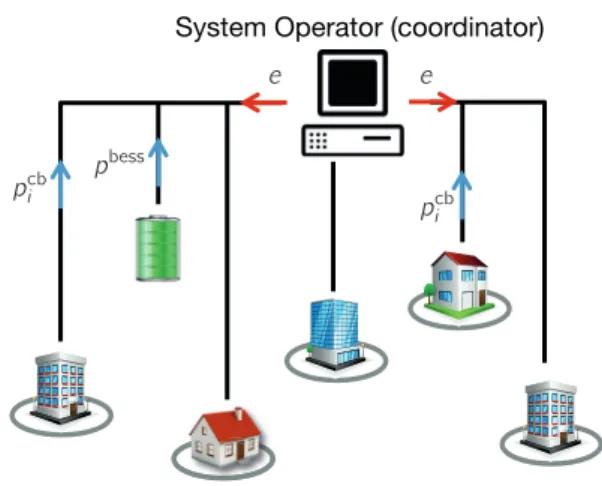
a global system operator (coordinator). The agents communicate their individual consumption vectors (pcbi , pbess) and the coordinator uses them in order to form an incentive signal (e) that will be in turn communicated to them. . . 23
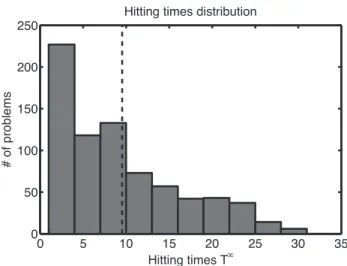
3.1 Histogram ofT∞= maxk{Tk}for 750 initial conditions of the 2 state system sampled from a normal distribution around(−3,0.3)with covariance matrixdiag(4,0.4). . . 42 3.2 Reachable sets for several horizon lengths and the LQ terminal set. The computation was
done using the MPT3 toolbox [HKJM13]. It is apparent that a short horizon length reduces significantly the feasible region of the problem.. . . 44 3.3 Comparison of MPC with finite horizon length, for several horizons, with CLQR. The
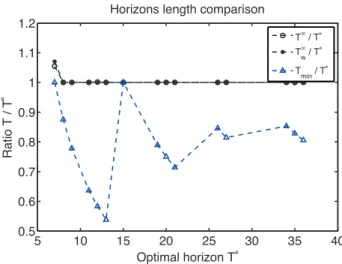
hor-izontal axis corresponds to the optimal horizon lengthT∗ per initial condition. AsT∗ in-creases, the corresponding states are sampled further from the origin. MPC with terminal set is depicted with the solid lines, while without terminal set with dashed lines. CLQR is performed both with the weight sequence, denoted asTw∞CLQR, and without the weights, denoted asT∞ CLQR. . . 44 3.4 Evolution of the ratios Tmin
T∗ , T ∞
w
T∗ and T ∞
T∗ for the sampled initial conditions.. . . 45
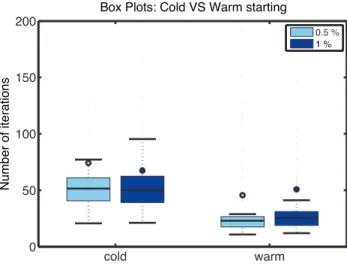
3.5 Histogram of T∞ = maxk{Tk} for 272 initial conditions sampled with a Hit-And-Run algorithm. . . 46 3.6 Box plots for the average number of iterations of the warm-starting policy, given
0.5%and1%uniform perturbations of the initial state are depicted. The horizontal line inside the box corresponds to the median, the edges of the box are the25th and
75th percentiles while the horizontal lines outside the boxes correspond to the most
extreme data points not considered outliers. Finally, the colored dots correspond to mean values. Warm-starting improves the performance of the suggested method in both cases, in all the depicted statistical measures. . . 46
LIST OF FIGURES xv 3.7 Solve times of the CLQR solver versus CPLEX, MOSEK and QPgen for the toy
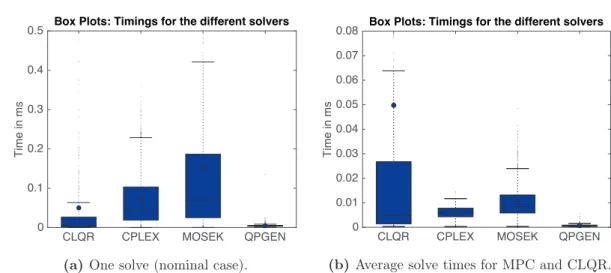
system, sampled from 750 initial conditions. In (a), the CLQR generally requires less time than solving a series of finite horizon optimal control problems, leading to the same optimal solution. Only the solver QPgen clearly outperforms our proposed approach, which makes use of the same, in principle, splitting method, enhanced by several add-on’s that enable speedup. In(b) the three solvers are faster. The large variance of the CLQR approach in comparison to the others is a typical charac-teristic of first-order methods, and can be significantly reduced with appropriately conditioning of the problem. . . 48 3.8 Iteration and factorization counts for the toy system. It can be seen in (a) that
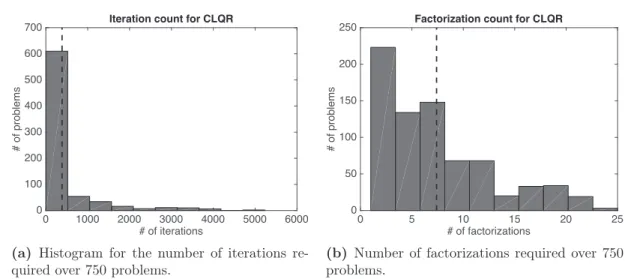
more than80% of the problems needed less than 400 iterations in order to converge, while the maximum number observed is around 5000 iterations. The mean value of factorizations in (b) is seven while no problem instance needed more than 25 factorizations. . . 49 4.1 BufferW is filled by the Write thread and emptied by the Compute thread. Similarly,
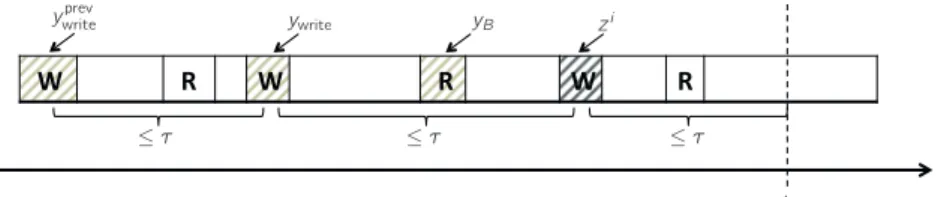
R is filled by the Compute thread and emptied by the Read thread. The scheme executes continuously and asynchronously, both at the coordinator level (concurrent threads) and at the interface between the agents and the coordinator. . . 61 4.2 An update is about to occur at k + 1. From Assumption 5, the observed agent
will update again no later than τ time epochs after zi was communicated to the coordinator. Consequently, ywrite cannot be further than 2τ from the next update, whileyprevwritecannot be further than 3τ. . . 63 4.3 Distance from optimizer VS wall-clock time. . . 70 4.4 The reference signal to be tracked is depicted in red. The contribution of the BESS
is colored in dark blue, that of the medium scale buildings in lighter blue and that of the two large buildings in green. The contribution of the small buildings is colored in pink, but is hardly visible due to their small capacity and despite their large population. 71 5.1 The epigraph of the envelope functionfγ(z)and that of the quadratic upper
bound-ing functionfγ(z;z1)are illustrated. For any point centered atvthat liesbelow the epigraph offγ(z;z1), the -subdifferential set is depicted as the normal cone of the set constructed by the tangent hyperplanes ofepi (fγ(z;z1)), depicted with the grey lines, at(v, fγ(v;z1)−). The actual gradient∇fγ(v)is contained in all∂fγ(v;z1)
for≥∗(v;z1). Asis getting smaller, the subdifferential sets shrink, and converge to ∂∗(v;z1)f
γ
(v;z1), depicted by the normal cone to the set illustrated by the blue lines in the right figure. . . 84 5.2 Assuming two query pointsz1 andz2, ∇fγ(v)can be located in the intersection of
the two normal cones, which is sketched in purple color. In addition, the function
fγ(z | J) = conv{fγ(z;z1), fγ(z;z2)}is drawn in deep red color. It is evident that the normal cone corresponding to the intersection of the two sets (left) is identical to the set∂∗(v|J)fγ(v| J)on the right. . . 87 5.3 Performance in terms of communication savings. . . 100 5.4 Tracking of a reference by a mix of small (pink) and medium scale (blue) buildings. 101
5.5 Performance in terms of communication savings for the price adjustment (dispatch) problem. . . 103 5.6 Performance in terms of communication savings for the randomized coordinate
List of Tables
3.1 Closed loop comparison between CLQR and MPC . . . 49
4.1 Micro-grid case study overview . . . 68
4.2 Accuracy reached withinT s= 40sec. . . 70
4.3 Average number of updates per agent within simulation time. . . 70
Chapter 1
Introduction
The impressive developments that have occurred in recent years both in hardware implementations and in numerical computing have resulted in rapidly falling prices in sensor and actuator tech-nologies. As a consequence, there is a massive deployment of sensing and communication hardware along with embedded computer platforms in a range of devices, a phenomenon that brought about a twofold change. First, once prohibitively expensive technologies are now available as consumer goods, as for example powerful smartphone devices and drones. Second, well-established industrial paradigms are questioned. For example, in modern electricity grids, the deployment of sensors and actuators along with increased computational capacity transforms traditionally passive loads into active producer-consumer (prosumer) entities, which are capable of engaging into decision making and of negotiating the provision of services to the network operator.
It is fair to say that mathematical optimization has been playing an active role for decades in enhancing the decision-making capacity of systems like the ones mentioned above. For example, the mathematical optimization framework has given rise tomodel predictive control (MPC), a control paradigm where one chooses the best possible control action from a set of candidate choices based on some performance criterion while guaranteeing safety of operations. MPC has been successfully applied to the process industry and has nowadays become a control standard. However, and in contrast to process industry applications, the current challenges push the limits of optimization-based solutions in terms of two specifications: increased computational speed and ability to deal with problems in a distributed way. The exploration of novel optimization algorithms that are capable of satisfying these specifications triggered interest in revisiting the family of optimization algorithms commonly known as decomposition schemes oroperator splitting methods. These algorithms have proven to be promising candidates thanks to two characteristics: Computationally low per-iteration cost along with small memory footprint for time-critical (control) applications that run on limited resources, and their capacity to deal with problems that need to be solved in a distributed way due to size, physical limitations or privacy requirements.
The speed requirement has triggered considerable interest in the control community, and as a result many efficient high-speed solvers have been developed for both linear and nonlinear con-trol, based on either first-order methods (FiOrdOs [Ull11], QPgen [GB],[GB15], DuQuad [NP15]),
interior point (IP) methods (FORCES [DZZMJ12], CVXGEN [MB12]) and active set methods
mak-ing its appearance more recently [OSB13], [GTSJ15], [GB], [GB15], [PB14b], and has demonstrated promising performance outcomes. Moreover, the ability of the latter methods to break the problem into simpler subproblems implies that there might be more to benefit from than only computational savings. Knowing that linear MPC is only an approximation to an infinite-dimensional constrained optimal control problem, one question that naturally arises is whether decomposition can be useful in helping to tackle the original problem while staying on par with MPC solvers in terms of speed and efficiency. The practical advantages of solving the original problem instead of the approxima-tion are not negligible either since the optimal control law comes with stability guarantees and for a larger set of initial states. The resulting scheme could thus be a competitor to linear MPC.
The low per-iteration cost that motivates the use of operator splitting methods in embedded MPC platforms is yet another reason that these algorithms are preferred for large-scale applica-tions. On the downside, however, these methods suffer from sublinear convergence rates, achieving initially quick progress towards some optimal point that subsequently levels off. Several ways to remedy this behavior have been proposed, including alternative metric selections [CV14; RL15; GB; GB15], relaxation strategies and inertial acceleration [AA01]. When it comes to large-scale machine learning-related applications, however, the inherent parallelization potential of operator splitting schemes can result in significant computational speedups, compensating for the often poor convergence rates. With that in mind, a considerable amount of research has been produced in asynchronous implementations, i.e., in problems when, e.g., the decision vector is stored in the shared memory space of a multicore computer and can be accessed and altered by the cores in an intermittent manner [LW15; PXYY16]. For example, a fitting problem might be so large that the features are assigned to different cores. Each core trains a block of features using a local model, and the blocks are updated by the cores in a continuous and asynchronous way. A reasonable thought is, therefore, to combine acceleration strategies which improve the theoretical convergence rate with asynchronous implementations and study the performance of the resulting schemes. The develop-ment of such schemes need not necessarily be beneficial only for multicore architectures, but rather for any setting that constitutes an inhomogeneous mixture of agents, the computations of which do not occur at a common rate.
Sometimes the need for solving a problem in a distributed manner does not stem from speedup requirements or size restrictions, but rather from physical limitations or privacy requirements. Take, for example, a population of physical agents that operate under a global coordinator in order to collaboratively solve a problem. In a convex setting, the local subproblems that need to be solved are often cast as proximal minimization problems, a term used to describe optimization problems that are regularized by the addition of a properly scaled quadratic term in their objective [PB14a]. The agents’ data must remain private and not be shared with the coordinator, thus communication between the two parties looks unavoidable. However, the special structure of proximal minimization problems allows the coordinator to gradually construct a model of the agent, which is iteratively refined every time that a communication round takes place. This observation has several implica-tions and can be used in different ways. One possible use is communication reduction in multi-agent setups when communication is costly. At the same time, such a communication protocol can raise privacy issues since the coordinator is able to gradually learn the value functions of the network agents. Studying such scenaria can, therefore, be valuable.
1.1 Outline and Contribution 3
1.1
Outline and Contribution
This dissertation is organized into five main chapters. Chapter 2 introduces some preliminary ma-terial that is necessary for the main chapters of the thesis. We start by giving some basic definitions from convex optimization and proceed with a presentation of the proximal operator, its relation to several operator splitting algorithms and its interpretation as an envelope function. We also briefly discuss the convergence properties of first-order methods and existing techniques for accelerating them. We subsequently give an introduction to monotone operators and represent the mentioned algorithms in this framework, i.e., as fixed-point iterations. The next section gives a short intro-duction to the basics of linear MPC, while the chapter concludes with a mention to electrical distribution grids and the services that can be provided by aggregations of smart buildings, which is the demonstration platform for the methods developed in this thesis.
In Chapter 3 we propose a method that solves the infinite-horizon constrained LQR problem using an accelerated version of the proximal gradient method. We prove that the method converges to the optimal infinite-horizon sequence and we derive convergence rates for the function values and the iterates. To the best of our knowledge, the proposed scheme is the least computationally intensive and the most scalable of the existing ones. Moreover, an exhaustive numerical analysis demonstrates the good convergence properties of the algorithm when warm-started in order to solve a sequence of optimal control problems, and that it is comparable to (and often faster than) corresponding MPC implementations.
The remaining parts of the thesis depart from centralized embedded control and focus on dis-tributed optimization in multi-agent environments in the presence of a global coordinator. The agents are represented as controllable loads, namely linear models of controlled commercial build-ings and battery energy storage systems. Two cases are considered. In Chapter 4 we propose an asynchronous and accelerated optimization splitting scheme that solves a cooperative tracking prob-lem using the mix of agents. Contrary to the majority of asynchronous optimization algorithms, the proposed scheme does not assume any probability distribution for the activation of the agents. We prove linear convergence of the algorithm under some structural assumptions on the involved functions.
In Chapter 5 we reverse the trade-off and favor computation over communication. Making use of fundamental properties from convex analysis we show that an optimizer of an instance of a proximal minimization problem can be located inside a convex set that can be explicitly generated as the intersection of ellipsoids. The agents solve local proximal minimization problems. As a result of the analysis, we propose a communication protocol where the coordinator constructs and maintains one set per agent, so as to locate its solution without communicating. We match the protocol to several distributed optimization algorithms and demonstrate its capability in terms of communication reduction in several examples.
Finally, we conclude the dissertation in Chapter 6 by discussing some possible extensions.
1.2
Publications
The material for Chapters 2, 3, 4 and 5 was taken from a series of papers. More specifically, we have the following:
Parts of Chapter 2 are taken from the following publication:
• G. Stathopoulos, H. Shukla, A. Szucs, Y. Pu, and C. N. Jones, “Operator splitting methods in control”, Foundations and TrendsR in Systems and Control, vol. 3, no. 3, pp. 249–362, 2016. [SSSPJ16]
Manuscript available athttps://infoscience.epfl.ch/record/225464 Chapter 3 is based on the following two publications:
• G. Stathopoulos, M. Korda, and C. N. Jones, “Solving the infinite-horizon constrained LQR problem using splitting techniques”, in19th IFAC World Congress, 2014. [SKJ14]
Manuscript available athttps://infoscience.epfl.ch/record/252916?&ln=en
• G. Stathopoulos, M. Korda, and C. N. Jones, “Solving the Infinite-Horizon Constrained LQR Problem using Accelerated Dual Proximal Methods”,IEEE Transactions on Automatic Con-trol, vol. 62, no. 4, pp. 1752–1767, 2017. [SKJ17]
Manuscript available athttps://infoscience.epfl.ch/record/225463?ln=en C++ code is publicly available onhttps://github.com/stathopog/InfHorCLQR Chapter 4 is taken from the following submission:
• G. Stathopoulos and C. N. Jones, “An Inertial Parallel and Asynchronous Forward-Backward Iteration for Distributed Convex Optimization”,Submitted to Journal of Optimization Theory and Applications, 2018. [SJ18a]
Manuscript available athttps://arxiv.org/abs/1706.00088
A Julia notebook is available onhttps://github.com/stathopog/AsyncInertialFBS Chapter 5 is based on the following two manuscripts:
• G. Stathopoulos and C. N. Jones, “A coordinator-driven communication reduction scheme for distributed optimization using the projected gradient method”, inProceedings of the 17th IEEE European Control Conference, ECC 2018, Limassol, Cyprus, 2018. [SJ18c]
Manuscript available athttps://infoscience.epfl.ch/record/253216?ln=en
• G. Stathopoulos and C. N. Jones, “Communication reduction in distributed optimization via estimation of the proximal operator”,Submitted to IEEE Transactions on Control of Network Systems, 2018. [SJ18b]
Manuscript available athttps://arxiv.org/abs/1803.07143
Published work related to the topics of this thesis but not discussed or only cited is:
• G. Stathopoulos, A. Szucs, Y. Pu, and C. N. Jones, “Splitting methods in control”, in Pro-ceedings of the 13th IEEE European Control Conference, ECC 2014, Strasbourg, France, 2014, pp. 2478 –2483. [SSPJ14]
1.2 Publications 5 Manuscript available athttps://infoscience.epfl.ch/record/201988?ln=en
• T. T. Gorecki, A. Bitlislioglu, G. Stathopoulos, and C. N. Jones, “Guaranteeing input tracking for constrained systems: theory and application to demand response”, in American Control Conference (ACC)., 2015, pp. 232–237. [GBSJ15]
Manuscript available athttps://infoscience.epfl.ch/record/201865?ln=en
• Y. Liu, J. H. Hours, G. Stathopoulos, and C. N. Jones, “Real-time distributed algorithms for nonconvex optimal power flow”, in2017 American Control Conference (ACC), 2017, pp. 3380– 3385. [LHSJ17]
Manuscript available athttps://infoscience.epfl.ch/record/225467?ln=en
• L. Ferranti, G. Stathopoulos, T. Keviczky, and C. N. Jones, “Constrained LQR Using On-line Decomposition Techniques ”, in Decision and Control (CDC), 2016 IEEE 55th Annual Conference on, 2016. [FSKJ16]
Manuscript available athttps://arxiv.org/pdf/1609.05799.pdf
• H. Ferreau, S. Almèr, R. Verschueren, M. Diehl, D. Frick, A. Domahidi, G. S. J.L. Jerez, and C. Jones, “Embedded Optimization Methods for Industrial Automatic Control ”, IFAC-PapersOnLine, vol. 50, pp. 13 194–13 209, 1 2017. [FAVDFDJJJ17]
Manuscript available at https://www.sciencedirect.com/science/article/pii/ S2405896317325764
Chapter 2
Preliminaries
Notation
We follow the notation of classical optimization textbooks like [BV04] and [Ber15].
We useRto denote the set of real numbers andNto denote the set of natural numbers. The set of nonnegative real numbers is denoted by R+ and the set of positive real numbers byR++. The
set of column vectors with lengthn is denoted by Rn, while the set of real-valuedm×n matrices by Rm×n. We use parentheses to construct column vectors from scalar or vector elements, e.g., if
a∈Rn, b∈Rm, then
(a, b) = [ab] ∈Rn+m .
The inner product between two vectors (or infinite dimensional sequences) is denoted by·,·. We use the inequality symbols and to denote positive semidefiniteness and positive defi-niteness, respectively, of a symmetric real matrix. For example, for Q∈Rn×n it holds that Q0 if and only if xQx ≥ 0 for any nonzero x ∈ Rn. We denote by I the identity matrix of proper dimensions that will be clear from the context. We use the regular inequality symbols ≤,≥, <, >
between vectors to denote componentwise inequality.
For a functionf :Rn→R∪ {+∞}, we denote the effective domain off bydom(f), where dom(f) ={x∈Rn |f(x)<+∞},
and its epigraph byepi(f). The epigraph is the subset ofRn+1 given by epi(f) ={(x, s)|x∈Rn, s∈R, f(x)≤s}.
The subdifferential of f at a point xis denoted by ∂f(x), while∇f(x)∈Rn denotes the gradient of f atx, provided that f is differentiable at x. The family of functionsf :Rn →R∪ {+∞} that are closed proper and convex (see Section 2.1 for the definitions) are denoted byf ∈Γ0(Rn).
A polyhedron is an intersection of a finite number of closed halfspaces in Rn, and a polytope is a bounded polyhedron. The expected value of a random variable X is denoted by E[X], the conditional expectation of X givenY byE[X|Y], while the probability thatX=xbyP[X=x]. Finally, we typically use the asterisk symbol∗to denote optimality (optimal value of a function, optimizer vector or set of optimizers), while we use the star symbolto denote the Fenchel conjugate
of a convex function (see Section 2.1). In addition, superscripts k are used to denote algorithmic iterations in all chapters except for Chapter 4, where the iterations are denoted by a subscript.
2.1
Convex Optimization
In this section we summarize some results from convex analysis that are essential for the compre-hension of this thesis.
2.1.1 Function properties
Definition 1 (Convexity). Let C be a convex subset ofRn. The function f:C →R is convexif
f(θz+ (1−θ)x)≤θf(z) + (1−θ)f(x), ∀z, x∈ C, ∀θ∈[0,1] .
Definition 2 (Strong Convexity). We say that a differentiable functionf is strongly convexif there existsσ >0such that
f(z)≥f(x) +∇f(x), z−x+σ
2z−x
2, ∀z, x∈ C .
The constantσ is referred to as the stong convexity constant (or modulus).
Remark 1. Although differentiability is not necessary for strong convexity to hold, whenever we consider a strongly convex function it will also be differentiable in the context of this work. Therefore the above definition is functional for our purposes.
Definition 3 (Properness). The function f :Z → [−∞,+∞], for Z ⊂Rn, is proper if f(z)<
+∞for at least onez∈ Z andf(z)>−∞for allz∈ Z.
Definition 4 (Closedness). The functionf :Z → [−∞,+∞] is closed if dom(f) is closed and epi(f) is closed.
Definition 5 (Lipschitz continuous gradient). We say that a differentiable functionf :Rn → R has Lipschitz continuous gradientwith constantLif
∇f(z)− ∇f(x) ≤Lz−x, ∀z, x∈Rn .
We denote hereafter the family of functionsf:Rn→R∪ {+∞}that are closed proper and convex by f∈Γ0(Rn).
2.1.2 Fenchel Duality
Consider the problem
2.1 Convex Optimization 9 with variablez ∈Rn, whereA∈Rm×n andf ∈Γ0(Rn), g∈Γ0(Rm). The problem can be written in the equivalent constrained form
minimize f(z) +g(x)
subject to Az=x , (2.1)
with variables z ∈ Rn andx ∈Rm. By introducing the dual variables λ∈ Rm, we can formulate the Lagrangian function
L(z, x;λ) :=f(z) +g(x) +λ, Az−x , (2.2) and, subsequently, thedual function
q(λ) := inf
z∈Rn,x∈Rm{f(z) +g(x) +λ, Az−x}
= inf
z∈Rn{f(z) +λ, Az}+ infx∈Rm{g(x)− λ, x} . We define the (Fenchel) conjugate ofg as
g(λ) := sup
x∈Rm{λ, x −g(x)}=−x∈infRm{g(x)− λ, x} , (2.3) where g:Rm→R∪ {−∞,+∞}. Consequently, the minimization (2.1) can be written as
minimize f(−Aλ) +g(λ) , (2.4)
with variableλ∈Rm.
Existence of primal and dual optimal solutions in the Fenchel duality framework as well as strong duality results are provided in several sources (see, e.g., , [Roc70]). They are summarized in [Ber15, Proposition 1.2.1] and, for our cases of interest, we will assume that they all hold.
We subsequently state below a fundamental theorem that stems from the Fenchel duality frame-work.
Theorem 1 (Conjugate Subgradient Theorem). Let f ∈ Γ0(Rn). The following relation holds:
u∈∂f(z), for somez∈Rn, ⇔ z∈∂f(u) .
2.1.3 -subgradient
Definition 6 (-subgradient). Given f ∈ Γ0(Rn) and a scalar >0, we say that a vector g is an -subgradientoff atx∈dom(f)if
f(z)≥f(x) +g, z−x −, ∀z∈Rn .
The -subdifferentialis the set of all-subgradients of f atx,i.e.,
It holds that
∂1f(x)⊂∂2f(x) 0< 1< 2 , and that
lim
→0∩∂f(x) =∂f(x) .
2.2
Proximal Splitting Methods
For f∈Γ0(Rn), itsproximal operator proxf :Rn→Rn is defined as proxγf(x) := arg min
z∈Rn f(z) + 1 2γz−x 2 , (2.5)
for some γ > 0. The proximal operator firstly appeared in the seminal work of Moreau [Mor62; Mor65]. The operator is evaluated at a given point x and looks for a minimizer that makes a compromise between the minimizer of the function f and the pointx.
The proximal operator is the source of numerous iterative approximation methods that find a minimizer of the convex functionf. The main idea is that the generated sequence{zk}is obtained by solving at eachk an approximate problem,
zk+1∈arg min z∈Rn F
k(z) ,
where Fk is a function that approximates f [Ber15, Chapter 5]. More details about the properties of the operator can be found in the recent survey [PB14a]. The results discussed in this section have appeared in [SSSPJ16] and [Ber15].
2.2.1 Proximal Point Algorithm (PPA)
PPA is the most straightforward application of the proximal operator to the minimization of the function f described above. It is given by the iteration
zk+1:=proxγkf(zk) , (2.6)
i.e., it minimizes f while not moving too far away from the previous minimizer. The distance to
zk is controlled by the sequence {γk}. The algorithm converges for γk > 0 and ∞k=1γk = ∞ while satisfying a cost function decrease property at each iterate, even if the set of optimizersZ∗ is empty orf∗=−∞[Ber15, Chapter 5]. In addition, the rate of convergence varies from sublinear to superlinear1, depending on thecurvature of the functionf close toZ∗and the choice of γk [Ber15, Proposition 5.1.4]. The aforementioned properties render PPA a robust algorithm that works under mild assumptions.
The method was introduced in [Mar70; Mar72], while a more general form than the one presented here appeared in [Roc76]. Convergence properties have been further analyzed in [G¨91]. On the downside, the PPA is only useful when the proximal operator off is easy to compute.
2.2 Proximal Splitting Methods 11
2.2.2 Moreau Envelope
An interesting interpretation of the proximal minimization problem (2.5) can be obtained by con-sidering the value function
fγ(x) = min z f(z) + 1 2γz−x 2 . (2.7)
Function (2.7) is also known as the Moreau envelope of f. In general,fγ(x) approximatesf from below and, the smaller the parameterγ, the tighter the approximation off by the envelope.
When f is a closed proper convex function, the Moreau envelope isconvex and differentiable, with Lipschitz continuous gradient with constant1/γ. Moreover,the set of minima off and offγ co-incide. A discussion about the envelope and its properties can be found in [Ber15, Section 5.1], while the Moreau envelope of a scalar linear function is depicted in Figure 2.2. It is also shown in [Ber15, Proposition 5.1.7] thatthe unique solution to the proximal minimization zγ(x) =proxγf(x)can be written as
zγ(x) =x−γ∇fγ(x) , (2.8)
i.e., it is the point at which the gradient iteration of fγ, evaluated at x, lands.
f(x)
fγ(x)
Figure 2.1: The Moreau envelope of a linear function constrained in [-3,1]. The proximal evaluations at several randomly generated points gradually form the envelope. Note that the minimum values coincide.
2.2.3 Proximal Gradient Method (PGM)
Consider the case that we want to minimize f(z) +g(z), wheref ∈ Γ0(Rn) is differentiable with Lipschitz continuous gradientL >0andg ∈Γ0(Rn). The proximal gradient method is the iteration
zk+1 :=proxγkg
zk−γk∇f(zk)
, (2.9)
It is interesting to rewrite the method as zk+1= arg min z∈Rn g(z) + 1 2γkz−(z k−γk∇f(zk))2 = arg min z∈Rn g(z) +f(zk) +∇f(zk), z−zk+ 1 2γkz−z k2 .
Consequently, the method minimizes the sum of the (possibly) nonsmooth functiongand aquadratic approximation of the continuously differentiable function f centered at the previously computed optimizer zk. If the stepsize is chosen to be fixed in the range (0,1/L], then the quadratic model upper bounds f around zk and the method can be shown to converge at a rate O(1/k) while satisfying a cost function decrease property similar to that of PPA [Ber15, Proposition 6.6.3]. In practice the method converges for any γ ∈(0,2/L), but the quadratic model does not necessarily act as an upper bound for stepsizes that are larger than1/L.
2.2.4 Dual Proximal Gradient Method and Alternating Minimization Algo-rithm
PGM can be applied to solve the dual problem (2.4) when the composite minimization problem involves more complicated arguments, as described in (2.1). Similar to (2.9), the dual proximal gradient iteration now takes the form
λk+1:=proxγkg
λk−γkA∇f(Aλk) . (2.10)
To be able to use iteration (2.10) to solve (2.1), it is necessary to assume that the functionf(Aλ) is differentiable. The gradient ∇f(Aλk) can be computed by making use of Theorem 1 and is given by ∇f(Aλk) = arg max z∈Rn z,−Aλk −f(z) = arg min z∈Rn f(z) +Aλk, z .
Differentiability of f(Aλ) can be ensured if the minimum of the above problem is uniquely attained for all λ ∈ Rm. For this to happen we need f(z) to be strongly convex with constant
σf >0.
We have, therefore, the Dual Proximal Gradient Method (DPGM) algorithm for a fixed stepsize
2.2 Proximal Splitting Methods 13 Algorithm 1 Dual Proximal Gradient Method
Require: Initializeγ < 2Lσf f2. loop 1:zk+1= arg min z∈Rn f(z) +A λk, z 2:λk+1=proxγgλk+γAzk+1 end loop
We will subsequently see the connection of DPGM with the Alternating Minimization Algorithm (AMA) of Tseng [Tse91]. In order to proceed we state below the Moreau identity, a useful lemma that associates a convex function with its conjugate and allows the computation of the proximal operator of a conjugate function when one knows the proximal operator of the original one.
Lemma 1. Letf ∈Γ0(Rn). Then for anyz ∈Rn
proxγf(z) +γproxf/γ(z/γ) =z, ∀0< γ <+∞ . We denote μk=λk+γAzk+1 and Lemma 1 suggests that
λk+1=proxγg
μk
=μk−γproxg/γ(μk/γ) .
By introducing the variable yk+1 = proxg/γ(μk/γ) = proxg/γ(Azk+1 +λk/γ), we conclude with the AMA:
Algorithm 2 Alternating Minimization Algorithm (AMA) Require: Initializeλ0∈Rm, and0< γ < 2Lσf
f2 loop 1:zk+1= arg min z∈Rn f(z) +A λk, z 2:yk+1=prox1 γg Azk+1+λk/γ 3:λk+1=λk+γ(Azk+1−yk+1) end loop
2.2.5 Douglas-Rachford Splitting and Alternating Direction Method of Multi-pliers
Let us consider again the dual problem (2.4) and denote h(λ) :=f(Aλ). This time we make no extra assumptions onf, i.e.,f ∈Γ0(Rn), g∈Γ0(Rm).
The Douglas-Rachford Splitting (DRS) scheme is constituted of the three iterations: vk+1=proxγh λk−wk (2.11) λk+1=proxγg vk+1+wk (2.12) wk+1=wk+vk+1−λk+1 . (2.13)
Note that the function h need not be differentiable in this case. It is shown in, e.g., the lecture notes [Van10], that ADMM can be derived from DRS. Since the derivation is not straightforward, we give it in Appendix A for the sake of completeness. We state below the ADMM iterations. Algorithm 3 Alternating Direction Method of Multipliers (ADMM)
Require: Initializey0∈Rm, λ0∈Rm, andγ >0 loop 1:zk+1= arg min z∈Rn f(z) +λ k, Az+ (γ/2)Az−yk2 2:yk+1=prox1 γg Azk+1+λk/γ 3:λk+1=λk+γ(Azk+1−yk+1) end loop
Note that the method has no restrictions on the parameter γ. It is often chosen in practical applications as the most reliable among the algorithms described.
2.2.6 Convergence Rates and Inertial Acceleration
The decomposition methods that are discussed above make use of first-order information about the functions involved in the optimization problems, namely they compute the iterates based on gradients and subgradients. Slow convergence is usually the case with first-order methods, and the algorithms presented above are no exception to this rule. In this aspect, the algorithms presented here cannot achieve a rate better than the existing worst case lower complexity bounds for first-order methods [NY83], [Nes04b]2
In the chapters that follow we frequently refer to convergencein function valuesandin sequence values. By saying that ‘we have O(1/kq), q ∈ (0,2] global rate of convergence in function values
for some function f’, we mean that lim k→+∞k
q(f(zk)−p∗)≤M ,
where p∗ is the optimal value off andM >0. Accordingly, ‘global O(1/kq)convergence rateof a sequence {zk}’ means that
lim k→+∞k
q(zk−z∗)≤M ,
2Nesterov’s results point to the existence of a problem for which the algorithms cannot converge at a rate faster than the one presented in the aforementioned works. It is often (and hopefully) the case that for specific problem instances the algorithms behave much better than the lower complexity bounds.
2.2 Proximal Splitting Methods 15 where z∗ is an optimizer andM >0.
Accordingly, we refer to convergence rate of o(1/kq) for a sequence {zk} (or in the function values of f) when lim k→+∞k q(zk−z∗) = 0, lim k→+∞k q(f(zk)−p∗) = 0 , respectively.
Intuitively, big-O says that ‘the sequence in the parenthesis (function values or iterates values)
can decay no slower than the sequence{1/kq}’, while the little-o convergence rate means that ‘the sequence in the parenthesiswill decay strictly faster than{1/kq}’, hence is a stronger statement.
First order methods typically come with sublinear convergence rates, both in function values and in terms of the iterates. These rates are given from q ∈ (0,2] as presented in the previous section, depending on the structure of the problem at hand. Very roughly speaking, the following hold:
1. Whenno structural assumptions on the functions are made, sublinear convergence rates typ-ically amount to aO(1/k)global rate in function values.
2. Under the assumption of differentiability, several acceleration techniques can be applied, re-sulting in aO(1/k2)global rate in function values.
3. The convergence rate of the sequences of variables can usually be recovered asO(1/√kq)from the function value’s convergence rate.
4. Under the assumption ofdifferentiability and strong convexity, linear convergence rates of the formO(ωk), ω∈(0,1)can be recovered.
Until very recently, almost all the convergence rate results regarding splitting methods, when no extra structural properties hold, were of big-O complexity. This landscape changed significantly with the works [DY16; Dav15b], where a faster rate of little-o complexity is proven to hold for the majority of the known splitting schemes.
More specifically, ADMM converges at a global rate ofo(1/k)if function values [Dav15b] and at
O(1/√k)in the sequences of primal and dual variables, for an arbitrarily large parameterγ[ST14]. Since AMA (Algorithm 2) is equivalent to PGM applied to the dual problem, anO(1/k)convergence rate in the dual function values is proven in [BT09, Theorem 3.1], enhanced too(1/k)in [Dav15b]. By making further assumptions on the function’s structure, faster convergence rates can be recovered. In his work [Pol64], Polyak proposed a way to speed up the gradient method, namely to use the modified update
ˆ
zk =zk+βk(zk−zk−1)
zk+1 = ˆzk−γk∇f(zk) ,
on the differentiable convex function f, with βk ∈ [0,1). This method is commonly known as the heavy ball method and has guaranteed convergence under a Lipschitz continuity assumption on ∇f. In this way the next iterate depends on the last gradient update and the previous step
that the gradient descent iteration can be seen as a discretization of the ODE z¨= −∇f(z), the iterates of which tend to ‘zig-zag’ in directions that do not point straight towards the minimizer. Adding ‘inertia’ or ‘damping’ to the iteration should help to keep the method on track towards the solution, thus he proposed to take the ODE γz¨+ ˙z =−∇f(z), γ > 0, leading to his heavy ball method [Lor15]. After discretization, the new iterate is udpated as a linear combination of the two previous iterates. This seemingly small change greatly improves the performance of the original gradient scheme.3
The method has been significantly improved in order to tackle more general problems, leading to the appearance of projected, proximal [OBP15] as well as incremental [GOP17] variants. In addition, its convergence rate has been studied and analyzed. More specifically, the method can be shown to converge linearly [Pol87] when the function f is both differentiable with Lipschitz continuous gradient and strongly convex.
In his seminal paper [Nes83], Nesterov modified the heavy ball method by simply evaluating the gradient at the extrapolated point zˆk instead ofzk. In addition, he proposed a special formula for computing the relaxation sequence {βk}, resulting in an optimal convergence rate for the scheme. The simple update formula is:
βk = 1 + 4(βk−1)2+ 1 /2 ˆ zk =zk+β k−1−1 βk (z k−zk−1) (2.14) zk+1 = ˆzk−γk∇f(ˆzk) ,
with β0 = 1. Nesterov’s scheme admits a similar ODE interpretation to that of Polyak’s [SBC14].
Subsequently, Güler extended Nesterov’s results for the PPA iteration (2.6) [Gül92], while Beck and Teboulle extended it for the PGM [BT09]. Tseng [Tse08] unified the analysis of fast PGM and proposed a condition for the acceleration sequence under which convergence is ensured. More specifically, the sequence {βk}needs to satisfy
1−βk+1
(βk+1)2 ≤
1 (βk)2 .
Application of such schemes results in anO(1/k2)global rate of convergence in function values; a rate that is optimal for first-order methods involving a differentiable and a nonsmooth function. Convergence in terms of the sequence was not proven until recently [CD15], and the derivation of a rate is still open (unless further assumptions on the structure of the function are made). Apart from the theoretical results, the scheme has been observed to practically accelerate convergence in numerous problem instances. In addition, the extra computational cost is insignificant. Finally, a better convergence rate of order o(1/k2) for variants of Nesterov’s method has been proven in [AP15].
3The blog [Goh17] provides a nice graphical and intuitive explanation of the mechanism behind the momentum sequence.
![Figure 2.1: The Moreau envelope of a linear function constrained in [-3,1]. The proximal evaluations at several randomly generated points gradually form the envelope](https://thumb-us.123doks.com/thumbv2/123dok_us/8990778.2796958/29.892.236.641.569.806/envelope-function-constrained-proximal-evaluations-randomly-generated-gradually.webp)