Probabilistic Models for Mining Imbalanced Relational Data
Amal Saleh Ghanem
This thesis is presented for the Degree of Doctor of Philosophy
of
Curtin University of Technology
lished by any other person except where due acknowledgment has been made. This thesis contains no material which has been accepted for the award of any other degree or diploma in any university.
Amal Ghanem November 2009
Abstract
Most data mining and pattern recognition techniques are designed for learning from flat data files with the assumption of equal populations per class. However, most real-world data are stored as rich relational databases that generally have imbalanced class distri-bution. For such domains, a rich relational technique is required to accurately model the different objects and relationships in the domain, which can not be easily represented as a set of simple attributes, and at the same time handle the imbalanced class problem.
Motivated by the significance of mining imbalanced relational databases that represent the majority of real-world data, learning techniques for mining imbalanced relational domains are investigated. In this thesis, the employment of probabilistic models in mining rela-tional databases is explored. In particular, the Probabilistic Relarela-tional Models (PRMs) that were proposed as an extension of the attribute-based Bayesian Networks. The effec-tiveness of PRMs in mining real-world databases was explored by learning PRMs from a real-world university relational database. A visual data mining tool is also proposed to aid the interpretation of the outcomes of the PRM learned models.
Despite the effectiveness of PRMs in relational learning, the performance of PRMs as pre-dictive models is significantly hindered by the imbalanced class problem. This is due to the fact that PRMs share the assumption common to other learning techniques of relatively balanced class distributions in the training data. Therefore, this thesis proposes a number of models utilizing the effectiveness of PRMs in relational learning and extending it for mining imbalanced relational domains.
The first model introduced in this thesis examines the problem of mining imbalanced relational domains for a single two-class attribute. The model is proposed by enriching the PRM learning with the ensemble learning technique. The premise behind this model is that an ensemble of models would attain better performance than a single model, as misclassification committed by one of the models can be often correctly classified by others. Based on this approach, another model is introduced to address the problem of mining multiple imbalanced attributes, in which it is important to predict several attributes rather than a single one. In this model, the ensemble bagging sampling approach is exploited to attain a single model for mining several attributes. Finally, the thesis outlines the problem of imbalanced multi-class classification and introduces a generalized framework to handle
Acknowledgments
First and foremost, I would like to thank God for giving me the patience and guidance to complete my PhD study.
Then, I would like to thank the following people for helping me to complete this thesis. First, I would like to thank my supervisors, Professor Svetha Venkatesh and Professor Geoff West. I thank them for guiding me to this interesting topic of my research and for their continuous support and motivation in all aspects of my research.
Also, I wish to express my gratitude to the University of Bahrain for its support and spon-sorship during my post-graduate studies which has greatly contributed to the successful completion of this study.
Additional thanks go to my colleagues in IMPCA group for their discussions and opinions during my study, and especially my office mates, Annika and Thorsten. I would also like to thank my friends: Loujane, Aisha, Moza, Nee’ama, Alaya, Kawther, and Amal for their encouragement and support especially at tough times.
My loving thanks to my parents and my husband, to whom I dedicate my work.
I am thankful to my wonderful parents for their love and best wishes during my study abroad.
I owe my deepest gratitude to my mother for being the heart of my life. Thank you for your patience, love, prayers and care in every step of my life.
I am heartily thankful to my father who taught me the values of hardworking, patience and self-confidence. Thank you for your endless support, advices and encouragement to proceed from one step to the next.
Without my parents’ encouragement and believe in me, it would have been impossible for me to finish this work.
my study. With his love and support, I enjoyed each moment in my study abroad and even loved my study more.
Finally, I wish to thank my lovely sisters: Ameena, Eman and Sarah and my young brother: Khalid, for their loving support. I thank them for all of their help during my study, especially when I was preparing to get married.
Contents
Abstract ii
Acknowledgments iv
Relevant Publications xii
1 Introduction 1
1.1 Aims and approach . . . 2
1.2 Contribution . . . 4
1.3 Thesis outline . . . 5
2 Background 7 2.1 Introduction . . . 7
2.2 Probabilistic Relational Models . . . 11
2.2.1 Probabilistic Relational Model representation . . . 11
2.2.1.1 Relational schema . . . 11 2.2.1.2 Probabilistic schema . . . 13 2.2.2 Learning PRMs . . . 15 2.2.2.1 Parameter Estimation . . . 16 2.2.2.2 Structure Learning . . . 17 2.2.3 Inference in PRMs . . . 19
2.3 Effectiveness of PRMs in mining imbalanced domains . . . 20
2.4 Imbalanced class problem . . . 21
2.4.1 The imbalanced class problems in relational domains . . . 23
2.4.2 Evaluation measures . . . 25
2.5 Classification of multiple imbalanced attributes . . . 28
2.5.1 Solutions proposed for classifying multiple attributes . . . 29
2.6 Multi-class pattern classification from imbalanced data . . . 33
2.6.1 Multi-class pattern classification . . . 34
2.6.1.1 Multi-class pattern classification using binary classifiers . . 34
2.6.1.2 Combining two strategies . . . 40
2.7 Mining imbalanced relational domains . . . 41
3.1 Introduction . . . 44
3.2 Dataset I: First-year relational database . . . 46
3.2.1 Applying PRMs to the students dataset . . . 48
3.2.1.1 Bachelor of Computer Science (BCS) . . . 49
3.2.1.2 Bachelor of Commerce (BCom) . . . 52
3.2.1.3 Similarities between the degrees . . . 54
3.2.1.4 The mining outcomes of PRMs on the students database . 55 3.3 Dataset II: Advanced undergraduate relational database . . . 57
3.3.1 Dataset description . . . 57
3.3.2 Applying PRMs to dataset II . . . 58
3.3.3 Spatial visualization of the PRM outcomes . . . 60
3.4 Conclusion . . . 66
4 Mining Imbalanced Relational Data 68 4.1 Introduction . . . 68
4.2 Ensemble learning . . . 71
4.3 Methodology . . . 77
4.4 Experimental results . . . 80
4.4.1 Datasets . . . 81
4.4.1.1 University relational database . . . 81
4.4.1.2 Financial Database . . . 84
4.4.1.3 Movie Database . . . 85
4.4.2 Experimental setup . . . 87
4.4.3 Results . . . 88
4.5 Conclusion . . . 93
5 Classifying Multiple Imbalanced Attributes in Relational Data 95 5.1 Introduction . . . 95
5.2 Bagging approach . . . 97
5.3 Methodology . . . 98
5.4 Experimental results . . . 106
5.4.1 Datasets . . . 107
5.4.1.1 Computing and Commerce datasets . . . 107
5.4.1.2 Engineering dataset . . . 108
5.4.2 Experimental setup . . . 109
5.4.3 Results . . . 111
6.1 Introduction . . . 119 6.2 Methodology . . . 121 6.3 Experimental results . . . 124 6.3.1 Datasets . . . 125 6.3.1.1 Students Database . . . 125 6.3.1.2 UCI Datasets . . . 126 6.3.2 Experimental setup . . . 126 6.3.3 Results . . . 128 6.4 Conclusion . . . 132 7 Conclusion 134 7.1 Future directions . . . 135 Bibliography 137
2.1 The relational schema of the company domain . . . 12
2.2 An instantiation example of the company schema . . . 13
2.3 An example of a dependency structure of the company domain . . . 14
2.4 Examples of ROC curves. . . 28
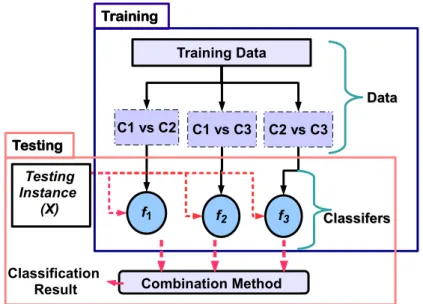
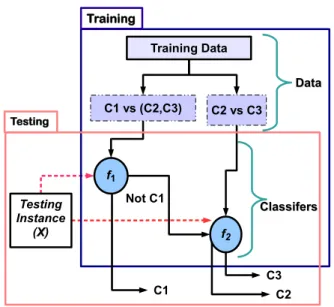
2.5 An illustration of the hierarchal approach for multiple attributes classification. 31 2.6 An illustration of One-Against-All (OAA) approach for three-class problem. 35 2.7 An illustration of One-Against-One (OAO) approach for three-class problem. 37 2.8 An illustration of One-Against-Higher-Order (OAHO) approach for three-class problem. . . 40
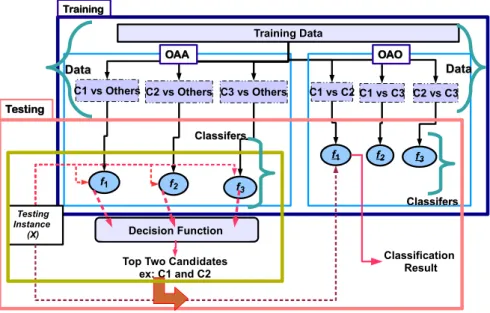
2.9 An illustration of All-and-One (A&O) approach for three-class problem. . . 41
3.1 The relational database schema of first year undergraduate students. . . 47
3.2 An example of the BCS dataset. . . 48
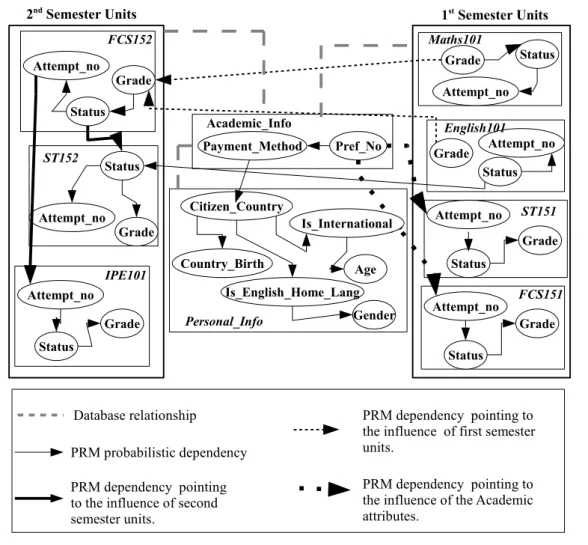
3.3 The PRM structure learned from the BCS dataset. . . 50
3.4 The comparison of students performance in semester II obtained by follow-ing the normal BCS prerequisites and the PRM suggested prerequisites. . . 51
3.5 The PRM structure learned from the BCom dataset. . . 52
3.6 The comparison of students performance in semester II obtained by follow-ing the normal BCom prerequisites and the PRM suggested prerequisites. . 54
3.7 The relational database schema of dataset II. . . 58
3.8 The PRM structure learned from dataset II. . . 59
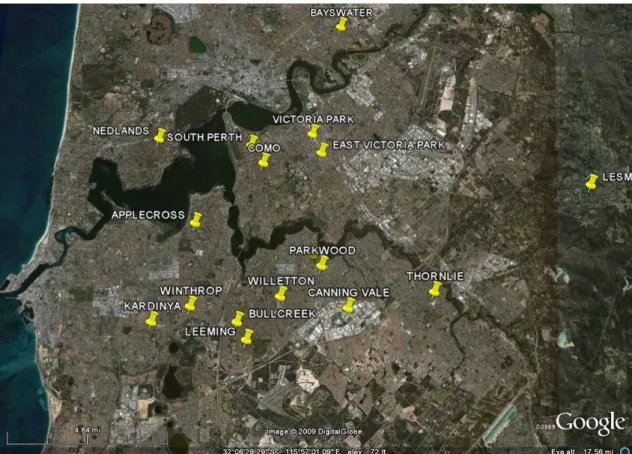
3.9 Snapshot of the geographical representation for using place-marks in Google Earth. . . 62
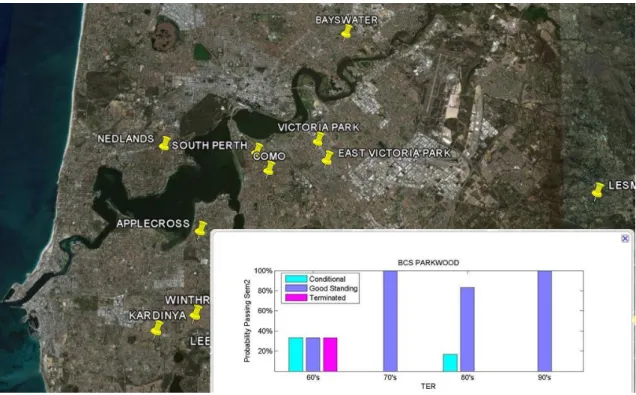
3.10 Displaying the students’ performances for a specific suburb. . . 63
3.11 Snapshot of the geographical representation for performances of BCS students. 64 3.12 Snapshot of the geographical representation for performances of BCom stu-dents. . . 64
3.13 The performances of BCS students of two nearby suburbs. . . 65
3.14 The performances of BCS students of three nearby suburbs. . . 65
3.15 The performances of BCom students of three nearby suburbs. . . 66
4.1 An illustration of the ensemble classification system. . . 73
4.2 An illustration of the PRMs-IM approach. . . 81
4.3 The relational schema of the students dataset used in evaluating PRMs-IM. 82 4.4 The relational schema of the Financial database. . . 84
4.6 ROC curves of 5-fold cross validation of the student relational database . . 89 4.7 ROC curves of 5-fold cross validation of the Financial and Movie datasets . 90 4.8 ROC curves of 2006-test set of the student relational database . . . 91 5.1 An illustration of the balancing and aggregation stages of PRMS-IM2. . . . 100 5.2 The algorithm of PRMs-IM2. . . 103 5.3 An illustration of PRMs-IM2 framework for classifying multiple imbalanced
attributes . . . 104 5.4 An illustration of the imbalanced situation caused by including the data of
all the imbalanced attributes in the balancing stage. . . 105 5.5 An example of the flat representation problem that could result when
bal-ancing multiple attributes. . . 106 5.6 An illustration of the hierarchical process for classifying multiple attributes. 111 5.7 ROC curves of the BCom student relational database for (a) MGT100
(b) MKT100 units (5-fold cross validation). . . 112 5.8 ROC curves of the BCS student relational database for (a) ST152 (b) FCS152
(c) IPE101 units (5-fold cross validation). . . 113 5.9 ROC curves of the Engineering student relational database for (a) Math2
(b) Systems1 (c) Materials1 units (5-fold cross validation). . . 114 5.10 ROC curves of the BCom student relational database for (a) MGT100
(b) MKT100 units (2006-Testing Set). . . 114 5.11 ROC curves of the BCS student relational database for (a) ST152 (b) FCS152
(c) IPE101 units (2006-Testing Set). . . 115 6.1 The training and inference procedures of Multi-IM approach. . . 122 6.2 An illustration of Multi-IM approach for learning from imbalanced
2.1 The confusion matrix. . . 25
2.2 An example of classification cases to demonstrate the concept of Stacking. . 38
3.1 The BCS first year curriculum. . . 48
3.2 The BCom first year curriculum. . . 49
3.3 A summary of the main PRM dependencies learned from the BCS dataset. 49 3.4 A summary of the main PRM dependencies learned from the BCom dataset. 53 3.5 The PRM suggested prerequisites for BCom. . . 54
3.6 The learned conditional probabilities of ST151 Attempt no. . . 55
4.1 Summary of the data distribution of (a) the BCS (b) the BCom training datasets. . . 83
4.2 Summary of the data distribution of (a) the BCS (b) the BCom test sets. . 83
4.3 Summary of the data distribution of the Financial database. . . 85
4.4 Summary of the data distribution of the Movie database. . . 87
4.5 The AUC results of the 5-fold Cross validation. . . 90
4.6 The AUC results of the student dataset for the 2006-test set validation. . . 90
5.1 Summary of the data distribution of the BCS and BCom training datasets. 107 5.2 Summary of the data distribution of the BCS and BCom test sets. . . 107
5.3 The curriculum of first year of BEng. . . 108
5.4 Data distribution of the BEng training dataset. . . 109
5.5 The AUC results of the 5-fold Cross validation and 2006 testing set. . . 112
5.6 Normalized number of classifiers used for (a) Training (b) Inference. . . 117
6.1 Training and testing data distribution of students datasets. . . 125
6.2 Training and Testing data distribution of Glass and Shuttle datasets. . . 126
6.3 Summary of the total AUC results obtained on datasets. . . 130
Relevant Publications
This thesis is based on some related work that has been published or documented else-where. The list of these publications is provided below.
• Ghanem, A. S., Venkatesh, S., and West, G. A. W. (2008). Learning in imbalanced relational data. In Proc. International Conference on Pattern Recognition (ICPR). IEEE Computer Society.
• Ghanem, A. S., Venkatesh, S., and West, G. (2009). Classifying multiple imbalanced attributes in relational data. In Proc. 22nd Australasian Joint Conference on Advances in Artificial Intelligence, pages 220–229, Berlin, Heidelberg. Springer-Verlag.
• Ghanem, A. S., Venkatesh, S., and West, G. A. W. (2010). Multi-class pattern classification in imbalanced data. In Proc. International Conference on Pattern Recognition (ICPR). IEEE Computer Society. to appear.
Introduction
For years, relational database systems have been used for storing and representing the data records of many real-world domains. This is due to their ability to represent data in a compact and natural structure, and at the same time characterize the different rela-tionships in the domain. Nowadays, the utilization of relational database systems ranges from major financial, medical and educational domains to small retailers.
The established and increasing use of these relational databases has highlighted the neces-sity for relational mining tools to analyse these rich domains and search for any interesting or important patterns within the data. Such tools are important in different domains, as they can significantly help in identifying the key factors for achieving further goals on the domain, and they can be also employed effectively for forecasting potential trends on the domain.
One of the methods that can be employed for mining relational domains is building a probabilistic model of the relational domain. This mainly concerns learning the different interactions between the relational variables that are linked in varied and complex forms. Such learning requires a rich probabilistic model that can handle the learning from the different configurations of the relational domain.
Probabilistic Graphical Models (Jordan, 1999, 2004) and especially Bayesian Networks (Pearl, 1988) have addressed this type of probabilistic modelling, and have been employed successfully in different domains. However, these models are designed to learn from single flat files that consist of a set of fixed attributes and a single static relationship that links the attributes. Therefore, for mining a relational domain using these methods, the data must be first converted into a flat file. This conversion has the major drawback of losing the different relationships between the domain variables, which play a significant role in mining and exploring these domains.
For the task of mining relational data, the Probabilistic Relational Models (PRMs) (Koller and Pfeffer, 1998; Getoor, 2002) were introduced as an extension of attribute-based Bayesian
Networks. PRMs handle the limitations of Bayesian Networks in learning from relational domains by utilizing the concepts of objects and object properties. Thus, PRMs learn from the entire relational database and describes the dependencies held in the domain, between attributes of the same table or related tables via foreign keys. Once a PRM model is learned, it can be used for data analysis to explore the important patterns and dependencies in the learned relational domain.
However, one of the critical tasks in mining relational domains is classification, which is the ability to obtain an accurate predictive model for classifying new instances of the learned domain. Although PRMs handle the problem of relational learning, it is based on the assumption shared by the majority of standard learning techniques of assuming balanced training data. Research has shown that the performance of most techniques degrades significantly for the case of learning with imbalanced data (Japkowicz and Stephen, 2002), where the majority of the data belongs to one class and only a few samples belong to the other classes. Consequently, the imbalanced class problem could severely limit the ability of PRMs to effectively mine imbalanced relational domains.
The imbalanced class problem is a common problem in real-world domains and a major issue in mining relational data. Although the imbalanced class problem has received con-siderable attention and several attempts have been proposed to handle this problem, these attempts mainly learn from a flat data representation. On the other hand, a few attempts have been proposed to handle the imbalanced class problem in relational domains, but they are practical only in certain contexts and lack the ability to fully explore and model the entire relational database as in PRMs.
The motivation behind the research in this thesis is to investigate the PRM learning tech-nique for exploring and analysing imbalanced relational domains and obtaining extended models that can be employed in many different real-world applications.
1.1
Aims and approach
This thesis examines the problem of mining imbalanced relational domains via extending PRMs. The objectives are to:
• Explore the PRM concepts in mining real-world imbalanced relational domains and investigate the effectiveness of the learnt PRM models as predictive models in such
domains.
• Investigate the specific problems of mining imbalanced relational data with: (1) mul-tiple imbalanced attributes, and (2) for the case of multi-class imbalanced classifica-tion.
• Develop extended models of PRMs to handle the stated problems of mining imbal-anced relational domains that can be applied to different domains.
The first part of this thesis tackles the exploration of the PRM concepts in mining real-world imbalanced relational domains. Therefore, the PRM was applied to a real-real-world university database for mining the records of undergraduate students. The objective of this application was to explore the PRM concepts and discover the main interactions in this domain. This goal was further supported by developing a visualization tool to illustrate the mining outcomes of the learned PRM model.
Although the learned PRM model from the university database confirmed the capability of PRMs in discovering the main dependencies in this domain, the learned model failed as a predictive model. The failure was a result of modelling a relational domain with imbalanced training data, in which one class of data is over-represented by a large number of samples compared to the other classes. The imbalanced class problem is common in many diverse domains and has been reported to have very poor performance with most well-known learning techniques.
The imbalanced class problem in relational data is even more complicated and a major issue in data mining. Therefore, this problem forms the basis of the research in this thesis and three models are introduced for mining imbalanced relational domains. The idea behind these models is the concept of utilizing the power of PRMs in modelling relational domains and extending it to handle the imbalanced class problem.
The first model, named PRMs-IM, extends the learning technique of PRMs to handle the imbalanced class problem in relational domains. The goal of this extension is to obtain a model from the relational training data that can be used effectively in classification, particularly for accurately classifying rare cases in the domain. This model is proposed for the problem of classifying one variable at a time, and specifically for the two-class case. The objective of this model is achieved by enriching the PRM with ensemble learning. This approach relies on the principle, reported in the literature, that an ensemble of a set of models often performs more effectively than individual models. Therefore, PRMs-IM handles the imbalanced class problem in relational domains by building an ensemble of
relational models rather than a single one.
Building on PRMs-IM, a further model, PRMs-IM2, is introduced for classifying mul-tiple imbalanced attributes in relational domains. PRMs-IM2 offers the opportunity to model several imbalanced attributes in one model rather than building an independent model for each attribute as proposed in PRMs-IM. To obtain a single model for all the imbalanced attributes, PRMs-IM2 employs the concept of the popular Bagging ensemble approach (Breiman, 1996). This allows PRMs-IM2 to model all the attributes simultane-ously, and at the same time reduces the time required for training and inference.
Both PRMs-IM and its extension PRMs-IM2 are introduced to address the imbalanced class problem in relational domains for the special case of two-class classification. However, in several domains, there are many different pattern classes required to be classified rather than just two classes. Therefore, to handle the multi-class classification of imbalanced attributes, a further model is introduced, named Multi-IM. The approach followed in Multi-IM is based on an evaluation of the popular multi-class methods reported in the literature. Based on this evaluation, Multi-IM was proposed to utilize the strengths of the methods reviewed and avoid their shortcomings. Importantly, Multi-IM is proposed as a generalized framework for both relational and non-relational domains.
1.2
Contribution
The contributions of this thesis lies in developing a number of mining models applicable for learning from imbalanced relational domains. Furthermore, a visual data mining tool is proposed to aid the interpretation of the outcomes of the PRM learned models. This visualization tool provides a simpler means of illustrating the outcomes of the PRM models by mapping them onto a spatial representation.
The three models introduced in this thesis are:
• The PRMs-IM model, which is the core contribution in this thesis. PRMs-IM is proposed and demonstrated experimentally to extend PRMs modelling to handle the imbalanced class problem in relational domains by using an ensemble of PRM models.
• The PRMs-IM2 model, that deals with the problem of modelling multiple imbalanced attributes in relational domains. PRMs-IM represents the starting point of this
model, which is extended using the popular Bagging approach (Breiman, 1996) to model more than one imbalanced attribute in a single model.
• The Multi-IM model, as a generalized framework for both relational and flat do-mains for imbalanced multi-class classification. This model is also based on the concepts of PRMs-IM and extended for multi-class classification rather than the binary classification of PRMs-IM.
In addition, a demonstration of the developed models is presented on real-world databases to show their effectiveness in mining such imbalanced relational domains.
1.3
Thesis outline
The thesis is organized as follows:
A review of the related work is presented in Chapter 2. The review starts with an overview of the Probabilistic Relational Model (PRM) describing its semantics and learning algo-rithm. Following this, a detailed overview of research in the area of mining imbalanced relational domains is presented. This overview includes research on modelling imbalanced multiple attributes and imbalanced multi-class classification.
In Chapter 3, a real-world application of PRMs is introduced. The objective behind this application is to explore the PRM concepts in mining a real-world university relational database. In this chapter, the effectiveness of PRMs in capturing the most important dependencies in this relational domain is presented. Additionally, a visualization data mining tool is provided to illustrate the outcomes of the learnt PRM models.
Chapter 4 describes an extension of PRMs to handle the imbalanced class problem in relational domains. In this chapter, the effectiveness of PRMs in obtaining accurate clas-sification models from imbalanced relational domains is investigated. Based on this inves-tigation, an extension of PRMs named PRMs-IM is introduced for learning from relational imbalanced data by enriching PRMs with ensemble learning.
In Chapter 5, an extension of the work proposed in its preceding chapter is outlined for classifying multiple imbalanced attributes in relational data. The objective behind this extension, named PRMs-IM2 is to handle the problem of the previous approach of modelling a single imbalanced attribute at a time. PRMs-IM2 utilizes the concept of
PRMs-IM and the popular bagging ensemble approach to model more than one attribute in a single model.
Chapter 6 discusses the problem of learning from imbalanced multi-class data and pro-poses a new approach, named Multi-IM, to handle this problem. Multi-IM derives its fundamentals from PRMs-IM and extends it to a generalized framework for multi-class imbalanced learning for both relational and non-relational domains.
Finally, Chapter 7 provides a concluding summary of the work of this thesis, along with potential future directions.
Background
This chapter discusses statistical methods for mining relational data in different do-mains. The chapter starts with the definitions of Graphical Models and Bayesian Networks and points to the effectiveness of these methods in modelling and mining real-world ap-plications. The limitations of Bayesian Networks in modelling relational domains are then discussed, and an extension of Bayesian Networks for relational learning, namely Probabilistic Relational Models, is presented. The semantics and learning techniques of Probabilistic Relational Models are then explored. Subsequently, the chapter discusses the effectiveness of employing Probabilistic Relational Models for mining imbalanced relational data. This discussion starts with defining the nature of the imbalanced class problem and the evaluation measures; followed by a review of the proposed solutions for this problem. Finally, the chapter points to the necessity of improving Probabilistic Relational Models to handle the problem of imbalanced data distributions in relational domains.
2.1
Introduction
The majority of real-word data are stored in relational database systems as a set of rela-tions related in various ways representing the domain structure. This relational data, in many cases acquired over many years, offers a rich ground for mining applications to gain a better understanding about the domain and how this data can be employed to achieve better performance. This mining task involves learning from a rich relational domain that cannot be easily represented as a set of simple attributes with a fixed relationship. For such domains, a rich relational technique is required to model the different objects and relationships in the domain.
An example of such modelling is offered by Probabilistic Graphical Models (Jordan, 1999, 2004), which provide a simple and yet very effective framework for modelling complex domains. The effectiveness of graphical models is achieved by combining probability and graph theory. The basic idea of graphical models is the concept of modularity, in which a
large-scale model can be built out of a set of local models, and probability theory is used to combine these models into a single consistent system representing the original domain problem.
A graphical model of a given domain can be viewed as a graph topology describing the interactions between the domain variables, along with a joint probability distribution over these variables. This graph not only provides a natural and compact representation of the data, but also a solid grounding for learning and inference algorithms to be implemented. Inference can be carried out by using probability theory to compute the marginal or conditional probabilities of the variables of interest.
A popular approach of graphical models is the Bayesian Network (BN) (Pearl, 1988). A BN is a directed graphical model for describing the probabilistic relationships between a set of variables. BN provides a compact representation over the variables by utilizing the conditional independence between the variables, in which only few variables of the domain affect each other directly.
Despite the success of BNs reported in the literature in different applications, BNs cannot deal with complex domains that have varying numbers of objects and relationships, such as relational domains that could be instantiated in different configurations. BNs usually involve learning from a single flat file that consists of all the data as a set of pre-specified attributes with fixed relationships. Therefore, to apply BN learning to a rich relational database, the data must be converted first into a flat representation. This flattening of the relational data has several limitations, including: having redundant data, losing the struc-tural representation of the data, losing the normalization benefits of the relational data and increasing the consistency-maintenance overhead. Moreover, Getoor (2002) discussed the problem of introducing statistical skew when flattening relational data, as records with multiple links would appear multiple times in the flat file, and hence result in incorrect statistics.
In order to learn directly from relational data, a number of approaches have been proposed, such as: FOIL (Quinlan and Cameron-Jones, 1993), TILDE (Blockeel and Raedt, 1998) and CrossMine (Yin et al., 2004). These approaches are designed to construct classifiers based on rules or decision trees. Therefore, these models are proposed for the specific purpose of relational classification, i.e. learn the classification rules of a specific domain variable. As a result, these methods do not provide a tool for modelling the different interactions between the relational domain variables. Moreover, the resulting model of these methods can be only used to perform inferences about the modelled variable, and hence do not have the ability to infer about another variable (or set of variables) in the
domain as in BNs.
The challenge in learning from relational data includes learning from the data in its re-lational format to discover the dependencies over the set of objects and relations, and then using the learnt model to do inferences about new objects of the relational domain given some observation. To address this task of relational learning and inference directly from relational domains, the Probabilistic Relational Models (PRMs) were first intro-duced by Koller and Pfeffer (1998) and then refined by Getoor (2002). PRMs have been introduced as an extension of the standard attribute-based BN to learn directly from the relational data without flattening the data as required in BN learning.
The relational learning is performed in PRMs by employing the concepts of objects, object properties, and interactions between objects. These concepts are utilized to specify the dependencies between the domain variables over the entire relational domain. Therefore, the PRM not only learns the correlations between the attributes in the same table as in the BN, but also learns the correlations between the attributes of different tables that are linked in different ways via foreign keys. The learnt PRM model provides a statistical model that can be used to answer many interesting inference queries about any aspect of the relational domain given the current status and relationships in the database.
In the PRM learning, an abstract model of the relational domain is built, which can be instantiated in different ways for each object of interest. The model specifies a template of the probability distribution over the relational database. The template includes: the relational schema of the domain that consists of the relational tables, attributes and links, and the probabilistic schema that describes the probabilistic dependencies between the domain attributes.
To understand the concepts of the PRM, consider a university relational domain with a set of tables, attributes, and relations describing a set of students and their units. Using this relational structure, the PRM constructs a probabilistic schema describing the depen-dencies between the domain attributes. The probabilistic schema consists of a set of nodes and directed links, representing the domain variables and the dependencies between them, respectively. Consequently, the probability distribution of each node depends only on the parents defined in the model, and hence the PRM specifies the probability distribution over the relational domain.
Using the PRM abstract (class) dependency model, new models can be created for new instances (students or units) of the relational domain. For example, for a specific unitui, a
ui. However, this model will be tied with the parameters of the class dependency model,
and thus can be used for further inference or exploratory analysis.
PRMs have been successfully applied to different real-world applications, such as for se-lectivity estimation in databases (Getoor et al., 2001d), for student modelling in virtual laboratories (Noguez et al., 2007), in the medical domain for tuberculosis epidemiology study (Getoor et al., 2004) and in the web domain for hypertext classification (Getoor et al., 2001c). Furthermore, several extensions of PRMs were also proposed, including: the approach by Li and Zhou (2007) that extends PRMs to learn from incomplete data, the approaches by Getoor et al.(2001a) for modeling link uncertainty, and the approach by Getoor et al. (2000) to use class hierarchies in learning PRMs.
The several applications reported in the literature of PRMs indicate the effectiveness of this learning technique in modelling relational data and capturing the important dependencies in the domain. However, an essential task of mining relational domains is also the ability to use the learnt model for classification, i.e. use the learnt model to classify new instances not seen before. Cowell et al.(1993) show that even for perfect models that discover the correct dependencies in the domain, they are not necessarily practical for classification.
This task could be even more complicated in the case of imbalanced training data, where the data is overrepresented by one class as compared with other classes. The imbal-anced class problem is a common real-world problem and has caused serious performance degradation for most standard learning techniques (Japkowicz and Stephen, 2002). This chapter reviews the PRM learning technique and its effectiveness to be used for mining and classification in real-world relational domains. In particular, the review will focus on the problem of mining imbalanced relational domains.
The layout of this chapter is as follows. Section 2.2 introduces the basic elements, concepts and the learning algorithm for PRMs. Section 2.3 raises the problem of employing PRMs for mining imbalanced relational domains. Then, Section 2.4 introduces the imbalanced class problem and discusses previous work that has been performed in this field. Sec-tions 2.5 and 2.6 continue the discussion about the imbalanced class problems, focusing on the classification of multiple imbalanced attributes and multi-class imbalanced classi-fication. Next, a discussion about mining imbalanced relational domains is presented in Section 2.7. Finally, Section 2.8 summarizes the chapter.
2.2
Probabilistic Relational Models
The Probabilistic Relational Models specify a template for a probability distribution over a relational database. The template consists of two components: the relational component that describes the relational schema of the domain, and the probabilistic component that describes the probabilistic dependencies in the domain. The following sections describe the semantics of each schema and also describes the learning algorithm for PRMs. This chapter uses the same notations and conventions as those used by Getoor (2002) to illustrate the concepts of PRMs.
2.2.1 Probabilistic Relational Model representation
2.2.1.1 Relational schema
The relational schema of PRMs is used to specify the type of objects and relations in the relational domain. A relational schema R consists of a set of classes (tables) X =
{X1, .., Xn}and a set of relations{R1, .., Rm}. Each class is associated with a key attribute
X.K, a set of descriptive attributesA(X) and a set of reference slotsR(X). A descriptive attribute A of class X (denoted as X.A) is a standard attribute that has a set of finite values V(X.A).
The set of reference slots of class X represents the set of foreign keys of the class. A reference slotρof classX is denoted asX.ρ. The relational schema also defines the range type of each reference slot, thus, for a reference slotX.ρ, the domain type (Dom[ρ]) is X and the range type (Range[ρ]) isY for a classY inX.
For each reference slotρ, an inverse slotρ−1 can be defined as the inference function ofρ. PRMs also define the notations of a reference slot chain, τ = ρ1, .., ρm, represented as a
sequence of one or more reference slots. The reference slot chain describes how objects from different classes are related indirectly.
Getoor (2002) used a simple relational schema of a university domain to illustrate the relational language of PRMs. In this chapter, the classical company database usually used to explain database systems, describing employees and departments relationships, will be used to illustrate the notations of PRMs. Fig. 2.1 shows the schema of the company domain.
Salary Gender Qualification Employee EmployeeID ProjectID Is-Completed Job-Type Assignment DepartmentID Level Location Project Domain Location Department
Figure 2.1: The relational schema of the company domain
In this domain, the company schema consists of four classes: Employee,Project, Depart-ment, and Assignment. Each class is associated with a set of descriptive attributes. For example, theEmployeeclass includes the ‘Salary’, ‘Gender’, and ‘Qualification’ attributes, and theProject class includes the ‘Location’ and ‘Level’ attributes.
Each descriptive attribute in the domain has a set of specified values, for example, the Assignment class has the descriptive attributes: ‘Is-Completed’ and ‘Job-Type’, which take values of {Yes, No} and {Full-Time, Part-Time}, respectively.
Additionally, to allow objects of one class to refer to objects of other classes, reference slots are used, such as in the Assignment class that has a reference slot ‘EmployeeID’ with range type Employee. The reference slots of the relational schema shown in the figure are underlined. An example of a slot chain linking objects of different classes is: ‘Assignment.ProjectID.DepartmentID’ denoting the department managing a particular assignment of a given project.
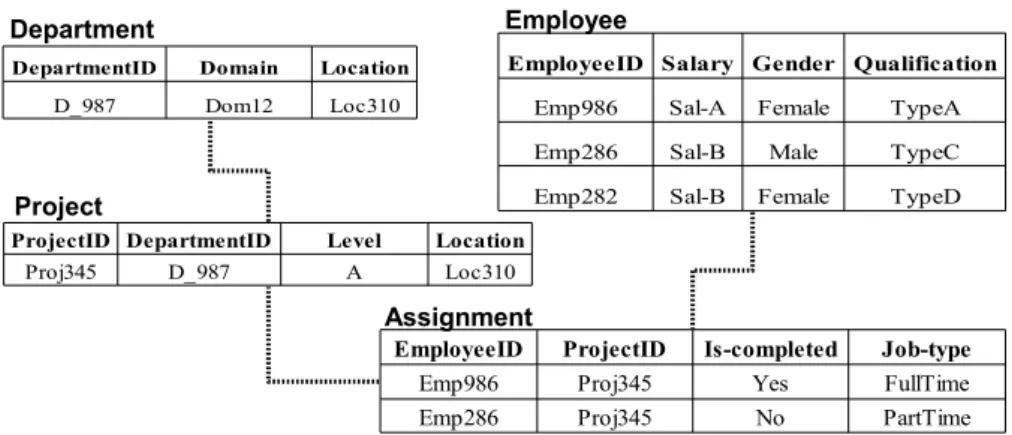
PRMs also specify an instance I of the relational schema R to denote an interpretation of the schema components. I specifies the set of objects of each class X and for each object it specifies the values of the descriptive attributes and the reference slots. Fig. 2.2 shows an example instantiation of the company domain. In this example, the instance shows that the department ‘D-987’ is running one project ‘Proj345’, with two employees ‘Emp986’ and ’Emp286’ working on this project.
Moreover, PRMs use the notation: relational skeleton (σr) to denote a partial
specifica-tion of the relaspecifica-tional instance I. σr specifies the set of objects for each class and the
relationships between the objects. However, it does not specify the values of the descrip-tive attributes. Each attribute in the skeleton is considered as a random variable. Given the skeletonσr, PRMs define the second component: the probabilistic schema.
EmployeeID Salary Gender Qualification
Emp986 Sal-A Female TypeA
Emp286 Sal-B Male TypeC
Emp282 Sal-B Female TypeD
EmployeeID ProjectID Is-completed Job-type
Emp986 Proj345 Yes FullTime
Emp286 Proj345 No PartTime
ProjectID DepartmentID Level Location
Proj345 D_987 A Loc310
DepartmentID Domain Location
D_987 Dom12 Loc310
Department
Project
Assignment Employee
Figure 2.2: An instantiation example of the company schema 2.2.1.2 Probabilistic schema
A PRM probabilistic schema Π is composed of two components: the dependency structure
S and the model parameters θS. S is defined by assigning a set of parents P a(X.A) for
each descriptive attribute X.A. The parents of an attribute X.A are other attributes of the domain that have direct influence on X.A.
The structure is represented graphically by a set of nodes, representing the domain tributes, and a set of directed links, showing the dependencies between the domain at-tributes. There are two types of formal parents of any attribute X.A: parents from the same classX or parents from related classes via the slot chain.
PRMs also address the dependency via a slot chain with a multi-set of values, i.e. the slot chain is referring to a set of objects rather than a single one. This multi-set of values is usually encountered in relationships of cardinality ‘zero or more’. For example, in the company example shown earlier, the ‘Salary’ of an employee can depend on the ‘Job-Type’ of theAssignment class. However, as each employee may be working on a different number of assignments (zero or more), the varying dependency of ‘Job-Type’ objects must be represented in a different way.
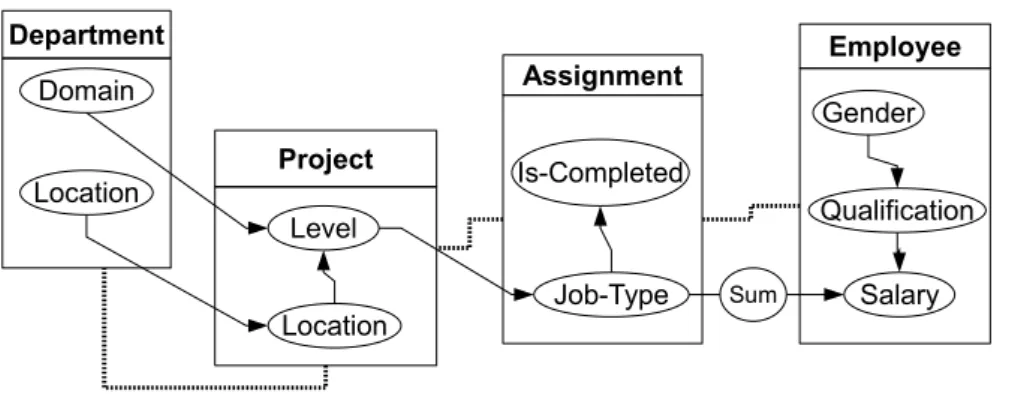
PRMs use the aggregation functionγ to address this issue. As in database systems, this function combines the multi-set values into a single value, using functions such as: mean, mode, median, maximum, etc. Therefore, for a parent U with multi-set values, the child attributeX.Awill depend on some aggregated property of the multi-set values ofU. An example of dependency structure of the company example is shown in Fig. 2.3, showing
Employee Assignment Department Domain Location Project Level Location Is-Completed Job-Type Salary Gender Qualification Sum
Figure 2.3: An example of a dependency structure of the company domain
the dependencies between the domain variables. In this example, this model shows that the employee ‘salary’ depends directly on two attributes: the ‘qualification’ attribute from the same class, and the sum of ‘Job-Type’ assigned to the employee from the related Assignment class .
By defining a set of parents P a(X.A) for each attribute X.A, the local conditional prob-ability distribution (CPD) can be obtained. The CPD of an attribute X.A specifies P(X.A|P a(X.A)), which denotes the probability distribution over the attribute’s value for each possible instantiation of the parents. The entire set of CPDs of the probabilistic model forms the model parametersθS.
By using the relational and probabilistic schema of PRMs, a PRM model can be summa-rized as follows:
Definition 1. (reproduced from (Getoor, 2002)) For a relational schema R that consists of a set of classes X =X1, .., Xn, a Probabilistic Relational Model (PRM) Πis defined as follows:
• Each descriptive attribute X.A has a set of parents P a(X.A) = (U1, .., Ul), where each parent Ui is either from the same class X; or from a related class via the slot chain. If the slot chain is not single-valued, then aggregation γ is used.
• Each descriptive attribute X.Ahas a conditional probability distribution (CPD) that specifies P(X.A|P a(X.A)).
Therefore, for a set of random variables in a relational skeleton, PRMs specify the prob-ability joint distribution over the values of those random variables. As in BNs, this is obtained by defining a node for each random variable and specifying the parents and the
CPD for each attribute. The joint probability distribution of the PRM model can then be computed as follows (Getoor, 2002):
P(I|σr,S, θS) = Y x∈σr Y A∈A(x) P(Ix.A|IP a(x.A)) = Y Xi Y A∈A(Xi) Y x∈σr(Xi) P(Ix.A|IP a(x.A)) (2.1)
Getoor (2002) states that his expression shares the same principle as the chain rule for BNs. But also points out two main differences: (1) the set of parents of a random variable is not fixed as in BNs and can change based on the relational skeleton, (2) the parameters in the PRM model are tied, thus, the CPDs of attributes of objects in the same class are identical.
As in BNs, it is important to ensure the coherence of the probability distribution, i.e. the probabilities of all instances sum to 1. In BNs, this is satisfied if the dependency structure is acyclic, thus, a variable does not depend on itself directly or indirectly (Pearl, 1988). Similarly, PRMs employ the acyclic principle to ensure that these probabilities define a coherent probability distribution. However, in PRMs, it is important to ensure that the dependency structure is acyclic for any resulting skeleton. Getoor (2002) proved that if the class dependency structure is acyclic, then each attribute will never depend on itself (directly or indirectly), and any resulting relational skeleton is also acyclic.
2.2.2 Learning PRMs
This section describes the task of learning PRMs from relational data using the PRM language and semantics defined in the previous sections. For learning the PRM model, the input consists of the relational schema and training data. The relational schema specifies the domain classes, attributes of each class and the relationships held in the domain. On the other hand, the training data is a complete instance of the specified relational schema.
The PRM learning problem consists of two tasks: parameter estimation and structure learning. In parameter estimation, it is assumed that the PRM dependency structure is given, and hence it is required to define the CPDs of the domain attributes. In structure
learning, the dependency structure is unknown, and therefore, it is required to learn both the dependency structure and the associated parameters from the training database. The following sections discuss each task of PRM learning.
2.2.2.1 Parameter Estimation
In parameter estimation, the input consists of the domain relational schema, a complete training instance I, and the structure dependency S, which specifies the set of parents for each attribute. Consequently, it is required to learn the structure parameters θS by
defining the CPD of each attribute in the domain.
In this task, the likelihood function is used to find the probability of the data given the model. In PRMs the likelihood of a parameter setθS is defined as (Getoor, 2002):
L(θS|I, σ,S) =P(I|σ,S, θS). (2.2)
Taking the log of this function:
l(θS|I, σ,S) = logP(I|σ,S, θS) = X Xi X A∈A(Xi) X x∈σ(Xi)
logP(Ix.A|IP a(x.A))
. (2.3)
Moreover, using the theory of BNs, themaximum likelihood parameter estimation can be utilized to find the parameter θS that maximizes the likelihood L(θS|I, σ,S) for a given
I, σ,andS. This can be computed as the summation of terms corresponding to the domain attributes, and each of these terms can be maximized independently.
For many parametric models, maximum likelihood can be obtained viasufficient statistics that summarizes the data. For the case of multinomial CPDs, the sufficient statistics are the count of times of observing each of the different values of the attribute X.A and its parents. This counting can be done in a straightforward manner using a standard database query.
Proposition 1 (reproduced from (Getoor, 2002)). The maximum likelihood parameter setting θS for multinomial CPDs can be defined as follows:
P(X.A=v|P a(X.A) =u) = PCX.A[v,u]
´
vCX.A[´v,u]
where CX.A[v,u] is the number of times counted in the training instanceI, for IX.A =v
and IP a(X.A)=u.
However, maximum likelihood can often overfit the data in many cases, thus in Bayesian networks a prior distribution over the parameters is used to avoid this problem. Using the same concept for BNs, PRMs have two assumptions: first, parameter independence, such that the priors over parameters θX.A|v are independent for different X.A and v. Second,
the prior over θX.A|v is a Dirichlet distribution (Heckerman, 1998). Therefore, in case of
multinomial CPDs satisfying these two assumptions, with hyper-parameters αX.A[´v,u],
PRMs define the posterior as follows (Getoor, 2002):
Eθ[P(X.A=v|P a(X.A) =u)|I] = PCX.A[v,u]+αX.A[v,u]
´
vCX.A[´v,u]+αX.A[´v,u]
2.2.2.2 Structure Learning
Structure learning can be defined as learning a dependency structure that represents the data well. This task includes three important subtasks:
• Determining the set of legal dependency structures.
• Evaluating the candidate structures.
• Searching for a good structure with a high score.
Legal Structures. The set of possible structures is defined by the set of parents for each attributeX.A. There is an infinite number of possible structures even for a simple domain. However, only the legal structures, that provide coherent probability models, should be considered. In order to ensure that the structure candidate is legal, PRMs requires that the class dependency structure is acyclic, as described in the previous sections. Thus, only dependency structures that satisfy this requirement are considered as legal candidates.
Evaluating Different Structures. In this task, it is required to evaluate the different legal structures and find the one that represents the data well. PRMs adapt the Bayesian selection model for this task by using a scoring function. Therefore, the posterior proba-bility of structureS can be defined as the posterior probability of the structure given the data I. This probability can be computed using Bayes rule, as follows (Getoor, 2002):
P(S|I, σ)∝P(I|S, σ)P(S|σ) (2.4)
This score is composed of two main components: the structure prior probability and the probability of the data given that structure. For the first componentP(S|σ), PRM assumes that the structure selection is independent of the skeleton, and thus P(S|σ) =P(S). The second component represents the marginal likelihood (Getoor, 2002): P(I|S, σ) = R
P(I|S, θS, σ)P(θS|S)dθS. In the case of using the parameter independent Dirichlet
prior, this integral is simply a product of integrals.
Proposition 2 (reproduced from (Getoor, 2002)). For P(θS|S) with parameter
indepen-dence and Dirichlet with hyper-parameters αX.A[v,u], and a complete assignment I, the marginal likelihood P(I|S) equals
Y i Y A∈A(Xi) Y u∈V(P a(Xi,A)) DM({CXi.A[v,u]},{αXi.A[v,u]}) where DM({C[v]},{α[v]}) = Γ( P vα[v]) Γ(P v(α[v]+C[v])) Q v Γ(α[v]+C[v]) Γ(α[v]) , and Γ(x) = R∞ 0 t x−1e−tdt is
the Gamma function.
In this marginal likelihood each term corresponds to P(X.A|u) where u ∈ V(P a(X.A)). The termP(X.A|u) depends only on hyper-parametersαX.A[v,u] and sufficient statistics
CX.A[v,u] for v∈ V(X.A). Additionally, as for the prior over parameters values for each
possible structure, the PRM learning algorithm assumes a uniform Dirichlet prior. Structure Search. In this stage, PRMs employ the scoring function to evaluate the struc-ture candidates and returns the high-scoring strucstruc-ture. Finding the best scoring strucstruc-ture is NP-hard (Chickering, 1996), and therefore PRMs use a heuristic search procedure. An example of such an algorithm is greedy hill-climbing search (Heckerman, 1998). This algo-rithm first considers the current structure, and then improves it iteratively by a set of local transformations and picks the one with the highest score. The transformations include:
add, delete or reverse an edge. To overcome the problem of the local-maxima (Heckerman, 1998), random restarts can be performed, i.e. perform a number of random steps whenever a local-maxima is reached, then continue the greedy hill-climbing process.
Moreover, the PRM learning algorithm addresses two problems: the large number of structures, and the high cost of computing the sufficient statistics. These problems are handled in the PRM by using a phased heuristic search algorithm. This algorithm proceeds in phases, such that in each phase k, the PRM has a set of potential parents P otk(X.A)
for each attribute X.A. Thus, the space of structures is restricted to those parents in the potential list. Moreover, by this method, the PRM can compute the corresponding view of X.A, P otk(X.A) in advance and then obtain the sufficient statistics for any subset of
potential parents, which could potentially reduce the computation cost of the sufficient statistics.
The selection of the potential parents is performed in an iterative approach based on the slot chain. Thus, the PRM starts with an empty structure and then proceeds based on the links in the slot chain. Therefore, the search is first performed within the dependencies within the same class, then between objects that are directly related, then between objects that are indirectly linked by two reference slots, then by those that are three slots apart and so on. Thus, the PRM selects the new potential parents based on the current phase of the slot chain and re-iterates, stopping when no further improvement is made. This approach allows the algorithm to gradually search the large space of structures and at the same time paying more attention to dependencies between objects that are more closely related.
2.2.3 Inference in PRMs
PRMs do not require a new inference algorithm, as they can use existing inference al-gorithms. The inference can be made about new objects by transforming to a BN. The BN is constructed from the database using the learnt PRM class dependency graph, and using parameter tying. Thus, to perform an inference task about an objectObji, the PRM
simply constructs a BN using the appropriate attributes ofObji and the set of objects
re-lated toObji. Then, the class-level parameters for each attribute are tied to the resulting
network. Given this BN, a standard BN inference algorithm can be used to perform the inference task.
2.3
Effectiveness of PRMs in mining imbalanced domains
PRMs offer a rich relational learning technique for learning from relational domains di-rectly. The power of PRMs is derived from the popular BNs, and extended to learn the correlation in relational domains. However, it is important for a learning technique to obtain an accurate statistical model that shows the dependencies in the domain, so as to be able to employ this model for classification. Classification is an important task in real-world applications, and a good classification model is the one that achieves a high recognition rate in classifying unseen instances.
Generally, the research on learning statistical modelling, such as BNs, is focused only on obtaining models that best represent the data (Ezawaet al., 1996). However, Ezawaet al. (1996) argues that these models may perform poorly when applied to specific goal, such as classification. Moreover, Cowell et al. (1993) show that even for perfect models that accurately capture the correlations in the domain, they are not necessarily practical for classification.
The classification task is often more complicated in the case of imbalanced training data. The imbalanced class problem is defined as having one class of data that is overrepresented by a large number of samples as compared to the other classes. Several investigations and experiments have reported that the classification performance of most well-known classifiers often degrades dramatically in the presence of imbalanced data (Japkowicz and Stephen, 2002; Batistaet al., 2004; Chawlaet al., 2004). This poor performance supports the earlier argument of Ezawa et al.(1996) and Cowell et al.(1993), and is often caused as a result of designing methods to learn from relatively balanced training data.
In imbalanced situations, the classification algorithms often get biased towards the ma-jority class, generating more rules for the mama-jority class, while ignoring those of the small/minority class. Consequently, most of the minority test samples are misclassified to be of the majority class, resulting in poor prediction for the minority samples. However, in several applications, the correct classification of the minority cases is more critical than the classification of the majority case. For example, consider the classical example of a medical application designed for detecting a certain disease that is usually rare when compared with the normal case. In such an application, it is more important to correctly detect people with the disease than detecting healthy people. Therefore, in this case, the required classifier is that which attains a high classification rate on the disease.
altering the training data or by biasing the learning algorithm internally. However, most of these methods are proposed to work within a set of certain assumptions or restrictions. A major restriction of these methods is learning from flat representation (non-relational data). However, as most of real-world data are nowadays stored as relational systems, the different interactions between the attributes in such domains needs to be considered when handling the imbalanced class problem. This indicates the need for additional research into methods to handle the imbalanced class problem in relational domains.
Learning from relational domains is gaining an increasing interest in machine learning, and a number of methods have been proposed for this task, such as FOIL (Quinlan and Cameron-Jones, 1993), CrossMine (Yin et al., 2004) and TILDE (Blockeel and Raedt, 1998). However, these methods are designed to learn from relatively balanced domains, and hence are inadequate for handling the imbalanced class problem. Moreover, although the PRM has shown successful implementations to discover the correct relationships of different relational domains, the PRM is also restricted to learning from relatively uniform data distributions. Consequently, in real classification problems, the performance of the PRM could be degraded significantly as a result of not being modelled for the specific goal of classification on imbalanced domains.
In this thesis, the PRM classification on imbalanced data is explored. Therefore, the following sections will discuss the imbalanced class problem and the different approaches proposed to solve this problem in relational and non-relational domains. Furthermore, a review is also presented about two further aspects of the classification on imbalanced data. The first case is the multiple imbalanced attributes problem, in which the domain consists of more than one imbalanced attribute to be classified. The second case is the multi-class imbalanced problem, in which it is required to find a classification function that maps the input into an output of more than two classes.
2.4
Imbalanced class problem
A training dataset is characterized as imbalanced if there are significantly more examples of some classes compared to others. In a two-class problem, the imbalanced class problem is defined as having one class (majority) that is represented by a large number of samples, while the other class (minority) has only a few samples. Usually, in such situations it is of-ten more critical to correctly detect the minority samples, as they represent the important rare cases, such as detecting oil spills in satellite images (Kubat et al., 1998), unreliable telecommunication customers (Ezawa et al., 1996), fraudulent telephone calls (Fawcett
and Provost, 1997), and customer churn (Burez and Van den Poel, 2009).
Throughout this thesis, the term ‘minority’ will be used to denote the class with the small number of instances that are regarded as critical to be classified correctly, and ‘majority’ will denote the dominant class with the large number of samples.
Several approaches have been proposed to handle the imbalanced class problem. Most of these approaches were proposed for the special two-class problem and for single flat files. Generally, these approaches can be categorized into the following groups (Chawla et al., 2004):
• Data-level approaches: At the data-level, the approaches attempt to re-balance the class distribution by re-balancing the training data. This re-balancing can be performed either by over-sampling the minority samples to match the size of the majority or by down-sampling the majority samples to match the size of the minority. Each method can be performed in a random manner or in a focused mode. The focused mode of re-sampling considers the data distribution. This approach first examines the distribution of the class, and then performs the sampling based on the information collected. A combination of the two sampling methods can be also performed. A detailed survey of the re-sampling methods and their behaviour is presented by Batistaet al. (2004).
Although re-sampling is the most common approach used in dealing with the im-balanced class problem, several shortcomings have been observed (Barandelaet al., 2003b; Japkowicz and Stephen, 2002). The random sampling approach could result in duplicate samples in the case of over-sampling, and in the case of down-sampling, there is a potential for losing useful and important data. Although, the focused mode of re-sampling offers a more advanced solution compared with random sampling, this approach results in an increased cost of data analysis.
• Algorithm-level approaches: At the algorithmic level, the proposed approaches try to bias an existing learning algorithm towards the minority class. Examples of this approach include: biasing the BN in favour of the imbalanced target at-tribute (Ezawa et al., 1996), searching for the best intervals for both majority and minority classes (Kubat et al., 1998), and vector quantization of the major-ity class (Nugroho, 2000).
A popular example of this approach is cost-sensitive learning. In this approach, the mis-classification costs of the classes are varied, such that the algorithm is biased towards the minority class. This is achieved by increasing the mis-classification
cost of the minority samples and reducing that of the majority samples (Pazzani et al., 1994; Sun et al., 2007). The main challenge of this method is setting the proper mis-classification costs, especially if this has to be carried out by non domain-experts (Japkowicz and Stephen, 2002). Experiments have shown that the algorithm-level approaches usually outperform the data-algorithm-level approaches (Lee et al., 2008; Japkowicz and Stephen, 2002).
2.4.1 The imbalanced class problems in relational domains
According to the rich literature on imbalanced learning techniques, most of the techniques were developed for learning from a single flat file, where the data is represented as a single data sheet that includes all the data attributes and corresponding values. However, the majority of real-world applications maintain their data as relational database systems instead of a single data file. In a relational database, the data would usually consists of several tables (relations) linked to each other in different ways via a set of foreign keys. Each relation consequently includes a set of attributes and the values of those attributes. Therefore, learning techniques are required to address the imbalanced class problem in relational data, where attributes are linked to each other in different ways. Throughout this chapter, a target attribute will be used to denote the attribute of interest that is to be classified; and the corresponding relation of that attribute will be denoted as a target relation. Any relation other than the target relation in the database will be denoted as non-target relation.
Only few attempts have been made to handle the imbalanced class problem in multi-relational data. Proposed techniques include:
• Cost-sensitive learning for structured data (Sen and Getoor, 2008): Sen and Getoor (2008) proposed two approaches for cost-sensitive relational learning using Conditional Markov Networks (Taskar et al., 2002). The main idea behind these approaches is based on the concept that exploiting the correlations in the relational domain can help in specifying the mis-classification costs of the individual samples. Consequently, these costs can be used in cost-sensitive learning to minimize the overall mis-classification cost. Sen and Getoor (2008) demonstrated that in relational domains, where data can be represented by a graph, such graphs can be employed effectively to identify the mis-classification costs of the examples. The mis-classification costs not only depend on the individual examples, but also on the
relational costs, which are the mis-classification costs of related examples.
• Learning from multiple views of a relational database (MVC-IM algo-rithm) (Guo and Viktor, 2007): In this approach an ensemble (Dietterich, 2000) of classifiers is constructed, in which each classifier is trained on a different view of the relational database. This framework relies mainly on two observations: (1) different views of the relational domain would usually yield different results in terms of learning the minority class, (2) an ensemble of classifiers learned from these differ-ent subsets would often be more effective than the individual classifiers. Therefore, MVC-IM tries to achieve better prediction results of the minority class by combining the knowledge obtained from different views. This is achieved by firstly constructing multiple views of the relational database. Each view is essentially a relation (table) of the database aggregated with the records of the target attribute propagated from the target table. Next, a separate classifier is learned from each view. Finally, the view classifiers are combined using majority voting. Although this approach utilizes the ensemble approach that has shown to perform extremely well in different appli-cations (Opitz and Maclin, 1999; Dietterich, 2000), it uses flat views of the database and hence does not exploit the relational structure of the data.
• Multi-relational g-mean decision tree algorithm (Mr.G-Tree) (Lee et al., 2008): Mr.G-Tree algorithm is a tree-based algorithm proposed for handling the im-balanced class problem in relational domains. In this algorithm, the imim-balanced class problem is addressed by employing the geometric mean (g-mean) (Kubatet al., 1997) and the concept of best intervals proposed in the SHRINK algorithm (Kubatet al., 1998). On the other hand, learning from relational data is handled by extending the propagation concepts of the relational learning technique: CrossMine (Yinet al., 2004). For a relational database, Mr.G-Tree first defines the best interval/subset of each attribute in the target relation by employing the concepts of SHRINK. Then, using the g-mean measure, these intervals are used to define the splitting function of the root node of the decision tree. Then, the relational learning occurs in the Mr.G-Tree algorithm by propagating the records of the target attribute to a non-target relation in the domain. Consequently, the splitting function of the second node in the decision tree is defined using the same procedure of using the best intervals and g-mean measure. This process continues until all relations are explored. This al-gorithm is proposed for the special case of two-class classification. Moreover, this algorithm shares the same prorogation concept as that of MVC-IM, where target class labels are propagated to each relation. Therefore, as in MVC-IM, the learning in Mr.G-Tree algorithm does not fully exploit the different interactions between the different attributes in the domain.
True Positive True Negative Predicted Positive True Positive (TP) False Positive (FP) Predicted Negative False Negative (FN) True Negative (TN)
Table 2.1: The confusion matrix.
• Multi-relational Na¨ıve Bayesian classifier (R-NB) (Xu et al., 2008): In this approach, basic under-sampling and over-sampling methods are employed to han-dle the imbalanced class problem, and classification is hanhan-dled by utilizing the Na¨ıve Bayes classifier. However, this classifier is enhanced to learn from relational domains by dealing with each table separately using the attribute filter criterion and mutual information. Firstly, mutual information is computed between the target attribute and each attribute from each relation in the domain. Then, the attributes are or-dered in descending order based on the mutual information, and the top attributes are selected for classification. In this approach, only the correlations between the domain relations and the target attribute are considered. Therefore, this approach is not suitable for classifying more than one target attribute. Moreover, this ap-proach utilizes the over/under-sampling methods, which have major limitations in classification, as discussed earlier.
2.4.2 Evaluation measures
Accuracy is often used as the standard performance measure in machine learning, in which the percentage of accurately classified samples is computed. For a two-class (Positive, Negative) problem, the classification of the class samples can be viewed as a confusion matrix, shown in Table 2.1.
The confusion matrix can be used to define the following measurements:
• The traditional accuracy is calculated as:
Accuracy = T P +T N
T P +F P +F N +T N (2.5)
• True Positive rate (T Prate): the percentage of true positive examples correctly
clas-sified, defined as:
T Prate=
T P
T P +F N (2.6)
classified, defined as:
T Nrate =
T N
T N+F P (2.7)
• False Positive rate (F Prate): the percentage of true positive examples misclassified
to be of the negative class, defined as: F Prate =
F P
T N+F P (2.8)
• False Negative rate (F Nrate): the percentage of true negative examples misclassified
to be of the positive class, defined as: F Nrate=
F N
T P +F N (2.9)
However, for imbalanced data, neither the traditional accuracy or the other measurements defined above are practical, as the minority cases have little impact on the accuracy as compared to that of majority (Kubatet al., 1998). For example, for a classification problem with the minority data represent only 2% of the data, and a classification algorithm that can successfully predict all the samples of the majority class, the accuracy would be 98%. Despite the high accuracy achieved in this problem, this measurement is really poor for applications where minority cases are more important to be correctly classified than the majority samples.
Therefore, to handle the evaluation of imbalanced classifiers, other methods were proposed. Considering the earlier two-class problem (Positive, Negative), where ‘Positive’ represents the minority class, the popular evaluation measures for imbalanced situation are:
1. F-measure(Sunet al., 2007): this measure focuses only on one class. For example, if the focus is on the positive class, then the Positive Predicted valueP Pvalueis used
with the True Positive rate (T Prate) to define the F-measure:
F-measure = 2×T Prate×P Pvalue T Prate+P Pvalue
(2.10)
The Positive Predicted value is defined as: P Pvalue=T P /(T P+F P), which denotes
the percentage of the predicted positive examples correctly classified. A high F-measure indicates that bothT Prate and P Pvalue are high.
2. Geometric mean (G-mean)(Kubatet al., 1997): The G-mean measure is used in imbalanced classification algorithms to denote the average ratio of accuracy of both minority and majority classes. The G-mean is defined as: