SURFACE
SURFACE
The Bead Forum: Newsletter of the Society of Bead Researchers Spring 2012
Issue 60, Spring 2012
Issue 60, Spring 2012
Society of Bead ResearchersFollow this and additional works at: https://surface.syr.edu/the_bead_forum
Part of the Archaeological Anthropology Commons, and the Social and Cultural Anthropology Commons
Recommended Citation Recommended Citation
Society of Bead Researchers, "Issue 60, Spring 2012" (2012). The Bead Forum: Newsletter of the Society of Bead Researchers. 10.
https://surface.syr.edu/the_bead_forum/10
This Book is brought to you for free and open access by SURFACE. It has been accepted for inclusion in The Bead Forum: Newsletter of the Society of Bead Researchers by an authorized administrator of SURFACE. For more information, please contact [email protected].
Glass Beads from Gloucester Point, Virginia
Laurie E. Burgess and Christopher Sperling
This addendum to a cultural resource manage-ment report is reprinted in its entirety courtesy of The Ottery Group, a cultural resource management firm based in Olney, Maryland. The piece is an update on the research previously presented by Christopher Sper-ling in 2005 in volume 47 of The Bead Forum. The beads derive from compliance-based excavations at Gloucester Point, Virginia, a town with a deep water harbor located at a strategic point on the York River.
I
n 2007, the glass beads from the project were sent to Laurie Burgess at the Smithsonian Institution for analysis. Former Ottery Group archaeologist Christopher Sperling had previously documented the beads and the analysis built upon Sperling’s work.There are four primary contexts for the 1,235 beads from Gloucester Point: 1) a Civil War-era context that yielded a total of 3 beads, 2) a burial, which yielded 561 beads, 3) a brick-lined cellar which contained 668 beads, and 4) a second
sub-surface feature that appears to be associated with the brick-lined cellar, which held 3 more beads. This second feature is possibly a small cellar.
Glass beads serve as temporal markers at archaeological sites, based on changes in bead varieties over time. Chronologies for early beads from the southeast and northeast have been cre-ated from numerous well-documented studies by Smith (1983), Wray (1983) and others, but these studies deal with collections that occurred con-siderably earlier than the Gloucester Point beads. Miller (1983) describes what he calls a paucity of beads in the Chesapeake prior to the mid-point of the seventeenth century, which he attributes to the fact that tobacco cultivation drove the regional economy, rather than the fur trade as in other areas of the country, and also to the popularity of shell beads in the Native American trade.
METHODOLOGY
The Gloucester Point beads had been prelimi-narily catalogued by Ottery Group staff, but were analyzed again using bead protocols followed by the Smithsonian. The 1,235 beads in the Gloucester Point collection are classified into 19 varieties (Table 1). The beads are categorized based on manufacture type, color, diaphaneity, shape, presence or absence of decoration, and size. The bead classification follows the Kidd and Kidd (1970) system for glass beads, as expanded by Karklins (1985). The classifi-cation also follows Ross (1990, 2000).
Bead shapes were described using the follow-ing terms: disk, disk-barrel, barrel, tubular and spherical. The length and diameter of beads were
recorded in millimeters and beads were graded into size groups according to Kidd and Kidd (1970). The
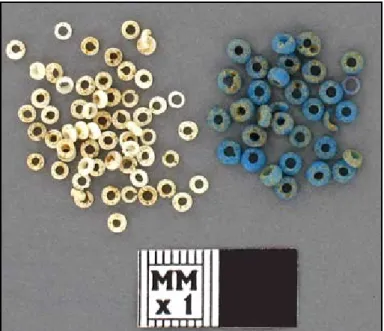
Continued on page 2 Figure 1. Blue and white drawn beads from burial.
--Continued from page 1
sizes are based on the diameter of the beads and are as follows: 0-2 mm are very small beads, 2-4 mm are small beads, 4-6 mm are medium beads, 6-10 mm are large beads, and 10+ mm are very large beads.
BEADS
Civil War Era Context
The two wound beads and one drawn bead that were recovered from a Civil War era Union encamp-ment context are all consistent with a nineteenth-cen-tury timeframe. The green wound bead, which is very roughly wound, came from a structure thought to have been destroyed during the Civil War. A pit-like feature located in the southeast corner of a suspected Civil War tent platform yielded a long, drawn, hexagonal tubular bead. There are generally similar and larger wound varieties that occur in early contexts, but this drawn bead variety is thought to have been manufac-tured in Bohemia, now known as the Czech Repub-lic, during the nineteenth century (Neuwirth 1994). Shorter varieties of these beads were often used to trim garments, shoes and purses at different times during the 1800s. The third bead comes from a Civil War-era midden and is a dark blue wound bead. This wound blue bead could be intrusive and may well predate the 1860s, but it could just as easily derive from the sec-ond half of the nineteenth century. However, a sample of only three beads limits the information that can be gained.
Burial
Far more beads were recovered from a burial that was located at a depth of just 5 cm below a crushed stone parking lot. Despite the presence of 563 beads, only two varieties are present, and they are two that persist for a very long time. They consist of 31 small drawn blue-green beads and 530 very small and small drawn white beads (Figure 1, front page). In his preliminary assessment, Smithsonian physical anthro-pology curator Doug Owsley identified the buried individual as being of African ancestry. His head was oriented to the north, and his feet were close together in a manner that usually indicates the use of a shroud. According to Riordan’s (2000) work at St. Mary’s City, also located in the general region, shroud burials were most common during the middle quarters of the 17th century, and became much less common during the first third of the 18th century. There are studies that address the cultural aspects of the color blue for people
of African ancestry (Stine et al. 1996). However, it is interesting to note that the white beads substantially outnumber the blue beads by a factor of seventeen. Whether this was a matter of cost, availability or cul-tural or personal preference — of the interred indi-vidual or of those who buried him, we will likely never know.
The beads were found in the area of the head and shoulders, which suggests they may have been a part of a necklace. No other personal items were found with the burial. The absence of clothing-related items com-bined with the apparent shroud burial, suggests that this burial is early and may date to the seventeenth century. Unfortunately, the beads themselves are not temporally diagnostic.
Brick-Lined Cellar
The 668 beads from the brick cellar are all drawn beads, and they, and the 3 beads from the associated subsurface feature, which is likely a cellar as well, appear to date to the late seventeenth to eighteenth centuries. Some of the varieties present have been also recovered from seventeenth century sites elsewhere. However, based on other objects dated by The Ottery
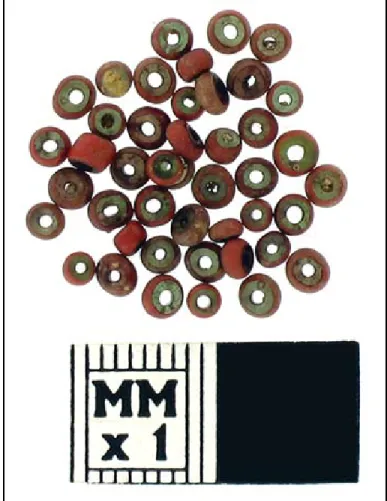
Figure 2. Polychrome beads (opaque red on translu-cent green) from the brick-lined cellar.
--Glass Beads from Gloucester Point, Virginia, continued
Group, it is thought that the occupation of the site spans the general time period of 1700-1750.
These beads derive from a domestic context and were recovered from the very base of excavations, near or on what would have been the old floor. Miller et al. (1983), in their overview of seventeenth century beads from the Chesapeake, state that historic records indicate that trade with Native Americans only took place in isolated areas after 1670, and that beads from sites postdating 1670 indicate domestic use. For the Gloucester Point beads, domestic use would be easy to assume if only a few beads were recovered from the brick-lined cellar. But the cellar contained almost 700 beads, which suggests something other than personal ornamentation of the household. The house may have been used as a tavern or ordinary, a supposition that is supported by the quantity of bottles present.
Sixty percent of the beads are small, chrome, tumbled drawn beads. Most of the mono-chrome small beads are blue, with only one white, one green and one black bead. Thirty-six percent of the beads are small, polychrome, tumbled drawn beads, Kidd and Kidd variety IVa6, with opaque red (or
red-Society News
The SBR board is planning to meet via confer-ence call later this year and the board report and 2012 budget will appear in the fall issue.
The position of secretary/treasurer is up for re-election at the end of the year. Alice Scherer, our cur-rent secretary/treasurer, has agreed to run for another term. Any additional interested candidates should contact the nominating committee, headed by Lois Rose Rose, at [email protected].
During the 2011 board meeting it was decided to add site analytics to our website, to provide infor-mation on how it is used. Since the beginning of the year, the site has had 3,101 unique visitors, with a total of 721 repeat visits, with a total of 27,630 individual page hits, peaking on February 20th. Most visitors are referred to us by Google, followed by Yahoo, a number of referring Russian sites, the Bead Society of Great Britain (2.94%), and BeadCollector.net (1.26%),
Spangles (England) and Rings and Things (Spokane, Washington). The journal contents page was the one most visited, with 1881 views, and the newsletter index received 688 views. Bylaws had a surprising 76 views. “Society of bead researchers” was the most pop-ular search term to find us, but “bead journal,” “he-bron beads,” and “tile bead manufacturing” also sent people to the site, along with a host of other terms. Regarding downloaded pdfs, the first supplement to the bibliography was requested 2,020 times, the over-seas order form 281, the North American order form 220, and the Bead Forum index 126 times.
The analytics show that our website is getting a fair amount of traffic. Board members have been discussing a number of additions we could make to the site, to increase its usefulness, including ways to steer more traffic to the site. Any help our members could provide, either regarding the site, or ways to direct visi-tors to the site, would be greatly appreciated. Contact the webmaster at [email protected].
wood) exteriors with a translucent green core (Figure 2). The red-on-green beads show up early and persist for a long time, continuing into the 19th century.
Long tubular beads are also present and occur in polychrome, decorated varieties (Figure 3). There are 12 polychrome, or two-layer, beads, and they have a red exterior and a core that appears black, although it is likely green glass. Nine of these tubular beads have 3-4 simple white stripes, and one has a compound stripe of blue glass on opaque white. The two white beads have no core, and have three red stripes each. The red stripes have deteriorated badly, and have sloughed off in some cases, leaving just a channel. A simple, tubular blue bead was recovered from the associated subsurface feature. Overall, tubular beads comprise 2% of the total cellar assemblage.
Six of the opaque white tubular beads with red stripes also occur at Fort Michilimackinac, where they came from contexts dating 1700-1750 (Stone 1974). A red tubular bead with a green core and a compound stripe was recovered there also, from a context with a date range of 1650-1750. These beads, like the Gloucester Point red tubular beads, have a very visible layer of clear glass on the exterior, over the opaque red glass (Stone 1974).
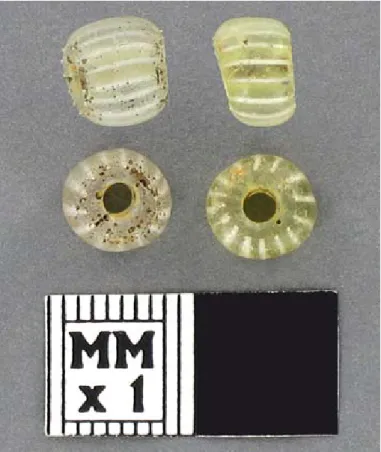
Two gooseberry beads, colorless drawn beads with simple white stripes, are present in the Gloucester Point assemblage. Smith (1983:150), who has worked with very early collections, suggests that the shape of these beads is temporally sensitive, and reports that an early 16th century gooseberry has an oval shape, that later gooseberries are spherical and that this bead vari-ety occurs in a barrel shape in the eighteenth century.
The gooseberry beads in the Jamestown Redis-covery assemblage described by Lapham (2000) are fairly spherical, which supports Smith’s suggestion that gooseberry shapes may have temporal implica-tions. The two gooseberry beads from Gloucester Point (Figure 4) are both more barrel-shaped than spherical, which is generally consistent with Smith’s eighteenth-century attribution for this shape. One of them derives from the cellar and is slightly yellow and has 15 stripes. The other is from the associated feature, is colorless and has 14 stripes. Kidd and Kidd describe this kind of color variation and say that the stripes usually num-ber from 12 to 15 (Kidd and Kidd 1983 [1970]).
DISCUSSION
As a whole, the Gloucester Point cellar collection is mostly comprised of blue and red beads. Blue beads
constitute 62% and red beads make up 38%. The tu-bular beads are predominantly red, with ten red beads, two white and one blue. Red beads are the hallmark of early bead assemblages in the Northeast, but only occur in small percentages in early collections from the Southeast. Those collections, however, occur primarily at early Native American-related sites. The Glouces-ter Point assemblage is from a laGlouces-ter, domestic, likely EuroAmerican brick-lined cellar that dates to a time of limited and isolated trade with Native Americans.
Miller et al. (1983:143), in an overview of sev-enteenth-century beads from the Chesapeake, divide sites on the James River into two time periods: 1618-1660 and 1618-1660-1730. The James River is quite close to the York River and these sites provide an excellent comparison. The beads from Miller’s earlier period are simple, drawn beads, with just one simple tubular bead and just one decorated bead present. This early period is dominated by simple, monochrome, undeco-rated drawn beads. However, the beads from Miller’s 1660-1730 domestic contexts are much more similar to the Gloucester Point cellar beads. The drawn bead varieties that overlap include simple tubes, polychrome tubes, and polychrome, or compound, beads. Based
Figure 4. Gooseberry beads. Bead on left is from the feature associated with the cellar; the slightly yellow bead is from the brick-lined cellar.
Figure 3. Tubular polychrome beads (opaque red on dark green with simple white stripes) from the brick-lined cellar.
--Provenience Manufac. D=Drawn W=Wound Kidd & Kidd
Code Diaphaneity* Color Size** Shape Count Notes
Civil War Midden, F111 W WIb Op Black L Spherical 1
-Civil War structure, F156 W WId Tsp Green blue L Disk 1 Very roughly wound CW tent platform trench, F158 D IIIa Op White S Tubular, hexagonal 1 Broken, hexagonal bead Burial 2, F542 D IIa Tsl Blue green S Disk 31
-Burial 2, F542 D IIa Op White VS/S Disk 530 Very thin walls Brick lined cellar, F162 D Ia3 Tsp Colorless S Barrel 1
-Brick lined cellar, F162 D Ib11 Op White M Tubular 1 Op white with red simple stripes Brick lined cellar, F162 D Ib11 Op White M Tubular 1 Op white with red simple stripes Brick lined cellar, F162 D IIa Op Blue S Disk 21 Deteriorated, possibly op blue, monochrome Brick lined cellar, F162 D IIa Op Blue VS/S Disk 81
-Brick lined cellar, F162 D IIa Op Blue S Disk 34 Op medium blue, very deteriorated Brick lined cellar, F162 D IIa Op Blue S Disk 1 Op blue, very deteriorated Brick lined cellar, F162 D IIa Op Blue S Disk 34 Probably medium blue, very deteriorated Brick lined cellar, F162 D IIa Tsl Green S Disk 1
-Brick lined cellar, F162 D IIa Op Purple-blue S Disk/barrel 237
-Brick lined cellar, F162 D IIa Op White S Disk 1 Partial (half) bead, op white, deteriorated/patinated Brick lined cellar, F162 D IIa6 Op Black L Barrel 1
-Brick lined cellar, F162 D IIb Tsp Color-less L Barrel 1 Gooseberry, 15 stripes, colorless but glass is very slightly yellow Brick lined cellar, F162 D IIIa Op Red M Tubular 1 Op red with 3 simple white stripes on tsl green/black Brick lined cellar, F162 D IIIa Op Red M Tubular 1 Op red with 3 simple white stripes on tsl green/black Brick lined cellar, F162 D IIIa Op Red M Tubular 1 Op red with 3 simple white stripes on tsl green/black Brick lined cellar, F162 D IIIa Op Red M Tubular 1 Op red with 3 simple white stripes on tsl green/black Brick lined cellar, F162 D IIIb Op Red M Tubular 1 Op red with 3 compound stripes (very dark blue on op white) Brick lined cellar, F162 D IIIb2 Op Red M Tubular 1 Op red on tsl green with 3 simple white stripes Brick lined cellar, F162 D IIIb2 Op Red M Tubular 1 Op red on tsl green with 3 simple white stripes Brick lined cellar, F162 D IIIb2 Op Red M Tubular 1 Op red on tsl green with 3 simple white stripes Brick lined cellar, F162 D IIIb2 Op Red M Tubular 1 Op red on tsl green with 3 simple white stripes Brick lined cellar, F162 D IIIb2 Op Red M Tubular 1 Op red on tsl green with 3 simple white stripes Brick lined cellar, F162 D IIIb2 Op Red M Tubular (short) 1 Op red on tsl green with 3 simple white stripes
--Provenience Manufac. D=Drawn W=Wound Kidd & Kidd
Code Diaphaneity* Color Size** Shape Count Notes
Brick lined cellar, F162 D IVa6 Op Red S Disk 46 Op red on tsl/tsp green Brick lined cellar, F162 D IVa6 Op Red S Disk 27 Op red on tsl green Brick lined cellar, F162 D IVa6 Op Red S Disk 168 Op red on tsl green
Brick lined cellar, F162 D IVa6 Op Red S Disk 1 Possible IIa. Green core not visible to unaided eye Feature 149, adjacent to F162 D Ia3 Op Purple-blue M Tubular 1 Op light purple blue
Feature 149, adjacent to F162 D IIa6 Op Blue L Barrel 1 A speo, dark navy Feature 149, adjacent to F162 D IIb18 Tsp Colorless L Barrel 1 Gooseberry, 14 stripes *tsp = transparent, tsl = translucent, op = opaque
** size grades follow Kidd & Kidd (very small < 2 mm, small = 2-4 mm, medium = 4-6 mm, large = 6-10 mm, very large = 10+ mm)
on this comparison, the Gloucester Point cellar beads fall within Miller’s 1660-1730 timeframe, which is generally consistent with the eighteenth century dates obtained from the pipestems and ceramics. The pipe-stem dates, which are 1722-1758 and 1723-1756, fall within Miller’s timeframe.
In summary, the beads from Gloucester Point were derived from compliance-driven excavations conducted by The Ottery Group, and fall into three contexts: Civil War-era, the burial of an individual of African ancestry and a brick-lined cellar. The 668 beads from the cellar are the most datable, and are consistent with Miller’s date range and with the dates ranges provided by the other material culture. Howev-er, some of these beads may occur somewhat earlier in the Mid-Atlantic/Chesapeake region. The beads recov-ered from the Gloucester Point excavations provide yet more clues in mapping out a regional bead chronology for the Mid-Atlantic/Chesapeake region.
ACKNOWLEDGEMENTS
The authors wish to thank Lyle Torpe, Managing Director, The Ottery Group, for granting permission to reprint this article.
REFERENCES
Karklins, Karlis
1985 Glass Beads: The Levin Catalogue of Mid-19th
Century Beads. (A Sample Book of 19th Century Venetian Beads, Guide to the Description and Classification of Glass Beads.) Parks Canada,
Ottawa.
Kidd, Kenneth E. and Martha A. Kidd
1970 A Classification System for Glass Beads for the Use
of Field Archaeologists. Canadian Historic Sites,
Occasional Papers in Archaeology and History 1:45-89. Ottawa. Reprinted in 1983 in Roch-ester Museum and Science Center, Research Records 16:219-257. Rochester, NY.
Lapham, Heather A.
2000 More Than “A Few Blew Beads”: The Glass and Stone Beads from Jamestown Rediscovery’s 1994-1997 Excavations. The Journal of the Jamestown
Rediscovery Center, Volume 1. Online at http://
www.apva.org/resource/jjrc/vol1/hltoc.html.
Miller, Henry M., Dennis J. Pogue and Michael A. Smolek
1983 Beads from the Seventeenth Century Chesa-peake. In Proceedings of the 1982 Glass Trade
Bead Conference, Research Records No. 16, edited
by Charles F. Hayes III. Rochester Museum and Science Center, Rochester, NY.
Neuwirth, Waltraud
1994 Beads from Gablonz. Selbsterverlag, Dr. Waltraud Neuwirth, Vienna. Privately published.
Riordan, Timothy
2000 Dig a Grave Both Wide And Deep: An
Archaeolog-ical Investigation of Mortuary Practice in the 17th-Century Cemetery at St. Mary’s City, Maryland.
Historic St. Mary’s City Series No. 3, Historic St. Mary’s City, MD.
Ross, Lester
1990 Trade Beads from Hudson’s Bay Company Fort Vancouver (1829-1860), Vancouver, Washing-ton. Beads: Journal of the Society of Bead
Research-ers 2:29-68.
2000 Trade Beads from Archeological Excavations at
--Borneo International Beads Conference 2011
Karlis Karklins
The second Borneo International BeadsConfer-ence was held at the Grand Margherita Hotel in Kuch-ing, Sarawak, Malaysian Borneo, 7-9 October 2011, and attracted about 100 participants from near and far. Organized under the direction of Heidi Munan by Crafthub, a non-profit organization in Kuching which aims to promote and sell Sarawak handicrafts, its aim was to not only share bead knowledge and expertise with international scholars and researchers, but to also facilitate creative interaction between Sarawak’s arti-sans/designers and their international counterparts; preserve the Sarawak bead tradition in a commercially viable way; encourage the production of top-quality beads and beadwork in Sarawak; promote competent modern design in beads and beadwork; showcase Sarawakan bead culture to a regional/international audience; promote cultural tourism in Sarawak; and improve the earning power of home-based cottage workers in Sarawak.
A number of events took place during the three-day conference, most significant being the lec-ture program which included 13 presentations by both Sarawakan and foreign individuals. The first session,
Beads of Antiquity, began with the keynote address
by Dr. Zuraina Majid-Lowe (Malaysia) which dealt
with “Ancient Beads of Peninsular Malaysia.” She was followed by Dr. Alok Kumar Kanungo (India) who discussed “Ornaments of the Dead among the Nagas.”
Three presentations comprised the session on
Bead Lore from Sarawak. The first of these was by
Hang Tuah Merawin (Sarawak) whose topic was “The Concept of Adat Law” (among some Sarawakan cultures, when an individual commits a serious breach of custom and taboo, certain beads may be used to pay the fine imposed under customary law). Hat Bin Hoklai (Sarawak) then spoke about the “Beads of the Melanau” which have protective powers. The session concluded with Henry Anyi Ajang’s (Sarawak) insight into “The Significance of Beads in Kayan-Kenyah Customary Law.”
The session on Beads of Southeast Asia included a survey of “Beaded Wedding Baskets of Southwestern Su-matra” by Arthur Astarita (United States), followed by a discussion of “The Beads Gallery of the Tun Jugah Foun-dation” by Janet Rata (Sarawak). More on this below.
In the Beading for the Market session, Dr. Eleanor Preston-Whyte (South Africa) reviewed South African beadwork trends over the past few decades in “Speaking National Park Service, Midwest Archeological
Center and the Fort Union Association, Lincoln, NE.
Smith, Marvin T.
1983 Chronology from Glass Beads: The Spanish Period in the Southeast, c. A.D. 1513-1670. In
Proceedings of the 1982 Glass Trade Bead Confer-ence, Research Records No. 16, edited by Charles
F. Hayes III. Rochester Museum and Science Center, Rochester, NY.
Stine, Linda, Melanie A. Cabek, and Mark D. Groover
1996 Blue Beads as African American Cultural Sym-bols. Historical Archaeology 30(3):49-75.
Stone, Lyle M.
1974 Fort Michilimackinac, 1715-1781: An
Archaeo-logical Perspective on the Revolutionary Frontier.
Museum, Michigan State University in coopera-tion with Mackinac Island State Park Commis-sion, Mackinaw Island, MI.
Wray, Charles F.
1983 Seneca Glass Trade Beads, c. A.D. 1520-1820. In Proceedings of the 1982 Glass Trade Bead
Conference, Research Records No. 16, edited by
Charles F. Hayes III. Rochester Museum and Science Center, Rochester, NY.
Laurie E. Burgess Associate Chair
Department of Anthropology
National Museum of Natural History Smithsonian Institution
Washington, DC 20013-7012 [email protected]
Christopher Sperling Senior Archaeologist
Fairfax County Park Authority Fairfax, VA 22035
--with New Voices: South African Beadwork, the Global Market, and the Re-invention of Culture,” while Karlis Karklins (Canada) dealt with “Haudenosaunee Souvenir Beadwork” from northeastern North America.
The “Art on a String from Arnhem Land” pre-sentation by Dr. Louise Hamby (Australia) during the
Beads and their Users session featured threaded work
of the Aboriginal women of Northern Australia. Heidi Munan (Sarawak) then discussed “‘Blue Beads to Trade with the Natives:’ A Case Study” with emphasis on the “blue barrel” much esteemed by several Borneo cul-tural groups.
The final session stressed the Beads of Borneo. Patricia Regis (Sabah) spoke about a category of highly valued necklace, the “Karoh: A Sacred and Secu-lar Symbol of Identity among the Lotud” of Sabah. Tazudin Mohtar (Sarawak) ended the program with a survey of the “Beads in the Sarawak Museum.”
The bulk of the presentations have been pub-lished in the Journal of the Borneo International Bead
Conference 2011 and may be ordered for $40US by
contacting Crafthub ([email protected]). Copies of the proceedings of BIBCo 2010 are also available from them for $35.
Concurrent with the conference was the Beads
Abuzz Bazaar which featured a wide variety of local as Figure 2. Rare Iban beaded over dress from the Kapit region of Sarawak.
well as South African beadwork and bead-related publica-tions. In addition, there were two workshops on Saturday afternoon which involved making a Zulu love letter and stringing beads of organic materials. These were accompa-nied by a bead identification table which saw many local ladies bring in their prized necklaces and beaded items for evaluation.
A visit was also made to the Leka Marik (Beads) Gallery at the Tun Jugah Foundation on the 4th level of the Tun Jugah Tower, Jalan Tunku Abdul Rahman, just a short walk from the conference hotel. Opened in 2010, it houses the private bead and beadwork col-lection of the late Datin Amar Margaret Linggi. The beads, especially, are displayed in novel ways. A high-light of the collection is a beautiful beaded over dress (Baju Marek) from the Kapit region (Figure 2). It is a heavy but colorful construct composed of numerous carnelian and glass beads. Pre- and post-conference tours were also offered that visited the major
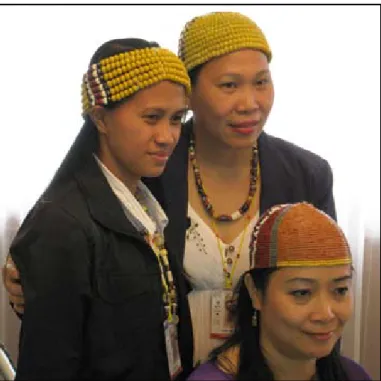
attrac-Figure 1. Some of the ladies at the bead identification
table with their distinctive beaded caps. All photographs by Karklis Karklins.
--Figure 3. Bidayuh woman at the Annah Rais longhouse making one of their distinctive beaded hats.
tions of Kuching and the Annah Rais longhouse (Fig-ure 3) near the Kalimantan border.
The social highlight of the conference was the gala dinner and fashion show at the nearby Riverside Majestic Hotel on Saturday evening. Attended by several hundred people, including local dignitaries and representatives of the various sponsors, the brightly lit runway saw lovely (and handsome) local models dressed in both traditional and modern garments that rivaled those of the North American and European fashion houses. The dinner itself was marvelous with numerous local dishes to be sampled and enjoyed. The winners of the Borneo International Beads Award 2011 were announced following the fashion show.
BIBCo 2011 provided an excellent opportunity for the attendees to not only learn more about the
beads and beadwork of Borneo but that of many other parts of the world as well. It was also a chance for them to interact and exchange ideas and information on a personal basis. The conference was well attended by local individuals but those from abroad were relatively few. This is a shame as the organizers put a lot of thought and effort into its production. Unfortunately, the expense and the lengthy flight understandably kept many distant individuals away, especially in these rather precarious economic times. Nonetheless, plans are already underway for BIBCo 2013 (they are skip-ping a year) and I, for one, am hoskip-ping to be able to attend that as well if for no other reason than to once again experience the warmth and hospitality of the Sarawakan people and their inherent love of beads.
-10-Selected Publications/Other Media
Bar-Yosef Mayer, D.E. and Porat, N.
2008 Green Stone Beads at the Dawn of Agriculture. Proceedings of the National Academy of Sci-ences, Vol. 105, pp. 8548–8551. http://www. pnas.org/content/105/25/8548.full.pdf+html and http://www.pnas.org/content/105/25/8548
Bradley, James. W.
2011 Re-visiting Wampum and Other Seventeenth-Century Shell Games. Archaeology of Eastern
North America, Volume 39.
Carter, Alison Kyra
2010 Trade and Exchange Networks in Iron Age Cambodia: Preliminary Results from a Com-positional Analysis of Glass Beads. Bulletin of
the Indo-Pacific Prehistory Association, Volume
30. http://journals.lib.washington.edu/index. php/BIPPA/article/view/9966
Presents the findings of compositional analysis (using laser ablation-inductively coupled-mass spectrometry, or LA-ICP-MS) of glass beads from six Iron Age (500 BC-500 AD) archaeological sites in Cambodia. The author uses the data to identify trade networks in Iron Age Cambodia.
Dahdul, Mariam
2011 Origins of Olivella Beads in the Coachella Valley, Alta California. California Archaeology:
Journal of the Society for California Archaeology,
Volume 3, Issue 2.
Dillian, Carolyn D.
2011 Colonoware bead production and African American tradition at 38GE560, Georgetown County, South Carolina. Archaeology of Eastern
North America, Volume 39.
Karklins, Karlis
2010 Glass, Metal, and Shell Beads. In The Eagle Ridge Site and Early Eighteenth Century In-dian-European Relations in Eastern Nebraska, edited by Gayle F. Carlson and John R. Bozell.
Central Plains Archeology 12(1):143-148.
Describes and illustrates the beads recovered from a probable Oto or possibly Ioway site. The beads include drawn and wound glass, yellow-metal tubes, and shell wampum.
Parker, Wendy
2010 A Study of Shell Bead Context, Distribution and
Use Within Northern California. Master’s thesis,
Department of Anthropology, University of California, Sacramento, CA.
Parmar, Narender
2009 Recent Explorations in the Bhiwani Block, District Bhiwani (Haryana). Bulletin of the
Dec-can College Post-Graduate and Research Institute,
68-69:95-112.
Parmar conducted a village-to-village survey in the Bhiwani district, exploring 66 sites, and placing 40 of them on the archaeological map of India for the first time. The sites range in date from the early Harappan through the medieval period and steatite, faience and terracotta beads were recovered.
Robertshaw, Peter, B. Rasoarifetra, M. Wood, E. Melchiorre, R. Popelka-Filcoff, and M. Glascock
2006 Chemical Analysis of Glass Beads from Mada-gascar. Journal of African Archaeology 4 (1):91-109.
Robertshaw, P., M. Wood, E. Melchiorre, R.S. Popelka-Filcoff, and M. Glascock
2010 Southern African Glass Beads: Chemistry, Glass Sources and Patterns of Trade. Journal of
Archae-ological Science 30:1898-1912.
Saitowitz, Sharma J. and David L. Reid
2001 Early Indian Ocean Glass Bead Trade Between Egypt and Malaysia: A Pilot Study. Indo-Pacific
Prehistory Association Bulletin 21, Melaka Papers, Volume 5. http://ejournal.anu.edu.au/index.
php/bippa/article/viewFile/266/256
Plasma mass spectrometry was used to assess the Rare Earth Trace Element content of beads from Egypt and
-11-Malaysia. Egyptian beads dating to AD 800-900 were
compared to Malaysian beads from the same time period, yielding virtually identical glass recipes. The data sheds new light on ancient trade between Egypt and Malaysia.
Shinde, Vasant, Shreekant Jadhav, Prabodh Shirvalkar, Amol Kulkarni, Abhijit Dan-dekar, Shrikant Ganvir, P.P. Joglekar, Girish Mandke, Arati Deshpande-Mukherjee, Su-shama G. Deo, S.N. Rajaguru, M.D. Kajale, and Satish Naik
2008 A Report on the Recent Archaeological Inves-tigations at Junnar, Maharashtra (2005-2007),
Bulletin of the Deccan College Post-Graduate and Research Institute, 66-67:113-134.
Recent excavations in the Junnar region of India yielded beads of semi-precious stone, faience, glass gold and terracotta, along with rings, bracelets and other ornaments.
Wood, Marilee
2011 Interconnections. Glass Beads and Trade in Southern and Eastern Africa and the Indian Ocean 7th to 16th Centuries AD. Uppsala Uni-versity, Studies in Global Archaeology 17. Glass beads comprise the most frequently found evi-dence of trade between southern Africa and the greater Indian Ocean between the 7th and 16th centuries A.D. In this study beads recovered from southern Afri-can archaeological sites are organized into series, based on morphology and chemical composition determined by LA-ICP-MS analysis. The results are used to inter-pret the trade patterns and partners that linked eastern Africa to the rest of the Indian Ocean world, as well as interconnetions between southern Africa and East Africa. Comprehensive reports on bead assemblages from several archaeological sites are presented, includ-ing Mapungubwe, K2, and Schroda in the Shashe-Limpopo Basin; Chibuene in southern Mozambique; Hlamba Mlonga in eastern Zimbabwe; Sibudu Cave in KwaZulu-Natal; Kaole Ruins in Tanzania; and Mahilaka in northwest Madagascar. The conclusions reached show that trade relationships and socio-politi-cal development in the south were different from those on the East Coast and that changes in bead series in the south demonstrate it was fully integrated into the cycles of the Eurasian and African world-system.
Note: Interconnections includes within its pages the following research papers noted on page 10 or 11 of this newsletter: Chemical Analysis of Glass Beads from Madagascar; The Glass Beads of Kaole Ruins; A Cache of ~5000 Glass Beads from the Sibudu Cave Iron Age Occupation; The Glass Beads from Hlamba Mlonga, Zimbabwe; and Southern African Glass Beads: Chem-istry, Glass Sources and Patterns of Trade.
Wood, Marilee
2009 The Glass Beads from Hlamba Mlonga, Zimba-bwe: Classification, Context and Interpretation.
Journal of African Archaeology 7(2):219-238.
2011 The Glass Beads of Kaole Ruins. (After) 2002. The Glass Beads of Kaole. In Southern Africa and
the Swahili World, edited by F. Charni, G. Pwiti,
and C. Radimilahy, pp. 50-65. Studies in the African Past 2. University Press, Dar-es-Salaam.
Wood, Marilee, L. Dussubieux, and L. Wadley
2009 A Cache of ~5000 Glass Beads from the Sibudu Cave Iron Age Occupation. South African
-1-Who We Are
The Society of Bead Researchers is a non-profit corporation, founded in 1981 to foster research on beads of all materials and periods, and to expedite the dissemination of the resultant knowledge. Membership is open to all persons involved in the study of beads, as well as those interested in keeping abreast of current trends in bead research. The society publishes a semi-annual newsletter, The Bead Forum, and an annual journal, BEADS: Journal
of the Society of Bead Researchers. The society’s website address, as of Spring 2010, is http://www.beadresearch.org.
Contents of the newsletter include current research news, requests for information, responses to queries, list-ings of recent publications, conference and symposia announcements, and brief articles on various aspects of bead research. Both historic and prehistoric subject materials are welcome.
The deadline for submissions to the next Bead Forum is September 1, 2012. Electronic submissions should be in Word for Windows 6.0 or later with no embedded sub-programs such as “End Notes.” References cited should be in Historical Archaeology format (http://www.sha.org/publications/for_authors.cfm).
Send electronic or paper submissions to the Forum editor: Laurie Burgess, Associate Chair
Department of Anthropology
National Museum of Natural History Smithsonian Institution
MRC 112, P.O. Box 37012 Washington, DC 20013-7012 (202) 633-1915
Officers and Others
President: Bill Billeck, Repatriation Program Manager, Department of Anthropology, National Museum of Natural History, Smithsonian Institution, [email protected]
Journal Editor: Karlis Karklins, former Head of Material Culture Research, Parks Canada, karlis4444@ gmail.com
Secretary/Treasurer: Alice Scherer, Founder, Center for the Study of Beadwork, [email protected]
The Bead Forum Editor: Laurie Burgess, Associate Chair, Department of Anthropology, National Museum of Natural History, Smithsonian Institution, [email protected]
The Bead Forum Design, Layout and Mailing: Alice Scherer
Journal Layout and Printing Preparation: David Weisel Webmaster: Alice Scherer
Finance Committee: Joan Eppen and Lois Rose Rose
Editorial Advisory Committee: Laurie Burgess (chair), Christopher DeCorse, and Marvin T. Smith
Publications Committee: Karlis Karklins (chair), Alice Scherer, and Margret Carey
Society of Bead Researchers, PO Box 13719, Portland, OR 97213 http://www.beadresearch.org