Edinburgh Research Explorer
Efficient Symbolic Integration for Probabilistic Inference
Citation for published version:Kolb, S, Mladenov, M, Sanner, S, Belle, V & Kersting, K 2018, Efficient Symbolic Integration for Probabilistic Inference. in Proceedings of the Twenty-Seventh International Joint Conference on Artificial Intelligence. IJCAI Inc, Freiburg, Germany, pp. 5031-5037, 27th International Joint Conference on Artificial Intelligence, Stockholm, Sweden, 13/07/18. DOI: 10.24963/ijcai.2018/698
Digital Object Identifier (DOI): 10.24963/ijcai.2018/698
Link:
Link to publication record in Edinburgh Research Explorer Document Version:
Peer reviewed version
Published In:
Proceedings of the Twenty-Seventh International Joint Conference on Artificial Intelligence
General rights
Copyright for the publications made accessible via the Edinburgh Research Explorer is retained by the author(s) and / or other copyright owners and it is a condition of accessing these publications that users recognise and abide by the legal requirements associated with these rights.
Take down policy
The University of Edinburgh has made every reasonable effort to ensure that Edinburgh Research Explorer content complies with UK legislation. If you believe that the public display of this file breaches copyright please contact [email protected] providing details, and we will remove access to the work immediately and investigate your claim.
Efficient Symbolic Integration for Probabilistic Inference
Samuel Kolb
a∗, Martin Mladenov
b, Scott Sanner
c, Vaishak Belle
d, Kristian Kersting
e aKU Leuven
bGoogle Research
cUniversity of Toronto
d
University of Edinburgh & Alan Turing Institute
eTU Darmstadt
[email protected], [email protected], [email protected],
[email protected], [email protected]
Abstract
Weighted model integration (WMI) extends weighted model counting (WMC) to the integration of functions over mixed discrete-continuous probability spaces. It has shown tremendous promise for solving inference prob-lems in graphical models and probabilistic programs. Yet, state-of-the-art tools for WMI are generally limited ei-ther by the range of amenable theories, or in terms of performance. To address both limitations, we propose the use of extended algebraic decision diagrams (XADDs) as a compilation language for WMI. Aside from tackling typical WMI problems, XADDs also enable partial WMI yielding parametrized solutions. To overcome the main roadblock of XADDs – the computational cost of integra-tion – we formulate a novel and powerful exact symbolic dynamic programming (SDP) algorithm that seamlessly handles Boolean, integer-valued and real variables, and is able to effectively cache partial computations, unlike its predecessor. Our empirical results demonstrate that these contributions can lead to significant computational reduction over existing probabilistic inference algorithms.
1
Introduction
Weighted model counting (WMC) is the problem of com-puting the mass of a function over the set of models of a propositional theory and lies at the heart of probabilistic ar-tificial intelligence, where a core issue is to quantify uncer-tainty over logically-structured worlds. Many state-of-the-art algorithms dealing with discrete Bayesian networks [Chavira and Darwiche, 2008], factor graphs [Choiet al., 2013], prob-abilistic programs [Fierens et al., 2013], and probabilistic databases [Suciuet al., 2011] reduce their inference problem to a WMC computation. While a typical WMC inference task is to compute the partition functions and marginals of factored probability distributions, it has also been used as a subroutine for more general tasks such as automated planning [Domshlak and Hoffmann, 2007].
Many of these successes have been powered by the de-velopment of 1) efficient model counting strategies and 2) efficient data structures for manipulating Boolean theories that support WMC. Inference in continuous and mixed discrete-continuous theories, however, had neither enjoyed fast algo-rithms, nor was it known whether there are efficient data
struc-∗
S. Kolb supported by the Research Foundation-Flanders (FWO)
tures for manipulation, until recently. Progress on the algo-rithmic front accelerated with the introduction of weighted model integration (WMI) [Belleet al., 2015] which extends the usual WMC setting by including real-valued variables, linear real-arithmetic (LRA) theories and symbolic weight functions. WMI (or closely related formulations) have recently been applied to a number of non-trivial graphical modeling and probabilistic programming tasks [Chistikovet al., 2015; Albarghouthiet al., 2017; Morettinet al., 2017; Belle, 2017; Brazet al., 2016]. On the data structure front, an extension of algebraic decision diagrams (ADDs) to piecewise polyno-mial functions over continuous linear and Boolean theories, so-calledextended ADDs(XADDs), was proposed in Sanner et al. (2011) and when combined withsymbolic dynamic pro-grammingtechniques has proven successful for probabilistic planning as well as probabilistic inference [Sanner and Ab-basnejad, 2012]. In the software verification community, a subset of XADDs dealing with piecewise-constant functions was independently developed under the name linear decision diagrams (LDDs) [Chakiet al., 2009].
Although impressive, progress in the mixed discrete-continuous domain on both the algorithmic and data struc-ture front is still far from its Boolean counterpart. Most WMI solvers are based on the so-called block-clause strategy, which naively enumerates the models of a LRA theory and is of-ten prohibitive in practice. Finally, most solvers, including improved variants such as the predication abstraction solver introduced by Morettin et al. (2017), do not consider partial WMI and the efficient storage of intermediate results of com-putation, which can speed up computing repeated conditional queries, occurring in tasks such as parameter estimation from data. Indeed, Belleet al.(2016) considered component caching but is restricted to interval formulas. From the data-structure perspective, current XADD methods suffer from an extremely high cost for integration in WMI; this has severely limited their application to problems with only a handful of variables and formulas [Sanner and Abbasnejad, 2012]. Finally, many prob-abilistic programming problems, see e.g. the argument of Braz
et al.(2016), involve Boolean, real-valued but also integer-valued variables, however, both existing state-of-the-art WMI solvers and XADDs currently do not support integer-valued variables. An exception is actually the work of Braz et al., which is probably closest to our work in terms of functionality. It supports both integer and real values, but does not
repre-sent and cache intermediate results, and Morettin et al. (2017) showed that their solver achieved better performance.
In this paper, we address both shortcomings of XADDs and provide additional extensions. Our contribution is cen-tered around a novel and powerful symbolic dynamic pro-gramming algorithmfor marginalization and integration. Con-cretely, we make the following contributions:1)we explore the use of XADDs [Sanneret al., 2011] as acompilation language
for WMI and show how to structure WMI problems as sym-bolic dynamic programming over XADDs;2)we contribute a novel marginalization and integration algorithm for XADDs that efficiently computes partial integrations, improving the state-of-the-art integration algorithms [Sanner and Abbasne-jad, 2012] by exploiting shared substructures in the XADD’s directed acyclic graph through caching and we additionally show how to handle integer-valued variables; and3)we show that the algorithm can be adapted for volume computations and, moreover, that XADDs can be used to compute partial WMI through partial integration, obtaining parametrized solu-tions that can be used for repeated query computasolu-tions or, for example, computing theargmaxfor the remaining variables. Our empirical results show that our novel WMI solver can lead to an exponential to linear computational reduction over previous state-of-the-art solvers for problem domains contain-ing high levels of mutually exclusive or XOR structure, and that its performance exceeds or matches existing WMI solvers. We remark that the decision versions of both #SAT and Bayesian inference are #P-complete. Nonetheless, the caching of partial computations and memoization schemes have been shown to achieve strong time-space tradeoffs, and are often very effective in practice [Bacchuset al., 2009].
2
Background
Foundations of Weighted Model Integration:We assume that the reader is familiar with propositional logic and the SAT problem. Satisfiability Modulo Theories (SMT) generalizes SAT to determining the satisfiability of a formula with respect to a decidable background theory. We consider the background theories LRA and LIA, which are first-order logic fragments restricting the interpretation of numbers, inequalities and oper-ators (sum, product) to their semantics in linear real and integer arithmetic, respectively, as in, e.g.,a∧(b∨(u+v≤5)).
Model counting (#SAT) refers to the task of counting the number of models that satisfy a given formula. Weighted model counting (WMC) generalizes this task by summing the weights assigned to models satisfying a formula. Cor-responding to the generalization of SAT to hybrid domains,
weighted model integration (WMI)generalizes WMC to sup-port SMT(LRA) formulas and real variables [Belle et al., 2015]. We, additionally, extend the WMI formulation to also support linear arithmetic over integers (LIA). Formulas are then Boolean combinations of Boolean literals, inequalities over real variables and inequalities over integer variables, which we will refer to as LA formulas.
Givennreal variablesx,mBoolean variablesA,pinteger variablesI, an LA formulaθ(x, A, I)overx,AandIand a weight functionw(x, A, I)that maps variable assignments to real weights, the weighted model integral (WMI), following
its most recent definition [Morettinet al., 2017], is defined as (usingWMI(θ, w)to abbreviateWMI(θ, w|A,x, Z)):
WMI(θ, w) = X µA∈Bm X µZ∈Zp Z θ(x,µA,µZ) w(x, µA, µZ)dx
That is, the WMI is obtained by summing over every pair of total truth assignmentsµAandµZ to the Boolean- and
inte-ger variables, substituting every Boolean or inteinte-ger variable inθ and wwith its truth value in µA orµZ, and
integrat-ingw(x, µA, µZ)over the values{x∗|θ(x∗, µA, µZ)}. In order to obtain algorithmic results we restrictwto the class of piecewise-polynomial case functions, i.e.,
f ={θ1:f1, . . . , θn:fn}, (1)
where thefiare polynomial functions over real and integer
variables and the case conditionsθiare LA formulas that
par-tition the underlying space. This class strictly generalizes the class ofpolynomial under LRA conditionsfunctions [Morettin
et al., 2017]. As input language for defining polynomial case functions, we fix the language of nested arithmetic andite compositions, i.e., a single caseφ={θ:f,¬θ: 0}is a case function; ifφ1, φ2 are case functions, then so areφ1+φ2,
φ1∗φ2, and,ite(θ, φ1, φ2), whereθis a sentence from one
of B, LRA or LIA, andite expands toif-then-elseunderstood in the usual manner. This language corresponds to the one implemented in the well-knownPySMTpackage [Gario and Micheli, 2015]. A case function is identified by its PySMT abstract syntax tree.
Decision Diagrams (DDs):DDs or arithmetic circuits are used to compactly represent logical formulas by compiling them into directed acyclic graphs (DAGs) whose internal nodes are labeled by atoms and whose leaf nodes are labeled by expressions. Every internal node has two edges labeled withtrue(>) andfalse(⊥) (traditionally calledhighandlow) that correspond to the atom of the internal node being satisfied or not. We denote the label of an internal nodef byfC or
C(f), its two child nodes asf>andf⊥, following the high and low edge respectively, the label of an edgeeasv(e)and the expression of a leaf nodelasexp(l).
Binary decision diagrams (BDDs) use Boolean variables as atoms and truth values ({>,⊥}or{1,0}) as expressions. Any propositional logical formula can be compiled into a BDD and decision diagrams support various efficient operations. E.g., computing SAT for a formula represented by a BDD corresponds to determining if there is a path from the root to
1. We consider three extensions of BDDs: LDDs, ADDs and XADDs (Table 1). LDDs support LRA atoms over continuous variables in internal nodes while ADDs allow an arbitrary number of leaf expressions labeled with real numbers. XADDs extends both by allowing LRA atoms in internal nodes as well as arbitrary symbolic polynomial functions over continuous variables in leaf nodes. Some XADD operations restrict the leaf nodes to be, e.g., linear functions.
XADDs [Sanneret al., 2011] represent case functions with linear inequality conditions and polynomial values. Every path in an XADD corresponds to a case and its DAG structure allows compact representation of multiple cases with common structure (see Fig. 1 for an example XADD). For a pathp=
BDD LDD ADD XADD Bn7→B Bn×Rm7→B Bn7→R Bn×Rm7→R
Boolean Boolean + LRA Boolean Boolean + LRA
{0, 1} {0, 1} c∈R Polynomial
Table 1: Overview of decision diagrams showing the type of labels for internal nodes and leaf nodes. While BDDs, LDDs, and ADDs have
constantsas leaves, XADDs havesymbolic polynomialsas leaves.
n1→e1 ...→en−1 nn→enl, the case condition and function
can be obtained by taking the conjunction of the labels of the nodes and the expression of the leaf nodel, respectively:
θ(p) =^
ni∈p
ite(v(ei), C(ni),¬C(ni)), f(p) =exp(l)
One of the advantages of DDs is that they allow operations to be performed on them. Theif-then-else(ite) construct allows DDs to be combined. E.g., given two decision diagramsd1
andd2and a condition atomc, we can construct a new
dia-gramd=ite(c, d1, d2). The new diagram introduces a new
internal nodenwithnC=c, n> =d1andn⊥ =d2, i.e., it
behaves asd1ifcis fulfilled and asd2otherwise. By using
the so-calledapplyoperation we can apply a binary operator to two decision diagrams. This operation constructs a new DD that corresponds to the composition of the two functions represented by the input diagrams. For BDDs and LDDs, dia-grams are combined using∧and∨, for ADDs and XADDs, diagrams can also be combined using element-wise sum and product, and both support marginalization for Boolean vari-ables. In addition, XADDs also support integration for real variables. We refer to marginalization through summation and integration (based on the variable type) as SO, short for sum-out. For real variablex, integer variablei, Boolean vari-ableband an XADDXfcorresponding to a polynomial case
functionf overx, i, b, we obtainSO(x, Xf) = R∞
−∞f(x)dx,
SO(i, Xf) =P∞i=−∞f andSO(b, Xf) =Pb∈{⊥,>}f. We writeSO(b,SO(i,SO(x, Xf)))asSO∗({x, i, b}, Xf).
3
XADD Compilation for WMI
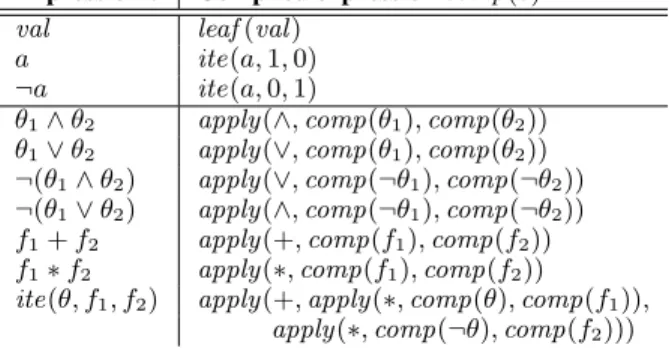
We propose a top-down compilation scheme to convert an SMT(LA) formula or polynomial case function from a nested arithmetic anditeabstract syntax tree to a valid XADD with a consistent node ordering. Our scheme recursively applies a set of grammar rules defined inductively in Table 2. The three base cases convert polynomials (including constants) to equivalent single-leaf XADDs and SMT(LA) literals a
or¬ato 0-1 XADDs with a single test onacorresponding toite(a,1,0)orite(a,0,1), respectively. For composite ex-pressions, the terms are recursively compiled and combined using the XADDapply operator [Sanneret al., 2011] that automatically collapses paths sharing sub-diagrams.
Example 1. The XADD depicted left in Fig. 1 is obtained by compiling the WMI problem withθ=x≥v∧(x < y∨x≤z)
andw=ite(x≤z∧x≥w,3x2,2x).
Marginalization for XADDs is currently supported for tests over Boolean variables, LRA atoms and difference arithmetic atoms, i.e., over a subset of LIA. In this paper we consider
Expressione Compiled expressioncomp(e)
val leaf(val) a ite(a,1,0)
¬a ite(a,0,1)
θ1∧θ2 apply(∧,comp(θ1),comp(θ2))
θ1∨θ2 apply(∨,comp(θ1),comp(θ2))
¬(θ1∧θ2) apply(∨,comp(¬θ1),comp(¬θ2))
¬(θ1∨θ2) apply(∧,comp(¬θ1),comp(¬θ2))
f1+f2 apply(+,comp(f1),comp(f2))
f1∗f2 apply(∗,comp(f1),comp(f2))
ite(θ, f1, f2) apply(+,apply(∗,comp(θ),comp(f1)), apply(∗,comp(¬θ),comp(f2)))
Table 2: Compilation rules for XADDs usingafor SMT(LA) atoms, i.e., Boolean variables or inequalities,θfor arbitrary SMT(LA) formu-las,valfor polynomial functions andffor polynomial case functions.
v >= z
y >= v y >= z
y^2 - z^2 0 y^2 - v^2
Figure 1: Illustration of two XADDs. The colors highlight different paths used in examples and are not part of the XADD data structure. Integrating outxfrom the red path results in the right XADD.
marginalization through summation and integration, leaving other operations, such as maximization, as future work.
Theorem 1. Given an SMT(LA) formulaθand a polynomial case functionw both over Boolean, integer and real vari-ablesA, Zandx, then, usingXψ=comp(ψ):
WMI(θ, w|A, Z,x) =exp(SO∗(A∪Z∪x, Xθ∗Xw)). Proof. Any case function defined by the input language of nestediteand arithmetic combinations can be compiled to an XADD by recursively applying the rules of Table 2. Similarly, every SMT(LA) function can be compiled to a 0-1 case func-tion by the same procedure. SinceXθ∗Xw=Xite(θ,w,0)and
WMI(θ, w) =WMI(>,ite(θ, w,0)), summing out all vari-ables fromXθ∗Xwyields the weighted model integral.
4
Novel XADD Partial Integrator
Having clarified that WMI-amenable theories of interest can be compiled to XADDs, we now discuss the WMI computation. The computational cost of the XADD marginalization (SO) algorithm introduced by Sanner et al. (2012) is often pro-hibitive even for relatively simple models. We identify the main issue as the inability to effectively cache intermediate re-sults of the integration process in the XADDs DAG and in this
section we aim to develop more efficient alternatives. In the following, we: 1) review Sanner et al.’s algorithm that is based on path enumeration; 2) introduce and discuss two variants of a novel algorithm based on bound resolution that introduce caching to SO; 3) conclude with an extension of XADDs and the marginalization algorithms to integer theories.
Every internal node containing a numeric variablex im-poses an upper-bound on one child and a lower bound on the other. For the sake of brevity, we assume in our algorithms and discussions that upper bounds are always imposed on the high child and that all numeric variables are continuous (not inte-ger). In practice, the algorithm would detect if an internal node test imposes a lower or upper bound and swap the child nodes if necessary. Note that w.r.t. integrating continuous variables strict and non-strict inequalities are equivalent.
Path Enumeration:Sanner et al. ’s SO algorithm is sum-marized in Alg. 1. Essentially, it works like a symbolic version of DPLL, expanding the XADD DAG into an XADD tree, i.e., it recursively traverses every path in the XADD, collecting all expressions that can bound the integration variablexalong the way. Reaching a leaf, the recursion returns the leaf integral
R
x∈Cf(x)dx, where the setCis the intersection of bounds on
xcollected during the descent. SinceCmay depend paramet-rically on all non-integrated variables, the integral is computed symbolically as follows. For each bound pairu∈U, l∈L, we consider the case whereuis the smallest of all possible upper bounds andlis the largest of all lower bounds, described by the formulaθul:=Vu0∈U(u≤u0)
V
l0∈L(l≥l0)∧(u≥l),
where the last atom ensures consistency (the upper bound must be at least as large as the lower bound for the integral to be well-defined). These formulas partition the space com-pletely, so the integral of{θ : f}is then the case function {θul :
Ru
x=lf(x)dx |ul∈U×L}. Let us quickly illustrate
this with an example.
Example 2. Consider the case function corresponding to the red path of Fig. 1 (omitting the cases where the result is0):
f ={x≥v∧x < y∧x > z: 2x};then
Z ∞
−∞
f dx={y≥v≥z:y2−z2, y≥z > v:y2−v2}
The XADD of that integral is illustrated in Fig. 1, right.
The computational disadvantage of this algorithm is that it does not exploit the DAG structure of the XADD. This is re-flected in the fact that theSOfunction receives all upper/lower bounds accumulated so far as an argument, hence the out-put of each recursive call depends on the entire context from which it is called. This eliminates any opportunity for caching, and what looks as dynamic programming is essentially a tree-structured recursion which must always traverse exponentially many paths. This renders the algorithm inapplicable on any-thing but toy models.
This is also akin to the depth-first PRAiSe algorithm [Braz
et al., 2016] which explicitly uses a symbolic extension of DPLL but not XADDs to represent piecewise functions.
Bound Resolution:We will now develop two alternatives of this algorithm that introduce increasing amounts of caching. The main idea is as follows: instead of collecting all candidate bounds until the bottom of the recursion and then introducing
Algorithm 1Integration using path enumeration.
1: procedureSO(varx, XADDf,U,L)
2: . U: upper-bounds,L: lower-bounds 3: iffis terminalthen 4: returnintegrate(x, f, U, L) 5: ifx∈fCthen 6: (l, u)←get bounds(x, fC) 7: returnSO(x, f>, U∪ {u}, L) +SO(x, f⊥, U, L∪ {l})
8: returnite(fC,SO(x, f>, U, L),SO(x, f⊥, U, L))
cases to compare among them, we maintain a single upper and lower bound candidate. As soon as a new potential upper or lower bound appears due to some test, the recursion introduces two cases: 1) if the new upper bound is greater than the current one, we keep the current bound and descend on child node; 2) if the new upper bound is less than the current one, it replaces the current bound before we descend on the child node. In the latter case, a consistency test is added to enforce that the new upper bound is greater than the current lower bound. For our first version, Alg. 2, we end up with the following recursive rule for the upper bound:
fu←ite(unew> u,SO(x, f>, u, l),
(unew≥l)∗SO(x, f>, unew, l)).
The output of this algorithm is identical to the output of Alg. 1, however, the context influence is reduced to only the upper and lower bound candidate. Hence, the tripleu, l, f can serve as the key for caching the result.
Example 3. Reconsider the left XADD from Fig. 1. Both the green path and the blue path will at some point encounter the callSO(x,3, z, v)as on both paths zandv appear as upper- and lower bound tox, respectively, and both paths go through node3. However, since the two paths go through different branches of node2, the recursion for green also invokesSO(x,3, v, y), whereas the recursion for blue invokes
SO(x,3, y, z). The latter two calls cannot profit from caching even though the paths generating them rejoin in the diagram.
Finally, we consider the version of Alg. 2b which is com-pletely context-independent. The key idea is that instead of callingSO(x, f>, unew, l), the same result is obtained by
call-ingSO(x, f>, uS, lS), where uS andlS are symbolic
vari-ables, and then substitutinguS byunew andlS by lin the
resulting XADD. Similarly, we obtain SO(x, f>, u, l))by substituting uS by uand lS by l. Notice that while unew
is available at the time of the recursion call, as it comes from the current node, we want to eliminateufrom the list of ar-guments. Hence, the second branch of theite expression is left with the dummy variableuS as a placeholder. This will
be substituted with the various upper bounds as the algorithm emerges from the recursion. We end up with the following recursive step:
fu←ite(unew> uS,SO(x, f>),
(unew≥lS)∗SO(x, f>){uS/unew}),
whereuS/unewdenotes the substitution of the dummy
Algorithm 2Integration using bound resolution
(2a)Algorithm for bound-pair caching 1: procedureSO(varx, XADDf,u,l)
2: . u: current upper-bound,l: current lower-bound
3: iff is terminalthen
4: returnintegrate(x, u, l, f)
5: ifx∈/ fCthen
6: returnite(fC,SO(x, f>, u, l),SO(x, f⊥, u, l))
7: (lnew, unew)←get bounds(x, fC) 8: fu←ite(unew> u,SO(x, f>, u, l),
(unew≥l)∗SO(x, f>, unew, l)) 9: fl←ite(lnew< l,SO(x, f⊥, u, l),
(lnew≤u)∗SO(x, f⊥, u, lnew)) 10: returnfu+fl
(2b)Algorithm for symbolic caching 1: procedureSO(varx, XADDf)
2:
3: iff is terminalthen 4: returnintegrate(x, f)
5: ifx∈/fCthen
6: returnite(fC,SO(x, f>),SO(x, f⊥))
7: (lnew, unew)←get bounds(x, fC) 8: fu←ite(unew> uS,SO(x, f>),
(unew≥lS)∗SO(x, f>){uS/unew}) 9: fl←ite(lnew< lS,SO(x, f⊥),
(lnew≤uS)∗SO(x, f⊥){lS/lnew}) 10: returnfu+fl
any context information from the call toSO, and the result ofSO(x, f) depends only onf. This algorithm is able to reuse any partial computation, exactly as the marginaliza-tion algorithm on ADDs. Moreover, it can be implemented in bottom-up message-passing style, as is characteristic for dynamic programming algorithms. To see the difference with the previous version, note that the entire computation of the integral under node3on Fig. 1 can be reused for both green and blue paths.
It is important to note that the second version of the algo-rithm does not subsume the first. Unlike the Boolean setting, where more caching almost universally improves performance, for linear theories this is not always the case. Having con-crete bounds allows us to prune the diagram early by detecting conflicting bounds, e.g., ifunew ≥ l can be detected to be
unsatisfiable, the recursion can be terminated. In practice, the first version seems to be the most versatile.
Theory-specific Considerations: We currently support XADDs that, aside from Boolean variables, can contain ei-ther real or integer variables. For integer variables symbolic summation is used instead of symbolic integration.1In order to guarantee that (symbolic) summation bounds are integral, we need to restrict the language of the tests. One amenable sub-theory of LIA is difference arithmetic. Additionally, for the integration of real variables, strict and weak inequalities are equivalent (the set of boundary points has measure zero), hence negation is obtained by simply flipping the inequal-ity. However, for integer variable this is not the case, e.g., the inverse ofx ≤ 5 is x > 5 orx ≥ 6, which leads to some implementation differences. Finally, a pruning routine for inconsistent paths in XADDs is implemented using linear programming for real variables, while for integer variables we currently use SMT(LIA) solvers as an oracle for testing inconsistency, as well as linear programming for a relaxed version of inconsistency.
5
XADD Integration for WMI
We can now show how WMI can be realized using XADD based SO-algorithms. Specifically, we introduce two tech-niques for solving single WMI problems and then propose a
1
Implemented in Python usingsympy[Meurer et al., 2017].
partial-WMI algorithm for computing probabilities of sets of WMI queries efficiently.
WMI using Repeated SO: Calculating the WMI corre-sponds to summing out a set of variables from an XADD, i.e.,
SO∗(vars, X). The simplest way to compute the outcome is to reuse an SO algorithm for XADDs, e.g., path enumeration or bound resolution, and sum out variables one by one.
WMI using Mass-SO: Alternatively, we can tweak our recursive bound-resolution algorithm to immediately sum-out all variables before emerging. This algorithm requires an
variable-orderedXADD in which the ordering of tests in the XADD depends on the variables occurring in them. Specifi-cally, given a variable orderingO=v1, v2, ..., vnwe call an
XADD variable-ordered with respect toOif any test whose
lastvariable has ranki, i.e., it has positioniin the ordering, occurs deeper in the diagram than any test whose last variable has a lower rankj < i. The last variable of a test is the variable in the test with the highest rank. The modified algorithm now proceeds by first summing out the variablev1with the lowest
rank using the original bounds-resolve algorithm (Alg. 2) and, whenever a test is encountered whose last variablevjis ranked
higher than the current variablevi, summing out variables
vi+1, ..., vj−1, vjrecursively before proceeding to sum outvi
from the resulting diagram. The ordering guarantees that after summing out a variable with ranki, the resulting diagram contains no variable with rankj≥i.
Partial WMI for Computing Query Probabilities: In practice, weighted model integration is used to compute query probabilities, where queries are arbitrary SMT(LA) formulas over both Boolean and numeric variables. Given a queryq
over variablesvars(q) ⊆ D, its probability is obtained by computing the ratio WMIWMI(θ(∧θ,wq,w|D|D)). Current solvers obtain this answer by computing both volumes separately and divid-ing the results. For a setQofnqueries, this requiresn+ 1
WMI computations. By exploiting symbolic SO, we propose a new technique for computing probabilities for sets of queries. This approach can drastically reduce the execution time when the number of variablesDQoccurring in any query is much
lower than the number of variables in the domain. The al-gorithmWMI∗consists of three steps: 1) it pre-computes a temporary diagramXQ by summing out variablesD\DQ
Figure 2: The execution time (top: mutual ex-clusivity, bottom: XOR) grows much slower for our algorithm (BR) than for path enumer-ation (PE) and the WMI solver (PA) both of which time out for larger numbers of terms.
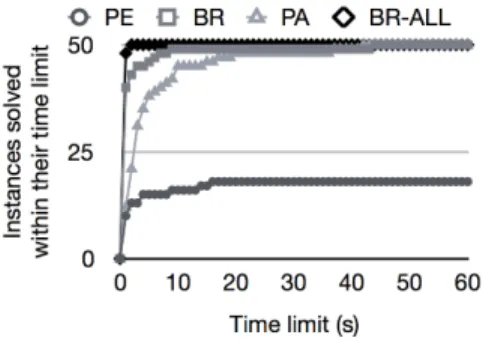
Figure 3: Both SO and mass-SO using bound resolution (BR, BR-ALL) are competitive with the WMI solver (PA) on the number of problems solved below increasing time limits. The path enumeration approach (PE) fails to solve several problems within60s.
Figure 4: The ratios between the cumulative execution times to solve a number of queries using our bound resolution algorithm (BR) and the WMI solver (PA) decrease to below1, even if the initial queries were slower to com-pute. Our algorithm timed out while comput-ing the partial WMI for problems4and7.
that do not occur in any query; 2) it computesWMI(θ, w)by summing out variablesVQfromXQ; and 3) for every queryq
it computesWMI(θ∧q, w)by summing out variablesVQ
fromXQ∗Xq.
Theorem 2. Givenθ,Qandwover variablesD, as before, thenWMI∗computes{WMIWMI(θ(∧θ,wq,w|D|D))|∀q∈Q}.
Proof. The algorithm computes WMI(θ ∧ q, w|D) and WMI(θ, w|D), whereq = >, using SO. Since WMI(θ∧
q, w|D) = SO∗(D, Xθ∗Xq ∗Xw)andXq is independent
of D \DQ it follows that the WMI can be computed as
SO∗(DQ,SO∗(D\DQ, Xθ∗Xw)∗Xq).
XQis the result of partial WMI, i.e.,WMI(θ, w|D\DQ),
and it should be clear that this can also be used to compute, e.g.,argmaxD
QXQ, which is a standard XADD operation.
6
Empirical Evaluations
We analyze the performance of our improved SO algorithm and how XADDs can be used to tackle WMI problems. First, we demonstrate our algorithms ability to exploit caching in very structured diagrams. Second, we compare our algorithm to the current XADD-based SO algorithm [Sanner and Ab-basnejad, 2012] and the state-of-the-art WMI solver [Moret-tin et al., 2017] (PA) on WMI computation for synthetic benchmark problems from the paper by Morettin et al. Third, we show how partial integration for XADDs can be lever-aged to repeatedly compute query probabilities and compare this approach to the PA solver. We generally use the order-ing in which literals (or variables for mass-SO) appear dur-ing compilation. The code for the implementations used in
our evaluation can be found at:https://github.com/
xadd-wmi/xadd-wmi.github.io.
Structured Diagrams:Our SO algorithm exploits caching in order to avoid redundant computations when sub-diagrams can be reached by multiple paths. We investigate the perfor-mance of our algorithm on two common types of heavily structured problems: 1) mutual-exclusivity (also calledexactly one) formulas; and 2) XOR formulas.
These structured constraints arise naturally in data and in modeling multi-valued attributes using arithmetic circuits, where each multi-valued attribute is converted into multiple binary variables with mutual exclusivity constraints.
For both problem types, given a number of termsn, we introducen+ 1variablesV ={c1, ..., cn, x},n+ 1terms
that introduce real-valued bounds for the variables (e.g.,bx=
((lx ≤x)∧(x≤ux))wherelx, ux ∈R∧(lx < ux)) and
ntermsT = {x ≤ c1, ..., x ≤cn}. Then we compute the
mutual-exclusivity formulafM Eand the XOR formulafXOR
as follows:
fM E = (Vv∈V bv)∧exactly_one((x≤c1), ...,(x≤cn))
fXOR= (Vv∈V bv)∧((x≤c1)Y...Y(x≤cn)).
We compute WMI(fXOR,1|V)and WMI(fM E,1|V)for
increasingnusing bound resolution, path enumeration, and the state-of-the-art WMI solver.
For both the XOR- and mutual-exclusivity-problems, our algorithm is able to compute the volume in well under120 sec-onds as its execution time grows slowly with the problem size. Therefore, it outperforms the state-of-the-art approaches that both exhibit exponentially growing execution times, see Fig. 2.
Predicate-abstraction Solver Benchmark: In the pa-per [Morettinet al., 2017], the authors demonstrate that their approach outperforms Praise [Brazet al., 2016] and block-clause based approaches [Belleet al., 2015] using a set of synthetically generated problems. Using the publicly available code for the PA solver we generated50such WMI problems and compared the performance of: 1) SO using path enu-meration; 2) SO using bound-resolution; 3) mass-SO using bound-resolution; and 4) the PA solver. For every problem we record the execution time per solver, with a time-out of60s.
Both bound-resolution based algorithms and the PA solver can compute any of the problems within60seconds, while the path enumeration based algorithm times out for many of the problems (Fig 3). Both bound-resolution based algorithms outperform the predicate-abstraction based solver by solving more problems faster. Additionally, the mass-SO approach solves all but one problem within a second.
Answering Sets of WMI queries: As described earlier, computing the probabilities of a set of queries can be sped
up using XADDs. We compare our approach to the state-of-the-art WMI solver by comparing the time required to solve an increasing number of queries for a set of benchmark WMI problems consisting of random pairs of nested SMT formulas and polynomial case functions in the form of PySMT ASTs, generated using the predicate-abstraction solver software pack-age. For every problem 100 queries were generated consisting of different inequalities over the variable of interest.
Our experiments show that our partial integration approach can achieve large speedups as the number of queries increases. Since only few variables occur in the queries, our approach results in much lower execution times per query as it avoids repeatedly computing the WMI for all variables. Time-outs can occur since, for arbitrary XADDs, operations may lead to exponential numbers of nodes, however, in practice variable-reordering strategies can help alleviate this problem. Reorder-ing schemes based on siftReorder-ing have already shown to be effec-tive for arithmetic based diagrams [Chakiet al., 2009].
7
Conclusion
Weighted model integration (WMI) is a promising and general approach to reasoning about mixed discrete and continuous spaces needed for probabilistic inference. We proposed the first XADD-based WMI solver that can cache partial compu-tations, smartly exploit DAG structure in integration, and han-dle integer-valued variables. Empirical results show this new WMI solver performs comparable to state-of-the-art solvers and often drastically better. We also showed that XADDs are a suitable compilation language for WMI and we hope it serves as a step towards making WMI as versatile a tool as WMC.
References
[Albarghouthiet al., 2017] Aws Albarghouthi, Loris D’Antoni, Samuel Drews, and Aditya V. Nori. Quantifying program bias. CoRR, abs/1702.05437, 2017.
[Bacchuset al., 2009] Fahiem Bacchus, Shannon Dalmao, and Toniann Pitassi. Solving #sat and bayesian inference with backtracking search.JAIR, 34:391–442, 2009. [Belleet al., 2015] Vaishak Belle, Andrea Passerini, and Guy
Van den Broeck. Probabilistic inference in hybrid domains by weighted model integration. InProc. of IJCAI, pages 2770–2776, 2015.
[Belleet al., 2016] Vaishak Belle, Guy Van den Broeck, and Andrea Passerini. Component caching in hybrid domains with piecewise polynomial densities. InProc. of AAAI, pages 3369–3375, 2016.
[Belle, 2017] Vaishak Belle. Weighted model counting with function symbols. InProc. of UAI, 2017.
[Brazet al., 2016] Rodrigo de Salvo Braz, Ciaran O’Reilly, Vibhav Gogate, and Rina Dechter. Probabilistic inference modulo theories. In Proc. of IJCAI, pages 3591–3599, 2016.
[Chakiet al., 2009] Sagar Chaki, Arie Gurfinkel, and Ofer Strichman. Decision diagrams for linear arithmetic. In
Proceedings of the Conference on Formal Methods in
Computer-Aided Design (FMCAD), pages 53–60. IEEE, 2009.
[Chavira and Darwiche, 2008] Mark Chavira and Adnan Dar-wiche. On probabilistic inference by weighted model count-ing.Artificial Intelligence, 172(6-7):772–799, 2008. [Chistikovet al., 2015] Dmitry Chistikov, Rayna Dimitrova,
and Rupak Majumdar. Approximate counting in SMT and value estimation for probabilistic programs. InTACAS. 2015.
[Choiet al., 2013] Arthur Choi, Doga Kisa, and Adnan Dar-wiche. Compiling probabilistic graphical models using sen-tential decision diagrams. InProceedings of 12th European Conference on Symbolic and Quantitative Approaches to Reasoning with Uncertainty (ECSQARU), pages 121–132. Springer, 2013.
[Domshlak and Hoffmann, 2007] Carmel Domshlak and Jörg Hoffmann. Probabilistic planning via heuristic forward search and weighted model counting. Journal of Artificial Intelligence Research, 30:565–620, 2007.
[Fierenset al., 2013] Daan Fierens, Guy Van den Broeck, Joris Renkens, Dimitar Shterionov, Bernd Gutmann, Ingo Thon, Gerda Janssens, and Luc De Raedt. Inference and learning in probabilistic logic programs using weighted Boolean formulas.Journal of Theory and Practice of Logic Programming, 15:358–401, 2013.
[Gario and Micheli, 2015] Marco Gario and Andrea Micheli. Pysmt: a solver-agnostic library for fast prototyping of smt-based algorithms. InProceedings of the 13th International Workshop on Satisfiability Modulo Theories (SMT), pages 373–384, 2015.
[Meurer et al., 2017] Aaron Meurer et al. Sympy: symbolic computing in python. PeerJ Computer Science, 3:e103, January 2017.
[Morettinet al., 2017] Paolo Morettin, Andrea Passerini, and Roberto Sebastiani. Efficient weighted model integration via smt-based predicate abstraction. InProc. of IJCAI, pages 720–728, 2017.
[Sanner and Abbasnejad, 2012] Scott Sanner and Ehsan Ab-basnejad. Symbolic variable elimination for discrete and continuous graphical models. InProc. of AAAI, 2012. [Sanneret al., 2011] Scott Sanner, Karina Valdivia Delgado,
and Leliane Nunes De Barros. Symbolic dynamic program-ming for discrete and continuous state mdps. InProc. of UAI, 2011.
[Suciuet al., 2011] Dan Suciu, Dan Olteanu, Christopher Ré, and Christoph Koch. Probabilistic databases. Synthesis Lectures on Data Management, 3(2):1–180, 2011.