Research Report
2009-2011
~
Laboratoire Traitement et Communication de l’Information - UMR 5141
février 2012
Télécom ParisTech / LTCI
Laboratoire Traitement et Communication de l’Information
D ´epartement INFRES
T ´el ´ecom ParisTech & CNRS
F ´evrier 2012
I
Networks and Computer Science
5
1 Interaction, Cognition and Complexity (IC2) 11
1.1 Objectives . . . 12
1.2 Main Results . . . 13
1.2.1 Databases and the World Wide Web (DBWeb) . . . 13
1.2.2 Advanced Interaction and Visualization (VIA) . . . 15
1.2.3 Business Intelligence (BILab) . . . 16
1.2.4 Complex Systems and Protocols (CSP) . . . 18
1.3 References . . . 19
1.3.1 ACL: Articles in ISI-Indexed Journals . . . 19
1.3.2 ACTIP: Articles in Proceedings of Major International Conferences . . . 19
1.3.3 ACLN: Articles in Other Refereed Journals . . . 21
1.3.4 INV: Invited Talks . . . 21
1.3.5 ACTI: Articles in Proceedings of other International Conferences . . . 21
1.3.6 ACTN: Articles in Proceedings of French Conferences . . . 23
1.3.7 COM: Talks in Conferences Which Do Not Publish Proceedings . . . 24
1.3.8 OS: Books and Book Chapters . . . 25
1.3.9 MS: Miscellaneous . . . 25
2 Maths of STIC, MIC2 27 2.1 Objectives . . . 28
2.2 Main Results . . . 28
2.2.1 Probability, Stochastic Modeling . . . 28
2.2.2 Discrete Mathematics, Communication, Information . . . 29
2.2.3 Algebraic Geometry, Number Theory and Cryptography . . . 29
2.3 References . . . 32
2.3.1 ACL: Articles in ISI-Indexed Journals . . . 32
2.3.2 ACTI: Selected Articles in Proceedings of International Conferences . . . . 34
2.3.3 OS: Books and Book Chapters . . . 34
2.3.4 THE: Doctoral Theses . . . 35
3 Network and Information Security 37 3.1 Objectives . . . 38
3.2 Main Results . . . 38
3.2.1 Security of Internetworking and Its Typical Applications . . . 39
3.2.2 Internet of Things, M2M and Identity Management with Trustworthy Devices 40 3.2.3 Infrastructureless, Wireless and Autonomous Networking . . . 41
3.2.4 Quantum Information . . . 43
3.2.5 Resilience, quantitative security and trust in open and critical infrastructures 46 3.2.6 International Cooperation on Security Research . . . 48
3.3 References . . . 50
3.3.2 ACTI: Articles in Proceedings of International Conferences . . . 53
3.3.3 OS: Books and Book Chapters . . . 56
3.3.4 PA: Patents . . . 56
3.3.5 TH: PhD Theses . . . 57
3.3.6 OT : Miscellaneous . . . 57
4 Networks, Mobility & Services (NMS) 59 4.1 Objectives . . . 59
4.2 Main Results . . . 61
4.2.1 Cloud and Services Architecture, Applications Services . . . 61
4.2.2 Wireless Networks and Mobility . . . 62
4.2.3 Future Internet, Internet of Things . . . 64
4.2.4 Core Networks . . . 66
4.2.5 Green Networking . . . 68
4.3 References . . . 68
4.3.1 ACL: Articles in ISI-Indexed Journals . . . 68
4.3.2 ACTI: Articles in Proceedings of International Conferences . . . 70
4.3.3 OS: Books and Book Chapters . . . 75
4.3.4 AP: Other Productions: Reports, Registred Software, Registred Patent, . . . 75
5 Software, Systems and Services (S3) 77 5.1 Objectives . . . 78
5.2 Main Results . . . 80
5.2.1 General Achievments and results . . . 80
5.2.2 Model driven development for High-Integrity Real-Time Embedded Sys-tems with realistic resource consumption modeling . . . 80
5.2.3 Model Driven Engineering with reusable components for the design of pre-dictable middleware in safe and secure real-time systems. . . 81
5.2.4 Advanced scheduling approaches for new hardware and software architec-tures in real-time embedded systems . . . 82
5.2.5 Architectures and Frameworks for Autonomic Systems . . . 83
5.2.6 Middleware and distributed algorithms for ad-hoc network based systems . 84 5.2.7 Architecting convergent and orchestrated services . . . 84
5.3 References . . . 85
5.3.1 ACL: Articles in ISI-Indexed Journals . . . 85
5.3.2 ACTIP: Articles in Proceedings of Major International Conferences . . . 85
5.3.3 ACLN: Articles in Other Refereed Journals . . . 86
5.3.4 INV: Invited Talks . . . 86
5.3.5 ACTI: Articles in Proceedings of other International Conferences . . . 86
5.3.6 ACTN: Articles in Proceedings of French Conferences . . . 86
5.3.7 COM: Talks in Conferences Which Do Not Publish Proceedings . . . 87
Department (INFRES)
Research Themes
The Network and Computer Science Department scientific work has been evolving around three main research themes: mobility, security, and complexity (where complex systems must be understood as encompassing large, complicated, distributed, exposed, dynamic, and possi-bly embedded systems). Energy efficiency is a relatively recent theme for the department, and new projects were defined and developed across different research groups during the period of evaluation.
Very large distributed systems are of particular interest with three particular instantiations: the Web, CloudComputing, and SmartGrid. The department recognizes the strategic importance of this kind of systems in our society of today and tomorrow and is organizing and applying its research to these particular use cases. In parallel, attention has to be paid to ”smart” and communicating objects as they regroup into networks called ”internet of things” which in turn can communicate to one another, access to the Web or to a cloud and globally form an instance of a complex distributed system that was described few lines sooner. These ”things” may dynamically appear or disappear from their environment, often, they are mobile, they may be exposed to many users which enables many novel consumer applications but by the same token raises questions of security and privacy. Their interfaces are highly heterogeneous and it is a challenge to be overcome when compounding them. At last, interacting with them (as a machine or as a user) poses a set of new challenges.
Designing and verifying such systems or networks requires investigating multiple topics: visu-alization, fragmentation, ambient/auto-organizing systems, very large graphs, resilience, green it, probabilistic modelization just to name a few addressed in the department.
It also requires to partner, develop oneself a key and well-chosen set of disciplines.
Partnership
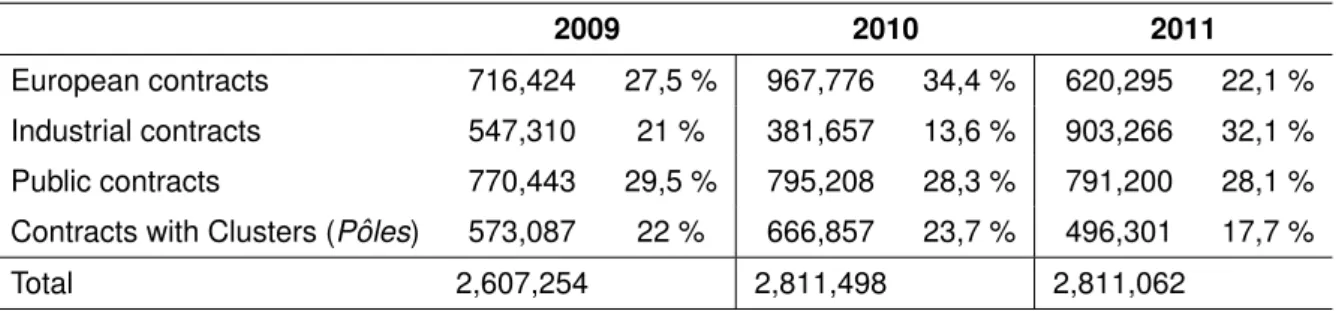
In order to participate to the unprecedented string of proposals investissements d”avenir in France such as: IRT, IEED, labex, Equipex called by ANR or ADEME, the department had to minimize its usually important involvement in European projects in 2010 and 2011. It shows on Table 2 where it can be seen that the percentage of European contract moves down from 27-35% range to 22% in 2011. The department has devoted a lot of time of its very best members to this endeavor with a noticeable success: two Equipex were selected Digiscope to design and build collaborative applications; FIT to prototype and study internet of things. It is now time to refocus our partnership outside of France and the department will prioritize three geographic areas: Europe, USA, and China. This does not mean that no other cooperation will be undertaken elsewhere, this rather means that a particular effort will be put to create and foster cooperation in these areas.
Our faculty staff is usually extremely stable, however, in this period, an important portion of our staff reached their retirement age. We succeeded to replace them with high potential young associated professors. Also, we were at the same time able to keep a strong relationship with members of our staff who departed: three former professors are today emeritus.
We have three visiting faculty members.
We also consolidated the quantum information activity by welcoming Isabelle Zaquine in the NIS group coming from the TSI department.
Four new HDR have been defended in 2010. Four professors have been promoted from associated professors. Teaching workload remains very important in the department: faculty members spend on average 35-40% of their time in research 65-60% of his time in education activities.
Infres in few numbers
Academic indicators
The number of defended thesis continues to vary between 15 and 25 theses each year with a low every other 3-4 years. This often matches with a pick amount of students defending their thesis in December the precedent year. This is what has happened in 2011 with only 11 theses against a high score of 26 in 2010 (Table 1).
The total number of publications is fairly stable approaching 200 publications in 2010 or 2011. 2009 2010 2011 Total
PhD 13 26 11 50
Journal papers 25 59 61 145
Papers in conference proceedings 57 121 110 288
Chapters and books 10 8 19 37
Patents and software 2 5 1 8
Software 3 3
Table 1: Academic indicators
The total amount of receivables is relatively stable since three years. The unusual percentage of industrial contracts in 2011 due to an important cooperation with Citelum on optimization and forecast for charging electric cars (Table 2).
2009 2010 2011
European contracts 716,424 27,5 % 967,776 34,4 % 620,295 22,1 % Industrial contracts 547,310 21 % 381,657 13,6 % 903,266 32,1 % Public contracts 770,443 29,5 % 795,208 28,3 % 791,200 28,1 % Contracts with Clusters (P ˆoles) 573,087 22 % 666,857 23,7 % 496,301 17,7 %
Total 2,607,254 2,811,498 2,811,062
Table 2: Contractual yearly receivables along four categories of contracts (ine).
The department has experienced a string of various important events which are a very good omen for the future of its endeavor.
As said earlier, the department is laureate of two Equipex: FIT and Digiscope. This will allow to partner with Paris11 U. and the TSI department in the case of Digiscope; with Paris6 and TSP in the case of FIT. End of 2011, the department joined the chair ”Complex Systems” funded by Thales, this will allow to develop our research on ambient systems and partner with Ecole Polytechnique.
Two common labs were created: the LINCS with Paris 6U., Inria, and Alcatel Lucent; and ISA which a cross department lab involving not only INFRES but Comelec and TSI.
The IRT SystemX has been selected in December 2011, the department has had an important involvement in the proposal and G. Memmi became member of the board representing Institut Telecom.
Last but not least, for the first time since 8 years TPT earned theprix de these ParisTechwith A. Leverrier highlighting the excellence of the department research on quantum information.
Interaction, Cognition and
Complexity (IC2)
Team leader T. Abdessalem (MC).
Faculty T. Abdessalem (MC), P. Bellot (P), B. Burtschy (P), B. Cautis (MC), A. Danzart (MC), J.L. Dessalles (MC), J. Eagan (MC, 04/11–), Y. Guiard (DR CNRS), G. Hebrail (P, –01/11), E. Lecolinet (MC), C. Potier (MC, –11/10), F. Rossi (P, –08/11), P. Senellart (MC), M. Vazir-giannis (Chair Professor, 05/11–).
PhD students K.-M. Adjanor (11/09–10/10), M. Baglioni (11/08–), L. Baud (01/07–04/10), I. Ben Dhia (10/10–), N. Derouiche (10/08–), A. Dimulescu (10/08–11/10), M. Durut (03/09–), M-K. El-Mahrsi (07/09–), N. Gabsi (11/07–05/11), R. Guigoures (10/10–), S. Malacria (10/07– 05/11), S. Maniu (10/09–), D. Munch (10/09–), T-L. Nguyen (03/08–08/10), M. Oita (11/09 –), S. Perrault (10/09–), A. Roudaut (11/06–02/10), N. Sokolovska (01/07–02/10), A. Souihli (10/09–), D-B. Vo (12/09–), Y. Wang (12/09–).
Post-docs, engineers and sabbaticals G. Bailly (06/09-01/11), N. Benguigui (10/08-09/09), Y. Chabchoub (11/09–09/10), A. Gomes Da Silva (10/09–12/11), V. Gomez Berdugo (12/10– 11/11), H. Olafsdottir (10/08–), T. Pietrzak (09/09–12/10), A. Tabard (03/09–09/09).
Hosted external collaborators Y. Amsterdamer (PhD Student, Tel Aviv University & INRIA Saclay, 02/11–09/11), M. Gueye (PhD student, Cheikh Anta Diop University at Dakar, 02/10–), E. Kharlamov (PhD student, Free University of Bozen-Bolzano & INRIA Saclay, 01/09–09/10), F. Suchanek (Post-doc, INRIA Saclay, 07/10–11/11).
1.1
Objectives
The IC2 team is working on several research problems in computer science, in the area of human-computer interaction, databases and web data management, cognitive computing, business in-telligence, and complex systems and protocols. The research activity of the team is organized in four institutional projects: two main projects in the fields of data and knowledge management (DBWeb) and human computer interactions (VIA), a former joint project with EDF company on business intelligence (BiLab), and a new project on complex systems and protocols (CSP). The objectives of these projects are presented in the following.
Databases and the World Wide Web (DBWeb Project)
In this project, we study the fundamental issues raised in modern data and knowledge systems, especially on the World Wide Web and in collaborative contexts oriented towards peer-to-peer networks. Research interests cover theoretical foundations, as practical solutions, applications, and cognitive aspects of data and knowledge management systems. The main challenges we are interested in are:
• Web data management, with a special focus on information extraction, Web sources selec-tion, and Web archiving;
• Query optimization over structured or semi-structured data, possibly with restricted access patterns (deep Web);
• Probabilistic databases;
• Relevance in communication and its applications in modern knowledge systems;
• Social web and social networks, with an emphasis on signed (trust–distrust) networks and collaborative applications, inference of signed links, access control, search and recommen-dation in social applications.
Advanced Interaction and Visualization (VIA Project)
This project is devoted to fundamental and applied research on Human Computer Interaction (HCI). It focuses on the double challenge of representing and manipulating more and more data, and to allow this not only on standard computers but also on small, mobile and non traditional devices. Our main contributions take place in the following domains:
• Novel interaction techniques and principles, which an emphasis on the leveraging of input dimensions that had been overlooked so far;
• Mobile interaction, with a special effort toward increasing the ”interaction bandwidth” be-tween users and their devices;
• Information visualization, and more specifically interactive visualization, which aims at al-lowing users to explore and manipulate the data actively;
• Fundamental HCI research on simple reaching movements, overwhelmingly frequent in HCI, with a project aimed at providing a more general understanding of the Fitts’ law; • End-user programming and reverse engineering, specifically with aims at giving end users
Business Intelligence (BILAB Project)
The activity of the BILab Project covers several aspects of the Business Intelligence field in rela-tion to both theoretical approaches and industrial applicarela-tions. A major activity of the project has been related to data stream processing. As a matter of fact, one of the main challenges today is the burst of the volume of available data that feed BI systems. One solution which has been studied recently is to process dataon the fly as they arrive instead of storing them beforehand in a data warehouse. This approach is referred as Data Stream Querying (if the goal is to query data) or Data Stream Mining (if the goal is to mine data).
Within this context, the BILab Project has acquired skills in this research domain and devel-oped an activity on summarizing the history of data streams. Indeed, all existing data stream processing approaches can only provide results from the part of the stream posterior to the defi-nition of queries or mining tasks.
Since 2007, the main activity of the project was within a joint research laboratory (the BILab, seehttp://bilab.enst.fr) with the research center of EDF (Electricit ´e de France). This work was completed in late December 2011.
Complex Systems and Protocols (CSP Project)
In this project, we study systems and communication protocols that can be described as complex, which means that their global behavior cannot be easily deduced from the properties of their components. The main goals are:
• to develop complex systems and protocols which emerging properties can be used to en-hance computing and communication;
• to study complex systems and to build mathematical models for them.
Our research works focus on overlay protocols to ensure routing resilience, on the develop-ment of a novel method based on Complex System theories to define and measure the capacity of Air Transport Management (ATM) resources, and, finally, on the study of the World Wide Web properties. Our experimental studies are taken from the industrial collaborations we developed with EDF Research & Innovation, Eurocontrol Experimental Centre and with Hadopi Research.
1.2
Main Results
1.2.1
Databases and the World Wide Web (DBWeb)
Faculty T. Abdessalem, B. Cautis, J.-L. Dessalles, P. Senellart, M. Vazirgiannis (40%).
Main events and external collaborations J.-L. Dessalles visited the Tokyo University of For-eign Studies (6 months) in 2009–2010.
P. Senellart organized the ACM SIGMOD programming contest in 2010 [145]; he chaired the Industrial track of EDBT 2011 and the tutorials of ICDE 2011.
Ongoing collaborations with the database groups of the University of California San Diego (B. Cautis and A. Deutsch), Renmin University (T. Abdessalem, B. Cautis, P. Senellart and J. Lu), and the University of Oxford (P. Senellart, M. Benedikt, G. Gottlob and D. Olteanu).
Projects FP7 IP ARCOMEM (2011–), COOPOL VMS3D (2010–), ANR DataRing (2009–), ANR ISICIL (2009–), MODIM Chair (2010–), ANR LPOD (2008–2010), ANR PANIC (2010– 2012), Advanced ERC Project DIADEM (2010–), Advanced ERC Project Webdam (2009–).
Relational and semi-structured databases. We study the problem of querying data sources that accept a limited set of queries, such as sources accessible by Web services which can implement very large (potentially infinite) families of queries. For the relational data model, we revisit in [3] a classical setting in which the application queries are conjunctive queries and the source accepts families of (possibly parameterized) conjunctive queries specified as the expan-sions of a (potentially recursive) Datalog program with parameters, under the assumption that sources satisfy integrity constraints. For semi-structured databases, we study in [22, 4] the prob-lem of querying XML data sources that accept only a limited set of queries, such as sources accessible by Web services which can implement very large (potentially infinite) families of XPath queries. We also consider the problem of answering queries under access pattern restrictions (deep Web), in [33] where we characterize the complexity of determining if a given source is relevant to a query.
We have done extensive research on the management of probabilistic databases, and proba-bilistic XML in particular. In [1], we present a common model for and compare the expressiveness of different ways of organizing probabilistic information in trees. We also investigated the com-plexity of aggregate queries over probabilistic XML [117, 14, 2], introducing in the process the possibility of representing continuous distributions of data values. We proposed an alternative model for probabilistic XML based on recursive Markov chains [21] that allow for trees of arbitrary depth and width, which is akin to XML schemas [118, 282]. We researched the complexity of a number of other probabilistic XML data management problems: updates [92], join queries [93], mining [139]. We study in [119] the complexity of query answering using views in a probabilistic XML setting, identifying large classes of XPath queries – with child and descendant navigation and predicates – for which there are efficient (PTime) algorithms. Finally, we looked at practi-cal aspects of implementing a probabilistic XML database engine, in particular with the help of approximation algorithms [127, 42].
Web data. We propose in [12, 299] a novel approach for extracting structured data from the Web, whose goal is to harvest real-world items from template-based HTML pages (the structured Web). It illustrates a two-phase querying of the Web, in which an intentional description of the data that is targeted is first provided, in a flexible and widely applicable manner. The extraction process leverages then both the input description and the source structure. Our approach is domain-independent, in the sense that it applies to any relation, either flat or nested, describing real-world items. Extensive experiments on five different domains and comparison with the main state of the art extraction systems from literature illustrate its flexibility and precision.
We study in [96, 38] the inference of a signed network (a “web of trust”) from interactions on user-generated content in Wikipedia. We investigate mechanisms by which relationships be-tween Wikipedia contributors – in the form of signed directed links – can be inferred based their interactions. Our study sheds light into principles underlying a signed network that is captured by social interaction. We look into whether this network over Wikipedia contributors represents indeed a plausible configuration of link signs. We assess connections to social theories such as structural balance and status, which have already been considered in online communities. We also evaluate on this network the accuracy of a learned predictor for edge signs, obtaining strong evidence that our network does reveal an implicit signed configuration and that it has similar char-acteristics to the explicit ones, even though it is inferred from interactions. This trust network can then be used to annotate Wikipedia articles with confidence information in each revision, a task that we handle using probabilistic XML [13, 63].
Similar graph mining algorithms are also applied to determining truth values of facts stated by independent sources [121, 32] and to a probabilistic approach to the matching of very large ontologies [128, 276].
We propose in [61] an access control model for online social networks, where access control rules are expressed as reachability constraints. Our work generalizes access constraints by taking into account the properties of the users, the indirect connections between these users, and is able to express complex relationships. The main idea is the specification of the target
audience of each access rule in terms of a reachability constraint, which is expressed as a path expression over the social network graph. Thus, the enforcement of an access rule consists in the evaluation of a path, which should be computed on the fly when the resource is requested by the seeker.
We propose in [122] a matrix factorization technique that aims at improving the accuracy of recommender systems. Matrix factorization models allow a high quality of rating prediction. How-ever, a major drawback of the existing techniques is their static nature that results in a progressive declining of the accuracy of the predictions after each factorization. Matrix factorization can not be done very often because of its high computational cost. The goal of our work was to enable online integration of new ratings, in order to maintain a good quality of the predictions between two factorizations. We proposed a solution that combines clustering and users’ biases in order limit the computational cost.
Finally, we have conducted a number of research works in the field of Web archiving. One line of work considers using semantic clues from RSS feeds to extract and archive the main content of a Web page [124, 100]. We have also surveyed the methods used for estimating the dynamics and freshness of Web pages [101], which is of great importance in Web crawling. We are currently investigating the introduction of intelligent, adaptive, behavior, in archival Web crawler, in particular in the context of the archiving of the social Web.
Cognitive computing. We propose in [6, 135, 53, 52, 84, 51, 133, 134, 136, 229, 54] a con-sistent model of social communication. Altruistic communicative acts are possible when agents maximize their own benefit (in contrast with cooperative models), if they provide reliable clues about some quality that is socially in demand. In this model, relevant communication is profitable to the emitter because it advertises definite qualities (relevance) that are appraised by listeners. This model crucially relies on the role played by communication in building and preserving of social networks.
We focus in [50, 26, 27, 28] on the simplicity theory (see http://www.simplicitytheory. org/) and we show that the interesting events are unexpected. Unexpectedness is formally defined as cognitive complexity drop. This law correctly predicts that events close in time and space are more likely to raise interest. It also explains in detail why coincidences are experienced as fascinating; it predicts story rounds, and several other spectacular aspects of spontaneous communication.
Additional and up to date information on DBWeb main results and publications can be found on the project web pagehttp://dbweb.enst.fr/
1.2.2
Advanced Interaction and Visualization (VIA)
Faculty E. Lecolinet, Y. Guiard, J. Eagan
Main events and external collaborations Official launching of the DIGISCOPE Equipex project (2011); Ongoing collaborations to the UBIMEDIA joint lab. with Bell Labs ; various research collaborations (1 PhD, several scientific papers) with LIG IIHM (Grenoble) and INRIA/Aviz & INRIA/InSitu (Orsay) ; Industrial collaborations with Technicolor, Movea and Archos.
Projects NIU project with Alcatel-Lucent Bell Labs (2008–), OSEO Quaero/PVAA (2008–), ANR TennisServer (2006-09), Cap Digital ENEIDE (2006-2010) and QUATRO 2 (2010–). Our work on novel interaction techniques have led us to develop new kinds of Marking menus, such as LeafMenus [40], Wavelet Menus [31] and Finger-Count and Radial-Stroke Shortcuts [17]. These techniques, based on gestural interaction, allow users to easily learn in novice (i.e., closed-loop) mode and later quickly execute in expert (i.e., open-loop) mode fairly large sets of commands. Recently we have extended this work by considering 3D gestures for increasing the interaction bandwidth with mobile devices [39] [16] and gesture-aware remote controls [18]. In the
context of Interactive TV, we have also investigated free-hand interaction techniques [19] using the Kinnect.
Our work on gestural interaction includes the leveraging of input dimensions that have been overlooked so far, such as pseudo-pressure for improving navigation in long lists [64]. We have also proposed several techniques that exploit the shape and the kinematics of gestures to enrich the input vocabulary of tactile surfaces. Thanks to rolling gestures, MicroRolls [41] make it pos-sible to interact very efficiently with the thumb. Motion-Pointing [30] and Cyclostar [36] rely on elliptical oscillatory gestures: Motion-Pointing allows selecting targets without pointing, CycloStar is a powerful approach for improving navigation tasks such as panning and zooming. Interest-ingly, most of these techniques are very well adapted for facilitating the interaction with mobile devices.
During this period we have also worked on augmented classrooms by developing the U-Note system [102] [37]. By using digital pen and capturing events that occurs during the class, U-Note allows to leverage the advantages of paper while letting teachers and pupils benefit from the richness that digital media can bring to a lecture.
We have also expanded our research focus into the area of end-user programming and re-verse engineering, particularly with regards to aiding end-users and third-party programmers at modifying the functionality and interaction of existing software applications to better suit their needs. This direction is off to an auspicious start with the first prototype system, Scotty [29], having received a notable paper award at UIST 2011.
Finally, we have started casting some new light on Fitts’ law, a famous empirical regularity of experimental psychology. In particular, we have clarified in what sense Fitts’ law constitutes an instance of a speed-accuracy tradeoff [144]. We have also shown that the traditional definition of the independent variables involved in the law suffers a high degree of indeterminacy, and suggested a novel way of defining the basic dimensions of the problem [34].
For working on these subjects, we have developed long-term collaborations with several in-dustrial and academic partners: Alcatel Lucent Bell Labs (and the UBIMEDIA joint research laboratory), LIG / IIHM (Grenoble), INRIA InSitu and Aviz projects (Orsay), etc.
Finally we are also part of the DIGISCOPE EquipeX which is a high-performance visualization infrastructure for collaborative interaction with extremely large data sets. DIGISCOPE involves 10 academic partners (CNRS LRI and LIMSI, INRIA, CEA, ECP...) and will foster lasting collabora-tions between them and the industrial parters that are associated to the project.
1.2.3
Business Intelligence (BILab)
Faculty B. Burtschy, A. Danzart, G. Hebrail, C.Potier, F. Rossi.
Main events and external collaborations A joint research laboratory with EDF R&D was cre-ated in 2007 for four years (2007-2011). The BiLab was headed by G. Hebrail until 2010, and by F. Rossi in 2011.
Industrial collaborations with Orange Labs (1 CIFRE PhD student), with Lokad (1 CIFRE PhD student).
Projects ANR MDCO MIDAS (2008-2010).
Data stream management. Our main activity related to data stream processing focuses on summarizing structured data streams: this requires the summaries to be built incrementally with little computation for each record and bounded or slowly growing disk space for storage [110]. We have developed several new approaches to summarize one or several structured data streams [137, 81],[112, 87, 80] and designed solutions to query the summaries both on the history of the stream and on the current stream [113, 23, 88]. We have extended the temporal sampling approach called ’Master’ developed in 2008. Master builds an optimized summary of a large number of distributed streams produced by remote sensors. A clustering strategy was introduced
to Master and gave rise to Clusmaster (clustering on master). Clusmaster applies a clustering method to the SSE (Sum of Square Errors) matrix in order to identify similar sensors before the execution of the optimized summarization phase. Experiments with time series from electric power meters were carried out and are described in [24, 5].
Also, we have analyzed data streams describing the working phases of a nuclear power plant [140]. The goal is to detect periods of dysfunctional states. The approach applied is a clustering based on non-overlapping windows to monitor system and detect changes in evolving data [131]. The main novelty in this approach concerns the change detection strategy which is based on the clustering extension, i.e., individual memberships reflecting the current system state.
Most of the work on data stream management has been done within the MIDAS ANR Project from 2008 to mid 2011. The BILab team was the leader of this project. The main result of the project is a demonstration platform which has been designed and integrated by the BILab team (seehttp://midas.enst.fr).
Finally, a new approach has been designed for forecasting the generation of photo-voltaic (PV) electric power. The goal is to forecast local production at a very short term (a few hours). The approach uses the history of the local production and is enhanced by a collaboration between neighbor sites [90, 123].
Time series and functional data mining. BI deals frequently with time varying objects. Such objects are not standard data described by a fixed set of numerical and/or nominal values. They are better understood as functional data: each object is described by some functions that map time to appropriate values describing the object on a given dimension at the specified date.
We provide exploratory analysis of functional datasets via a combined clustering and segmen-tation approach. Functions are clustered into homogeneous clusters with the specific property that each cluster is represented by a simple functional prototype, for instance a piecewise con-stant function. The complexity of the prototype set is globally optimized by an efficient dynamic programming scheme [91, 142, 8]. Related work include [94] in which a piecewise constant approximation of functional data is built in a supervised manner: one finds a simplified represen-tation optimized according to an external criterion (such as the ability to separate efficiently two classes of functions). We have also continued our work on supervised modelling of functional data, in particular on the use of derivatives to capture some shape aspects of functional data [60, 11].
In [132], we handle time varying data in a quite different manner: in this case, the evolution through time of an unique system (a web server) is studied. A time aware clustering algorithm is used to track the evolution of the web server usage patterns.
Graph exploratory analysis. We have been developing graph/network exploratory analysis techniques, with a focus on social networks. We have proposed in [103, 59, 10] a new topological quality measure for graph clustering, inspired by the self organizing map algorithm. Our determin-istic annealing based algorithm optimizes this way a tradeoff between a graph clustering quality measure (Girvan and Newman’s Modularity measure) and a visualization quality measure. The method results in a coarse grained graph that is both a faithful simplification of the original graph and easy to draw. We have used this method and similar graph clustering techniques to analyze successfully real world networks in the genetic domain [95], in the epidemic domain [83, 82] and in the historical domain [126]. We have also modelled information propagation in social networks and used similar visualization technique to display local propagation in important clusters [141].
Large scale data analysis. Large scale data analysis has recently gained interest in database and data mining communities, and in the information industry. Processing and analyzing large volumes of data provides both opportunities and challenges. In France, the forthcoming deploy-ment of new communication power meter (Linky) in 35 million households until 2020 will generate
massive load curves in real time. New approaches are needed in order to deal with such a volu-minous and dynamic data. A proactive work has been initiated in collaboration with EDF R&D in order to look for solutions to storage and manage massive time-changing data series. A proto-type solution based on HDFS (Hadoop distributed file system) for distributed storage and Hadoop ecosystem (Pig, Hive, Hbase) for massive data analysis has been designed and tested in a pri-vate cloud at EDF R&D. In addition, cloud based implementation of data mining techniques have been studied in collaboration with Lokad [85, 120].
1.2.4
Complex Systems and Protocols (CSP)
Faculty P. Bellot
Main events and external collaborations Conference organizations (IEEE RIVF 2009 and 2010). Best research paper award at WebTech 2010.
Ongoing collaboration with EDF Research (Chatou, STEP departement), Eurocontrol Ex-perimental Centre (Br ´etigny sur Orge), and Hadopi Research (Paris).
Projects ANR HQNET (2006–2010), EUROCONTROL (2009).
One of our main results is the design and implementation of ROSA (Robust Overlay with Self-Adaptive topology) [47, 71, 69, 70, 68, 67, 65, 75, 66]. Overlay networks offer a way to bypass the routing characteristics of the underlying network. ROSA used this property to offer a resilient rout-ing to critical applications. Unlike other overlay networks dealrout-ing with the routrout-ing resilience issue, we oriented our research towards building a locally robust overlay network topology instead of a robust routing function. Resilience is an emerging property of the system. ROSA is basically an unstructured overlay network. We proposed a structure, called Chain of Lumps (CoL) which pro-vides the advantage of structuring ROSA. Once ROSA endowed with the structure, we proposed a reliable storage system deployed over ROSA. We showed using simulations and the Watts and Strogatz model, that the routing algorithm of ROSA, based on a DHT, is a case of small-word phenomenon. This is interesting from a routing point of view. Indeed, a routing algorithm with the small-world property is not influenced anymore by the size of the network. That means that the number of virtual hops to route a message is nearly constant and does not depend on the size of the network. In the post Fukushima context, we have set up a collaboration with EDF Research & Innovation to study the possibility of using ROSA as an emergency routing algorithm for an intelligent and autonomous middleware for the orchestration of contextual services of the nuclear plant control command.
In collaboration with Eurocontrol, the European Organisation for the Safety of Air Navigation, we develop a new method, based on Complex Systems theories, to define and evaluate the capacity in terms of ATM resources availability [20, 106, 45]. Measurements and analysis of traffic flow characteristics and controllers activities provide meaningful indicators to evaluate the intrinsic difficulty of the ATM tasks as well as the methodologies to quantify these indicators impact on the system performance. An hybrid model of the availability of system resources is currently built embedding a macroscopic level of controller cognition. Mechanisms that are used to balance cognitive complexity and desired system performance will be described. We hope that the proposed model and mechanisms not only can estimate the available capacity but will also provide an effective way to allocate traffic to traffic management.
Complementary to the previous works, we have developed a toolkit named SAW-SDK (Stand Alone Web application SDK) [74, 49, 73, 72, 48] for an easy Java development of efficient Web and Mobile applications. Available athttp://www.infres.enst.fr/saw, it has been used for the IEEE RIVF 2010 conference that can be seen athttp://www.infres.enst.fr/rivf2010. It is used internally to provide a Web and a mobile Android application for students evaluation. One of its avatar will probably be incorporated in the middleware we are currently developing with EDF Reasearch & Innovation for services implementation.
1.3
References
1.3.1
ACL: Articles in ISI-Indexed Journals
[1] S. Abiteboul, B. Kimelfeld, Y. Sagiv, and P. Senellart. On the expressiveness of probabilistic XML models.VLDB Journal, 18(5):1041–1064, Oct. 2009.
[2] S. Abiteboul, E. Kharlamov, W. Nutt, T.-H. H. Chan, and P. Senellart. Capturing continuous data and answering aggregate queries in probabilistic XML. TODS (Transactions on Database Systems), 36 (4), 2011.
[3] B. Cautis, A. Deutsch, and N. Onose. Querying data sources that export infinite sets of views.Theory of Computing Systems (ToCS), 2011.
[4] B. Cautis, A. Deutsch, N. Onose, and V. Vassalos. Querying XML data sources that export very large sets of views. ACM Transactions on Database Systems (TODS), 36(1), 2011.
[5] A. Da Silva, R. Chiky, and G. H ´ebrail. A clustering approach for sampling data streams in sensor networks. Knowledge and Information Systems (KAIS), Nov. 2011.
[6] J.-L. Dessalles. Reasoning as a lie detection device (commentary on Mercier & Sperber: ‘Why do humans reason? Arguments for an argumentative theory’). Behavioral & Brain Sciences, 34(2): 76–77, Apr. 2011.
[229] J.-L. Dessalles. The real mystery about language. Physics of Life Reviews, 8(4), Dec. 2011.
[8] G. H ´ebrail, B. Hugueney, Y. Lechevallier, and F. Rossi. Exploratory analysis of functional data via clustering and optimal segmentation. Neurocomputing, 73(7–9):1125–1141, Mar. 2010.
[9] S. Manegold, I. Manolescu, L. Afanasiev, J. Feng, G. Gou, M. Hadjieleftheriou, S. Harizopoulos, P. Kalnis, K. Karanasos, D. Laurent, M. Lupu, N. Onose, C. R ´e, V. Sans, P. Senellart, T. Wu, and D. Shasha. Repeatability & workability evaluation of SIGMOD 2009. SIGMOD Record, 39(3):40–43, Sept. 2009.
[10] F. Rossi and N. Villa. Optimizing an organized modularity measure for topographic graph clustering: a deterministic annealing approach.Neurocomputing, 73(7–9):1142–1163, Mar. 2010.
[11] F. Rossi and N. Villa. Consistency of functional learning methods based on derivatives. Pattern Recognition Letters, 32(8):1197–1209, June 2011.
1.3.2
ACTIP: Articles in Proceedings of Major International Conferences
[12] T. Abdessalem, B. Cautis, and N. Derouiche. ObjectRunner: Lightweight, targeted extraction and querying of structured Web data. Proceedings of the VLDB Endowment, presented at The 36th International Conference on Very Large Data Bases, Singapore., 3(2), Sept. 2010.
[13] T. Abdessalem, M. L. Ba, and P. Senellart. A probabilistic XML merging tool. In EDBT (Extending DataBase Technology), Uppsala, Sweden, Mar. 2011.
[14] S. Abiteboul, T.-H. H. Chan, E. Kharlamov, W. Nutt, and P. Senellart. Aggregate queries for discrete and continuous probabilistic XML. InICDT (International Conference on Database Theory), pages 50–61, Lausanne, Switzerland, Mar. 2010.
[282] S. Abiteboul, Y. Amsterdamer, D. Deutch, T. Milo, and P. Senellart. Finding optimal probabilistic gen-erators for xml collections. InICDT (International Conference on Database Theory), Berlin, Germany, Mar. 2012.
[16] M. Baglioni, E. Lecolinet, and Y. Guiard. Jerktilts: Using accelerometers for eight-choice selection on mobile devices. InICMI (13th International Conference on Multimodal Interaction), Alicante Espagne, Nov. 2011. ACM Press.
[17] G. Bailly, E. Lecolinet, and Y. Guiard. Finger-count and radial-stroke shortcuts: Two techniques for augmenting linear menus. In ACM CHI (Conference on Human Factors in Computing Systems), pages 591–594, Atlanta, USA, Apr. 2010. ACM Press.
[18] G. Bailly, D.-B. Vo, E. Lecolinet, and Y. Guiard. Gesture-aware remote controls: guidelines and interaction techniques. InICMI (13th International Conference on Multimodal Interaction), Alicante, Espagne, Nov. 2011. ACM Press.
[19] G. Bailly, R. Walter, J.-P. M ¨uller, T. Ning, and E. Lecolinet. Comparing free hand menu techniques for distant displays using linear, marking and finger-count menus. InINTERACT 2011 (13th IFIP TC13 Conference on Human-Computer Interaction), Lisbon, Portugal, Sept. 2011. Springer Verlag. [20] P. Bellot, M. Hu, F. Vormer, V. Duong, and Y. Wang. Spatial, temporal, and grouping behaviors
in controller communication activities. In Ninth USA/Europe ATM R&D Seminar, page 10, Berlin, Germany, June 2011.
[21] M. Benedikt, E. Kharlamov, D. Olteanu, and P. Senellart. Probabilistic XML via Markov chains. Pro-ceedings of the VLDB Endowment, 3(1):770–781, Sept. 2010.
[22] B. Cautis, A. Deutsch, N. Onose, and V. Vassalos. Efficient rewriting of XPath queries using query set specifications. In 35th International Conference on Very Large Data Bases (VLDB) 2009, Lyon (France), Aug. 2009.
[23] R. Chiky, L. Decreusefond, and G. H ´ebrail. Aggregation of asynchronous electric power consumption time series knowing the integral. In Extending Data Base Technology, pages 675–680, Lausanne, Suisse, Mar. 2010.
[24] A. Da Silva, R. Chiky, and G. H ´ebrail. Clusmaster: A clustering approach for sampling data streams in sensor networks. InIEEE International Conference on Data Mining (ICDM), Sydney, Australie, Dec. 2010. IEEE.
[299] N. Derouiche, B. Cautis, and T. Abdessalem. Automatic extraction of structured web data with domain knowledge. In28th IEEE International Conference on Data Engineering (ICDE), Washington, Apr. 2012.
[26] J.-L. Dessalles. Emotion in good luck and bad luck: predictions from simplicity theory. In32nd Annual Conference of the Cognitive Science Society, Portland, Or, Aug. 2010.
[27] J.-L. Dessalles. Simplicity effects in the experience of near-miss. In33rd Annual Conference of the Cognitive Science Society, pages 408–413, Boston, MA, USA, July 2011. Cognitive Science Society. [28] A. Dimulescu and J.-L. Dessalles. Understanding narrative interest: Some evidence on the role of unexpectedness. In 31st Annual Conference of the Cognitive Science Society, pages 1734–1739, Amsterdam, NL, July 2009.
[29] J. Eagan, M. Beaudouin-Lafon, and W. Mackay. Cracking the cocoa nut: User interface programming at runtime. Proceedings of the ACM Symposium on User Interface Software and Technology, pages 225–234, Oct. 2011.
[30] J.-D. Fekete, N. Elmqvist, and Y. Guiard. Motion-pointing: Target selection using elliptical motions. InACM CHI (Conference on Human Factors in Computing Systems), pages 289–298, Boston, USA, Apr. 2009.
[31] J. Francone, G. Bailly, L. Nigay, and E. Lecolinet. Wavelet menus on handheld devices: Stacking metaphor for novice mode and eyes-free selection for expert mode. InACM AVI (Int. conf. on Ad-vanced Visual interfaces), pages 173–180, Rome, Italy, May 2010.
[32] A. Galland, S. Abiteboul, A. Marian, and P. Senellart. Corroborating information from disagreeing views. InWSDM (Web Search and Data Mining), pages 131–140, New York, USA, Feb. 2010. [33] G. Gottlob, M. Benedikt, and P. Senellart. Determining relevance of accesses at runtime. InPODS
(Principles of Database Systems), pages 211–222, Athens, Greece, June 2011.
[34] Y. Guiard. The problem of consistency in the design of fitt’s law experiments: Consider either target distance and width or movement form and scale. InACM CHI (Conference on Human Factors in Computing Systems), pages 1809–1818, Boston, USA, Apr. 2009.
[35] Y. Guiard, H. B. Olafsdottir, and S. T. Perrault. Fitts’ law as an explicit time/error trade-off. InCHI (ACM Conference on Human Factors in Computing Systems), Vancouver, Canada, May 2011. [36] S. Malacria, E. Lecolinet, and Y. Guiard. Clutch-free panning and integrated pan-zoom control on
touch-sensitive surfaces: the cyclostar approach. In ACM CHI (Conference on Human Factors in Computing Systems), pages 2615–2624, Atlanta, GA, USA, Apr. 2010. ACM Press.
[37] S. Malacria, T. Pietrzak, E. Lecolinet, and A. Tabard. U-note: Capture the class and access it every-where. InINTERACT 2011 (13th IFIP TC13 Conference on Human-Computer Interaction), volume 6946, pages 643–660, Lisbon, Portugal, Sept. 2011. Springer Verlag.
[38] S. Maniu, T. Abdessalem, and B. Cautis. Casting a web of trust over Wikipedia: an interaction-based approach. In20th International World Wide Web Conference (WWW 2011), Hyderabad, India, Mar. 2011.
[39] A. Roudaut, M. Baglioni, and E. Lecolinet. Timetilt: Using sensor-based gestures to travel through multiple applications on a mobile device. InInteract (IFIP Conference in Human-Computer Interac-tion), Uppsala, Su `ede, Aug. 2009.
[40] A. Roudaut, G. Bailly, E. Lecolinet, and L. Nigay. Leaf menus: Linear menus with stroke shortcuts for small handheld devices. In Interact (IFIP Conference in Human-Computer Interaction), pages 616–619, Uppsala, Su `ede, Aug. 2009.
[41] A. Roudaut, E. Lecolinet, and Y. Guiard. Microrolls: Expanding touch-screen input vocabulary by distinguishing rolls vs. slides of the thumb. InACM CHI (Conference on Human Factors in Computing Systems), pages 927–936, Boston, USA, Apr. 2009.
trees. InSIGMOD (Special Interest Group on Management of Data), Athens, Greece, June 2011. [276] F. M. Suchanek, S. Abiteboul, and P. Senellart. PARIS: Probabilistic alignment of relations, instances,
and schema. Proceedings of the VLDB Endowment, Dec. 2011.
[44] F. M. Suchanek, A. Varde, R. Nayak, and P. Senellart. The hidden Web, XML, and semantic Web: A scientific data management perspective. In EDBT (Extending DataBase Technology), Uppsala, Sweden, Mar. 2011.
[45] Y. Wang, V. Duong, F. Vormer, and M. Hu. Empirical analysis of air traffic controller dynamics. In4th International Conference on Research in Air Transportation, pages 401 – 407, Budapest, Hungary, Oct. 2010. Vu Duong, David Lovell.
1.3.3
ACLN: Articles in Other Refereed Journals
[46] T. Abdessalem and P. Senellart. Gestion de donn ´ees dans les r ´eseaux sociaux.Telecom, 156:56–58, Jan. 2010.
[47] L. Baud and P. Bellot. Small-world routing in rosa - an interesting property of the chain of lumps.
GSTF Journal on Computing, 1(3), July 2011.
[48] P. Bellot and L. Baud. A dedicated architecture for efficient web server technology.Journal of Science and Technology, Special Issue on Theories and Application of Computer Science, 48(4):26–37, Sept. 2010.
[49] P. Bellot and L. Baud. Java autonomous web applications with standalone entities. GSTF Journal on Computing, 1(3), July 2011.
[50] J.-L. Dessalles. Destin ou co¨ıncidences ? Cerveau&Psycho, 35:18–21, Sept. 2009.
[51] J.-L. Dessalles. In praise of resemblance: Human communicational universals as basis for mutual acceptance. Generalized Science of Humanity Series, 5:65–73, Mar. 2010.
[52] J.-L. Dessalles. Et si la coop ´eration ´etait un mythe ? Un pilier des sciences sociales ´ebranl ´e par la simulation. Nouvelles perspectives en sciences sociales, 5(2):79–89, May 2010.
[53] J.-L. Dessalles. Comment le langage est venu `a l’homme. La Recherche, 445:64–65, Nov. 2010. [54] J.-L. Dessalles, E. Machery, J. McKenzie Alexander, and F. Cowie. Symposium on J.-L. Dessalles’s
Why we Talk.Biology and philosophy, 25(5):851–901, Dec. 2010.
[55] Y. Guiard and H. B. Olafsdottir. On the measurement of movement difficulty in the standard approach to fitts’ law. PLoS ONE, 6(10), Oct. 2011.
[56] C. Le-Quoc and P. Bellot. How can quasi-trusted nodes help to securely relay qkd keys.International Journal of Network Security, 9(3):233–241, Nov. 2009.
[57] C. Le-Quoc and P. Bellot. A novel approach to build qkd relaying models.Wiley’s International Journal of Security and Communication Networks, Aug. 2009.
[58] B. Nguyen, A. Vion, F.-X. Dudouet, D. Colazzo, I. Manolescu, and P. Senellart. XML content ware-housing: Improving sociological studies of mailing lists and Web data. Bulletin of Methodological Sociology, 112(1):5–31, Oct. 2011.
1.3.4
INV: Invited Talks
[59] N. Villa and F. Rossi. M ´ethode de classification organis ´ee pour les recherche de communaut ´es dans les r ´eseaux sociaux. In41 `emes Journ ´ees de Statistique, SFdS, Journ ´ee satellite STID, Bordeaux, France, May 2009.
[60] N. Villa and F. Rossi. Classification and regression based on derivatives: a consistency result. InII Simposio sobre Modelamiento Estad´ıstico, Valparaiso, Chile, Dec. 2010.
1.3.5
ACTI: Articles in Proceedings of other International Conferences
[61] T. Abdessalem and I. Ben Dhia. A reachability-based access control model for online social networks. InProc. of the first ACM SIGMOD Workshop on Databases and Social Networks (DBSocial), Athens, June 2011.
[62] S. Abiteboul, S. Amer-Yahia, A. Galland, A. Marian, and P. Senellart. Birds of a tag flock together. In
SSM (Search in Social Media), New York, USA, Feb. 2010.
[63] M. L. Ba, T. Abdessalem, and P. Senellart. Towards a version control model with uncertain data. In
PIKM (PhD Students in Information and Knowledge Management), Glasgow, United Kingdom, Oct. 2011.
[64] M. Baglioni, S. Malacria, E. Lecolinet, and Y. Guiard. Flick-and-brake: Finger control over iner-tial/sustained scroll motion. InCHI-EA (Conference on Human Factors in Computing Systems), Van-couver, Canada, May 2011. ACM Press.
[65] L. Baud and P. Bellot. The rosa protocol adapted to aeronautical mobile ad-hoc network. In 8th Innovative Research Workshop & Exhibition (INO 2009), Br ´etigny sur Orge, France, Dec. 2009. [66] L. Baud and P. Bellot. Robust overlay network with self-adaptive topology: The chain of lumps
struc-ture. In2009 International Workshop on Peer-To-Peer Networking, St. Pertersburg, July 2009. [67] L. Baud and P. Bellot. A purpose adjustable overlay network. In6th EuroNF Conferencece on Next
Generation Internet (NGI 2010), Paris, France, June 2010.
[68] L. Baud and P. Bellot. Securing a critical infrastructure. In2010 IEEE-RIVF International Conference on Computing and Communication Technologies Research, Innovation and Vision for the Future, pages 188–191, Hanoi (Vietnam), Nov. 2010. Akim Demaille, Ralf-Detlef Kutsche.
[69] L. Baud and P. Bellot. Robust overlay network with self-adaptive topology: Scalability and connectivity. InThe First International Conference on Networking and Future Internet (ICNFI 2011), Paris (France), Apr. 2011.
[70] L. Baud and P. Bellot. Virtual routing in the small world of rosa. InInternational Conference on Web Technologies & Internet Applications (WebTech 2011), Penang (Malaysia), Mar. 2011.
[71] L. Baud and P. Bellot. The ciso multitool knife. InSAR-SSI 2011 (The 6th Conference on Network Architectures and Information Systems Security), Sainte-Marie de R ´e (France), May 2011.
[72] P. Bellot and L. Baud. A dedicated architecture for efficient web server technology. In3rd International Conference on Theories and Applications of Computer Science (ICTACS 2010), Can Tho (Vietnam), Sept. 2010.
[73] P. Bellot and L. Baud. Efficient entities management for java autonomous web applications. In Interna-tional Conference on Web Technologies & Internet Applications (WebTech 2011), Penang (Malaysia), Mar. 2011.
[74] P. Bellot and L. Baud. Sessions design and management for java autonomic web applications. In23rd International Conference on Software & Systems Engineering and their Applications (ICSSEA’11), Paris (France), Nov. 2011.
[75] P. Bellot and M. D. Dang. Bb84 implementation and computer reality. In IEEE-RIVF International Conference on Computing and Communication Technologies (IEEE-RIVF 2009), Danang (Vietnam), July 2009.
[76] B. Burtschy and F. Popentiu-Vladicescu. A robust face recognition algorithm. InRussian Acadmy Of Sciences, pages 510–515, Saint-Petersburg, Russia, Mar. 2010. ISBN 978-5-8088-0541-5.
[77] B. Burtschy, G. . Albeanu, and F. Popentiu-Vladicescu. Fuzzy methods in optimal sotware reliability alocation. InRussian Academy of Sciences, pages 206–211, Saint-Petersburg, Russia, Mar. 2010. ISBN 978-5-8088-0541-5.
[78] B. Cautis. Tutorial: Xpath rewriting using views: The more the merrier. InThe Second International Workshop on XML Data Management (with APWeb 2011)), Pekin (Chine), Apr. 2011.
[79] B. Cautis and G. Ruberg. Tutorial: Answering queries using views - the XML chapter. InSBBD 2010 (25th Brazilian Symposium on Databases), Belo Horizonte, Brazil, Oct. 2010.
[80] Y. Chabchoub and G. H ´ebrail. Sliding hyperloglog: Estimating cardinality in a data stream over a sliding window. In IEEE International Conference on Data Mining (ICDM) Workshops’2010, page p.1297 1303, Sydney, Australie, Nov. 2010.
[81] R. Chiky and G. H ´ebrail. Spatial and temporal sampling of distributed data streams. InConference of International Federation of Classification Societies (IFCS), Dresde, Allemagne, Mar. 2009.
[82] S. Cl ´emenc¸on, H. De Arazoza, F. Rossi, and V. C. Tran. Visual mining of epidemic networks. In11th International Work-Conference on Artificial Neural Networks (IWANN 2011), volume 6692, pages 276–283, Malaga, Spain, June 2011.
[83] S. Cl ´emenc¸on, H. De Arazoza, V. C. Tran, and F. Rossi. Hierarchical clustering for graph visualization. InEuropean Symposium on Artificial Neural Networks (ESANN), pages 227–232, Bruges, Belgique, Apr. 2011.
[84] J.-L. Dessalles. Have you anything unexpected to say? The human propensity to communicate surprise and its role in the emergence of language. In8th International conference on the evolution of language, pages 99–106, Utrecht, Netherlands, Apr. 2010.
[85] M. Durut and F. Rossi. Communication challenges in cloud k-means. InEuropean Symposium on Artificial Neural Networks (ESANN), pages 387–392, Bruges, Belgium, Apr. 2011.
[86] G. Ebrard, M. A. Fern ´andez, J.-F. Gerbeau, F. Rossi, and N. Zemzemi. From intracardiac electrograms to electrocardiograms. models and metamodels. InFunctional Imaging and Modeling of the Heart,
Nice (France), June 2009.
[87] M. K. El Mahrsi, G. H ´ebrail, C. Potier, and F. Rossi. Spatiotemporal sampling for trajectory streams. InACM SAC, pages 1627–1628, Sierre, Switzerland, Mar. 2010. ACM.
[88] N. Gabsi, F. Cl ´erot, and G. H ´ebrail. Efficient trade-off between speed processing and accuracy in summarizing data stream. In Pacific-Asia Conference on Knowledge Discovery and Data Mining (PAKDD), Hyderabad, India, June 2010.
[89] P. Gallion, F. J. Mendieta, and P. Bellot. Security in quantum based cryptography: Toward an holistic approach. In8th IEEE International Conference on Information and Communication Technologies RIVF 2010, HANOI, Oct. 2010. IEEE.
[90] V. GOMEZ BERDUGO, C. Chaussin, L. Dubus, G. H ´ebrail, and V. Leboucher. Collaborative analog method for very short term pv predictions (poster). InInternational Conference on Meterology and Energy, Gold Coast, Australia, Nov. 2011.
[91] B. Hugueney, G. H ´ebrail, Y. Lechevallier, and F. Rossi. Simultaneous clustering and segmentation for functional data. InEuropean Symposium on Artificial Neural Networks (ESANN), pages 281–286, Bruges, Belgium, Apr. 2009.
[92] E. Kharlamov, W. Nutt, and P. Senellart. Updating probabilistic XML. In Updates in XML, page /, Lausanne, Switzerland, Mar. 2010.
[93] E. Kharlamov, W. Nutt, and P. Senellart. Value joins are expensive over (probabilistic) XML. InLID (Logics in Databases), Uppsala, Sweden, Mar. 2011.
[94] C. Krier, M. Verleysen, F. Rossi, and D. Franc¸ois. Supervised variable clustering for classification of nir spectra. InEuropean Symposium on Artificial Neural Networks (ESANN), pages 263–268, Bruges, Belgium, Apr. 2009.
[95] L. Liaubet, N. Villa, A. Gamot, F. Rossi, P. Ch ´erel, and M. San Cristobal. The structure of a gene network reveals 7 biological functions underlying eqtls in pig. In 9th World Congress on Genetics Applied to Livestock Production (WCGALP), Leipzig, Germany, Aug. 2010.
[96] S. Maniu, B. Cautis, and T. Abdessalem. Building a signed network from interactions in Wikipedia. In
First ACM SIGMOD Workshop on Databases and Social Networks (DBSocial), Athens, Greece, June 2011. ACM.
[97] F. J. Mendieta, P. Gallion, P. Bellot, E. GARCIA, J. Loppez, and A. Arizu. Holistic approach to security in quantum key distribution systems. InTheory and Realisation of Practical Quantum Key Distribution Waterloo, Waterloo, June 2010.
[98] T. Muhammad, G. Bailly, Y. Guiard, and E. Lecolinet. Tactile assistance for selecting list favorites with a bifocal absolute and relative representation. In ChiNL’09, Leiden, Netherlands (Pays-Bas), June 2009.
[99] T. Muhammad, G. Bailly, E. Lecolinet, and G. Mouret. Categorization, analysis and properties of tactile patterns. InChiNL’09, Leiden, Netherlands (Pays-Bas), June 2009.
[100] M. Oita and P. Senellart. Archiving data objects using Web feeds. InIWAW (International Workshop on Web Archiving), pages 31–41, Vienna, Austria, Sept. 2010.
[101] M. Oita and P. Senellart. Deriving dynamics of Web pages: A survey. In TWAW (Temporal Web Analytics Workshop), Hyderabad, India, Mar. 2011.
[102] T. Pietrzak, S. Malacria, A. Tabard, and E. Lecolinet. What do u-note? an augmented note taking system for the classroom. InPaperComp: International Workshop on Paper Computing, Copenhagen, Denmark, Sept. 2010.
[103] F. Rossi and N. Villa. Topologically ordered graph clustering via deterministic annealing. InEuropean Symposium on Artificial Neural Networks (ESANN), pages 529–534, Bruges, Belgium, Apr. 2009. [104] A. Vellido, J.-C. Martin, F. Rossi, and P. Lisboa. Seeing is believing: The importance of visualization
in real-world machine learning applications. InEuropean Symposium on Artificial Neural Networks (ESANN), pages 219–226, Bruges, Belgium, Apr. 2011.
[105] A. Viard, G. Bailly, E. Lecolinet, and E. Fritsch. Augmenting quantums-gis for collaborative and interactive tabletops. InInternational Cartographic Conference, Paris, July 2011.
[106] Y. Wang, V. Duong, and M. Hu. Fluctuation scaling in the air traffic controller communication activities. InThe Second ENRI International Workshop on ATM/CNS, Tokyo, Japan, Nov. 2010.
1.3.6
ACTN: Articles in Proceedings of French Conferences
[107] K. Adjanor, E. Lecolinet, Y. Guiard, and M. Ribi `ere. Visualisation interactive de donn ´ees temporelles: un aperc¸u de l’ ´etat de l’art. In IHM (Conf ´erence francophone sur l’Interaction Homme Machine), Luxembourg, Sept. 2010. ACM Press.
[108] M. Baglioni, E. Lecolinet, and Y. Guiard. Espace de caract ´erisation des interactions gestuelles physiques sur dispositifs mobiles. In IHM (Conf ´erence francophone sur l’Interaction Homme Ma-chine), Grenoble, Nov. 2009.
[109] Y. Chabchoub and B. Grossin. Agr ´egation robuste de donn ´ees massives `a la vol ´ee : application aux compteurs ´electriques communicants. In Extraction et Gestion des Connaissances (EGC), pages 179–190, Brest, France, Nov. 2011.
[110] Collectif auteurs projet ANR MIDAS. R ´esum ´e g ´en ´eraliste de flux de donn ´ees. InExtraction et Gestion des Connaissances (EGC), Hammamet, Tunisie, Jan. 2010.
[111] J. Francone, G. Bailly, L. Nigay, and E. Lecolinet. Wavelet menu: une adaptation des marking menus pour les dispositifs mobiles. InIHM (Conf ´erence francophone sur l’Interaction Homme Machine), Oct. 2009.
[112] N. Gabsi, F. Cl ´erot, and G. H ´ebrail. R ´esum ´e hybride de flux de donn ´ees par ´echantillonnage et classification automatique. InExtraction et Gestion des Connaissances (EGC), number RNTI-E15, pages 229–240, Strasbourg, France, Jan. 2009.
[113] N. Gabsi, F. Cl ´erot, and G. H ´ebrail. Interrogation des r ´esum ´es de flux de donn ´ees. InExtraction et Gestion des Connaissances (EGC), Hammamet, Tunisie, Jan. 2010.
[114] S. Malacria and E. Lecolinet. U-note : Classe augment ´ee et stylo num ´erique. InIHM (Conf ´erence francophone sur l’Interaction Homme Machine), pages 255–258, Grenoble, France, Oct. 2009. ACM Press.
[115] S. T. Perrault, G. Bailly, Y. Guiard, and E. Lecolinet. Promesses et contraintes de la joaillerie num ´erique interactive : Un aperc¸u de l’ ´etat de l’art. In IHM’11 (Conference Internationale Franco-phone sur I’Interaction Homme-Machine), pages 1–4, Nice - Sophia Antipolis, Oct. 2011. ACM Press. [116] D.-B. Vo, G. Bailly, E. Lecolinet, and Y. Guiard. Un espace de caract ´erisation de la t ´el ´ecommande dans le contexte de la t ´el ´evision interactive. InIHM (Conf ´erence francophone sur l’Interaction Homme Machine), Nice - Sophia Antipolis, France, Oct. 2011. ACM Press.
1.3.7
COM: Talks in Conferences Which Do Not Publish Proceedings
[117] S. Abiteboul, T.-H. H. Chan, E. Kharlamov, W. Nutt, and P. Senellart. Agr ´egation de documents XML probabilistes. InBDA (Bases de Donn ´ees Avanc ´ees), Namur, Belgium, Oct. 2009.
[118] S. Abiteboul, Y. Amsterdamer, D. Deutch, T. Milo, and P. Senellart. Optimal probabilistic generators for XML corpora. InBDA (Bases de donn ´ees avanc ´ees), Rabat, Morocco, Oct. 2011.
[119] B. Cautis and E. Kharlamov. Challenges for view-based query answering over probabilistic XML. In
Proceedings of the 5th Alberto Mendelzon International Workshop on Foundations of Data Manage-ment, Santiago (Chili), May 2011.
[120] M. Durut and F. Rossi. K-means on azure. InLCCC: NIPS 2010 Workshop on Learning on Cores, Clusters and Clouds, Whistler, Canada, Dec. 2010.
[121] A. Galland, S. Abiteboul, A. Marian, and P. Senellart. Corroboration de vues discordantes fond ´ees sur la confiance. InBDA (Bases de Donn ´ees Avanc ´ees), Namur, Belgium, Oct. 2009.
[122] M. Gueye, T. Abdessalem, and H. Naacke. A cluster-based matrix-factorization for online integration of new ratings. In 27- `emes journ ´ees Bases de Donn ´ees Avanc ´ees (BDA’11), Rabat, Maroc, Oct. 2011.
[123] G. H ´ebrail, V. GOMEZ BERDUGO, L. Dubus, V. Leboucher, and C. Chaussin. Analog method for collaborative very-short-term forecasting of power generation from photovoltaic systems. In Next Generation Data Mining Summit, Ath `enes, Gr `ece, Sept. 2011.
[124] M. Oita and P. Senellart. Archivage du contenu ´eph ´em `ere du Web `a l’aide des flux Web. InBDA (Bases de Donn ´ees Avanc ´ees), Toulouse, France, Oct. 2010.
[125] O. Rioul and Y. Guiard. The power model of fitts’ law does not encompass the logarithmic model. In
2011 Meeting of the European Mathematical Psychology Group (EMPG 2011), Paris, France, Aug. 2011.
[126] F. Rossi, N. Villa, and F. Hautefeuille. Exploration of a large database of french charters with social network methods. InInternational Medieval Congress, page 1607, Leeds, United Kingdom, July 2011. [127] P. Senellart and A. Souihli. Un syst `eme de gestion de donn ´ees XML probabiliste. InBDA (Bases de
Donn ´ees Avanc ´ees), Toulouse, France, Oct. 2010.
[128] F. M. Suchanek, S. Abiteboul, and P. Senellart. Ontology matching at the instance and schema level. InBDA (Bases de donn ´ees avanc ´ees), Rabat, Morocco, Oct. 2011.
1.3.8
OS: Books and Book Chapters
[359] S. Abiteboul, I. Manolescu, P. Rigaux, M.-C. Rousset, and P. Senellart. Web Data Management. Cambridge University Press, New York, USA, 2012.
[361] M. Benedikt and P. Senellart. Databases. In E. K. Blum and A. V. Aho, editors,Computer Science. The Hardware, Software and Heart of It. Springer, 2012.
[131] A. Da Silva.Analyse des donn ´ees ´evolutives de l’usage du Web. Editions universitaires europeennes, 2011.
[132] A. Da Silva, Y. Lechevallier, F. Rossi, and F. De Carvalho. Clustering dynamic web usage data. In
Innovative Applications in Data Mining, chapter 4, pages 71–82. Springer, Berlin, Allemagne, 2009. [133] J.-L. Dessalles. L’ ´emergence du langage au cours de l’ ´evolution. InLa fabrique du signe - Linguistique
de l’ ´emergence, pages 22–33. Presses Universitaires du Mirail, Toulouse, 2010. [134] J.-L. Dessalles. Pr ´eface. InLa langue d’Adam, pages v–ix. Dunod, Paris, France, 2010.
[135] J.-L. Dessalles. Aux sources du langage. InLe langage, pages 126–135. Editions Sciences Hu-maines, Auxerre, France, 2010.
[136] J.-L. Dessalles. Pragmatics and evolution. InThe Cambridge Encyclopedia of the language sciences, pages 649–651. Cambridge University Press, Cambridge, UK, 2011.
[137] N. Gabsi, F. Cl ´erot, and G. H ´ebrail. An hybrid data stream summarizing approach by sampling and clustering. InAdvances in Knowledge Discovery and Management, pages 181–200. Springer, 2010. [138] B. Hammer, A. Hasenfuß, and F. Rossi. Median topographic maps for biomedical data sets. In
Similarity-Based Clustering, pages 92–117. Springer, Berlin / Heidelberg, 2009.
[139] E. Kharlamov and P. Senellart. Modeling, querying, and mining uncertain XML data. InXML Data Mining: Models, Methods, and Applications. IGI Global, 2011.
[140] Y. Lechevallier, A. Da Silva, and R. Seraoui. A Clustering Approach to Monitor System Working: an Application to Electric Power Production. Chapman&Hall, 2011.
[141] A. Rona-Tas, S. Cl ´emenc¸on, S. Blanchemanche, F. Rossi, and C. Dhanjal. The unexpected link: Dissemination of health information within social networks. InNetworks in Social Policy Problems. Cambridge University Press, 2010.
[142] F. Rossi and Y. Lechevallier. Constrained variable clustering and the best basis problem in functional data analysis. In R. V. Bernard Fichet, Domenico Piccolo and M. Vichi, editors, Classification and Multivariate Analysis for Complex Data Structures, pages 435–444. Springer Berlin / Heidelberg, 2011.
[143] M. Verleysen, F. Rossi, and D. Franc¸ois. Advances in feature selection with mutual information. In
Similarity-Based Clustering, pages 52–69. Springer, Berlin / Heidelberg, 2009.
1.3.9
MS: Miscellaneous
[144] Y. Guiard. Langage ordinaire et mod ´elisation math ´ematique: quelle fonction d’ ´echange dans la loi du mouvement canalis ´e d’accot et zhai ? InIHM, conference francophone d’interaction homme-machine, pages 11–18, IRCAM (Paris, France), 2007.
[145] V. Hudlet, C. Genzmer, H. Park, D. Schall, and P. Senellart. The sigmod 2010 programming contest: A distributed query engine. SIGMOD Record, 39(2):61–64, June 2010.
Mathematics of Information,
Communications and Computation
(MIC
2
)
Team leader L. Decreusefond (P) (01/09–11/11), O. Hudry (P) (11/11–)
Faculty I. Charon (P) (–06/11; Emeritus Professor since 06/11), G. Cohen (P), L. Decreuse-fond (P), O. Hudry (P), A. Lobstein (CR CNRS), D. Madore (MC), B. Meyer (MC) (09/11–), H. Randriambololona (MC), J. Sakarovitch (DR CNRS), A.S. ¨Ust ¨unel (P).
PhD students P.-Y. Angrand (09/08–), D. Auger (10/07–06/10), I. Camilier (07/07–09/10), C. Car-denas (01/07–), E. Ferraz (01/09–01/12), I. Flint (11/10–), J.-P. Flori (09/08–), T. Fuhr (10/08–10/11), B. Kindarji (09/07–06/10), R. Lassalle (09/09 –), A. Patey (05/11 –), J. Valen-tin (04/09–), A. Vergne (10/10 –), T. Vu (09/08–).
Post-docs, engineers and sabbaticals J. K ¨orner (05/09–07/09, 04/11-05/11)