Requirements, Specification and Design of a
Cloud-Computing Environment for Police
and Law Enforcement
Andreas Tellefsen
Master’s Thesis
Master of Science in Information Security 30 ECTS
Department of Computer Science and Media Technology Gjøvik University College, 2012
Høgskolen i Gjøvik Postboks 191 2802 Gjøvik
Department of Computer Science and Media Technology
Gjøvik University College Box 191
N-2802 Gjøvik Norway
Specification and Design of a Cloud-Computing
Environment for Police and Law Enforcement
Andreas Tellefsen
2012/07/01
Abstract
As the amount of information found at digital forensic crime scenes increases each year, conventional methods for evidence handling and analysis come under pressure to per-form at a sufficient level. New techniques are needed to meet this demand, and cloud computing is a possible solution. However, little has been done to explore this possibility. Cloud computing uses the combined power of multiple servers to create a resource pool, which can then be divided between the cloud’s users based on their need for comput-ing resources. Such features could prove to be very useful for digital forensic analysis applications.
To explore the possibilities of a governmental cloud-computing environment, the be-nefits and drawbacks of such an implementation have been studied. A qualitative ap-proach was used to explore and discuss the individual drawbacks and benefits for pos-sible cloud deployment models. The thesis continues with a study of the requirements for cloud implementations for law enforcement. Here, a guide for creating such require-ments was created. Finally, the requirerequire-ments guide was tested using Microsoft Operations Framework, a project management methodology. This was done to explore the usability of the guide.
The results from the study of benefits and drawbacks show that the private cloud de-ployment model currently is the most promising alternative for law enforcement imple-mentations. The results also state that conventional environments remain a good choice, and often preferable to cloud environments given their predictability and potential for sound security. However, we believe that this result will change to favour the cloud as the technology gradually matures.
During the second part of the thesis, an elaborate collection of requirements for the planning of a governmental cloud-computing environment was created. This cov-ers, amongst other things, legal, compliance and structural demands. The requirements guide will enable a project to focus on cloud-specific issues, thereby limiting the potential for failure during such projects.
Finally, the requirements guide has been tested using the Microsoft Operations Frame-work to prove its applicability. The steps in the guide were successfully integrated into the Microsoft methodology, thereby shifting its focus towards cloud issues.
We believe that the results presented in this thesis will both provide a clearer picture of the latent possibilities of cloud computing in our day and time, and aid coming projects to focus on the cloud-specific issues.
Sammendrag
Mengden data som må samles inn på et digitalt åsted øker hvert eneste år, og konvens-jonelle metoder for behandling og analyse blir lagt under stadig mer press for å fungere tilfredsstillende. Videre utvikling av metodene trengs for å møte dette behovet, og dis-tribuerte systemer kalt cloud computing er en mulig løsning. Likevel er det gjort lite for å utforske den mulige benyttelsen av cloud computing i politisammenheng.
Cloud computing benytter kombinerte ressurser fra flere enkeltstående servere, et såkalt ressurs magasin, som gjøres tilgjengelig for flere brukere samtidig. Ressurser tildeles brukerne etter behov, og frigjøres for annen bruk når behovet ikke lenger er til stedet. En slik løsning vil kunne være til stor nytte for analyseløsninger for digitale bevis og rammeverk for disse.
For å kunne utforske mulighetene for statlige cloud-miljøer har vi studert fordelene og ulempene ved en slik implementasjon. Kvalitative studier har blitt benyttet for å vurdere og diskutere individuelle fordeler og ulemper ved de forskjellige cloud modellene som finnes. Forskningen fortsatte med en vurdering av hvilke krav som bør settes til cloud-miljøer for politimyndighet. I løpet av dette arbeidet ble det konstruert en guide for kravspesifisering for slik dokumentasjon. For å undersøke dets anvendbarhet ble dok-umentet testet ved bruk av prosjektstyringsrammeverket Microsoft Operations Frame-work.
Utforskingen av fordeler og ulemper viste at private løsninger er det cloud-miljøet som er best skikket for statlig bruk. Videre viste det seg at konvensjonelle systemer forblir et godt alternativ, som sansynligvis kommer til å bli foretrukket. Grunnen til dette er at slike systemer er forutsigbare og støtter gjennomprøvde sikkerhetsløsninger. Vi tror likevel at cloud-løsningene kommer til å bli enda mer aktuelle etter hvert som teknolo-gien utvikles.
Spesifikasjonsdokument for krav, som be laget i løpet av oppgavens andre del, in-neholder blant annet lovmessige, standardbaserte og strukturelle krav. Dokumentet vil kunne hjelpe prosjekter med å holde fokus på cloud-spesifikke problemstillinger, noe som senker sansynligheten for at feil og mangler oppstår underveis.
Til slutt ble guiden testet ved å benytte denne i et fiktivt Microsoft Operations Frame-work prosjekt. Stegene i guiden ble lagt inn i rammeverkets faser, noe som gjorde at disse ble bedre skikket til å vurdere og dokumentere planleggingen av cloud-implementasjoner. Vi håper og tror at resultatene som er presentert i denne masteroppgaven vil gjøre det lettere å se hvilke muligheter som per i dag finnes for cloud computing. Videre tror vi at kravspesifiseringsdokumentet vil kunne tilby hjelp i løpet av en planleggingsprosess for implementering av cloud miljøer for statlig bruk.
Contents
Abstract. . . iii
Sammendrag. . . v
Contents . . . vii
List of Figures . . . xi
List of Tables . . . xiii
List of Abbreviations . . . xv
Acknowledgements . . . xvii
1 Introduction . . . 1
1.1 Topic covered by the Thesis . . . 1
1.2 Keywords . . . 2
1.3 Problem Description . . . 2
1.4 Justification, Motivation and Benefits . . . 2
1.5 Research Questions . . . 3 1.6 Methodology . . . 3 1.7 Contributions . . . 6 1.8 Thesis Outline . . . 6 2 Related Literature . . . 7 2.1 Forensics . . . 7 2.1.1 Definitions . . . 7 2.1.2 History . . . 9
2.1.3 Problems of Traditional Law Enforcement in the Digital Age . . . . 11
2.1.4 Digital Forensic Methods . . . 11
2.2 Cloud Computing . . . 14 2.2.1 Definitions . . . 14 2.2.2 History . . . 14 2.2.3 Essential Characteristics . . . 16 2.2.4 Service Models . . . 17 2.2.5 Deployment Models . . . 18 2.2.6 Business Models . . . 20
2.2.7 Cloud Computing Vendors . . . 20
2.3 Cloud Computing Forensics . . . 23
2.3.1 Cloud Computing as a Forensic Tool . . . 23
2.3.2 Forensic Investigations in the Cloud . . . 23
3 Implementing Forensic Applications in the Cloud . . . 29
3.1 Hypotheses . . . 30 3.2 Benefits . . . 30 3.2.1 Benefits Overview . . . 31 3.2.2 Private Cloud . . . 34 3.2.3 Public Cloud . . . 36 3.2.4 Hybrid Cloud . . . 37
3.2.5 Conventional . . . 39 3.3 Drawbacks . . . 39 3.3.1 Drawbacks Overview . . . 39 3.3.2 Private Cloud . . . 43 3.3.3 Public Cloud . . . 48 3.3.4 Hybrid Cloud . . . 50 3.3.5 Conventional . . . 52 3.4 Scenarios . . . 53
3.4.1 Public Information Services . . . 54
3.4.2 Mobile Information System for Law Enforcement . . . 54
3.4.3 Internal Law Enforcement Cooperation System . . . 55
3.4.4 Digital Forensic Analysis System . . . 55
3.4.5 Public On-line Case Registration . . . 56
3.5 Results and Discussion . . . 57
3.5.1 Calculation Description . . . 57
3.5.2 Comparing Deployment Models . . . 59
3.5.3 Questionnaire . . . 60
3.5.4 Calculation of the Best Deployment Models for Scenarios . . . 62
3.5.5 Discussion . . . 63
4 Requirements for a Governmental Law Enforcement Cloud Environment. . 67
4.1 Setting the Stage: Digital Forensic Analysis System in the Cloud . . . 67
4.2 High-Level Requirements . . . 68
4.2.1 Users and User Stories . . . 68
4.2.2 Functional and Non-Functional Requirements . . . 69
4.3 Detailed Requirements . . . 70
4.3.1 Use-Case Diagrams . . . 70
4.3.2 Data Flow . . . 71
4.3.3 Assets . . . 72
4.4 Assessing Cloud Applicability . . . 73
4.4.1 Cloud Service Model Study . . . 73
4.4.2 Cloud Deployment Model Study . . . 73
4.4.3 Cloud Service Provider Study . . . 73
4.5 Legal Issues . . . 74
4.5.1 European Union Regulations . . . 74
4.5.2 US Regulations . . . 76
4.6 Compliance Demands . . . 77
4.6.1 Daubert Criteria . . . 78
4.6.2 FedRAMP . . . 78
4.6.3 ISO/IEC 27001/2:2005 . . . 78
4.6.4 Architecture: Common Criteria . . . 79
4.6.5 Architecture: Neumann . . . 80 4.6.6 NIST SP800-27 . . . 80 4.6.7 PCI DSS . . . 80 4.7 Security Demands . . . 81 4.7.1 Securing Data . . . 81 4.7.2 Securing Equipment . . . 83
4.7.3 Securing Users . . . 83
4.8 Risk Assessment . . . 85
4.9 Requirements Document Disposition . . . 85
4.10 Discussion . . . 86
5 Prototypical Specification . . . 89
5.1 Project Scenario . . . 89
5.2 MOF Plan Phase . . . 89
5.3 MOF Deliver Phase . . . 90
5.3.1 Envision . . . 90
5.3.2 Project Planning . . . 98
5.4 Final Notes . . . 105
5.5 Discussion . . . 105
6 Discussion, Further Work and Conclusion . . . 109
6.1 Summary . . . 109
6.2 Theoretical Implications . . . 109
6.3 Practical Considerations . . . 111
6.4 Conclusion and Further Work . . . 111
Bibliography . . . 115
A Benefits and Drawbacks Result Tables . . . 125
A.1 Benefits and Drawbacks Result Tables: In-depth Study . . . 125
A.2 Benefits and Drawbacks Result Tables: Questionnaire . . . 127
B Result Tables: Other calculation methods . . . 129
C Category Comparison Tables. . . 131
C.1 Comparison Table for Deployment Models using Squared Values . . . 132
C.2 Comparison Table for Deployment Models using Squared Values: Ques-tionnaire Values . . . 133
D Best Deployment Model Tables . . . 135
E Scenario Score Calculation. . . 137
F Questionnaire for Research Question One . . . 139
G Questionnaire Results . . . 147
H Requirements Document . . . 155
H.1 Requirements guide . . . 155
H.2 Requirement Appendices . . . 165
H.2.1 Example use-case and use-case diagram . . . 165
H.2.2 Example use-case table . . . 165
H.2.3 Example Data Flow Model . . . 166
H.2.4 Example Risk Assessment Method . . . 166
I Microsoft Operations Framework . . . 169
I.1 Plan Phase . . . 169
I.2 Deliver Phase . . . 170
I.3 Operate Phase . . . 171
I.4 Management Layer . . . 172
List of Figures
1 NIST General Forensic Investigation Process . . . 8
2 NIST Visual CC definition model . . . 15
3 NIST scope and control chart for cloud service models . . . 17
4 NIST Visual CC stack model . . . 18
5 Cloud deployment and placement model . . . 19
6 XCP in detail . . . 21
7 Cloud Stack Model . . . 21
8 Eucalyptus Deployment Model . . . 22
9 Taxonomy of Forensic Techniques in Cloud Computing . . . 28
10 Deployment Model versus Categories . . . 60
11 Questionnaire: Deployment Model versus Categories . . . 61
12 UML Use-Case diagram for the forensic analysis system . . . 71
13 Flow chart visualizing log in functionality . . . 72
14 Hub and Spoke model . . . 84
15 ISO 27005 Risk management flowchart . . . 85
16 Quick overview of the deliver phase . . . 90
17 Quick overview of the hardware implementation . . . 106
18 Guide: UML Use-Case diagram for the forensic analysis system . . . 166
19 Guide: Flow chart visualizing log in functionality . . . 166
20 Guide: ISO 27005 Risk management flowchart . . . 167
List of Tables
1 Benefits overview . . . 32
2 Drawbacks overview . . . 40
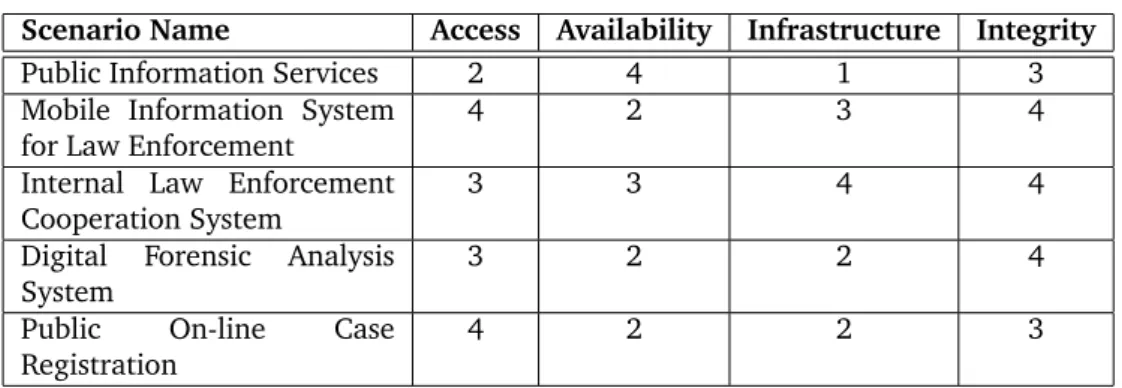
3 An overview of the scenarios and category priorities . . . 53
4 Deployment Model versus Categories . . . 59
5 Deployment Model versus Categories . . . 61
6 In-Depth Study Deployment Model Scores . . . 62
7 Questionnaire Study Deployment Model Scores . . . 63
8 Asset list for a digital forensic analysis system . . . 72
9 Identified user stories . . . 93
10 Identified user groups . . . 93
11 High-level functional requirements . . . 94
12 High-level non-functional requirements . . . 94
13 Advanced use-case table . . . 102
14 Sensitivity assessment of asset 1 . . . 104
15 Asset 1 description table . . . 105
16 Overview of benefit and drawback values for the Squared Values model . . 125
17 Private Cloud Results Overview with Squared Values . . . 126
18 Hosted-Private Cloud Results Overview with Squared Values . . . 126
19 Public Cloud Results Overview with Squared Values . . . 126
20 Conventional Results Overview with Squared Values . . . 126
21 Private Cloud Results Overview with Squared Values . . . 128
22 Hosted-Private Cloud Results Overview with Squared Values . . . 128
23 Public Cloud Results Overview with Squared Values . . . 128
24 Conventional Results Overview with Squared Values . . . 128
25 Access Comparison Table using Squared Values . . . 132
26 Availability Comparison Table using Squared Values . . . 132
27 Infrastructure Comparison Table using Squared Values . . . 132
28 Integrity Comparison Table using Squared Values . . . 132
29 Access Comparison Table using Squared Values from the Questionnaire . . 133
30 Availability Comparison Table using Squared Values from the Questionnaire133 31 Infrastructure Comparison Table using Squared Values from the Question-naire . . . 133
32 Integrity Comparison Table using Squared Values from the Questionnaire . 133 33 Best Deployment Model when using Squared Values . . . 135
34 Questionnaire: Best Deployment Model when using Squared Values . . . . 135
35 Example use-case table . . . 165
36 MOF Plan Phase Mapping . . . 175
37 MOF Deliver Phase Mapping . . . 175
List of Abbreviations
CC - Cloud Computing
SLA - Service Level Agreement
SaaS - Software-as-a-Service
PaaS - Platform-as-a-Service
IaaS - Infrastructure-as-a-Service
AAII - Access, Availability, Infrastructure, Integrity
CSP - Cloud Service Provider
ISP - Internet Service Provider
VM - Virtual Machine
VMM - Virtual Machine Monitor
DDoS - Distributed Denial-of-Service
CoC - Chain-of-Custody
PHI - Protected Health Information
PII - Personally Identifiable Information
Acknowledgements
First, I would like to thank my supervisor, Professor Katrin Franke, for her help with elaborating the thesis context and scope, providing literature and academic knowledge, and for guidance throughout the thesis period.
Secondly I would like to thank Anders O. Flaglien, who has acted as my unofficial external supervisor and sparring partner, and who provided his experience both from education and the private sector.
I would also like to thank my classmates at GUC, whose input regarding both on- and off-topic issues have aided me in my work and lifted my spirits many a time. I would especially like to thank my opponent, Lars Arne Sand, for his help and support.
Finally I would like to extend my gratitude to my family for their help throughout the years, and to my fiancée, Line Solberg Espedal, for her tireless support and patience.
1
Introduction
This chapter starts with an introduction to the topic of the thesis, then follows the prob-lem description and a motivation section. Next comes a description of the research ques-tions and the methodology, and finally the contribuques-tions and the outline of the thesis are presented.
1.1
Topic covered by the Thesis
The amount of data created using information technology (IT) is rapidly growing, and studies propose that this amount might more than double every two years [1]. Naturally, computing power and storage capacity will have to keep up with this pace. For law enforcement this means that the amount of digital evidence collected for a given case might significantly increase each year [2, 3].
Being able to handle this amount of data in the best possible way is a prime concern of any digital forensic analyst, as imaging and analysis of entire partitions is quickly be-coming infeasible. Partitions of several terabytes are simply too large to be handled in an effective way, as the resource demands become too high for conventional servers and vir-tualization platforms. Re-enactments of scenarios for digital investigations are similarly difficult, as the numbers of machines, network traffic and other resource demands make conventional virtual platforms unable to sufficiently run simulations. It is clear that new technology is needed to keep up with the demands of current digital crime scenes.
Cloud computing (CC) is a new frontier in the IT world. By enabling large data centres to provision computing resources and services to the public at their demand, the indi-vidual user is able to tap into and utilize resources that are far superior to any single server. Such a reservoir of computing power is in the context of CC known as aresource pool, which enables the users of the cloud to boost their computing capabilities tempor-arily or permanently. The concept can be visualized as a cloud of computers, where the users of the cloud will commission computing resources without knowledge of which computers are used or where these are located.
The strength of a CC system becomes especially visible when there is a change in the resource demands of a part of the system. When a cloud user needs additional resources to do a job, the cloud can be asked to assign these resources in the form of more or faster virtual machines, thereby scaling up the user’s infrastructure. In the same way, as the user’s needs diminish, the resources can be released backs into the resource pool to be used elsewhere.
Unfortunately, criminal applications of the technology have already been discovered. By utilizing the power of scalability and elasticity, everything from cracking password hashes [4] to distributing botnet services [5] is possible. What makes this a real threat is that it can all be done by one person on one physical machine, where thousands would have been needed before.
Because of such examples, the focus of research in the area of information security has mostly highlighted the problems of conducting digital forensics in the cloud, but little has been done to explore the benefits of using such a system for law enforcement.
It seems likely that expandable resources combined with the versatility of virtualization could be put to good use for digital analysts, and potentially solves many of the emerging problems. The question is: How?
1.2
Keywords
Cloud computing, digital forensics, law enforcement, computational forensics, network security, requirements, project planning framework.
1.3
Problem Description
Finding a solution to the problems of resource deficiency for law enforcement is vital to raising the overall potency of current and future digital forensic techniques. Creating an infrastructure for the analysis of digital evidence or testing of security software that can handle large volumes and scale for large scenarios is a key functionality of the next generation of digital forensic tools. It is in this setting we believe CC will come to its right.
Many implementations of analysis environments are currently created, and academic projects like deLink [6], Jungle [7] and the Information Security Test Laboratory [8] have shown that the applications of virtualization are great in the field of digital forensics, be it malware analysis, software security analysis or scenario building. Many commercial systems have also been built for such purposes, including AD LAB computer forensics software solutions [9] and the FRED stand-alone forensic-analysis workstation [10]. This project aims to assess the applicability of CC for such tasks.
Even though the cloud seems to address the new demands of digital forensics, several problems have to be addressed when planning for CC implementations. As examples, standards, frameworks or best practices have yet to be announced for this technology, as these are still under evaluation by organizations such as the National Institute of Standards and Technology (NIST) and the Cloud Security Alliance (CSA). Furthermore, compliance frameworks have not been specifically created to cater for cloud solutions, and legal and jurisdictional issues constitute severe problem areas. Solutions therefore have to be based on frameworks that are not optimized for the cloud, which could yield problems. These and other arguments state that the cloud may not be the best choice for digital forensics.
1.4
Justification, Motivation and Benefits
CC is here to stay, and most of the corporate and governmental world have already moved some of its services and business infrastructure to the cloud. Following them is the entire criminal society, which seek to reap the benefits of this new technology in its infant stages, as implementations are conducted before the security implications of these are fully understood. In addition, the ever increasing amount of digital evidence in criminal cases implies that new techniques have to be created for the handling of such evidence [2, 3].
This provides a strong incentive for law enforcement to start using cloud systems, as the creation of a cloud environment for forensic analysis will provide the digital investig-ator with a strong and versatile environment for analysis applications. Such applications could assist in the analysis of digital content at a large scale. As an added bonus, the experience gained while using CC will be helpful in developing new techniques for
ana-lyzing such systems in the future.
One direct example of how digital analysis systems may benefit from introducing cloud-like systems is the Norwegian National Authority for Investigation and Prosecution of Economic and Environmental Crime ØKOKRIM [11]. This Norwegian law enforcement agency decided to base their new digital analysis system on Access Data’s AD LAB soft-ware, implementing it using resource pooling in a cloud-like fashion. This was said to dramatically improve the abilities of ØKOKRIM to process and analyze data.
In the long run, the advantages of implementing in the cloud is found in the inherent qualities of CC, as a centralized cloud for a country’s law enforcement could be used by all offices regardless of size. In this way, abundant computing resources, training and analysis capabilities can be made available for all personnel, and not just the local department.
1.5
Research Questions
In order to specify the problems that should be addressed, some research questions were formed. The main question will be answered based on its sub-questions.
The main question is:
• How can the field of digital forensics and law enforcement benefit from the use of cloud computing?
The sub-questions are:
• What are the potential benefits and drawbacks of implementing forensic applica-tions in the cloud?
• What needs to be included in a specification for a private cloud-computing envir-onment for law enforcement?
• How can one best design a functional private cloud for law enforcement?
To be able to answer these questions the field of CC and digital forensics must first be thoroughly understood. Additionally, a literature study is needed to research the usage of forensic analysis methods, and to identify parts of these that might be interesting to move to a cloud environment. Furthermore, information regarding legal, security, architectural and compliance issues must be researched in order to create a specification for such a system.
Exploration of the benefits and drawbacks of moving governmental or forensic sys-tems to the cloud should then be performed. During this assessment, potential cloud deployment models have to be surveyed and compared to identify possible problems and further elaborate on benefits and drawbacks. Several scenarios are also created and assessed to review a possible selection of governmental cloud applications.
Following this, we must create a list of requirements that needs to be documented and discussed in order to plan the implementation of governmental systems in the cloud. The requirements must then be tested using feasible scenarios.
1.6
Methodology
This thesis will rely on a qualitative approach, as the questions are more general and complex than specific and focused. Compared to Peshkin’s categories of qualitative ana-lysis and their outcome [12] the research questions that are proposed fall within two of
these.Interpretationis the first one, as the project will elaborate on the existing concepts of CC and digital forensics. It might also provide insights into the identification of prob-lems in the field.Evaluationwill also be used, as we wish to provide the means to create detailed specifications of CC environments in law enforcement, thereby elaborating on the practices in the field. We also believe that such specifications and their implementa-tion may strengthen the tools of digital forensics by increasing their performance.
The qualitative research design can be categorized as a case study, as explained in [13]. However, the research will be performed somewhat differently compared to the definition. The research will focus on the law enforcement community and its possible utilization of the new CC technology. Observing and documenting a case over time will therefore not be a part of this project.
To be able to answer the presented research questions, a literature study first has to be conducted in the fields of law enforcement, digital forensics and CC. The results of the study are presented in Chapter 2, and create the foundation for further elaboration of the research questions.
The order of the questions is laid out in a way that lets the results of one question be beneficial for us when attempting to answer the next in line. The questions will there-fore mostly be answered in sequential order, although some parallel work between the questions will be natural. This will especially be the case with the first and the second question.
After the literature study we will collect the information regarding the advantages and disadvantages of CC for governmental agencies and law enforcement. The goal of this phase is a listing of the benefits and drawbacks as well as a table comparing differ-ent CC deploymdiffer-ent models against each other. This table provide insight into how the benefits and drawbacks reflect in the choice of deployment models when assessed from our governmental viewpoint, and help us find the ones that provide the best foundation for such CC environments.
Several ways may exist to collect the benefits and drawbacks, and assess the size of the positive and negative effects of these. One possible solution would be to arrange a workshop, collecting participants from several of the departments of Gjøvik University College (GUC), related IT industry and law enforcement. Drawbacks and benefits could thus be collected, discussed and documented. Another approach would be to perform in-depth interviews with selected participants to map benefits and drawbacks. Question-naires can also be used, and dispatched to a large number of participants in order to collect benefits and drawbacks, and concatenate the results into the final list. Finally, the creation of benefits and drawbacks can be based on an in-depth study of existing literature and cloud solutions. The impact of these would then be discussed at length.
The first approach listed in the preceding paragraph might be the best choice, as it would create a great foundation on which to collect a detailed and justified list of drawbacks and benefits. However, we find that given the limited amount of time and resources available to us, such a solution is not feasible. The same arguments remain for in-depth interviews, as it would require us to either travel to the subject’s location, or pay for their travel to GUC. Using a questionnaire for the collection of benefits and drawbacks seemed unfitting, as it would require the respondents to describe their thoughts at great length. Although this was the case, a questionnaire could be more useful if concrete questions could be presented to the respondents.
Because of this we decided to explore possible benefits and drawbacks by doing an in-depth analysis of existing literature, and rate the possible impact levels of such based on discussions in each case. Based on the results we would then create a questionnaire presenting the benefits and drawbacks in the form of questions, and ask respondents to rate the impact levels of these. This would then give us an indication of how our discussed impact ratings compared to the results of the questionnaire.
In order to explore the results presented, the impact levels may be translated into values, which can then be used in calculations. Since we would like to explore the best cloud deployment model in a given situation, the drawback points related to a deploy-ment model can therefore be subtracted from the benefit points of the same deploydeploy-ment model. The results from this simple calculation could then give us a good opportunity for further exploring the combinations of cloud deployment models, and how these compare to each other.
Another approach would be to qualitatively assess and discuss the combinations of benefits and drawbacks that relate to given deployment models. Based on this one can attempt to reach a conclusion for which model is better, for instance by applying relevant scenarios and discuss at length.
The advantage of using calculations for assessing such problems is that the results are easily measured, as a difference in numbers can be more clearly stated than a difference in discussed arguments. A downside of simply calculating is that the details behind the comparison of deployment models might be lost. This is also the benefit of discussion, as all details concerning each benefit and drawback can be exhaustively studied for each deployment model. A downside of this method is that it is far more time consuming.
Given that the study would use five cloud deployment models and four categories of benefits and drawbacks (see 3 for details) we decided that the qualitative approach would be too time consuming. Choosing to calculate the answers would also give us a chance to combine a qualitative and quantitative approach, and we decided to use this method. The details of this approach can be found in Section 3.5.
Work will then continue with defining a list of requirements for a CC environment for law enforcement, which will create the foundation for the potential implementation. The goal will here be to create a guide that can be useful during the planning of similar projects, both within research and the commercial market. In order to do this, the know-ledge we gain from the related literature studies regarding CC and digital forensics, and knowledge concerning project frameworks has to be combined.
At last, our requirements document has to be tested using a relevant scenario. Sev-eral areas will have to be mapped out during this stage, such as the project planning methodology to be used, what hardware and software the scenario is based on and its goals. The reason for doing this is find out if our requirements document can provide relevant projects with assistance and guidance, regardless of the methodology used. The guide should help to focus the project towards CC by adding steps and tasks specifically tailored for this purpose.
The first two questions will be highly theoretical, and rely on the information found during the literature study. The third question will be approached in a practical way, as it concerns the implementation of a complete environment. After these have been answered, the deliverables will consist of the list of benefits and drawbacks as well as the calculations based on these, the requirements documentation and the documentation of
a fictional test scenario using our requirements guide.
1.7
Contributions
By answering the research questions we seek to investigate the possibility of using the cloud as an environment for governmental CC, and a forensic environment for investig-ators. As pointed out in Section 1.1, many researchers have discussed the implications of the cloud on forensics, but few, to our knowledge, has addressed the implications of utilizing the cloud for the benefit of law enforcement in the field.
A thorough investigation of benefits and drawbacks will contribute to clarify the premises on which forensic environments in the cloud should rely. Following this, the creation of a guide for exploring cloud-specific requirements will aid in the planning of such implementations. Finally, a test of the guide’s applicability will be performed using MOF. The documentation of this can be used for exemplifying the design and planning process.
1.8
Thesis Outline
This section will cover the chapter distribution of the paper and the reason why they are organized as they are. Each chapter is quickly summarized in its own bullet point.
• Chapter two covers the related literature concerning forensics, CC and cloud forensics.
• Chapter three discuss the benefits and drawbacks of implementing forensic applic-ations in the cloud. The results, presented in Section 3.5, culminate in a suggestion for the best suited cloud deployment models, and how these compare to the cap-abilities of conventional computing environments in several different scenarios
• Chapter four explores the layout of a complete guide for the creation of require-ments for a governmental CC environment for law enforcement. The guide, found in Appendix H, is created to be framework agnostic, and to help a project to focus on cloud-specific issues.
• Chapter five covers the testing of the document created in Chapter four by using the MOF project methodology. The requirements guide is applied to the distinct phases of MOF and used to plan and design a fictional law enforcement cloud environment
• Chapter six discusses the results of the research conducted, concludes the master thesis report and provide ideas for further work based on the presented results.
• The appendices of the thesis document support the research and its findings. Amongst other things, the appandices feature tables (Appendix A, B, C and D) used for the calculation of results in chapter three, and an overview of MOF (Appendix I)
2
Related Literature
In this section a related literature study concerning the specific fields covered in this master thesis report is covered. Forensics and several fields linking to the core concepts of CC will be presented. The sections covering CC and digital forensics have in full or parts been selected from my own paper written during my time at GUC [14].
2.1
Forensics
This section covers the field of forensics both traditional and digital. As the focus point of this thesis is on the field of digital forensics, traditional forensics will only be covered briefly.
2.1.1 Definitions
Some expressions will have to be defined, which will be used throughout this report. These cover both conventional law enforcement and digital forensic terms.
Law
The Oxford dictionary define law as ”A system of rules which a particular country or community recognizes as regulating the actions of its members and which it may enforce by the imposition of penalties” [15]. Basically, this means that it is the collection of actions for which one might be punished for doing.
Law Enforcement
The Oxford dictionary definition of enforcement, when limited to law, creates the follow-ing: ”The act of compelling observance of or compliance with law” [15]. This means that law enforcement is the observation of actions according to law, and the legal pursuit of those who do not abide by these.
Police
Police can be defined as: ”The civil force of a state, responsible for the prevention and detection of crime and the maintenance of public order” [15]. One can therefore establish that police is the civil force of law enforcement.
Jurisdiction
Jurisdiction is in the Oxford dictionary defined as: ”The official power to make legal decisions and judgments” [15]. In most cases, a jurisdiction is a limited area where a certain set of laws exist. A country is an example of a jurisdiction. Another example is the operational jurisdiction of a police force, for instance the state jurisdictional areas of the United States.
The Forensic Approach
The general forensic approach is outlined in the NIST Special Publication 800-86 regard-ing forensic techniques in incident response [16]. The model presented in the paper is used by the digital forensic courses at GUC in a revised form. Figure 1 shown underneath is a visual presentation of this refined model, and the one we will be using.
Figure 1: NIST General Forensic Investigation Process. Inspired by [16]
The Digital Forensic Investigation Process
Here we briefly comment on the model from a digital forensic point of view, and use the NIST standard as a reference [16].
Identification
This is the verification of the fact that an incident has occurred, and often the trigger for a forensic investigation. This point is not stated in the NIST standard, but is crucial for digital forensics as one might put processes like intrusion detection/prevention systems (IDS/IPS) in place to detect and mitigate threats, and get a head start on the forensic investigation.
Collection
All identification, collection and labeling of data from all systems that was a part of or monitored the incident. This can for instance include the extraction of all data located on drives, surveillance footage, eye witness statements and other information. In digital forensics one also has to decide whether to seize all hardware or to only copy the needed files from the source.
Examination
The examination process includes processing the data in a way that makes is ready for analysis by both automatic and manual methods. This may include decryption of encryp-ted materials, restoring damaged files and searching for hidden data.
Analysis
In this section all the data is analyzed for useful information regarding the incident. This might for instance include the creation of time lines based on the information in files and monitoring systems and the identification of participants in the incident like IP ad-dresses, MAC addresses other identification information.
The final section gathers all collected information throughout the investigation process and presents it in a report. This will include the entire process from the identification of an event to the detection of all evidence from all sources. It describes tools that were used in the collection, examination and analysis phases, the analysts thoughts surround-ing the scenario, time line of the incident, what was taken/changed and why, and can also include recommendations for hardening of the systems software, policies and secur-ity measures.
Evidence Integrity
Refers to preservation of evidence in its original form1, and is a crucial part of the entire investigative process. Some of the methods that can be used to obtain this are hashes; which can be used to maintain integrity, and write blockers; which are tools or methods that ensure that the evidence is not altered (willingly or accidentally). The latter can be found in both software and hardware form.
It’s worth noting though that in some cases, especially at live forensics the evidence change during acquisition. Volatile data is data that will be lost or changed when a ma-chine shuts down, or as it is used. One can consult with an Order of Volatility (OOV) list to assess what needs to be captured and to capture the most volatile of the interesting data first.
Chain of Custody
Chain of custody (CoC), also referred to as chain of evidence, refers to the documenta-tion of evidence acquisidocumenta-tion, control, analysis, disposal (both physical and electronically). The documentation can include paper trails, hashes, event reconstruction images, photo-graphy’s and so on. To maintain this, we often use lists, notes, reports, time stamps and hash values.
This part of the process must be kept up to date and controlled throughout the in-vestigative process, as it is an important part of the assurance that the evidence is found and kept in a safe way. A slip here might be costly in a court of law, as one could specu-late that the evidence is faulty, or question the origin of it. This could in turn render the evidence useless in court [17].
Forensic Readiness
The concept of forensic readiness is not a part of our referenced model, but an important part of the forensic process none the less. The main difference of this task from the previous ones is that the task is performed by the businesses themselves, and not the forensic analysts. By creating or modifying a computer system to assist in the gathering of evidence when this may be needed, one will aid in the identification and collection of events and evidence. A part of establishing forensic readiness also applies to the training of the business workforce, and the creation of appropriate policies.
2.1.2 History
Law Enforcement and Forensics
According to Wikipedia [18] several examples of police-like forces existed in ancient cultures. An example is the prefects of ancient China which existed approximately 1000 years BC. There are also reports that the Chinese started to use fingerprints to identify authors of documents and the creators of sculptures around the year 700 AD, albeit
with no specific classification. The first documented example of medical forensics used is found in the bookHsi Duan Yu from 1248, where the distinctions between death by drowning and by strangulation is determined.
In modern times, the first organization into Police offices originate from France in 1667, while George II of England (1737) was the first to pay individuals in London out of tax funds to guard the streets. This shifted the organization of police forces towards governmental control, which set the standard for how police forces are structured today. Although this is the case it is worth to mention that during this time several privately funded police forces also existed in London. During the same time period, in 1784, the first known case where physical matching was used to convict a suspect is documented in England, when a newspaper scrap found on a gun was matched to a paper found in the suspect’s pocket.
A lot of new forensic methods were researched at the end of the 19th century, when both methods for poison identification in blood samples and bullet comparison and iden-tification was published. Additionally, the first case of a crime being solved by fingerprint identification was documented in 1880.
By the start of the 20th century the University of Lausanne in Switzerland became one of the first known institutions to offer a forensics curriculum. A couple of years later, in 1908, the Federal Bureau of Investigations (FBI) was founded, who later created their crime laboratory in 1932.
During the 1950’s the world saw several new techniques for the capturing of evidence, including the tape lift method (1950) and the invention of the breathalyzer (1954) to test sobriety. During the 1980’s the first DNA profiling tests were under way, and by 1986 a crime was solved, as the first one ever, by DNA samples [19]. Even though the admissibility of DNA samples was severely challenged in a 1987 case, it was still widely researched. By 1996 the second National Research Council Committee on Forensic DNA convened, and stated that there should no longer be any reservations against the usage of DNA as admissible evidence in a criminal investigation [20].
Digital Forensics
This section is inspired by the Computer Forensic Timeline [21].
Most of the recorded history of digital forensics originates from the United States, in which the first criminal cases involving computers were registered. In these cases the criminal act mostly related to fraud. By the 1980’s it became clear that, in some cases, the available evidence only existed in a digital form.
The eighties spawned a new era for forensics, as tools and techniques had to be cre-ated to be able to handle these high-tech cases. Tools like Norton’s ”Unerase” tool were released, and several law enforcement and academic institutions like SEARC’s High-Tech Crime Training Services, the Federal Law Enforcement Training Center and the Asso-ciation of Certified Fraud Examiners began to train personnel in computer forensics. Programs like FBI’s Magnetic Media Program, later to become known as the Computer Analysis and Response Team (CART) were also founded to meet the demands of the digital age. Furthermore, in 1988, the International Association of Computer Investigat-ive Specialists (IACIS) was founded. The IACIS still lInvestigat-ives on as a training resource and certification body [22].
for best practices and specifications concerning digital forensics. Stories like the Cuckoo’s Egg [23] can be read for some insight into how unstructured law enforcement in this area was at that time. Many new organizations were founded, and conferences regarding the field of digital forensics were organized. The first international conference on computer evidence was held in 1993, and the International Organization on Computer Evidence (IOCE) was founded in 1995.
In the G8 conference in 1997 it was declared that law enforcement personnel must be trained to handle high-tech crimes, setting a new standard for law enforcement practice. The creation of the principles and best practices used to reach this goal became the job of the IOCE. By the end of the nineties the first INTERPOL Forensic Science Symposium to contain a digital forensics paper was held, further addressing the need for focus on digital forensics.
In the year 2000 the first FBI Regional Computer Forensics Laboratory was created. By 2003 the case load for the CART program had reached 6500 cases containing 782 terabytes of digital evidence. The 2000’s also saw advances in forensic software solutions. In 2001, the first version of EnCase was released, and by 2005 the first version of the Forensic ToolKit (FTK) followed suite. As a testimony for the need for advances in digital forensics, it is now estimated that around 80 % of all criminal cases now include some form of digital evidence [24].
2.1.3 Problems of Traditional Law Enforcement in the Digital Age
Several reasons exist for traditional law enforcement methods being less efficient in today’s digital society. First of all, evidence is not always available in a physical form. As most traditional methods are based on physically examining evidence, these become unusable, or significantly less efficient. Furthermore, complete and identical copies of digital evidence can be made without leaving any trace. Confiscating a piece of digital evidence will therefore not necessarily mean that the recovered evidence is the only one of its kind. This also means that the evidence will have to be stored differently, as gaining access to the evidence may cause a version of it to be extracted and removed. Evidence can also very easily be deleted when existing in a digital form, without leaving noticeable traces. This will also have implications both for how it is secured and stored.
2.1.4 Digital Forensic Methods
In this chapter we will quickly describe some of the different digital forensic methods which are used today. The sections and the content are inspired by the work done in a GUC course paper [25].
Post-Mortem Analysis
Post-mortem does in this sense mean the analysis of equipment that has been unplugged or shut down. It constitutes the basic method of seizure of evidence performed by most law enforcement to this day. As an example, during a raid several computers are found. To seize these, the police pull the plug on the machines, and thereby freeze some of their current state. This also makes sure that no changes can befall the evidence after its capture, for instance by running processes. The equipment is then brought into a lab for analysis by a forensic analyst.
By capturing evidence in this way, police make sure that the machine is not altered after it is seized, but a lot of information is lost in the process. Volatile information in
accordance to the OOV might be lost, information that could have proved interesting. Open windows, processes, network traffic and data stored in the main memory cannot be retrieved when using this method.
Live Analysis
The opposite of the post-mortem analysis is the live analysis of evidence. In this case, a machine is not shut down upon seizure, but rather kept plugged in and turned on in order to capture or log the current activities of the machine. This can be done by utilizing several tools for live memory capture, network traffic capture and similar techniques. One could also force the machine into hibernation mode, which saves the current state of the machine to a hibernation file. This can be an easy way to assure some live forensic material even if the specific competence in the field is not present.
By performing live forensics on evidence, additional information might be found. There are, however, some downsides to these techniques. For one, the analyst has to perform tasks on the machine that alters its state. In the worst case scenario this could contaminate evidence to the extent that it becomes non-applicable in court, and has to be dismissed.
Data Duplication
Specifically, data duplication is the process of collecting logical evidence from physical evidence. This can for instance be a hard-drive or a digital camera. Data duplication is one of the most used techniques in a digital forensic analyst’s arsenal, as it will have to be performed on pretty much all digital data which is going to be analyzed. An analyst will typically refrain from analyzing the original data, as the principle of evidence integrity states that no change should befall the evidence.
Using data duplication the digital forensic analyst is put in a unique position, as mul-tiple identical copies of evidence can be produced. This can be used to test different hypotheses on the evidence without having to worry about harming the evidence, and it can be distributed to other analysts for peer-reviews or cooperation for a more effective investigation. However, in the case of data duplication and distribution, high demands are set for the CoC of the evidence, making sure that no copy is lost or leaked. This could in the worst case scenario damage the investigation and prosecution of a suspect, for instance by deeming the evidence non-admissible.
Data Reduction
As mentioned in the introduction of this report, the increasing amount of digital evidence that is captured in each case makes the analysis hard to handle. By reducing the evidence to be analyzed down from several terabytes to maybe a couple of hundred megabytes the analysis process can be significantly enhanced. There exist several ways to perform data reduction, but blacklisting and whitelisting are the most used methods.
A whitelist is a register of known good files, often by means of their cryptographic hash algorithms, which can then be excluded from the evidence. By doing this, files like known operating system and program files that have not been altered can be excluded, as well as several others. The upside to whitelisting is that only the files known to be common or uninteresting are excluded. The downside is that several other files that are irrelevant for the investigation will remain, making the search set far larger than it needs to be.
the same way as in the whitelist, which can then be used to identify files of interest in digital evidence. An analyst can therefore easily identify files known to be affiliated with criminal behaviour, and single these out from the search set.
The upside to such an analysis is that the interesting files can be singled out very quickly, giving the analyst some clue about what evidence might contain. The downside is that only the registered files are found, and many more files could exist that should be analyzed further.
Because of the inherent strengths and weaknesses of whitelisting and blacklisting, an analyst should use both in succession. By for instance using whitelisting to remove known good files and blacklisting to store known bad files, one is left with what is called gray files. These are files that are not registered, and should be investigated further to be checked out of the case or registered as interesting.
Data Recovery
Often data will be deleted, obfuscated, encrypted or corrupted on the storage medium. As this data can be interesting for an investigator it is important to make it available. The recovery of such evidence can be attempted using several techniques, some of which are presented here.
String searching can be used to search for known words of interest, aliases or other interesting strings in available evidence. An example is the search for passwords in data recovered from main memory.
File carving is a technique for identifying the parts of files and rearranging these to recover complete files. In situations where deleted material has to be recovered, corrup-ted files have to be fixed, or information in slack space or host-proteccorrup-ted areas has to be found, file carving can be applied to attempt the recovery.
Encrypted information may be found during an analysis of evidence, which could prove important to a case. Often the deciphering key to such information is lost or not obtainable, and information has to be decrypted in order to be recovered. Brute forcing and rainbow tables are examples of techniques that can be used in an attempt to find the key for encrypted material, and recover the data.
File Analysis
In file analysis the focus lies in exploring files existing in the evidence. These can for instance be log files like event-, network- or registry-logs and individual files related to applications on the target machine. The analysis of malicious files is often conducted in order to understand the inner workings of malware, which is often of interest for the forensic analyst if the malware is used as a staging point in the criminal activity.
Within the file analysis technique there exist many methods for extracting inform-ation. By searching for strings one may specifically find files connected to users, time periods or applications. One can also search for files changed during a given period of time and what was changed. Another focus point can be the analysis of registry files to detect previously opened or executed files, user settings and previously connected hard-ware.
Network Analysis
The analysis of captured network traffic in the form of network packets is called network analysis. Methods for capturing the traffic are many, and depend on the transfer protocol used and the position of the capturing device. The packets can also be captured for other
purposes, like IDS/IPS. This can in some cases prove to be a viable source for forensic evidence, and can therefore be viewed as a good forensic readiness tool.
After they are captured the packets can be analyzed for interesting information like content, sender and receiver, evidence of network behaviour, emails, communication with other specific nodes on a local or external network and more.
Memory Analysis
Memory analysis is still being researched, and is not, as of yet, an exact science. Its incentive is, however, quite tempting. Passwords and other information which are usually found in an encrypted state is always saved into memory as clear text. Several research projects have been conducted on the matter, including [26, 27]. Tools have also been made available for the capture of main memory [28].
Volatile information like the connections which existed on the computer, processes, passwords and deciphered files can be captured using this type of analysis. Some methods exist to save volatile data, even when applying post-mortem techniques, but these are still in the experimental phases. By for instance freezing down memory modules in liquid nitrogen, the data’s persistence on the modules is prolonged, and can be extracted at a later time [29]. However, these techniques are not widespread in use.
2.2
Cloud Computing
In this section we cover the definitions that we use throughout the thesis report, the history of CC, and the general benefits and drawbacks of outsourcing to a CC vendor.
2.2.1 Definitions
One quite broad definition is stated by Lu et. al. is... share storage, computation, and services transparently among a mass of users,...[30]. A more intricate definition is given in a NIST draft from 2011;Cloud computing is a model for enabling ubiquitous, conveni-ent, on-demand network access to a shared pool of configurable computing resources (e.g., networks, servers, storage, applications, and services) that can be rapidly provisioned and re-leased with minimal management effort or service provider interaction.[31]. The definition also includes some essential characteristics and some service and deployment models. This definition model is also used by the Cloud Security Alliance (CSA).
We will use the NIST definition together with its characteristics and models as a basis for this part of our paper. This is because the definition is commonly used in one form or another by almost all papers discussing CC that we have encountered. Furthermore, it is highly detailed and is in our opinion the closest we have to a standard definition of CC. A figure inspired by the NIST CC definition model is given in Figure 2. It shows the essential characteristics, service models and deployment models that forms the foundation of CC.
2.2.2 History
One of the first thoughts regarding a distributed system for services across networks was stated by John McCarthy at MIT Centennial in 1961, where he stated that”If computers of the kind I have advocated become the computers of the future, then computing may someday be organized as a public utility just as the telephone system is a public utility... The computer utility could become the basis of a new and important industry.” [32], thereby founding the termUtility computing.
Figure 2: NIST Visual CC definition model. Inspired by [31]
precluding an 1963 ARPA meeting which would ultimately result in the ARPA-net, some more thoughts were brought to light. In the memo Licklider describes a network in which an end node can pull on services from several other systems in order to do its job [33], lining out some of the main thoughts of CC.
The first known use of the term CC on print is found in a Compaq business plan from 1996 calledInternet Solutions Division Strategy for Cloud Computing[34]. However, after the construction of the Internet as we know it, there have been many synonyms to cloud computing, which explanations more or less differ from CC.
Grid Computing
This is one of these terms which are based on the workings of a power grid. The term was presented by Ian Foster and Carl Kesselman [35], and states that computer power can be made as accessible as the power grid and stated thatThe goal is to put full supercomputing capabilities into the hands of anyone who needs it while providing for more efficient use of the supercomputers of tomorrow. Borrowing some thoughts fromutility computing, the method of paying based on the amount of computing power used (much like the time-sharing computers used before) is retained.
Distributed Computing
This applies to many of the thoughts stated in grid-computing theory, but differs in the way that it is more like a community than a vendor service. Distributed computing is used mostly as collaboration projects, where a private person, wanting to aid in a project requiring huge amounts of computing power, can configure his or her machine to donate surplus CPU time to working for that project. Projects like Search for Extra-Terrestrial Intelligence(SETI)@home [36], and several other projects including for instance medical research projects have made good use of such services for years.
Virtualization
Virtualization creates the basis for all CC environments, as it allows for the creation of virtual computing nodes existing purely in software. The first examples of resource virtu-alization was implemented by IBM, when they during the 1960s started to partition their
mainframes in order to run parallel applications [37]. In the early 1990s, the concept of virtualization was introduced for the x86 platform, providing virtualization capabilities at much lower cost than previous examples.
A virtualization platform typically uses a hypervisor, also called a virtual machine monitor, to control the virtual nodes built on top of them. The hypervisors act as an abstraction layer between the hardware and the virtual machines(VMs), translating and sending instructions between these.
There are primarily two virtualization techniques used today: Hardware virtualization and paravirtualization.
Hardware virtualization (also called hardware assisted virtualization or full virtual-ization) is used to emulate the entirety of a hardware configuration [38]. Unlike its paravirtualized counterparts, hardware virtual machines (HVMs) uses CPU virtualization extensions, and the OSs running on these will not need modified kernels to be virtual-ization aware. A positive characteristic for hardware virtualvirtual-ization is that any operating system should in theory be able to run on the fully virtualized platform as long as it sup-ports the hardware that is being virtualized. A negative side is overhead, as virtualizing the entire hardware infrastructure is resource-consuming.
Paravirtualization does not need virtualization extensions on host CPUs. Instead, the VMs utilize virtualization aware kernels which are able to generate hypervisor calls. A paravirtualized guest OS must therefore be specifically tailored to the environment in which it is supposed to operate [38]. One strength of using paravirtualization is that the hypervisor and virtualization aware kernel share the complexity of virtualization process, unlike the hardware virtualized systems where the platform must handle all such tasks. Another strength is performance, as paravirtualization lacks the overhead of virtualizing hardware [38]. The drawbacks are the demand for modified kernels, as this constricts possible choices of OSs.
2.2.3 Essential Characteristics
These characteristics are meant to both relate and differentiate CC from other computing methods [31].
Broad Network Access
States that the capabilities should be available over the network, and be accessible through various thick and thin client platforms. This includes, but is not limited to mobile phones, PDAs, laptops, etc. The mobility capabilities of a CC service should be absolute.
Rapid Elasticity
The system should be able to quickly scale up or down based on a customer’s needs in storage, computing power, etc. The thought is that additional resources should be available when needed, and in an almost unlimited quantity. Customers will be able to quickly call on additional resources when in need, and pay for them as they are used, and then scale down to a default setting when a normal situation is reinstated.
Measured Service
A CC system should be highly automated in regards to optimization of resources. Mon-itoring and reporting should be available both from the client and vendor side. This is important for both sides as it eases the controlling of service level agreement (SLA) points, and provides a manual view of the optimization process.
A consumer should be able to request (manually or automatically, for instance based on policies) additional resources without having to depend on human interaction. The characteristic is tightly linked to the elasticity principle, and creates the foundation for acquiring resources quickly when in need.
Resource Pooling
Resources should be able to be drawn from all parts of the system, split between the consumers, and pooled where needed. Customers should not be able to pinpoint the origin of the computing resources, but might be able to decide the general location, for instance the country or vendor data centre (DC). This is important if a company has a security policy that blacklists certain countries from managing their data.
2.2.4 Service Models
The models use basic computing terms which are redefined in a CC system. The three terms, Service, Platform and Infrastructure, make up the parts of the SPI-model [31]. Figure 3 describes the different service models by how much of the stack is controlled by the CSP, and how much is accessible and configurable for the cloud consumer.
Figure 3: NIST scope and control chart for cloud service models. Inspired by [39]
Software as a Service (SaaS)
SaaS is provided by letting a consumer utilize applications running on the vendors CC system, usually through a web browser. One can say that a SaaS solution enables a user to upload data and use a limited CSP controlled API to handle it in some way. The consumer has no control over where the application is physically run from or the resources it uses (virtual and physical), but might be able to configure the software. One example is a web based e-mail service where the consumer can specify redirection of emails and filters for incoming messages. Another example is web based storage providers like Dropbox.
Platform as a Service (PaaS)
This service model lets a consumer use their own software in a cloud environment which can basically be viewed as a virtualised language environment. The underlying infra-structure and resources are still beyond the consumers’ control, and operating systems (OS) are usually prohibited. The model is a good fit for companies that need to deliver a
service of their own making, but do not need the full functionality of a virtual server. A good example of a PaaS solution is Google App Engine (GAE).
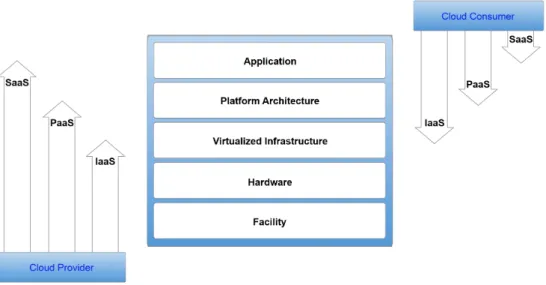
Figure 4: NIST Visual CC stack model [40]
Infrastructure as a Service (IaaS)
This gives a consumer control over all sys-tem resources but the underlying cloud in-frastructure and parts of the networking components. In essence, machines, net-works and storage solutions can be vir-tualised to give users a cloud environ-ment with low-level access rights. The consumer can run their OS of choice (al-though usually with some restrictions set by the CC vendor) and applications, and can configure some of the networking cap-abilities. This means that the computer can set up a complete server and/or work-station system with their choice of re-sources, OS and software, configuring al-most all parts of it to their specific needs. A good example of an IaaS solution is Amazon Web Services.
The three parts are building upon each other with the IaaS as a foundation, PaaS on top of that and SaaS at the peak. The model in Figure 4, obtained in the CSA documentSecurity Guidance for Crit-ical Areas of Focus in Cloud Computing V3.0 [40], shows this relationship and its internal components more clearly. Here, IaaS incorporates the abstraction of re-sources, and the user’s connectivity to these by the use of APIs. PaaS is placed on top of IaaS, and creates an abstraction
to the underlying stack by using application development frameworks and middle ware capabilities. SaaS is placed at the summit, and provides the operation environment and user experience.
2.2.5 Deployment Models
These models can be used with all of the service models, and cater to the specific needs of the consumer(s). Figure 5 visualizes the deployment placements.
Public
This infrastructure is used by companies which provide cloud services to the general public or other companies, for instance be CC vendors. According to [39] three broad classes of public clouds exist:
The first class consists of no-cost cloud services supported by advertisement, typically search engines or web mail and for non-commercial use. Non-negotiable terms of use and
service agreements are standard. Security like encrypted connections might be lacking.
Figure 5: Cloud deployment and placement model
The second class consists of fee-based services, free of advertisements. Non-negotiable service agreements are still common, but the security standards are usually better and often configurable by the user. This class is still primarily fo-cused on private consumers.
The third class of public cloud services is also fee-based, but there the SLA is ne-gotiated upon by the organization (client) and the CSP. Cost is often dependent on the amount of or extent of the changes made to a standard SLA for the given agreement plans offered by the CSP. This class focuses specifically on the business market.
Public clouds are multi-tenant systems by design, meaning that the cloud imple-mentation is made to serve several inde-pendent clients simultaneously. The same physical resources can therefore serve sev-eral users at the same time. The available resources are shared between the users in a flexible way by automatic provisioning based on a client’s demands.
Private
The private model is intended only for serving a single consumer, and is isolated for that purpose. Some may call this type of cloud a single-tenant cloud, although a client can consist of many users. The private cloud will therefore still be able to support multiple tenants of the same client. The infrastructure can be deployed on-site at the customers by themselves, or be outsourced. In the former case we can use open source systems like the
Xen Cloud Platform[41]. In the latter case we often talk abouthosted, orremote private clouds, as it is maintained outside of the company firewall by a CSP. An example of such a cloud solution is VCODYNE [42].
Hybrid
A hybrid cloud consists of two or more of the other cloud models that are linked together, and share information and/or resources. One can for instance combine a community cloud with a private one to easily share the information obtained in the collaboration with other companies, and use it in the company ”isolated” cloud.
Community
This model is meant to be shared between actors which have some kind of collaboration, be it business wise, security wise, etc. The CC system can be run by the consumers, or be outsourced to a vendor in the same way as the other models.
![Figure 1: NIST General Forensic Investigation Process. Inspired by [16]](https://thumb-us.123doks.com/thumbv2/123dok_us/10256388.2931289/28.892.135.693.133.364/figure-nist-general-forensic-investigation-process-inspired.webp)
![Figure 2: NIST Visual CC definition model. Inspired by [31]](https://thumb-us.123doks.com/thumbv2/123dok_us/10256388.2931289/35.892.194.767.130.394/figure-nist-visual-cc-definition-model-inspired.webp)
![Figure 4: NIST Visual CC stack model [40]](https://thumb-us.123doks.com/thumbv2/123dok_us/10256388.2931289/38.892.420.697.208.746/figure-nist-visual-cc-stack-model.webp)

![Figure 6: XCP in detail [41]](https://thumb-us.123doks.com/thumbv2/123dok_us/10256388.2931289/41.892.216.699.130.357/figure-xcp-in-detail.webp)
![Figure 9: Taxonomy of Forensic Techniques in Cloud Computing [14]](https://thumb-us.123doks.com/thumbv2/123dok_us/10256388.2931289/48.892.129.744.174.758/figure-taxonomy-forensic-techniques-cloud-computing.webp)