
Title ARBITER: Adaptive rate-based intelligent HTTP streaming algorithm Author(s) Zahran, Ahmed H.; Sreenan, Cormac J.
Publication date 2016-07
Original citation Zahran, A. H. and Sreenan, C. J. (2016) 'ARBITER: Adaptive rate-based intelligent HTTP streaming algorithm', 2016 IEEE International Conference on Multimedia and Expo Workshop (ICMEW), 11-15 July, Seattle, WA, USA. doi: 10.1109/ICMEW.2016.7574709
Type of publication Article (peer-reviewed) Conference item Link to publisher's
version http://dx.doi.org/10.1109/ICMEW.2016.7574709Access to the full text of the published version may require a subscription.
Rights © 2016 IEEE. Personal use of this material is permitted. Permission from IEEE must be obtained for all other uses, in any current or future media, including reprinting/republishing this material for advertising or promotional purposes, creating new collective works, for resale or redistribution to servers or lists, or reuse of any copyrighted component of this work in other works.
Item downloaded
from http://hdl.handle.net/10468/4935
Downloaded on 2018-08-23T19:11:57Z
ARBITER: ADAPTIVE RATE-BASED INTELLIGENT HTTP STREAMING ALGORITHM
Ahmed H. Zahran
1,2and Cormac J. Sreenan
11
Dept. of Computer Science, University College Cork, Ireland
2
EECE Dept., Faculty of Engineering, Cairo University, Egypt
a.zahran, [email protected]
ABSTRACT
Dynamic Adaptive streaming over HTTP (DASH) is widely used by content providers for video delivery and dominates traffic on cellular networks. The inherent variability in both video bitrate and network bandwidth negatively impacts the user Quality of Experience (QoE), motivating the design of better DASH-compliant adaptation algorithms. In this paper we present ARBITER, a novel streaming adaptation algorithm that explicitly integrates the variations in both video and network dynamics in its adaptation decisions. Our simulation-based performance evaluation, using real video content and cellular bandwidth traces, shows that ARBITER achieves an excellent tradeoff among streaming metrics in terms of received video quality, stall count, stall duration, and switching dynamics, leading to a relative improvement of 17-45% in user QoE in comparison to state-of-the-art algorithms.
Introduction
The volume of mobile video traffic is growing rapidly. How-ever, the shared and highly-variable nature of wireless nega-tively impacts the streaming performance [1]. Hence, there is a need to design intelligent streaming systems capable of ac-commodating the frequent variations in operating conditions. In HTTP streaming systems, the video is split into mul-tiple small duration chunks, known assegments, that are re-quested from the content distribution networks (CDN) using HTTP. Each segment is encoded into different representations that may vary in resolution, quality, and/or data rate. The DASH standard [2] defines the structure of a media presen-tation description (MPD) file that specifies segment encoding and related details. However, the DASH standard does not define the algorithm used by the client for deciding which segment quality to request or how to adapt so as to achieve good Quality of Experience (QoE).
The design of an adaptive streaming policy involves trade-offs between several visual quality impairments, such as low video quality, and temporal impairments, such as stalls. The state-of-the-art in adaptive streaming algorithms can be gen-erally classified as buffer-based [3], rate-based [4], and hy-brid strategies [5, 6]. In wireless systems, the channel
fea-978-1-4799-0000-0
tures temporal variations due to its multi-path nature, user mobility, and medium sharing. Additionally, the variable bi-trate nature of video traffic further contributes to the inherent system variability. Such highly variable operating conditions may significantly affect the performance of different adapta-tion algorithms leading to degrading the user QoE.
In this paper, we propose ARBITER as a novel algorithm that integrates application state, network state, and video dy-namics to intelligently adapt to operating conditions. Funda-mentally, ARBITER is a rate-based algorithm that establishes an estimate for the available bandwidth based on the mea-sured throughput of previously downloaded segments. How-ever, we include a new algorithmic feature that scales the throughout estimate based on the variations in the measured throughput samples for segments and on a buffer level. Addi-tionally, ARBITER considers a short-term average for qual-ity representation bitrate in its adaptation decisions. In our evaluation, we compare the performance of ARBITER to the state-of-the-art algorithms BBA [3] and ELASTIC [6], show-ing a significant improvement in user QoE. For example, with a typical 60 second client buffer and 4 second segment dura-tion, ARBITER reduces stalls by33%in comparison to BBA while maintaining similar average video quality and switch-ing dynamics, yieldswitch-ing 26% improvement in QoE. Over a wide variety of parameters, ARBITER improves QoE over the state-of-the-art algorithms by 17-45%.
In Section 2 we highlight the background and related work. ARBITER design is presented in Section 3 followed by its performance evaluation in Section 4. Conclusions are then presented in Section 5.
Background and Related Work
DASH is dominating video transmission due to its ability to traverse firewalls and the availability of HTTP infrastructure. A DASH client implements a media buffer as an interface between the media transmission and decoding process. As the buffer depletes, the media playout stalls and only resumes when sufficient media is replenished in the media buffer. HTTP streaming clients implement an adaptation algorithm so that the next segment quality is selected so as to maintain sufficient media in the buffer while avoiding visual impair-ments such as reduced video quality and irritating quality
changes.
In [3], Huang et al. propose multiple versions of buffer-based strategies that select the video representation buffer-based on the buffer level. A couple of the proposed variants adopt rate-based strategies for the initial buffering to improve the video quality while initially filling the buffer. In rate-based strate-gies, the selected quality rate is bounded by the client estimate for the average network throughput. In [4], Jiang et al. pro-pose FESTIVE as a streaming heuristic that employs a har-monic mean estimate for the network throughput, a random-ized request scheduler, stateful rate switching, and delayed rate update. These different components target improving the streaming performance when multiple users share a network bottleneck. Li et al. [7] propose PANDA as a streaming heuristic that selects the segment quality that ensures an ac-curate estimate for the measured segment throughput by us-ing the network persistently. This is smoothed usus-ing a har-monic mean as a rate bound for the selected quality. All of the aforementioned rate-based algorithms abstract the mea-sured throughput by its mean. ARBITER goes beyond this by using both the first and second moments of the throughput samples to better accommodate the high variability in wire-less network throughput. In [8], Xie et al. exploit physical layer information to improve the available network through-put estimation and hence, enhance the streaming performance in cellular networks. In contrast, ARBITER only depends on application level information and can be used with any access technology.
Hybrid adaptation algorithms consider both application and network states in their decision. In [6], De Cicco et al. propose ELASTIC that employs a proportional integral con-troller combined with a harmonic network throughput estima-tor to determine the next representation quality. In [9], Bokani et al. present an adaptation engine using a Markov Decision Process (MDP) framework. The authors propose three heuris-tics that use online or offline estimates for bandwidth statisheuris-tics to accommodate MDP complexity. In [5], Yin et al. propose model predictive control (MPC) as a QoE optimised adapta-tion framework that combines both network and applicaadapta-tion status. Additionally, they propose a heuristic by quantising their decision parameter space. In [10], OSCAR optimises visual quality subject to a probabilistic constraint on the stalls using a detailed optimisation framework. In contrast, AR-BITER is a generic light-weight decision heuristic that in-telligently integrates application and network states without relying on any optimisation tools or stored guiding data.
ARBITER Design
We consider a client streaming a video split intoN segments each of which containsTseconds of video. We assume a per-sistent HTTP connection over which segments are sequen-tially requested using HTTP GET requests. Each segment is encoded into Q quality representations with each repre-sentation having an average encoding rate Rq, where q ∈
{1, ..., Q}. For every segmentn, the streaming client chooses the streaming ratern ∈ {R1, ..., RQ}and the corresponding
segment size of this segment is denoted asSrn.
The main objective of ARBITER is to improve the user streaming experience by realising a balanced profile of rel-evant performance metrics, such as number of stalls, dura-tion of stalls, average quality rate, average number of quality switches, and average level of quality switching. ARBITER includes two components in its segment quality selection: an adaptive throughput estimator and a quality-aware adaptation policy.
Adaptive Throughput Estimation
Our throughput mean estimateµs is based on an
exponen-tially weighted moving estimation window that accommo-datesW samples. Letkbe the index of the last downloaded segment. Segmentkthroughput would be assigned a weight, denoted as ω. The throughput of previous segments in the throughput estimation window would be assigned a weight ω(1−ω)k−i, whereiis the segment index. These weights are
then normalised to their geometric sum and the final weights are expressed as
wi=
ω(1−ω)k−i
1−(1−ω)W ∀i∈ {1, .., W}. (1)
The weighted throughput meanµscan be expressed as
µs =
W
X
i=1
wibk−i, (2)
wherebnrepresents the measured throughput for segmentn.
Typically,ωwould be a fraction, i.e.,ω ∈(0,1). Large val-ues ofωwould improve the responsiveness of the estimator to changes in the bandwidth but also could lead to frequent irritating switches in video quality level. ARBITER adjusts this average throughput estimate based on network and ap-plication state information. A scale parameter is estimated based on the variations in the observed segment throughput samples.
In highly variable link conditions, such as wireless, the streaming client should be more cautious about its rate esti-mate. Many of the algorithms [6, 7, 4, 5] employ a harmonic mean estimator, which tends to be conservative and could lead to streaming low video quality and under-utilising the system resources. ARBITER adopts a different approach by employ-ing adaptively scalemploy-ing its estimate based on the second mo-ment of the throughput samples. We define our throughput variance scaling factor, denoted asρv, as
ρv=ρv+ (1−ρv) (1−min(θ,1))
2
, (3)
whereρv represents a minimum bound onρv and θ
repre-sents the coefficient of variation of segment throughput sam-ples and is expressed as
θ= v u u t W W−1 W−1 X i=0 wi(bk−i−µs)2/µs. (4)
Hence, if the throughput measurements feature a small variation, θ tends to 0 and; hence, ρv would tend to 1 and
no reduction is applied to the estimated mean rate µs. On
the contrary, as the throughput variance increases,ρv would
tend to the minimum boundρv. This design implies that the
average throughput is a considered a good estimate at stable network condition. Alternatively,ρvwould kick in to provide
a more network-cautious estimate.
Our throughput estimate so far is unaware of the appli-cation state. Typically, a low appliappli-cation buffer level is a good indicator of imminent stalls that noticeably affect the user-perceived QoE. A high buffer-level could be an indicator for good network conditions. However, as the buffer satu-rates, the streaming client stops requesting new segments un-til there exists enough buffer space for one or more segments. This documented ON-OFF [11] behaviour may significantly affect the performance of rate-based algorithms as the client would not have an accurate estimate for the available network throughput during OFF periods. Hence, ARBITER employs a buffer-based rate scaling factor, denoted asρb, to reduce the
throughput estimate at low buffer levels to avoid stalls and build up the buffer. At high buffer levels,ρb scales the
es-timated rate up to avoid OFF periods and improve the video quality. The buffer-based scaling factorρbis expressed as
ρb =ρb+ (ρb−ρb)
Bk
Bm
, (5)
whereBk represents the buffer level on receiving segmentk,
Bmrepresents a buffer size,ρbandρbrespectively represent
lower and upper bounds forρb. Finally, our adaptive
through-put estimate, denoted asrt, is calculated as
rt=µs∗ρv∗ρb. (6)
Video-Aware Adaptation Policy
Encoded video features significant variations in the actual segment bitrate from the average representation rate ad-vertised in the MPD file. Such variations may mislead an adaptation policy that establishes its decision based on the advertised average representation rate, which represents a long-term average rate. Hence, ARBITER bases its adapta-tion decision based on a short-term average rate estimated for the next few segments, denoted asra, for a window of future
video segments for each candidate quality rate. The actual rate is estimated as ra(q) = PWv i=1Sk+i(q) Wv∗T , (7)
whereWv represents the size of the look ahead window in
segments andSi(q)represents the size of segmentiat quality
q. ARBITER then identifies a set of candidate qualities whose actual rates are upper bounded byrt and selects the
high-est quality representation among the candidate set provided that quality up-switches are limited tons levels. The latter
constraint is added to ensure progressive quality improvement
Algorithm 1ARBITER
INPUT:bn,ω,W,ρv,ρb, ρb,Bm,rk,Wv OUTPUT: selected raters
estimateµs,θ,ρv,ρb,rt[i.e., 1-6]
rs= maxri ∈R|ri< rt
s=Index(rs)// index of last selected representation
l=Index(rk); // index of last received segment
if (s−l≥ns)
s=l+ns
while (N ot(ra(s)≤rt))
s- -; // reduce representation rate if short-term rate is larger than target rate
requestrs
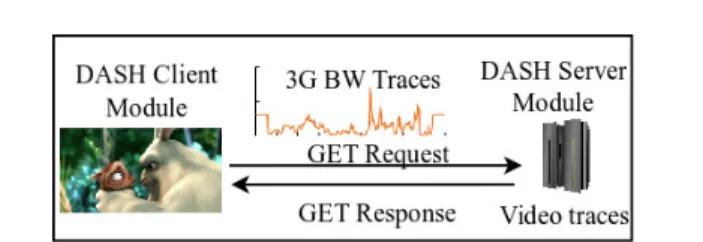
Fig. 1: Evaluation Setup
and avoiding abrupt quality changes. The implementation of ARBITER is presented in Algorithm.
Performance Evaluation
We first present our evaluation setup and performance metrics followed by our performance evaluation results.
Evaluation Setup
We evaluate the performance of ARBITER using ns-31. Our
evaluation setup is shown in Figure 1. We implemented a new module to emulate DASH operation in ns-3. The DASH client communicates with a DASH server over a single TCP con-nection over which HTTP requests and responses are com-municated. In our implementation, we consider a fixed HTTP header size of 100 bytes for both requests and responses. To emulate wireless links, we connect the client and server us-ing a point-to-point link whose bandwidth is varied accordus-ing to cellular throughput traces [12]. These traces are collected with the users riding different transportation means including car, ferry, tram, metro, and bus. Since these traces do not include information about the link delay, we tested different RTT delays including 20ms, 40ms, and 80ms. Due to space limitations, we show the results for 40ms only; we observed that varying RTT does not have a significant impact on the performance trends and conclusions. Hence, we believe that bandwidth variations in the cellular systems has the dominant impact on DASH performance.
In our simulations, we used seven different five-minute clips including A New Hope, An Idiot Abroad, Avatar, Big Hero 6, Casino Royal, Game Plan, and Harry Potter from
Table 1: The parameters of streaming algorithms BBA [3] r= 2T r¯= 0.6Bm ∆B= 0.875T τh= 0.9Bm ELASTIC [6] W = 5 kp= 0.01 kI = 0.001 ARBITER ω= 0.4 W = 10 Wv= 5 ρv= 0.3 ρb= 0.5 ρb = 1.5
Dash dataset [13]2, where videos are encoded at {235, 375, 560, 750, 1050, 1750, 2350, 3000, 3850, 4300}. We used multiple videos in our evaluation as we were interested in in-vestigating the interaction between bandwidth changes and temporal variation in rate demands of different videos. In-terestingly, we found there exist significant differences in the performance of different videos with the same network trace. We compare the performance of different streaming algo-rithms including ARBITER, BBA [3]3, and ELASTIC [6] in
different configurations of segment and buffer sizes. ELAS-TIC represents the class of hybrid streaming clients while and BBA represents the class of buffer-based streaming clients. Table 1 shows the main parameters of different algorithms. The parameters of ARBITER identified based on scanning for its parameter space. In our experiments, we consider differ-ent application buffer sizes including 60 Sec and 120 seconds. Additionally, we consider different segment sizes including 4 sec and 10 sec.
Our performance metrics per-session include the average received quality rate (rav) in kbps, the average number of
stalls (nst), the average total stall duration (tst) in seconds,
the average number of switches (nsw), the average
switch-ing level (lsw), and DASH-user experience (DASH-UE) QoE
metric (χ) [14], which is highly correlated with subjective re-sults. DASH-UE models temporal (initial startup delay, stall count, and stall delay) and visual impairments (persistence on low quality video and performing down switching). The qual-ity and switching penalties are estimated based on the objec-tive video quality metric that is known for its high correlation to subjective evaluation. The highest DASH-UE value is 100 and reduces as the level of impairment increases. Our results represent the average of 448 evaluation scenarios - all combi-nations of 64 mobility traces and 7 videos.
Simulation Results
Table 2-a shows the averaged results using a 60 sec buffer and 4 second segment. With 4 sec segment, we consider two seg-ments for initial buffering and one segment rebuffering be-fore resuming playout after stalls. ARBITER strikes a bal-ance between different key performbal-ance metrics leading to the highest user QoE. On comparing ARBITER to BBA, we find that it closely attains the same average quality raterav
with only103kbpsdrop. This drop may not be perceived by
2http://www.cs.ucc.ie/~jq5/www_dataset/
3We implemented BBA-2 variant with linear mapping between the
reser-voir and the upper buffer threshold.
200 400 600 800 1000 1200 1400 1600 1800 0 50 100 150 200 250 300 Representation Rate (kbps) Time (Sec)
ELASTIC BBA ARBITER
Fig. 2: Quality rates as determined by the algorithms in one of the tram traces
users considering that the average difference between quality rates is445kbps. However, this insignificant quality reduc-tion is accompanied by a noticeable33%drop in the number of stallsnst and 35% in the average stall duration per
ses-sion. ARBITER has a similar relative number of switches nsw as BBA, performed with lower amplitudes as suggested
bylsw and as shown in Figure 2 , which plots the selected
quality rates of the compared algorithms in one of simulated scenarios. Hence, such quality transitions are probably less noticeable by the end-user. ARBITER scores a QoE metricχ that 1.26x BBA’s QoE.
ELASTIC shows the best stall performance with 30% less stalls and 60% average session stall duration in comparison to ARBITER. Additionally, ELASTIC reduces the average number of switches relative to ARBITER by 50%. These gains are due to the conservative throughput estimate, as shown in Figure 2, that enables ELASTIC to fill in its buffer without making many switches. Hence, ELASTIC becomes more immune to stalls when the network conditions deterio-rate for long periods. However, these gains are accompanied by a huge reduction in the average video quality rate that is approximately63%of the rate achieved by ARBITER. This huge quality gap enables ARBITER to achieve a QoE metric that is 1.29x ELASTIC’s QoE.
Large Buffer Size
Table 2-b shows the key performance metrics for the adapta-tion algorithms with 120 Sec client buffer and 4 Sec segment. Clearly, the larger buffer size enables all algorithms to im-prove their stall performance by reducing both the number of stalls and stall duration. ARBITER and ELASTIC shows the best stall performance followed by BBA. ELASTIC performs the least number of representation switches followed by BBA and then ARBITER. This is interpreted by the conservative throughput estimate of ELASTIC the leads to persisting on low representation qualities for longer periods. Hence, both ARBITER and BBA achieves an average quality rate that is 1.9x that achieved by ELASTIC. Interestingly, BBA shows a great improvement in its switching dynamics as the buffer
Table 2: Key Performance metrics
(a) 60 sec buffer - 4 Sec segment (b) 120 sec buffer - 4 Sec segment (c) 120 sec buffer - 10 Sec segment
nst tst rav nsw lsw χ nst tst rav nsw lsw χ nst tst rav nsw lsw χ
ARBITER 0.34 2.8 1055 26.3 1.1 48.7 0.08 0.8 935 22.8 1.1 47.8 0.06 1.0 928 11.6 1.2 40.3 BBA2 0.44 4.3 1158 25.3 1.7 38.5 0.10 0.9 983 15.2 1.3 40.8 0.09 1.5 987 10.8 1.7 30.3 ELASTIC 0.24 1.7 662 13.3 1.2 37.3 0.08 0.7 495 10.4 1.2 30.5 0.03 0.8 474 5.5 1.5 27.9 was increased from 60 sec to 120 sec. We believe this is due
to the larger cushion region that mandates larger buffer sub-regions for each representation quality. Hence, larger buffer size would improve both switching and stall performance of BBA but reduces its average quality rate. However, use of larger client buffers leads to wasted link use (and possibly increased user cost) in cases where a user abandons the ses-sion [15]. The improved switching performance and higher average quality enabled BBA to achieve a QoE that is 1.56x ELASTIC’s QoE. ARBITER scores the highest QoE metric that is 1.17x BBA’s QoE score.
Figures 3 plots the cumulative distribution function (CDF) of different performance metrics for different algorithms and buffer sizes. Fig. 3a confirms that ELASTIC’s low average rate is due to picking lower quality rates in comparison to both BBA and ARBITER. It is also clear that with smaller buffer, all algorithms tends to pick higher rates for different reasons. BBA streams higher rates because the buffer gets full faster and hence the client starts to request higher quality representations. On the other hand, ARBITER tends to pick higher rates because the upscaling buffer factor is activated earlier as the buffer occupancy increases.
Figure 3b plots the CDF of number of stalls encountered by different algorithms. The figure shows that doubling the buffer size from 60 sec to 120 sec helps increasing the number of stall free sessions from 85% to 95% for BBA, from 88% to 96.5% for ARBITER and from 90% to 97% for ELASTIC. Increasing the buffer size also reduces the maximum number of stalls for all algorithms to 5 stalls from 8, 13, and 17 stalls for ELASTIC, ARBITER, and BBA, respectively.
Figure 3c shows that increasing the application buffer re-duces the number of switches for all algorithms. Clearly, BBA features a larger reduction in the number of the switches for the same reasons explained above. While ARBITER per-forms more switches, its switches have smaller amplitude in comparison to ELASTIC and BBA.
Figure 3d shows the CDF of the QoE metric for the simu-lated algorithms and different buffer sizes. The figure shows that ARBITER sessions have higher QoE metric values in comparison to BBA and ELASTIC. This superiority is inter-preted by ARBITER’s ability to maintain an excellent profile of stall, switching and quality metrics. The lowest QoE met-ric values are attained by BBA with small buffer (BBA-60) and ELASTIC with large buffer (ELASTIC-120). BBA-60 low QoE is due to bad switching and stall performance while ELASTIC-60 low QoE is due to persisting on low video
qual-ity due to conservative throughput estimates.
Clearly, the buffer size significantly affects the perfor-mance of different streaming algorithms in different ways. Note that, with the smaller buffer, ELASTIC scores higher QoE even though it features worse stall performance. We also see how BBA’s performance metrics are affected by the buffer size. Hence, adjusting the buffer size plays a signifi-cant role in achieving a balanced profile of streaming perfor-mance metrics such that the user QoE is improved. Identi-fying the optimal buffer size of different streaming strategies based on streaming context, operating condition, and other relevant factors represents an interesting future research point.
Larger Segment
Some content providers prefer using large segment sizes for wireless networks. Table 2-c shows our key performance met-rics for the tested algorithms when 10-sec video segments are used. For this set of results, video client initial buffering and rebuffering are set to 10 seconds (one segment). Note that the client need to download fewer but larger segments. In com-parison to the 4-seg segment and 120 sec buffer case, using 10 sec segments helps all algorithms to reduce their average number of stalls by 25%, 9%, and 62% for ARBITER, BBA2, and ELASTIC, respectively. However, the average stall dura-tion increased by approximately 37%, 77%, and 10% for AR-BITER, BBA and ELASTIC, respectively. The reduced num-ber of stalls is steered by two factors. The first is the reduction in stall opportunities as the client downloads fewer segments while the second is the larger media duration available in the buffer after every stall recovery. Yet, the second factor also leads to increasing the stall duration as longer download time is observed.
The impact of the segment size on the average received quality rate is insignificant as it remains less than 5% for all algorithms. The number of the switches is approximately halved as the segment size increases because the number of downloaded segments decreases. However, by estimating the ratio of number of switches to the switching opportunities (74 for 4-sec segment and 29 for 10-sec segment in a five minute video), all algorithms would have a higher relative switch-ing frequency. The average quality level switchswitch-ing increases for all algorithms because the client would have to deal with larger variations that may take place over the longer segment download time. With smaller segments, the client would be able to promptly adapt to network changes leading to frequent but smoother quality changes.
0 20 40 60 80 100 0 500 1000 1500 2000 2500 3000 3500 4000 4500 CDF (%)
Average Representation Rates (kbit/s) ARBITER-120s ARBITER-60s BBA-120s BBA-60s ELASTIC-120s ELASTIC-60s
(a) Average received data rate
84 86 88 90 92 94 96 98 100 0 5 10 15 20 CDF (%) Number of Stalls ARBITER-120s ARBITER-60s BBA-120s BBA-60s ELASTIC-120s ELASTIC-60s
(b) Number of stalls per session
0 20 40 60 80 100 0 10 20 30 40 50 60 70 CDF (%) Number of Switches ARBITER-120s ARBITER-60s BBA-120s BBA-60s ELASTIC-120s ELASTIC-60s
(c) Number of quality switches per ses-sion 0 20 40 60 80 100 -40 -20 0 20 40 60 80 100 CDF (%)
QOE Metric Value ARBITER-120s ARBITER-60s BBA-120s BBA-60s ELASTIC-120s ELASTIC-60s (d) User QoE
Fig. 3: CDF of Performance metrics (4 sec segment) QoE score with an approximate improvement of 34% and
46% in comparison to BBA2 and ELASTIC, respectively. Our analysis indicated that the drop in QoE is mainly due to increasing the penalty of persisting on low qualities decreases and a slight increase in switching penalty of ELASTIC and ARBITER. These increases take over the drop in stall QoE penalty that took place for all algorithms. Hence, one can conclude that using a medium segment size (e.g., 4 sec) would help intelligent clients to improve the user QoE.
Conclusions
The design of adaptive algorithms for HTTP-based stream-ing systems is challenged by the inherent variability in both network conditions and video dynamics. In this paper, AR-BITER is presented as a novel streaming algorithm that in-tegrates application and network states in its adaptation de-cision. ARBITER captures the network condition by inte-grating both the average and variance of the received seg-ment throughput in the decision. Additionally, ARBITER also considers the application state by integrating the buffer occupancy and actual video segment rates in the representa-tion rate selecrepresenta-tion decision. Our simularepresenta-tions, derived using real video content and cellular network traces, show that AR-BITER strikes a balance between achieved rate, stalls dynam-ics and switching behaviour. ARBITER achieves the highest QoE in comparison to state-of-the-art algorithms by a rela-tively large margin.
Acknowledgment
This publication has emanated from research conducted with the financial support of Science Foundation Ireland (SFI) un-der Grant Number 13/IA/1892. The authors wish to thank Ja-son Quinlan for providing us with access to the DASH video dataset.
References
[1] F. Fund et. al., “Performance of DASH and WebRTC Video Services for Mobile Users,” inProc. PV’13, San Jose, CA, Dec 2013.
[2] I. Sodagar, “The MPEG-DASH Standard for Multimedia Streaming Over the Internet,”IEEE MultiMedia, vol. 18, no. 4, pp. 62–67, Oct. 2011.
[3] T.-Y. Huang et. al, “A Buffer-based Approach to Rate Adap-tation: Evidence from a Large Video Streaming Service,” in
Proc. of the 2014 ACM SIGCOMM ’14, Chicago, Illinois, USA, 2014, pp. 187–198.
[4] J. Jiang et. al., “Improving Fairness, Efficiency, and Stability in HTTP-based Adaptive Video Streaming with FESTIVE,” in
Proc. of CoNEXT ’12, Nice, France, 2012, pp. 97–108. [5] X. Yin et. al., “A Control-Theoretic Approach for Dynamic
Adaptive Video Streaming over HTTP,”SIGCOMM Comput. Commun. Rev., vol. 45, no. 5, pp. 325–338, Aug. 2015. [6] L. De Cicco et. al., “ELASTIC: A Client-Side Controller for
Dynamic Adaptive Streaming over HTTP (DASH),” inProc. of PV ’13, San Jose, CA, Dec 2013.
[7] Z. Li et. al., “Probe and Adapt: Rate Adaptation for HTTP Video Streaming At Scale,” IEEE J. Sel. Area in Commun., vol. 32, no. 4, pp. 719–733, 2014.
[8] X. Xie et. al., “piStream: Physical Layer Informed Adaptive Video Streaming over LTE,” inProc. of MobiCom ’15, Paris, France, 2015, pp. 413–425.
[9] A. Bokani et. al., “HTTP-Based Adaptive Streaming for Mo-bile Clients using Markov Decision Process,” in Proc. of PV’13, San Jose, CA, Dec 2013.
[10] A. H. Zahran et. al., “OSCAR: An Optimized Stall-Cautious Adaptive Bitrate Streaming Algorithm For Mobile Networks,” inProc. MoVid’16 (to appear), 2016.
[11] A. Saamer et. al., “What Happens when HTTP Adaptive Streaming Players Compete for Bandwidth?” in Proc. of NOSSDAV’12, ser. NOSSDAV ’12, 2012, pp. 9–14.
[12] H. Riiser et. al., “Commute Path Bandwidth Traces from 3G Networks: Analysis and Applications,” inProc. of MMSys ’13, Oslo, Norway, 2013, pp. 114–118.
[13] J. J. Quinlan et. al, “Datasets for AVC (H.264) and HEVC (H.265) for Evaluating Dynamic Adaptive Streaming over HTTP (DASH),” inProc. of MMsys dataset track (to appear), 2016.
[14] Y. Liu et. al., “Deriving and Validating User Experience Model for DASH Video Streaming,”IEEE Trans. on Broadcasting, vol. 61, no. 4, pp. 651–665, Dec 2015.
[15] S. S. Krishnan and R. K. Sitaraman, “Video Stream Quality Impacts Viewer Behavior: Inferring Causality Using Quasi-experimental Designs,” inProc. of ACM IMC’12, Boston, Mas-sachusetts, USA, 2012, pp. 211–224.
![Table 1: The parameters of streaming algorithms BBA [3] r = 2T r = 0.6B¯ m ∆B = 0.875T τ h = 0.9B m ELASTIC [6] W = 5 k p = 0.01 k I = 0.001 ARBITER ω = 0.4 W = 10 W v = 5 ρ v = 0.3 ρ b = 0.5 ρ b = 1.5](https://thumb-us.123doks.com/thumbv2/123dok_us/10133758.2914369/5.918.505.795.109.313/table-parameters-streaming-algorithms-bba-t-elastic-arbiter.webp)

